battery location MITSUBISHI 3000GT 1991 Service Manual
[x] Cancel search | Manufacturer: MITSUBISHI, Model Year: 1991, Model line: 3000GT, Model: MITSUBISHI 3000GT 1991Pages: 1146, PDF Size: 76.68 MB
Page 985 of 1146
INTERIOR - Troubleshooting52A-7OPERATION
Key-reminder warning
L0 Battery voltage is always supplied, through
fusible link No. 6 to the key-reminder switch.
l When the driver’s seat is opened while the
ignition key is still in the key cylinder, the door
switch is switched ON, electricity flows to
fusible link No. 6, the key-reminder switch, the
buzzer, the door switch, and ground, and the
buzzer sounds.
Seat belt warning
lBattery voltage is applied, through fuse No. 11
to the ETACS unit when the ignition key is at the
“ON” position.
l Electricity flows to fusible link No. 6, the seat
belt warning light, the ETACS unit, and ground,
and the seat belt warning light flashes for
approx. 6 seconds.
lIf the driver does not buckle the seat belt, the
seat belt switch is switched ON, electricity
flows to fusible link No. 6, the key-reminder
switch, the buzzer, the seat belt switch, the
ETACS unit, and ground, and the buzzer sounds
for approx. 6 seconds.
lWhen the driver buckles the seat belt, the seat
belt switch is switched OFF and the buzzer
stops.
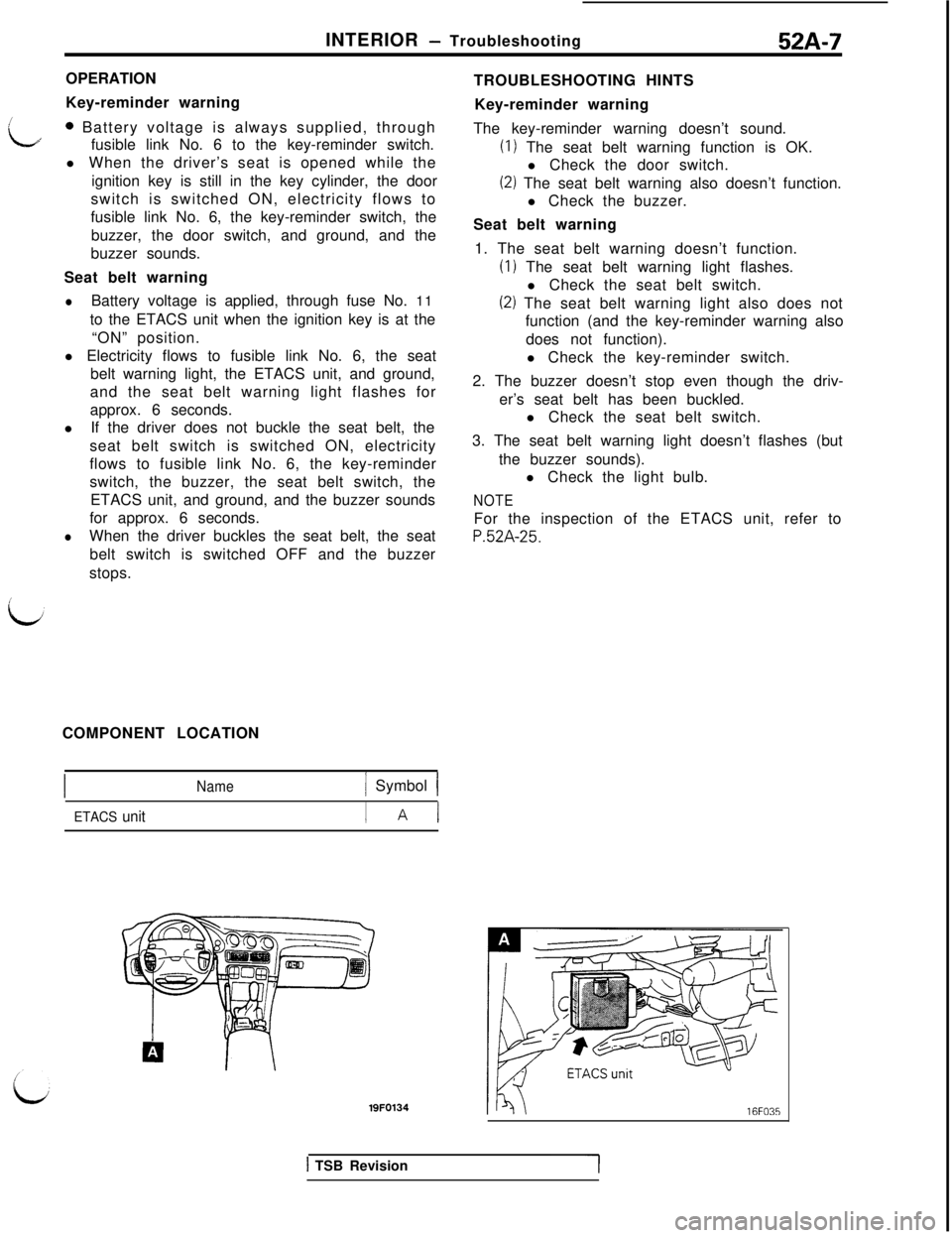
COMPONENT LOCATION
Name1 Symbol (
ETACS unitIA t19FO134TROUBLESHOOTING HINTS
Key-reminder warning
The key-reminder warning doesn’t sound.
(I) The seat belt warning function is OK.
l Check the door switch.
(2) The seat belt warning also doesn’t function.
l Check the buzzer.
Seat belt warning
1. The seat belt warning doesn’t function.
(I) The seat belt warning light flashes.
l Check the seat belt switch.
(2) The seat belt warning light also does not
function (and the key-reminder warning also
does not function).
l Check the key-reminder switch.
2. The buzzer doesn’t stop even though the driv-
er’s seat belt has been buckled.
l Check the seat belt switch.
3. The seat belt warning light doesn’t flashes (but
the buzzer sounds).
l Check the light bulb.
NOTEFor the inspection of the ETACS unit, refer to
P.52A-25.16FO35
1 TSB Revision
Page 1033 of 1146
r
/
lliSUPPLEMENTAL RESTRAINT SYSTEM (SRS)
- Troubleshootina 52B-23
L
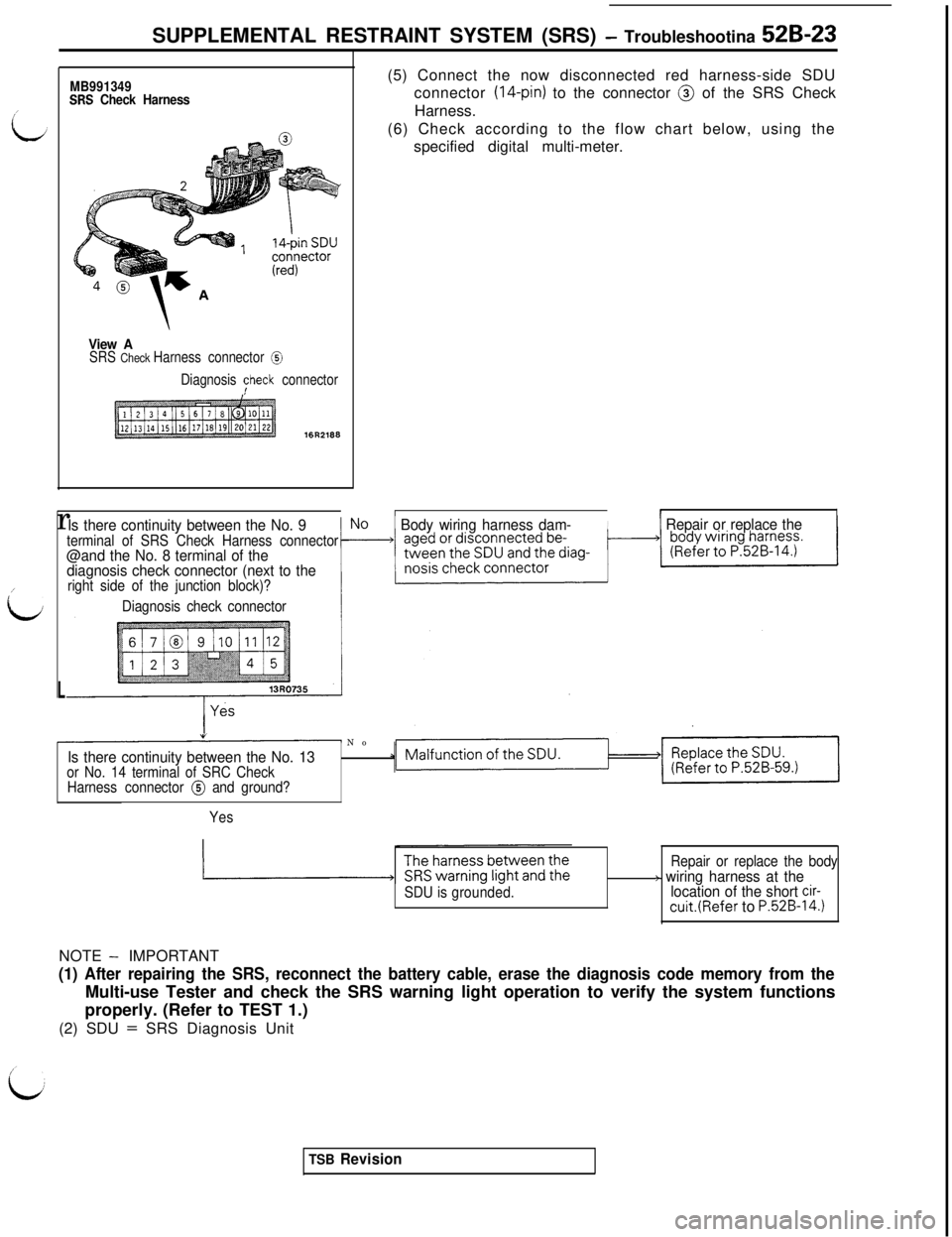
MB991349SRS Check Harness
View ASRS Check Harness connector @
Diagnosis Fheck connector16R2166(5) Connect the now disconnected red harness-side SDU
connector
(l&pin) to the connector @ of the SRS Check
Harness.
(6) Check according to the flow chart below, using the
specified digital multi-meter.
III1 Body wiring harness dam-/1 Repair or replace the1Is there continuity between the No. 9terminal of SRS Check Harness connector@and the No. 8 terminal of the
diagnosis check connector (next to the
right side of the junction block)?
Diagnosis check connectorv
~ No
Is there continuity between the No. 13or No. 14 terminal of SRC Check
Harness connector @ and ground?
Yes
SDU is grounded.Repair or replace the body
+ wiring harness at the
location of the short cir-cuit.(Refer to P.52B-14.)NOTE
- IMPORTANT
(1) After repairing the SRS, reconnect the battery cable, erase the diagnosis code memory from theMulti-use Tester and check the SRS warning light operation to verify the system functions
properly. (Refer to TEST 1.)
(2) SDU
= SRS Diagnosis Unit
TSB Revision
Page 1081 of 1146
idAir Bag Module
SUPPLEMENTAL RESTRAINT SYSTEM (SRS)
- Disposal Procedures 52B-71
2.
19FO119Two wires
ConytionInsulation tape
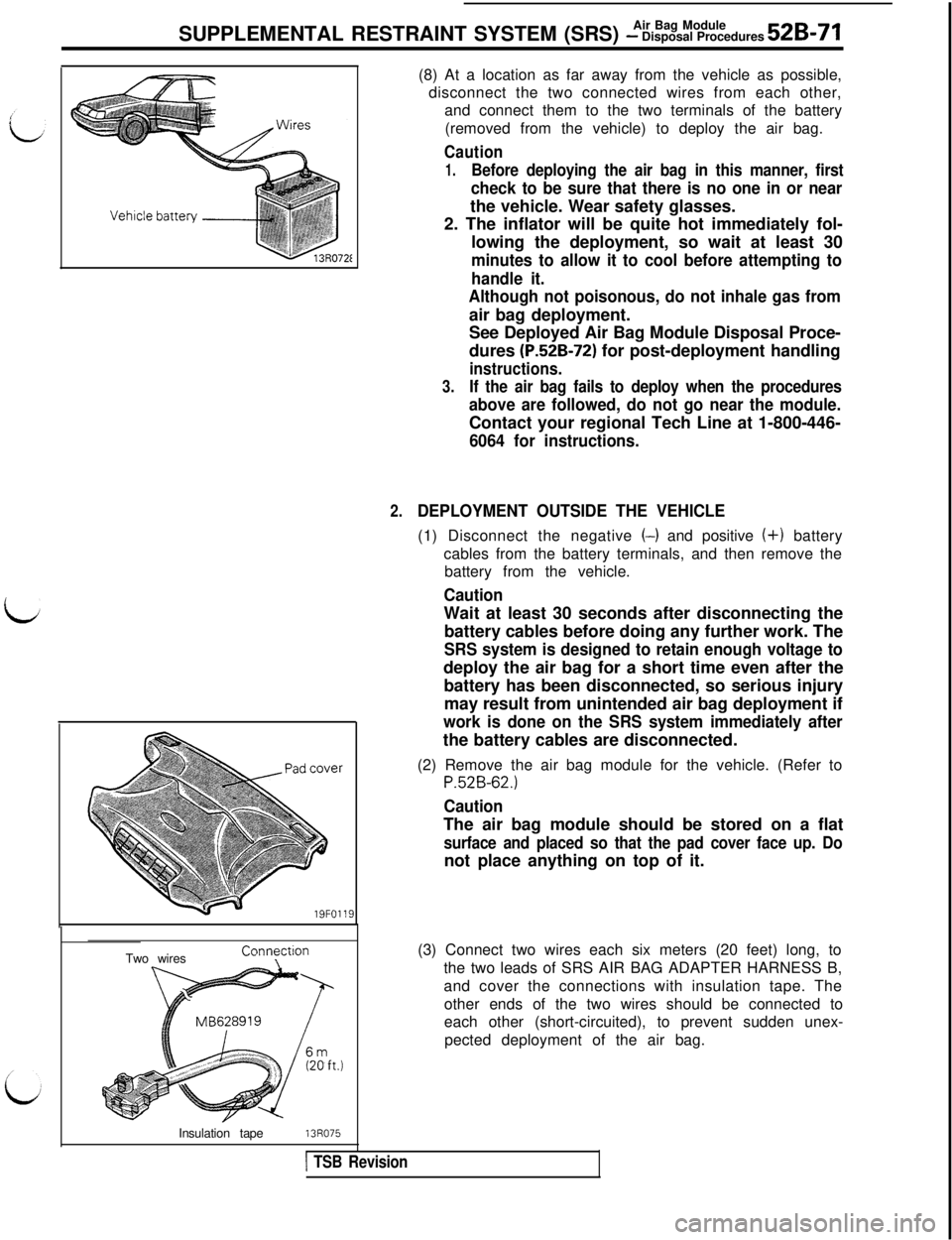
13~075(8) At a location as far away from the vehicle as possible,
disconnect the two connected wires from each other,
and connect them to the two terminals of the battery
(removed from the vehicle) to deploy the air bag.
Caution
1.Before deploying the air bag in this manner, first
check to be sure that there is no one in or nearthe vehicle. Wear safety glasses.
2. The inflator will be quite hot immediately fol-
lowing the deployment, so wait at least 30
minutes to allow it to cool before attempting to
handle it.
Although not poisonous, do not inhale gas fromair bag deployment.
See Deployed Air Bag Module Disposal Proce-
dures
(P.52B-72) for post-deployment handling
instructions.
3.If the air bag fails to deploy when the procedures
above are followed, do not go near the module.Contact your regional Tech Line at 1-800-446-
6064 for instructions.
DEPLOYMENT OUTSIDE THE VEHICLE(1) Disconnect the negative
(4 and positive (+) battery
cables from the battery terminals, and then remove the
battery from the vehicle.
CautionWait at least 30 seconds after disconnecting the
battery cables before doing any further work. The
SRS system is designed to retain enough voltage todeploy the air bag for a short time even after the
battery has been disconnected, so serious injury
may result from unintended air bag deployment if
work is done on the SRS system immediately afterthe battery cables are disconnected.
(2) Remove the air bag module for the vehicle. (Refer toP.528-62.)
CautionThe air bag module should be stored on a flat
surface and placed so that the pad cover face up. Donot place anything on top of it.
(3) Connect two wires each six meters (20 feet) long, to
the two leads of SRS AIR BAG ADAPTER HARNESS B,
and cover the connections with insulation tape. The
other ends of the two wires should be connected to
each other (short-circuited), to prevent sudden unex-
pected deployment of the air bag.
1 TSB Revision
Page 1082 of 1146
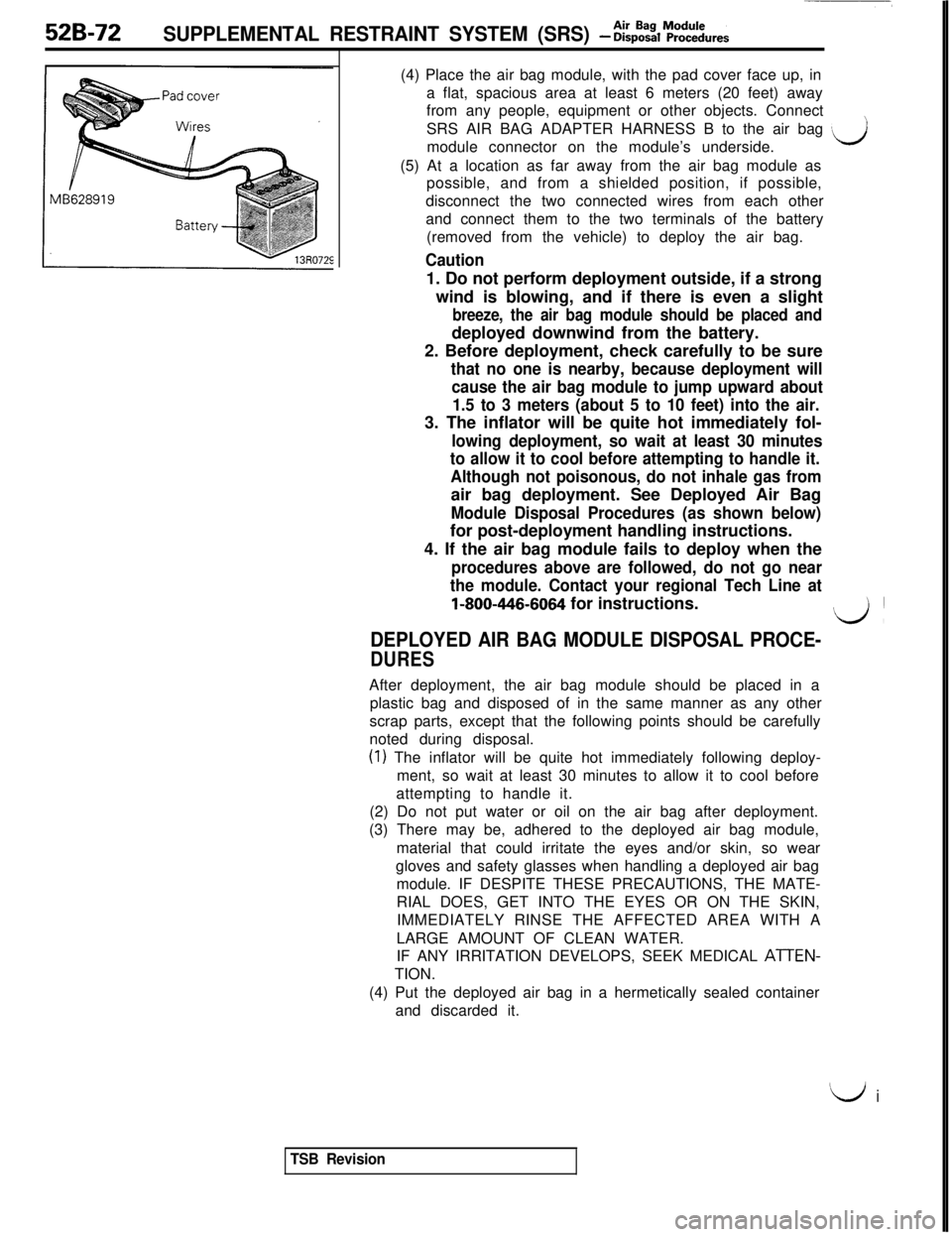
52B-72SUPPLEMENTAL RESTRAINT SYSTEM (SRS) - &%~~~~~ures(4) Place the air bag module, with the pad cover face up, in
a flat, spacious area at least 6 meters (20 feet) away
from any people, equipment or other objects. Connect
SRS AIR BAG ADAPTER HARNESS B to the air bag
mdmodule connector on the module’s underside.
(5) At a location as far away from the air bag module as
possible, and from a shielded position, if possible,
disconnect the two connected wires from each other
and connect them to the two terminals of the battery
(removed from the vehicle) to deploy the air bag.
Caution1. Do not perform deployment outside, if a strong
wind is blowing, and if there is even a slight
breeze, the air bag module should be placed anddeployed downwind from the battery.
2. Before deployment, check carefully to be sure
that no one is nearby, because deployment will
cause the air bag module to jump upward about
1.5 to 3 meters (about 5 to 10 feet) into the air.3. The inflator will be quite hot immediately fol-
lowing deployment, so wait at least 30 minutes
to allow it to cool before attempting to handle it.
Although not poisonous, do not inhale gas fromair bag deployment. See Deployed Air Bag
Module Disposal Procedures (as shown below)for post-deployment handling instructions.
4. If the air bag module fails to deploy when the
procedures above are followed, do not go near
the module. Contact your regional Tech Line at
l-800-446-6064 for instructions.\J’
DEPLOYED AIR BAG MODULE DISPOSAL PROCE-
DURESAfter deployment, the air bag module should be placed in a
plastic bag and disposed of in the same manner as any other
scrap parts, except that the following points should be carefully
noted during disposal.
(1) The inflator will be quite hot immediately following deploy-
ment, so wait at least 30 minutes to allow it to cool before
attempting to handle it.
(2) Do not put water or oil on the air bag after deployment.
(3) There may be, adhered to the deployed air bag module,
material that could irritate the eyes and/or skin, so wear
gloves and safety glasses when handling a deployed air bag
module. IF DESPITE THESE PRECAUTIONS, THE MATE-
RIAL DOES, GET INTO THE EYES OR ON THE SKIN,
IMMEDIATELY RINSE THE AFFECTED AREA WITH A
LARGE AMOUNT OF CLEAN WATER.
IF ANY IRRITATION DEVELOPS, SEEK MEDICAL
A-I-TEN-TION.
(4) Put the deployed air bag in a hermetically sealed container
and discarded it.
‘LJ i
TSB Revision