four wheel drive MITSUBISHI 3000GT 1991 Service Manual
[x] Cancel search | Manufacturer: MITSUBISHI, Model Year: 1991, Model line: 3000GT, Model: MITSUBISHI 3000GT 1991Pages: 1146, PDF Size: 76.68 MB
Page 208 of 1146
13-102FUEL SYSTEM - On-vehicle Inspection of MPI Components
TROUBLESHOOTING HINTSHint 1: If the engine is hard to start when hot, check fuel pressure and check the injector for leaks.
Hint 2:If the injector does not when the engine that is hard to start is cranked, the following as well as the
Iinjector itself may be responsible.
(1) Faulty power supply circuit to the engine control unit, faulty ground circuit
\-J
-(2) Faulty control relay
Hint 3:(3) Faulty crank angle sensor, top dead center sensor
If there is any cylinder whose idle state remains unchanged when the fuel injection of injectors is cut
one after another during idling, make following checks about such cylinder.
(1) Injector and harness check
(2) Ignition plug and high tension cable check
(3) Compression pressure check
Hint 4: If the injector harness and individual part checks have resulted normal but the injector drive time is
out of specification, the following troubles are suspected.
(1)Poor combustion in the cylinder (faulty ignition plug, ignition coil, compression pressure, etc.)
(2) Loose EGR valve seating
(3) High engine resistance
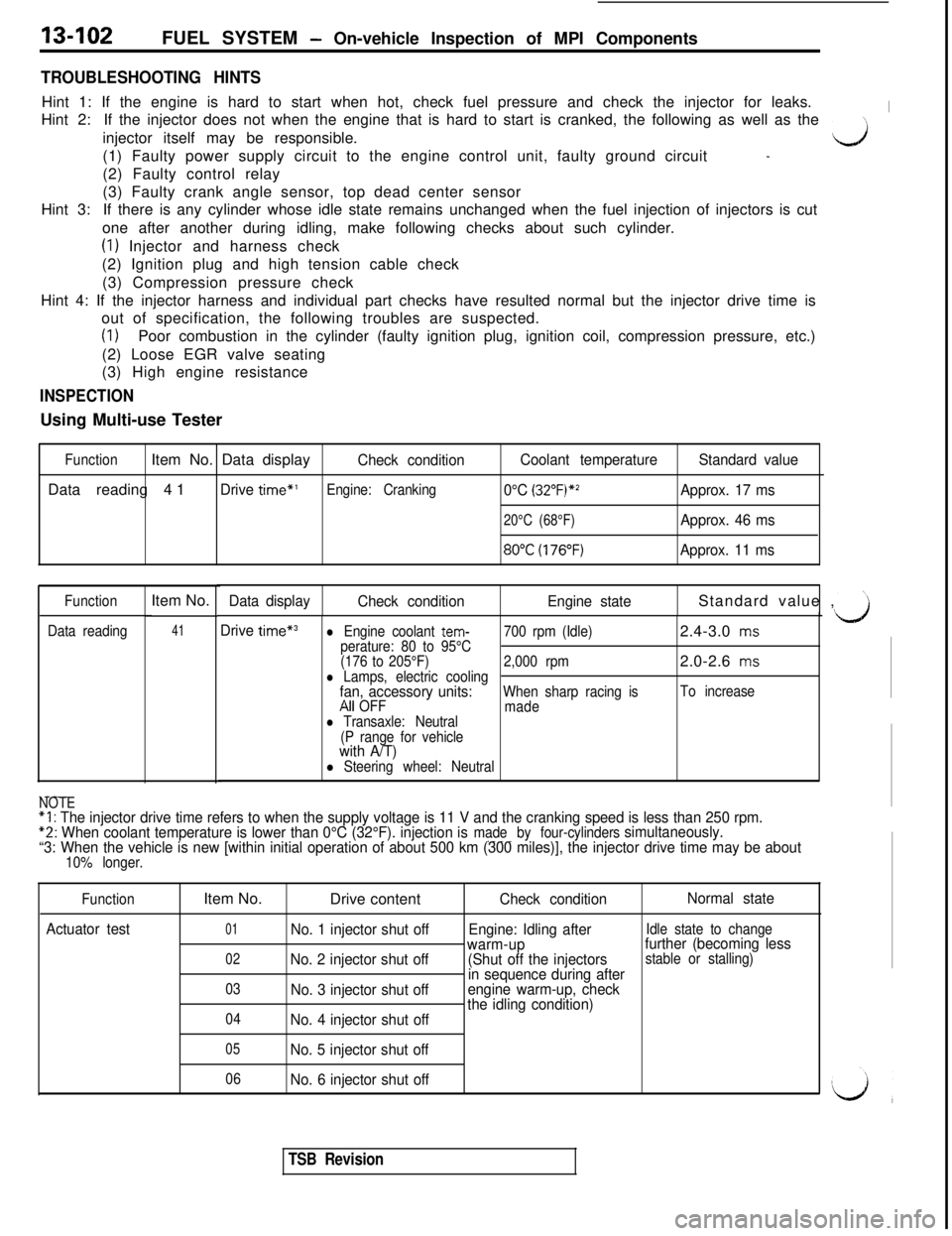
INSPECTIONUsing Multi-use Tester
FunctionItem No. Data displayCheck conditionCoolant temperatureStandard valueData reading 41
Drive time”’Engine: Cranking0°C (32”F)*zApprox. 17 ms
20°C (68°F)Approx. 46 ms
8O"C(176"F)Approx. 11 ms
Function
Data readingItem No.Data display
41Drive time*3l Engine coolant tem-perature: 80 to 95°C700 rpm (Idle)2.4-3.0 ms
(176 to 205°F)2,000 rpm2.0-2.6
msl Lamps, electric coolingfan, accessory units:When sharp racing isTo increaseAll OFF
madel Transaxle: Neutral
(P range for vehicle
with A/T)l Steering wheel: Neutral
Check conditionEngine stateStandard value ,
.---NOTE“I : The injector drive time refers to when the supply voltage is 11 V and the cranking speed is less than 250 rpm.*2: When coolant temperature is lower than 0°C (32°F). injection ismade by four-cylinders.---simultaneously.
“3: When the vehicle is new [within initial operation of about 500 km (300 miles)], the injector drive time may be about
10% longer.
Function
Actuator testItem No.
Drive content
Check conditionNormal state
01No. 1 injector shut offEngine: Idling afterIdle state to change
02No. 2 injector shut offwarm-up
(Shut off the injectorsfurther (becoming less
in sequence during afterstable or stalling)
03
No. 3 injector shut offengine warm-up, check
04No. 4 injector shut offthe idling condition)
05No. 5 injector shut off
06No. 6 injector shut off
TSB Revision
Page 212 of 1146
13-106FUEL SYSTEM - On-vehicle Inspection of MPI Components
INSPECTION
Using Multi-use Tester
FunctionItem No.Data displayCheck conditionCoolant temperatureStandard value‘L,,,J
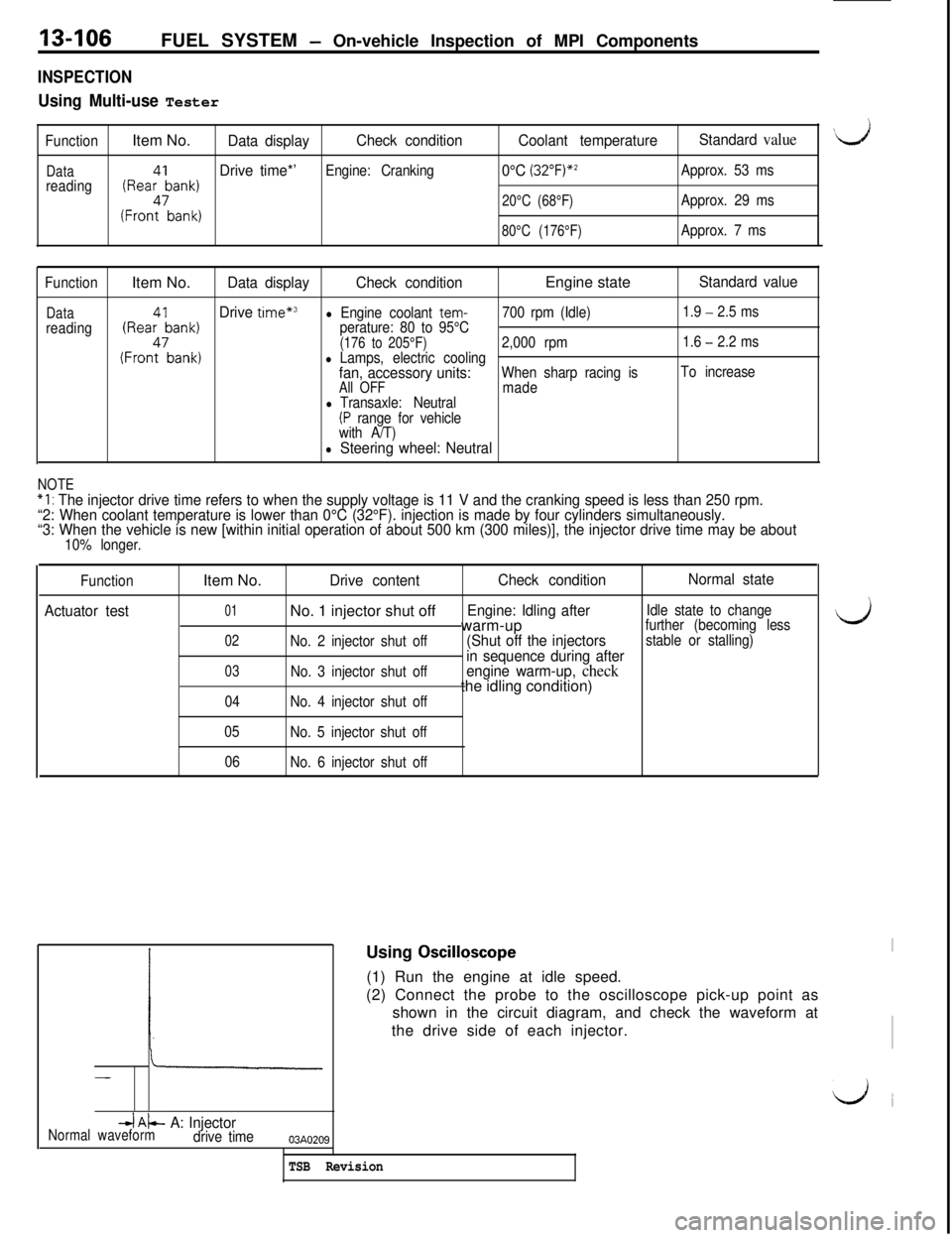
DataDrive time*’0°C (32’F)*’readingiRea:bankiEngine: CrankingApprox. 53 ms
(FronT7bank)20°C (68°F)
Approx. 29 ms
80°C (176°F)Approx. 7 ms
FunctionItem No.
Data displayCheck conditionEngine stateStandard value
Datareading(Reaebank)Drive time*3l Engine coolant tem-700 rpm (Idle)1.9 - 2.5 ms
perature: 80 to 95°C
(Front7banki(176 to 205°F)2,000 rpm1.6 - 2.2 ms
l Lamps, electric coolingfan, accessory units:To increase
All OFFWhen sharp racing is
made
l Transaxle: Neutral(P range for vehicle
with A/T)
l Steering wheel: Neutral
NOTE“I : The injector drive time refers to when the supply voltage is 11 V and the cranking speed is less than 250 rpm.
“2: When coolant temperature is lower than 0°C (32°F). injection is made by four cylinders simultaneously.
“3: When the vehicle is new [within initial operation of about 500 km (300 miles)], the injector drive time may be about
10% longer.
Function
Actuator testItem No.
Drive contentCheck conditionNormal state
01No. 1 injector shut offEngine: Idling afterIdle state to changewarm-upfurther (becoming less
02No. 2 injector shut off(Shut off the injectorsstable or stalling)
03in sequence during afterNo. 3 injector shut offengine warm-up, checkthe idling condition)
04No. 4 injector shut off
05
No. 5 injector shut off
06
No. 6 injector shut off
\,iUsing
OscillqscopeI(1) Run the engine at idle speed.
(2) Connect the probe to the oscilloscope pick-up point as
shown in the circuit diagram, and check the waveform at
the drive side of each injector.~
-
LJ
4 AL A: InjectorNormal waveformdrive time03A0209
TSB Revision
Page 622 of 1146
27-26
REAR AXLE
SERVICE POINTS OF INSTALLATION
7. INSTALLATION OF DIFFERENTIAL CARRIERm27lDAL
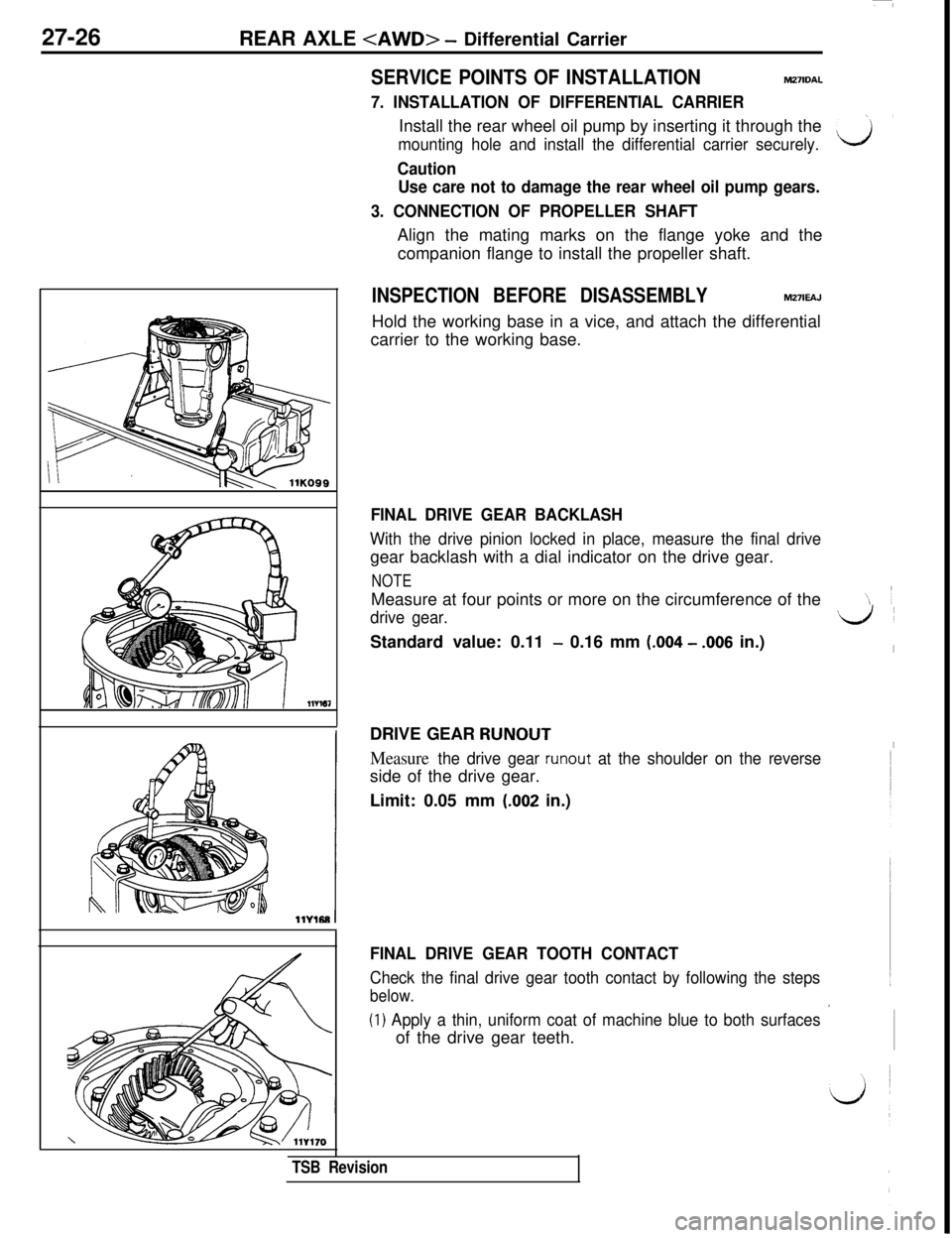
Install the rear wheel oil pump by inserting it through the
mounting hole and install the differential carrier securely.\yiIlYl61
Caution
Use care not to damage the rear wheel oil pump gears.
3. CONNECTION OF PROPELLER SHAFTAlign the mating marks on the flange yoke and the
companion flange to install the propeller shaft.
INSPECTION BEFORE DISASSEMBLYM27lEAJHold the working base in a vice, and attach the differential
carrier to the working base.
FINAL DRIVE GEAR BACKLASH
With the drive pinion locked in place, measure the final drivegear backlash with a dial indicator on the drive gear.
NOTEMeasure at four points or more on the circumference of the
drive gear.d’Standard value: 0.11
- 0.16 mm (.004 - .006 in.)IDRIVE GEAR
RUNOUTI
Measure the drive gear runout at the shoulder on the reverseside of the drive gear.
Limit: 0.05 mm
(.002 in.)
FINAL DRIVE GEAR TOOTH CONTACT
Check the final drive gear tooth contact by following the steps
below.
(1) Apply a thin, uniform coat of machine blue to both surfaces ’of the drive gear teeth.
TSB Revision
Page 802 of 1146
35-80SERVICE BRAKES - Front Disc Brake14FOOl14FOO4
14FOO2:
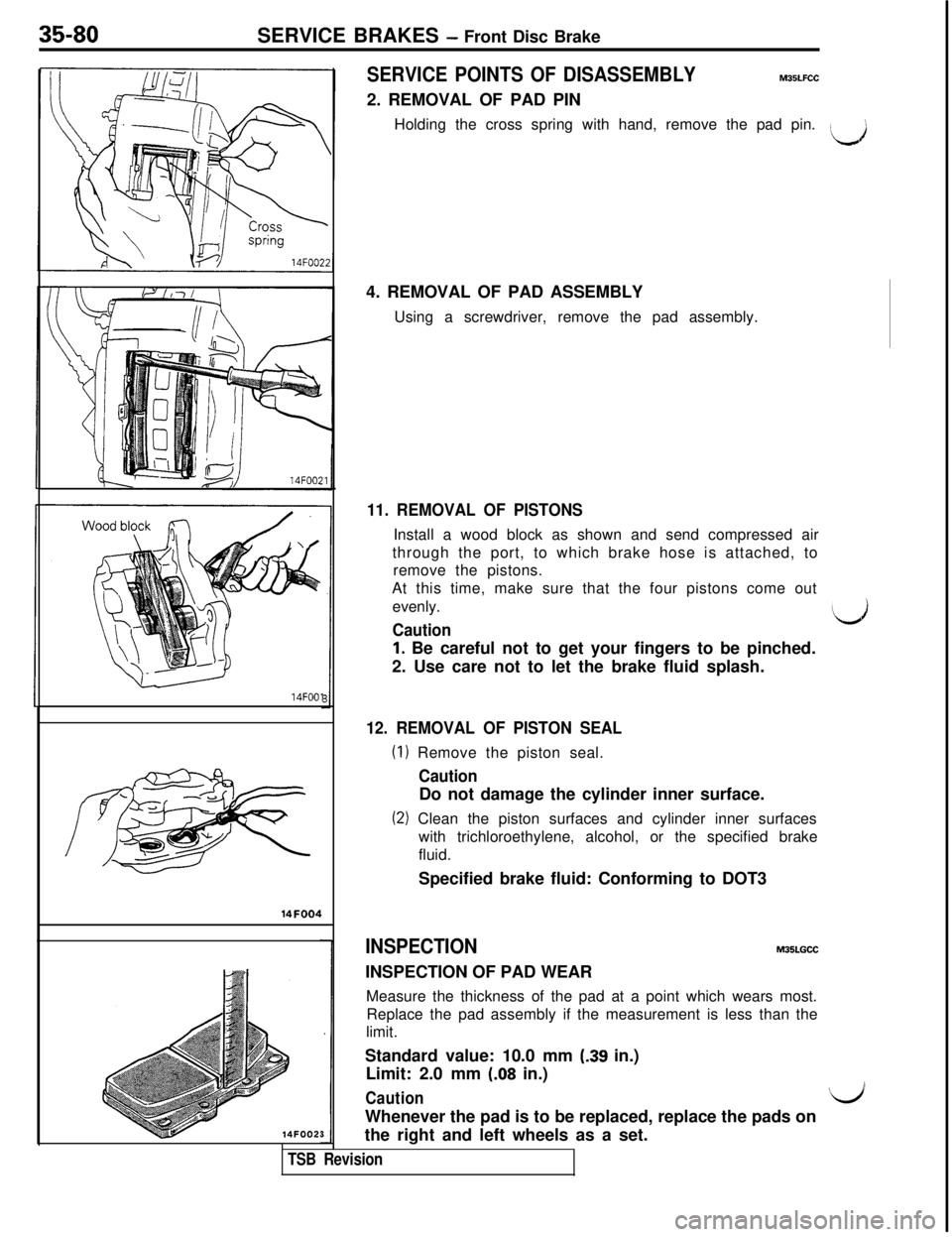
SERVICE POINTS OF DISASSEMBLYM35LFCC2. REMOVAL OF PAD PIN
Holding the cross spring with hand, remove the pad pin.
4. REMOVAL OF PAD ASSEMBLY
Using a screwdriver, remove the pad assembly.
11. REMOVAL OF PISTONSInstall a wood block as shown and send compressed air
through the port, to which brake hose is attached, to
remove the pistons.
At this time, make sure that the four pistons come out
evenly.
Caution
1. Be careful not to get your fingers to be pinched.
2. Use care not to let the brake fluid splash.
‘d
12. REMOVAL OF PISTON SEAL
(1) Remove the piston seal.
CautionDo not damage the cylinder inner surface.
(2) Clean the piston surfaces and cylinder inner surfaces
with trichloroethylene, alcohol, or the specified brake
fluid.
Specified brake fluid: Conforming to DOT3
INSPECTIONMJSLGCCINSPECTION OF PAD WEAR
Measure the thickness of the pad at a point which wears most.
Replace the pad assembly if the measurement is less than the
limit.
Standard value: 10.0 mm
(.39 in.)
Limit: 2.0 mm
(.08 in.)
CautionI/’Whenever the pad is to be replaced, replace the pads on
the right and left wheels as a set.
TSB Revision