turn signal MITSUBISHI 3000GT 1991 Service Manual
[x] Cancel search | Manufacturer: MITSUBISHI, Model Year: 1991, Model line: 3000GT, Model: MITSUBISHI 3000GT 1991Pages: 1146, PDF Size: 76.68 MB
Page 117 of 1146
FUEL SYSTEM - Troubleshooting13-11
L
L
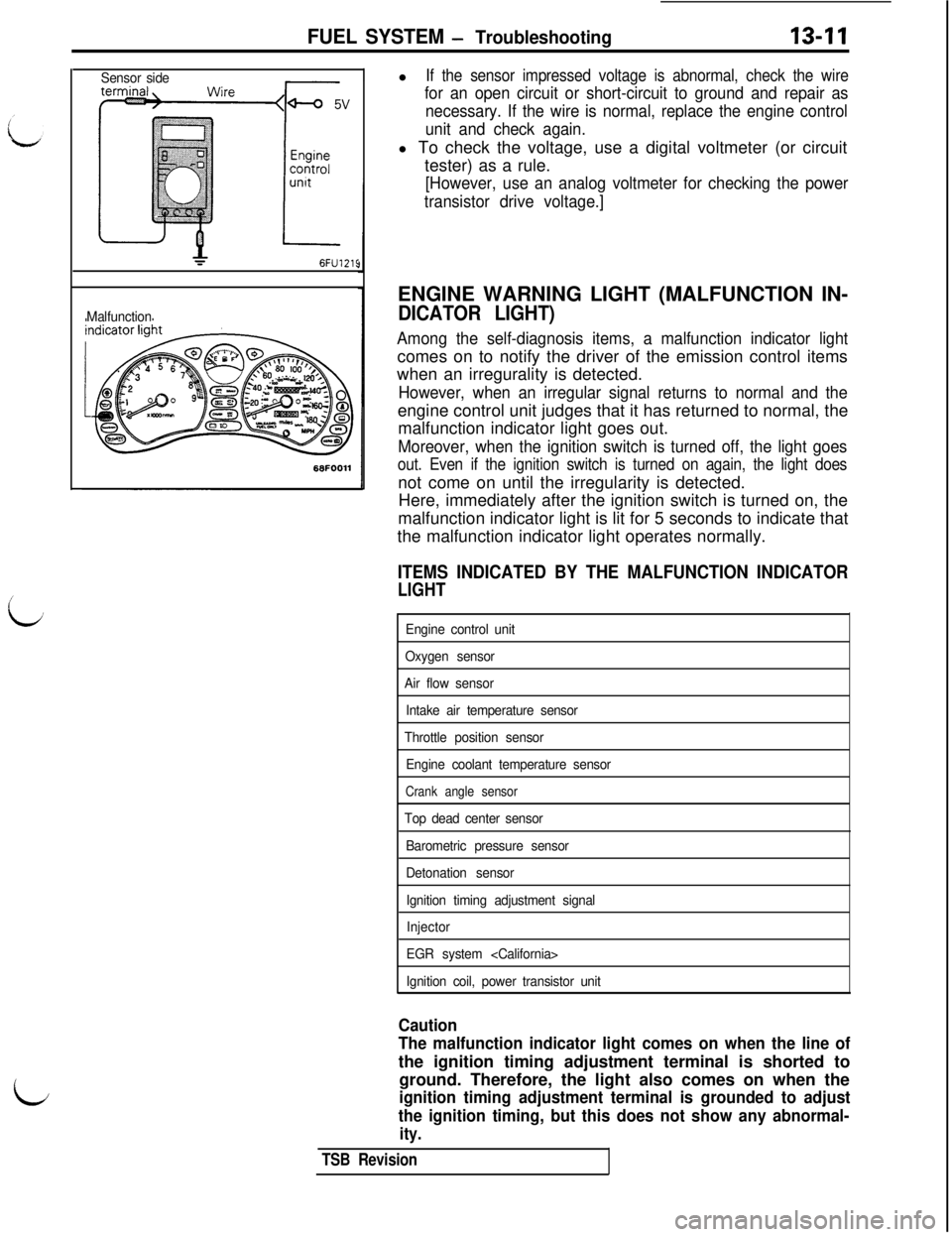
Sensor side6FU1215
Malfunctionl
If the sensor impressed voltage is abnormal, check the wire
for an open circuit or short-circuit to ground and repair as
necessary. If the wire is normal, replace the engine control
unit and check again.l To check the voltage, use a digital voltmeter (or circuit
tester) as a rule.
[However, use an analog voltmeter for checking the power
transistor drive voltage.]ENGINE WARNING LIGHT (MALFUNCTION IN-
DICATOR LIGHT)
Among the self-diagnosis items, a malfunction indicator lightcomes on to notify the driver of the emission control items
when an irregurality is detected.
However, when an irregular signal returns to normal and theengine control unit judges that it has returned to normal, the
malfunction indicator light goes out.
Moreover, when the ignition switch is turned off, the light goes
out. Even if the ignition switch is turned on again, the light doesnot come on until the irregularity is detected.
Here, immediately after the ignition switch is turned on, the
malfunction indicator light is lit for 5 seconds to indicate that
the malfunction indicator light operates normally.
ITEMS INDICATED BY THE MALFUNCTION INDICATOR
LIGHT
Engine control unit
Oxygen sensor
Air flow sensor
Intake air temperature sensor
Throttle position sensor
Engine coolant temperature sensor
Crank angle sensor
Top dead center sensor
Barometric pressure sensor
Detonation sensor
Ignition timing adjustment signal
Injector
EGR system
Ignition coil, power transistor unit
Caution
The malfunction indicator light comes on when the line ofthe ignition timing adjustment terminal is shorted to
ground. Therefore, the light also comes on when the
ignition timing adjustment terminal is grounded to adjust
the ignition timing, but this does not show any abnormal-
ity.
TSB Revision
Page 118 of 1146

13-12FUEL SYSTEM - Troubleshooting
MALFUNCTION INDICATOR LIGHT INSPECTION
(1) Check that when the ignition switch is turned on, the lightilluminates for about 5 seconds and then goes out.
(2) If the light does not illuminate, check for open circuit in
dharness, blown fuse and blown bulb.
SELF-DIAGNOSIS
The engine control unit monitors the input/output signals (some
signals at all times and the others under specified conditions) ofthe engine control unit.
When it is noticed that an irregularity has continued for a
specified time or longer from when the irregular signal is
initially monitored, passing a certain number, the engine controlunit judges that an irregularity has occurred, memorizes the
malfunction code, and outputs the signal to the self-diagnosis
output terminal.
There are 21 diagnosis items, including the normal state, andthe diagnosis results can be read out with a voltmeter or
multi-use tester.Moreover, since memorization of the malfunction codes is
backed up directly by the battery, the diagnosis results are
memorized even if the ignition key is turned off. The malfunc-
tion codes will, however, be erased when the battery terminalor the engine control unit connector is disconnected.
The malfunction code can also be erased by turning on the
ignition switch and sending the malfunction code erase signalfrom the multi-use tester to the engine control unit.
CautionIf the sensor connector is disconnected with the ignition
_ _switch turned on, the malfunction code is memorized. Ind
this case, send the malfunction code erase signal from themulti-use tester to the engine control unit or disconnect
the battery terminal
(-) for 10 seconds or more, and the
diagnosis memory will be erased.
The 21 diagnosis items are provided as follows, and if plural
items are activated, they are all indicated sequentially from the
smallest code number.
CautionThe malfunction code for the ignition timing adjustment
signal is output when the line of the ignition timing
adjustment terminal is shorted to ground. Therefore, the
malfunction code is also output when the ignition timing
adjustment terminal is grounded to adjust the ignition
timing, but this does not show any abnormality.
TSB Revision
Page 160 of 1146
FUEL SYSTEM - 0
n-vehicle Inspection of MPI Components
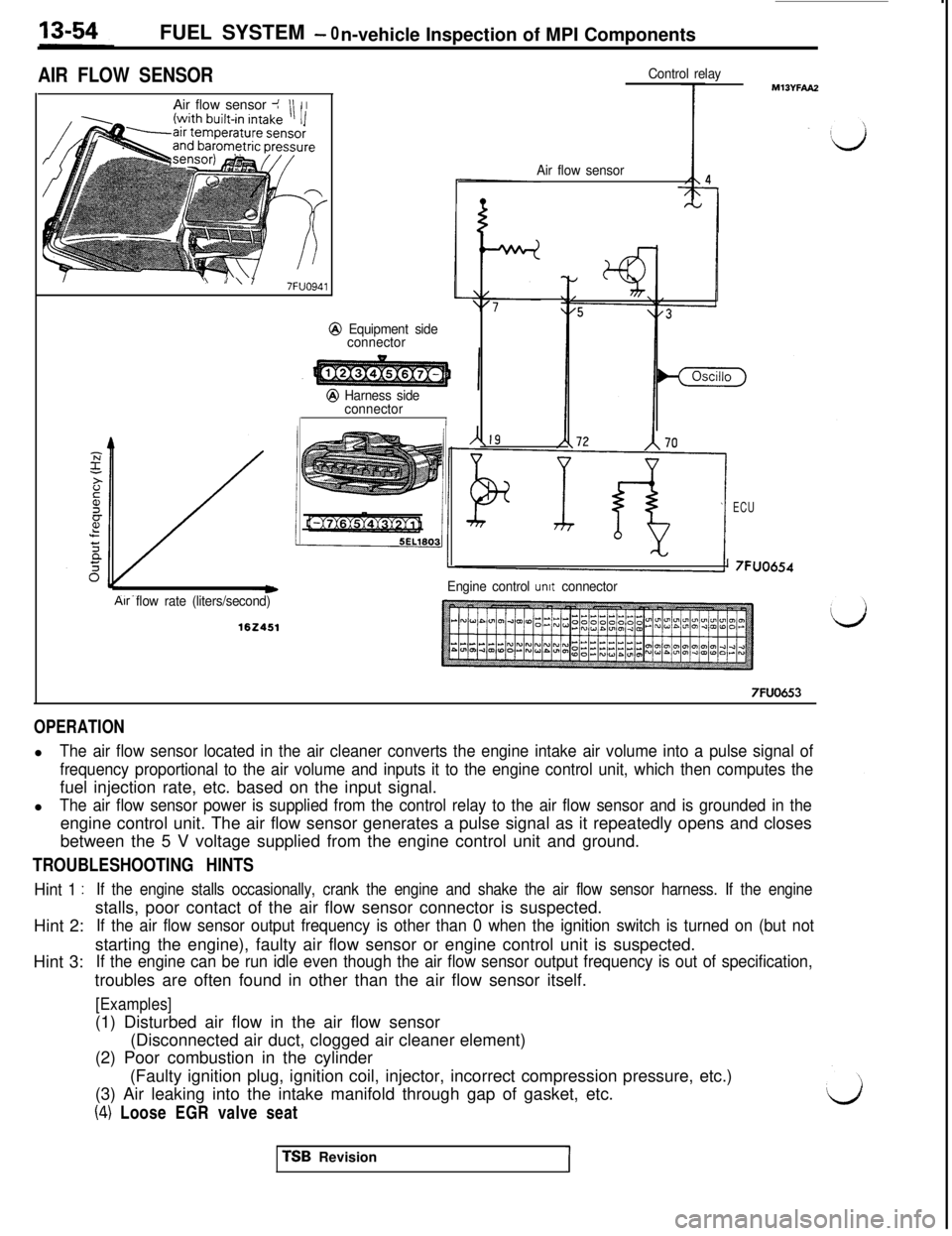
AIR FLOW SENSORAir flow sensor J
III I
\I\Y7FUO941
@ Equipment side
connector
Air flow rate (liters/second)
@ Harness side
connector
I
Control relay
I
Air flow sensor
ECU
’ 7FUO654
Engine control
unit connector
7FUO653
OPERATIONl
The air flow sensor located in the air cleaner converts the engine intake air volume into a pulse signal of
frequency proportional to the air volume and inputs it to the engine control unit, which then computes thefuel injection rate, etc. based on the input signal.
l
The air flow sensor power is supplied from the control relay to the air flow sensor and is grounded in theengine control unit. The air flow sensor generates a pulse signal as it repeatedly opens and closes
between the 5 V voltage supplied from the engine control unit and ground.
TROUBLESHOOTING HINTS
Hint 1 :If the engine stalls occasionally, crank the engine and shake the air flow sensor harness. If the engineHint 2:stalls, poor contact of the air flow sensor connector is suspected.
If the air flow sensor output frequency is other than 0 when the ignition switch is turned on (but notHint 3:starting the engine), faulty air flow sensor or engine control unit is suspected.
If the engine can be run idle even though the air flow sensor output frequency is out of specification,troubles are often found in other than the air flow sensor itself.
[Examples](1) Disturbed air flow in the air flow sensor
(Disconnected air duct, clogged air cleaner element)
(2) Poor combustion in the cylinder
(Faulty ignition plug, ignition coil, injector, incorrect compression pressure, etc.)
(3) Air leaking into the intake manifold through gap of gasket, etc.
(4) Loose EGR valve seatTSB Revision
Page 171 of 1146
FUEL SYSTEM - On-vehicle Inspection of MPI Components13-65
i
1
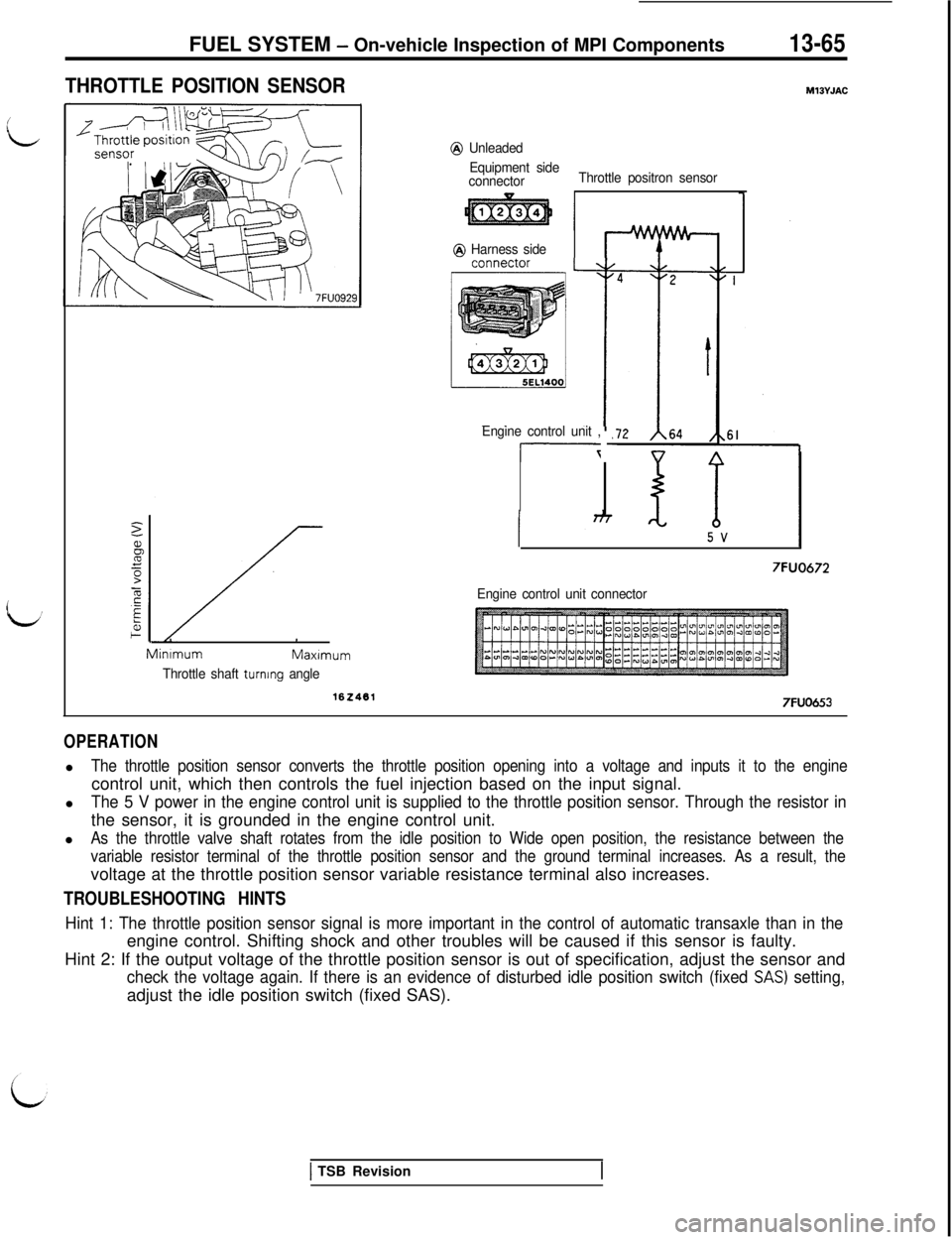
THROTTLE POSITION SENSORM13YJAC
Maximum
Throttle shaft
turning angle
162481
Minlmum
@ Unleaded
Equipment side
connectorThrottle positron sensor
I
@ Harness side
connector
Ii
SEL14001
Engine control unit ,
I
Engine control unit connector
7FUO672
7FUO653
OPERATIONl
The throttle position sensor converts the throttle position opening into a voltage and inputs it to the enginecontrol unit, which then controls the fuel injection based on the input signal.
l
The 5 V power in the engine control unit is supplied to the throttle position sensor. Through the resistor inthe sensor, it is grounded in the engine control unit.
l
As the throttle valve shaft rotates from the idle position to Wide open position, the resistance between the
variable resistor terminal of the throttle position sensor and the ground terminal increases. As a result, thevoltage at the throttle position sensor variable resistance terminal also increases.
TROUBLESHOOTING HINTS
Hint 1: The throttle position sensor signal is more important in the control of automatic transaxle than in theengine control. Shifting shock and other troubles will be caused if this sensor is faulty.
Hint 2: If the output voltage of the throttle position sensor is out of specification, adjust the sensor and
check the voltage again. If there is an evidence of disturbed idle position switch (fixed SAS) setting,adjust the idle position switch (fixed SAS).
1 TSB Revision
Page 174 of 1146
13-68FUEL SYSTEM - On-vehicle Inspection of MPI Components
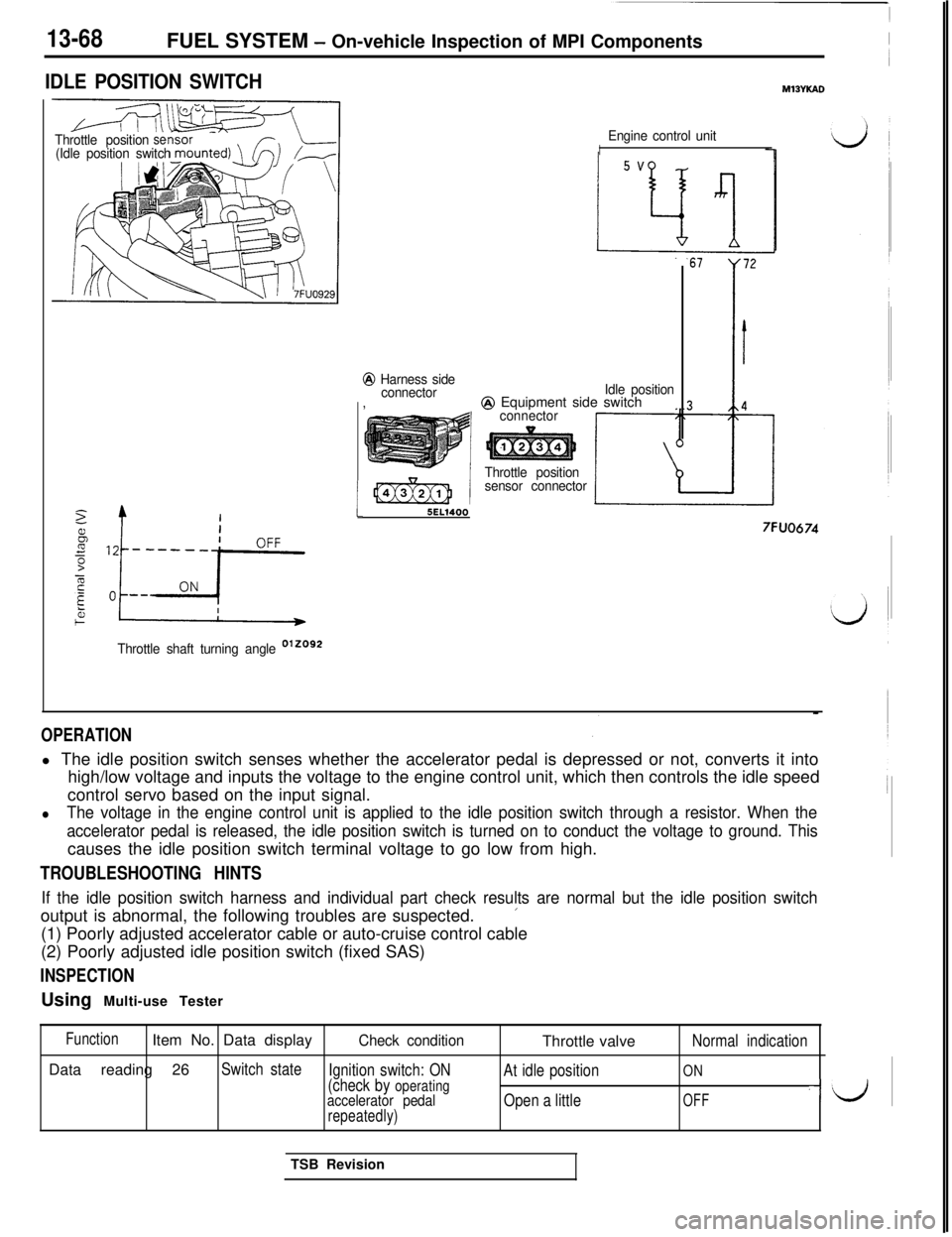
IDLE POSITION SWITCHMlBYKAD
Throttle positionse(Idle position switch
2
/bz----;-p
b+i
Throttle shaft turning angle D’20g2
i
Engine control unitI
@ Harness side
connectorIdle position,
@ Equipment side switchconnector
Throttle position
sensor connector
5EL1400
7FUO674
OPERATIONl The idle position switch senses whether the accelerator pedal is depressed or not, converts it into
high/low voltage and inputs the voltage to the engine control unit, which then controls the idle speed
control servo based on the input signal.
lThe voltage in the engine control unit is applied to the idle position switch through a resistor. When the
accelerator pedal is released, the idle position switch is turned on to conduct the voltage to ground. Thiscauses the idle position switch terminal voltage to go low from high.
TROUBLESHOOTING HINTS
If the idle position switch harness and individual part check results are normal but the idle position switchoutput is abnormal, the following troubles are suspected.
’(1) Poorly adjusted accelerator cable or auto-cruise control cable
(2) Poorly adjusted idle position switch (fixed SAS)
INSPECTIONUsing Multi-use Tester
FunctionItem No. Data displayCheck conditionThrottle valveNormal indicationData reading 26
Switch state
Ignition switch: ONON(check by operatingAt idle position
accelerator pedalOpen a littleOFF-J
repeatedly)TSB Revision
Page 176 of 1146
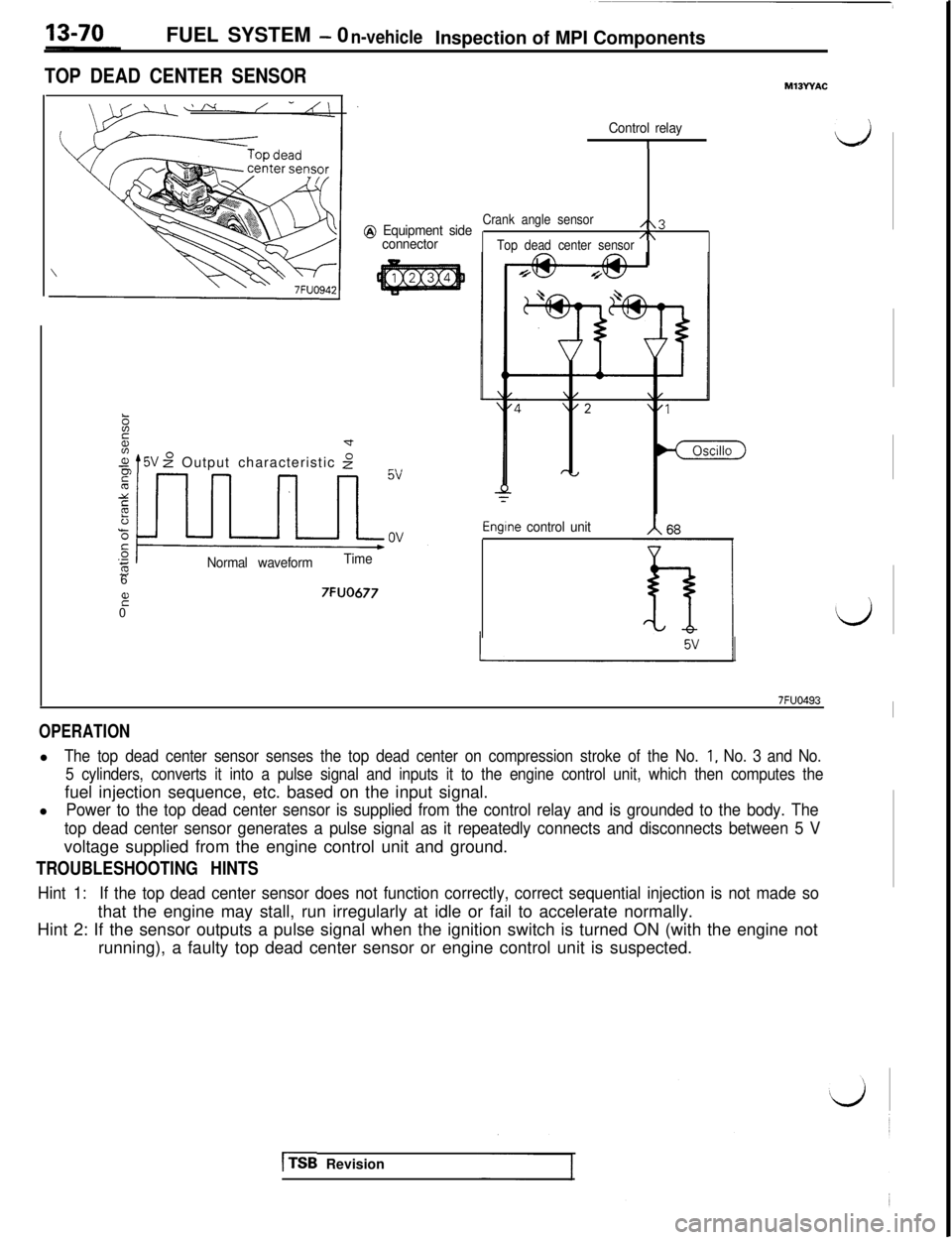
FUEL SYSTEM - 0n-vehicleInspection of MPI Components
TOP DEAD CENTER SENSOR
Control relay
1d
@ Equipment side
connector
zd
.+$ t5V z” Output characteristic 2r~,
Normal waveformTime6
it07FUO677
Crank angle sensor/\3
Top dead center sensor/\
Engtne control unit
d
7FUO493I
OPERATIONl
The top dead center sensor senses the top dead center on compression stroke of the No. 1, No. 3 and No.
5 cylinders, converts it into a pulse signal and inputs it to the engine control unit, which then computes thefuel injection sequence, etc. based on the input signal.
l
Power to the top dead center sensor is supplied from the control relay and is grounded to the body. The
top dead center sensor generates a pulse signal as it repeatedly connects and disconnects between 5 Vvoltage supplied from the engine control unit and ground.
TROUBLESHOOTING HINTS
Hint 1:If the top dead center sensor does not function correctly, correct sequential injection is not made sothat the engine may stall, run irregularly at idle or fail to accelerate normally.
Hint 2: If the sensor outputs a pulse signal when the ignition switch is turned ON (with the engine not
running), a faulty top dead center sensor or engine control unit is suspected.
[TSB Revision
Page 178 of 1146

13-72FUEL SYSTEM - On-vehicle Inspection of MPI Components
CRANK ANGLE SENSOR
co.ntiector
Output characteristic
LTime
7FUO682
MllYiAC
Control relay-I-
Crank angle sensorsideA3
Crank angle sensor/\
‘=
Engine controlunft69I
1
h5v
7FUO499
OPERATIONl
The crank angle sensor senses the crank angle (piston position) of each cylinder, converts it into a pulse
signal and inputs it to the engine control unit, which then computes the engine speed and controls the fuelinjection timing and ignition timing based on the input signal.
lPower to the crank angle sensor is supplied from the control relay and is grounded to the body. The crank
angle sensor generates a pulse signal as it repeatedly connects and disconnects between 5 V voltagesupplied from the engine control unit and ground.
TROUBLESHOOTING HINTSHint 1: If unexpected shocks are felt during driving or the engine stalls suddenly during idling, shake the
crank angle sensor harness. If this causes the engine to stall, poor contact of the sensor connector is
suspected.Hint 2: If the crank angle sensor outputs a pulse signal when the ignition switch is turned ON (with the
engine not running), a faulty crank angle sensor or engine control unit is suspected.
Hint 3:
If the tachometer reads 0 rpm when the engine that has failed to start is cranked, faulty crank angleHint 4:sensor or broken timing belt is suspected.
If the tachometer reads 0 rpm when the engine that has failed to start is cranked, the primary current
of the ignition coil is not turned on and off. Therefore, troubles in the ignition circuit and ignition coil orfaulty power transistor is suspected.
Hint 5: If the engine can be run at idle even though the crank angle sensor reading is out of specification,troubles are often in other than the crank angle sensor.
[Examples](1) Faulty engine coolant temperature sensor
(2) Faulty idle speed control servo
(3) Poorly adjusted reference idle speed
TSB Revision
Page 186 of 1146

13-80FUEL SYSTEM - 0
n-vehicle Inspection of MPI Components
POWER STEERING OIL PRESSURE SWITCHMlOYQAA
B
$-
Engine control unit
'107
@ Harness side
connector
ml-
Power steering oil
Pressure switch
7FUO536700-2.000 1.500-2.000(100-284) (213-284)Pressure [kPa (psi)]
0, l.oIu
OPERATIONl
The power steering oil pressure switch converts presence/absence of power steering load into low/high
voltage and inputs it to the engine control unit, which then controls the idle speed control servo based on
this signal.l The battery voltage in the engine control unit is applied through a resistor to the power steering oil
pressure switch. Steering operation causes the power steering oil pressure to increase, turning the
switch on. As a result, continuity is produced between the battery voltage applied and ground. This
causes the power steering oil pressure terminal voltage to go from high to low.
TSB Revision
Page 188 of 1146

13-82FUEL SYSTEM - On-vehicle Inspection of MPI Components
AIR CONDITIONER SWITCH AND POWER RELAY
\
*I \\-- \
Air conditronerAir conditioner
control unitAir conditioner
compressor lock
controllerr
Engine control unit
Dual pressureswitch
M13YRAA2
b1IFF
Air conditioner
compressor
Engine control
unit connector
7FUO966
7FUO653
OPERATION
lThe air conditioner switch applies the battery voltage to the engine control unit when the air conditioner is
turned on.
lWhen the air conditioner ON signal is input, the engine control unit drives the idle speed control servo and
turns ON the power transistor. As a result, the air conditioner power relay coil is energized to turn on therelay switch, which activates the air compressor magnetic clutch.
TROUBLESHOOTING HINTS
If the air compressor magnet clutch is not activated when the air conditioner switch is turned on during idling,faulty air conditioner control system is suspected.
INSPECTION
Using Multi-use Tester
AIR CONDITIONER SWITCH
Function1 Item No. 1 Data display 1Check condition) Air conditioner switch 1 Normal indication IData reading 28
Switch stateEngine: Idling (airOFFOFFcompressor to be running
when air conditionerONONswitch is ON)\k”JTSB Revision
Page 192 of 1146
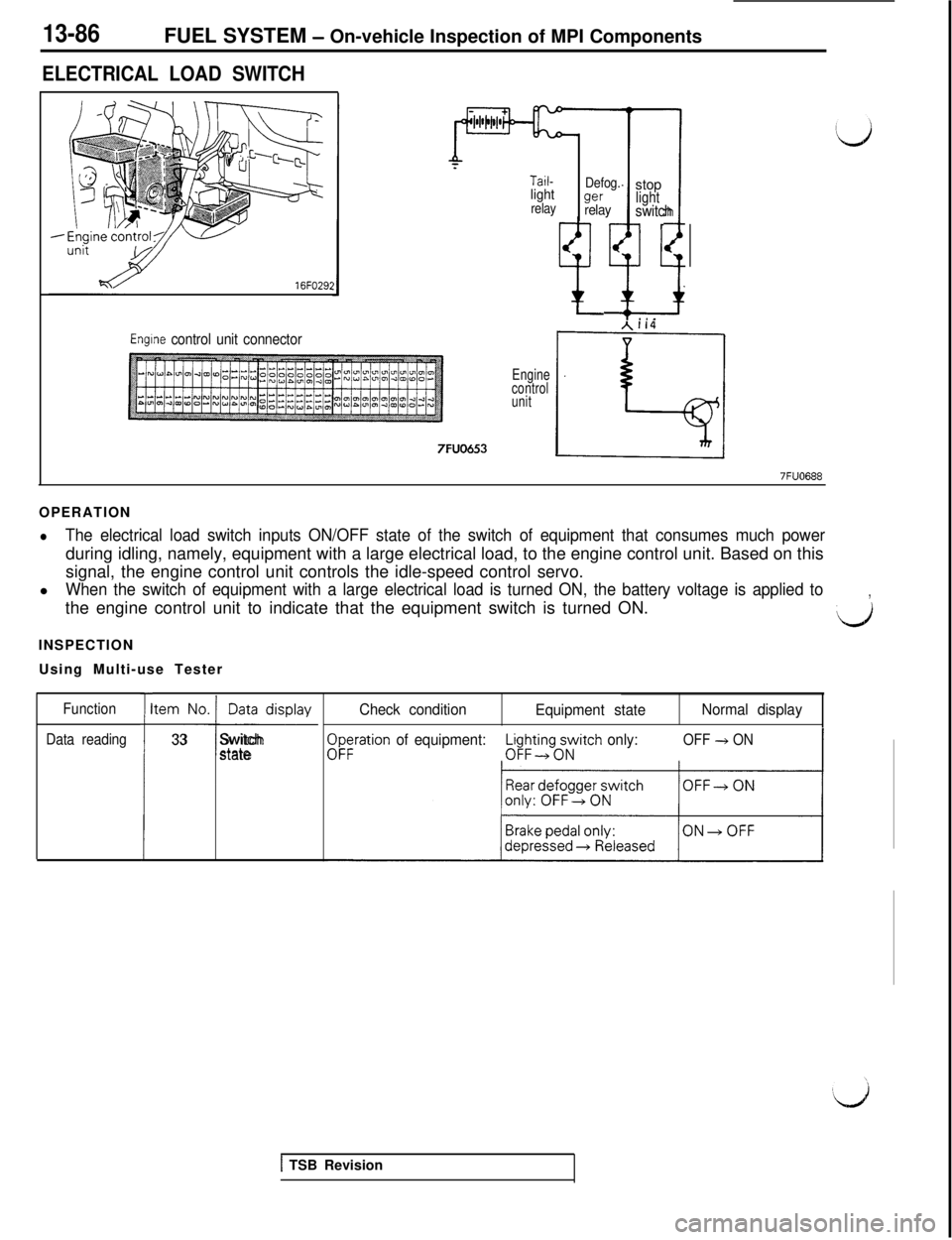
13-86FUEL SYSTEM - On-vehicle Inspection of MPI Components
ELECTRICAL LOAD SWITCH16FO29;
Tail-lightrelayDefog.wrelaystoplight
t;1
switch
ti* . .
Engine control unit connector
Engine
control
unit7FUO653
7FUO688OPERATION
lThe electrical load switch inputs ON/OFF state of the switch of equipment that consumes much powerduring idling, namely, equipment with a large electrical load, to the engine control unit. Based on this
signal, the engine control unit controls the idle-speed control servo.
l
When the switch of equipment with a large electrical load is turned ON, the battery voltage is applied tothe engine control unit to indicate that the equipment switch is turned ON.,
LJINSPECTION
Using Multi-use Tester
Function
Data reading
I
tem No. Data display
-I-
33Switchstate
Check condition
Equipment stateNormal display
$;ration of equipment:L$ing;Atch only:OFF + ON-3
1 TSB Revision