speed MITSUBISHI 3000GT 1992 2.G Repair Manual
[x] Cancel search | Manufacturer: MITSUBISHI, Model Year: 1992, Model line: 3000GT, Model: MITSUBISHI 3000GT 1992 2.GPages: 738, PDF Size: 35.06 MB
Page 453 of 738
Downloaded from www.Manualslib.com manuals search engine ENGINE ELECTRICAL - Charging System16-7/
L
(6) Connect a tachometer. (For the procedure for
connecting the tachometer, refer to GROUP
- On-vehicle Service.)(7)
kkconnect the negative battery cable.
(8) Leave the hood open.
(9) Start the engine.
(lO)With the engine running at 2500 rpm, turn the
headlights and other lights on and off to adjust
the generator load so that the value displayed
on the ammeter is slightly above 30A.Limit value: Max. 0.3 V
NOTE
When the generator output is high and the value
displayed on the ammeter does not decreaseto
30A, set the value to 40A. Read the value
displayed on the voltmeter at this time.
In this case the limit value becomes max. 0.4V.
Adjust the engine speed by gradually decreas-
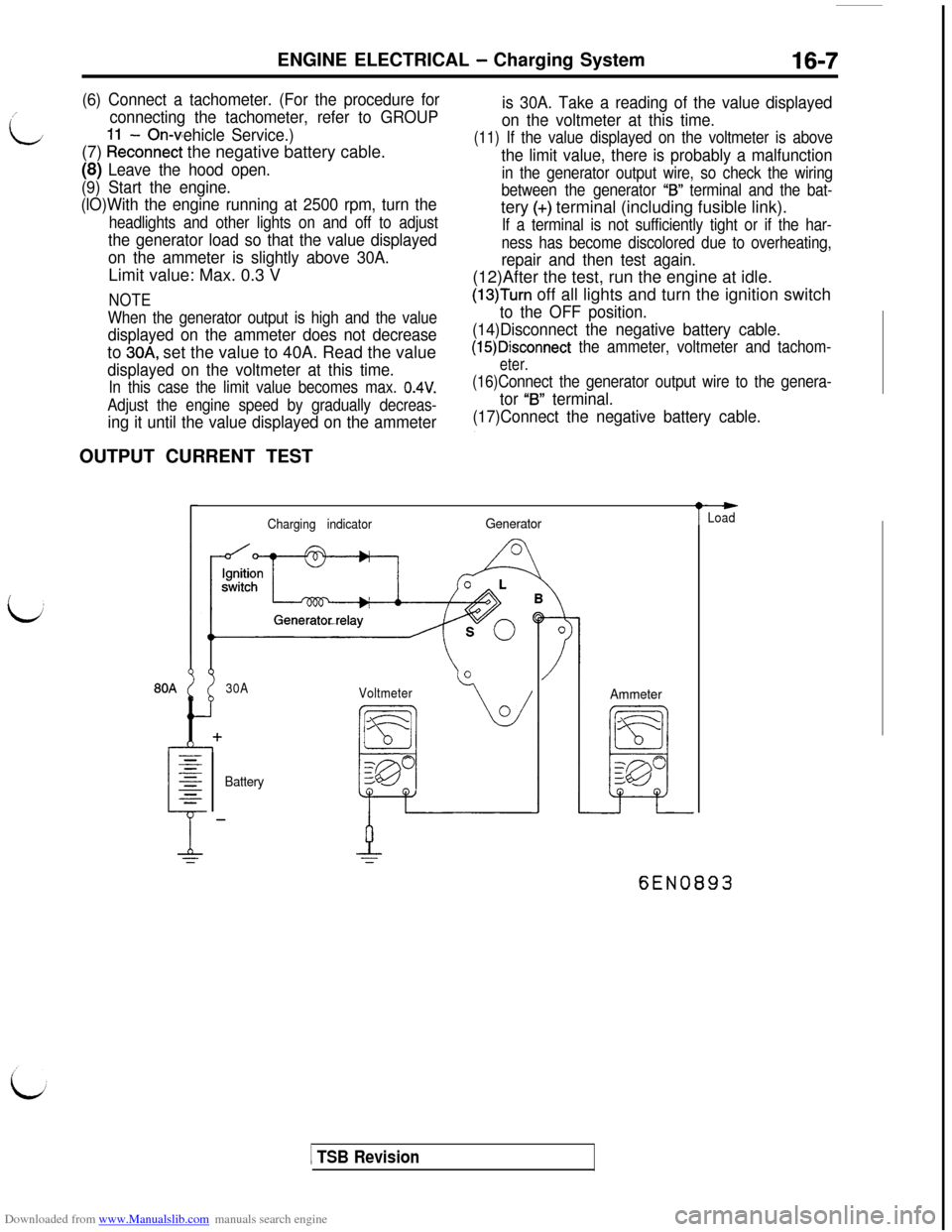
ing it until the value displayed on the ammeterOUTPUT CURRENT TEST
is 30A. Take a reading of the value displayed
on the voltmeter at this time.
(11) If the value displayed on the voltmeter is above
the limit value, there is probably a malfunction
in the generator output wire, so check the wiring
between the generator
“IS” terminal and the bat-tery
(+) terminal (including fusible link).
If a terminal is not sufficiently tight or if the har-
ness has become discolored due to overheating,
repair and then test again.(12)After the test, run the engine at idle.
(13)Turn off all lights and turn the ignition switch
to the OFF position.
(14)Disconnect the negative battery cable.
(15)Disconnect the ammeter, voltmeter and tachom-
eter.
(16)Connect the generator output wire to the genera-
tor “B” terminal.
(17)Connect the negative battery cable.
Charging indicatorGenerator
30A
Voltmeter
BatteryAmmeter
t
-Load
6EN0893
1 TSB Revision
Page 454 of 738
Downloaded from www.Manualslib.com manuals search engine 16-8ENGINE ELECTRICAL - Charging System
This test determines whether the generator outputs
normal current.(1) Before the test, always be sure to check the
following.l Generator installation
l
Battery (Refer to GROUP 54 - Battery.)
NOTE
The battery to be used should be slightly dis-charged. The load in a fully-charged battery
will be insufficient and the test may not be able
to be carried out correctly.l Generator drive belt tension (Refer to
GROUP 11- On-vehicle Service.)l Fusible link
l Abnormal noise from the generator while
the engine is running(2) Turn the ignition switch to the OFF position.
(3) Disconnect the negative battery cable.
(4) Disconnect the generator output wire from the
generator
“B” terminal and connect a DC testammeter with a range of O-100 A in series
between the “B” terminal and the disconnected
output wire. (Connect the
(+) lead of the amme-ter to the
“B” terminal, and then connect the(-) lead of the ammeter to the disconnected
output wire.)
Caution
Never use clips but tighten bolts and nutsto connect the line.
Otherwise loose
connections (e.g. using clips) will lead to
a serious accident because of high current.
NOTE
A clamp-type ammeter which enables measure-
ments to be taken without disconnecting the
generator output wire is recommended.(5) Connect a voltmeter with a range of 0
- 20
V between the generator “B” terminal and the
ground. (Connect the
(+) lead of the voltmeterto the “B” terminal, and then connect the (-)
lead of the voltmeter to the ground.)
(6) Connect a tachometer. (For the procedure forconnecting the tachometer, refer to GROUP
11 - On-vehicle Service.)
(7) Connect the negative battery cable.
(8) Leave the hood open.(9) Check to be sure that the reading on the
voltmeter is equal to the battery voltage.
NOTE
If the voltage is 0 V, the cause is probably an
open circuit in the wire or fusible link between
the generator “B” terminal and the battery
(+)
terminal.
(1O)After turning the light switch on and turning on
the headlights, start the engine.
(1l)lmmediately after setting the headlights to high
beam and turning the heater blower switch to
the high revolution position, increase the enginespeed to 2,500
r/min and read the maximum
current output value displayed on the ammeter.
Limit value: 70% of nominal current output
NOTEl
For the nominal current output, refer to the
Generator Specifications.l
Because the current from the battery will
soon drop after the engine is started, the
above step should be carried out as quickly
as possible in order to obtain the maximum
current output value.l The current output value will depend on
the electrical load and the temperature of
the generator body.l
If the electrical load is small while testing,the specified level of current may not be
output even though the generator is normal.
In such cases, increase the electrical load
by leaving the headlights turned on for sometime to discharge the battery or by using
the lighting system in another vehicle, and
then test again.l
The specified level of current also may not
be output if the temperature of the generator
body or the ambient temperature is too high.
In such cases, cool the generator and then
test again.
(12)The reading on the ammeter should be above
the limit value. If the reading is below the limit
value and the generator output wire is normal,
remove the generator from the engine and check
the generator.(13)Run the engine at idle speed after the test.
(14)Turn the ignition switch to the OFF position.
(15)Disconnect the negative battery cable.
(16)Disconnect the ammeter, voltmeter and
tachometer.(17)Connect the generator output wire to the
generator “B” terminal.
(18)Connect the negative battery cable.
TSB Revision
Page 455 of 738
Downloaded from www.Manualslib.com manuals search engine ENGINE ELECTRICAL - Charging Svstem16-9REGULATED VOLTAGE TEST
\:
b
Ignitionswitch (IGl)Generator
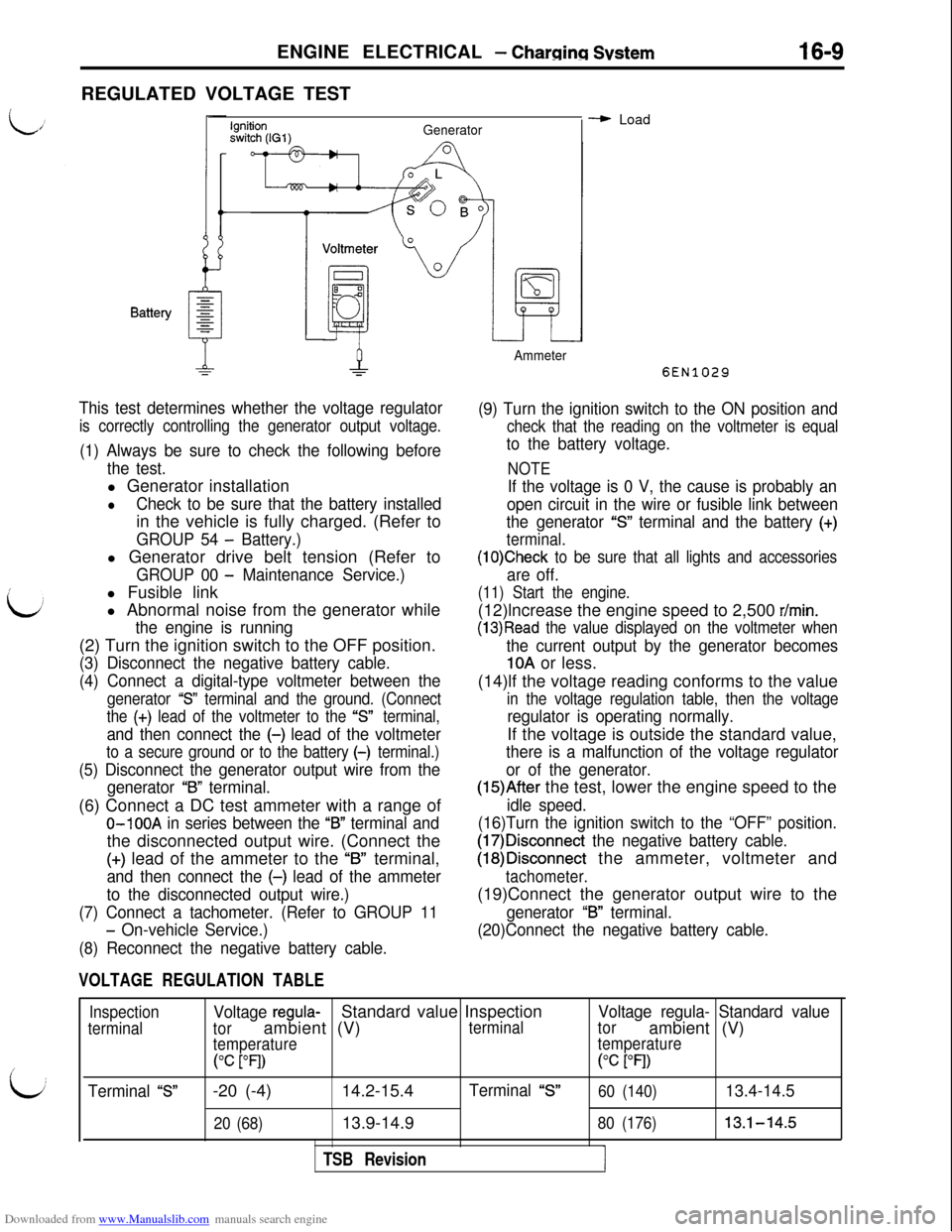
This test determines whether the voltage regulator
is correctly controlling the generator output voltage.
(1) Always be sure to check the following before
the test.l Generator installation
lCheck to be sure that the battery installedin the vehicle is fully charged. (Refer to
GROUP 54 - Battery.)l Generator drive belt tension (Refer to
GROUP 00 - Maintenance Service.)l Fusible link
l Abnormal noise from the generator while
the engine is running(2) Turn the ignition switch to the OFF position.
(3) Disconnect the negative battery cable.
(4) Connect a digital-type voltmeter between the
generator “S” terminal and the ground. (Connect
the
(+) lead of the voltmeter to the “s” terminal,
and then connect the (-) lead of the voltmeter
to a secure ground or to the battery (-) terminal.)
(5) Disconnect the generator output wire from the
generator
“B” terminal.(6) Connect a DC test ammeter with a range of
O-100A in series between the “B” terminal andthe disconnected output wire. (Connect the
(+) lead of the ammeter to the “B” terminal,
and then connect the (-) lead of the ammeter
to the disconnected output wire.)
(7) Connect a tachometer. (Refer to GROUP 11
- On-vehicle Service.)
(8) Reconnect the negative battery cable.
VOLTAGE REGULATION TABLE
Ammeter
- Load
6EN1029
(9) Turn the ignition switch to the ON position and
check that the reading on the voltmeter is equal
to the battery voltage.
NOTE
If the voltage is 0 V, the cause is probably an
open circuit in the wire or fusible link between
the generator
“S” terminal and the battery (+)
terminal.
(1O)Check to be sure that all lights and accessories
are off.
(11) Start the engine.(12)lncrease the engine speed to 2,500
r/min.
(13)Read the value displayed on the voltmeter when
the current output by the generator becomes
10A or less.
(14)lf the voltage reading conforms to the value
in the voltage regulation table, then the voltage
regulator is operating normally.If the voltage is outside the standard value,
there is a malfunction of the voltage regulator
or of the generator.
(15)After the test, lower the engine speed to the
idle speed.
(16)Turn the ignition switch to the “OFF” position.
(17)Disconnect the negative battery cable.
(18)Disconnect the ammeter, voltmeter and
tachometer.(19)Connect the generator output wire to the
generator “B” terminal.
(20)Connect the negative battery cable.
Inspection
terminal
Terminal “S”
Voltage regula-Standard value Inspection
torambient (V)terminal
temperature
(“C PI)-20 (-4)14.2-15.4
Terminal “S”
20 (68)13.9-14.9
TSB Revision
Voltage regula- Standard value
torambient (V)
temperature(“c
PI)
60 (140)13.4-14.5
80 (176)13.1-14.5
I
Page 456 of 738
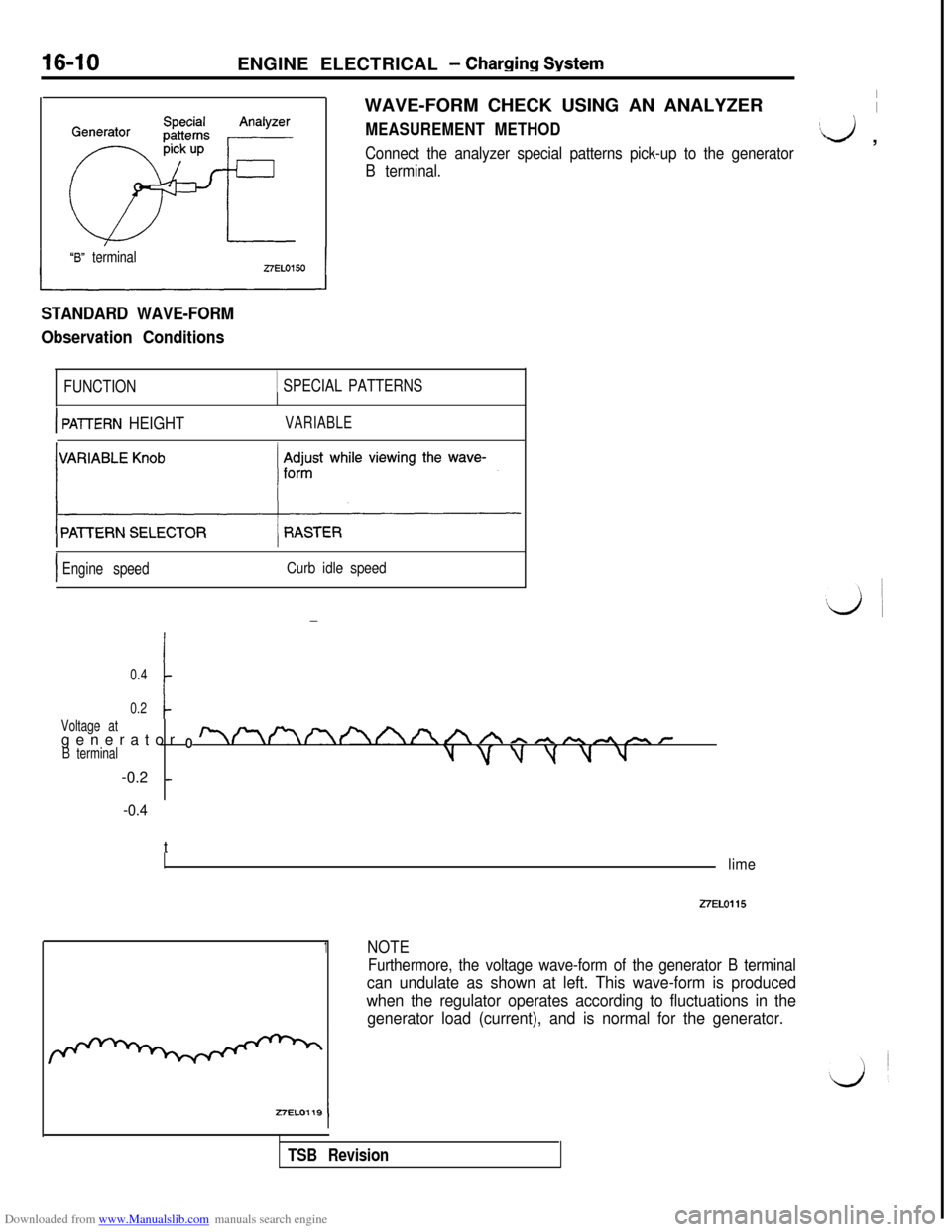
Downloaded from www.Manualslib.com manuals search engine ENGINE ELECTRICAL - Charqinq SystemWAVE-FORM CHECK USING AN ANALYZER
II
MEASUREMENT METHOD
Connect the analyzer special patterns pick-up to the generator
:L.J ,
B terminal.
I“B” terminalZ7ELOlSlI
STANDARD WAVE-FORM
Observation Conditions
FUNCTION1 SPECIAL PATTERNS
IPATTERN HEIGHTVARIABLEAdjust while viewing the
wave-
{
IEngine speedCurb idle speed
-
0.4
0.2
IVoltage atgenerator 0 p7r-\fTfTfi/\AJ\ I+ h A fi 4 n rB terminal-0.2
-
-0.4t
lime
27ELOl15
1NOTE
Furthermore, the voltage wave-form of the generator B terminal
can undulate as shown at left. This wave-form is produced
when the regulator operates according to fluctuations in the
generator load (current), and is normal for the generator.
TSB Revision
Page 465 of 738
Downloaded from www.Manualslib.com manuals search engine ENGINE ELECTRICAL - Starting System16-19
L/J
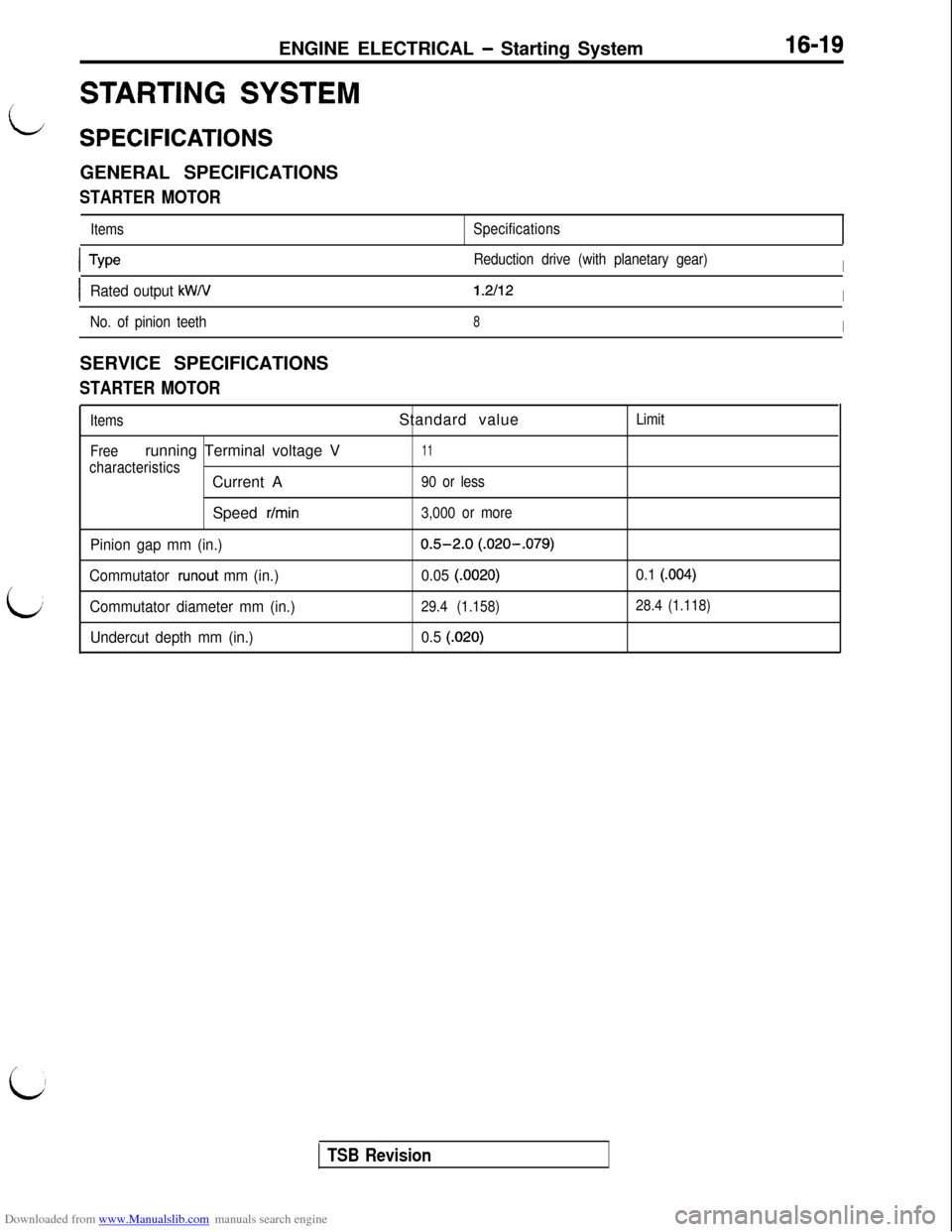
STARTING SYSTEM
SPECIFICATIONSGENERAL SPECIFICATIONS
STARTER MOTOR
ItemsSpecifications
L
ITypeReduction drive (with planetary gear)I
IRated output kW/V1.2112I
No. of pinion teeth8ISERVICE SPECIFICATIONS
STARTER MOTOR
Items
Freerunning Terminal voltage V
characteristicsCurrent A
Speed
r/min
Pinion gap mm (in.)
Commutator
runout mm (in.)
Commutator diameter mm (in.)
Undercut depth mm (in.)Standard value
11
90 or less
3,000 or more
0.5-2.0 (.020-.079)
0.05
(.0020)
29.4 (1.158)
0.5 (.020)Limit
0.1 (.004)
28.4 (1.118)
i
TSB Revision
Page 480 of 738
Downloaded from www.Manualslib.com manuals search engine 16-34ENGINE ELECTRICAL - Ignition System
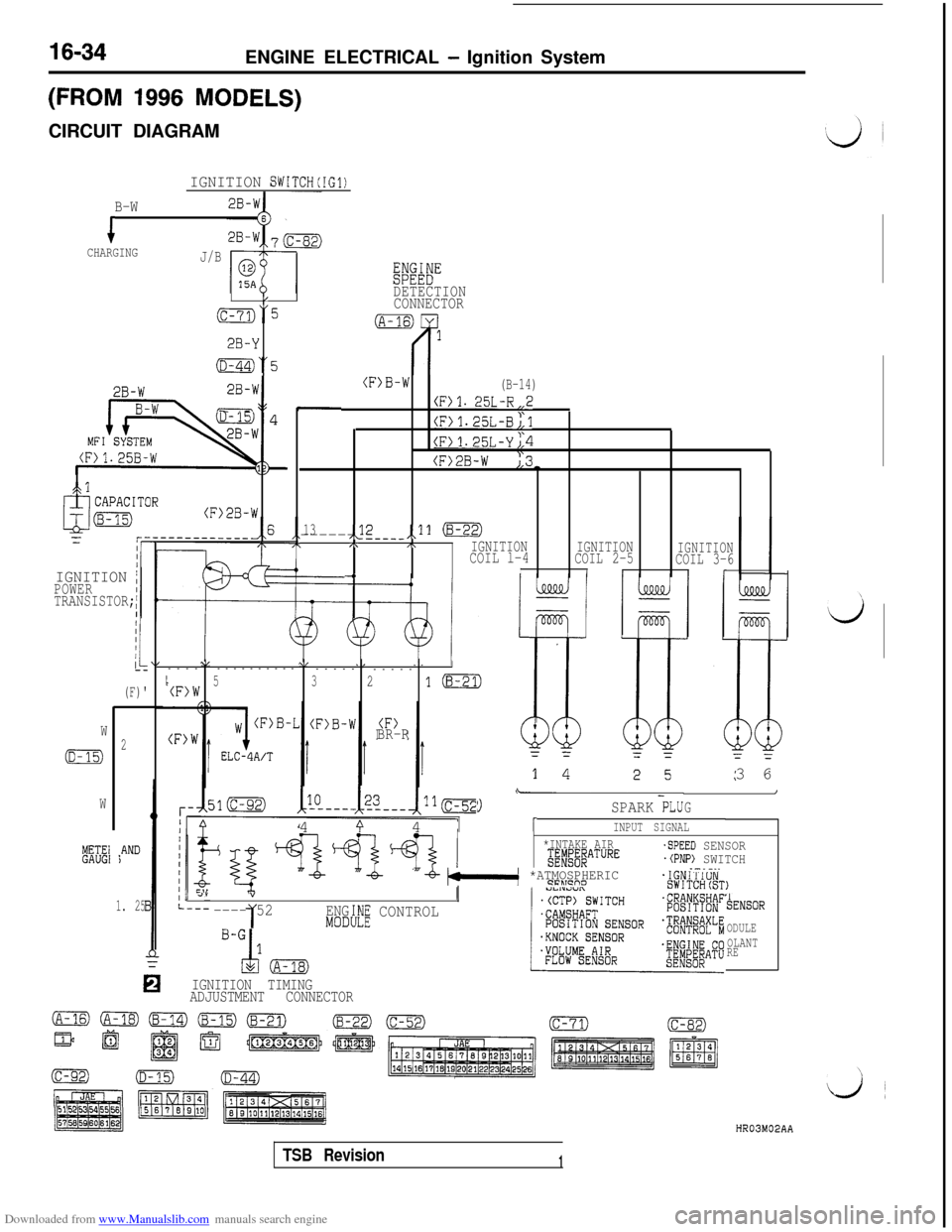
(FROM 1996 MODELS)CIRCUIT DIAGRAM
IGNITION SWITCH(IG1)
B-W
iCHARGINGJ/B
Eiwi"
/DETECTION
(c-73)“5CONNECTOR
2B-Y
(D-44)“5
2B-W-I
2B-W
MFILS - --
(F>B-W(B-14)
(F)l. 25L-R,,2
(F)1.25L-B;,l
(F>1.25L-Yj,4
(F>2B-W ),3-
.
13,<2------ ---__,,11 (8-22),\,\IGNITIONCOIL l-4IGNITION
COIL 2-5IGNITIONCOIL 3-6-4III(r
,cl
(F>2B-W
IGNITION /POWER
TRANSISTOR;
I
(F)'
\I\/,I--------------
-----
-----
I5(F)W321m
BR-RW
(D-15)2
W
METE1GAUGI*AND)3 6
\-I
G9SPARK PLU4
9 41INPUT SIGNAL
*INTAKE AIRg;#j#ATURE
"-b- bkl *ATMOSPHERIC9FLTcno
-SPEED SENSOR.(PNP) SWITCH.-.-..
, 4””
---- 521ENG:h!E CONTROLMODI
TENSOR
ODULE
OLANT
RE
IGNITION TIMING
ADJUSTMENT CONNECTOR
1. 25
HR03M02AA
TSB Revision1
Page 484 of 738
1
PAT")
Downloaded from www.Manualslib.com manuals search engine 16-38ENGINE ELECTRICAL - Ignition System
STANDARD WAVE-FORM
Observation Conditions
FUNCTIONSECONDARY
\
\j’i
IPATTERN HEIGHTHIGH (or LOW)1
PATTERN SELECTORRASTER
Engine revolutions
Curb idle speed
kV
Secondary
ignition
voltagewave-form
-6
Ignition voltage(Point D)
Dwell sectionSpark line (Point A)
/Wave damping reduction section
(Point B)
/
Time
7EL0147
Observation conditions (Only PAlTERN SELECTOR below changes from the above conditions)
PATTERN SELECTOR
DISPLAY
Secondary
ignition
voltagewave-formt
No. 1 Cylinder
No. 2 Cylinderignition noiseNo. 3 Cylinder
ignition noiseNo. 4 Cylinder
No. 5 CylinderNo. 6 Cylinder(Waveform is ignition noise ignition noise
TimeI)I7EL0148
1 TSB Revision
Page 487 of 738
Downloaded from www.Manualslib.com manuals search engine ENGINE ELECTRICAL - lanition Svstem16-41
/
L
i
Analyzer
GroundL
01L1008
STANDARD WAVE-FORM
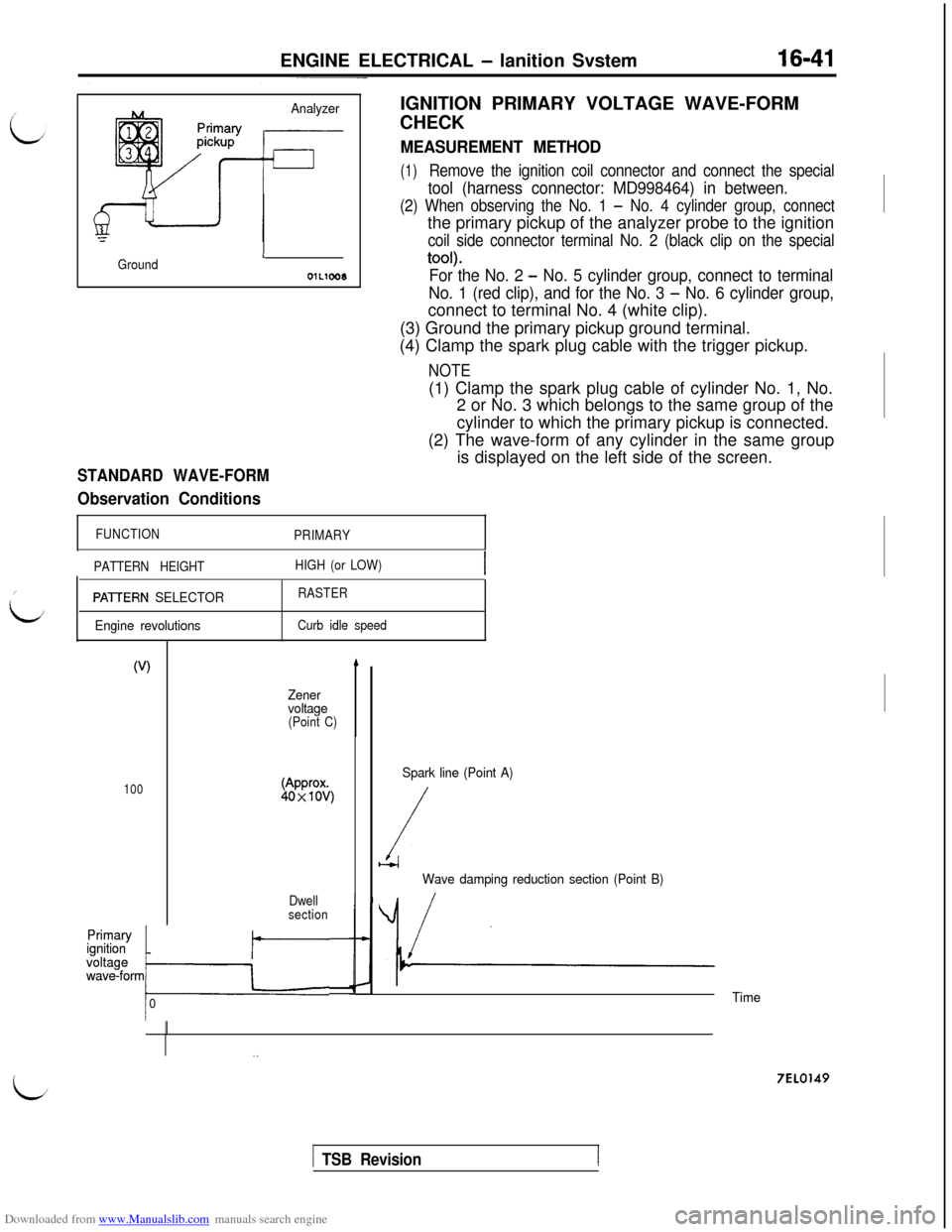
Observation ConditionsIGNITION PRIMARY VOLTAGE WAVE-FORM
CHECK
MEASUREMENT METHOD
(1)Remove the ignition coil connector and connect the special
tool (harness connector: MD998464) in between.
(2) When observing the No. 1 - No. 4 cylinder group, connectthe primary pickup of the analyzer probe to the ignition
coil side connector terminal No. 2 (black clip on the special
tool).
For the No. 2 - No. 5 cylinder group, connect to terminal
No. 1 (red clip), and for the No. 3
- No. 6 cylinder group,connect to terminal No. 4 (white clip).
(3) Ground the primary pickup ground terminal.
(4) Clamp the spark plug cable with the trigger pickup.
NOTE(1) Clamp the spark plug cable of cylinder No. 1, No.
2 or No. 3 which belongs to the same group of the
cylinder to which the primary pickup is connected.
(2) The wave-form of any cylinder in the same group
is displayed on the left side of the screen.
FUNCTION
PRIMARY
PATTERN HEIGHTHIGH (or LOW)
PAVERN SELECTOR
Engine revolutionsRASTER
Curb idle speed
(V)
100
Primary Primary*ignition ignition
voltage voltage
wave-form
owave-formkr
0
Zener
voltage
(Point C)
Dwell
section
b
Spark line (Point A)
/b-4
Wave damping reduction section (Point B)
/
Time
7EL0149
/ TSB Revision
Page 492 of 738
Downloaded from www.Manualslib.com manuals search engine 16-46ENGINE ELECTRICAL - Ignition Svstem
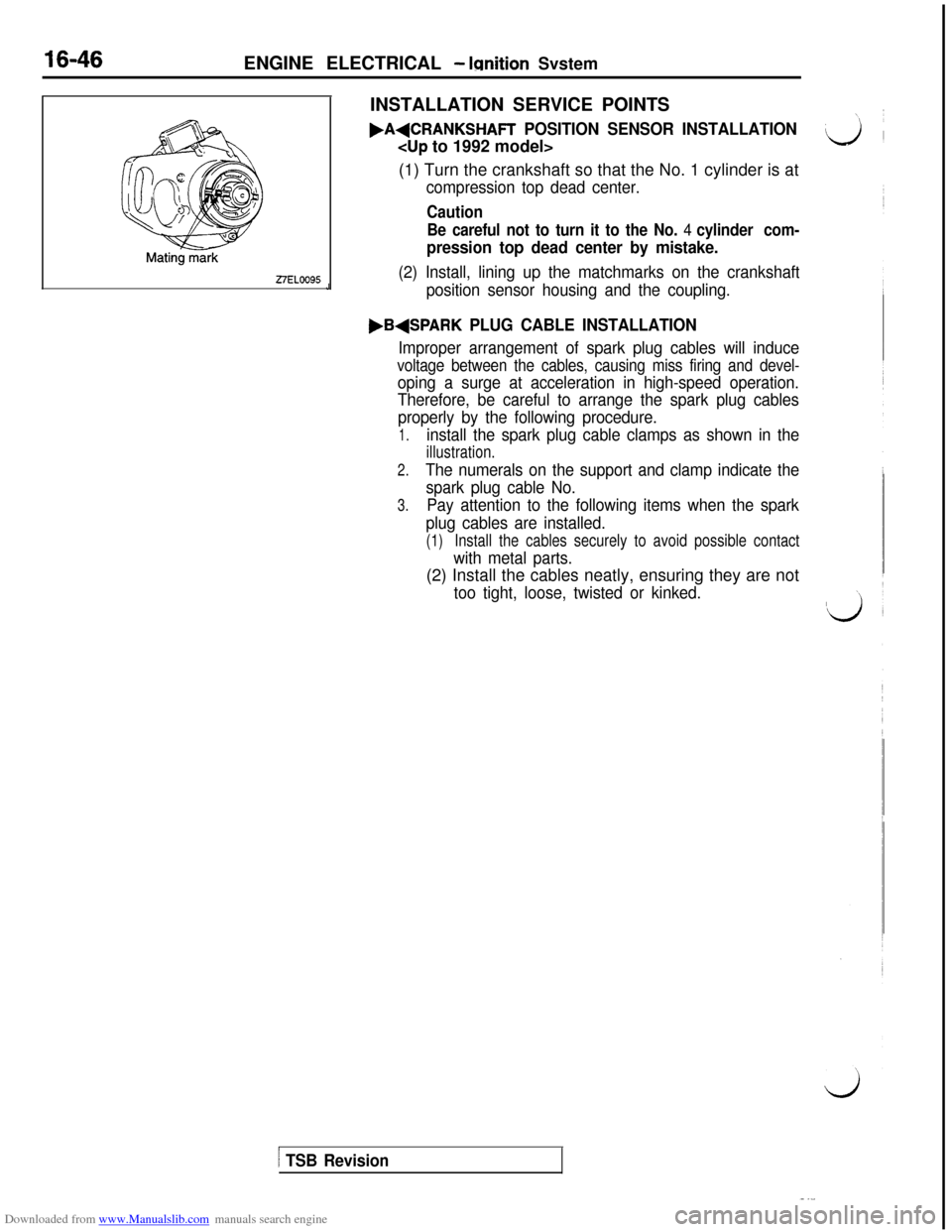
27ELOO95JINSTALLATION SERVICE POINTS.A+CRANKSHAFT
POSITION SENSOR INSTALLATION
(1) Turn the crankshaft so that the No. 1 cylinder is at
compression top dead center.
Caution
Be careful not to turn it to the No.
4 cylinder com-
pression top dead center by mistake.
(2) Install, lining up the matchmarks on the crankshaft
position sensor housing and the coupling.
,B+SPARK PLUG CABLE INSTALLATION
Improper arrangement of spark plug cables will induce
voltage between the cables, causing miss firing and devel-
oping a surge at acceleration in high-speed operation.
Therefore, be careful to arrange the spark plug cables
properly by the following procedure.
1.install the spark plug cable clamps as shown in the
illustration.
2.The numerals on the support and clamp indicate the
spark plug cable No.
3.Pay attention to the following items when the spark
plug cables are installed.
(1)Install the cables securely to avoid possible contact
with metal parts.(2) Install the cables neatly, ensuring they are not
too tight, loose, twisted or kinked.
/ TSB Revision
Page 507 of 738
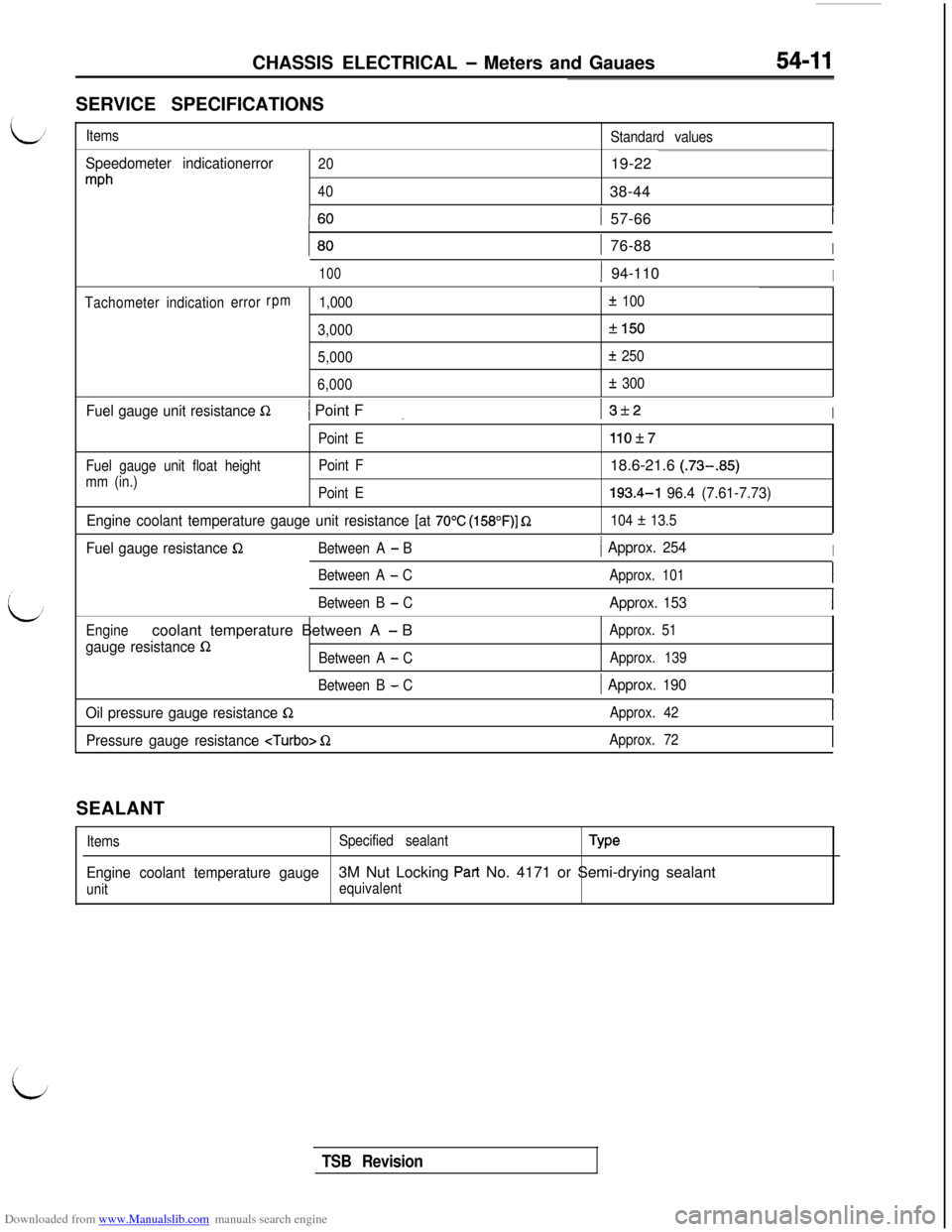
Downloaded from www.Manualslib.com manuals search engine CHASSIS ELECTRICAL - Meters and Gauaes
SERVICE SPECIFICATIONS
Items
Standard values
Speedometer indicationerror
mph
2019-22
4038-44
1 57-66
1 76-88I
1001 94-110I
Tachometerindicationerrorrpm1,000f 100
3,000
f150
5,000f 250
6,000
Ik 300
Fuel gauge unit resistance R/ Point F_I3f2I
Point E
Fuel gauge unit float heightPoint F
mm (in.)
Point E
Engine coolant temperature gauge unit resistance [at 70°C (158”F)] Q110+7
18.6-21.6 (.73-.85)193.4-l
96.4 (7.61-7.73)
104 f 13.5
Fuel gauge resistance QBetween A - B/ Approx. 254I
Between A - CApprox. 101I
Between B - CApprox. 153I
Enginecoolant temperature Between A - B
gauge resistance QBetween A - CApprox. 51
Approx. 139
Between B
- C/ Approx. 190I
Oil pressure gauge resistance QApprox. 42I
Pressure gauge resistance
ItemsSpecified sealantType
Engine coolant temperature gauge3M Nut Locking Part No. 4171 or Semi-drying sealant
unitequivalent
TSB Revision