Coil MITSUBISHI 3000GT 1993 2.G User Guide
[x] Cancel search | Manufacturer: MITSUBISHI, Model Year: 1993, Model line: 3000GT, Model: MITSUBISHI 3000GT 1993 2.GPages: 738, PDF Size: 35.06 MB
Page 187 of 738
Downloaded from www.Manualslib.com manuals search engine CIRCUIT DIAGRAMS - Cooling Circuit185
OPERATIONThe engine control module controls the power
transistors (high speed and low speed) in the moduleto provide radiator fan motor and condenser fan
motor rotation controls in accordance with the engine
coolant temperature and vehicle speed.
NOTEIn the event of faulty water temperature sensor,
the engine control module commands the fan motors
(for both radiator and condenser) to rotate at high
speeds.1. Radiator Fan (Low Speed Rotation)
l
When the engine control module turns onthe power transistor (low speed) in the
module, the current flows from the ignition
switch to the engine control module throughthe radiator fan motor relay (LO) coil.
If the current flows to the fan motor relay
coil, the switch of the relay turns on to supplythe motor driving power (for low speed
rotation). This will cause the current to flow
from the battery to the ground through the
radiator fan motor, relay switch and resistor,rotating the radiator fan at low speeds.
2. Condenser Fan (Low Speed Rotation)
l
The power from the NC compressor lock
controller turns on the condenser fan motorrelay (LO) to rotate the condenser fan at
low speeds.3. Radiator Fan, Condenser Fan (High
Speed Rotation)l
When the engine control module turns onthe power transistor (high speed) in the
module. the radiator fan motor relay (HI)
and condenser fan motor relay (HI) will
operate and the motor driving power (for
high speed rotation) is sent to the radiator
fan motor and condenser fan motor to rotate
the radiator fan and condenser fan at high
speeds.
TROUBLESHOOTING HINTS1. Neither the radiator fan nor condenser
fan rotate at all.
l Check fusible link No. 5.
2. Only the condenser fan does not
operate.l Check dedicated fuse No. 8.
3. The condenser fan do not operate in the
low speed mode, but operate otherwise.
(1) The A/C compressor magnet clutch does
not enter the “ON” state.l Check whether the output of the air
conditioning compressor lock controller
unit is available.
(2) The A/C compressor magnet clutch enters
the “ON” state.l
Check the condenser fan motor relay
(LO)-4. The radiator fan and condenser fan do
not operate in the high speed mode, but
operate otherwise.l Check the engine control unit.
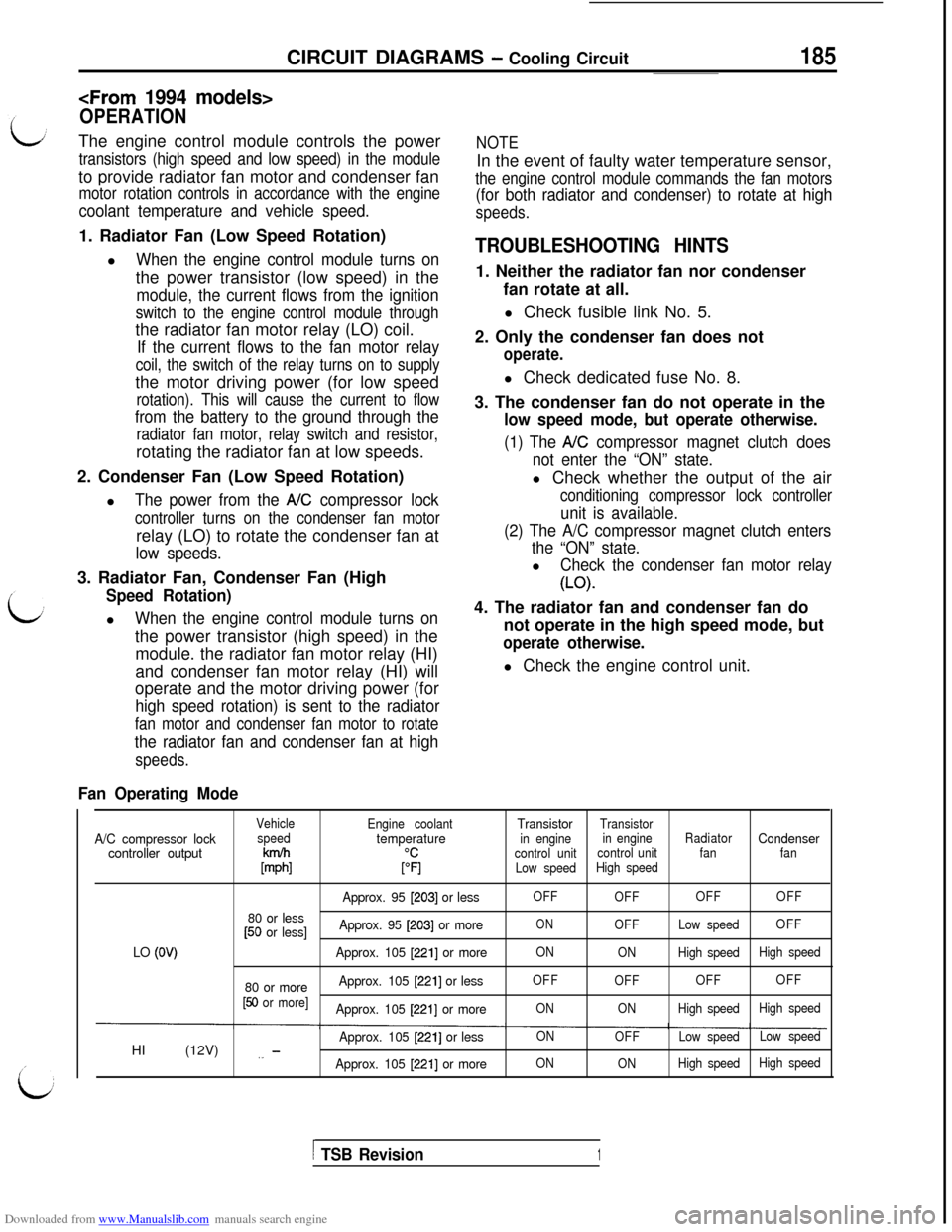
Fan Operating Mode
VehicleA/C compressor lockspeedcontroller output
k%
80 or less[50 or less]
LO
(OV)
80 or more[50 or more]HI (12V)
,_ -
Engine coolanttemperature
$1
Approx. 95 [203] or less
Approx. 95
[203] or more
Approx. 105
[221] or more
Approx. 105
[221] or less
Approx. 105
[221] or more
Approx. 105
[221] or less
Approx. 105
12211 or moreTransistor
Transistor
in enginein engineRadiatorCondensercontrol unitcontrol unitfanfan
Low speedHigh speed
OFF
OFFOFFOFF
ONOFFLow speedOFF
ON
ONHigh speedHigh speed
OFF
OFFOFFOFF
ONONHigh speedHigh speed
ON
OFFLow speedLow speed
ON
ONHigh speedHigh speed
1 TSB Revision1
Page 448 of 738
Downloaded from www.Manualslib.com manuals search engine ENGINE ELECTRICAL - Charging Svstem
CHARGING SYSTEM
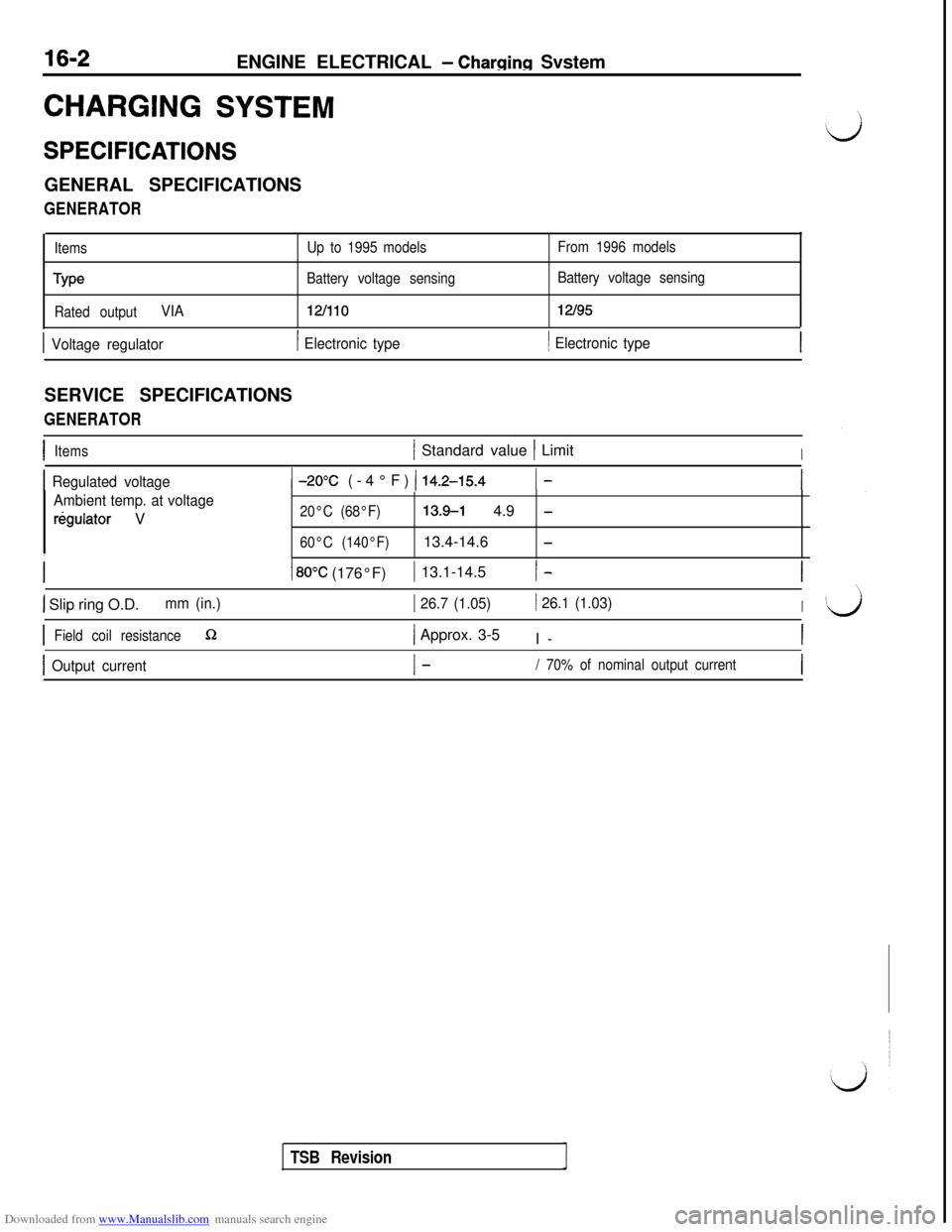
SPECIFICATIONSGENERAL SPECIFICATIONS
GENERATOR
ItemsUp to 1995 modelsFrom 1996 models
TypeBattery voltage sensingBattery voltage sensing
Rated output
VIA12fllO12l95
1 Voltage regulator1 Electronic type1 Electronic typeSERVICE SPECIFICATIONS
GENERATOR
IItems1 Standard value 1 LimitI
I Regulated voltage
Ambient temp. at voltage
rkgulator V
1 -2O’C (-4°F) ( 14.2-15.41 -I
20°C (68°F)13.9-l 4.9 -
60°C (140°F)13.4-14.6 -IIIII
1 80°C (176°F)1 13.1-14.5I-
1 Slip ring O.D.mm (in.)1 26.7 (1.05)/ 26.1 (1.03)I
IField coil resistanceQ1 Approx. 3-5
I-I
I Output currentI-/ 70% of nominal output currentI
TSB Revision
Page 450 of 738
CIRCUIT DIAGRAM
(F)8W-:F>IW-F
\
1
1-8
COIL
-
i
~
i
-
(Ir
METER AND
GAUGES
-
3 Eb3-
B-")
Downloaded from www.Manualslib.com manuals search engine 16-4ENGINE ELECTRICAL - Charging System
(FROM 1994 MODELS)CIRCUIT DIAGRAM
(F)8W-:F>IW-F
\
1
1-8
COIL
-
i
~
i
-
(Ir
METER AND
GAUGES
-
3 Eb3-
B-\
(c-01
B-\
J
gfF;E$ATOR r
(A-1OX)
I
nr
D r
hJ
s-77
3
ILJL
_)
tc
(F>
----- -------.
3
ILTAGE YEGULATOS
L
;
:
(
L
2B-W7(c-82)
J/B,\
0715A
\,0.85
6(c-71)
B-W
--COMBINATION@ METER
z7TURN-SIGNAL
?LIGHT ANDHAZARD LIGHT
GENEARATOR
IGNITIONSWITCH(IG1)
I2B-WI
(Flo (D-45) DEFOGGER
HR04MOlAA
TSB Revision
Page 451 of 738
Downloaded from www.Manualslib.com manuals search engine ENGINE ELECTRICAL - Charging System16-5
OPERATION
When engine is stoppedWhen the ignition switch is switched to the “ON”
position, electricity flows from the
‘I” terminal of
the generator to the field coil, and at the same time
the charging warning light illuminates.
When engine is being started/has started
When the engine is started, charging voltage is ap-
plied to the ‘I” terminal of the generator, with the
result that the charging warning light is extinguished.
In addition, because battery voltage is applied to
the “S” terminal of the generator, this battery voltage
is monitored at the
IC voltage regulator, thus switch-ing ON and OFF the current to the field coil and
thereby controlling the output voltage of the genera-
tor.
Power is supplied to each load from the “B” terminal
of the generator.
NOTE
The generator relay functions as a back-up for the
flow of electricity to the field coil if there is a discon-
nection or damaged wiring of the charging warning
light.
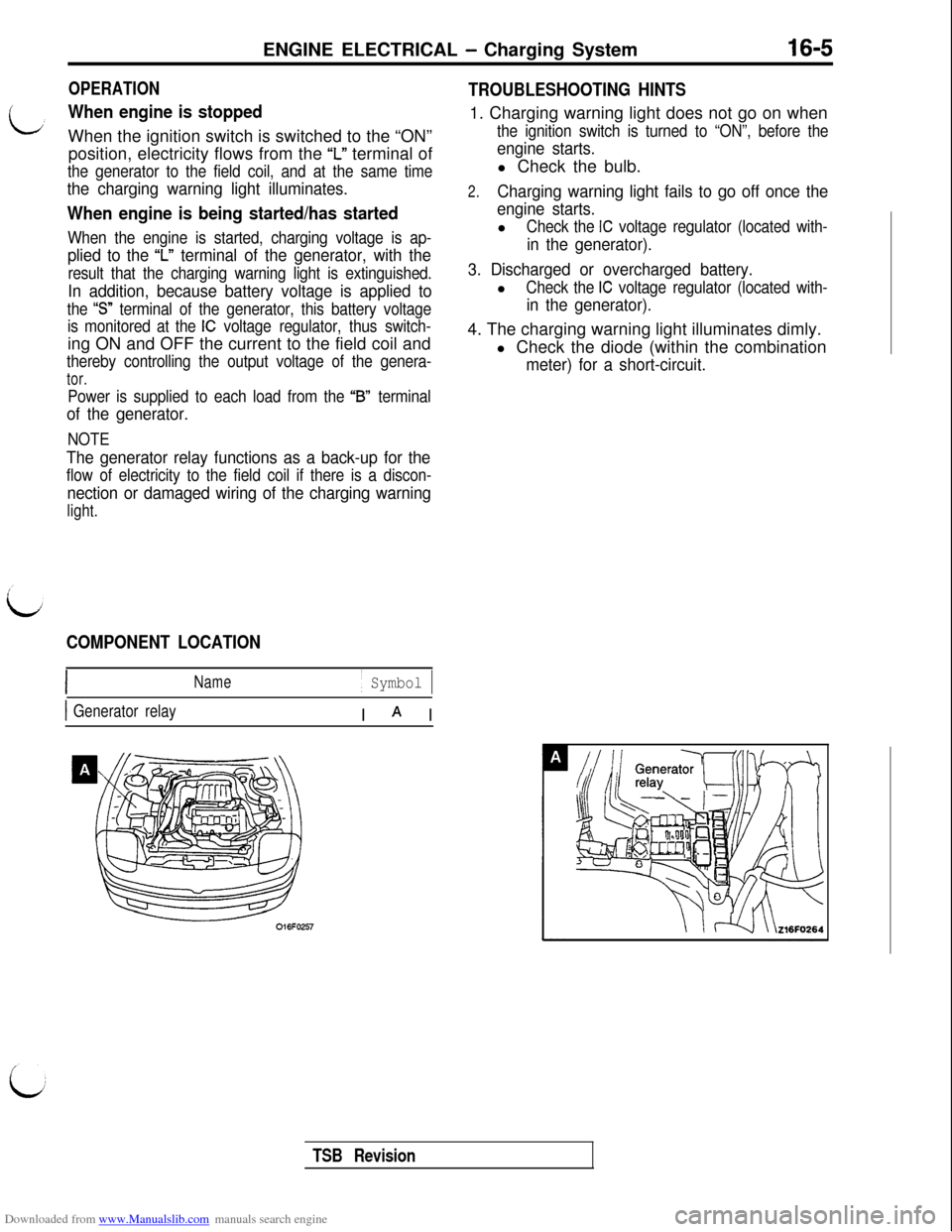
COMPONENT LOCATION
Name/ Symbol 1
1 Generator relayI A I
TROUBLESHOOTING HINTS1. Charging warning light does not go on when
the ignition switch is turned to “ON”, before the
engine starts.l Check the bulb.
2.Charging warning light fails to go off once the
engine starts.l
Check the IC voltage regulator (located with-
in the generator).
3. Discharged or overcharged battery.l
Check the IC voltage regulator (located with-
in the generator).4. The charging warning light illuminates dimly.
l Check the diode (within the combination
meter) for a short-circuit.
TSB Revision
Page 457 of 738
Downloaded from www.Manualslib.com manuals search engine ENGINE ELECTRICAL - Charging System16-11
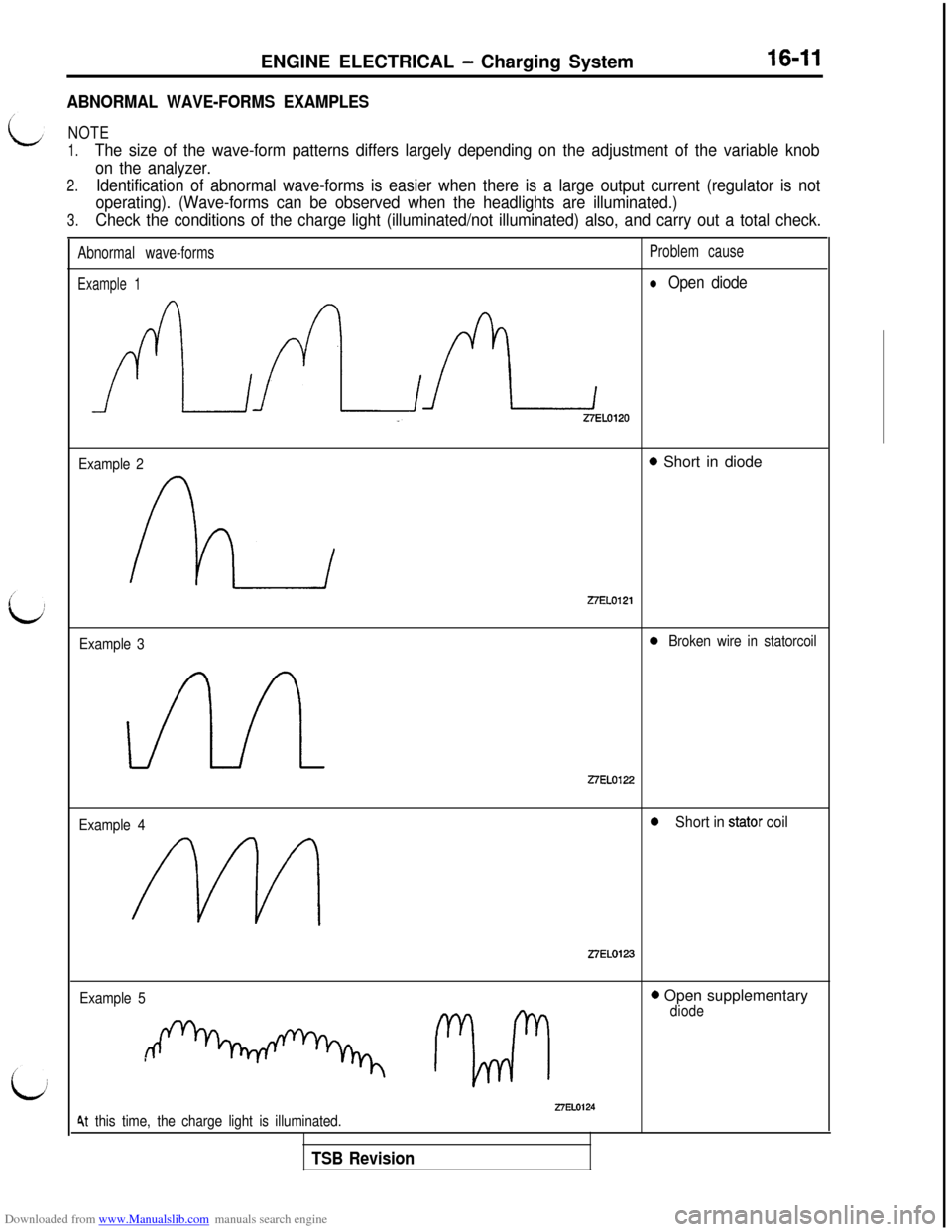
ABNORMAL WAVE-FORMS EXAMPLES
NOTE
1.The size of the wave-form patterns differs largely depending on the adjustment of the variable knob
on the analyzer.
2.Identification of abnormal wave-forms is easier when there is a large output current (regulator is not
operating). (Wave-forms can be observed when the headlights are illuminated.)
3.Check the conditions of the charge light (illuminated/not illuminated) also, and carry out a total check.
Abnormal wave-formsProblem cause
Example 1l Open diode
AALZELOlZO
Example 20 Short in diodeZ7EL0121
Example 30Broken wire in statorcoil
27EL0122
Example 40Short in stator coil
Z7EL0123
Example 5
1 r2rrirl
0 Open supplementarydiode
27EL01244t this time, the charge light is illuminated.
TSB Revision
Page 460 of 738
Downloaded from www.Manualslib.com manuals search engine 16-14ENGINE ELECTRICAL - Charging System
(From 1996 models)
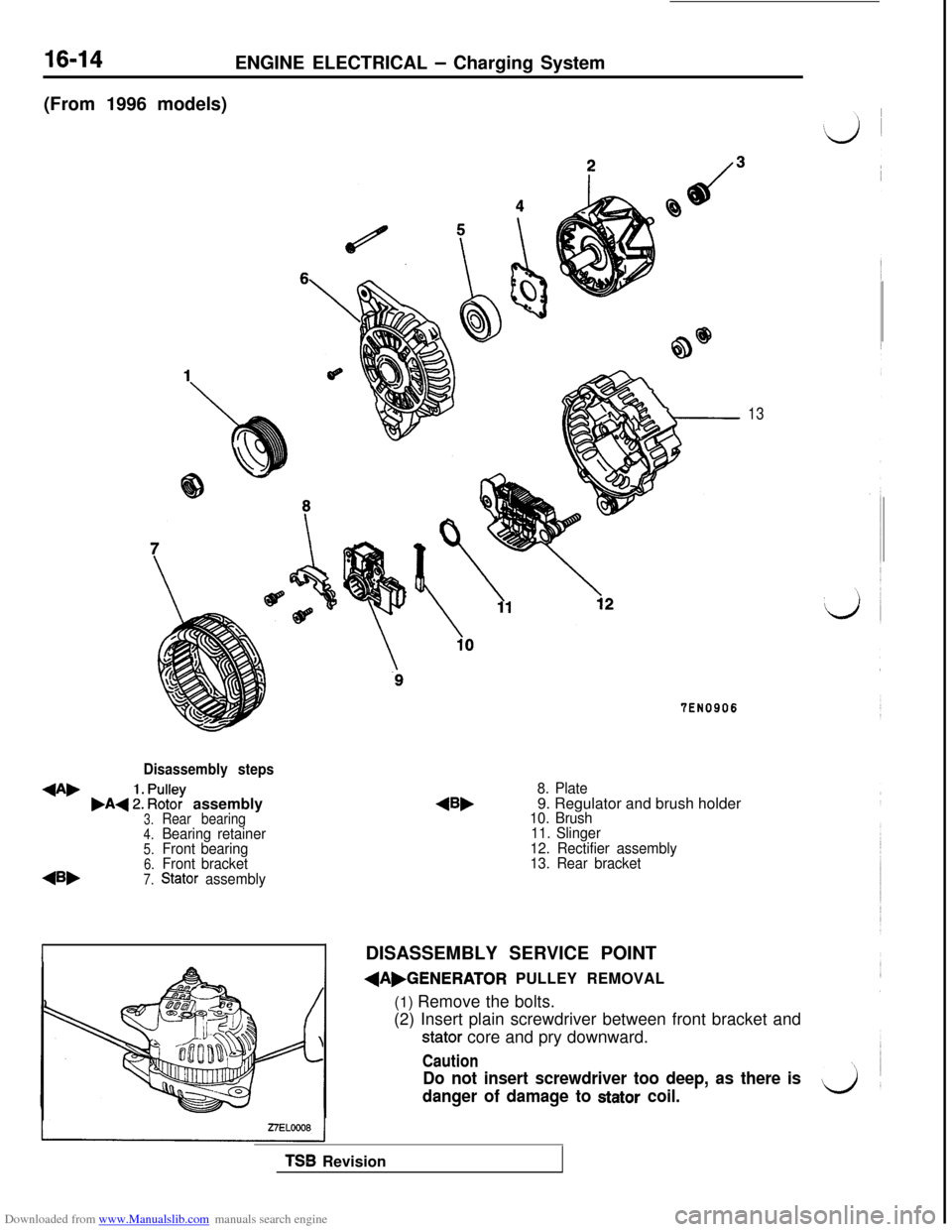
Disassembly steps
+A,,A+ :: ~%? assembly3.Rear bearing4.Bearing retainer5.Front bearing6.Front bracket
45,7.Stator assembly
13
TEN0906
8. Plate9. Regulator and brush holder
10. Brush
11. Slinger
12. Rectifier assembly
13. Rear bracket
IDISASSEMBLY SERVICE POINT
dAbGENERATOR PULLEY REMOVAL
(1) Remove the bolts.
(2) Insert plain screwdriver between front bracket and
stator core and pry downward.
Caution
Do not insert screwdriver too deep, as there is
danger of damage to
stator coil.
TSB Revision
Page 462 of 738
Downloaded from www.Manualslib.com manuals search engine ENGINE ELECTRICAL - Charging System
h\Z3ELOlO
\23ELOllINSPECTION
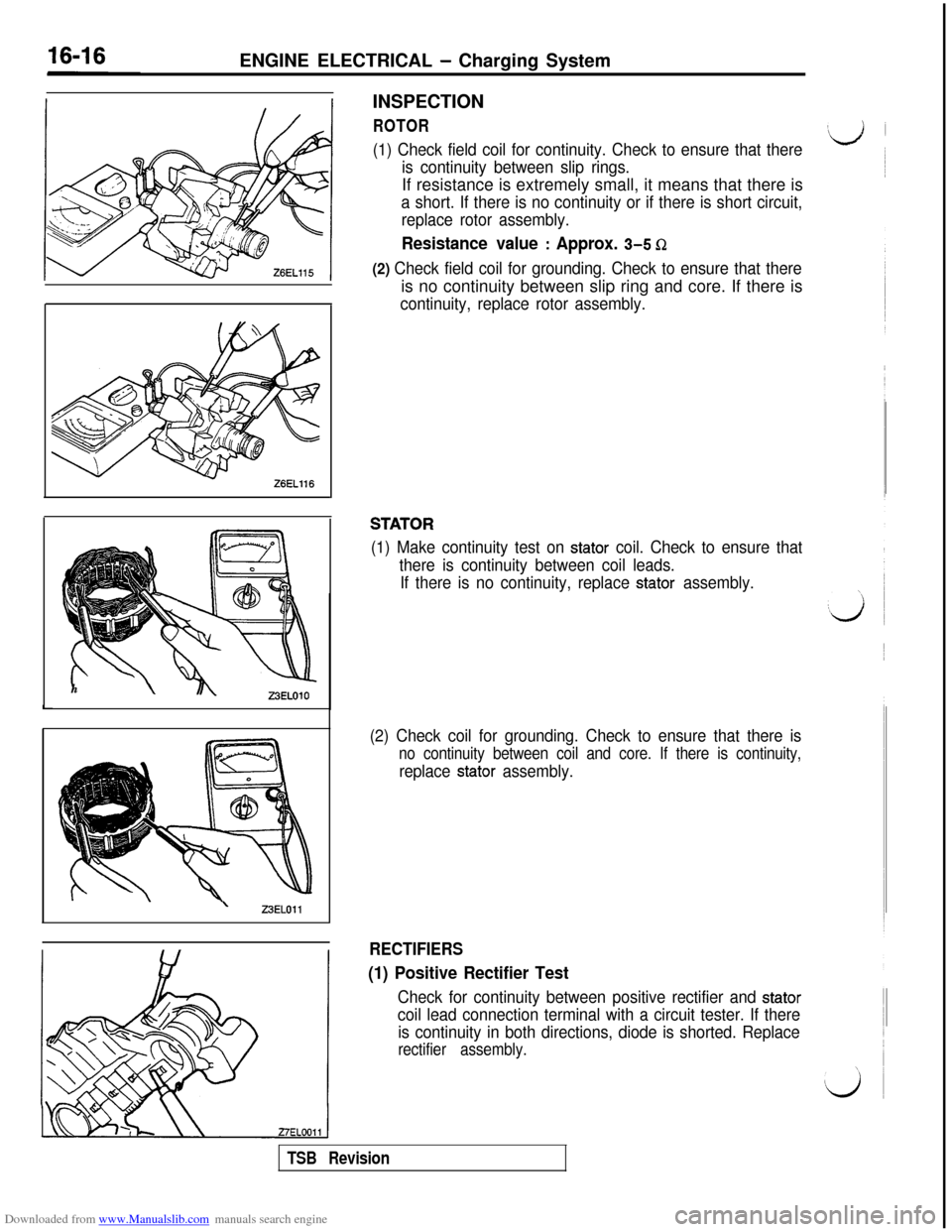
ROTOR
(1) Check field coil for continuity. Check to ensure that there
is continuity between slip rings.If resistance is extremely small, it means that there is
a short. If there is no continuity or if there is short circuit,
replace rotor assembly.
Resistance value : Approx. 3-5 Q
(2) Check field coil for grounding. Check to ensure that thereis no continuity between slip ring and core. If there is
continuity, replace rotor assembly.
STATOR
(1) Make continuity test on stator coil. Check to ensure that
there is continuity between coil leads.
If there is no continuity, replace
stator assembly.
(2) Check coil for grounding. Check to ensure that there is
no continuity between coil and core. If there is continuity,
replace stator assembly.
RECTIFIERS
(1) Positive Rectifier Test
Check for continuity between positive rectifier and stator
coil lead connection terminal with a circuit tester. If there
is continuity in both directions, diode is shorted. Replace
rectifier assembly.
TSB Revision
Page 463 of 738
Downloaded from www.Manualslib.com manuals search engine ENGINE ELECTRICAL - Charging System16-17
Limit line
WELO
,Soldered
27EL0014
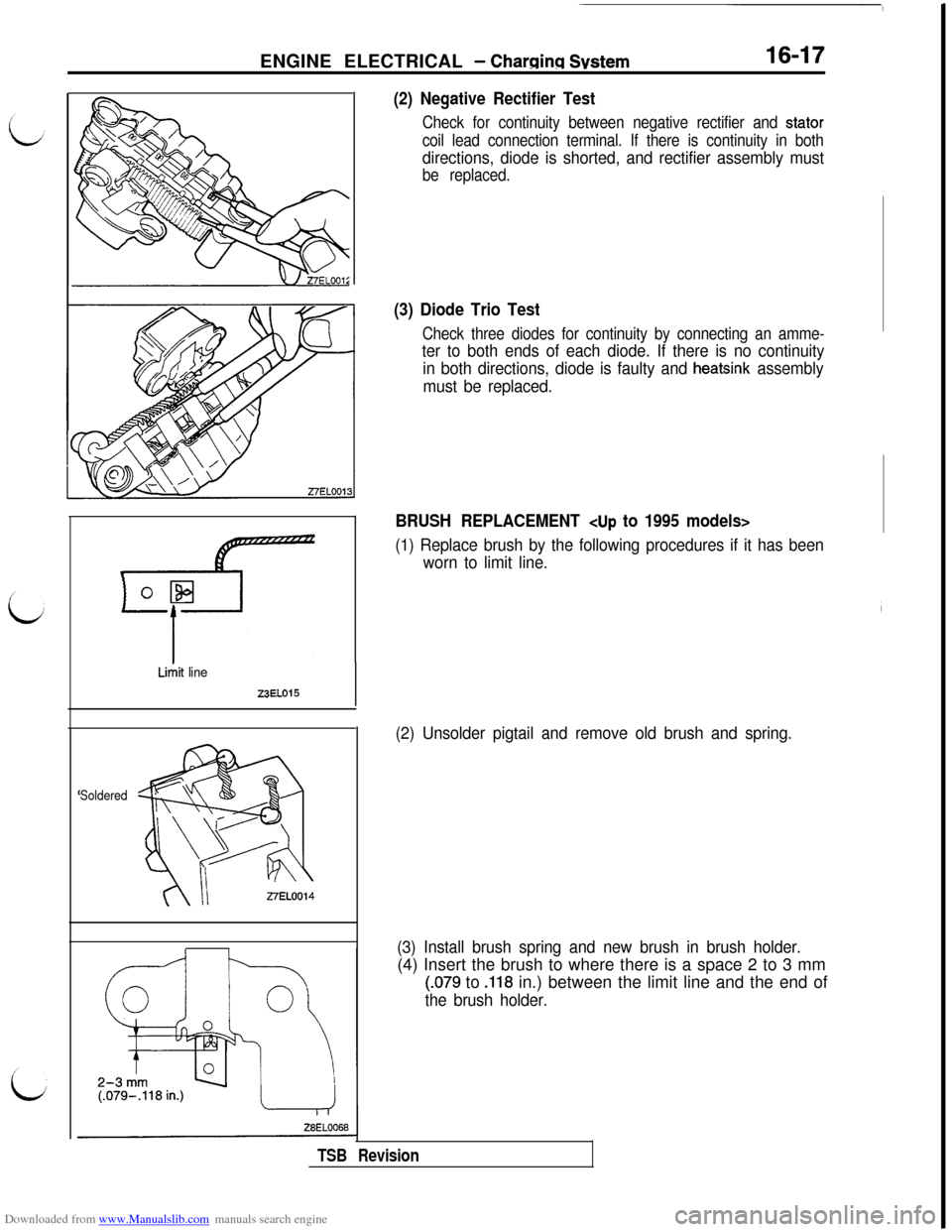
(2) Negative Rectifier Test
Check for continuity between negative rectifier and stator
coil lead connection terminal. If there is continuity in both
directions, diode is shorted, and rectifier assembly must
be replaced.
(3) Diode Trio Test
Check three diodes for continuity by connecting an amme-
ter to both ends of each diode. If there is no continuity
in both directions, diode is faulty and
heatsink assembly
must be replaced.
BRUSH REPLACEMENT
(1) Replace brush by the following procedures if it has been
worn to limit line.
(2) Unsolder pigtail and remove old brush and spring.
(3) Install brush spring and new brush in brush holder.(4) Insert the brush to where there is a space 2 to 3 mm
(.079 to .118 in.) between the limit line and the end of
the brush holder.
TSB Revision
Page 469 of 738
Downloaded from www.Manualslib.com manuals search engine ENGINE ELECTRICAL - Starting System16-23
OPERATION
L
0For models equipped with the M/T, the clutch
pedal position switch contact is switched OFF
when the clutch pedal is depressed; when the
ignition switch is then switched to the “ST’ posi-tion, electricity flows to the starter relay and
the starter motor, the contact (magnetic switch)of the starter is switched ON and the starter
motor is activated.
NOTEIf the ignition switch is switched to the “ST
position without the clutch pedal being de-
pressed, electricity flows to the starter relay
(coil), the clutch pedal position switch (contacts)
and to ground, with the result that the contacts
of the starter relay are switched OFF, and, be-
cause the power to the starter motor is thereby
interrupted, the starter motor is not activated.lFor models equipped with the
AIT, when the
ignition switch is switched to the “ST’ position
while the selector lever is at the “P” or “N” posi-
tion, the contact (magnetic switch) of the starter
is switched ON and the starter motor is activated.
TROUBLESHOOTING HINTSThe starter motor does not operate at all.
l Check the starter (coil).
lCheck for poor contact at the battery terminals
and starter.l Check Park/Neutral position switch.
l Check clutch pedal position switch.
l Check starter relay.
l Check theft-alarm starter relay.
l Check key reminder switch.
i
/’
L&J
Fieldcoil wire
Iii?Stopper
IPinion gap
PinionZ6EL003
STARTER MOTORREMOVAL AND INSTALLATION
Refer to GROUP 22
- Manual Transaxle, or GROUP 23 -
Automatic Transaxle.INSPECTION
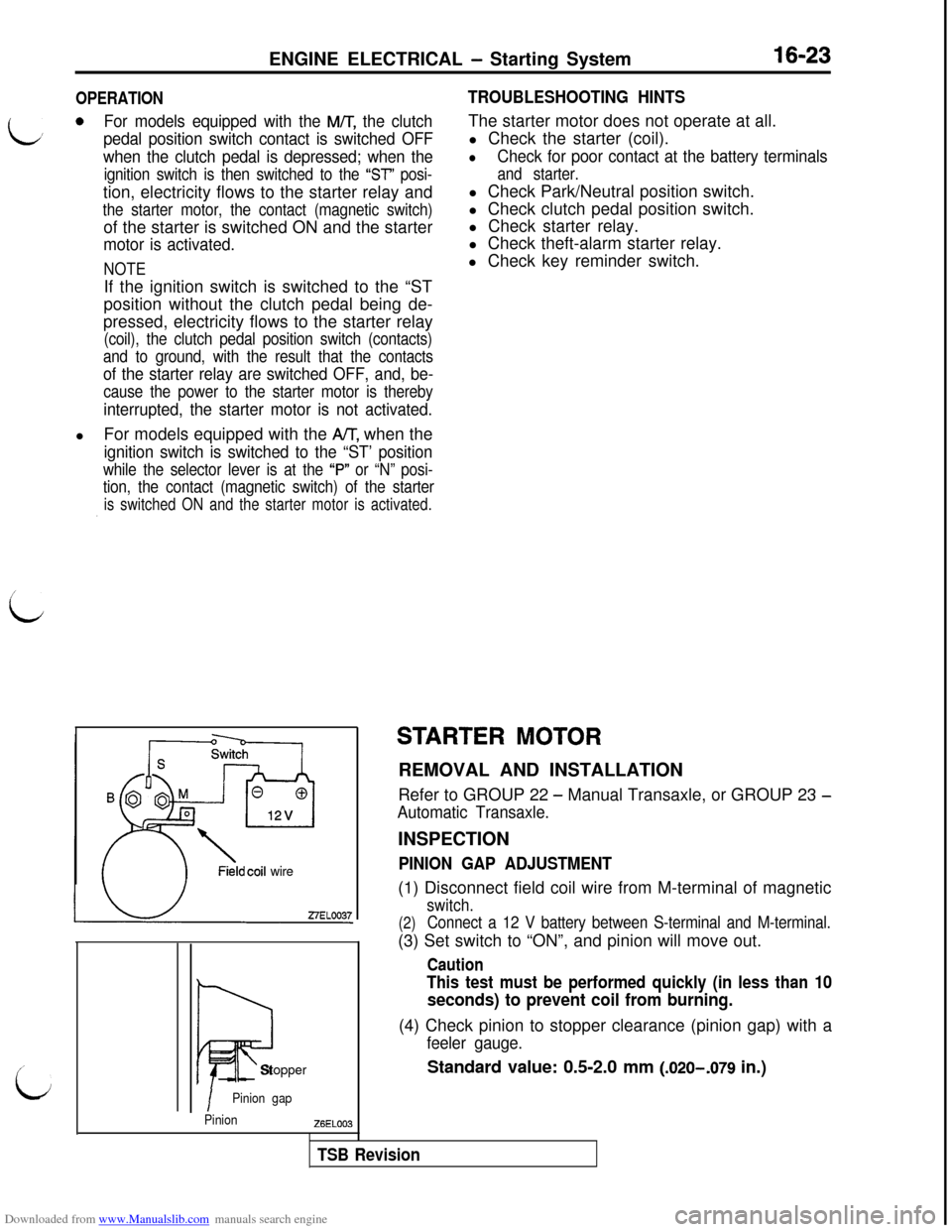
PINION GAP ADJUSTMENT(1) Disconnect field coil wire from M-terminal of magnetic
switch.
(2)Connect a 12 V battery between S-terminal and M-terminal.(3) Set switch to “ON”, and pinion will move out.
Caution
This test must be performed quickly (in less than 10
seconds) to prevent coil from burning.(4) Check pinion to stopper clearance (pinion gap) with a
feeler gauge.
Standard value: 0.5-2.0 mm (.020-,079 in.)
TSB Revision
Page 470 of 738
Downloaded from www.Manualslib.com manuals search engine 16-24ENGINE ELECTRICAL - Starting System
ZlEL11327ELOOlQ
0
5
Startermotor
Carbon-pile rheostat
-I-Battery
i12v I
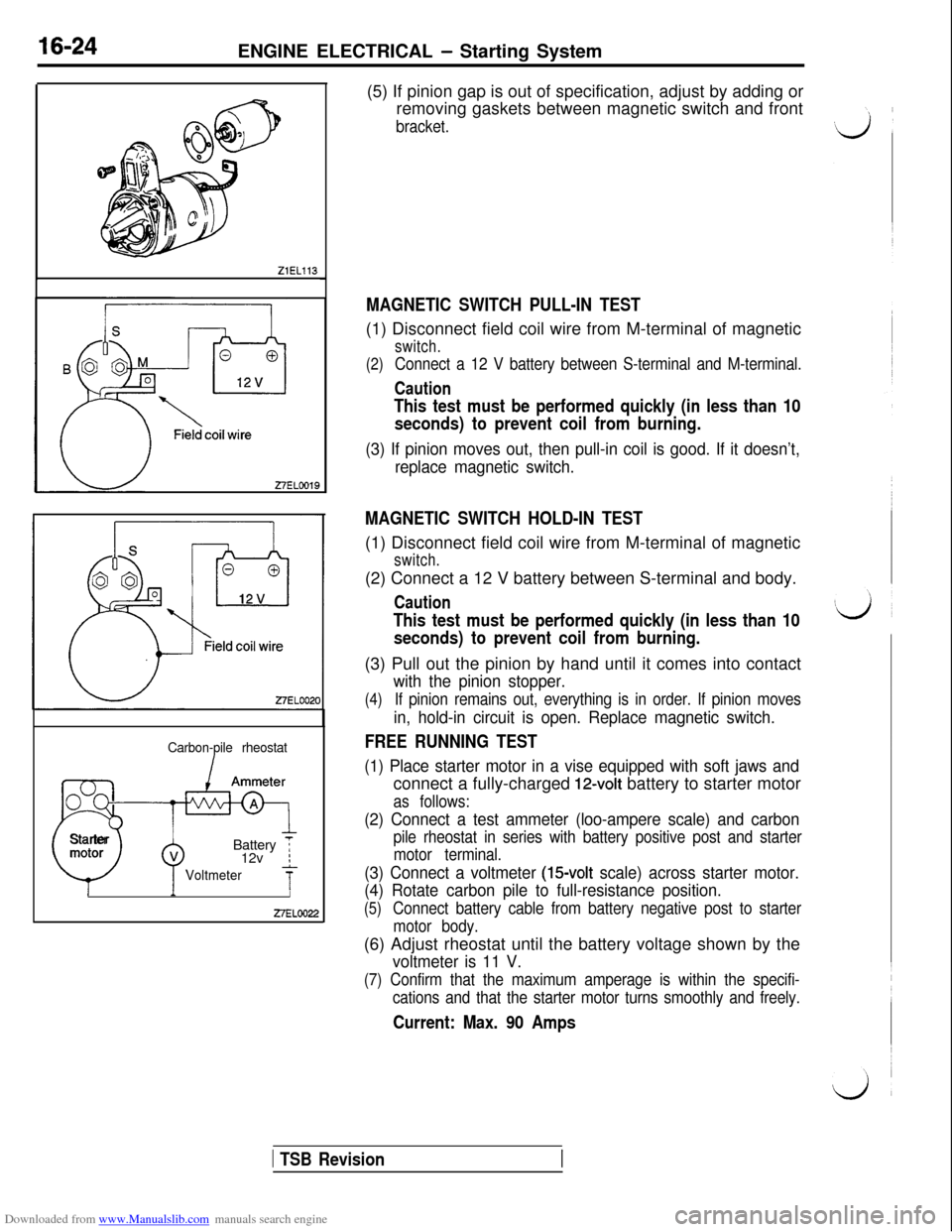
Voltmeter7-II27ELOO22(5) If pinion gap is out of specification, adjust by adding or
removing gaskets between magnetic switch and front
bracket.
MAGNETIC SWITCH PULL-IN TEST(1) Disconnect field coil wire from M-terminal of magnetic
switch.
(2)
Connect a 12 V battery between S-terminal and M-terminal.
Caution
This test must be performed quickly (in less than 10
seconds) to prevent coil from burning.
(3) If pinion moves out, then pull-in coil is good. If it doesn’t,
replace magnetic switch.
MAGNETIC SWITCH HOLD-IN TEST(1) Disconnect field coil wire from M-terminal of magnetic
switch.(2) Connect a 12 V battery between S-terminal and body.
Caution
This test must be performed quickly (in less than 10
seconds) to prevent coil from burning.(3) Pull out the pinion by hand until it comes into contact
with the pinion stopper.
(4)If pinion remains out, everything is in order. If pinion moves
in, hold-in circuit is open. Replace magnetic switch.
FREE RUNNING TEST
(1) Place starter motor in a vise equipped with soft jaws andconnect a fully-charged
12-volt battery to starter motor
as follows:
(2) Connect a test ammeter (loo-ampere scale) and carbon
pile rheostat in series with battery positive post and starter
motor terminal.
(3) Connect a voltmeter (15volt scale) across starter motor.
(4) Rotate carbon pile to full-resistance position.
(5)Connect battery cable from battery negative post to starter
motor body.(6) Adjust rheostat until the battery voltage shown by the
voltmeter is 11 V.
(7) Confirm that the maximum amperage is within the specifi-
cations and that the starter motor turns smoothly and freely.
Current: Max. 90 Amps
1 TSB Revision