Coil MITSUBISHI 3000GT 1993 2.G Owner's Guide
[x] Cancel search | Manufacturer: MITSUBISHI, Model Year: 1993, Model line: 3000GT, Model: MITSUBISHI 3000GT 1993 2.GPages: 738, PDF Size: 35.06 MB
Page 490 of 738
Downloaded from www.Manualslib.com manuals search engine ENGINE ELECTRICAL - Ignition System
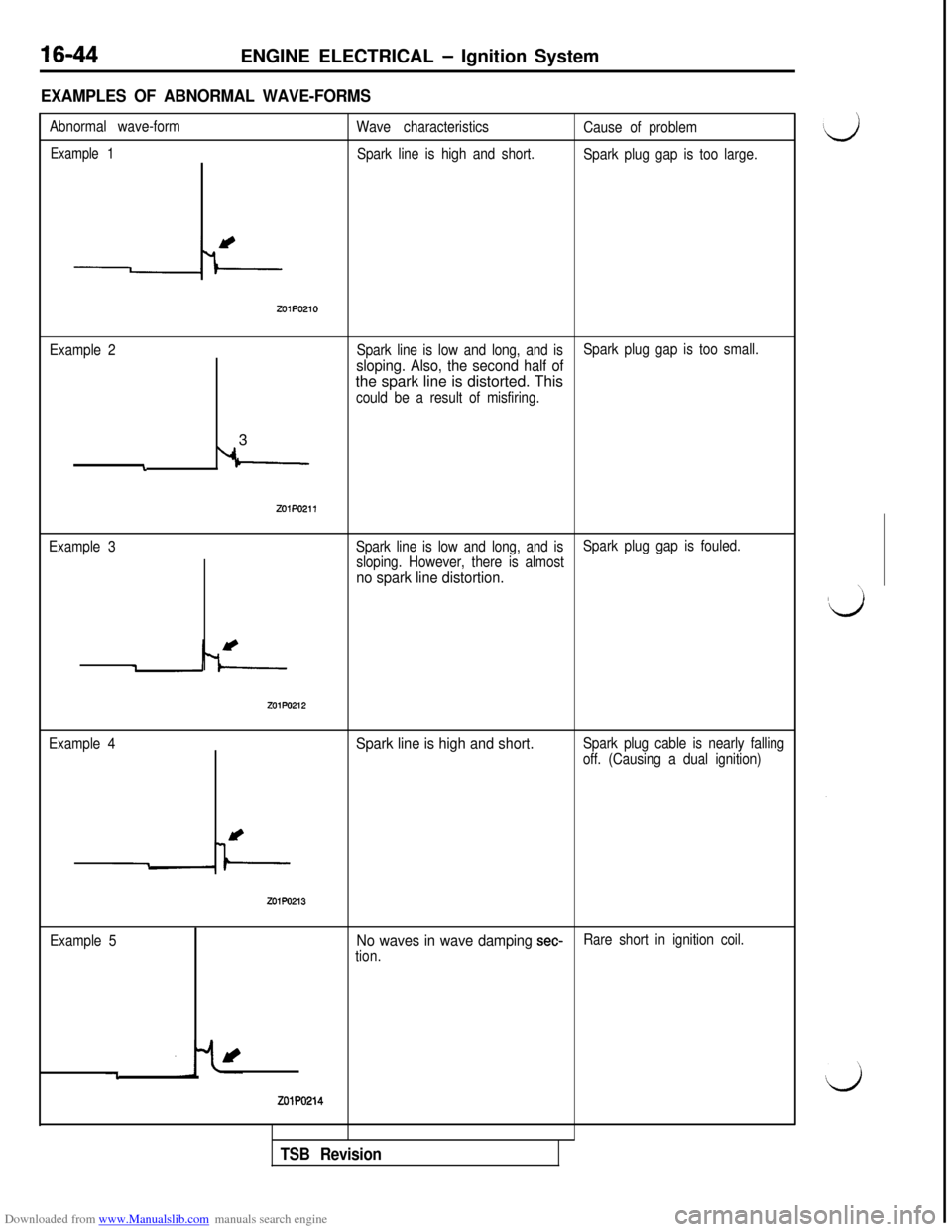
EXAMPLES OF ABNORMAL WAVE-FORMS
Abnormal wave-form
Wave characteristics
Cause of problem
Example 1Spark line is high and short.
Spark plug gap is too large.
z01P0210
Example 2Spark line is low and long, and is
sloping. Also, the second half of
Spark plug gap is too small.the spark line is distorted. This
could be a result of misfiring.3
i
Example 3
zo1Po211
Spark line is low and long, and is
sloping. However, there is almostSpark plug gap is fouled.
no spark line distortion.
ZOlPO212
Example 4Spark line is high and short.Spark plug cable is nearly falling
off. (Causing a dual ignition)
ZOlPO213
Example 5No waves in wave damping set-tion.Rare short in ignition coil.
-l
zolPo214
TSB Revision
Page 491 of 738
Downloaded from www.Manualslib.com manuals search engine ENGINE ELECTRICAL - Ignition System16-45 l
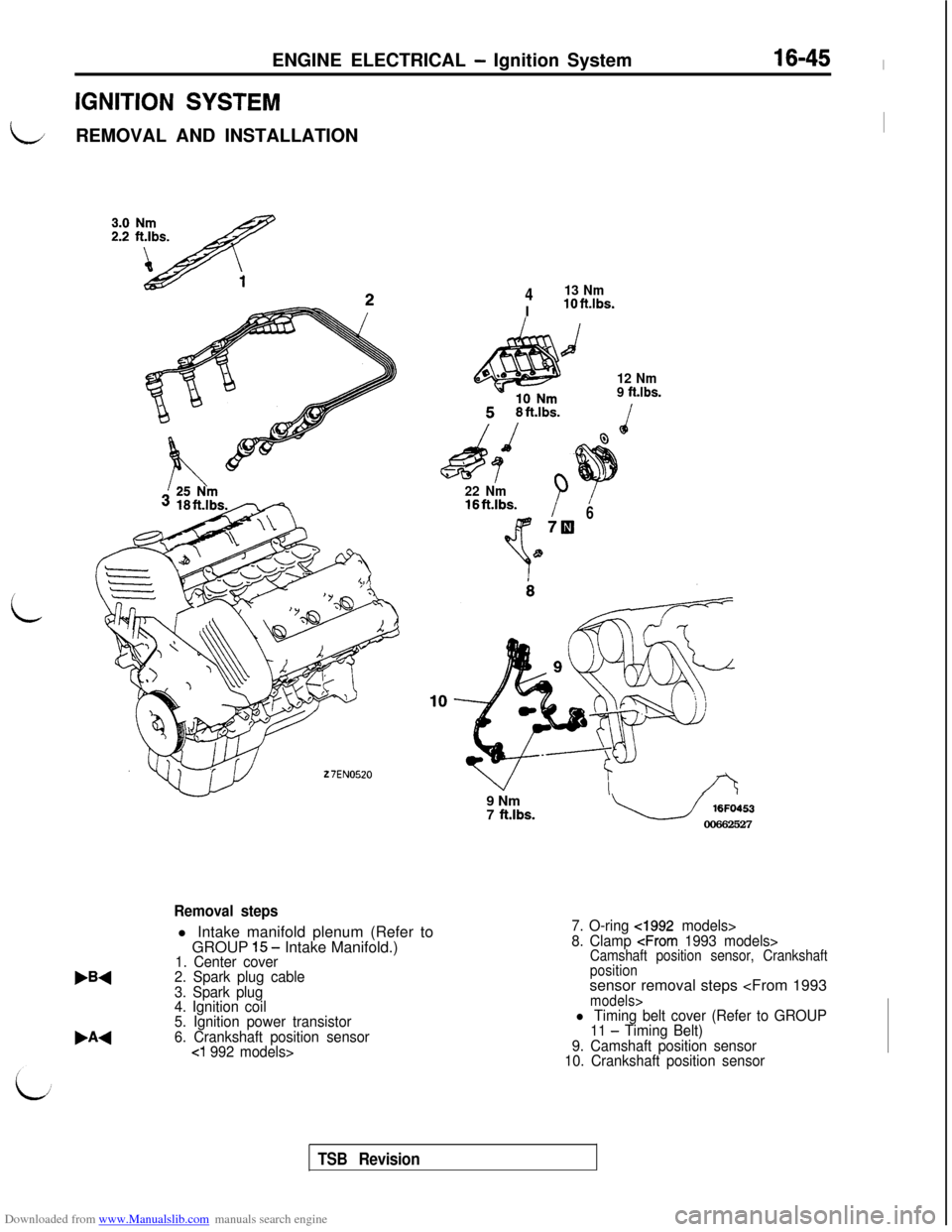
IGNITION SYSTEM
LREMOVAL AND INSTALLATIONI
i
27EN0520
413 NmIlOft.lbs.
d
12 Nm
9 ft.lbs.
22 Nm16ftAbs.B678
W1
,A4
Removal stepsl Intake manifold plenum (Refer to
GROUP
1.5 - Intake Manifold.)1. Center cover
2. Spark plug cable
3. Spark plug
4. Ignition coil
5. Ignition power transistor
6. Crankshaft position sensor
cl 992 models>9 Nm
7
ft.lbs.u 16FO453
00662527
7. O-ring cl992 models>
8. Clamp
positionsensor removal steps
11 - Timing Belt)
9. Camshaft position sensor
10. Crankshaft position sensor
TSB Revision
Page 494 of 738
Downloaded from www.Manualslib.com manuals search engine 16-48ENGINE ELECTRICAL - lanition Svstem
\/27EL0086
/DEL0087INSPECTION
SPARK PLUGCheck the plug gap and replace if the limit is exceeded.
Standard value:
1.0-l .l mm (.039-.043 in.)
Limit: 1.3 mm
(.051 in.)
Caution
1.Do not attempt to adjust the gap of the platinum plug.
2.Cleaning of the platinum plug may damage the plati-num tip. Therefore, if carbon deposits must be re-
moved, use a plug cleaner and complete cleaning with-
in 20 seconds for protection of the electrode. Do not
use wire brushes.
SPARK PLUG CABLE(1) Check cap and coating for cracks.
(2) Measure resistance.Limit: Max. 22
ksZ
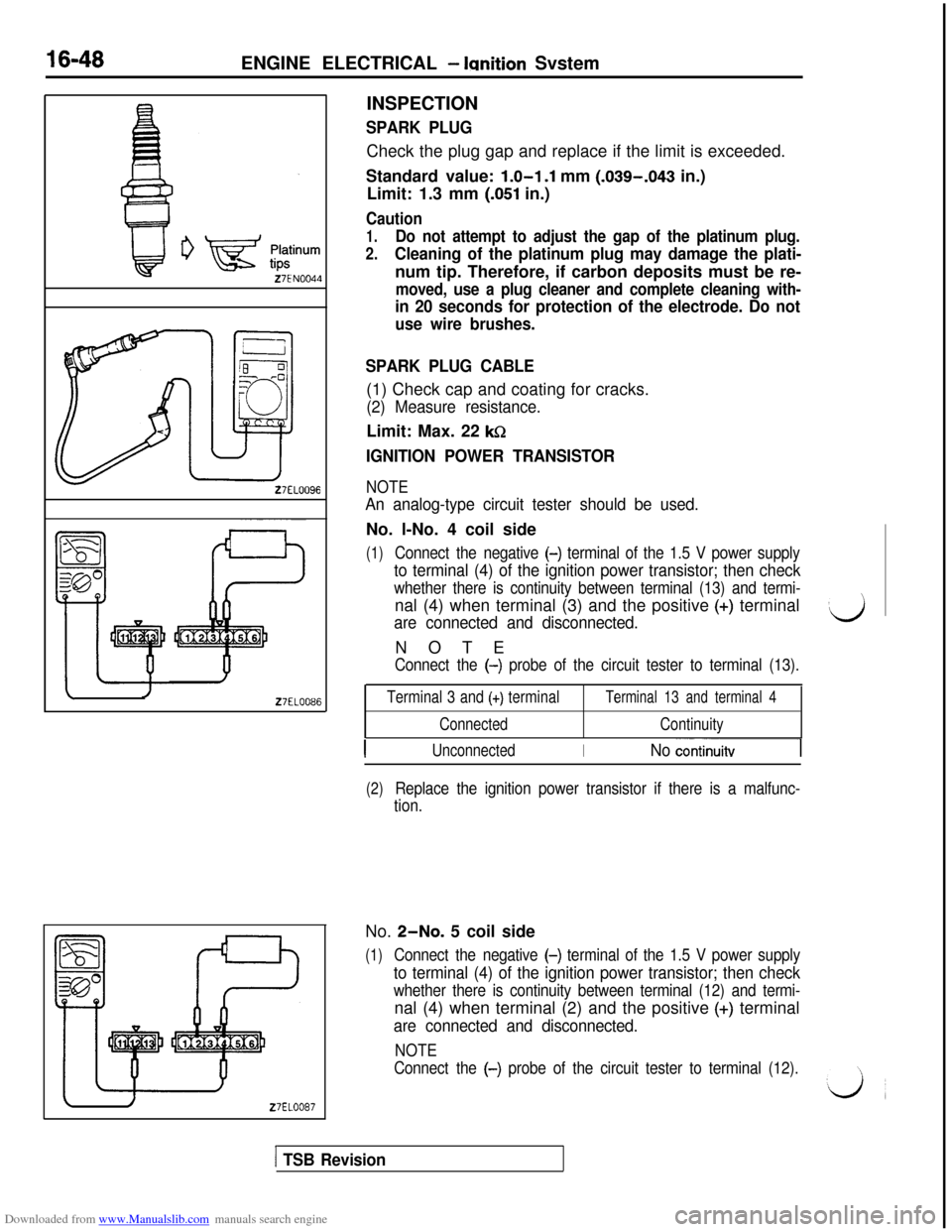
IGNITION POWER TRANSISTOR
NOTE
An analog-type circuit tester should be used.No. l-No. 4 coil side
(1)Connect the negative (-) terminal of the 1.5 V power supply
to terminal (4) of the ignition power transistor; then check
whether there is continuity between terminal (13) and termi-nal (4) when terminal (3) and the positive
(+) terminal
are connected and disconnected.NOTE
Connect the (-) probe of the circuit tester to terminal (13).
Terminal 3 and (+) terminal
ConnectedTerminal 13 and terminal 4
Continuity
IUnconnectedINo continuitv
(2)Replace the ignition power transistor if there is a malfunc-
tion.No. ~-NO. 5 coil side
(1)Connect the negative (-) terminal of the 1.5 V power supply
to terminal (4) of the ignition power transistor; then check
whether there is continuity between terminal (12) and termi-nal (4) when terminal (2) and the positive
(+) terminal
are connected and disconnected.
NOTE
Connect the (-)
probe of the circuit tester to terminal (12).
[ TSB Revision
Page 495 of 738
Downloaded from www.Manualslib.com manuals search engine ENGINE ELECTRICAL b Ignition System16-49
27EL0089
Z7ELOOQO
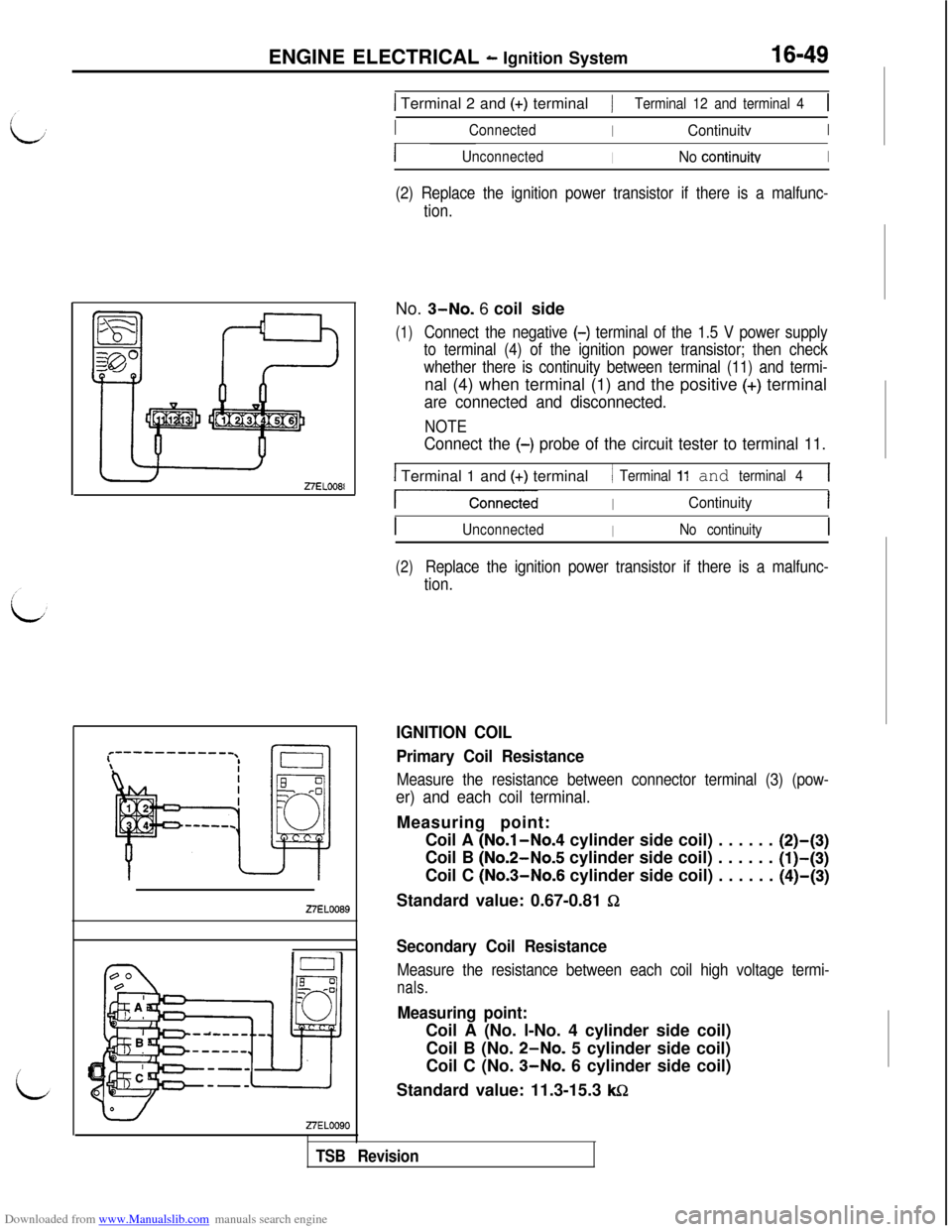
1 Terminal 2 and (+) terminal/Terminal 12 and terminal 41
IConnectedIContinuitvI
IUnconnectedINo continuitvI
(2) Replace the ignition power transistor if there is a malfunc-
tion.No. ~-NO. 6 coil side
(1)Connect the negative (-) terminal of the 1.5 V power supply
to terminal (4) of the ignition power transistor; then check
whether there is continuity between terminal (11) and termi-nal (4) when terminal (1) and the positive
(+) terminal
are connected and disconnected.
NOTE
Connect the (-) probe of the circuit tester to terminal 11.
I Terminal 1 and (+) terminal/ Terminal 11 and terminal 41
-ConnectedIContinuityI
IUnconnectedINo continuityI
(2)Replace the ignition power transistor if there is a malfunc-
tion.
IGNITION COIL
Primary Coil Resistance
Measure the resistance between connector terminal (3) (pow-
er) and each coil terminal.Measuring point:
Coil A
(No.l-No.4 cylinder side coil) . . . . . . (2)-(3)Coil B (No.2-No.5 cylinder side coil) . . . . . .
(l)-(3)Coil C (No.3-No.6 cylinder side coil) . . . . . .
(4)-(3)Standard value: 0.67-0.81
Sz
TSB Revision
Secondary Coil Resistance
Measure the resistance between each coil high voltage termi-
nals.
Measuring point:Coil A (No. l-No. 4 cylinder side coil)
Coil B (No. ~-NO. 5 cylinder side coil)
Coil C (No. ~-NO. 6 cylinder side coil)
Standard value: 11.3-15.3
Wz
Page 514 of 738
Downloaded from www.Manualslib.com manuals search engine 54-18CHASSIS ELECTRICAL - Meters and Gauges
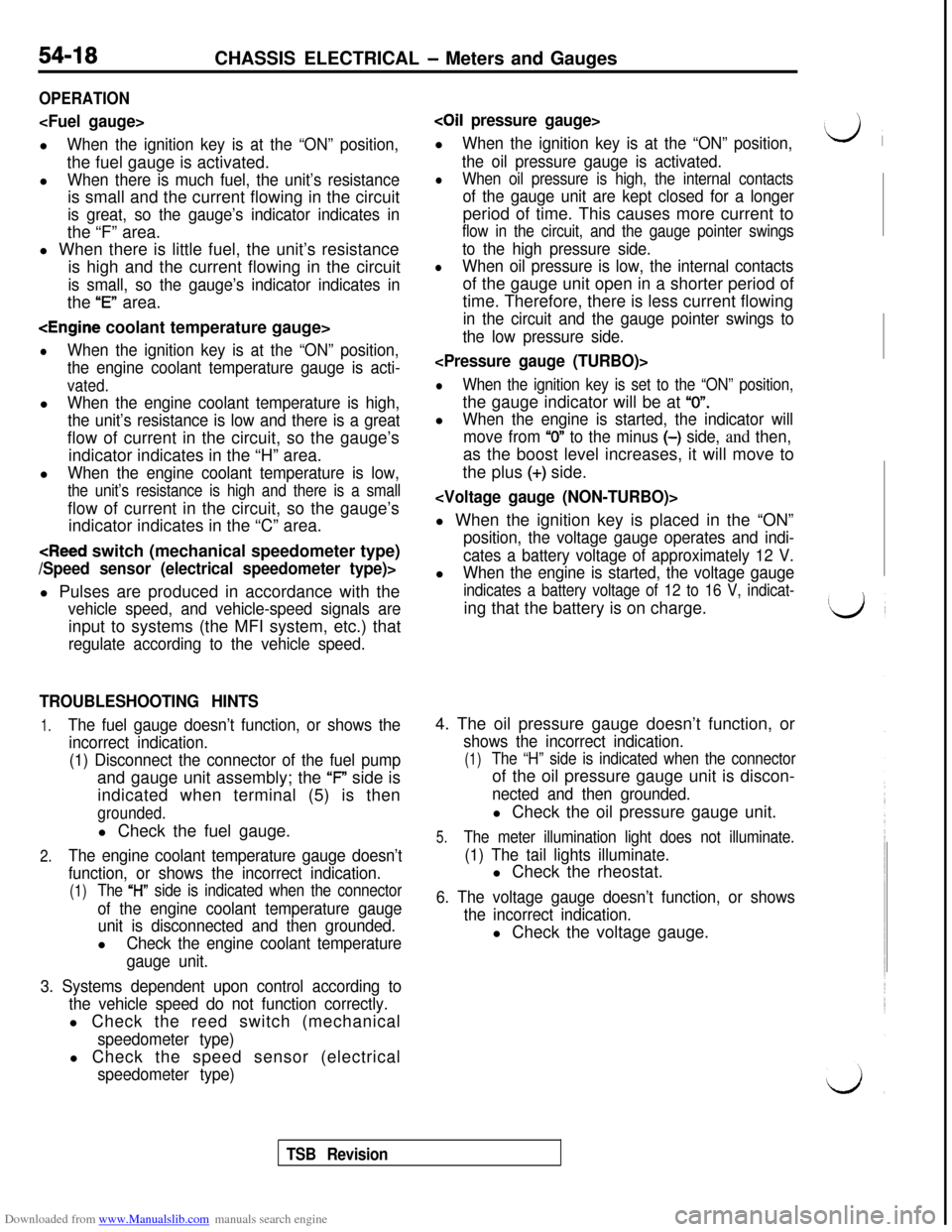
OPERATION
When the ignition key is at the “ON” position,the fuel gauge is activated.
l
When there is much fuel, the unit’s resistanceis small and the current flowing in the circuit
is great, so the gauge’s indicator indicates inthe “F” area.
l When there is little fuel, the unit’s resistance
is high and the current flowing in the circuit
is small, so the gauge’s indicator indicates inthe
“E” area.
lWhen the ignition key is at the “ON” position,
the engine coolant temperature gauge is acti-
vated.l
When the engine coolant temperature is high,
the unit’s resistance is low and there is a greatflow of current in the circuit, so the gauge’s
indicator indicates in the “H” area.
l
When the engine coolant temperature is low,
the unit’s resistance is high and there is a smallflow of current in the circuit, so the gauge’s
indicator indicates in the “C” area.
vehicle speed, and vehicle-speed signals areinput to systems (the MFI system, etc.) that
regulate according to the vehicle speed.
TROUBLESHOOTING HINTS
1.The fuel gauge doesn’t function, or shows the
incorrect indication.
(1) Disconnect the connector of the fuel pumpand gauge unit assembly; the ‘F” side is
indicated when terminal (5) is then
grounded.l Check the fuel gauge.
2.The engine coolant temperature gauge doesn’t
function, or shows the incorrect indication.
(1)The “l-l” side is indicated when the connector
of the engine coolant temperature gauge
unit is disconnected and then grounded.l
Check the engine coolant temperature
gauge unit.
3. Systems dependent upon control according to
the vehicle speed do not function correctly.l Check the reed switch (mechanical
speedometer type)l Check the speed sensor (electrical
speedometer type)
coil pressure gauge>l
When the ignition key is at the “ON” position,
the oil pressure gauge is activated.
lWhen oil pressure is high, the internal contacts
of the gauge unit are kept closed for a longerperiod of time. This causes more current to
flow in the circuit, and the gauge pointer swings
to the high pressure side.
lWhen oil pressure is low, the internal contactsof the gauge unit open in a shorter period of
time. Therefore, there is less current flowing
in the circuit and the gauge pointer swings to
the low pressure side.
lWhen the ignition key is set to the “ON” position,the gauge indicator will be at
“0”.l
When the engine is started, the indicator will
move from
“0” to the minus (-) side, and then,as the boost level increases, it will move to
the plus
(+) side.
position, the voltage gauge operates and indi-
cates a battery voltage of approximately 12 V.l
When the engine is started, the voltage gauge
indicates a battery voltage of 12 to 16 V, indicat-ing that the battery is on charge.
4. The oil pressure gauge doesn’t function, or
shows the incorrect indication.
(1)The “H” side is indicated when the connectorof the oil pressure gauge unit is discon-
nected and then grounded.l Check the oil pressure gauge unit.
5.The meter illumination light does not illuminate.
(1) The tail lights illuminate.l Check the rheostat.
6. The voltage gauge doesn’t function, or shows
the incorrect indication.l Check the voltage gauge.
TSB Revision
Page 533 of 738
Downloaded from www.Manualslib.com manuals search engine CHASSIS ELECTRICAL - Lighting System54-37
i
TROUBLESHOOTING
LHEADLIGHT
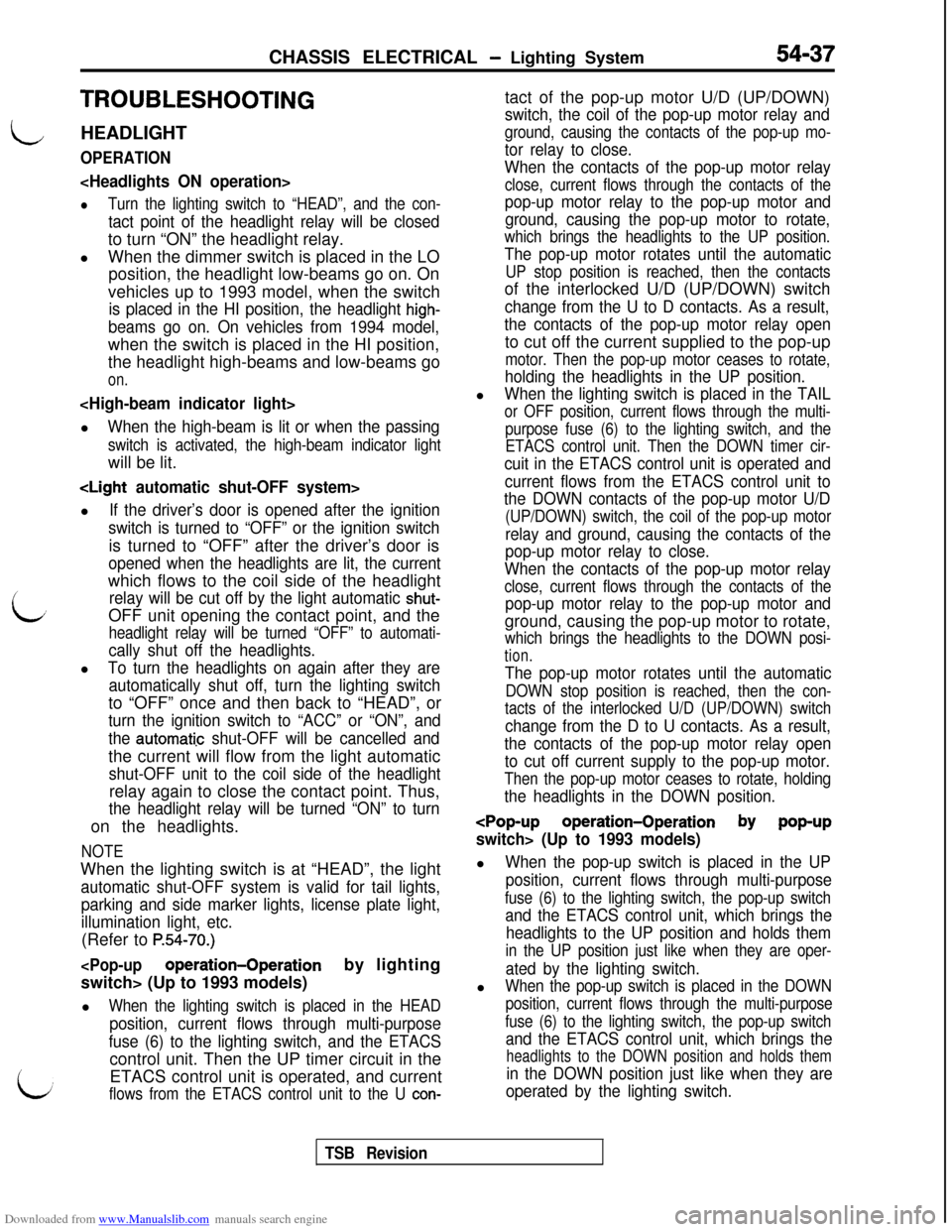
OPERATION
lTurn the lighting switch to “HEAD”, and the con-
tact point of the headlight relay will be closedto turn “ON” the headlight relay.
lWhen the dimmer switch is placed in the LO
position, the headlight low-beams go on. On
vehicles up to 1993 model, when the switch
is placed in the HI position, the headlight high-
beams go on. On vehicles from 1994 model,when the switch is placed in the HI position,
the headlight high-beams and low-beams go
on.
When the high-beam is lit or when the passing
switch is activated, the high-beam indicator lightwill be lit.
If the driver’s door is opened after the ignition
switch is turned to “OFF” or the ignition switchis turned to “OFF” after the driver’s door is
opened when the headlights are lit, the currentwhich flows to the coil side of the headlight
relay will be cut off by the light automatic shut-OFF unit opening the contact point, and the
headlight relay will be turned “OFF” to automati-
cally shut off the headlights.l
To turn the headlights on again after they are
automatically shut off, turn the lighting switchto “OFF” once and then back to “HEAD”, or
turn the ignition switch to “ACC” or “ON”, and
the
aut0mati.c shut-OFF will be cancelled andthe current will flow from the light automatic
shut-OFF unit to the coil side of the headlightrelay again to close the contact point. Thus,
the headlight relay will be turned “ON” to turnon the headlights.
NOTEWhen the lighting switch is at “HEAD”, the light
automatic shut-OFF system is valid for tail lights,
parking and side marker lights, license plate light,
illumination light, etc.(Refer to
P.54-70.)
l
When the lighting switch is placed in the HEAD
position, current flows through multi-purpose
fuse (6) to the lighting switch, and the ETACScontrol unit. Then the UP timer circuit in the
LETACS control unit is operated, and currentflows from the ETACS control unit to the U con-tact of the pop-up motor U/D (UP/DOWN)
switch, the coil of the pop-up motor relay and
ground, causing the contacts of the pop-up mo-
tor relay to close.
When the contacts of the pop-up motor relay
close, current flows through the contacts of the
pop-up motor relay to the pop-up motor and
ground, causing the pop-up motor to rotate,
which brings the headlights to the UP position.
The pop-up motor rotates until the automatic
UP stop position is reached, then the contactsof the interlocked U/D (UP/DOWN) switch
change from the U to D contacts. As a result,
the contacts of the pop-up motor relay opento cut off the current supplied to the pop-up
motor. Then the pop-up motor ceases to rotate,
holding the headlights in the UP position.l
When the lighting switch is placed in the TAIL
or OFF position, current flows through the multi-
purpose fuse (6) to the lighting switch, and the
ETACS control unit. Then the DOWN timer cir-
cuit in the ETACS control unit is operated and
current flows from the ETACS control unit to
the DOWN contacts of the pop-up motor U/D
(UP/DOWN) switch, the coil of the pop-up motor
relay and ground, causing the contacts of the
pop-up motor relay to close.
When the contacts of the pop-up motor relay
close, current flows through the contacts of the
pop-up motor relay to the pop-up motor andground, causing the pop-up motor to rotate,
which brings the headlights to the DOWN posi-
tion.
The pop-up motor rotates until the automatic
DOWN stop position is reached, then the con-
tacts of the interlocked U/D (UP/DOWN) switch
change from the D to U contacts. As a result,
the contacts of the pop-up motor relay open
to cut off current supply to the pop-up motor.
Then the pop-up motor ceases to rotate, holding
the headlights in the DOWN position.
When the pop-up switch is placed in the UP
position, current flows through multi-purpose
fuse (6) to the lighting switch, the pop-up switch
and the ETACS control unit, which brings the
headlights to the UP position and holds them
in the UP position just like when they are oper-
ated by the lighting switch.l
When the pop-up switch is placed in the DOWN
position, current flows through the multi-purpose
fuse (6) to the lighting switch, the pop-up switch
and the ETACS control unit, which brings the
headlights to the DOWN position and holds them
in the DOWN position just like when they are
operated by the lighting switch.
TSB Revision
Page 558 of 738
Downloaded from www.Manualslib.com manuals search engine 54-62CHASSIS ELECTRICAL - Lighting System
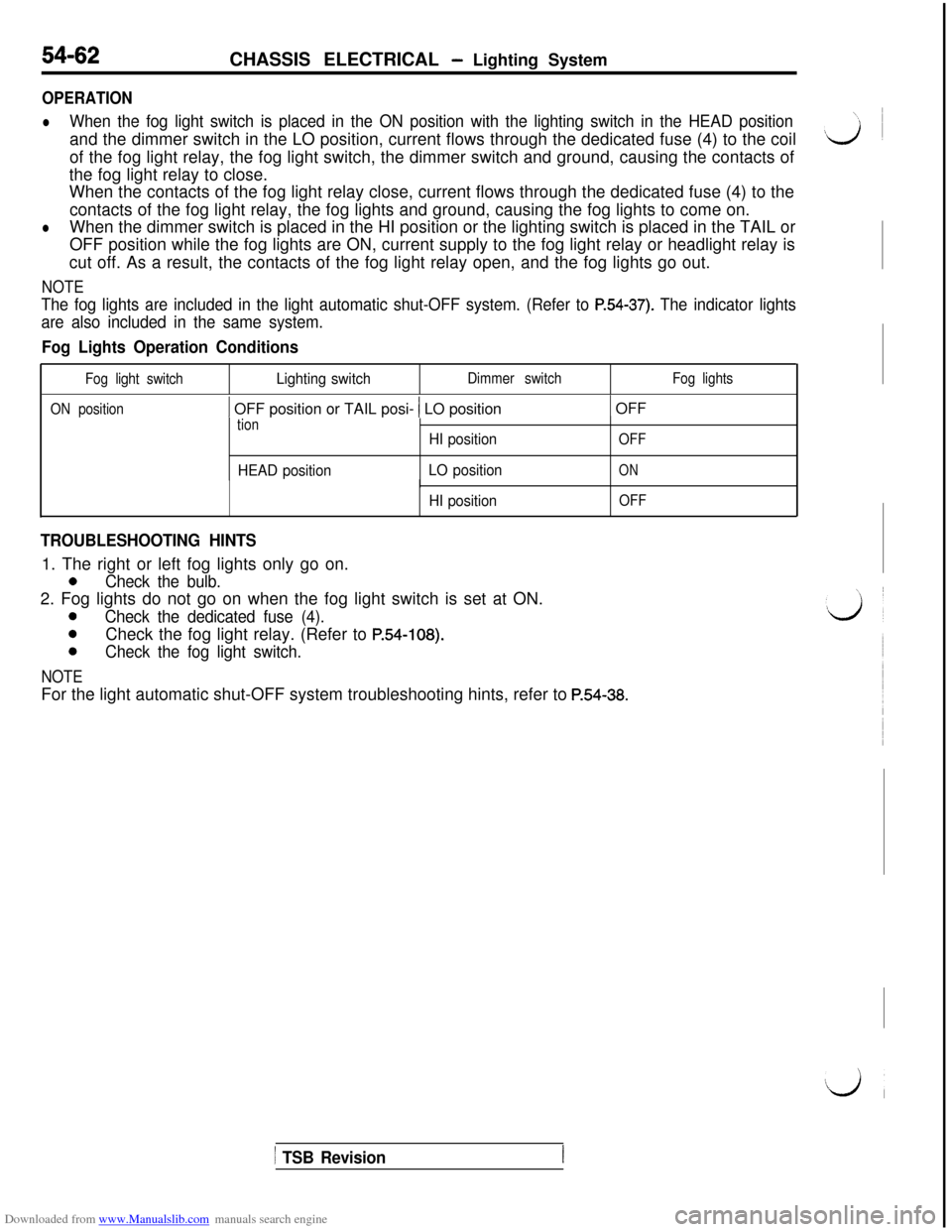
OPERATION
lWhen the fog light switch is placed in the ON position with the lighting switch in the HEAD positionand the dimmer switch in the LO position, current flows through the dedicated fuse (4) to the coil
of the fog light relay, the fog light switch, the dimmer switch and ground, causing the contacts of
the fog light relay to close.
When the contacts of the fog light relay close, current flows through the dedicated fuse (4) to the
contacts of the fog light relay, the fog lights and ground, causing the fog lights to come on.
lWhen the dimmer switch is placed in the HI position or the lighting switch is placed in the TAIL or
OFF position while the fog lights are ON, current supply to the fog light relay or headlight relay is
cut off. As a result, the contacts of the fog light relay open, and the fog lights go out.
NOTE
The fog lights are included in the light automatic shut-OFF system. (Refer to P.54-37). The indicator lights
are also included in the same system.
Fog Lights Operation Conditions
Fog light switchLighting switchDimmer switchFog lights
ON position
1 OFF position or TAIL posi- 1 LO position1 OFF
tion
HEAD positionHI position
LO position
OFF
ON
HI position
I
OFF
TROUBLESHOOTING HINTS1. The right or left fog lights only go on.
0Check the bulb.2. Fog lights do not go on when the fog light switch is set at ON.
0Check the dedicated fuse (4).
0Check the fog light relay. (Refer to P.54-108).
0Check the fog light switch.
NOTEFor the light automatic shut-OFF system troubleshooting hints, refer to
P.54-38.
1 TSB Revision
Page 566 of 738
Downloaded from www.Manualslib.com manuals search engine 54-70CHASSIS ELECTRICAL - Lighting System
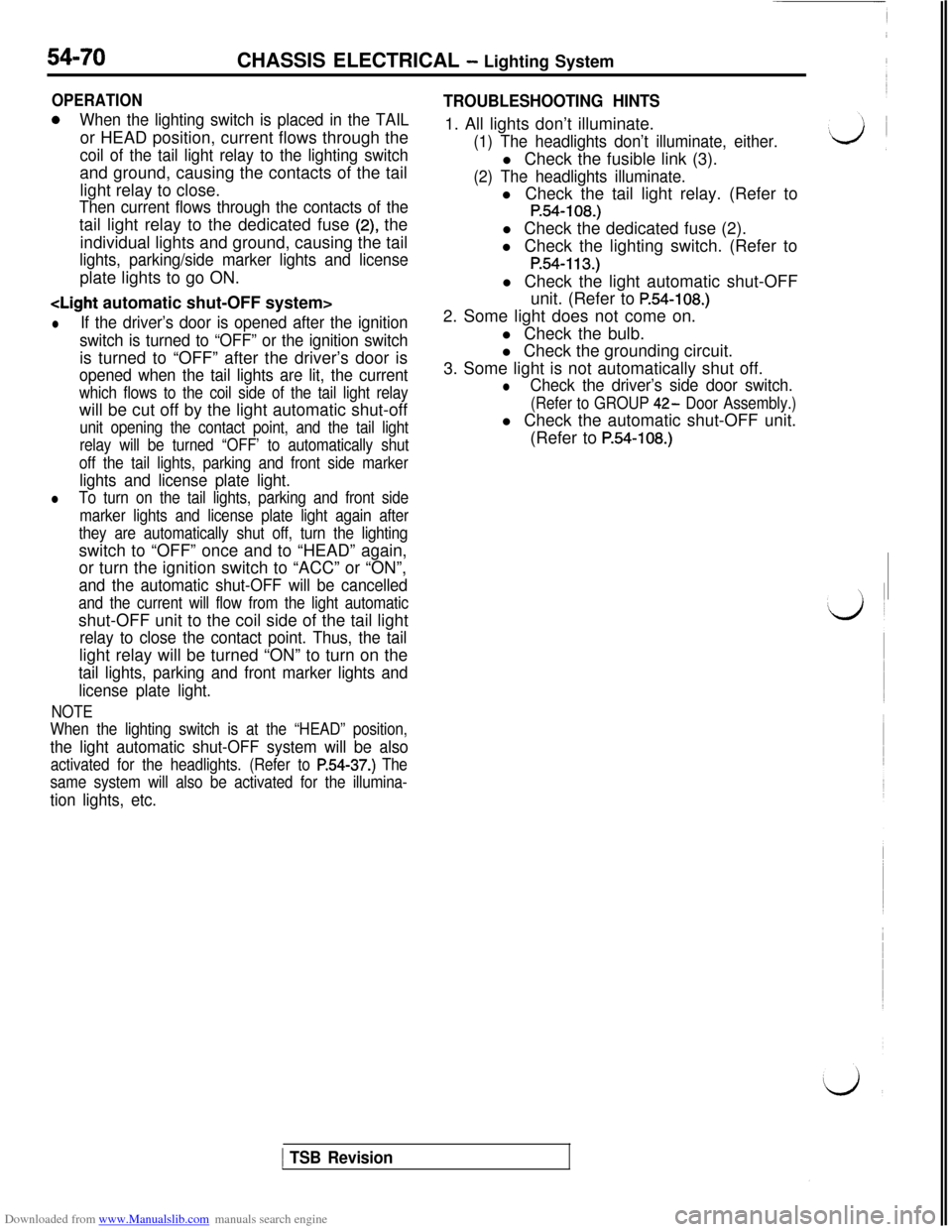
OPERATION
0When the lighting switch is placed in the TAILor HEAD position, current flows through the
coil of the tail light relay to the lighting switchand ground, causing the contacts of the tail
light relay to close.
Then current flows through the contacts of thetail light relay to the dedicated fuse
(2) the
individual lights and ground, causing the tail
lights, parking/side marker lights and licenseplate lights to go ON.
lIf the driver’s door is opened after the ignition
switch is turned to “OFF” or the ignition switchis turned to “OFF” after the driver’s door is
opened when the tail lights are lit, the current
which flows to the coil side of the tail light relaywill be cut off by the light automatic shut-off
unit opening the contact point, and the tail light
relay will be turned “OFF’ to automatically shut
off the tail lights, parking and front side marker
lights and license plate light.
lTo turn on the tail lights, parking and front side
marker lights and license plate light again after
they are automatically shut off, turn the lightingswitch to “OFF” once and to “HEAD” again,
or turn the ignition switch to “ACC” or “ON”,
and the automatic shut-OFF will be cancelled
and the current will flow from the light automaticshut-OFF unit to the coil side of the tail light
relay to close the contact point. Thus, the taillight relay will be turned “ON” to turn on the
tail lights, parking and front marker lights and
license plate light.
NOTE
When the lighting switch is at the “HEAD” position,
the light automatic shut-OFF system will be also
activated for the headlights. (Refer to P.54-37.) The
same system will also be activated for the illumina-
tion lights, etc.
TROUBLESHOOTING HINTS1. All lights don’t illuminate.
(1) The headlights don’t illuminate, either.l Check the fusible link (3).
(2) The headlights illuminate.l Check the tail light relay. (Refer to
P.54-108.)l Check the dedicated fuse (2).
l Check the lighting switch. (Refer to
P.54-113.)l Check the light automatic shut-OFF
unit. (Refer to
P.54-108.)2. Some light does not come on.
l Check the bulb.
l Check the grounding circuit.
3. Some light is not automatically shut off.
lCheck the driver’s side door switch.
(Refer to GROUP 42- Door Assembly.)l Check the automatic shut-OFF unit.
(Refer to
P.54-108.)
1 TSB Revision
Page 611 of 738
Downloaded from www.Manualslib.com manuals search engine CHASSIS ELECTRICAL - Horn54-115
HORN
SPECIFICATIONS
GENERAL SPECIFICATIONS
Horn (Except for theft-alarm horn)
ItemsI Specifications
Type
Effective sounding voltage V
Power consumption A
Sound level dB
Fundamental frequency Hz
“low” sound
“high” sound
“low” sound
“high” sound
Fiat type
11.5-15
3.0
100-112
100-112350-390395-435
Theft-alarm horn
1 ItemsI Specifications
1 Type1 Flat typeI
Effective sounding voltage V
Power consumption A
Sound level dB
Fundamental frequency Hz
11-14.5
Max. 3.5
105-120I
I 405-435
TROUBLESHOOTING
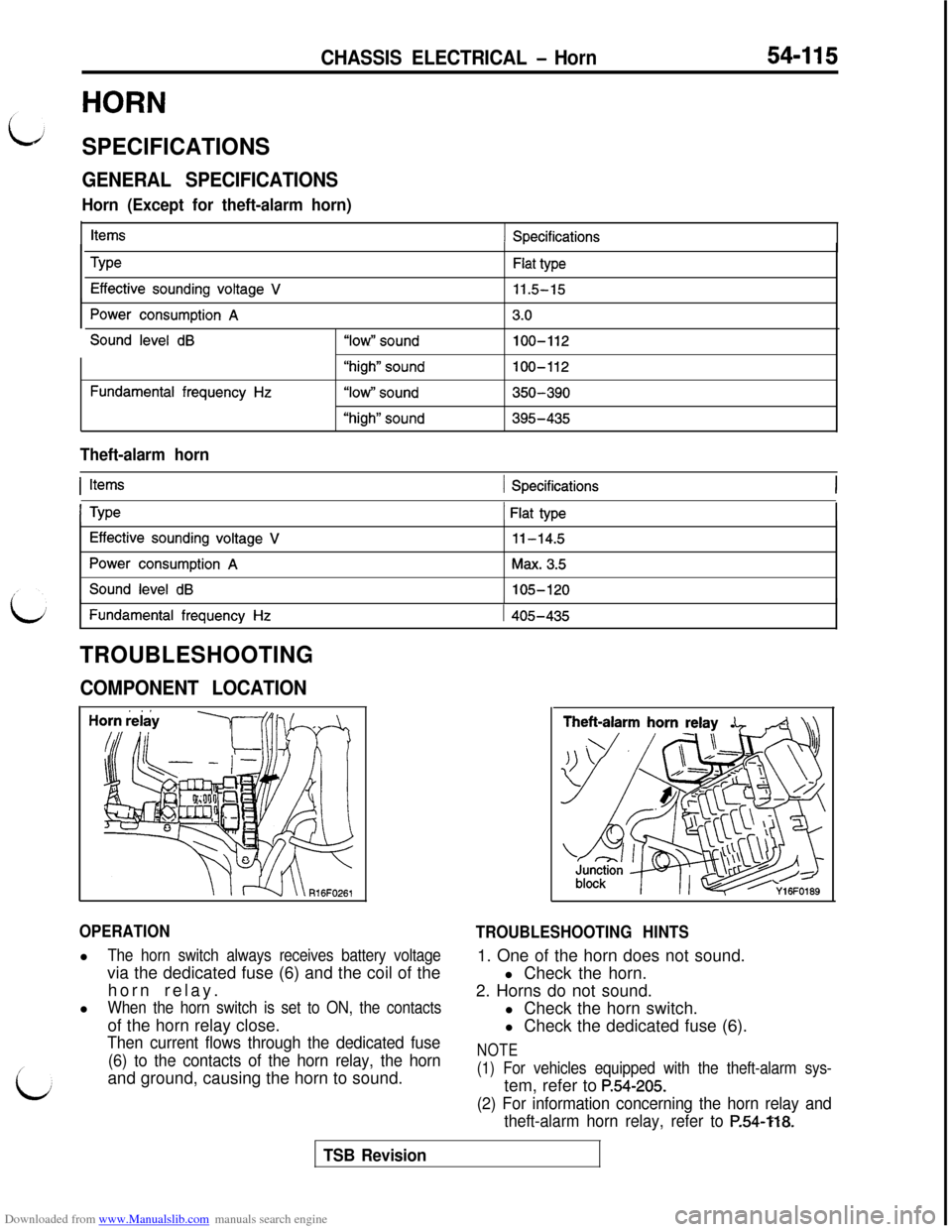
COMPONENT LOCATION
OPERATIONl
The horn switch always receives battery voltagevia the dedicated fuse (6) and the coil of the
horn relay.
l
When the horn switch is set to ON, the contactsof the horn relay close.
Then current flows through the dedicated fuse
(6) to the contacts of the horn relay, the hornand ground, causing the horn to sound.1. One of the horn does not sound.
TROUBLESHOOTING HINTSl Check the horn.
2. Horns do not sound.
l Check the horn switch.
l Check the dedicated fuse (6).
NOTE
(1) For vehicles equipped with the theft-alarm sys-tem, refer to
P.54-205.
(2) For information concerning the horn relay and
theft-alarm horn relay, refer to
P.54-?18.
TSB Revision
Page 660 of 738
Downloaded from www.Manualslib.com manuals search engine 54-164CHASSIS ELECTRICAL - Radio and Tape Player
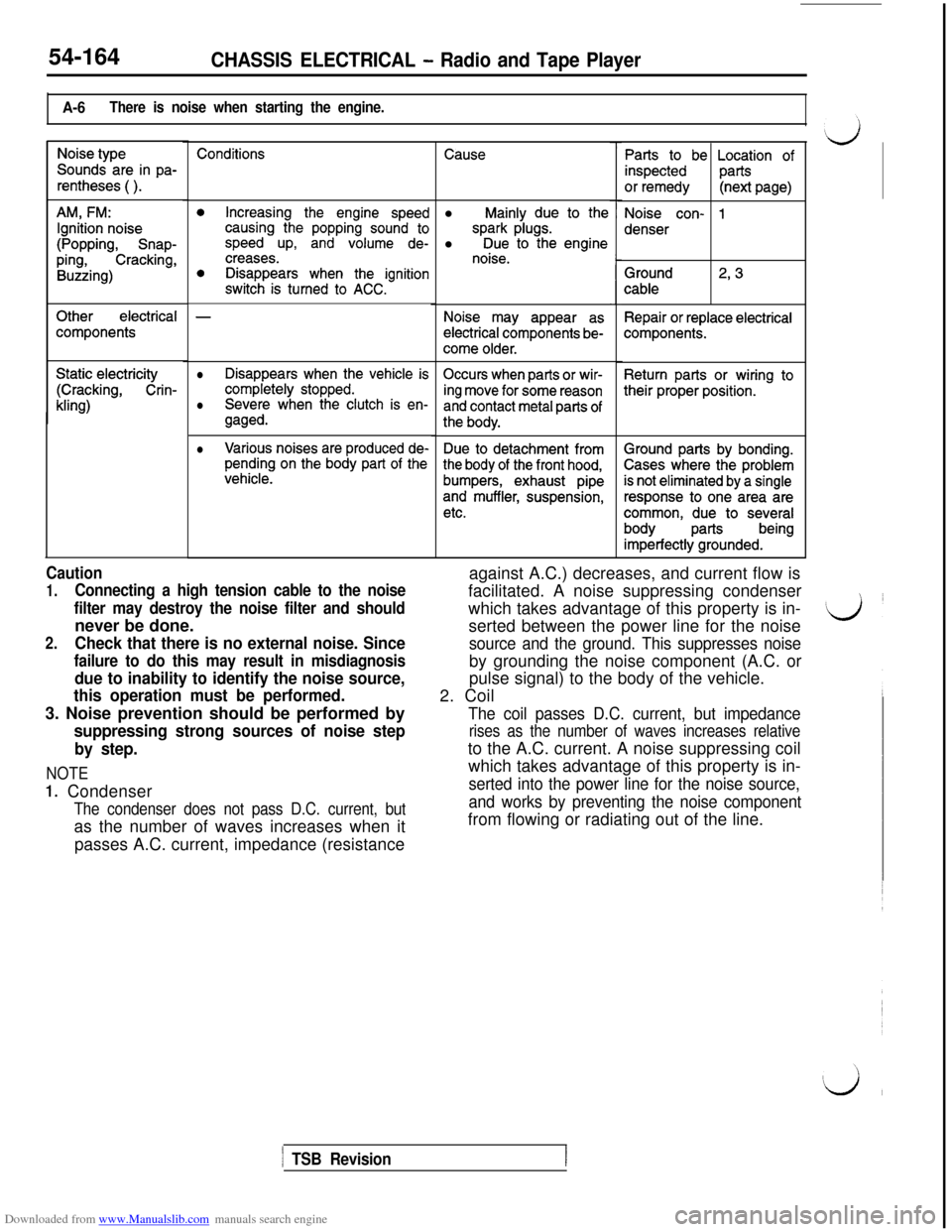
A-6There is noise when starting the engine.
Noise type
Sounds are in pa-
rentheses ( ).
AM, FM:
Ignition noise
(Popping, Snap-
ping,Cracking,
Buzzing)
Otherelectrical
components
Static electricity
(Cracking, Crin-
kling)
Conditions
0Increasing the engine speedcausing the popping sound tospeed up, and volume de-creases.0Disappears when the ignitionswitch is turned to ACC.
-
lDisappears when the vehicle is
completely stopped.Occurs when parts or wir-
Severe when the clutch is en-ing move for some reasonlgaged.and contact metal parts of
the body.
lVarious noises are produced de-pending on the body part of thevehicle.
Due to detachment from
the body of the front hood,
bumpers, exhaust pipe
and muffler, suspension,
etc.
Causel
Mainly due to the
spark plugs.l Due to the enginenoise.
Noise may appear as
electrical components be-
come older.
Parts to be Location of
inspectedparts
or remedy(next page)
Noise con- 1
denser
Ground
cable2, 3
Repair or replace electricalcomponents.
Return parts or wiring to
their proper position.
Caution
1.Connecting a high tension cable to the noise
filter may destroy the noise filter and shouldnever be done.
2.Check that there is no external noise. Since
failure to do this may result in misdiagnosis
due to inability to identify the noise source,
this operation must be performed.3. Noise prevention should be performed by
suppressing strong sources of noise step
by step.
NOTE
1. Condenser
The condenser does not pass D.C. current, butas the number of waves increases when it
passes A.C. current, impedance (resistanceagainst A.C.) decreases, and current flow is
facilitated. A noise suppressing condenser
which takes advantage of this property is in-
serted between the power line for the noise
source and the ground. This suppresses noiseby grounding the noise component (A.C. or
pulse signal) to the body of the vehicle.
2. Coil
The coil passes D.C. current, but impedance
rises as the number of waves increases relativeto the A.C. current. A noise suppressing coil
which takes advantage of this property is in-
serted into the power line for the noise source,
and works by preventing the noise componentfrom flowing or radiating out of the line.
1 TSB Revision
Ground parts by bonding.
Cases where the problem
is not eliminated by a single
response to one area are
common, due to several
bodypartsbeing
imperfectly grounded.