check oil MITSUBISHI 3000GT 1994 2.G User Guide
[x] Cancel search | Manufacturer: MITSUBISHI, Model Year: 1994, Model line: 3000GT, Model: MITSUBISHI 3000GT 1994 2.GPages: 738, PDF Size: 35.06 MB
Page 474 of 738
Downloaded from www.Manualslib.com manuals search engine 16-28ENGINE ELECTRICAL - Starting System
Stop ringZ6EL0097
Z6ELOO96+B,SNAP
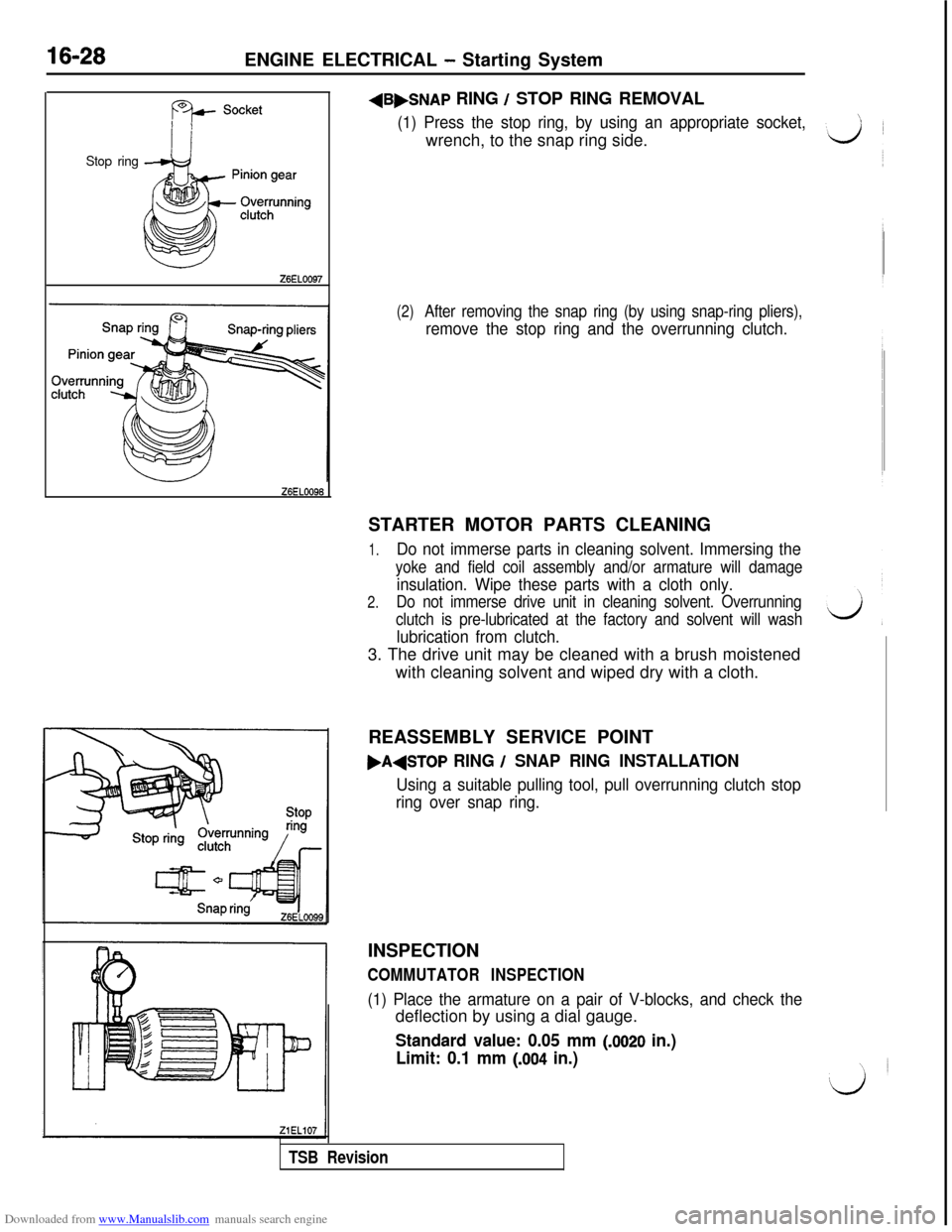
RING / STOP RING REMOVAL
(1) Press the stop ring, by using an appropriate socket,wrench, to the snap ring side.
(2)After removing the snap ring (by using snap-ring pliers),
remove the stop ring and the overrunning clutch.STARTER MOTOR PARTS CLEANING
1.Do not immerse parts in cleaning solvent. Immersing the
yoke and field coil assembly and/or armature will damage
insulation. Wipe these parts with a cloth only.
2.Do not immerse drive unit in cleaning solvent. Overrunning
clutch is pre-lubricated at the factory and solvent will wash
lubrication from clutch.3. The drive unit may be cleaned with a brush moistened
with cleaning solvent and wiped dry with a cloth.
REASSEMBLY SERVICE POINT
,A+TOP RING / SNAP RING INSTALLATION
Using a suitable pulling tool, pull overrunning clutch stop
ring over snap ring.INSPECTION
COMMUTATOR INSPECTION
(1) Place the armature on a pair of V-blocks, and check thedeflection by using a dial gauge.
Standard value: 0.05 mm (JO20 in.)
Limit: 0.1 mm
(.004 in.)
TSB Revision
Page 476 of 738
Downloaded from www.Manualslib.com manuals search engine 16-30ENGINE ELECTRICAL - Starting System
Eq
C-- Wear limit line
-
New brush
Soldered
(Make sure that
there is no
excess solder on
brush surface)
Surface
Amarked
Zl EL049
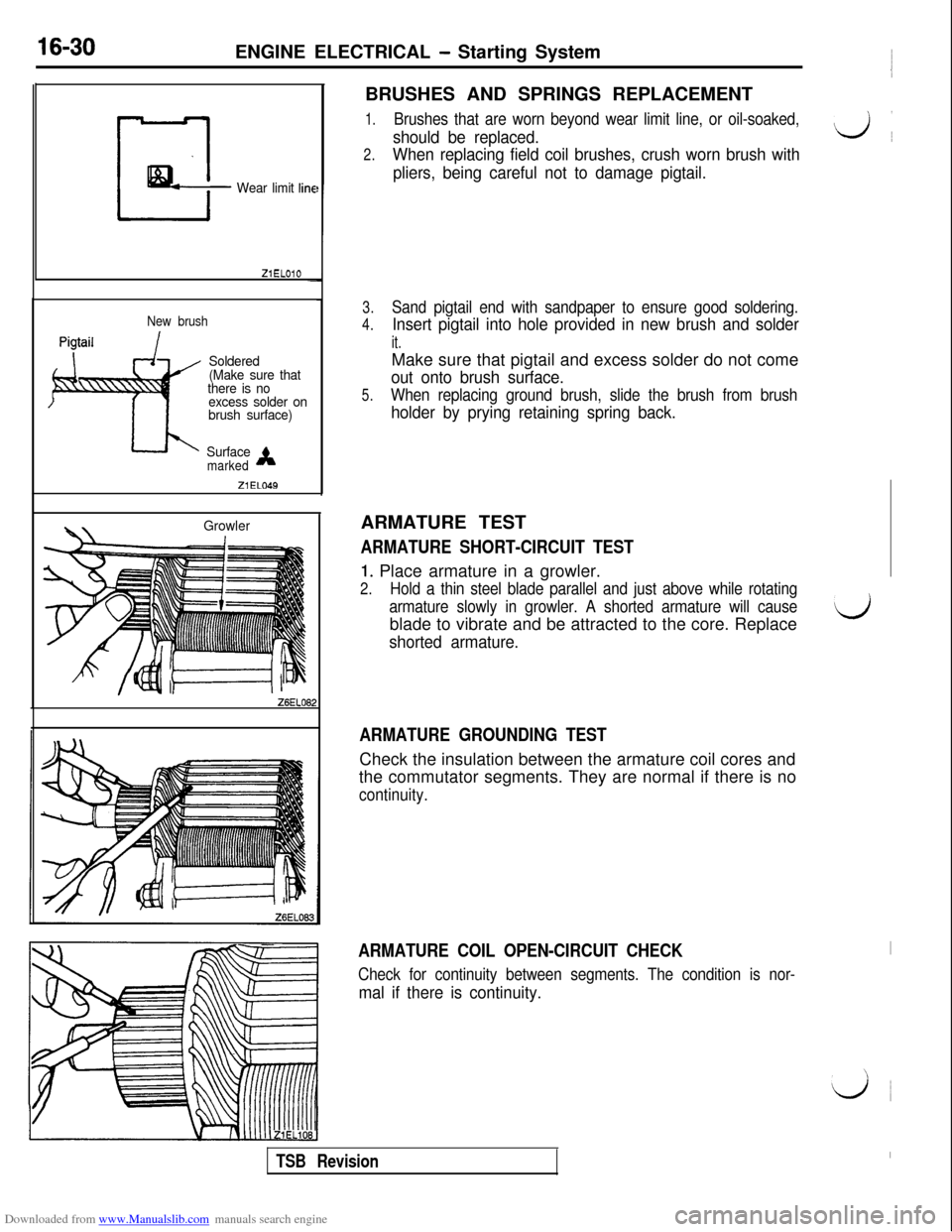
GrowlerBRUSHES AND SPRINGS REPLACEMENT
1.Brushes that are worn beyond wear limit line, or oil-soaked,
should be replaced.do
2.When replacing field coil brushes, crush worn brush with
pliers, being careful not to damage pigtail.
3.
4.Sand pigtail end with sandpaper to ensure good soldering.
Insert pigtail into hole provided in new brush and solder
it.Make sure that pigtail and excess solder do not come
out onto brush surface.
5.When replacing ground brush, slide the brush from brush
holder by prying retaining spring back.ARMATURE TEST
ARMATURE SHORT-CIRCUIT TEST
1. Place armature in a growler.
2.Hold a thin steel blade parallel and just above while rotating
armature slowly in growler. A shorted armature will causeblade to vibrate and be attracted to the core. Replace
shorted armature.
ARMATURE GROUNDING TESTCheck the insulation between the armature coil cores and
the commutator segments. They are normal if there is no
continuity.
ARMATURE COIL OPEN-CIRCUIT CHECK
Check for continuity between segments. The condition is nor-
mal if there is continuity.
TSB Revision
Page 477 of 738
Downloaded from www.Manualslib.com manuals search engine i/ENGINE ELECTRICAL
- Ignition System
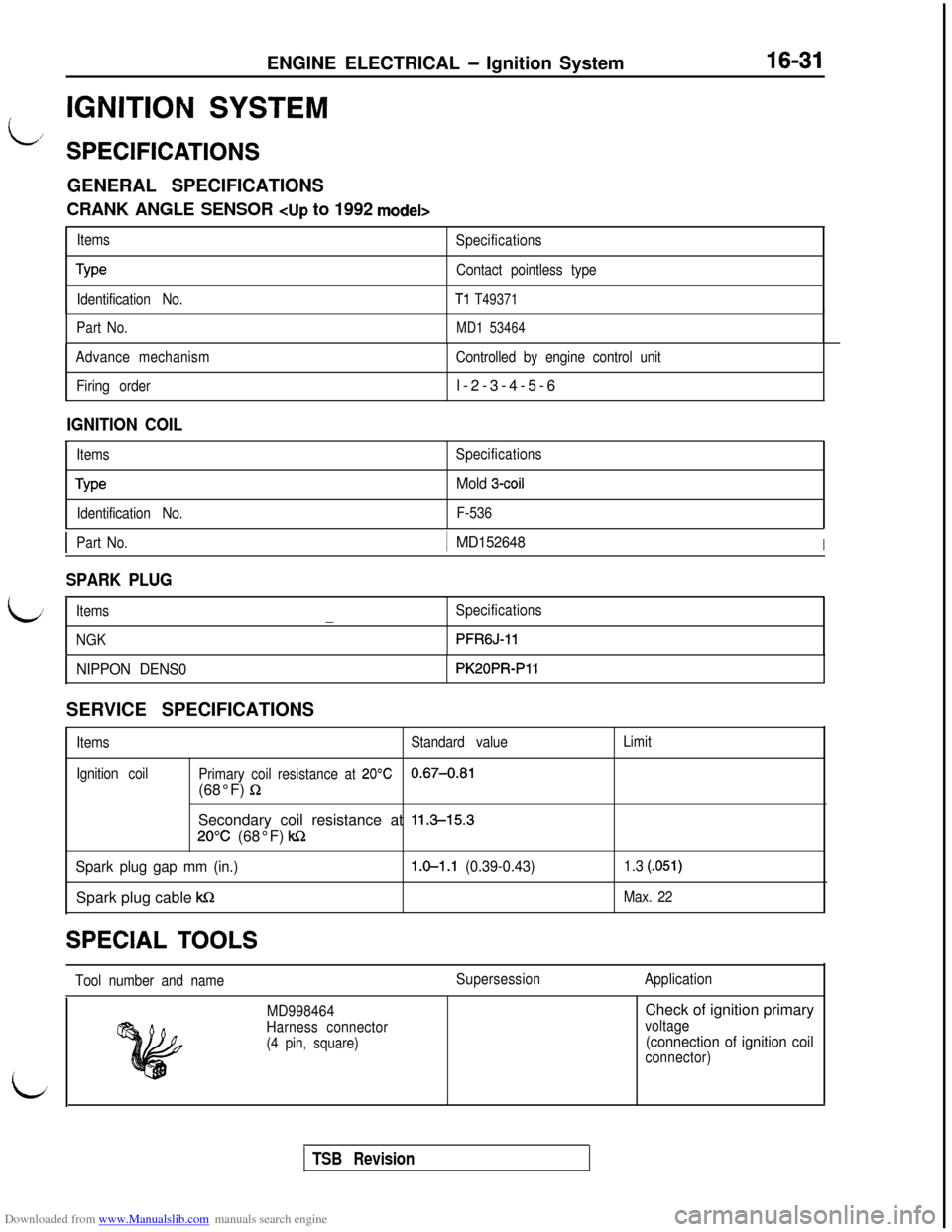
IGNITION SYSTEM
16-31
SPECIFICATIONSGENERAL SPECIFICATIONS
CRANK ANGLE SENSOR cup to 1992 model>
Items
Specifications
TypeContact pointless type
Identification No.
Tl T49371
Part No.MD1 53464
Advance mechanism
Firing orderControlled by engine control unitl-2-3-4-5-6
IGNITION COILrItems
Type
Identification No.SpecificationsMold 3-coil
F-536
L
IPart No.j MD152648I
SPARK PLUG
Items
NGK-Specifications
PFRGJ-11
NIPPON DENS0PK20PRPllSERVICE SPECIFICATIONS
Items
Ignition coilStandard valueLimit
Primary coil resistance at
20°C0.67-0.81(68°F)
RSecondary coil resistance at
11.3-15.3
20°C (68°F) kc2
Spark plug gap mm (in.)1.0-l .l (0.39-0.43)Spark plug cable
kQ
1.3 (.051)
Max. 22SPECIAL
TOOLS
Tool number and nameSupersessionApplication
i
MD998464
Harness connector
(4 pin, square)Check of ignition primaryvoltage
(connection of ignition coil
connector)
i
TSB Revision
Page 481 of 738
Downloaded from www.Manualslib.com manuals search engine i;ENGINE ELECTRICAL
- Ignition System16-35
OPERATIONl
Turn ignition switch to .“ON”position, and batteryvoltage will be applied to primary winding of
ignition coil.l
When crankshaft position sensor and camshaft
position sensor signal is input to engine control
module, engine control module makes ON-OFF
control of power transistors one by one.l When power transistor is turned on, current
flows from ignition coil (primary winding) to
ground through power transistor.l When power transistor A is turned from ON
to OFF, the spark plugs of No. 1 and No. 4
cylinders spark. Turning of power transistor B
from ON to OFF will produce sparking in spark
plugs of No. 2 and No. 5 cylinders. Furthermore,
when power transistor C is turned from ON toOFF, sparking is produced in spark plugs of
No. 3 and No. 6 cylinders.
TROUBLESHOOTING HINTS1. Engine cranks, but does not start.
(1) Spark is insufficient or does not occur at
all (on spark plug).l Check ignition coil.
l Check camshaft position sensor and
crankshaft position sensorl Check power transistor.
l Check spark plugs.
l Check spark plug cable.
(2) Spark is good.
l Check ignition timing.
2. Engine idles roughly or stalls.
l Check spark plugs.
l Check ignition timing.
l Check ignition coil.
l Check spark plug cable.
3. Poor acceleration
l Check ignition timing.
l Check spark plug cable.
l Check ignition coil.
TSB Revision
Page 487 of 738
Downloaded from www.Manualslib.com manuals search engine ENGINE ELECTRICAL - lanition Svstem16-41
/
L
i
Analyzer
GroundL
01L1008
STANDARD WAVE-FORM
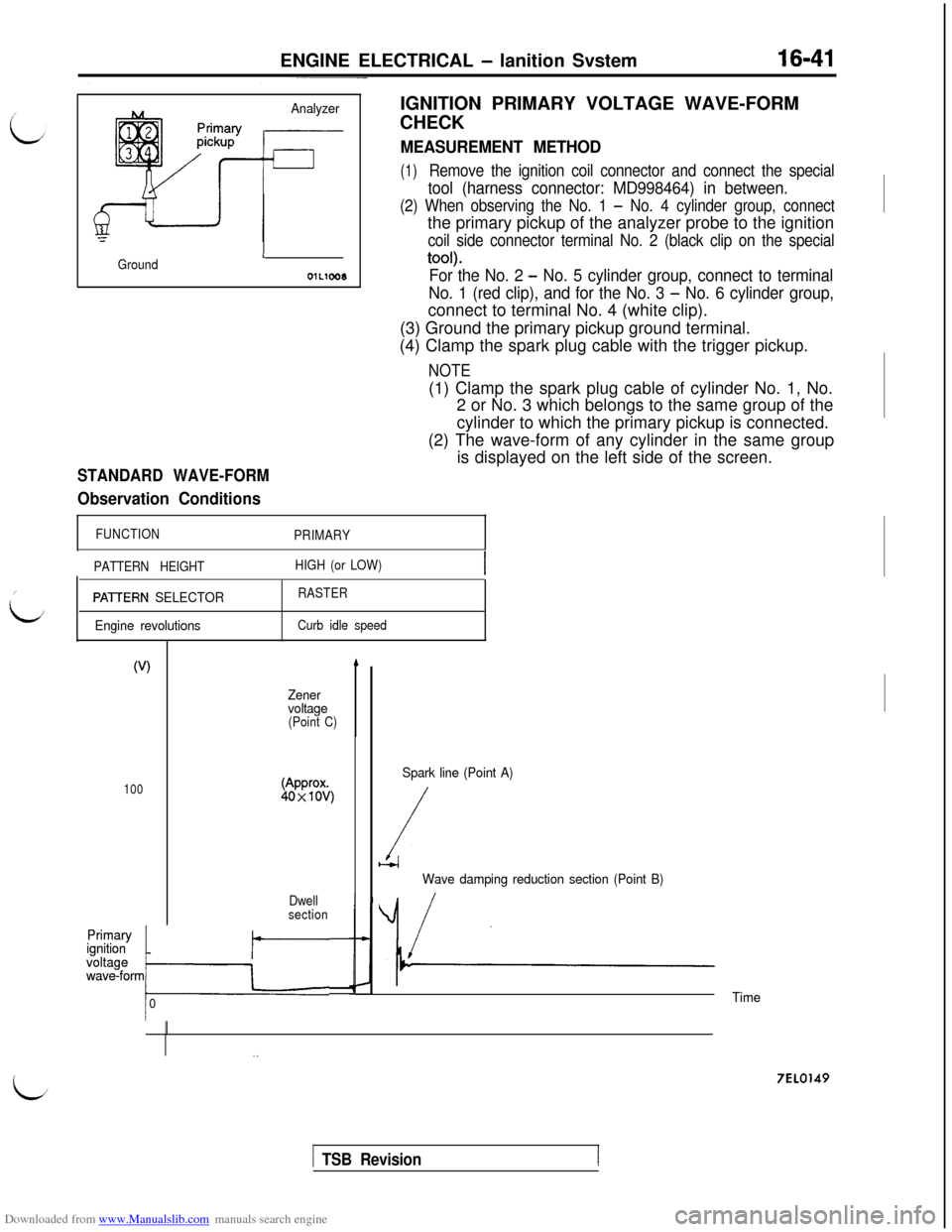
Observation ConditionsIGNITION PRIMARY VOLTAGE WAVE-FORM
CHECK
MEASUREMENT METHOD
(1)Remove the ignition coil connector and connect the special
tool (harness connector: MD998464) in between.
(2) When observing the No. 1 - No. 4 cylinder group, connectthe primary pickup of the analyzer probe to the ignition
coil side connector terminal No. 2 (black clip on the special
tool).
For the No. 2 - No. 5 cylinder group, connect to terminal
No. 1 (red clip), and for the No. 3
- No. 6 cylinder group,connect to terminal No. 4 (white clip).
(3) Ground the primary pickup ground terminal.
(4) Clamp the spark plug cable with the trigger pickup.
NOTE(1) Clamp the spark plug cable of cylinder No. 1, No.
2 or No. 3 which belongs to the same group of the
cylinder to which the primary pickup is connected.
(2) The wave-form of any cylinder in the same group
is displayed on the left side of the screen.
FUNCTION
PRIMARY
PATTERN HEIGHTHIGH (or LOW)
PAVERN SELECTOR
Engine revolutionsRASTER
Curb idle speed
(V)
100
Primary Primary*ignition ignition
voltage voltage
wave-form
owave-formkr
0
Zener
voltage
(Point C)
Dwell
section
b
Spark line (Point A)
/b-4
Wave damping reduction section (Point B)
/
Time
7EL0149
/ TSB Revision
Page 494 of 738
Downloaded from www.Manualslib.com manuals search engine 16-48ENGINE ELECTRICAL - lanition Svstem
\/27EL0086
/DEL0087INSPECTION
SPARK PLUGCheck the plug gap and replace if the limit is exceeded.
Standard value:
1.0-l .l mm (.039-.043 in.)
Limit: 1.3 mm
(.051 in.)
Caution
1.Do not attempt to adjust the gap of the platinum plug.
2.Cleaning of the platinum plug may damage the plati-num tip. Therefore, if carbon deposits must be re-
moved, use a plug cleaner and complete cleaning with-
in 20 seconds for protection of the electrode. Do not
use wire brushes.
SPARK PLUG CABLE(1) Check cap and coating for cracks.
(2) Measure resistance.Limit: Max. 22
ksZ
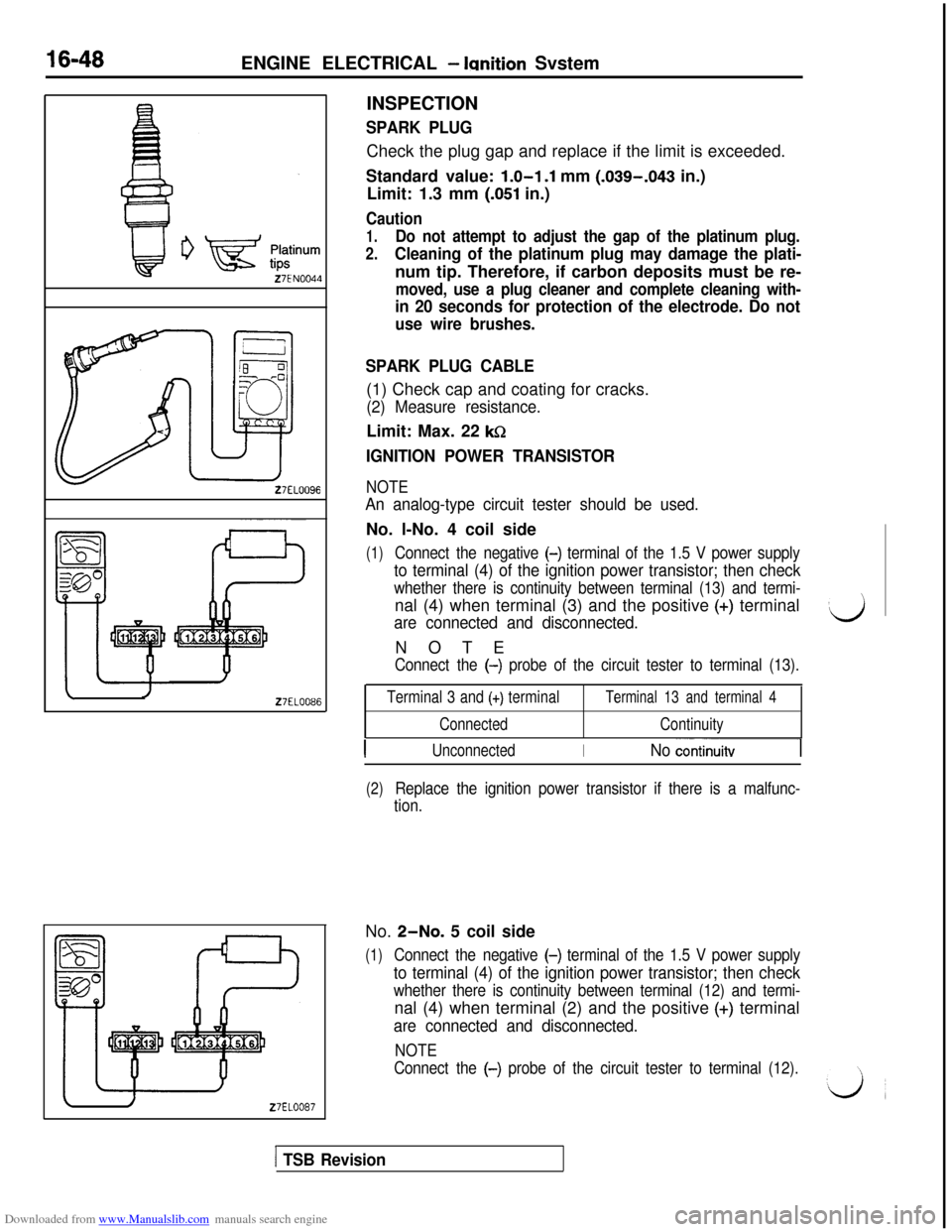
IGNITION POWER TRANSISTOR
NOTE
An analog-type circuit tester should be used.No. l-No. 4 coil side
(1)Connect the negative (-) terminal of the 1.5 V power supply
to terminal (4) of the ignition power transistor; then check
whether there is continuity between terminal (13) and termi-nal (4) when terminal (3) and the positive
(+) terminal
are connected and disconnected.NOTE
Connect the (-) probe of the circuit tester to terminal (13).
Terminal 3 and (+) terminal
ConnectedTerminal 13 and terminal 4
Continuity
IUnconnectedINo continuitv
(2)Replace the ignition power transistor if there is a malfunc-
tion.No. ~-NO. 5 coil side
(1)Connect the negative (-) terminal of the 1.5 V power supply
to terminal (4) of the ignition power transistor; then check
whether there is continuity between terminal (12) and termi-nal (4) when terminal (2) and the positive
(+) terminal
are connected and disconnected.
NOTE
Connect the (-)
probe of the circuit tester to terminal (12).
[ TSB Revision
Page 495 of 738
Downloaded from www.Manualslib.com manuals search engine ENGINE ELECTRICAL b Ignition System16-49
27EL0089
Z7ELOOQO
1 Terminal 2 and (+) terminal/Terminal 12 and terminal 41
IConnectedIContinuitvI
IUnconnectedINo continuitvI
(2) Replace the ignition power transistor if there is a malfunc-
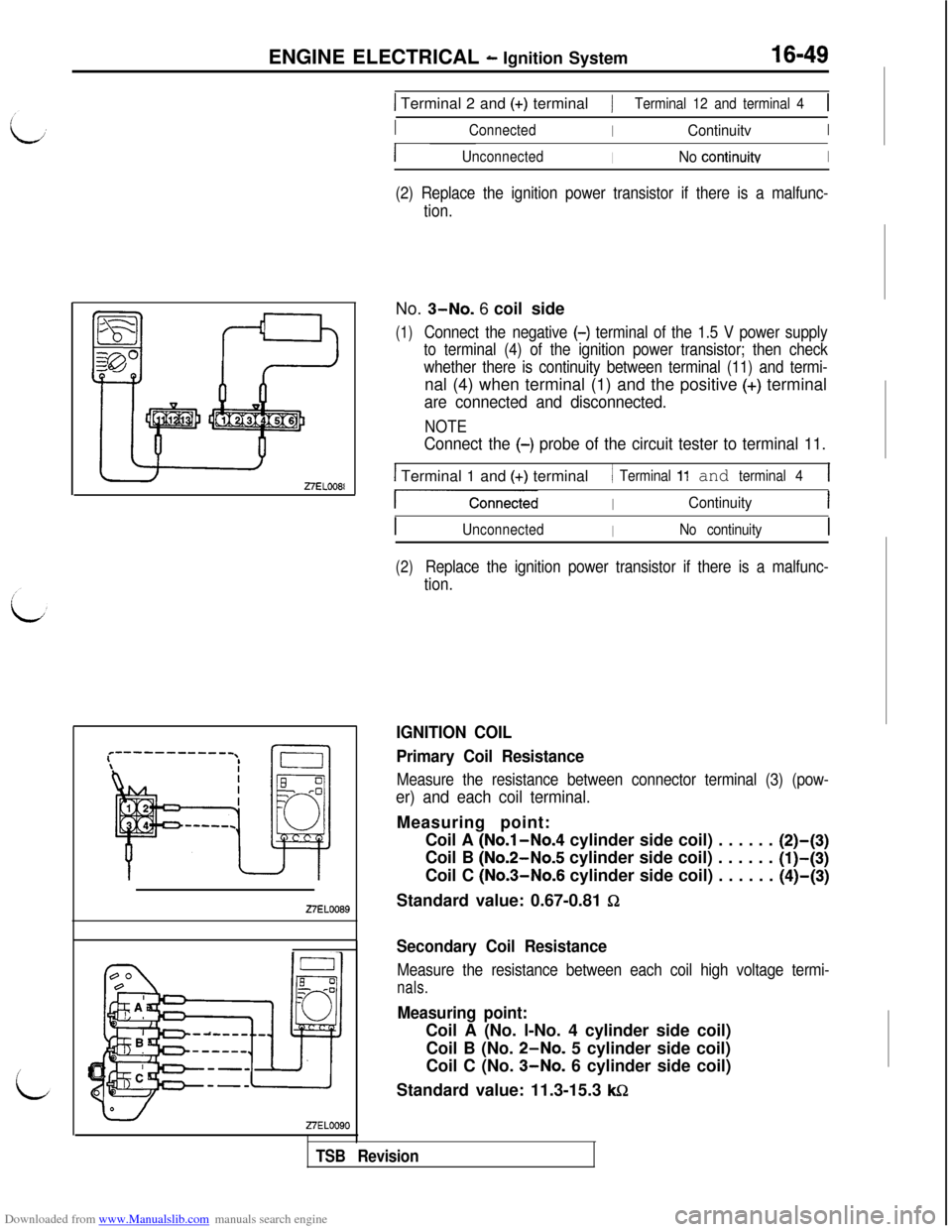
tion.No. ~-NO. 6 coil side
(1)Connect the negative (-) terminal of the 1.5 V power supply
to terminal (4) of the ignition power transistor; then check
whether there is continuity between terminal (11) and termi-nal (4) when terminal (1) and the positive
(+) terminal
are connected and disconnected.
NOTE
Connect the (-) probe of the circuit tester to terminal 11.
I Terminal 1 and (+) terminal/ Terminal 11 and terminal 41
-ConnectedIContinuityI
IUnconnectedINo continuityI
(2)Replace the ignition power transistor if there is a malfunc-
tion.
IGNITION COIL
Primary Coil Resistance
Measure the resistance between connector terminal (3) (pow-
er) and each coil terminal.Measuring point:
Coil A
(No.l-No.4 cylinder side coil) . . . . . . (2)-(3)Coil B (No.2-No.5 cylinder side coil) . . . . . .
(l)-(3)Coil C (No.3-No.6 cylinder side coil) . . . . . .
(4)-(3)Standard value: 0.67-0.81
Sz
TSB Revision
Secondary Coil Resistance
Measure the resistance between each coil high voltage termi-
nals.
Measuring point:Coil A (No. l-No. 4 cylinder side coil)
Coil B (No. ~-NO. 5 cylinder side coil)
Coil C (No. ~-NO. 6 cylinder side coil)
Standard value: 11.3-15.3
Wz
Page 514 of 738
Downloaded from www.Manualslib.com manuals search engine 54-18CHASSIS ELECTRICAL - Meters and Gauges
OPERATION
When the ignition key is at the “ON” position,the fuel gauge is activated.
l
When there is much fuel, the unit’s resistanceis small and the current flowing in the circuit
is great, so the gauge’s indicator indicates inthe “F” area.
l When there is little fuel, the unit’s resistance
is high and the current flowing in the circuit
is small, so the gauge’s indicator indicates inthe
“E” area.
lWhen the ignition key is at the “ON” position,
the engine coolant temperature gauge is acti-
vated.l
When the engine coolant temperature is high,
the unit’s resistance is low and there is a greatflow of current in the circuit, so the gauge’s
indicator indicates in the “H” area.
l
When the engine coolant temperature is low,
the unit’s resistance is high and there is a smallflow of current in the circuit, so the gauge’s
indicator indicates in the “C” area.
vehicle speed, and vehicle-speed signals areinput to systems (the MFI system, etc.) that
regulate according to the vehicle speed.
TROUBLESHOOTING HINTS
1.The fuel gauge doesn’t function, or shows the
incorrect indication.
(1) Disconnect the connector of the fuel pumpand gauge unit assembly; the ‘F” side is
indicated when terminal (5) is then
grounded.l Check the fuel gauge.
2.The engine coolant temperature gauge doesn’t
function, or shows the incorrect indication.
(1)The “l-l” side is indicated when the connector
of the engine coolant temperature gauge
unit is disconnected and then grounded.l
Check the engine coolant temperature
gauge unit.
3. Systems dependent upon control according to
the vehicle speed do not function correctly.l Check the reed switch (mechanical
speedometer type)l Check the speed sensor (electrical
speedometer type)
coil pressure gauge>l
When the ignition key is at the “ON” position,
the oil pressure gauge is activated.
lWhen oil pressure is high, the internal contacts
of the gauge unit are kept closed for a longerperiod of time. This causes more current to
flow in the circuit, and the gauge pointer swings
to the high pressure side.
lWhen oil pressure is low, the internal contactsof the gauge unit open in a shorter period of
time. Therefore, there is less current flowing
in the circuit and the gauge pointer swings to
the low pressure side.
lWhen the ignition key is set to the “ON” position,the gauge indicator will be at
“0”.l
When the engine is started, the indicator will
move from
“0” to the minus (-) side, and then,as the boost level increases, it will move to
the plus
(+) side.
position, the voltage gauge operates and indi-
cates a battery voltage of approximately 12 V.l
When the engine is started, the voltage gauge
indicates a battery voltage of 12 to 16 V, indicat-ing that the battery is on charge.
4. The oil pressure gauge doesn’t function, or
shows the incorrect indication.
(1)The “H” side is indicated when the connectorof the oil pressure gauge unit is discon-
nected and then grounded.l Check the oil pressure gauge unit.
5.The meter illumination light does not illuminate.
(1) The tail lights illuminate.l Check the rheostat.
6. The voltage gauge doesn’t function, or shows
the incorrect indication.l Check the voltage gauge.
TSB Revision
Page 526 of 738
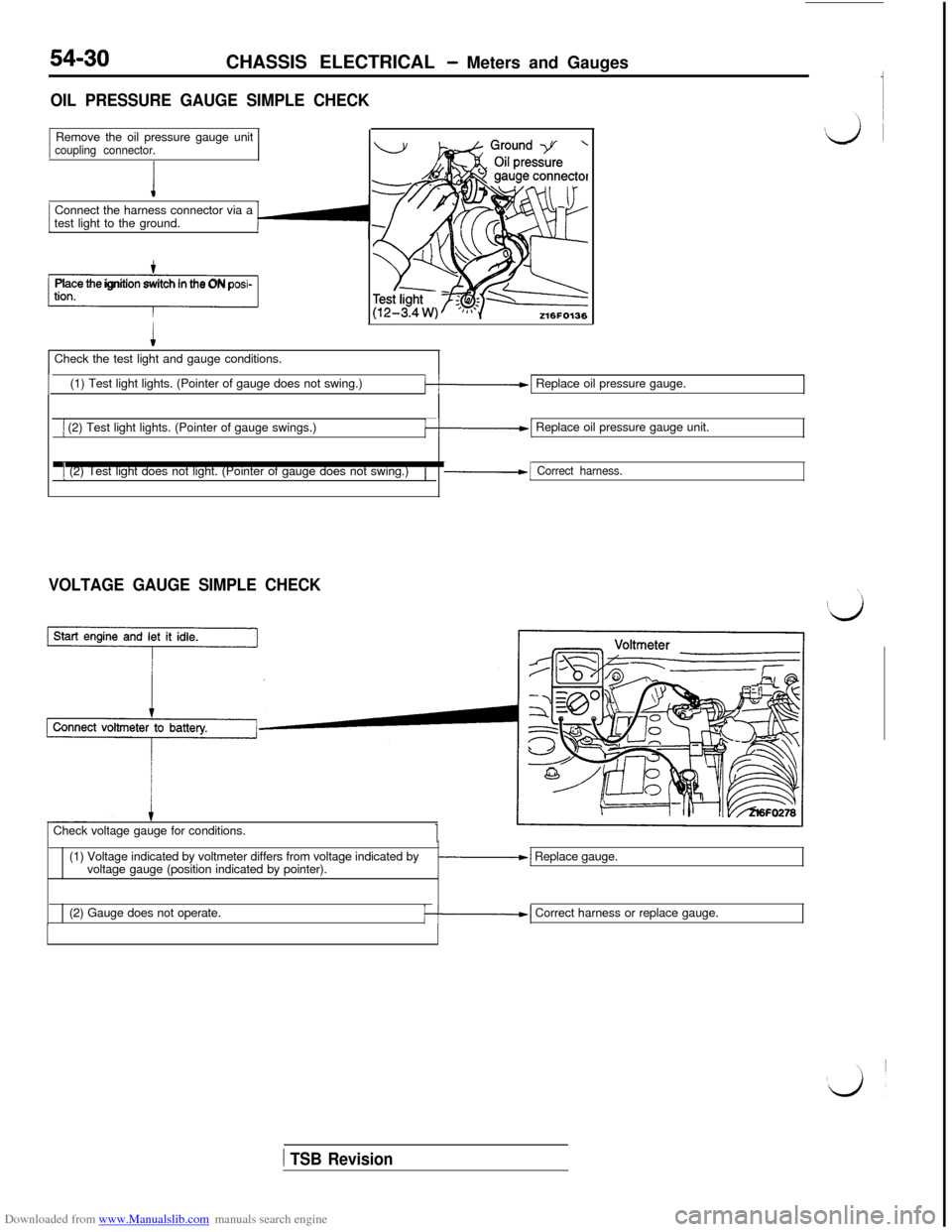
Downloaded from www.Manualslib.com manuals search engine 54-30CHASSIS ELECTRICAL - Meters and Gauges
OIL PRESSURE GAUGE SIMPLE CHECKRemove the oil pressure gauge unit
coupling connector.Connect the harness connector via a
test light to the ground.
-1Place the ignition switch in the ON posi-Check the test light and gauge conditions.
(1) Test light lights. (Pointer of gauge does not swing.)
k-1 Replace oil pressure gauge.
1 (2) Test light lights. (Pointer of gauge swings.)k-1 Replace oil pressure gauge unit.
1 (2) Test light does not light. (Pointer of gauge does not swing.)/-1 Correct harness.
VOLTAGE GAUGE SIMPLE CHECKCheck voltage gauge for conditions.
(1) Voltage indicated by voltmeter differs from voltage indicated by
voltage gauge (position indicated by pointer).
-1 Replace gauge.
(2) Gauge does not operate.
/--I Correct harness or replace gauge.
1 TSB Revision
Page 530 of 738
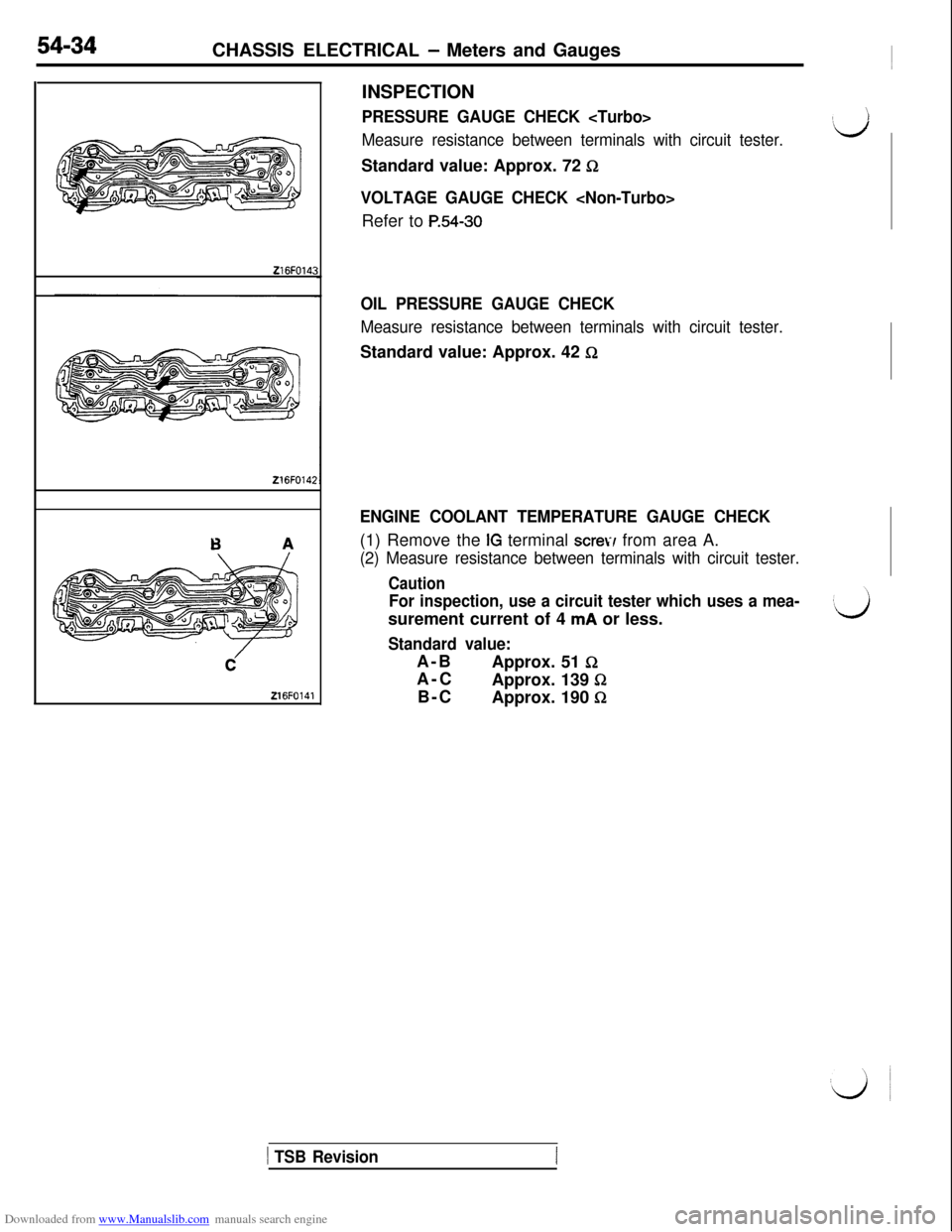
Downloaded from www.Manualslib.com manuals search engine 54-34CHASSIS ELECTRICAL - Meters and Gauges216FO14C
216FO14:216FO141INSPECTION
PRESSURE GAUGE CHECK
Measure resistance between terminals with circuit tester.Standard value: Approx. 72
&2
VOLTAGE GAUGE CHECK
P.54-30
OIL PRESSURE GAUGE CHECK
Measure resistance between terminals with circuit tester.Standard value: Approx. 42
Q
ENGINE COOLANT TEMPERATURE GAUGE CHECK(1) Remove the
IG terminal scre\;/ from area A.
(2) Measure resistance between terminals with circuit tester.
Caution
For inspection, use a circuit tester which uses a mea-surement current of 4
mA or less.
Standard value:A-B
Approx. 51
SzA-C
Approx. 139
QB-C
Approx. 190
R
1 TSB Revision