brake MITSUBISHI 380 2005 Workshop Manual
[x] Cancel search | Manufacturer: MITSUBISHI, Model Year: 2005, Model line: 380, Model: MITSUBISHI 380 2005Pages: 1500, PDF Size: 47.87 MB
Page 1455 of 1500
KNUCKLE
REAR AXLE27-8
KNUCKLE
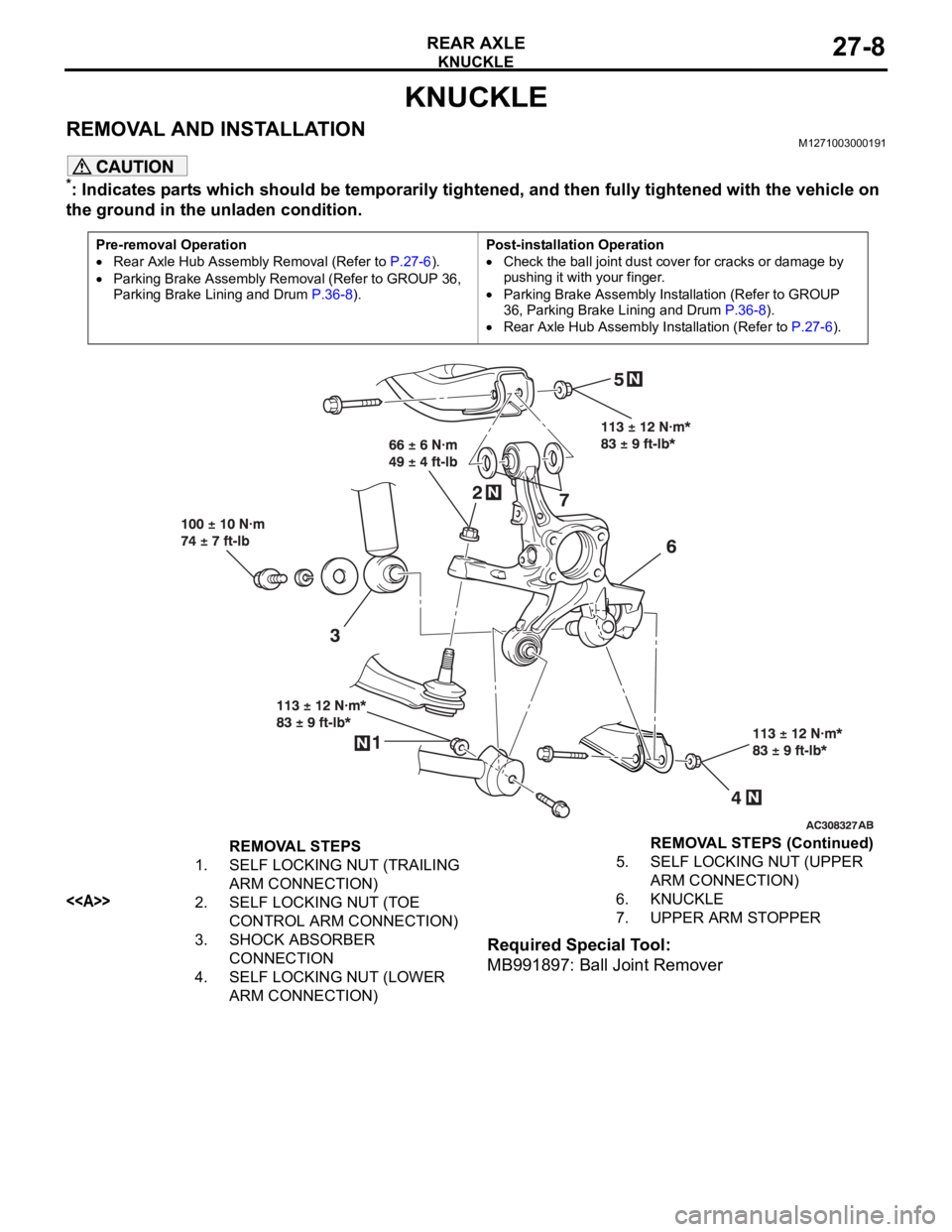
REMOVAL AND INSTALLATIONM1271003000191
*: Indicates parts which should be temporarily tightened, and then fully tightened with the vehicle on
the ground in the unladen condition.
Required Special Tool:
MB991897: Ball Joint Remover
Pre-removal Operation
Rear Axle Hub Assembly Removal (Refer to P.27-6).
Parking Brake Assembly Removal (Refer to GROUP 36,
Parking Brake Lining and Drum P.36-8).Post-installation Operation
Check the ball joint dust cover for cracks or damage by
pushing it with your finger.
Parking Brake Assembly Installation (Refer to GROUP
36, Parking Brake Lining and Drum P.36-8).
Rear Axle Hub Assembly Installation (Refer to P.27-6).
REMOVAL STEPS
1. SELF LOCKING NUT (TRAILING
ARM CONNECTION)
<>2. SELF LOCKING NUT (TOE
CONTROL ARM CONNECTION)
3. SHOCK ABSORBER
CONNECTION
4. SELF LOCKING NUT (LOWER
ARM CONNECTION)5. SELF LOCKING NUT (UPPER
ARM CONNECTION)
6. KNUCKLE
7. UPPER ARM STOPPERREMOVAL STEPS (Continued)
Page 1457 of 1500

SPECIFICATIONS
REAR AXLE27-10
SPECIFICATIONS
FASTENER TIGHTENING SPECIFICATIONSM1271004000332
SERVICE SPECIFICATIONSM1271000300502
ITEM SPECIFICATION
Knuckle Lower arm assembly to knuckle nut 113
12 Nm (83 9 ft-lb)
Shock absorber assembly to knuckle
bolt100
10 Nm (74 7 ft-lb)
Self locking nut (toe control arm
connection)66
6 Nm (49 4 ft-lb)
Trailing arm assembly to knuckle nut 113
12 Nm (83 9 ft-lb)
Upper arm assembly to knuckle nut 113
12 Nm (83 9 ft-lb)
Rear axle hub assembly Brake caliper assembly bolt 60
5 Nm (45 3 ft-lb)
Rear hub assembly bolt 73
7 Nm (54 5 ft-lb)
ITEM LIMIT
Wheel bearing end play mm (in) 0.05 (0.002)
Rear hub rotary-sliding resistance N (lb) 24 (5.4)
Page 1462 of 1500

GENERAL DESCRIPTION
AUTOMATIC TRANSMISSION23A-3
GENERAL DESCRIPTIONM1231000100366
ITEM SPECIFICATION
Transmission modelF5A5A-4-C5Z
Engine model 6G75-S4-MP
Torque converter Type 3-element, 1-stage, 2-phase type
Lock-up Provided
Stall torque ratio 1.71
Transmission type5 forward speeds, 1 reverse speed, fully automatic
Transmission gear
ratio1st 3.789
2nd 2.162
3rd 1.421
4th 1.000
5th 0.686
Reverse 3.117
Final reduction ratio (Differential gear ratio) 3.325
Clutch Multi-disc type 4 sets
Brake Multi-disc type 2 sets, band type 1 set
Manual control system P-R-N-D (4 position) + Sport mode (up, down)
Shift pattern control Electronic control
Hydraulic control during shifting Electronic control (Each clutch hydraulically independently
controlled)
Torque converter clutch control Electronic control
Transmission fluid Specified lubricants MITSUBISHI ELC4-SP III
Quantity (litres) 8.4
Page 1463 of 1500
GENERAL DESCRIPTION
AUTOMATIC TRANSMISSION23A-4
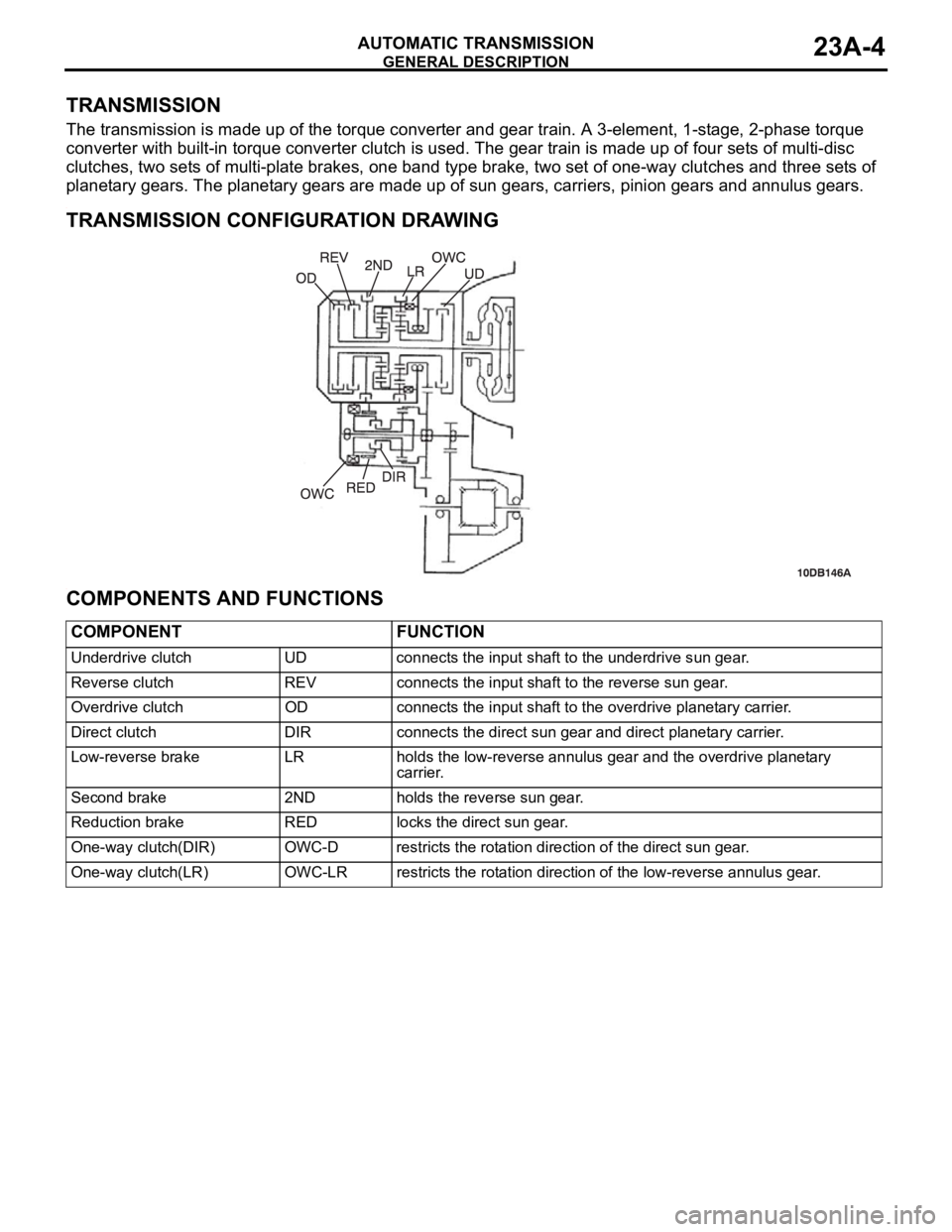
TRANSMISSION
The transmission is made up of the torque converter and gear train. A 3-element, 1-stage, 2-phase torque
converter with built-in torque converter clutch is used. The gear train is made up of four sets of multi-disc
clutches, two sets of multi-plate brakes, one band type brake, two set of one-way clutches and three sets of
planetary gears. The planetary gears are made up of sun gears, carriers, pinion gears and annulus gears.
.
TRANSMISSION CONFIGURATION DRAWING
.
COMPONENTS AND FUNCTIONS
COMPONENT FUNCTION
Underdrive clutch UD connects the input shaft to the underdrive sun gear.
Reverse clutch REV connects the input shaft to the reverse sun gear.
Overdrive clutch OD connects the input shaft to the overdrive planetary carrier.
Direct clutch DIR connects the direct sun gear and direct planetary carrier.
Low-reverse brake LR holds the low-reverse annulus gear and the overdrive planetary
carrier.
Second brake 2ND holds the reverse sun gear.
Reduction brake RED locks the direct sun gear.
One-way clutch(DIR) OWC-D restricts the rotation direction of the direct sun gear.
One-way clutch(LR) OWC-LR restricts the rotation direction of the low-reverse annulus gear.
Page 1464 of 1500

GENERAL DESCRIPTION
AUTOMATIC TRANSMISSION23A-5
FUNCTION ELEMENT TABLE
: Function element : Not applicable
NOTE: * operates only when the vehicle is stationary [at approximately 10 km/h (6.2 mph) or less].
OPERATING
ELEMENTSTART PARKING
MECHANI
SMUNDER
DRIVE
CLUTCH
(UD)REVERSE
CLUTCH
(REV)OVER-
DRIVE
CLUTCH
(OD)DIRECT
CLUTCH
(DIR)LOW-
REVERSE
BRAKE
(LR)SECOND
BRAKE
(2ND)REDUCTI-
ON
BRAKE
(RB) TRANSMISSION
RANGE
POK
R
NOK
Sport
mode1st*
2nd
3rd
4th
5th
Page 1465 of 1500
GENERAL DESCRIPTION
AUTOMATIC TRANSMISSION23A-6
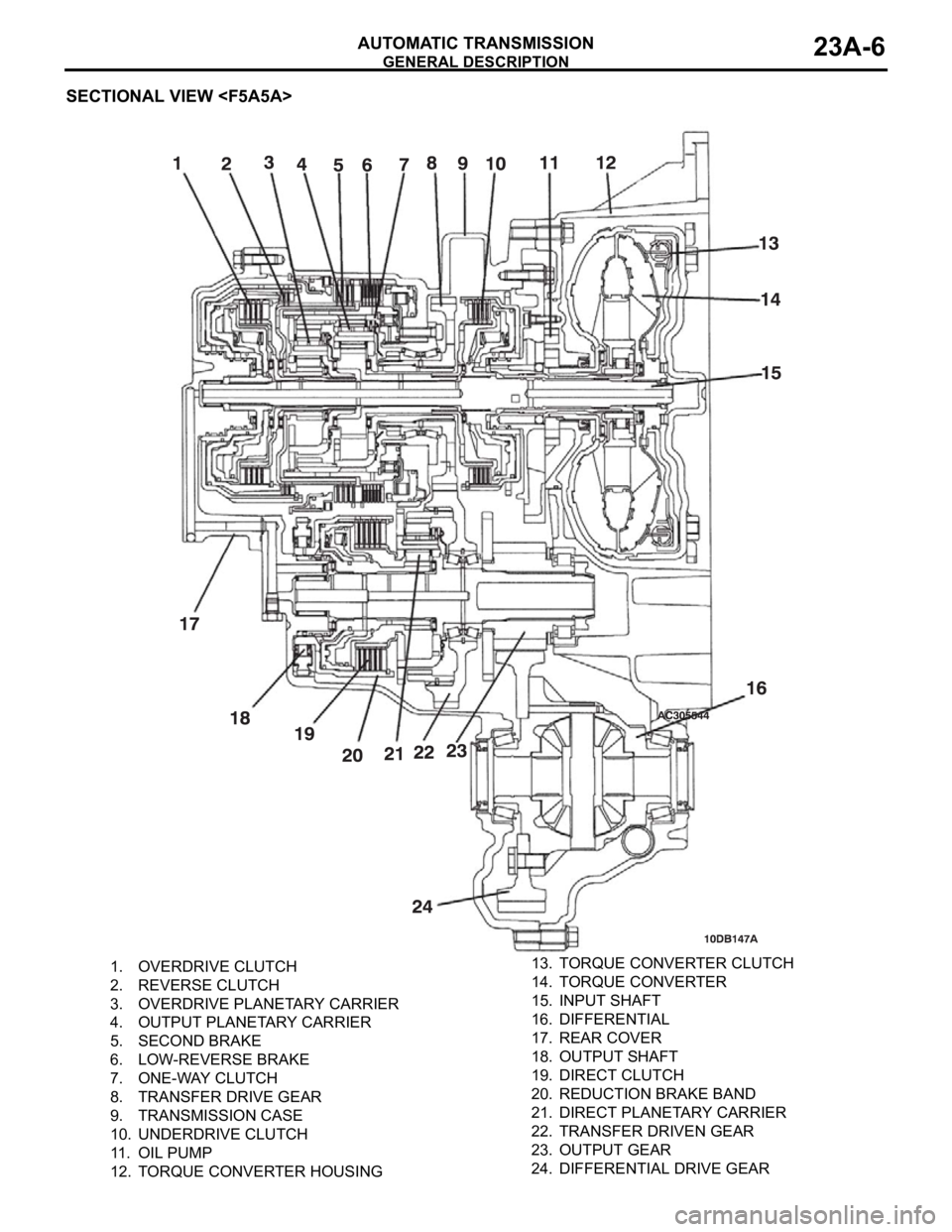
SECTIONAL VIEW
1. OVERDRIVE CLUTCH
2. REVERSE CLUTCH
3. OVERDRIVE PLANETARY CARRIER
4. OUTPUT PLANETARY CARRIER
5. SECOND BRAKE
6. LOW-REVERSE BRAKE
7. ONE-WAY CLUTCH
8. TRANSFER DRIVE GEAR
9. TRANSMISSION CASE
10. UNDERDRIVE CLUTCH
11. OIL PUMP
12. TORQUE CONVERTER HOUSING13. TORQUE CONVERTER CLUTCH
14. TORQUE CONVERTER
15. INPUT SHAFT
16. DIFFERENTIAL
17. REAR COVER
18. OUTPUT SHAFT
19. DIRECT CLUTCH
20. REDUCTION BRAKE BAND
21. DIRECT PLANETARY CARRIER
22. TRANSFER DRIVEN GEAR
23. OUTPUT GEAR
24. DIFFERENTIAL DRIVE GEAR
Page 1467 of 1500
GENERAL DESCRIPTION
AUTOMATIC TRANSMISSION23A-8
FEATURES
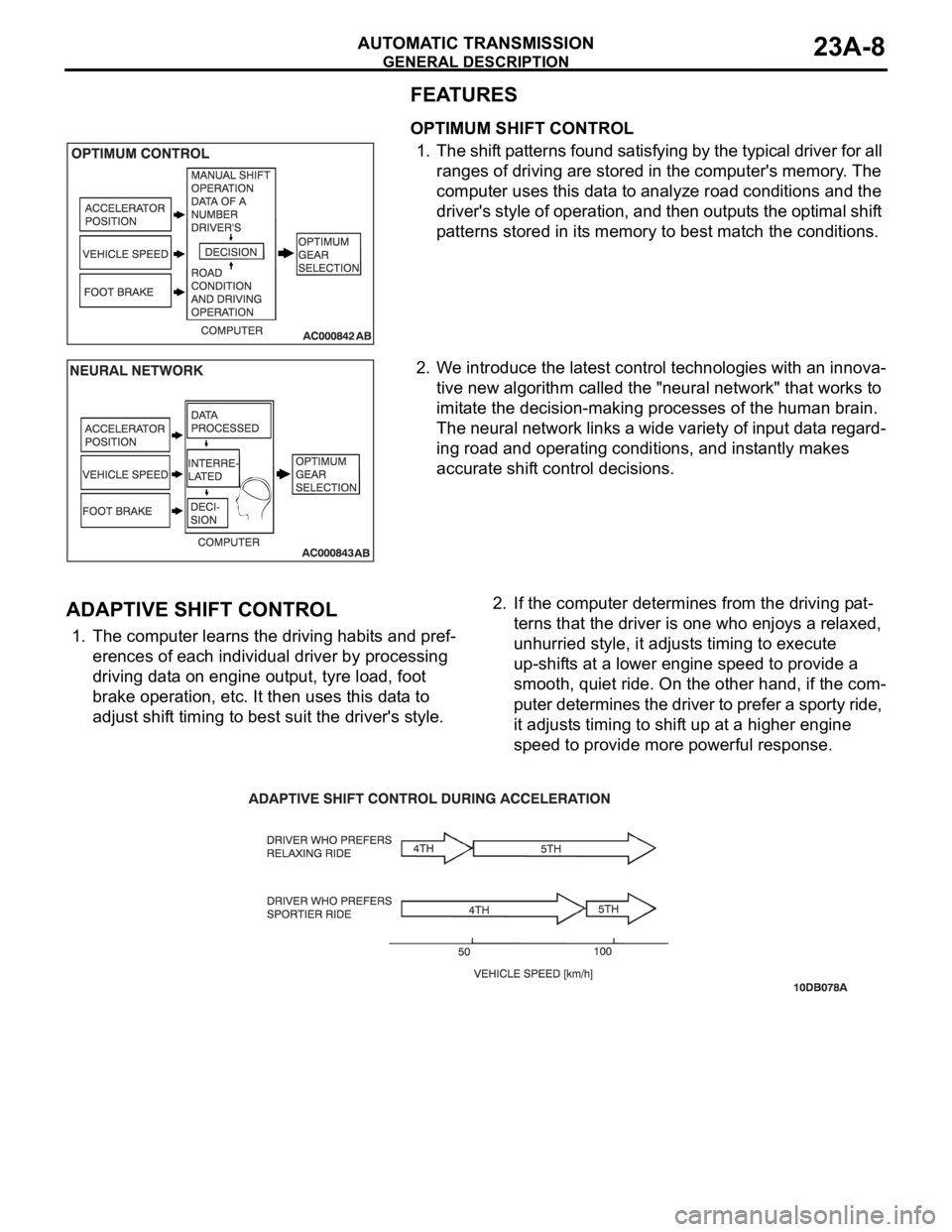
OPTIMUM SHIFT CONTROL
1. The shift patterns found satisfying by the typical driver for all
ranges of driving are stored in the computer's memory. The
computer uses this data to analyze road conditions and the
driver's style of operation, and then outputs the optimal shift
patterns stored in its memory to best match the conditions.
2. We introduce the latest control technologies with an innova-
tive new algorithm called the "neural network" that works to
imitate the decision-making processes of the human brain.
The neural network links a wide variety of input data regard-
ing road and operating conditions, and instantly makes
accurate shift control decisions.
.
ADAPTIVE SHIFT CONTROL
1. The computer learns the driving habits and pref-
erences of each individual driver by processing
driving data on engine output, tyre load, foot
brake operation, etc. It then uses this data to
adjust shift timing to best suit the driver's style.2. If the computer determines from the driving pat-
terns that the driver is one who enjoys a relaxed,
unhurried style, it adjusts timing to execute
up-shifts at a lower engine speed to provide a
smooth, quiet ride. On the other hand, if the com-
puter determines the driver to prefer a sporty ride,
it adjusts timing to shift up at a higher engine
speed to provide more powerful response.
.
Page 1478 of 1500
AUTOMATIC TRANSMISSION DIAGNOSIS
AUTOMATIC TRANSMISSION23A-19
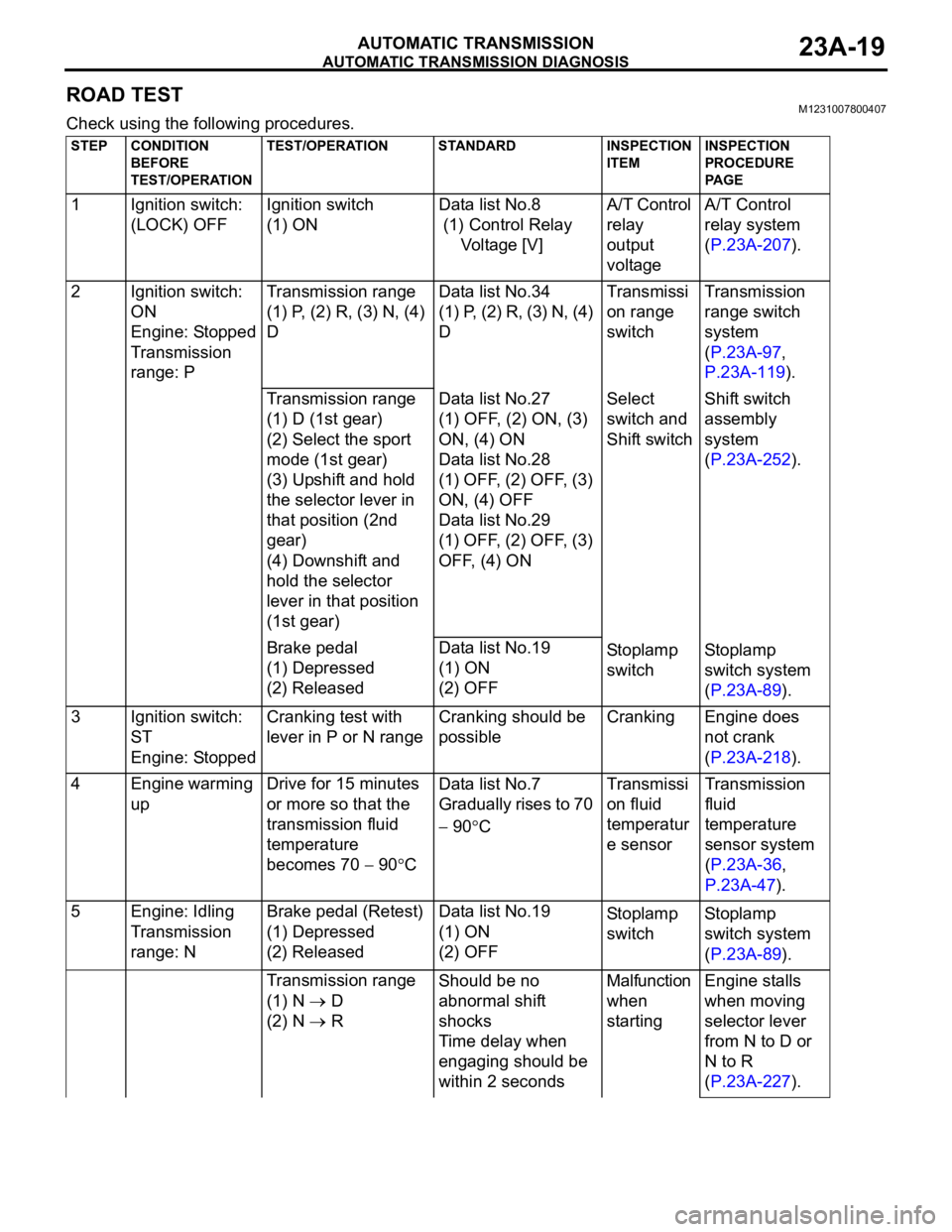
ROAD TESTM1231007800407
Check using the following procedures.
STEP CONDITION
BEFORE
TEST/OPERATIONTEST/OPERATION STANDARD INSPECTION
ITEMINSPECTION
PROCEDURE
PA G E
1 Ignition switch:
(LOCK) OFFIgnition switch
(1) ONData list No.8
(1) Control Relay
Voltage [V]A/T Control
relay
output
voltageA/T Control
relay system
(P.23A-207).
2 Ignition switch:
ON
Engine: Stopped
Transmission
range: PTransmission range
(1) P, (2) R, (3) N, (4)
DData list No.34
(1) P, (2) R, (3) N, (4)
DTransmissi
on range
switchTransmission
range switch
system
(P.23A-97,
P.23A-119).
Transmission range
(1) D (1st gear)
(2) Select the sport
mode (1st gear)
(3) Upshift and hold
the selector lever in
that position (2nd
gear)
(4) Downshift and
hold the selector
lever in that position
(1st gear)Data list No.27
(1) OFF, (2) ON, (3)
ON, (4) ON
Data list No.28
(1) OFF, (2) OFF, (3)
ON, (4) OFF
Data list No.29
(1) OFF, (2) OFF, (3)
OFF, (4) ONSelect
switch and
Shift switchShift switch
assembly
system
(P.23A-252).
Brake pedal
(1) Depressed
(2) ReleasedData list No.19
(1) ON
(2) OFFSto pl amp
switchSt o pla mp
switch system
(P.23A-89).
3 Ignition switch:
ST
Engine: StoppedCranking test with
lever in P or N rangeCranking should be
possibleCranking Engine does
not crank
(P.23A-218).
4 Engine warming
upDrive for 15 minutes
or more so that the
transmission fluid
temperature
becomes 70
90CData list No.7
Gradually rises to 70
90CTransmissi
on fluid
temperatur
e sensorTransmission
fluid
temperature
sensor system
(P.23A-36,
P.23A-47).
5 Engine: Idling
Transmission
range: NBrake pedal (Retest)
(1) Depressed
(2) ReleasedData list No.19
(1) ON
(2) OFFSto pl amp
switchSt o pla mp
switch system
(P.23A-89).
Transmission range
(1) N
D
(2) N
RShould be no
abnormal shift
shocks
Time delay when
engaging should be
within 2 secondsMalfunction
when
startingEngine stalls
when moving
selector lever
from N to D or
N to R
(P.23A-227).
Page 1484 of 1500
AUTOMATIC TRANSMISSION DIAGNOSIS
AUTOMATIC TRANSMISSION23A-25
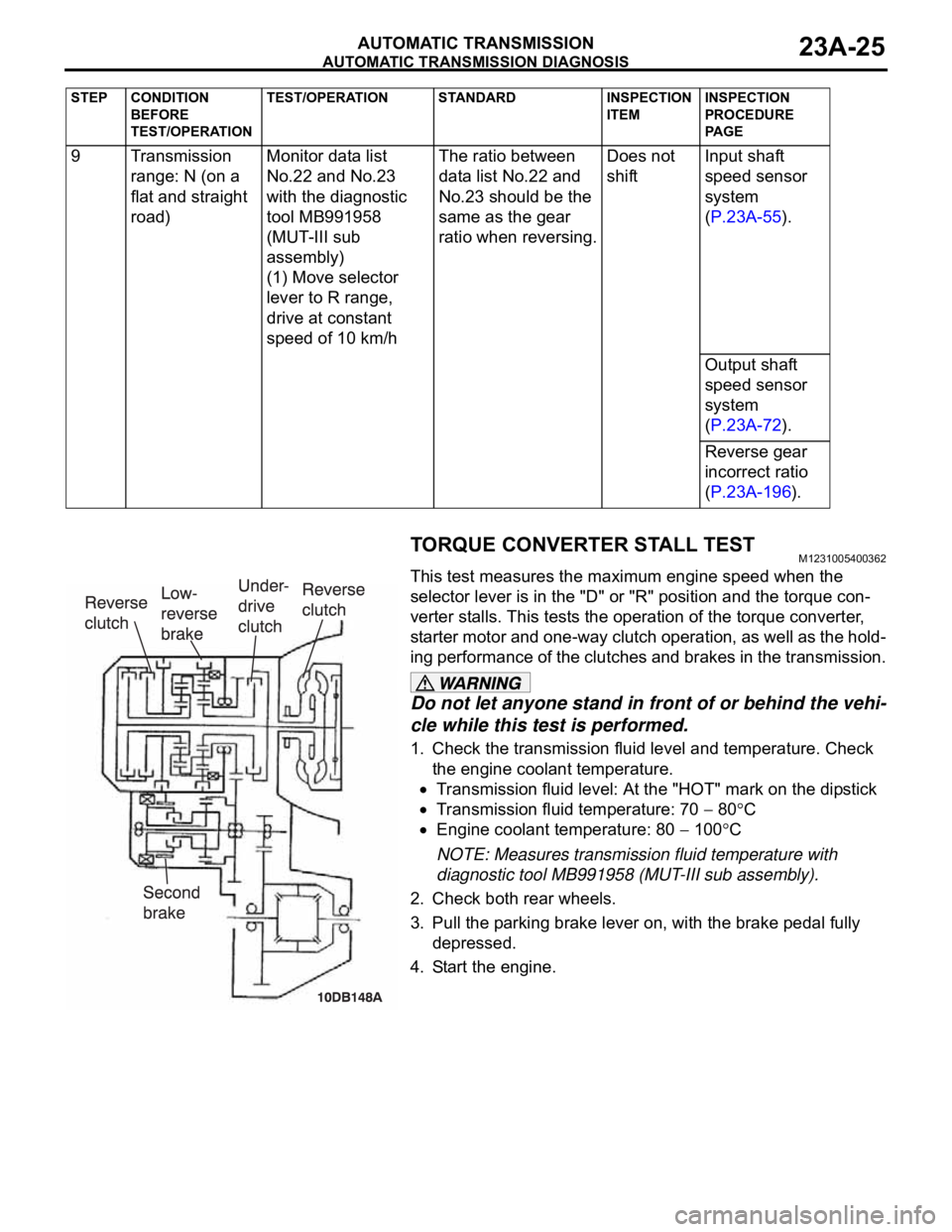
TORQUE CONVERTER STALL TESTM1231005400362
This test measures the maximum engine speed when the
selector lever is in the "D" or "R" position and the torque con-
verter stalls. This tests the operation of the torque converter,
starter motor and one-way clutch operation, as well as the hold-
ing performance of the clutches and brakes in the transmission.
Do not let anyone stand in front of or behind the vehi-
cle while this test is performed.
1. Check the transmission fluid level and temperature. Check
the engine coolant temperature.
Transmission fluid level: At the "HOT" mark on the dipstick
Transmission fluid temperature: 70 80C
Engine coolant temperature: 80 100C
NOTE: Measures transmission fluid temperature with
diagnostic tool MB991958 (MUT-III sub assembly).
2. Check both rear wheels.
3. Pull the parking brake lever on, with the brake pedal fully
depressed.
4. Start the engine. 9 Transmission
range: N (on a
flat and straight
road)Monitor data list
No.22 and No.23
with the diagnostic
tool MB991958
(MUT-III sub
assembly)
(1) Move selector
lever to R range,
drive at constant
speed of 10 km/hThe ratio between
data list No.22 and
No.23 should be the
same as the gear
ratio when reversing.Does not
shiftInput shaft
speed sensor
system
(P.23A-55).
Output shaft
speed sensor
system
(P.23A-72).
Reverse gear
incorrect ratio
(P.23A-196).
STEP CONDITION
BEFORE
TEST/OPERATIONTEST/OPERATION STANDARD INSPECTION
ITEMINSPECTION
PROCEDURE
PA G E
Page 1485 of 1500
AUTOMATIC TRANSMISSION DIAGNOSIS
AUTOMATIC TRANSMISSION23A-26
The throttle should not be fully open for any more than
five seconds.
If you repeat the stall test when the transmission fluid
temperature is greater than 80
C, move the selector
lever to the "N" position and let the engine run at
approximately 1,000 r/min for at least one minute. Wait
until the transmission fluid temperature returns to 80
C
or less.
5. Move the selector lever to the "D" position. Fully depress the
accelerator pedal and read the maximum engine speed at
this time.
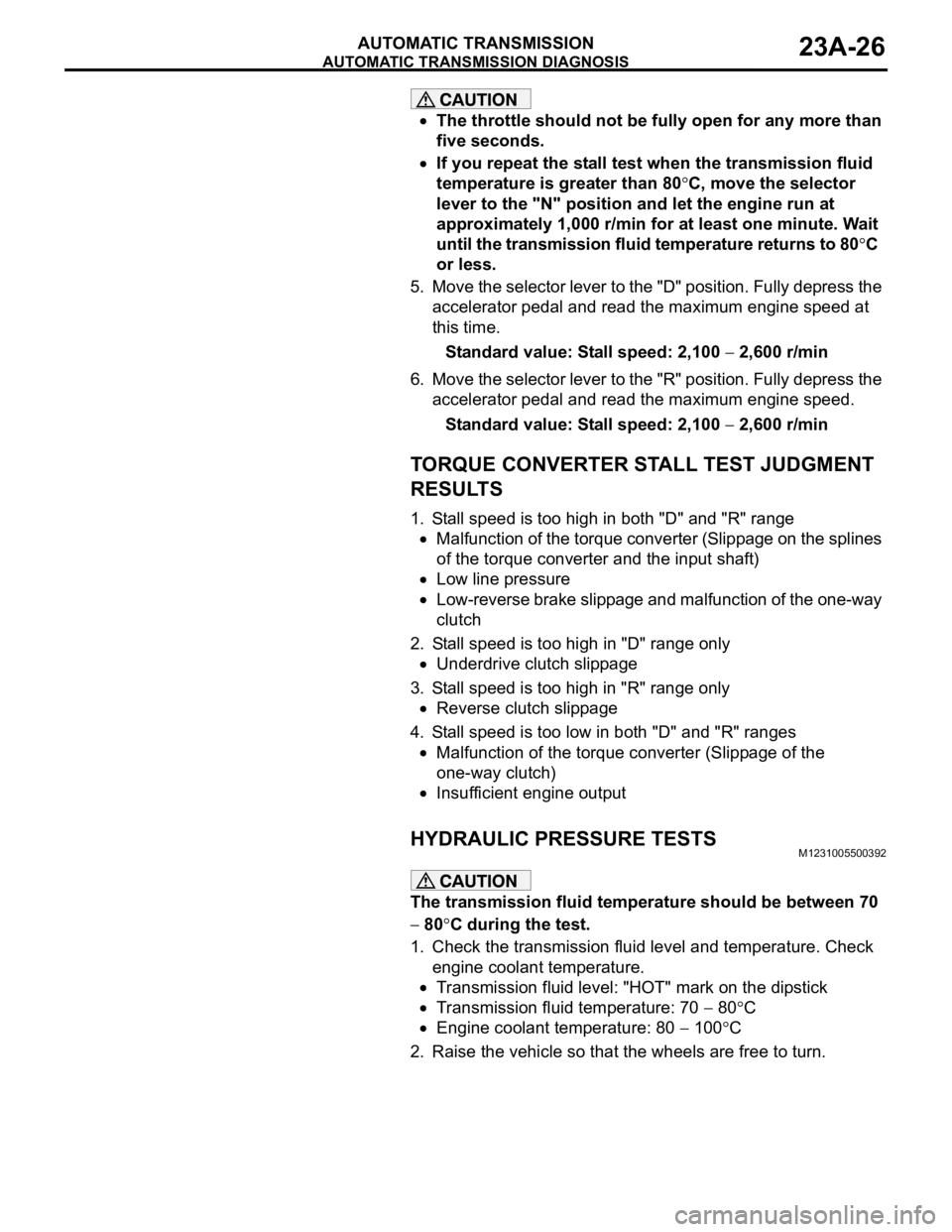
Standard value: Stall speed: 2,100
2,600 r/min
6. Move the selector lever to the "R" position. Fully depress the
accelerator pedal and read the maximum engine speed.
Standard value: Stall speed: 2,100
2,600 r/min
TORQUE CONVERTER STALL TEST JUDGMENT
RESULTS
1. Stall speed is too high in both "D" and "R" range
Malfunction of the torque converter (Slippage on the splines
of the torque converter and the input shaft)
Low line pressure
Low-reverse brake slippage and malfunction of the one-way
clutch
2. Stall speed is too high in "D" range only
Underdrive clutch slippage
3. Stall speed is too high in "R" range only
Reverse clutch slippage
4. Stall speed is too low in both "D" and "R" ranges
Malfunction of the torque converter (Slippage of the
one-way clutch)
Insufficient engine output
HYDRAULIC PRESSURE TESTSM1231005500392
The transmission fluid temperature should be between 70
80C during the test.
1. Check the transmission fluid level and temperature. Check
engine coolant temperature.
Transmission fluid level: "HOT" mark on the dipstick
Transmission fluid temperature: 70 80C
Engine coolant temperature: 80 100C
2. Raise the vehicle so that the wheels are free to turn.