brake MITSUBISHI 380 2005 Manual Online
[x] Cancel search | Manufacturer: MITSUBISHI, Model Year: 2005, Model line: 380, Model: MITSUBISHI 380 2005Pages: 1500, PDF Size: 47.87 MB
Page 1379 of 1500
AUTO-CRUISE CONTROL
ENGINE AND EMISSION CONTROL17-48
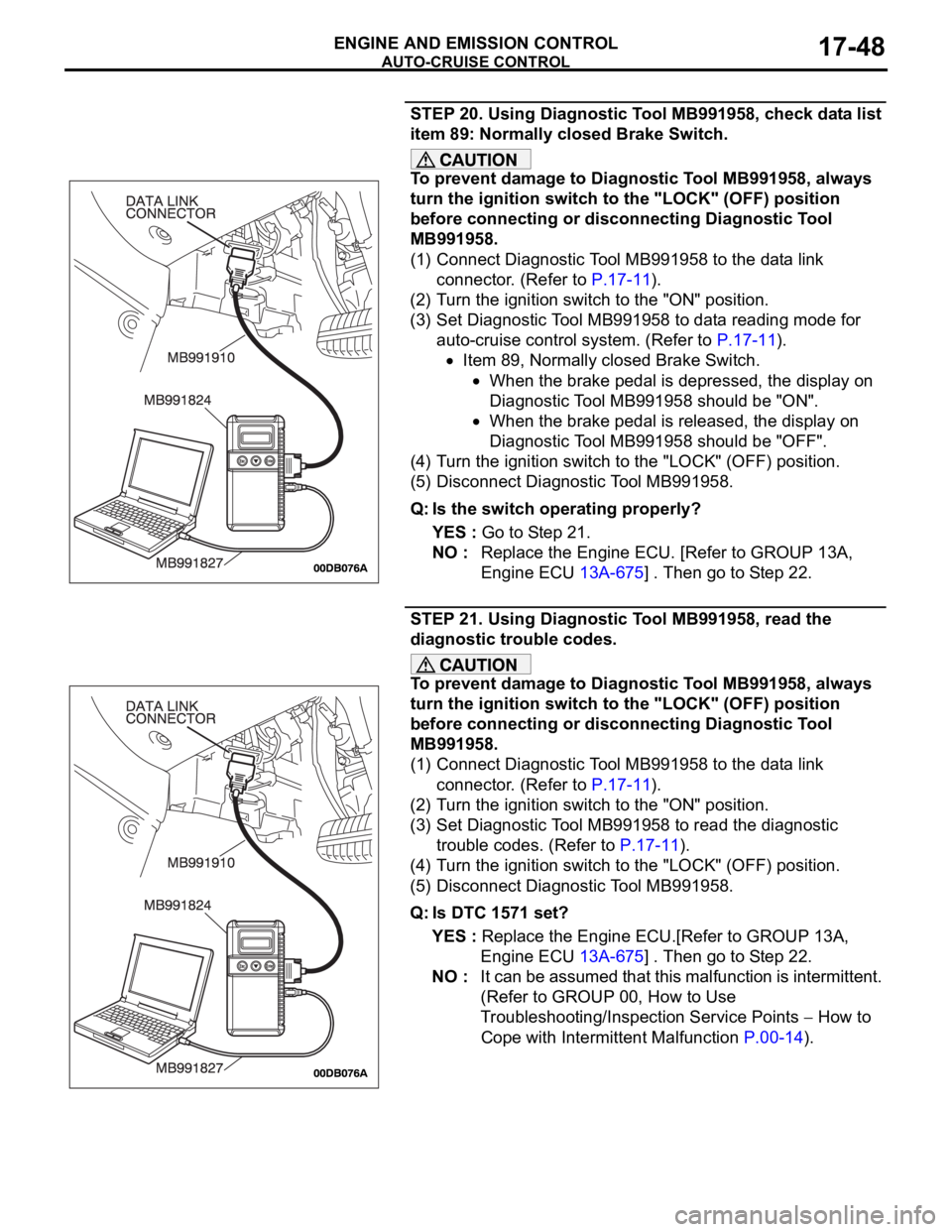
STEP 20. Using Diagnostic Tool MB991958, check data list
item 89: Normally closed Brake Switch.
To prevent damage to Diagnostic Tool MB991958, always
turn the ignition switch to the "LOCK" (OFF) position
before connecting or disconnecting Diagnostic Tool
MB991958.
(1) Connect Diagnostic Tool MB991958 to the data link
connector. (Refer to P.17-11).
(2) Turn the ignition switch to the "ON" position.
(3) Set Diagnostic Tool MB991958 to data reading mode for
auto-cruise control system. (Refer to P.17-11).
Item 89, Normally closed Brake Switch.
When the brake pedal is depressed, the display on
Diagnostic Tool MB991958 should be "ON".
When the brake pedal is released, the display on
Diagnostic Tool MB991958 should be "OFF".
(4) Turn the ignition switch to the "LOCK" (OFF) position.
(5) Disconnect Diagnostic Tool MB991958.
Q: Is the switch operating properly?
YES : Go to Step 21.
NO : Replace the Engine ECU. [Refer to GROUP 13A,
Engine ECU 13A-675] . Then go to Step 22.
STEP 21. Using Diagnostic Tool MB991958, read the
diagnostic trouble codes.
To prevent damage to Diagnostic Tool MB991958, always
turn the ignition switch to the "LOCK" (OFF) position
before connecting or disconnecting Diagnostic Tool
MB991958.
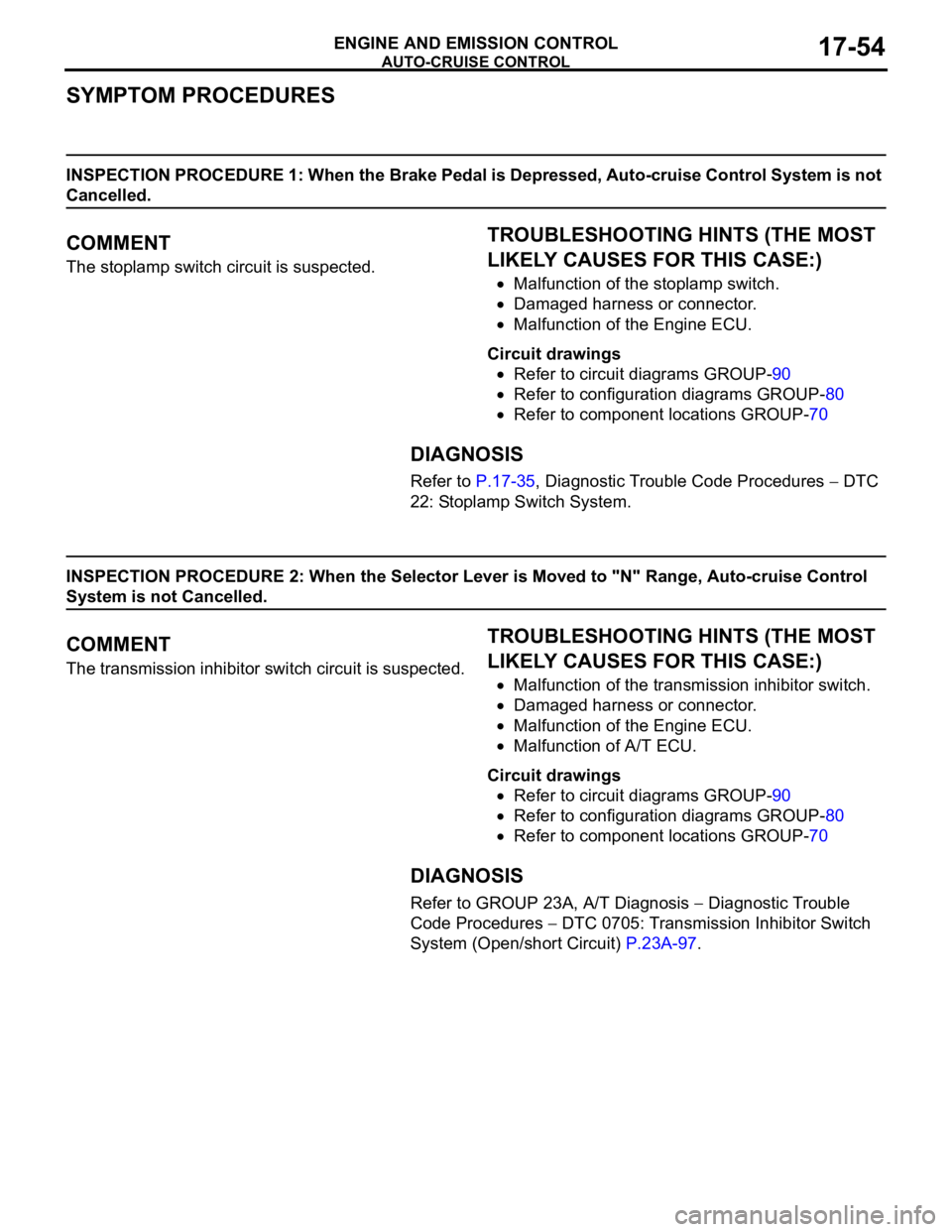
(1) Connect Diagnostic Tool MB991958 to the data link
connector. (Refer to P.17-11).
(2) Turn the ignition switch to the "ON" position.
(3) Set Diagnostic Tool MB991958 to read the diagnostic
trouble codes. (Refer to P.17-11).
(4) Turn the ignition switch to the "LOCK" (OFF) position.
(5) Disconnect Diagnostic Tool MB991958.
Q: Is DTC 1571 set?
YES : Replace the Engine ECU.[Refer to GROUP 13A,
Engine ECU 13A-675] . Then go to Step 22.
NO : It can be assumed that this malfunction is intermittent.
(Refer to GROUP 00, How to Use
Troubleshooting/Inspection Service Points
How to
Cope with Intermittent Malfunction P.00-14).
Page 1384 of 1500

AUTO-CRUISE CONTROL
ENGINE AND EMISSION CONTROL17-53
SYMPTOM CHARTM1172002300366
NOTE: If engine speed reaches and exceeds 6000
r/min the Auto Cruise Control System will be can-
celled automatically.SYMPTOM INSPECTION
PROCEDURE NO.REFERENCE
PA G E
Communication with
Diagnostic Tool is
not possibleCommunication with all systems is
impossible- Group 13A, MPI
Diagnosis
Symptom
Procedures
Inspection
Procedure 1
13A-539 .
Communication with the Engine ECU only
is impossible- Group 13A, MPI
Diagnosis
Symptom
Procedures
Inspection
Procedure 2
13A-541 .
Auto-cruise control
system is not
cancelled.When brake pedal is depressed 1
P.17-54
When selector lever is moved to "N" range 2
P.17-54
When "CANCEL" switch is turned ON 3
P.17-55
When clutch pedal is depressed 4
P.17-55
Auto-cruise control system cannot be set. 5
P.17-56
Hunting (repeated acceleration and deceleration) occurs at the
set vehicle speed.6
P.17-60
When "CRUISE" (MAIN) switch is turned "ON", "CRUISE"
indicator lamp inside combination meter does not illuminate.
(However, auto-cruise control system is normal).7
P.17-62
Page 1385 of 1500
AUTO-CRUISE CONTROL
ENGINE AND EMISSION CONTROL17-54
SYMPTOM PROCEDURES
INSPECTION PROCEDURE 1: When the Brake Pedal is Depressed, Auto-cruise Control System is not
Cancelled.
.
COMMENT
The stoplamp switch circuit is suspected.
.
TROUBLESHOOTING HINTS (THE MOST
LIKELY CAUSES FOR THIS CASE:)
Malfunction of the stoplamp switch.
Damaged harness or connector.
Malfunction of the Engine ECU.
Circuit drawings
Refer to circuit diagrams GROUP-90
Refer to configuration diagrams GROUP-80
Refer to component locations GROUP-70
DIAGNOSIS
Refer to P.17-35, Diagnostic Trouble Code Procedures DTC
22: Stoplamp Switch System.
INSPECTION PROCEDURE 2: When the Selector Lever is Moved to "N" Range, Auto-cruise Control
System is not Cancelled.
.
COMMENT
The transmission inhibitor switch circuit is suspected.
.
TROUBLESHOOTING HINTS (THE MOST
LIKELY CAUSES FOR THIS CASE:)
Malfunction of the transmission inhibitor switch.
Damaged harness or connector.
Malfunction of the Engine ECU.
Malfunction of A/T ECU.
Circuit drawings
Refer to circuit diagrams GROUP-90
Refer to configuration diagrams GROUP-80
Refer to component locations GROUP-70
DIAGNOSIS
Refer to GROUP 23A, A/T Diagnosis Diagnostic Trouble
Code Procedures
DTC 0705: Transmission Inhibitor Switch
System (Open/short Circuit) P.23A-97.
Page 1389 of 1500
AUTO-CRUISE CONTROL
ENGINE AND EMISSION CONTROL17-58
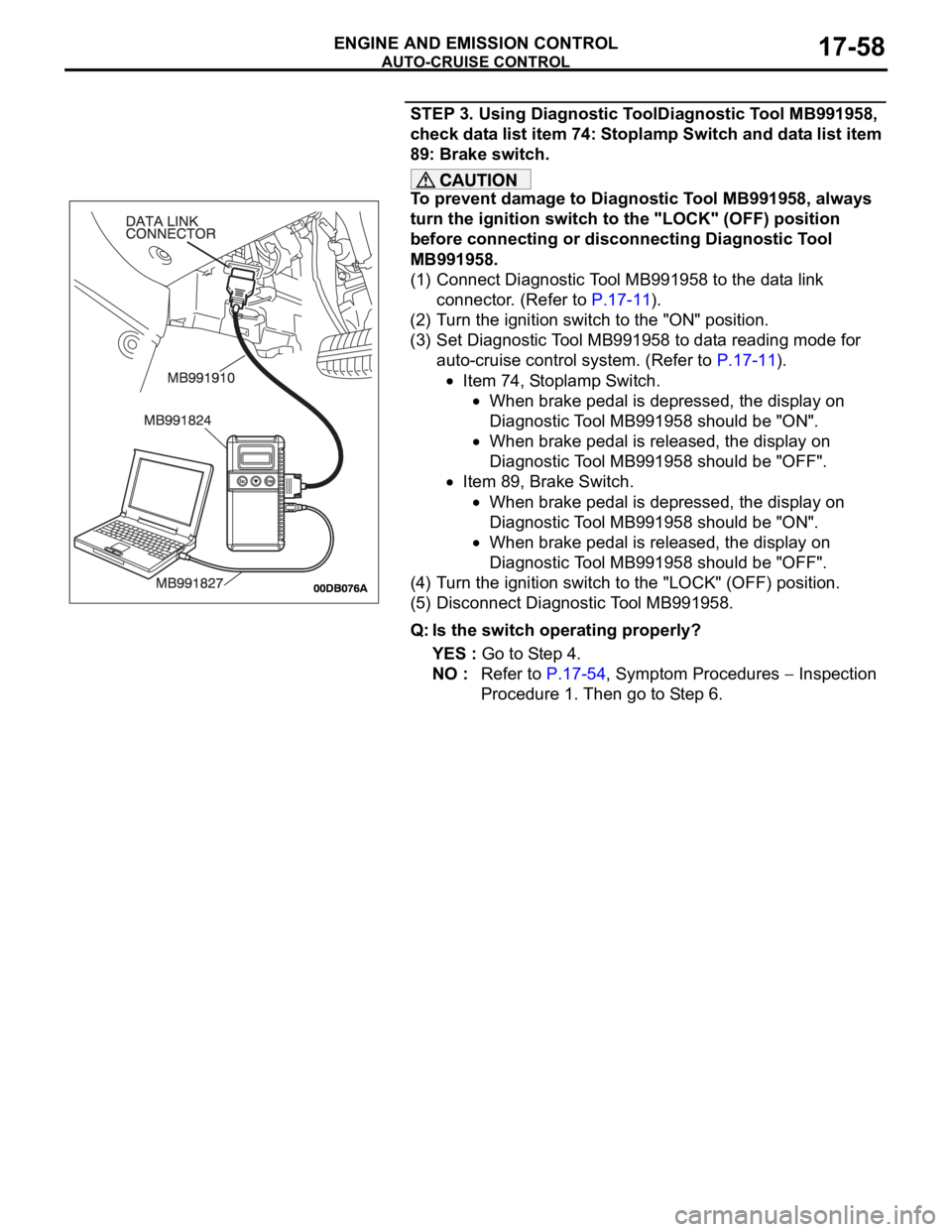
STEP 3. Using Diagnostic ToolDiagnostic Tool MB991958,
check data list item 74: Stoplamp Switch and data list item
89: Brake switch.
To prevent damage to Diagnostic Tool MB991958, always
turn the ignition switch to the "LOCK" (OFF) position
before connecting or disconnecting Diagnostic Tool
MB991958.
(1) Connect Diagnostic Tool MB991958 to the data link
connector. (Refer to P.17-11).
(2) Turn the ignition switch to the "ON" position.
(3) Set Diagnostic Tool MB991958 to data reading mode for
auto-cruise control system. (Refer to P.17-11).
Item 74, Stoplamp Switch.
When brake pedal is depressed, the display on
Diagnostic Tool MB991958 should be "ON".
When brake pedal is released, the display on
Diagnostic Tool MB991958 should be "OFF".
Item 89, Brake Switch.
When brake pedal is depressed, the display on
Diagnostic Tool MB991958 should be "ON".
When brake pedal is released, the display on
Diagnostic Tool MB991958 should be "OFF".
(4) Turn the ignition switch to the "LOCK" (OFF) position.
(5) Disconnect Diagnostic Tool MB991958.
Q: Is the switch operating properly?
YES : Go to Step 4.
NO : Refer to P.17-54, Symptom Procedures
Inspection
Procedure 1. Then go to Step 6.
Page 1396 of 1500

AUTO-CRUISE CONTROL
ENGINE AND EMISSION CONTROL17-65
DATA LIST REFERENCE TABLE - Auto Cruise ControlM1172002400471
When shifting the selector lever to "D" range, apply the brakes so that the vehicle does not move
forward.
Driving tests always need two persons: one driver and one observer.
NOTE: *:After the inspection is completed, disconnect the throttle position sensor connector, and then delete
the diagnostic trouble code using use of Diagnostic Tool MB991958. (Refer to P.17-11).
MUT-III
Diagnostic
To o l
DISPLAYITEM
NO.INSPECTION ITEM INSPECTION REQUIREMENT NORMAL
CONDITION
APS
SNS(MAIN)11 A c c e l e r a t o r p e d a l
position sensor (main)Ignition
switch:
"ON"Accelerator pedal: Released
435
1,035 mV
Accelerator pedal: Gradually
depressedIncreases in
response to the
pedal depression
stroke
Accelerator pedal: Fully
depressed4,000 mV or more
BRAKE SW 89 Stoplamp switch Brake pedal: Depressed ON
Brake pedal: Released OFF
CANCEL
CODE57 Cancel code Ignition switch: "ON" The cancel code,
which set when the
auto-cruise control
system was
cancelled at the
last time, is set
again.
CANCEL
SWITCH75 Auto-cruise
control
switchCANCEL "CANCEL" switch: ON ON
"CANCEL" switch: OFF OFF
CLUTCH SW 78 Transmission inhibitor
switchTransmission inhibitor switch: "P" or
"N"ON
Transmission inhibitor switch: Other
than aboveOFF
CRUISE 81 Auto-cruise control
system operationAuto-cruise control system: active ON
Auto-cruise control system: Inactive OFF
MAIN SW 86 Auto-cruise
control
switchCRUISE
(MAIN)"CRUISE" (MAIN) switch: "ON" ON
"CRUISE" (MAIN) switch: "OFF" OFF
RESUME
SWITCH91 Auto-cruise
control
switchACC/RES "ACC/RES" switch: ON ON
"ACC/RES" switch: OFF OFF
SET SWITCH 92 Auto-cruise
control
switchCOAST/S
ET"COAST/SET" switch: ON ON
"COAST/SET" switch: OFF OFF
STOPLIGHT
SW74 Stoplamp switch Brake pedal: Depressed ON
Brake pedal: Released OFF
Page 1398 of 1500
AUTO-CRUISE CONTROL
ENGINE AND EMISSION CONTROL17-67
ENGINE ECU TERMINAL VOLTAGE REFERENCE CHART FOR AUTO-CRUISE
CONTROL SYSTEM OPERATION
M1172004800055
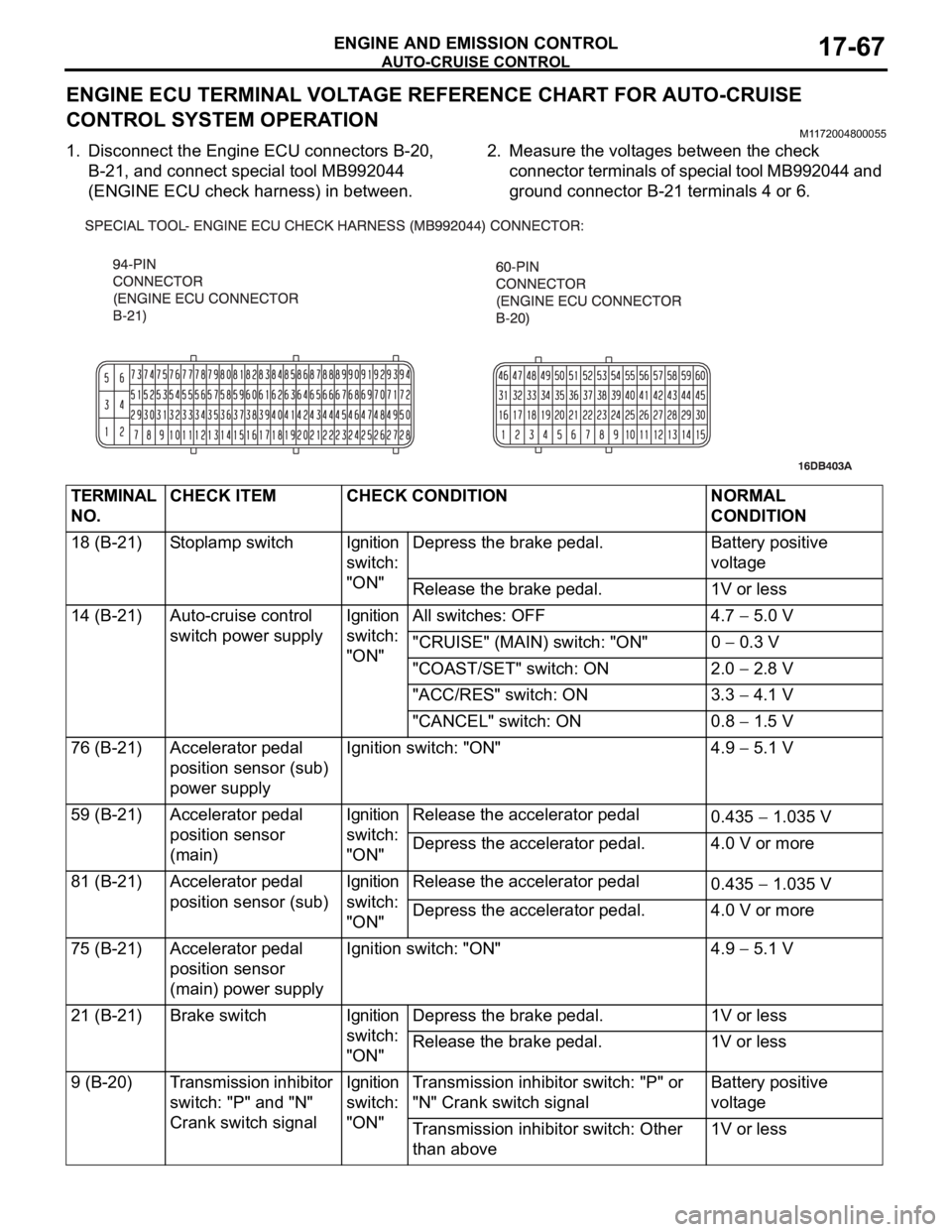
1. Disconnect the Engine ECU connectors B-20,
B-21, and connect special tool MB992044
(ENGINE ECU check harness) in between.2. Measure the voltages between the check
connector terminals of special tool MB992044 and
ground connector B-21 terminals 4 or 6.
TERMINAL
NO.CHECK ITEM CHECK CONDITION NORMAL
CONDITION
18 (B-21) Stoplamp switch Ignition
switch:
"ON"Depress the brake pedal. Battery positive
voltage
Release the brake pedal. 1V or less
14 (B-21) Auto-cruise control
switch power supplyIgnition
switch:
"ON"All switches: OFF 4.7
5.0 V
"CRUISE" (MAIN) switch: "ON" 0
0.3 V
"COAST/SET" switch: ON 2.0
2.8 V
"ACC/RES" switch: ON 3.3
4.1 V
"CANCEL" switch: ON 0.8
1.5 V
76 (B-21) Accelerator pedal
position sensor (sub)
power supplyIgnition switch: "ON" 4.9
5.1 V
59 (B-21) Accelerator pedal
position sensor
(main)Ignition
switch:
"ON"Release the accelerator pedal
0.435
1.035 V
Depress the accelerator pedal. 4.0 V or more
81 (B-21) Accelerator pedal
position sensor (sub)Ignition
switch:
"ON"Release the accelerator pedal
0.435
1.035 V
Depress the accelerator pedal. 4.0 V or more
75 (B-21) Accelerator pedal
position sensor
(main) power supplyIgnition switch: "ON" 4.9
5.1 V
21 (B-21) Brake switch Ignition
switch:
"ON"Depress the brake pedal. 1V or less
Release the brake pedal. 1V or less
9 (B-20) Transmission inhibitor
switch: "P" and "N"
Crank switch signalIgnition
switch:
"ON"Transmission inhibitor switch: "P" or
"N" Crank switch signalBattery positive
voltage
Transmission inhibitor switch: Other
than above1V or less
Page 1403 of 1500
AUTO-CRUISE CONTROL
ENGINE AND EMISSION CONTROL17-72
SPEED-INCREASE SETTING
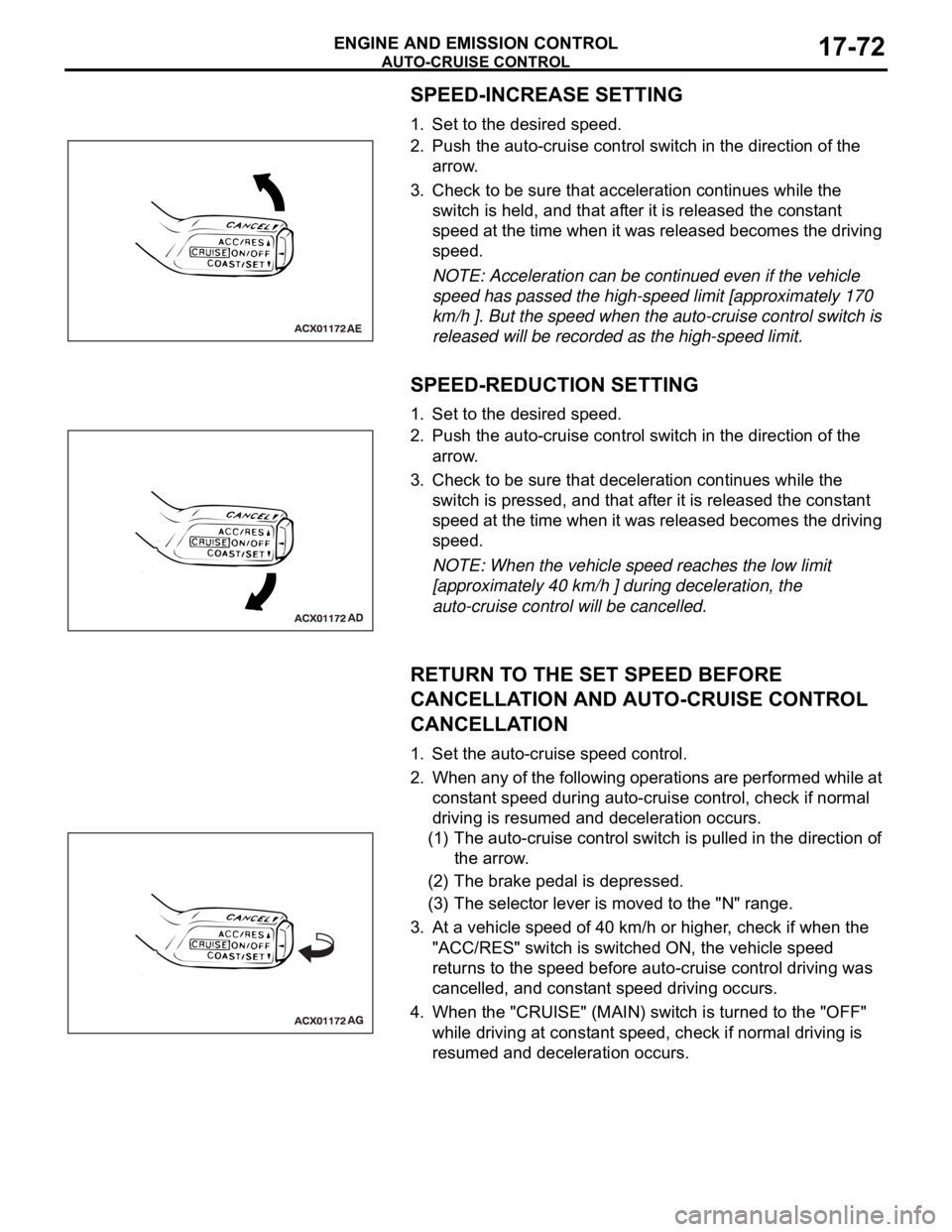
1. Set to the desired speed.
2. Push the auto-cruise control switch in the direction of the
arrow.
3. Check to be sure that acceleration continues while the
switch is held, and that after it is released the constant
speed at the time when it was released becomes the driving
speed.
NOTE: Acceleration can be continued even if the vehicle
speed has passed the high-speed limit [approximately 170
km/h ]. But the speed when the auto-cruise control switch is
released will be recorded as the high-speed limit.
SPEED-REDUCTION SETTING
1. Set to the desired speed.
2. Push the auto-cruise control switch in the direction of the
arrow.
3. Check to be sure that deceleration continues while the
switch is pressed, and that after it is released the constant
speed at the time when it was released becomes the driving
speed.
NOTE: When the vehicle speed reaches the low limit
[approximately 40 km/h ] during deceleration, the
auto-cruise control will be cancelled.
RETURN TO THE SET SPEED BEFORE
CANCELLATION AND AUTO-CRUISE CONTROL
CANCELLATION
1. Set the auto-cruise speed control.
2. When any of the following operations are performed while at
constant speed during auto-cruise control, check if normal
driving is resumed and deceleration occurs.
(1) The auto-cruise control switch is pulled in the direction of
the arrow.
(2) The brake pedal is depressed.
(3) The selector lever is moved to the "N" range.
3. At a vehicle speed of 40 km/h or higher, check if when the
"ACC/RES" switch is switched ON, the vehicle speed
returns to the speed before auto-cruise control driving was
cancelled, and constant speed driving occurs.
4. When the "CRUISE" (MAIN) switch is turned to the "OFF"
while driving at constant speed, check if normal driving is
resumed and deceleration occurs.
Page 1404 of 1500
AUTO-CRUISE CONTROL
ENGINE AND EMISSION CONTROL17-73
AUTO-CRUISE CONTROL SYSTEM COMPONENT
CHECK
M1172001700316
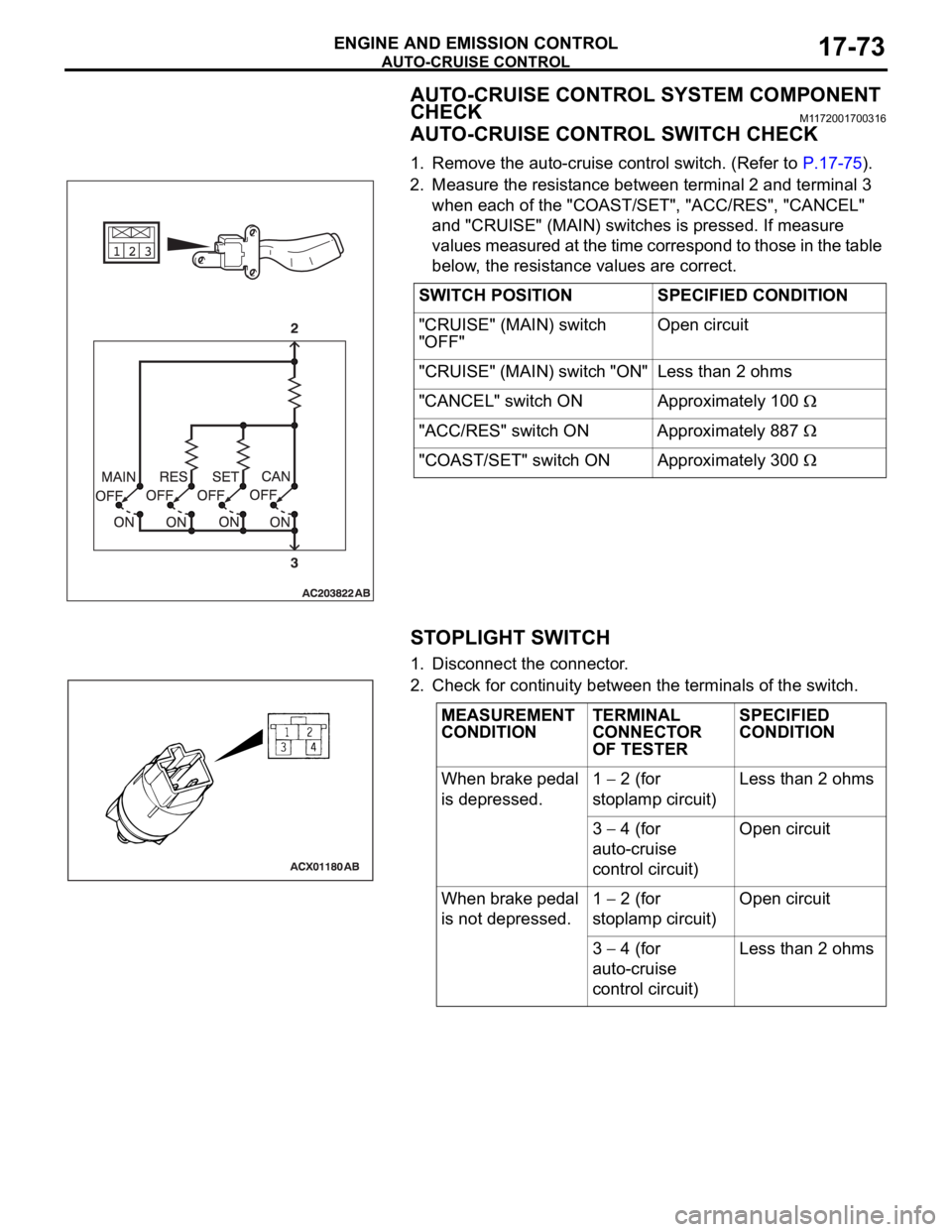
AUTO-CRUISE CONTROL SWITCH CHECK
1. Remove the auto-cruise control switch. (Refer to P.17-75).
2. Measure the resistance between terminal 2 and terminal 3
when each of the "COAST/SET", "ACC/RES", "CANCEL"
and "CRUISE" (MAIN) switches is pressed. If measure
values measured at the time correspond to those in the table
below, the resistance values are correct.
STOPLIGHT SWITCH
1. Disconnect the connector.
2. Check for continuity between the terminals of the switch.SWITCH POSITION SPECIFIED CONDITION
"CRUISE" (MAIN) switch
"OFF"Open circuit
"CRUISE" (MAIN) switch "ON" Less than 2 ohms
"CANCEL" switch ON Approximately 100
"ACC/RES" switch ON Approximately 887
"COAST/SET" switch ON Approximately 300
MEASUREMENT
CONDITIONTERMINAL
CONNECTOR
OF TESTERSPECIFIED
CONDITION
When brake pedal
is depressed.1
2 (for
stoplamp circuit)Less than 2 ohms
3
4 (for
auto-cruise
control circuit)Open circuit
When brake pedal
is not depressed.1
2 (for
stoplamp circuit)Open circuit
3
4 (for
auto-cruise
control circuit)Less than 2 ohms
Page 1406 of 1500
AUTO-CRUISE CONTROL
ENGINE AND EMISSION CONTROL17-75
AUTO-CRUISE CONTROL
REMOVAL AND INSTALLATIONM1172001400467
Before removal of the air bag module, refer to GROUP 52B, SRS Service Precautions
P.52B-16 and GROUP 52B, Air Bag Module and Clock Spring P.52B-237.
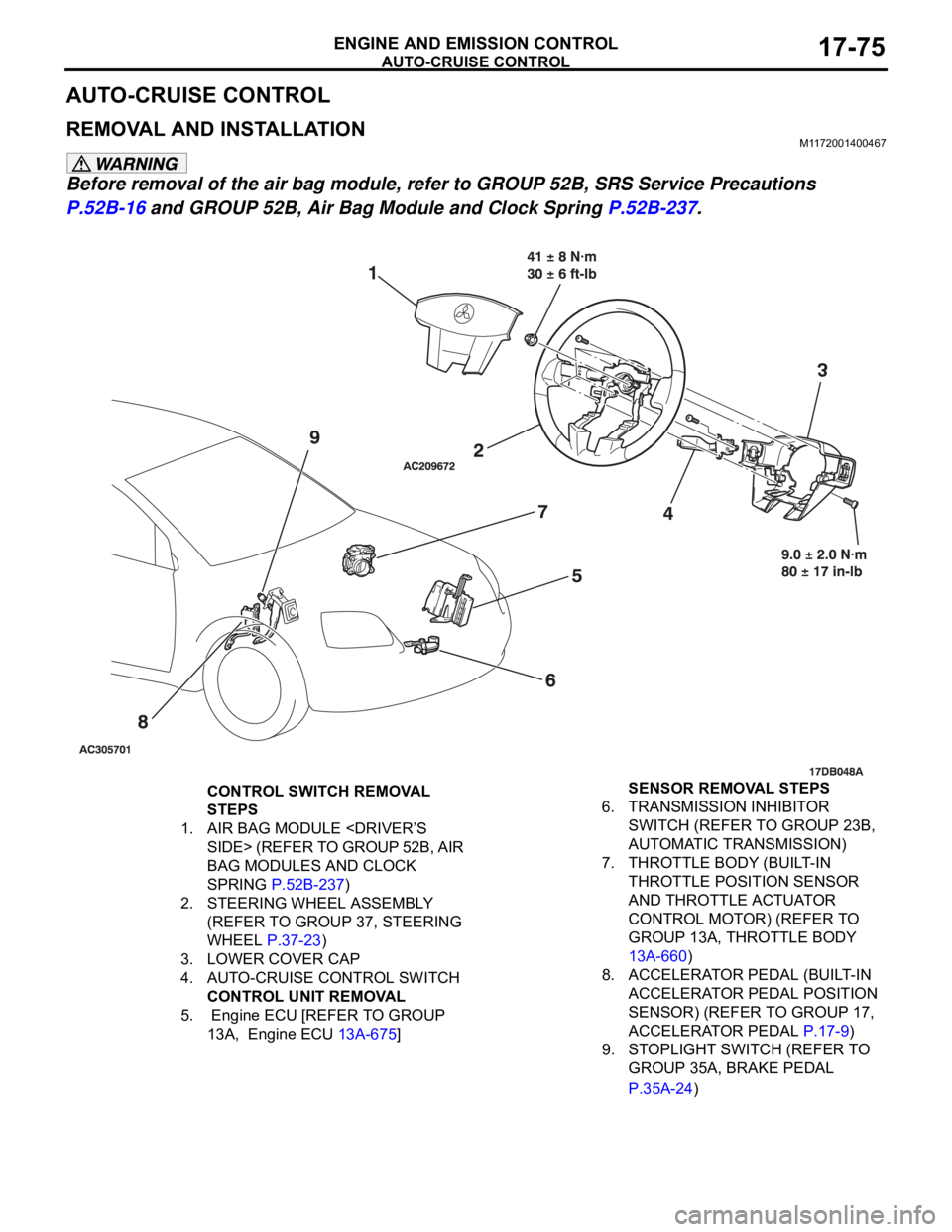
CONTROL SWITCH REMOVAL
STEPS
1. AIR BAG MODULE
BAG MODULES AND CLOCK
SPRING P.52B-237)
2. STEERING WHEEL ASSEMBLY
(REFER TO GROUP 37, STEERING
WHEEL P.37-23)
3. LOWER COVER CAP
4. AUTO-CRUISE CONTROL SWITCH
CONTROL UNIT REMOVAL
5. Engine ECU [REFER TO GROUP
13A, Engine ECU 13A-675] SENSOR REMOVAL STEPS
6. TRANSMISSION INHIBITOR
SWITCH (REFER TO GROUP 23B,
AUTOMATIC TRANSMISSION)
7. THROTTLE BODY (BUILT-IN
THROTTLE POSITION SENSOR
AND THROTTLE ACTUATOR
CONTROL MOTOR) (REFER TO
GROUP 13A, THROTTLE BODY
13A-660)
8. ACCELERATOR PEDAL (BUILT-IN
ACCELERATOR PEDAL POSITION
SENSOR) (REFER TO GROUP 17,
ACCELERATOR PEDAL P.17-9)
9. STOPLIGHT SWITCH (REFER TO
GROUP 35A, BRAKE PEDAL
P.35A-24)
Page 1420 of 1500
FRONT AXLE DIAGNOSIS
FRONT AXLE26-3
2. Verify that the condition described by the
customer exists.3. Find the malfunction by following the Symptom
Chart.
4. Verify malfunction is eliminated.
SYMPTOM CHARTM1261005700269
SYMPTOM PROCEDURES
INSPECTION PROCEDURE 1: Noise during Wheel Rotation
DIAGNOSIS
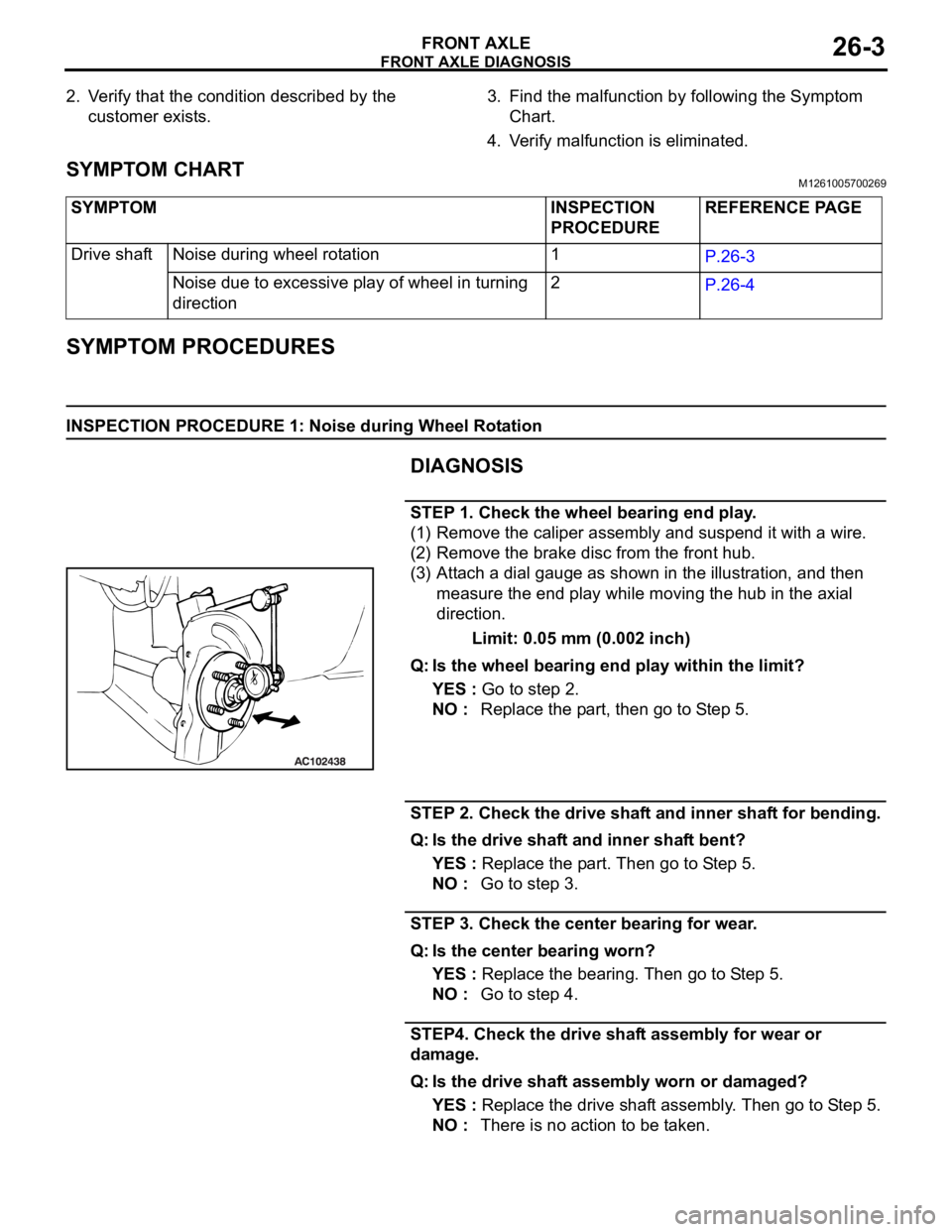
STEP 1. Check the wheel bearing end play.
(1) Remove the caliper assembly and suspend it with a wire.
(2) Remove the brake disc from the front hub.
(3) Attach a dial gauge as shown in the illustration, and then
measure the end play while moving the hub in the axial
direction.
Limit: 0.05 mm (0.002 inch)
Q: Is the wheel bearing end play within the limit?
YES : Go to step 2.
NO : Replace the part, then go to Step 5.
STEP 2. Check the drive shaft and inner shaft for bending.
Q: Is the drive shaft and inner shaft bent?
YES : Replace the part. Then go to Step 5.
NO : Go to step 3.
STEP 3. Check the center bearing for wear.
Q: Is the center bearing worn?
YES : Replace the bearing. Then go to Step 5.
NO : Go to step 4.
STEP4. Check the drive shaft assembly for wear or
damage.
Q: Is the drive shaft assembly worn or damaged?
YES : Replace the drive shaft assembly. Then go to Step 5.
NO : There is no action to be taken. SYMPTOM INSPECTION
PROCEDUREREFERENCE PAGE
Drive shaft Noise during wheel rotation 1
P.26-3
Noise due to excessive play of wheel in turning
direction2
P.26-4