air conditioning MITSUBISHI 380 2005 Workshop Manual
[x] Cancel search | Manufacturer: MITSUBISHI, Model Year: 2005, Model line: 380, Model: MITSUBISHI 380 2005Pages: 1500, PDF Size: 47.87 MB
Page 873 of 1500
REFRIGERANT LINE
HEATER, AIR CONDITIONING AND VENTILATION55-172
O-RING AND PIPE SERVICE POINT
.
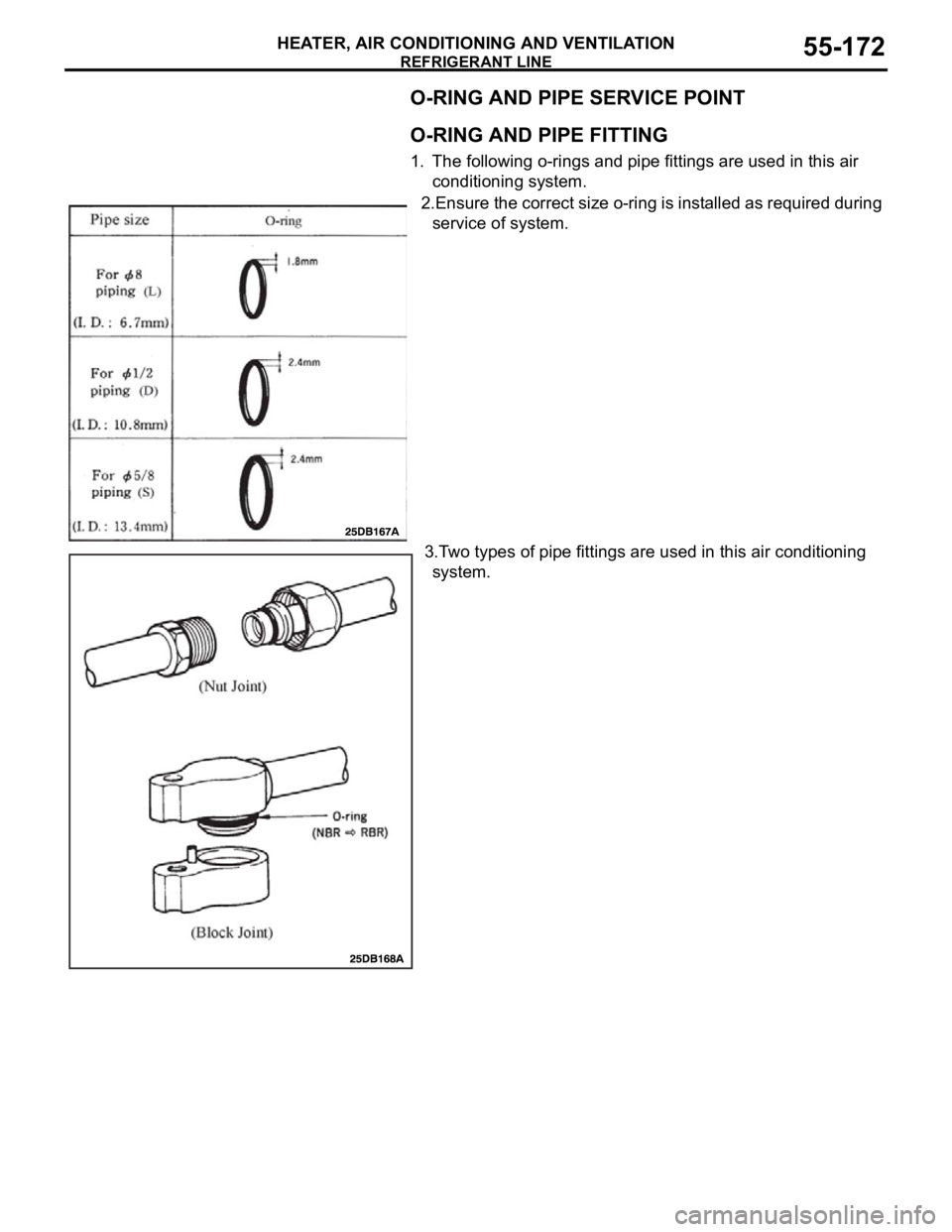
O-RING AND PIPE FITTING
1. The following o-rings and pipe fittings are used in this air
conditioning system.
2.Ensure the correct size o-ring is installed as required during
service of system.
3.Two types of pipe fittings are used in this air conditioning
system.
.
Page 874 of 1500
REFRIGERANT LINE
HEATER, AIR CONDITIONING AND VENTILATION55-173
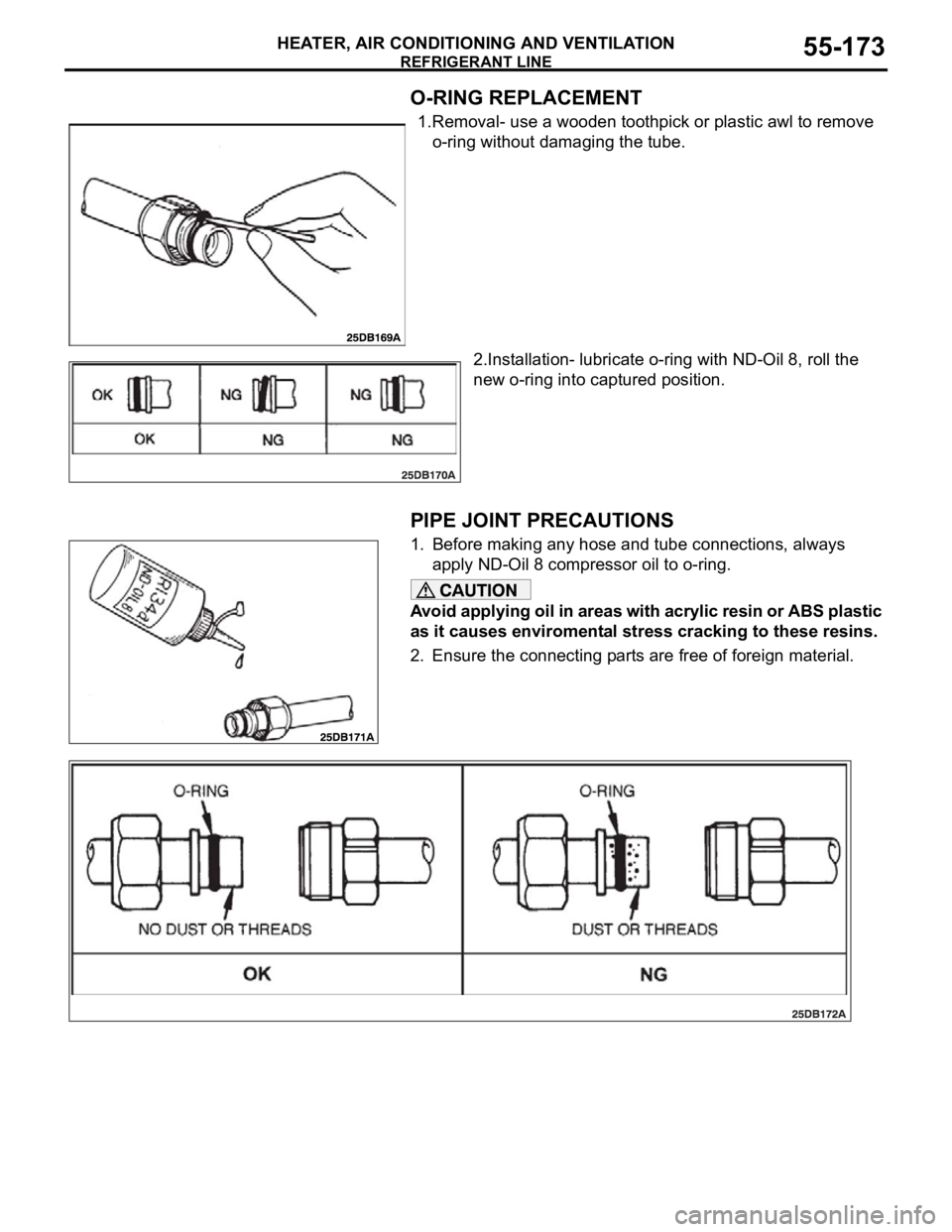
O-RING REPLACEMENT
1.Removal- use a wooden toothpick or plastic awl to remove
o-ring without damaging the tube.
2.Installation- lubricate o-ring with ND-Oil 8, roll the
new o-ring into captured position.
.
PIPE JOINT PRECAUTIONS
1. Before making any hose and tube connections, always
apply ND-Oil 8 compressor oil to o-ring.
Avoid applying oil in areas with acrylic resin or ABS plastic
as it causes enviromental stress cracking to these resins.
2. Ensure the connecting parts are free of foreign material.
Page 875 of 1500
REFRIGERANT LINE
HEATER, AIR CONDITIONING AND VENTILATION55-174
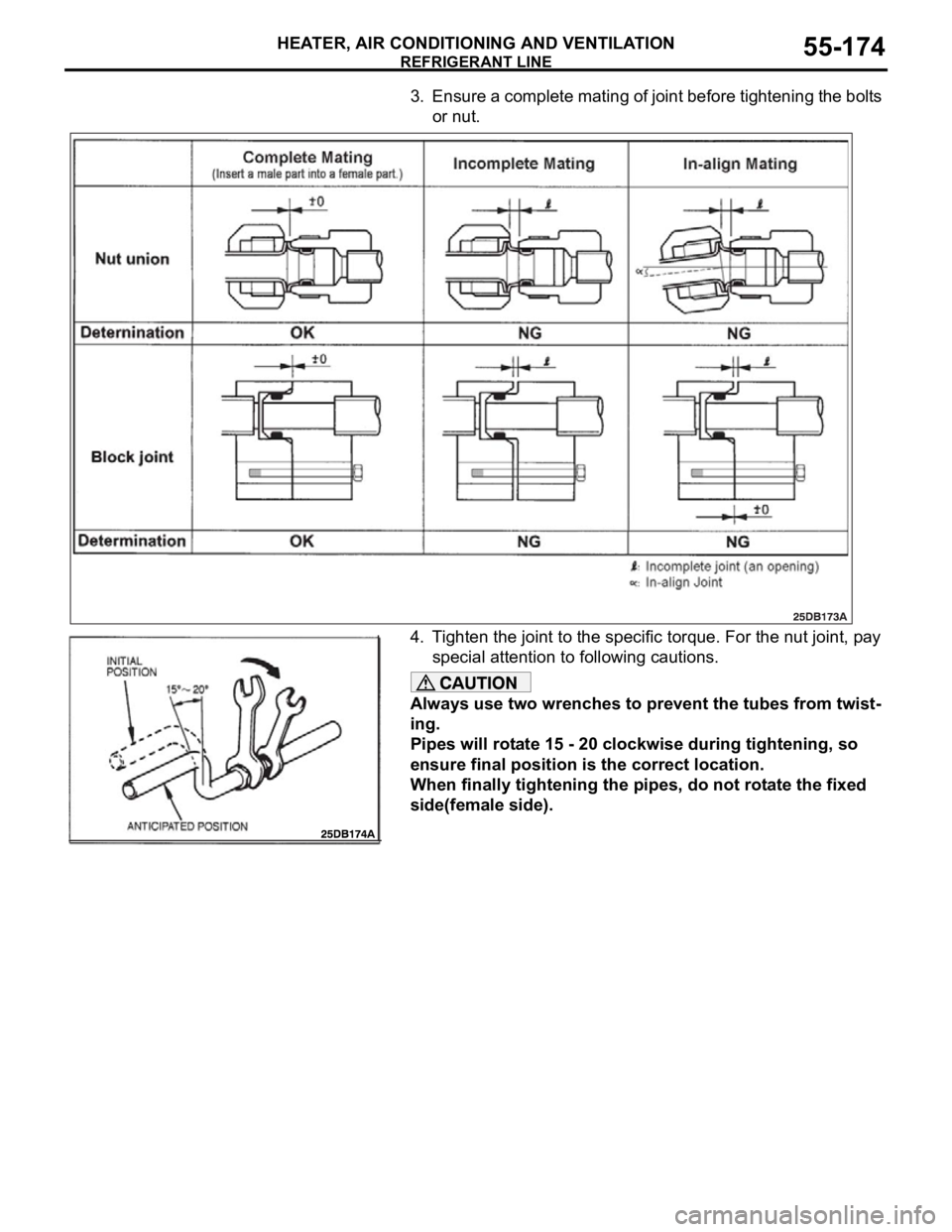
3. Ensure a complete mating of joint before tightening the bolts
or nut.
4. Tighten the joint to the specific torque. For the nut joint, pay
special attention to following cautions.
Always use two wrenches to prevent the tubes from twist-
ing.
Pipes will rotate 15 - 20 clockwise during tightening, so
ensure final position is the correct location.
When finally tightening the pipes, do not rotate the fixed
side(female side).
Page 876 of 1500
DUCTS
HEATER, AIR CONDITIONING AND VENTILATION55-175
DUCTS
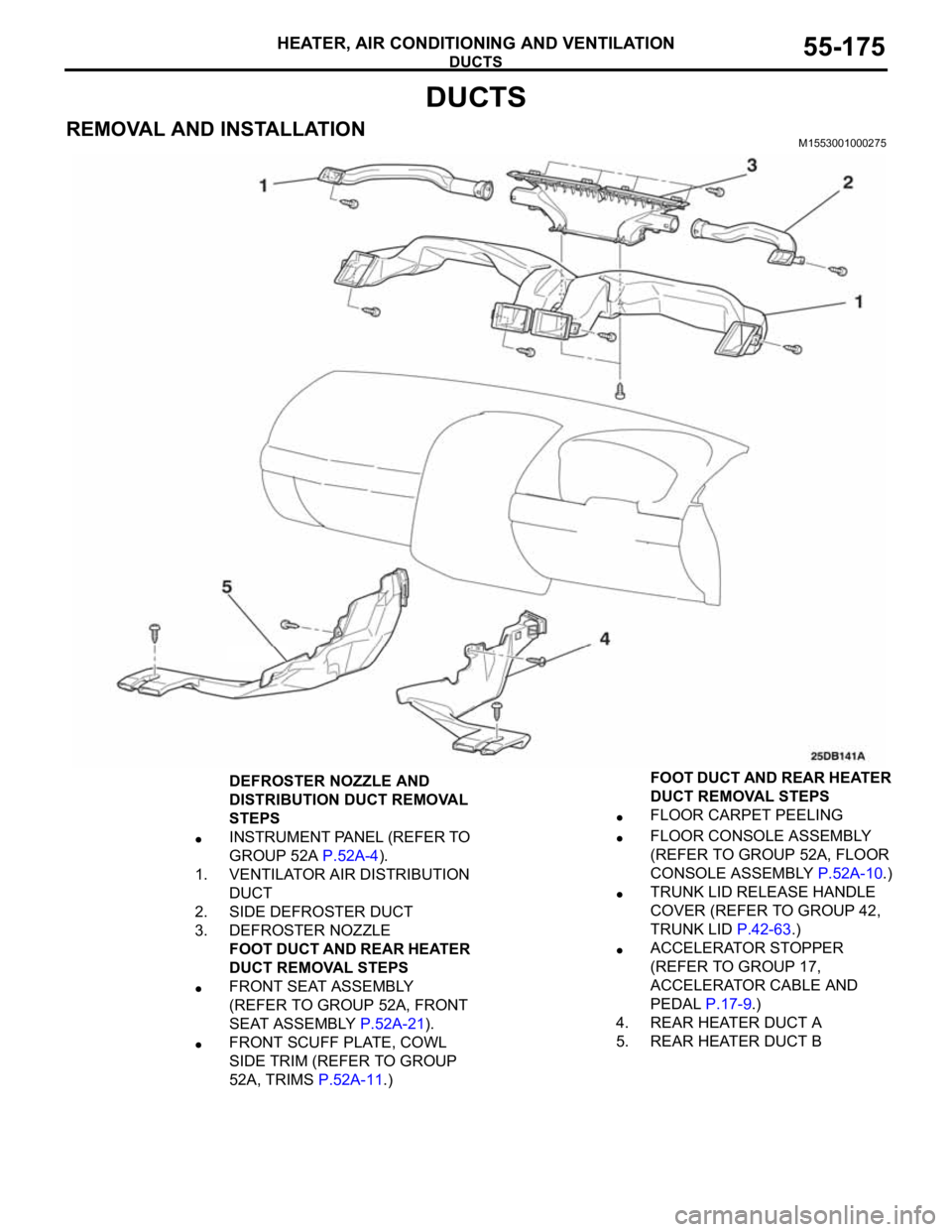
REMOVAL AND INSTALLATIONM1553001000275
DEFROSTER NOZZLE AND
DISTRIBUTION DUCT REMOVAL
STEPS
INSTRUMENT PANEL (REFER TO
GROUP 52A P.52A-4).
1. VENTILATOR AIR DISTRIBUTION
DUCT
2. SIDE DEFROSTER DUCT
3. DEFROSTER NOZZLE
FOOT DUCT AND REAR HEATER
DUCT REMOVAL STEPS
FRONT SEAT ASSEMBLY
(REFER TO GROUP 52A, FRONT
SEAT ASSEMBLY P.52A-21).
FRONT SCUFF PLATE, COWL
SIDE TRIM (REFER TO GROUP
52A, TRIMS P.52A-11.)
FLOOR CARPET PEELING
FLOOR CONSOLE ASSEMBLY
(REFER TO GROUP 52A, FLOOR
CONSOLE ASSEMBLY P.52A-10.)
TRUNK LID RELEASE HANDLE
COVER (REFER TO GROUP 42,
TRUNK LID P.42-63.)
ACCELERATOR STOPPER
(REFER TO GROUP 17,
ACCELERATOR CABLE AND
PEDAL P.17-9.)
4. REAR HEATER DUCT A
5. REAR HEATER DUCT BFOOT DUCT AND REAR HEATER
DUCT REMOVAL STEPS
Page 877 of 1500
DUCTS
HEATER, AIR CONDITIONING AND VENTILATION55-176
DUCTS Cont.
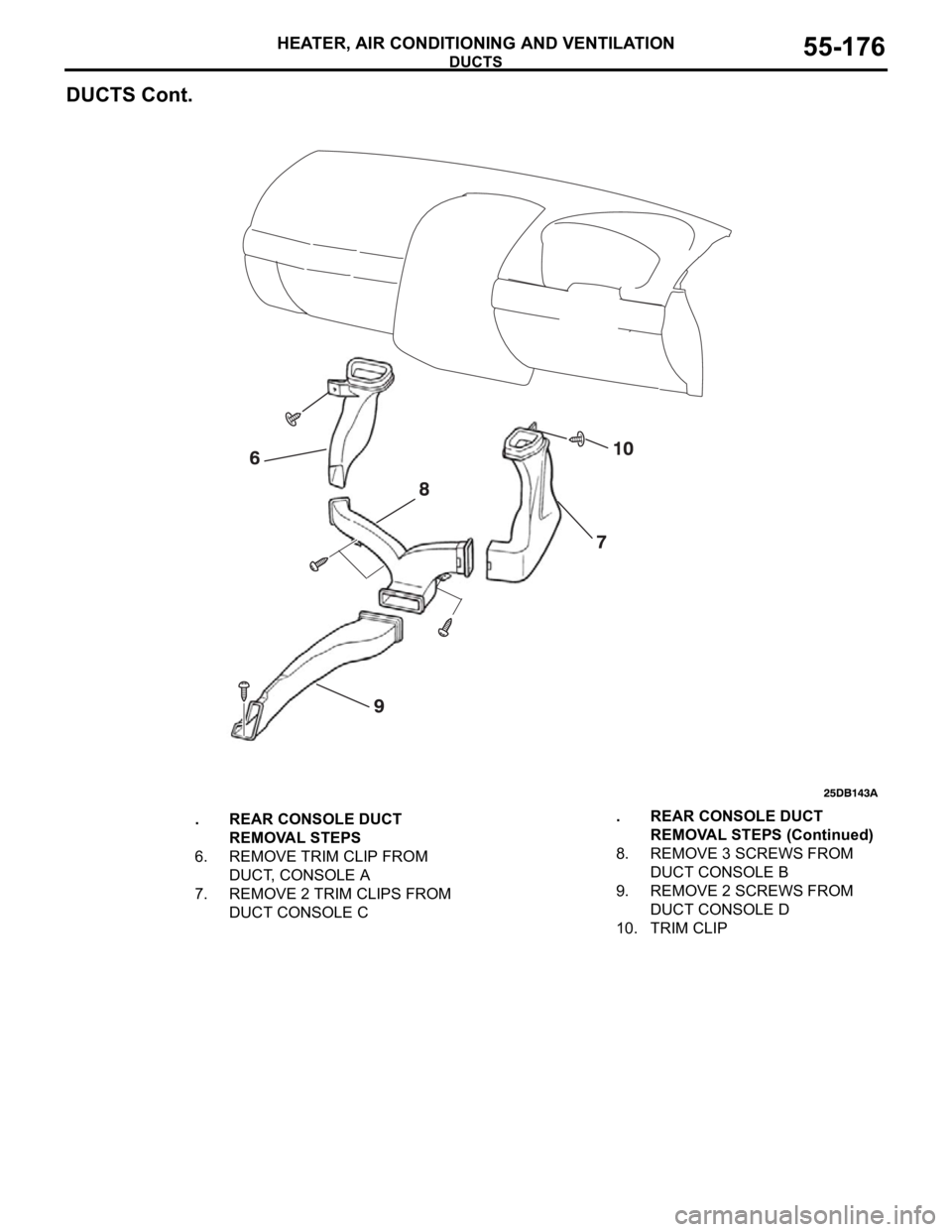
. REAR CONSOLE DUCT
REMOVAL STEPS
6. REMOVE TRIM CLIP FROM
DUCT, CONSOLE A
7. REMOVE 2 TRIM CLIPS FROM
DUCT CONSOLE C8. REMOVE 3 SCREWS FROM
DUCT CONSOLE B
9. REMOVE 2 SCREWS FROM
DUCT CONSOLE D
10. TRIM CLIP . REAR CONSOLE DUCT
REMOVAL STEPS (Continued)
Page 878 of 1500
VENTILATORS
HEATER, AIR CONDITIONING AND VENTILATION55-177
VENTILATORS
REMOVAL AND INSTALLATIONM1553001600352
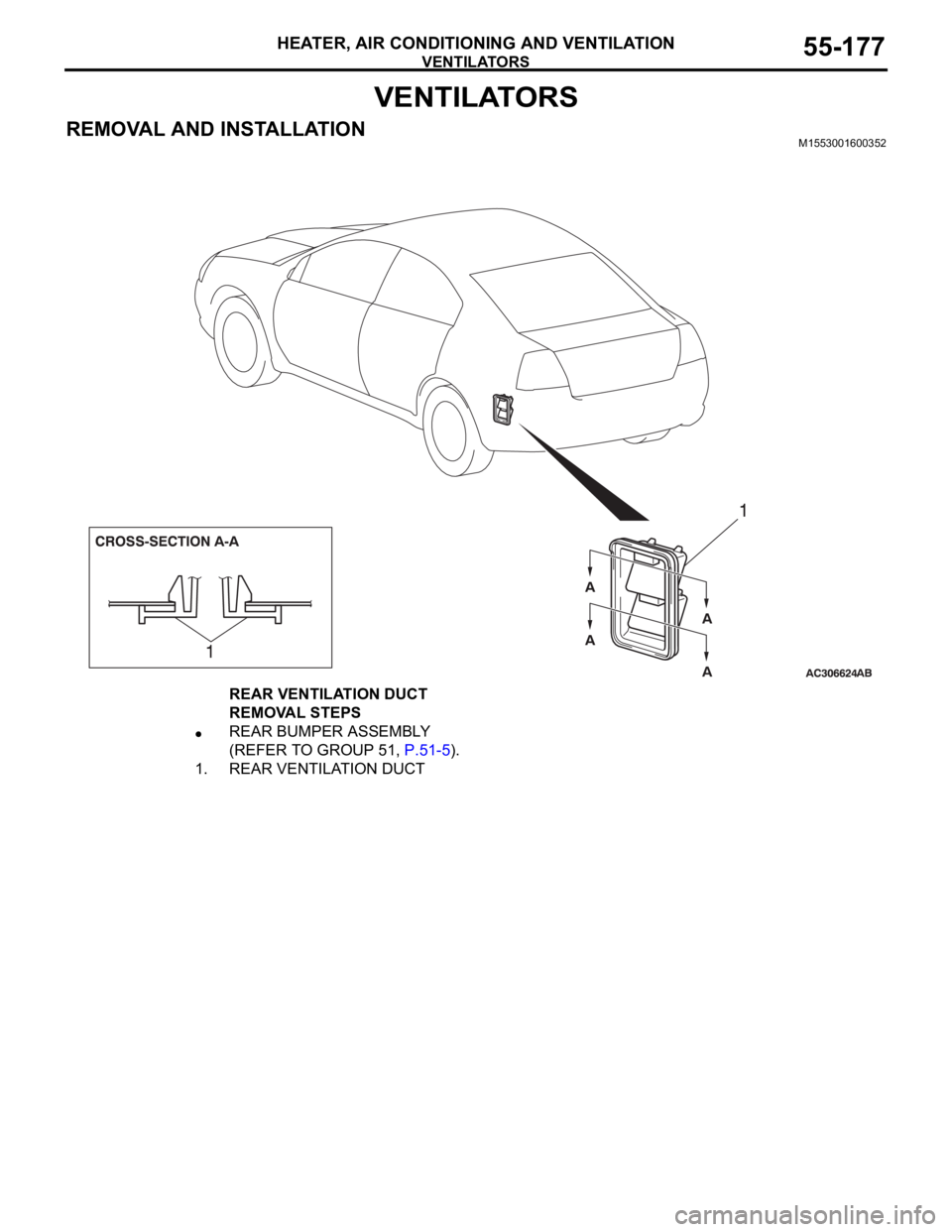
REAR VENTILATION DUCT
REMOVAL STEPS
REAR BUMPER ASSEMBLY
(REFER TO GROUP 51, P.51-5).
1. REAR VENTILATION DUCT
Page 879 of 1500

SPECIFICATIONS
HEATER, AIR CONDITIONING AND VENTILATION55-178
SPECIFICATIONS
FASTENER TIGHTENING SPECIFICATIONSM1552012100273
GENERAL SPECIFICATIONSM1552000200262
SERVICE SPECIFICATIONSM1552000300333
LUBRICANTSM1552000400329
ITEM SPECIFICATION
Liquid pipe mounting nut (heater unit side) 4.9
0.9 Nm (43 8 in-lb)
Liquid pipe mounting bolt (condenser side) 4.9
0.9 Nm (44 8 in-lb)
Suction flexible hose mounting nut (compressor side) 25
4 Nm (18 3 ft-lb)
Suction pipe mounting nut (heater unit side) 12
2 Nm (107 17 in-lb)
Suction pipe to suction hose union nut 32
2 Nm
Discharge flexible hose mounting bolt (compressor side) 25
4 Nm (18 3 ft-lb)
Discharge flexible hose mounting nut (condenser side) 12
2 Nm (107 17 in-lb)
ITEM MANUAL AIR CONDITIONING
Heater control Dial type
Air conditioning switch Push-button type
Compressor Type 10S17 (Swashplate type)
Displacement (cm
3)188
Refrigerant Type R134a (HFC-134a)
Amount (grams) 435
475
ITEM STANDARD VALUE
Idle speed r/min 680
50
Idle-up speed r/min 680
50
Air mix damper potentiometer resistance k
1.7 5.0
Air outlet changeover damper potentiometer resistance k
0.8 4.8
Air gap (air conditioning compressor clutch) mm (in) 0.3
0.5 (0.012 0.020)
ITEM SPECIFIED LUBRICANT QUANTITY(ml)
Each connection of refrigerant line ND Oil 8 As required
Compressor refrigerant unit lubricant (ml) ND Oil 8 140
Page 980 of 1500
CHARGING SYSTEM
ENGINE ELECTRICAL16-3
CHARGING SYSTEM DIAGNOSISM1161000700427
TROUBLESHOOTING HINTS
Alternator malfunction light dose not go on when the ignition
switch is turned to ON, before the engine starts.
Check the bulb.
Alternator malfunction light dose not switch off after the engine
starts.
Check the IC voltage regulator inside the
alternatoralternator.
Discharged or overcharged battery.
Check the IC voltage regulator inside the alternator.
The alternator malfunction light illuminates dimly.
Check the diode (inside the combination meter) for a
short-circuit.
TROUBLESHOOTING GUIDE
The charging system troubleshooting guide is shown in the fol-
lowing steps.
STEP 1.
Q: Is the battery in good condition? (Refer to GROUP 54A,
Chassis Electrical
Battery On-vehicle Service
Battery Check P.54A-5.)
YES : Go to Step 2.
NO : Charge or replace the battery.
STEP 2.
Q: Is the alternator drive belt in good condition? (Refer to
GROUP 00, General
Maintenance Service Drive Belts
(For Alternator, Power Steering Pump and Air
Conditioning) (Check) P.00-39.)
YES : Go to Step 3.
NO : Adjust the belt tension or replace the belt.
STEP 3.
Q: Does the alternator malfunction light come on when the
ignition switch is turned on?
YES : Go to Step 4.
NO :
Check the ignition switch. (Refer to GROUP 54A,
Chassis Electrical
Ignition Switch Ignition
Switch
Inspection P.54A-44.)
Check for burnt-out alternator malfunction light.
Check the alternator. (Refer to Charging System
Alternator Assembly
Inspection P.16-17.)
Check the alternator malfunction light-related
circuits.
Page 984 of 1500
CHARGING SYSTEM
ENGINE ELECTRICAL16-7
ON-VEHICLE SERVICE
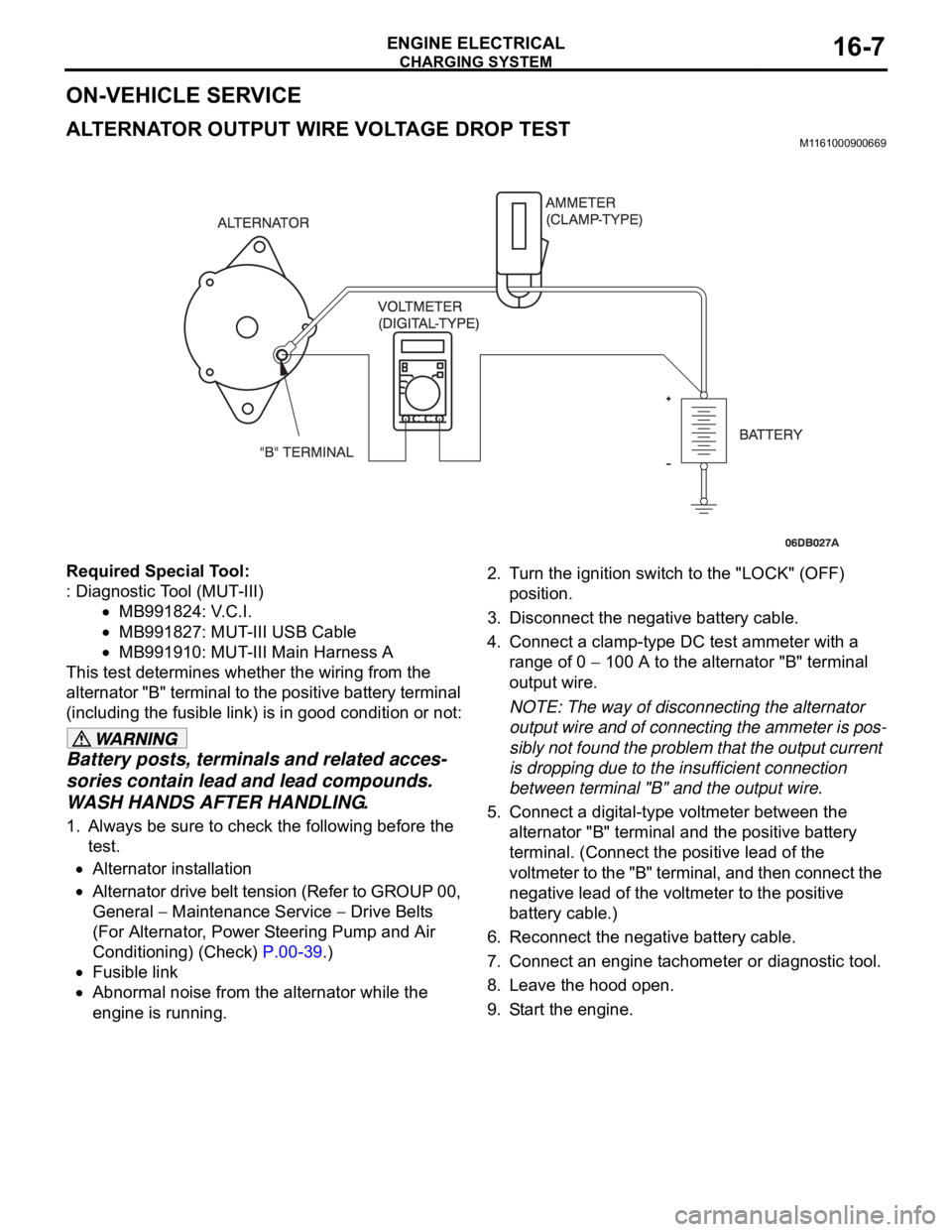
ALTERNATOR OUTPUT WIRE VOLTAGE DROP TESTM1161000900669
Required Special Tool:
: Diagnostic Tool (MUT-III)
MB991824: V.C.I.
MB991827: MUT-III USB Cable
MB991910: MUT-III Main Harness A
This test determines whether the wiring from the
alternator "B" terminal to the positive battery terminal
(including the fusible link) is in good condition or not:
Battery posts, terminals and related acces-
sories contain lead and lead compounds.
WASH HANDS AFTER HANDLING.
1. Always be sure to check the following before the
test.
Alternator installation
Alternator drive belt tension (Refer to GROUP 00,
General
Maintenance Service Drive Belts
(For Alternator, Power Steering Pump and Air
Conditioning) (Check) P.00-39.)
Fusible link
Abnormal noise from the alternator while the
engine is running.2. Turn the ignition switch to the "LOCK" (OFF)
position.
3. Disconnect the negative battery cable.
4. Connect a clamp-type DC test ammeter with a
range of 0
100 A to the alternator "B" terminal
output wire.
NOTE: The way of disconnecting the alternator
output wire and of connecting the ammeter is pos-
sibly not found the problem that the output current
is dropping due to the insufficient connection
between terminal "B" and the output wire.
5. Connect a digital-type voltmeter between the
alternator "B" terminal and the positive battery
terminal. (Connect the positive lead of the
voltmeter to the "B" terminal, and then connect the
negative lead of the voltmeter to the positive
battery cable.)
6. Reconnect the negative battery cable.
7. Connect an engine tachometer or diagnostic tool.
8. Leave the hood open.
9. Start the engine.
Page 986 of 1500
CHARGING SYSTEM
ENGINE ELECTRICAL16-9
Required Special Tool:
: Diagnostic Tool (MUT-III)
MB991824: V.C.I.
MB991827: MUT-III USB Cable
MB991910: MUT-III Main Harness A
This test determines whether the alternator outputs
normal current. For best results, use a charging sys-
tem tester. If not available, follow the steps below.
Battery posts, terminals and related acces-
sories contain lead and lead compounds.
WASH HANDS AFTER HANDLING.
1. Before the test, always be sure to check the
following.
Alternator installation
Battery (Refer to GROUP 54A, Chassis Electrical
Battery On-vehicle Service Battery Check
P.54A-5.)
NOTE: The battery to be used should be slightly
discharged. The load in a fully-charged battery
will be insufficient and the test may not be able to
be carried out correctly.
Alternator drive belt tension (Refer to GROUP 00,
General
Maintenance Service Drive Belts
(For Alternator, Power Steering Pump and Air
Conditioning) (Check) P.00-39.)
Fusible link
Abnormal noise from the alternator while the
engine is running.
2. Turn the ignition switch to the "LOCK" (OFF)
position.
3. Disconnect the negative battery cable.
Never use clips to connect the wire. Loose
connections (for example, using clips) will
lead to a serious accident because of high
current.
4. Connect a clamp-type DC test ammeter with a
range of 0
120 A to the alternator "B" terminal
output wire.
5. Connect a voltmeter with a range of 0
20 V
between the alternator "B" terminal and ground.
(Connect the positive lead of the voltmeter to the
"B" terminal, and then connect the negative lead
of the voltmeter to ground.)
6. Connect the negative battery cable.
7. Connect an engine tachometer or diagnostic tool.
8. Leave the hood open.9. Check to be sure that the reading on the voltmeter
is equal to the battery positive voltage.
NOTE: If the voltage is 0 V, the cause is probably
an open circuit in the wire or fusible link between
the alternator "B" terminal and the battery positive
terminal or malfunctioning voltmeter.
10.After turning on the headlights, start the engine.
NOTE: Because the current from the battery will
soon drop after the engine is started, step 11
should be carried out as quickly as possible in
order to obtain the maximum current output value.
11.Immediately after setting the headlights to high
beam and turning the heater blower switch to the
highest position, increase the engine speed to
2,500 r/min and read the maximum current output
value displayed on the ammeter.
Limit value: 70 % of nominal current output
NOTE: For the nominal current output, refer to the
Alternator Specifications.
NOTE: The current output value will depend on
the electrical load and the temperature of the
alternator body.
NOTE: If the electrical load is small while testing,
the specified level of current may not be output
even though the alternator is normal. In such
cases, increase the electrical load by leaving the
headlights turned on for some time to discharge
the battery or by using the lighting system in
another vehicle, and then test again.
NOTE: The specified level of current also may not
be output if the temperature of the alternator body
or the ambient temperature is too high. In such
cases, cool the alternator and then test again.
12.The reading on the ammeter should be above the
limit value. If the reading is below the limit value
and the alternator output wire is normal, remove
the alternator from the engine and check the
alternator.
13.Run the engine at idle speed after the test.
14.Turn the ignition switch to the "LOCK" (OFF)
position.
15.Disconnect the engine tachometer or diagnostic
tool.
16.Disconnect the negative battery cable.
17.Disconnect the ammeter and voltmeter .
18.Connect the negative battery cable.
19.Run the engine for 10 minutes at an idle.