Coil MITSUBISHI 380 2005 Workshop Manual
[x] Cancel search | Manufacturer: MITSUBISHI, Model Year: 2005, Model line: 380, Model: MITSUBISHI 380 2005Pages: 1500, PDF Size: 47.87 MB
Page 557 of 1500
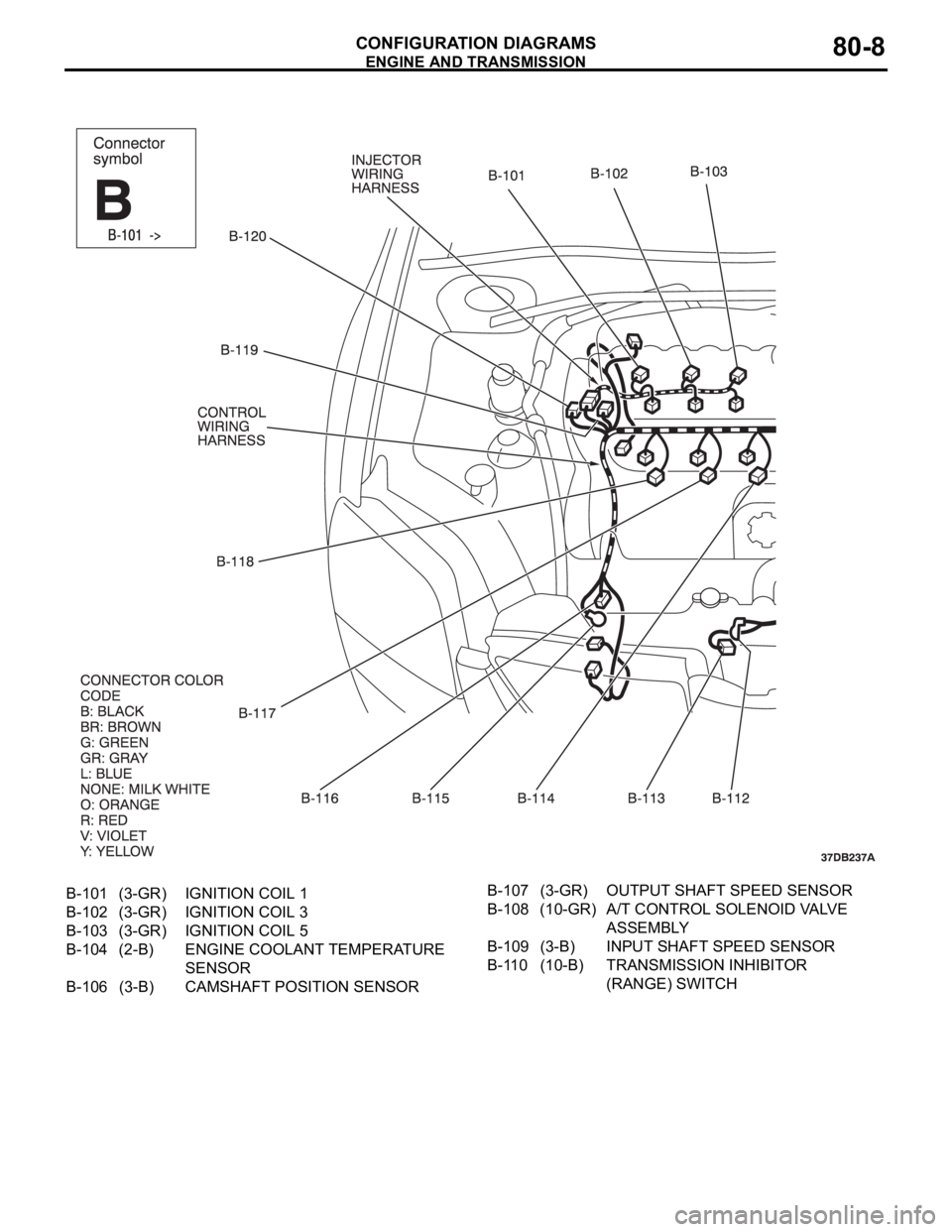
ENGINE AND TRANSMISSION
CONFIGURATION DIAGRAMS80-8
B-101 (3-GR) IGNITION COIL 1
B-102 (3-GR) IGNITION COIL 3
B-103 (3-GR) IGNITION COIL 5
B-104 (2-B) ENGINE COOLANT TEMPERATURE
SENSOR
B-106 (3-B) CAMSHAFT POSITION SENSORB-107 (3-GR) OUTPUT SHAFT SPEED SENSOR
B-108 (10-GR) A/T CONTROL SOLENOID VALVE
ASSEMBLY
B-109 (3-B) INPUT SHAFT SPEED SENSOR
B-110 (10-B) TRANSMISSION INHIBITOR
(RANGE) SWITCH
Page 558 of 1500
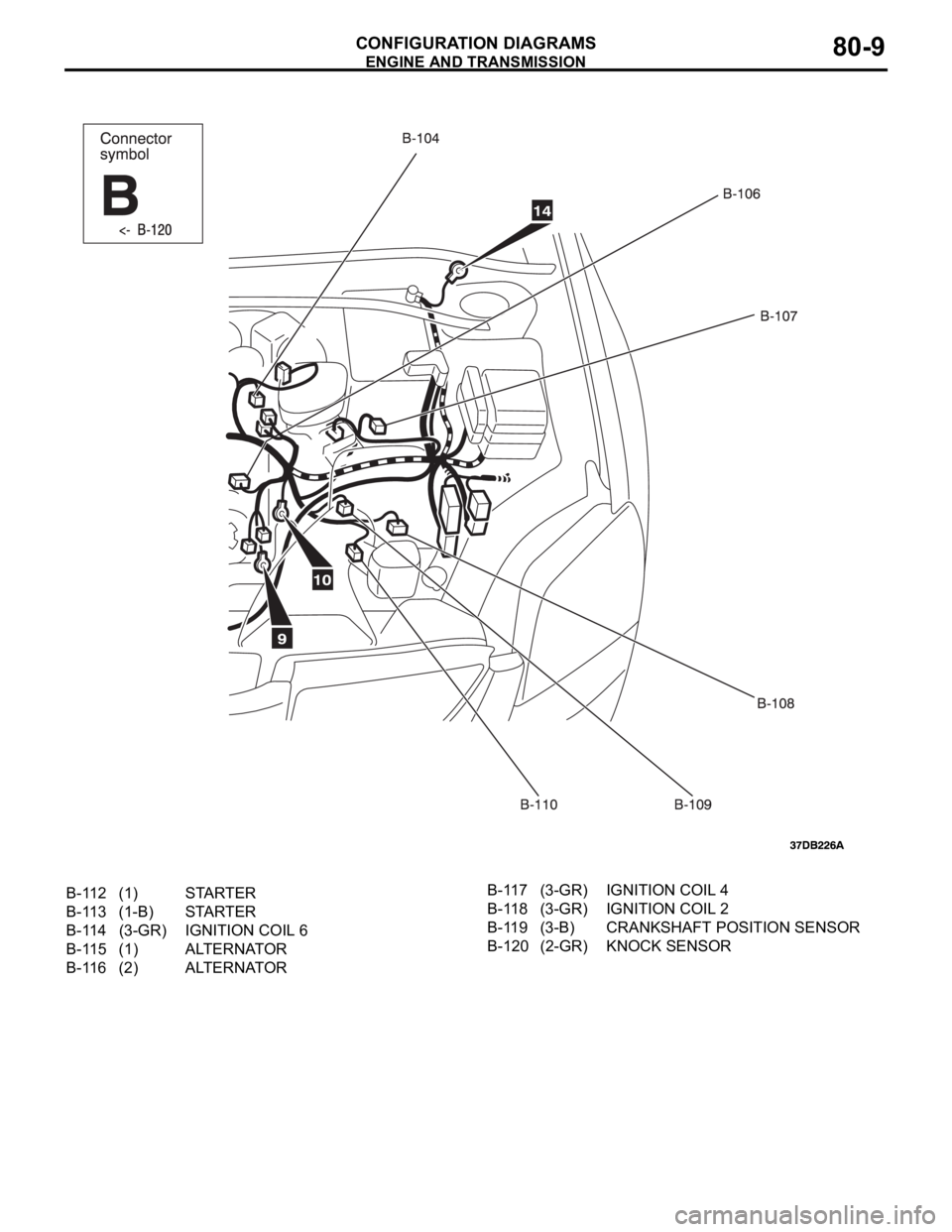
ENGINE AND TRANSMISSION
CONFIGURATION DIAGRAMS80-9
B-112 (1) STARTER
B-113 (1-B) STARTER
B-114 (3-GR) IGNITION COIL 6
B-115 (1) ALTERNATOR
B-116 (2) ALTERNATORB-117 (3-GR) IGNITION COIL 4
B-118 (3-GR) IGNITION COIL 2
B-119 (3-B) CRANKSHAFT POSITION SENSOR
B-120 (2-GR) KNOCK SENSOR
Page 566 of 1500
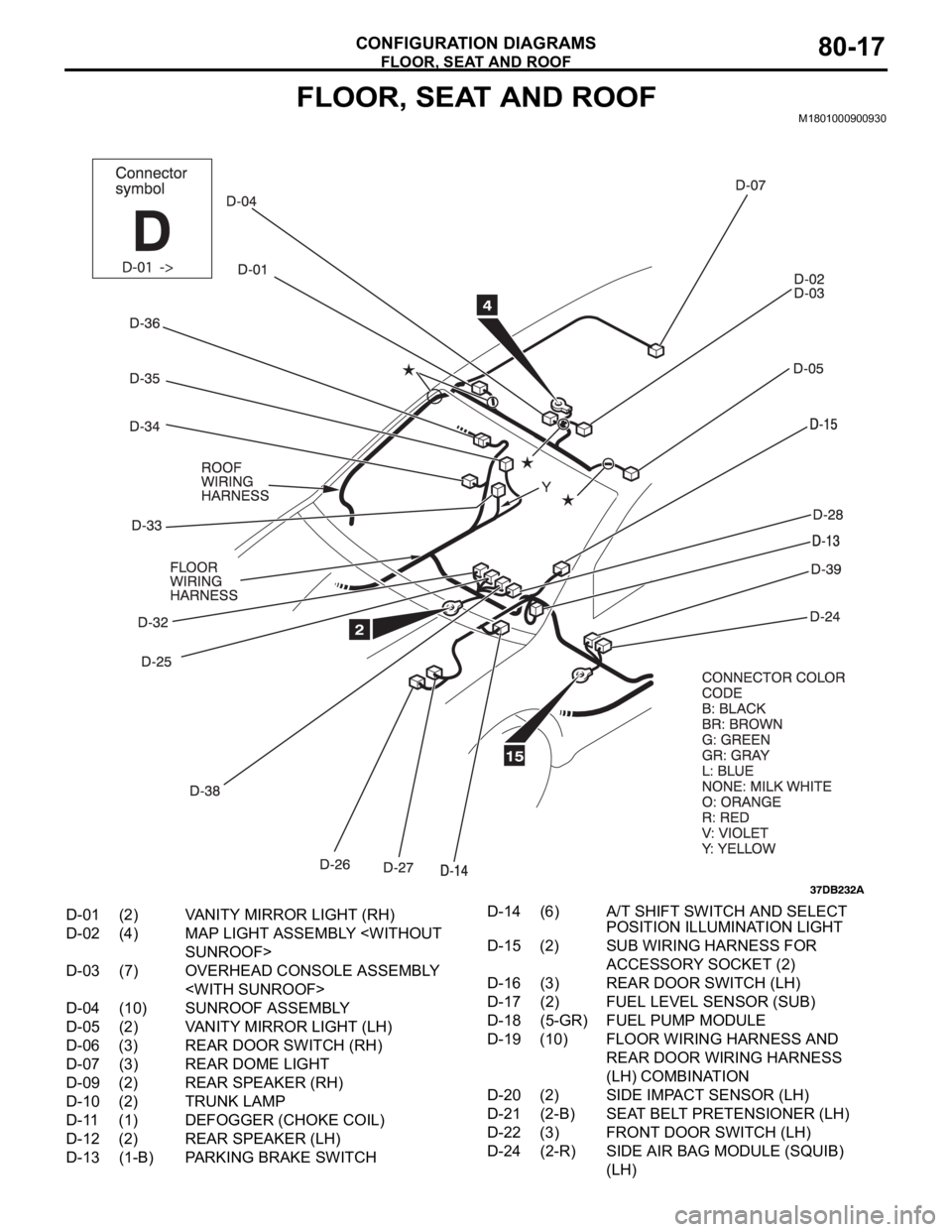
FLOOR, SEAT AND ROOF
CONFIGURATION DIAGRAMS80-17
FLOOR, SEAT AND ROOFM1801000900930
D-01 (2) VANITY MIRROR LIGHT (RH)
D-02 (4) MAP LIGHT ASSEMBLY
D-03 (7) OVERHEAD CONSOLE ASSEMBLY
D-04 (10) SUNROOF ASSEMBLY
D-05 (2) VANITY MIRROR LIGHT (LH)
D-06 (3) REAR DOOR SWITCH (RH)
D-07 (3) REAR DOME LIGHT
D-09 (2) REAR SPEAKER (RH)
D-10 (2) TRUNK LAMP
D-11 (1) DEFOGGER (CHOKE COIL)
D-12 (2) REAR SPEAKER (LH)
D-13 (1-B) PARKING BRAKE SWITCHD-14 (6) A/T SHIFT SWITCH AND SELECT
POSITION ILLUMINATION LIGHT
D-15 (2) SUB WIRING HARNESS FOR
ACCESSORY SOCKET (2)
D-16 (3) REAR DOOR SWITCH (LH)
D-17 (2) FUEL LEVEL SENSOR (SUB)
D-18 (5-GR) FUEL PUMP MODULE
D-19 (10) FLOOR WIRING HARNESS AND
REAR DOOR WIRING HARNESS
(LH) COMBINATION
D-20 (2) SIDE IMPACT SENSOR (LH)
D-21 (2-B) SEAT BELT PRETENSIONER (LH)
D-22 (3) FRONT DOOR SWITCH (LH)
D-24 (2-R) SIDE AIR BAG MODULE (SQUIB)
(LH)
Page 592 of 1500

CENTRALISED JUNCTION
CIRCUIT DIAGRAMS90-15
NO. POWER SUPPLY
CIRCUITNAME RATED
CAPACITY (A)HOUSING
COLOURLOAD CIRCUIT
1 Fusible link No.1 Fuse 30 Green Rear window demister
2 30 Green Blower motor and resistor
3
4
5 15 Blue Accessory socket
6 15 Blue Data link connector and ETACS-ECU
7 Ignition switch (ACC) 15 Blue ETACS-ECU
8
9 Ignition switch (IG2) 7.5 Brown Sunroof assembly
10 Ignition switch (ACC) 7.5 Brown Remote controlled mirror
11
12
13 Ignition switch (IG1) 7.5 Brown Fuel pump relay and Engine ECU
14 Ignition switch (ACC) 20 Yellow Windscreen wiper
15 Fusible link No.1
(Fuse No.5 in junction
block)7.5 Brown Remote controlled mirror
16 Ignition switch (IG2) 7.5 Brown A/C compressor clutch relay,
A/C-ECU, blower relay, condenser
fan motor, fan control relay,
front-ECU, outside/inside air selection
damper control motor and rear
window defogger relay
17 Ignition switch (IG1)
18 7.5 Brown A/T control relay, input shaft speed
sensor, output shaft speed sensor,
Engine ECU, rear combination lamp
and SRS-ECU
19 7.5 Brown ABS-ECU, ABS/TCL-ECU, column
switch, combination meter,
ETACS-ECU, multi-center display unit
and SRS-ECU
20 10 Red Ignition coil
21
22
23 Fusible link No.5 20 Yellow Sunroof assembly
24
Page 813 of 1500
AUTO A/C DIAGNOSIS
HEATER, AIR CONDITIONING AND VENTILATION55-112
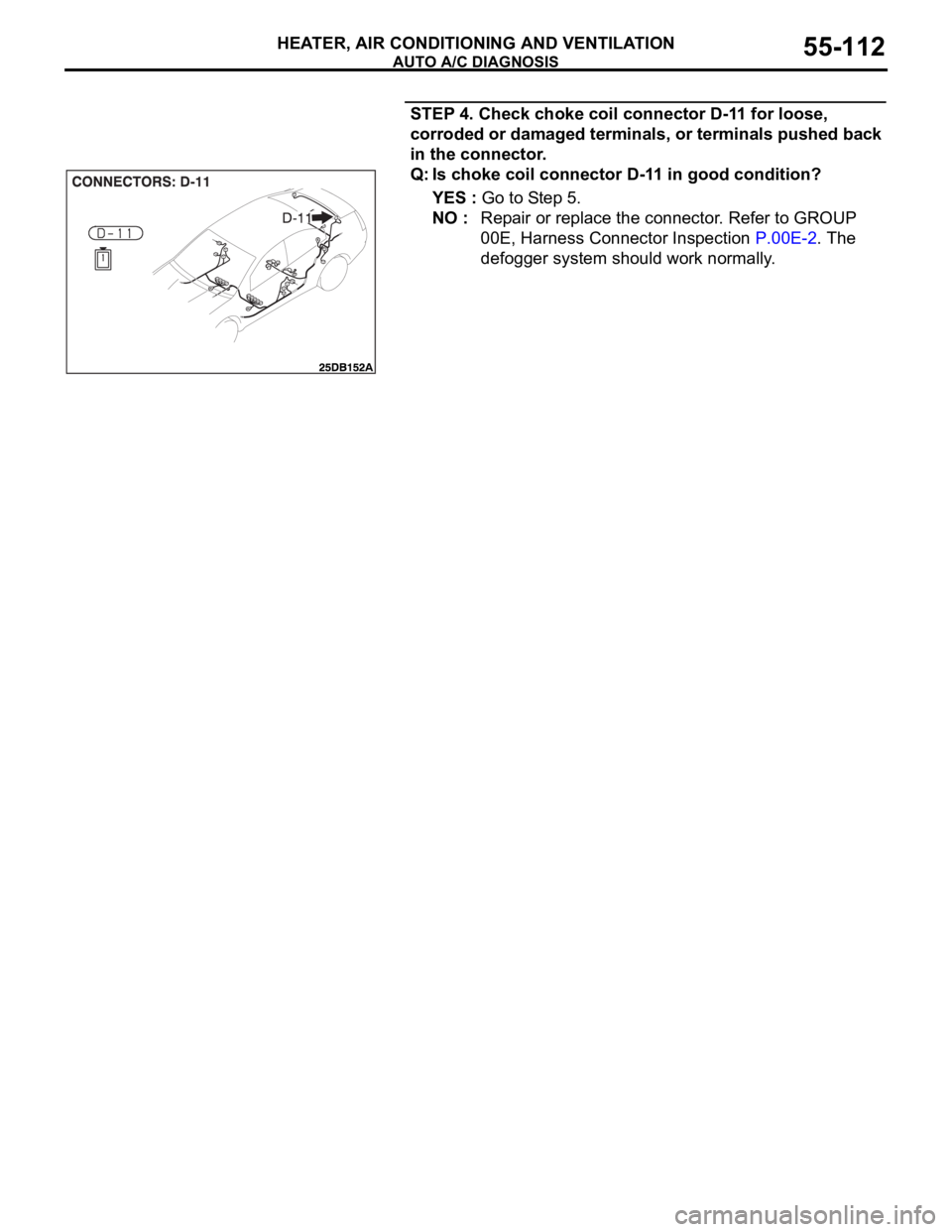
STEP 4. Check choke coil connector D-11 for loose,
corroded or damaged terminals, or terminals pushed back
in the connector.
Q: Is choke coil connector D-11 in good condition?
YES : Go to Step 5.
NO : Repair or replace the connector. Refer to GROUP
00E, Harness Connector Inspection P.00E-2. The
defogger system should work normally.
Page 814 of 1500
AUTO A/C DIAGNOSIS
HEATER, AIR CONDITIONING AND VENTILATION55-113
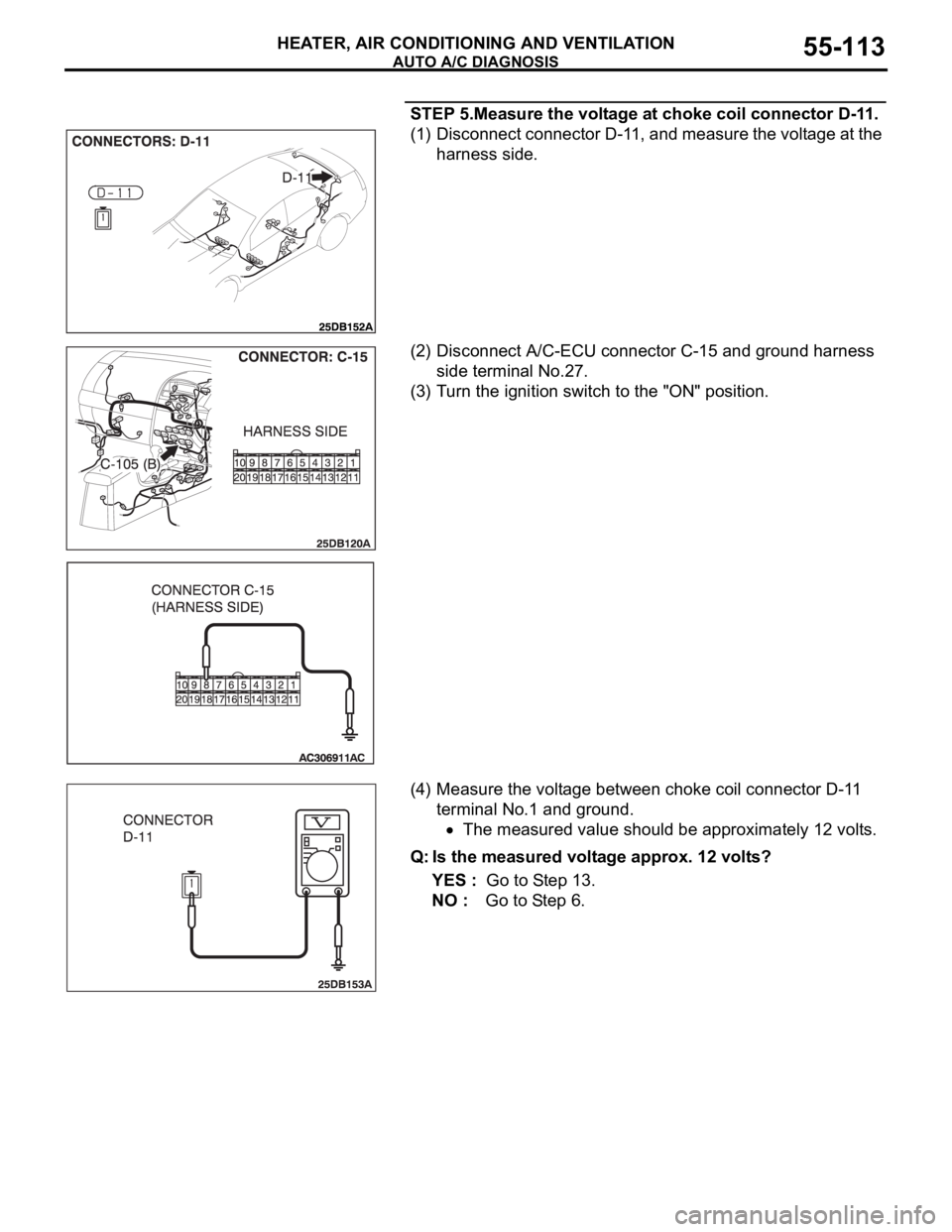
STEP 5.Measure the voltage at choke coil connector D-11.
(1) Disconnect connector D-11, and measure the voltage at the
harness side.
(2) Disconnect A/C-ECU connector C-15 and ground harness
side terminal No.27.
(3) Turn the ignition switch to the "ON" position.
(4) Measure the voltage between choke coil connector D-11
terminal No.1 and ground.
The measured value should be approximately 12 volts.
Q: Is the measured voltage approx. 12 volts?
YES : Go to Step 13.
NO : Go to Step 6.
Page 820 of 1500
AUTO A/C DIAGNOSIS
HEATER, AIR CONDITIONING AND VENTILATION55-119
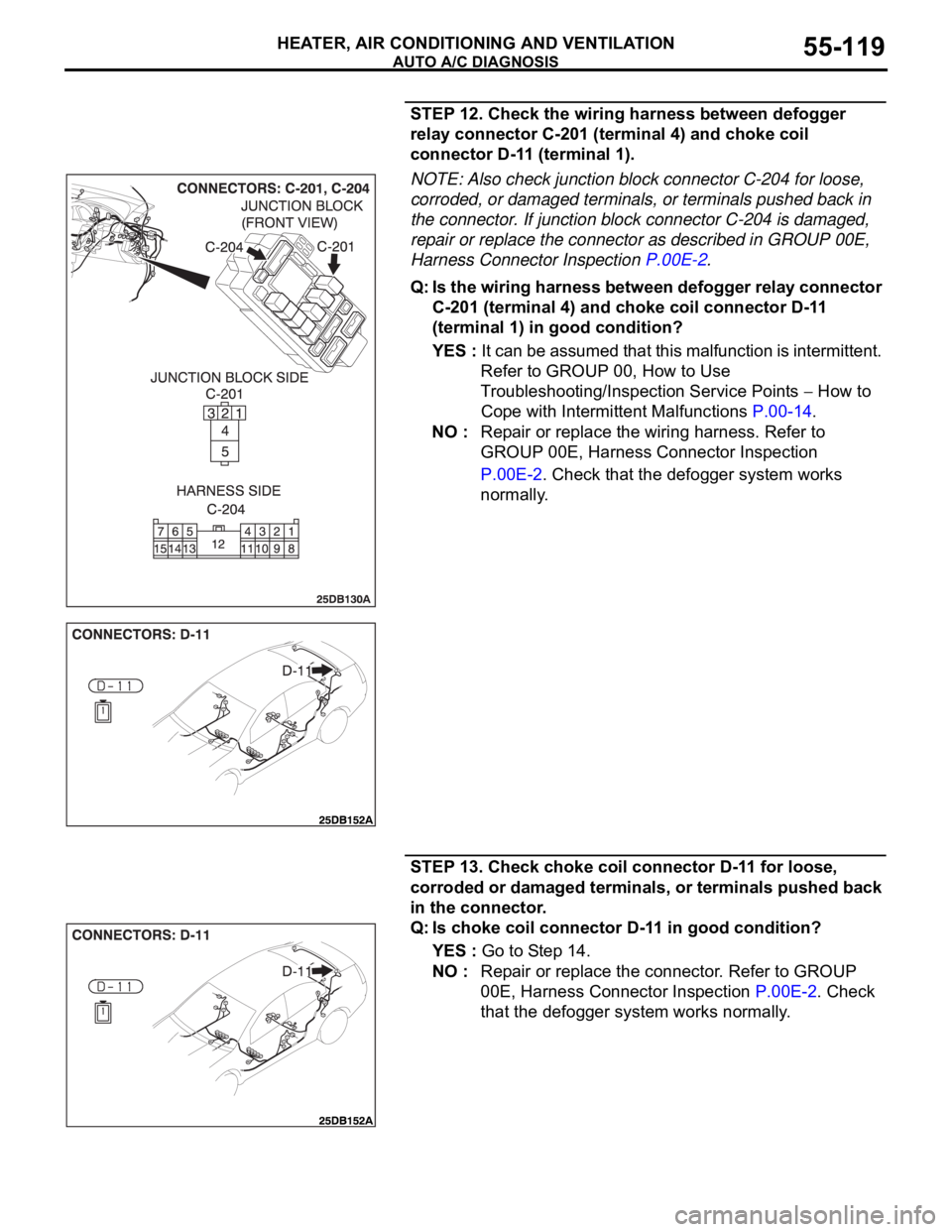
STEP 12. Check the wiring harness between defogger
relay connector C-201 (terminal 4) and choke coil
connector D-11 (terminal 1).
NOTE: Also check junction block connector C-204 for loose,
corroded, or damaged terminals, or terminals pushed back in
the connector. If junction block connector C-204 is damaged,
repair or replace the connector as described in GROUP 00E,
Harness Connector Inspection P.00E-2.
Q: Is the wiring harness between defogger relay connector
C-201 (terminal 4) and choke coil connector D-11
(terminal 1) in good condition?
YES : It can be assumed that this malfunction is intermittent.
Refer to GROUP 00, How to Use
Troubleshooting/Inspection Service Points
How to
Cope with Intermittent Malfunctions P.00-14.
NO : Repair or replace the wiring harness. Refer to
GROUP 00E, Harness Connector Inspection
P.00E-2. Check that the defogger system works
normally.
STEP 13. Check choke coil connector D-11 for loose,
corroded or damaged terminals, or terminals pushed back
in the connector.
Q: Is choke coil connector D-11 in good condition?
YES : Go to Step 14.
NO : Repair or replace the connector. Refer to GROUP
00E, Harness Connector Inspection P.00E-2. Check
that the defogger system works normally.
Page 821 of 1500
AUTO A/C DIAGNOSIS
HEATER, AIR CONDITIONING AND VENTILATION55-120
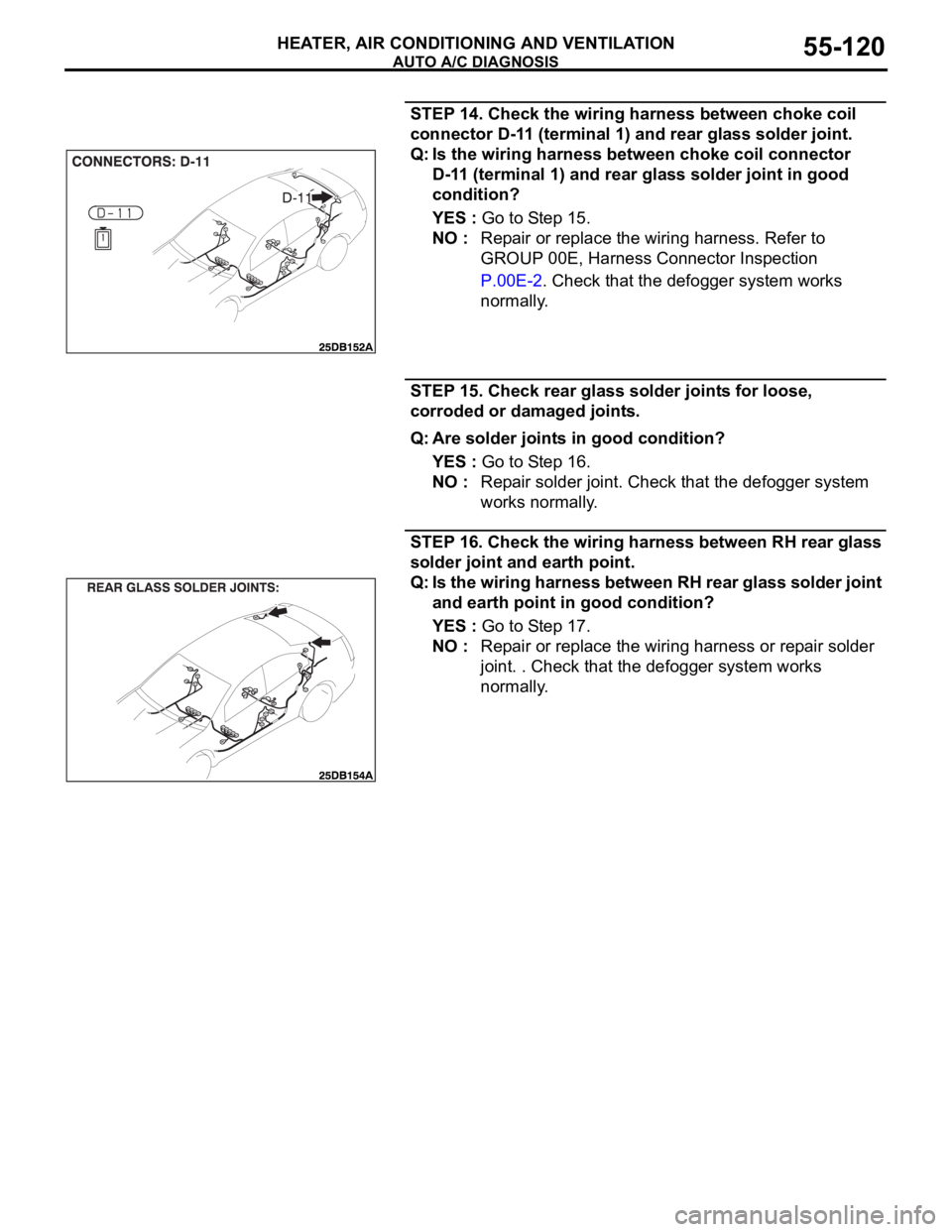
STEP 14. Check the wiring harness between choke coil
connector D-11 (terminal 1) and rear glass solder joint.
Q: Is the wiring harness between choke coil connector
D-11 (terminal 1) and rear glass solder joint in good
condition?
YES : Go to Step 15.
NO : Repair or replace the wiring harness. Refer to
GROUP 00E, Harness Connector Inspection
P.00E-2. Check that the defogger system works
normally.
STEP 15. Check rear glass solder joints for loose,
corroded or damaged joints.
Q: Are solder joints in good condition?
YES : Go to Step 16.
NO : Repair solder joint. Check that the defogger system
works normally.
STEP 16. Check the wiring harness between RH rear glass
solder joint and earth point.
Q: Is the wiring harness between RH rear glass solder joint
and earth point in good condition?
YES : Go to Step 17.
NO : Repair or replace the wiring harness or repair solder
joint. . Check that the defogger system works
normally.
Page 907 of 1500
HOW TO DIAGNOSE
GENERAL
5. Ohmmeter
An ohmmeter is used to check continuity or measure
resistance of a switch or coil. If the measuring range has
been changed, the zero point must be adjusted before
measurement.
CHECKING FUSESM1001005000044
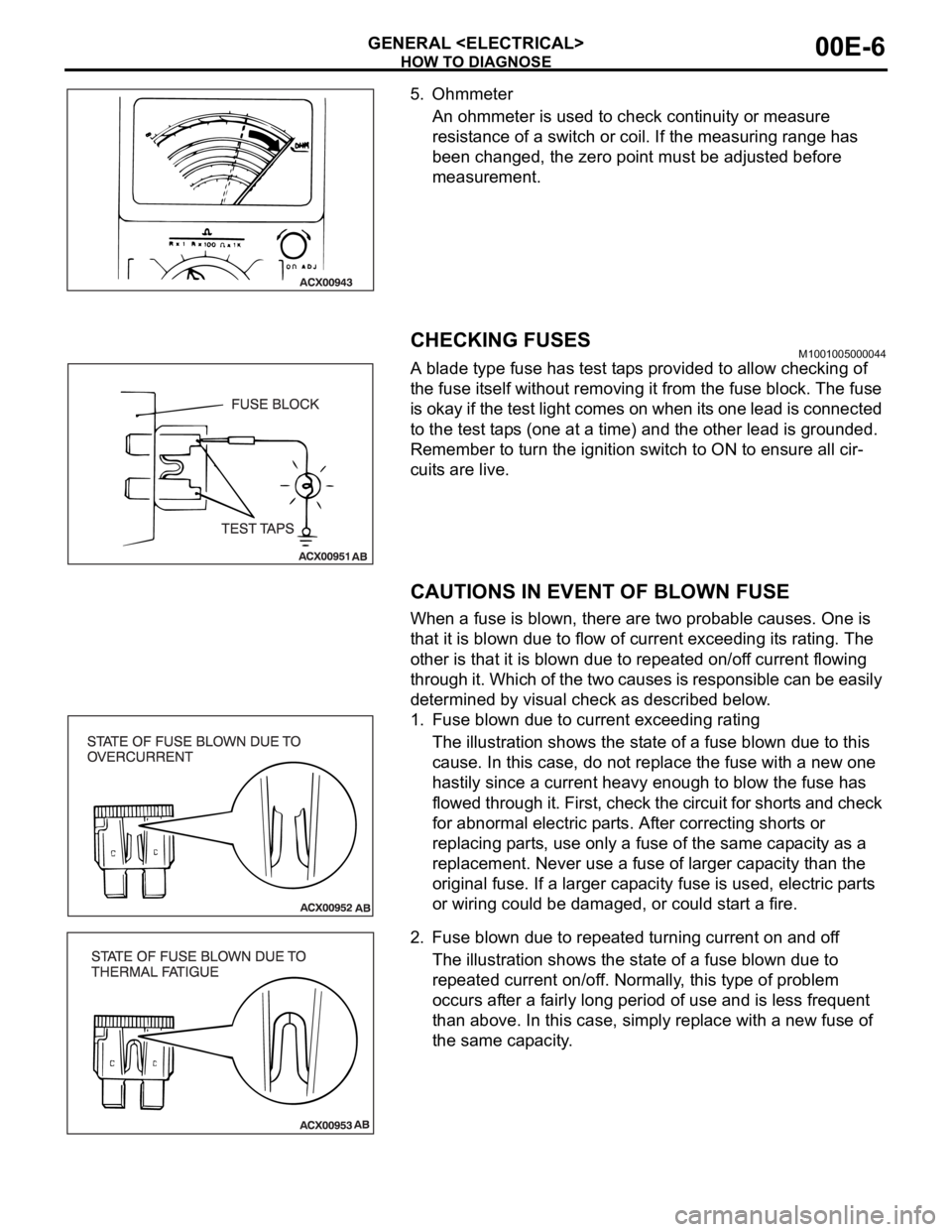
A blade type fuse has test taps provided to allow checking of
the fuse itself without removing it from the fuse block. The fuse
is okay if the test light comes on when its one lead is connected
to the test taps (one at a time) and the other lead is grounded.
Remember to turn the ignition switch to ON to ensure all cir-
cuits are live.
CAUTIONS IN EVENT OF BLOWN FUSE
When a fuse is blown, there are two probable causes. One is
that it is blown due to flow of current exceeding its rating. The
other is that it is blown due to repeated on/off current flowing
through it. Which of the two causes is responsible can be easily
determined by visual check as described below.
1. Fuse blown due to current exceeding rating
The illustration shows the state of a fuse blown due to this
cause. In this case, do not replace the fuse with a new one
hastily since a current heavy enough to blow the fuse has
flowed through it. First, check the circuit for shorts and check
for abnormal electric parts. After correcting shorts or
replacing parts, use only a fuse of the same capacity as a
replacement. Never use a fuse of larger capacity than the
original fuse. If a larger capacity fuse is used, electric parts
or wiring could be damaged, or could start a fire.
2. Fuse blown due to repeated turning current on and off
The illustration shows the state of a fuse blown due to
repeated current on/off. Normally, this type of problem
occurs after a fairly long period of use and is less frequent
than above. In this case, simply replace with a new fuse of
the same capacity.
Page 909 of 1500
HOW TO DIAGNOSE
GENERAL
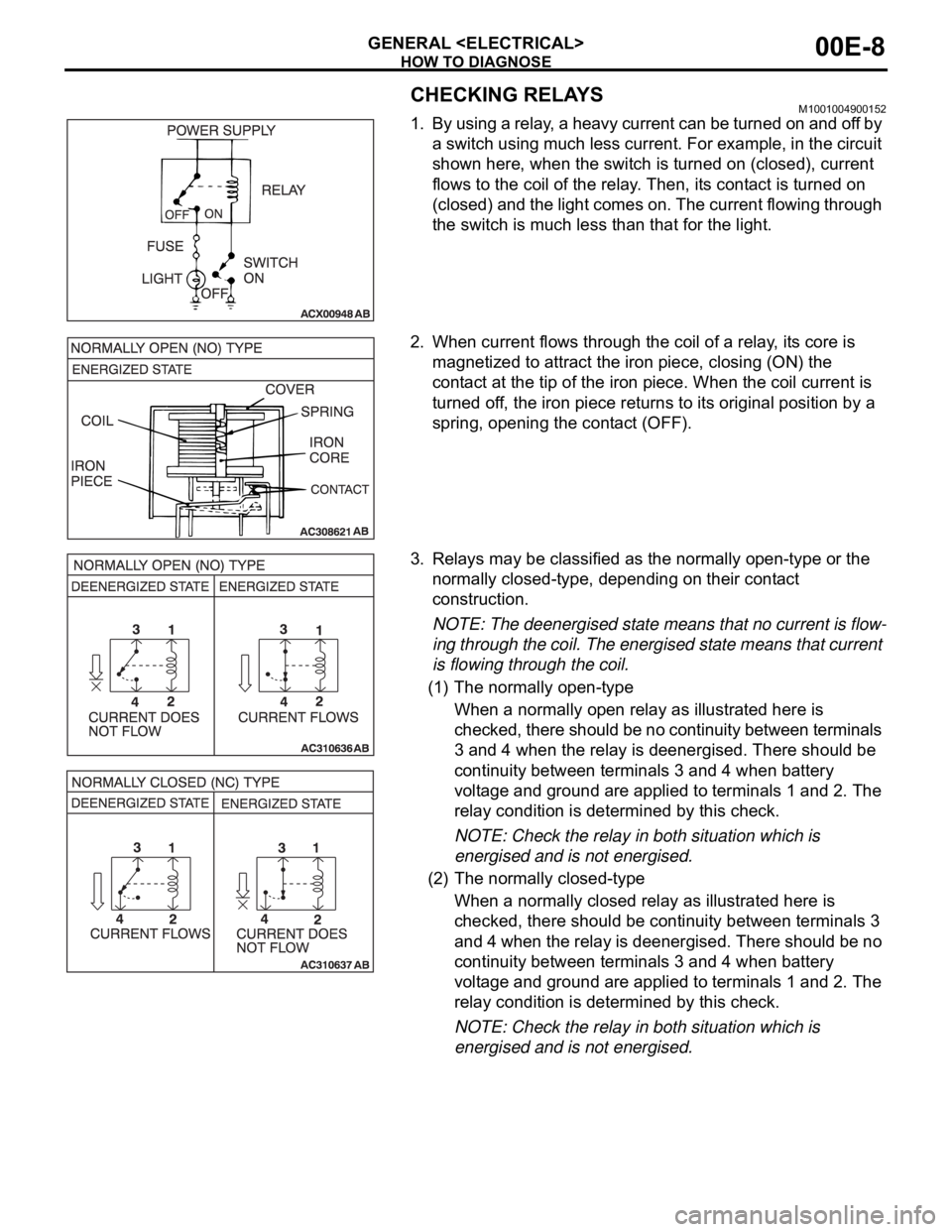
CHECKING RELAYSM1001004900152
1. By using a relay, a heavy current can be turned on and off by
a switch using much less current. For example, in the circuit
shown here, when the switch is turned on (closed), current
flows to the coil of the relay. Then, its contact is turned on
(closed) and the light comes on. The current flowing through
the switch is much less than that for the light.
2. When current flows through the coil of a relay, its core is
magnetized to attract the iron piece, closing (ON) the
contact at the tip of the iron piece. When the coil current is
turned off, the iron piece returns to its original position by a
spring, opening the contact (OFF).
3. Relays may be classified as the normally open-type or the
normally closed-type, depending on their contact
construction.
NOTE: The deenergised state means that no current is flow-
ing through the coil. The energised state means that current
is flowing through the coil.
(1) The normally open-type
When a normally open relay as illustrated here is
checked, there should be no continuity between terminals
3 and 4 when the relay is deenergised. There should be
continuity between terminals 3 and 4 when battery
voltage and ground are applied to terminals 1 and 2. The
relay condition is determined by this check.
NOTE: Check the relay in both situation which is
energised and is not energised.
(2) The normally closed-type
When a normally closed relay as illustrated here is
checked, there should be continuity between terminals 3
and 4 when the relay is deenergised. There should be no
continuity between terminals 3 and 4 when battery
voltage and ground are applied to terminals 1 and 2. The
relay condition is determined by this check.
NOTE: Check the relay in both situation which is
energised and is not energised.