Gasket cover MITSUBISHI 380 2005 Workshop Manual
[x] Cancel search | Manufacturer: MITSUBISHI, Model Year: 2005, Model line: 380, Model: MITSUBISHI 380 2005Pages: 1500, PDF Size: 47.87 MB
Page 966 of 1500
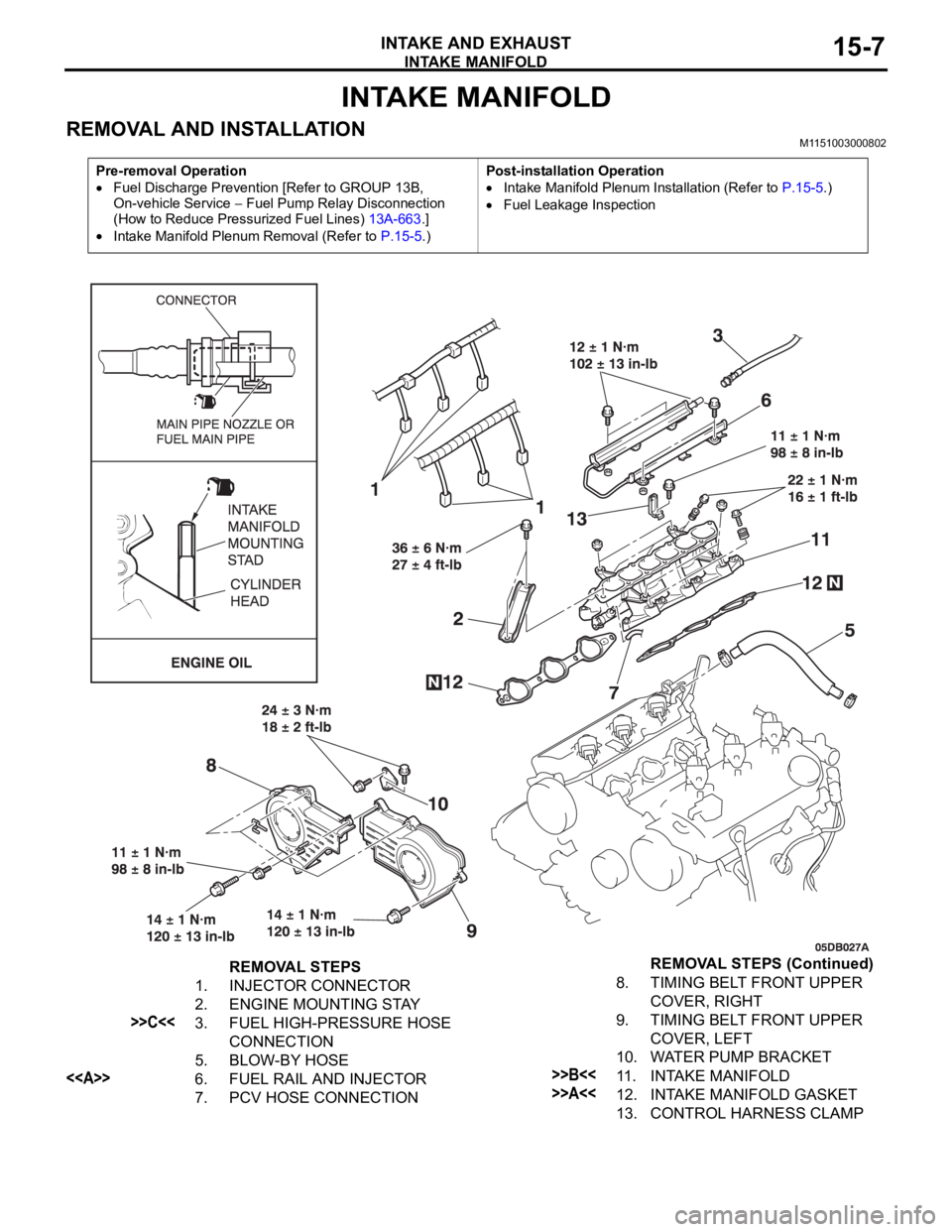
INTAKE MANIFOLD
INTAKE AND EXHAUST15-7
INTAKE MANIFOLD
REMOVAL AND INSTALLATION M1151003000802
Pre-removal Operation
Fuel Discharge Prevention [Refer to GROUP 13B,
On-vehicle Service
Fuel Pump Relay Disconnection
(How to Reduce Pressurized Fuel Lines) 13A-663.]
Intake Manifold Plenum Removal (Refer to P.15-5.)Post-installation Operation
Intake Manifold Plenum Installation (Refer to P.15-5.)
Fuel Leakage Inspection
REMOVAL STEPS
1. INJECTOR CONNECTOR
2. ENGINE MOUNTING STAY
>>C<<3. FUEL HIGH-PRESSURE HOSE
CONNECTION
5. BLOW-BY HOSE
<>6. FUEL RAIL AND INJECTOR
7. PCV HOSE CONNECTION8. TIMING BELT FRONT UPPER
COVER, RIGHT
9. TIMING BELT FRONT UPPER
COVER, LEFT
10. WATER PUMP BRACKET>>B<<11. INTAKE MANIFOLD
>>A<<12. INTAKE MANIFOLD GASKET
13. CONTROL HARNESS CLAMPREMOVAL STEPS (Continued)
Page 969 of 1500
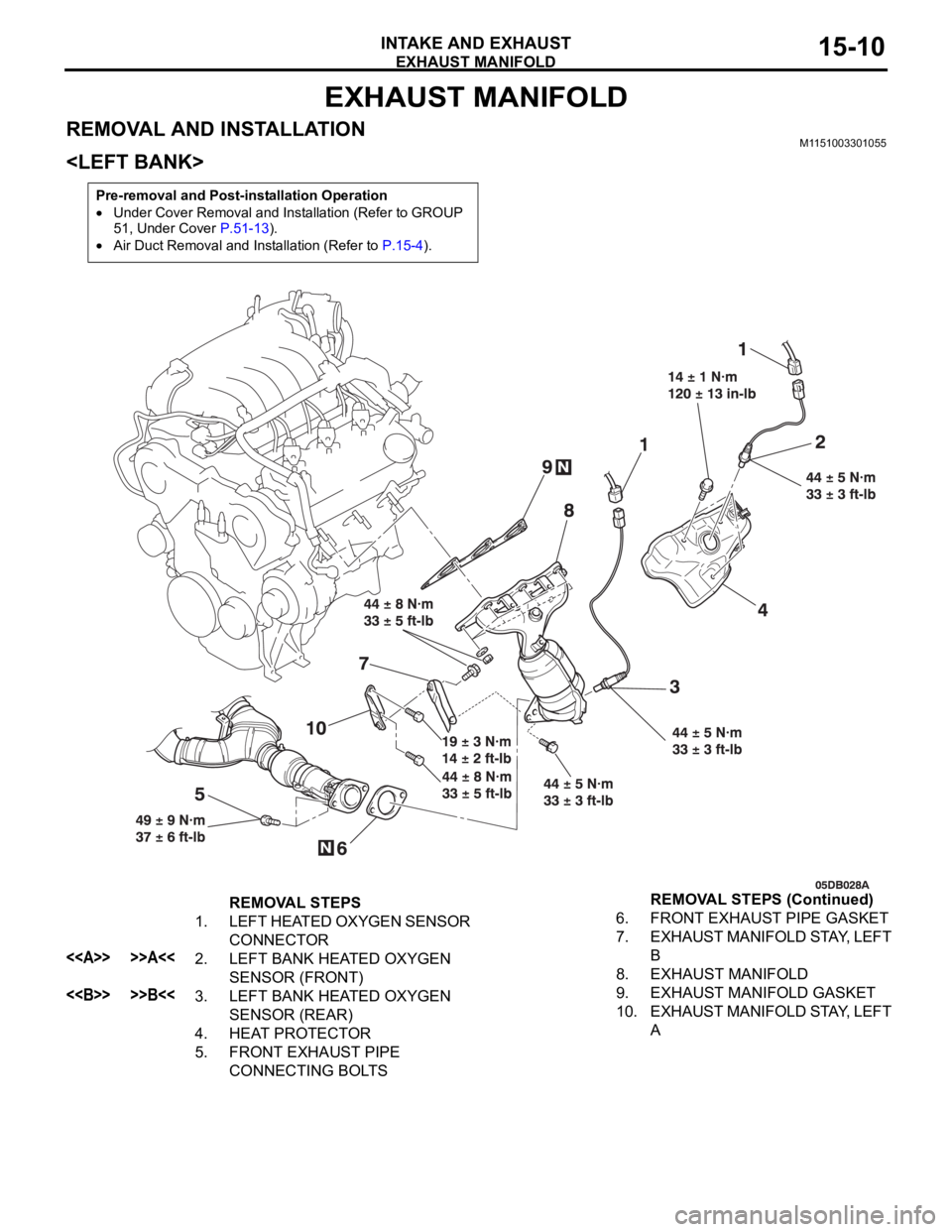
EXHAUST MANIFOLD
INTAKE AND EXHAUST15-10
EXHAUST MANIFOLD
REMOVAL AND INSTALLATION M1151003301055
Pre-removal and Post-installation Operation
Under Cover Removal and Installation (Refer to GROUP
51, Under Cover P.51-13).
Air Duct Removal and Installation (Refer to P.15-4).
REMOVAL STEPS
1. LEFT HEATED OXYGEN SENSOR
CONNECTOR
<> >>A<<2. LEFT BANK HEATED OXYGEN
SENSOR (FRONT)
<> >>B<<3. LEFT BANK HEATED OXYGEN
SENSOR (REAR)
4. HEAT PROTECTOR
5. FRONT EXHAUST PIPE
CONNECTING BOLTS6. FRONT EXHAUST PIPE GASKET
7. EXHAUST MANIFOLD STAY, LEFT
B
8. EXHAUST MANIFOLD
9. EXHAUST MANIFOLD GASKET
10. EXHAUST MANIFOLD STAY, LEFT
A REMOVAL STEPS (Continued)
Page 970 of 1500
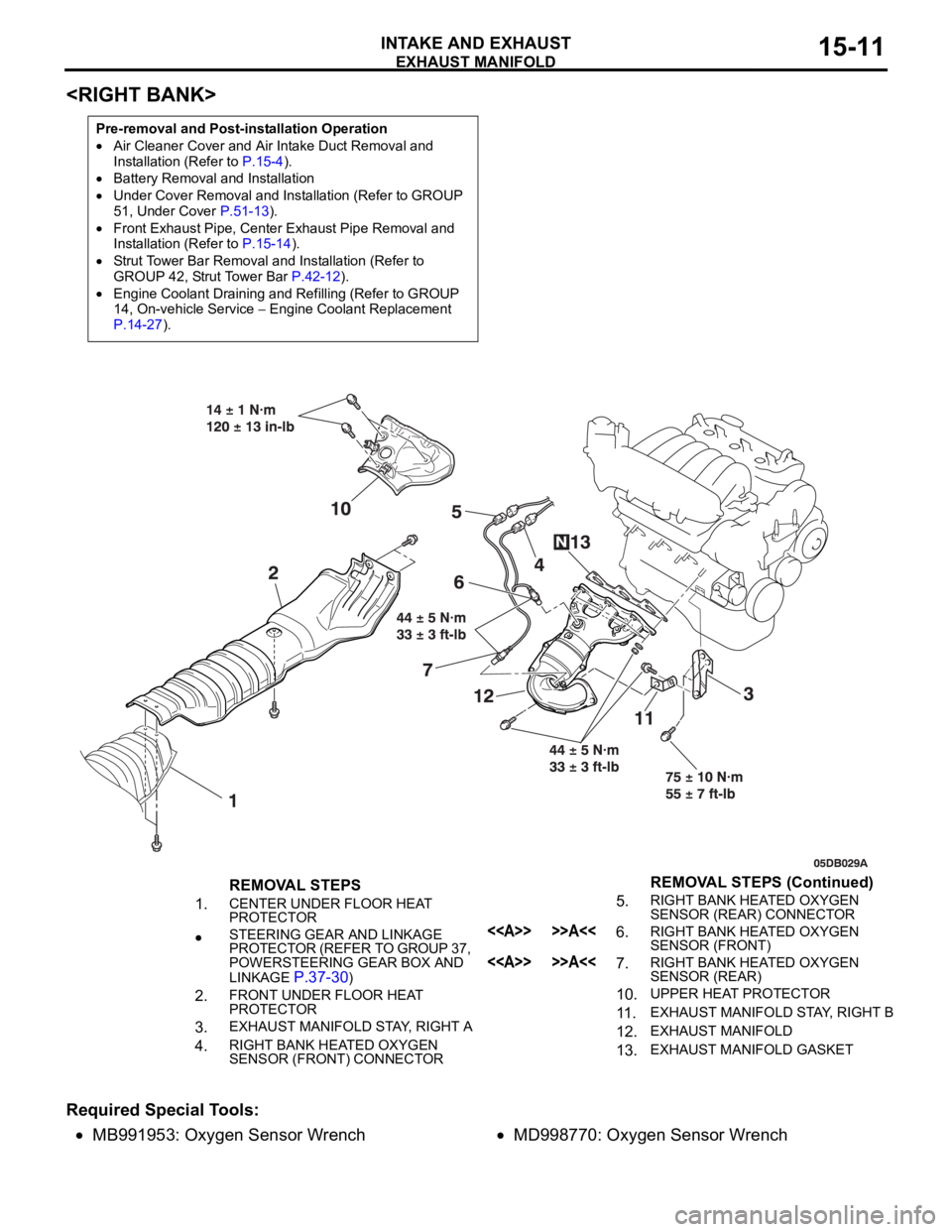
EXHAUST MANIFOLD
INTAKE AND EXHAUST15-11
Required Special Tools:
MB991953: Oxygen Sensor WrenchMD998770: Oxygen Sensor Wrench
Pre-removal and Post-installation Operation
Air Cleaner Cover and Air Intake Duct Removal and
Installation (Refer to P.15-4).
Battery Removal and Installation
Under Cover Removal and Installation (Refer to GROUP
51, Under Cover P.51-13).
Front Exhaust Pipe, Center Exhaust Pipe Removal and
Installation (Refer to P.15-14).
Strut Tower Bar Removal and Installation (Refer to
GROUP 42, Strut Tower Bar P.42-12).
Engine Coolant Draining and Refilling (Refer to GROUP
14, On-vehicle Service Engine Coolant Replacement
P.14-27).
REMOVAL STEPS
1.
CENTER UNDER FLOOR HEAT
PROTECTOR
STEERING GEAR AND LINKAGE
PROTECTOR (REFER TO GROUP 37,
POWERSTEERING GEAR BOX AND
LINKAGE
P.37-30)
2.FRONT UNDER FLOOR HEAT
PROTECTOR
3.EXHAUST MANIFOLD STAY, RIGHT A
4.RIGHT BANK HEATED OXYGEN
SENSOR (FRONT) CONNECTOR
5.RIGHT BANK HEATED OXYGEN
SENSOR (REAR) CONNECTOR
<> >>A<<6.RIGHT BANK HEATED OXYGEN
SENSOR (FRONT)
<> >>A<<7.RIGHT BANK HEATED OXYGEN
SENSOR (REAR)
10.UPPER HEAT PROTECTOR
11 .EXHAUST MANIFOLD STAY, RIGHT B
12.EXHAUST MANIFOLD
13.EXHAUST MANIFOLD GASKET
REMOVAL STEPS (Continued)
Page 1255 of 1500
LUBRICATION AND MAINTENANCE
GENERAL00-34
LUBRICATION AND MAINTENANCEM1001001200336
Maintenance and lubrication service recommenda-
tions have been compiled to provide maximum pro-
tection for the vehicle owner's investment against all
reasonable types of driving conditions. Since these
conditions vary with the individual vehicle owner's
driving habits, the area in which the vehicle is oper-
ated and the type of driving to which the vehicle is
subjected, it is necessary to prescribe lubrication and
maintenance service on a time frequency as well as
mileage interval basis.
Oils, lubricants and greases are classified and
graded according to standards recommended by the
Society of Automotive Engineers (SAE) and the Aus-
tralian Petroleum Institute (API).
MAINTENANCE SCHEDULES
For Information on service maintenance refer to the
"Service handbook".
ENGINE OIL
Tests have shown that laboratory animals
develop skin cancer after prolonged contact with
used engine oil. Accordingly, the potential exists
for humans to develop a number of skin disor-
ders, including cancer, from such exposure to
used engine oil. Therefore, when changing
engine oil, be careful not to touch it as much as
possible. Protective clothing and gloves, that
cannot be penetrated by oil, should be worn. The
skin should be thoroughly washed with soap and
water, or use waterless hand cleaner, to remove
any used engine oil. Do not use petrol, thinners,
or solvents.Either of the following engine oils should be used:
1. Engine oil conforming to the ACEA classification:
"For service A1, A2 or A3.
2. Engine oil conforming to the API classification:
"For service SG" or higher.
FUEL USAGE STATEMENT
Using leaded petrol in this car will damage the
catalytic converters and heated oxygen sensors,
and affect the warranty coverage validity.
This vehicle must use unleaded petrol only.
This vehicle has a fuel filler tube which is especially
designed to accept only the smaller-diameter
unleaded petrol dispensing nozzle.
The 3.8L model is designed to operate on unleaded
petrol having an octane rating (DIN 51607) of 90
RON or higher.
.
PETROL CONTAINING ALCOHOL
Some petrol sold at service stations contain alcohol
although they may not be so identified.
Using fuels containing alcohol is not recommended
unless the nature of the blend can be determined as
being satisfactory, as follows.
Gasohol: A mixture of 10% ethanol and 90%
unleaded gasoline may be used in your vehicle. If
driveability problems are experienced as a result of
using gasohol, it is recommended that the vehicle be
operated on petrol.
Methanol: Do not use petrol containing methanol
(wood alcohol). Using this type of alcohol can result
in vehicle performance deterioration and damage
critical parts in the fuel system components. Fuel
system damage and performance problems resulting
from the use of petrol containing methanol may not
be covered by the new vehicle warranty.
MATERIALS ADDED TO FUEL
Indiscriminate use of fuel system cleaning agents
should be avoided. Many materials intended for gum
and varnish removal may contain highly active sol-
vents or similar ingredients that can be harmful to
gasket and diaphragm materials used in fuel system
component parts.