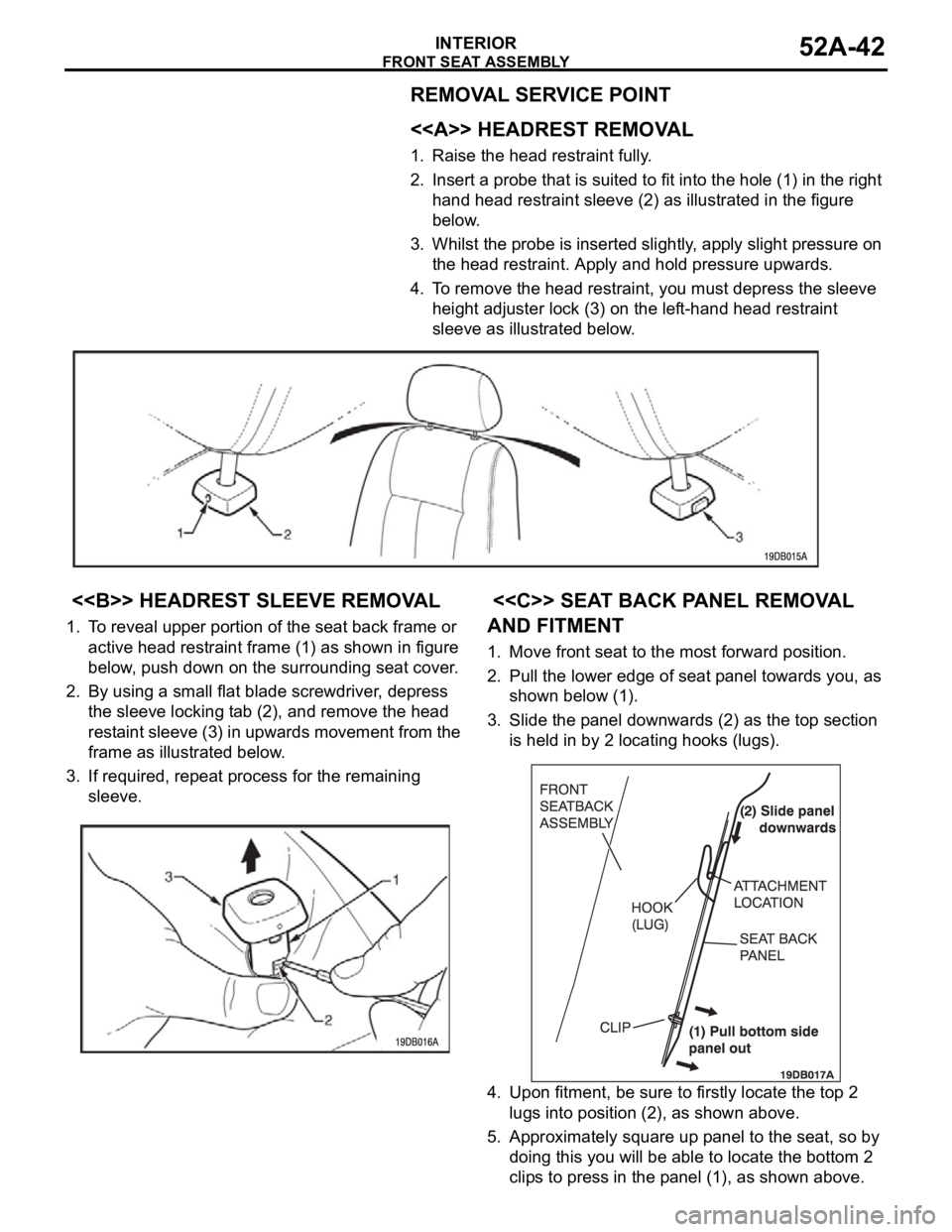
height MITSUBISHI 380 2005 Workshop Manual
[x] Cancel search | Manufacturer: MITSUBISHI, Model Year: 2005, Model line: 380, Model: MITSUBISHI 380 2005Pages: 1500, PDF Size: 47.87 MB
Page 525 of 1500

Page 531 of 1500
Page 567 of 1500
FLOOR, SEAT AND ROOF
CONFIGURATION DIAGRAMS80-18
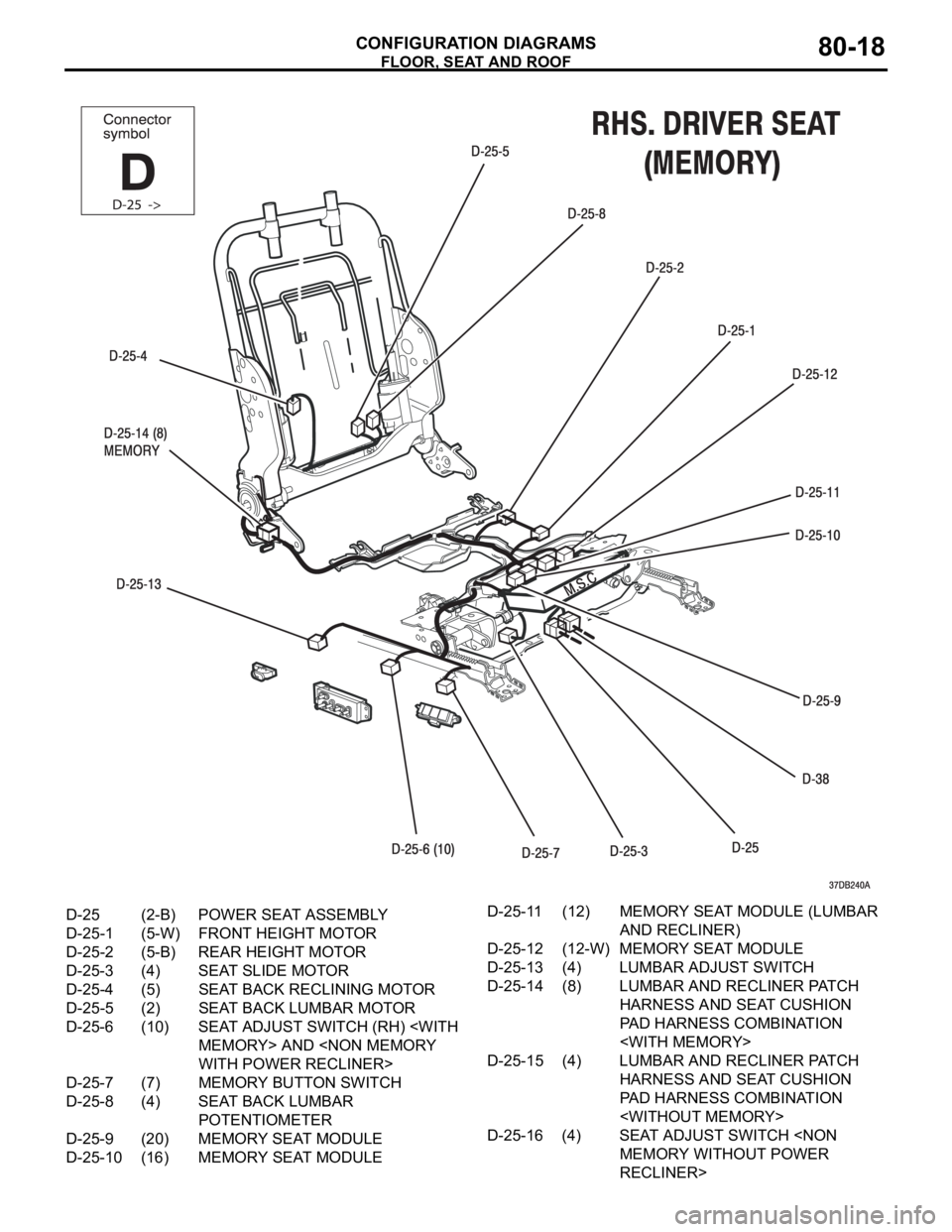
D-25 (2-B) POWER SEAT ASSEMBLY
D-25-1 (5-W) FRONT HEIGHT MOTOR
D-25-2 (5-B) REAR HEIGHT MOTOR
D-25-3 (4) SEAT SLIDE MOTOR
D-25-4 (5) SEAT BACK RECLINING MOTOR
D-25-5 (2) SEAT BACK LUMBAR MOTOR
D-25-6 (10) SEAT ADJUST SWITCH (RH)
D-25-7 (7) MEMORY BUTTON SWITCH
D-25-8 (4) SEAT BACK LUMBAR
POTENTIOMETER
D-25-9 (20) MEMORY SEAT MODULE
D-25-10 (16) MEMORY SEAT MODULED-25-11 (12) MEMORY SEAT MODULE (LUMBAR
AND RECLINER)
D-25-12 (12-W) MEMORY SEAT MODULE
D-25-13 (4) LUMBAR ADJUST SWITCH
D-25-14 (8) LUMBAR AND RECLINER PATCH
HARNESS AND SEAT CUSHION
PAD HARNESS COMBINATION
D-25-15 (4) LUMBAR AND RECLINER PATCH
HARNESS AND SEAT CUSHION
PAD HARNESS COMBINATION
D-25-16 (4) SEAT ADJUST SWITCH
RECLINER>
Page 571 of 1500
FLOOR, SEAT AND ROOF
CONFIGURATION DIAGRAMS80-22
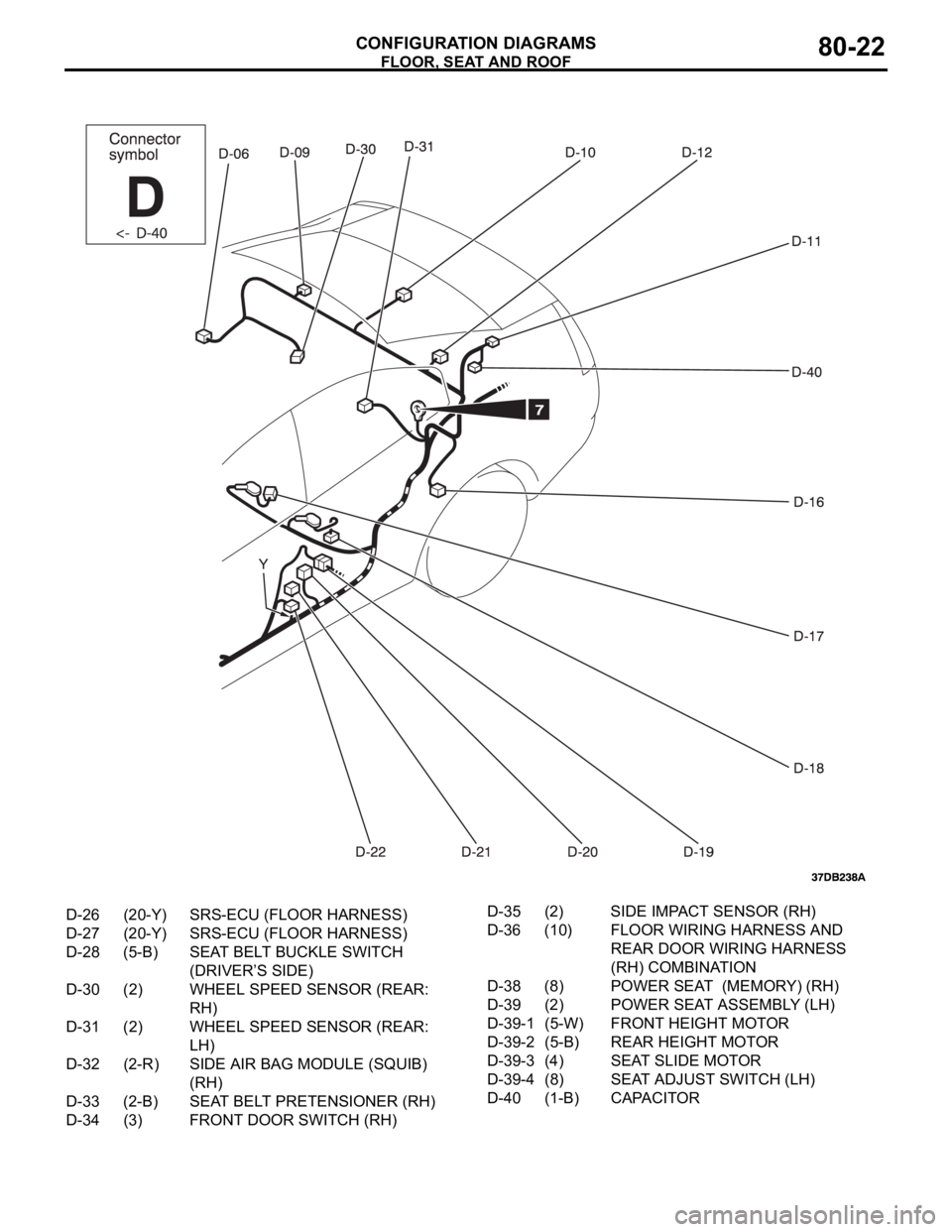
D-26 (20-Y) SRS-ECU (FLOOR HARNESS)
D-27 (20-Y) SRS-ECU (FLOOR HARNESS)
D-28 (5-B) SEAT BELT BUCKLE SWITCH
(DRIVER’S SIDE)
D-30 (2) WHEEL SPEED SENSOR (REAR:
RH)
D-31 (2) WHEEL SPEED SENSOR (REAR:
LH)
D-32 (2-R) SIDE AIR BAG MODULE (SQUIB)
(RH)
D-33 (2-B) SEAT BELT PRETENSIONER (RH)
D-34 (3) FRONT DOOR SWITCH (RH)D-35 (2) SIDE IMPACT SENSOR (RH)
D-36 (10) FLOOR WIRING HARNESS AND
REAR DOOR WIRING HARNESS
(RH) COMBINATION
D-38 (8) POWER SEAT (MEMORY) (RH)
D-39 (2) POWER SEAT ASSEMBLY (LH)
D-39-1 (5-W) FRONT HEIGHT MOTOR
D-39-2 (5-B) REAR HEIGHT MOTOR
D-39-3 (4) SEAT SLIDE MOTOR
D-39-4 (8) SEAT ADJUST SWITCH (LH)
D-40 (1-B) CAPACITOR
Page 953 of 1500
THERMOSTAT
ENGINE COOLING14-38
INSPECTIONM1141002500450.
Thermostat Check
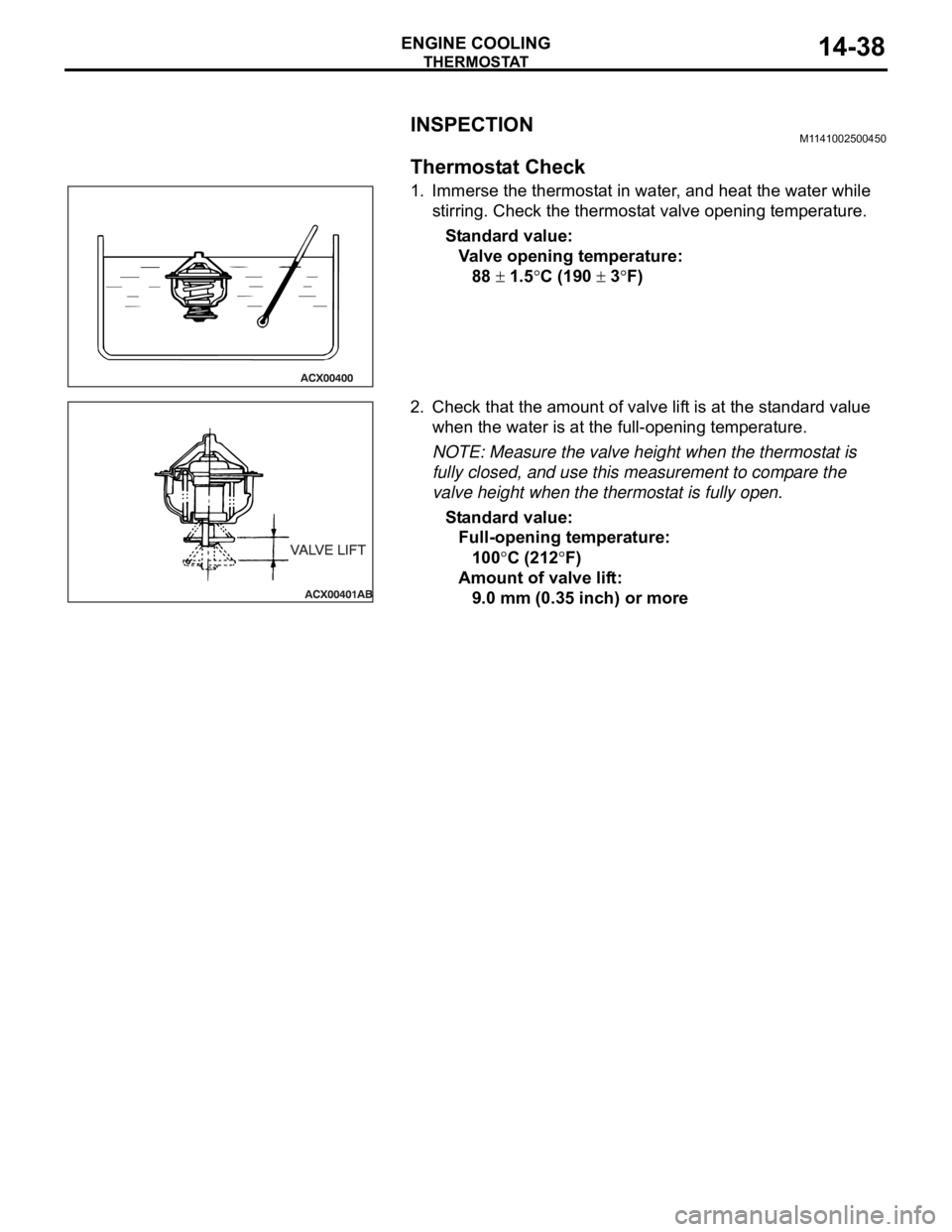
1. Immerse the thermostat in water, and heat the water while
stirring. Check the thermostat valve opening temperature.
Standard value:
Valve opening temperature:
88
1.5C (190 3F)
2. Check that the amount of valve lift is at the standard value
when the water is at the full-opening temperature.
NOTE: Measure the valve height when the thermostat is
fully closed, and use this measurement to compare the
valve height when the thermostat is fully open.
Standard value:
Full-opening temperature:
100
C (212F)
Amount of valve lift:
9.0 mm (0.35 inch) or more
Page 988 of 1500
CHARGING SYSTEM
ENGINE ELECTRICAL16-11
11.Increase the engine speed to 2,500 r/min.
12.Read the value displayed on the voltmeter when
the current output by the alternator becomes 10 A
or less.
13.If the voltage reading conforms to the value in the
voltage regulation table, then the voltage regulator
is operating normally.
If the voltage is outside the standard value, there
is a malfunction of the voltage regulator or the
alternator (Refer to the following table).14.After the test, lower the engine speed to idle.
15.Turn the ignition switch to the "LOCK" (OFF)
position.
16.Disconnect the engine tachometer or diagnostic
tool .
17.Disconnect the negative battery cable.
18.Disconnect the ammeter and voltmeter.
19.Connect the negative battery cable.
20.Run the engine for 10 minutes at an idle.
VOLTAGE REGULATION TABLE
WAVE PATTERN CHECK USING AN
OSCILLOSCOPE
M1161001200180.
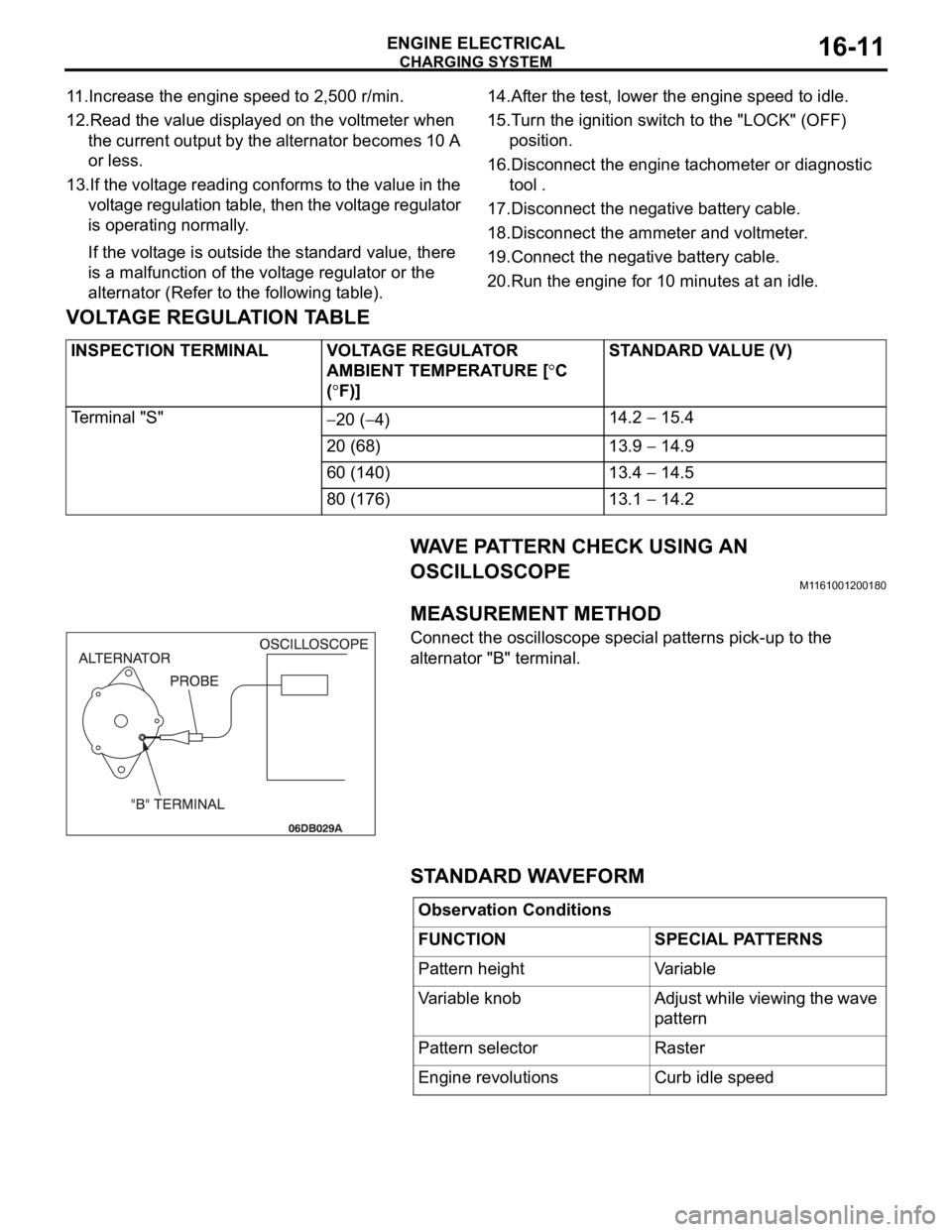
MEASUREMENT METHOD
Connect the oscilloscope special patterns pick-up to the
alternator "B" terminal.
.
STANDARD WAVEFORM
INSPECTION TERMINAL VOLTAGE REGULATOR
AMBIENT TEMPERATURE [
C
(
F)]STANDARD VALUE (V)
Te r m i n a l " S "
20 (4)14.2 15.4
20 (68) 13.9
14.9
60 (140) 13.4
14.5
80 (176) 13.1
14.2
Observation Conditions
FUNCTION SPECIAL PATTERNS
Pattern height Variable
Variable knob Adjust while viewing the wave
pattern
Pattern selector Raster
Engine revolutions Curb idle speed
Page 989 of 1500
CHARGING SYSTEM
ENGINE ELECTRICAL16-12
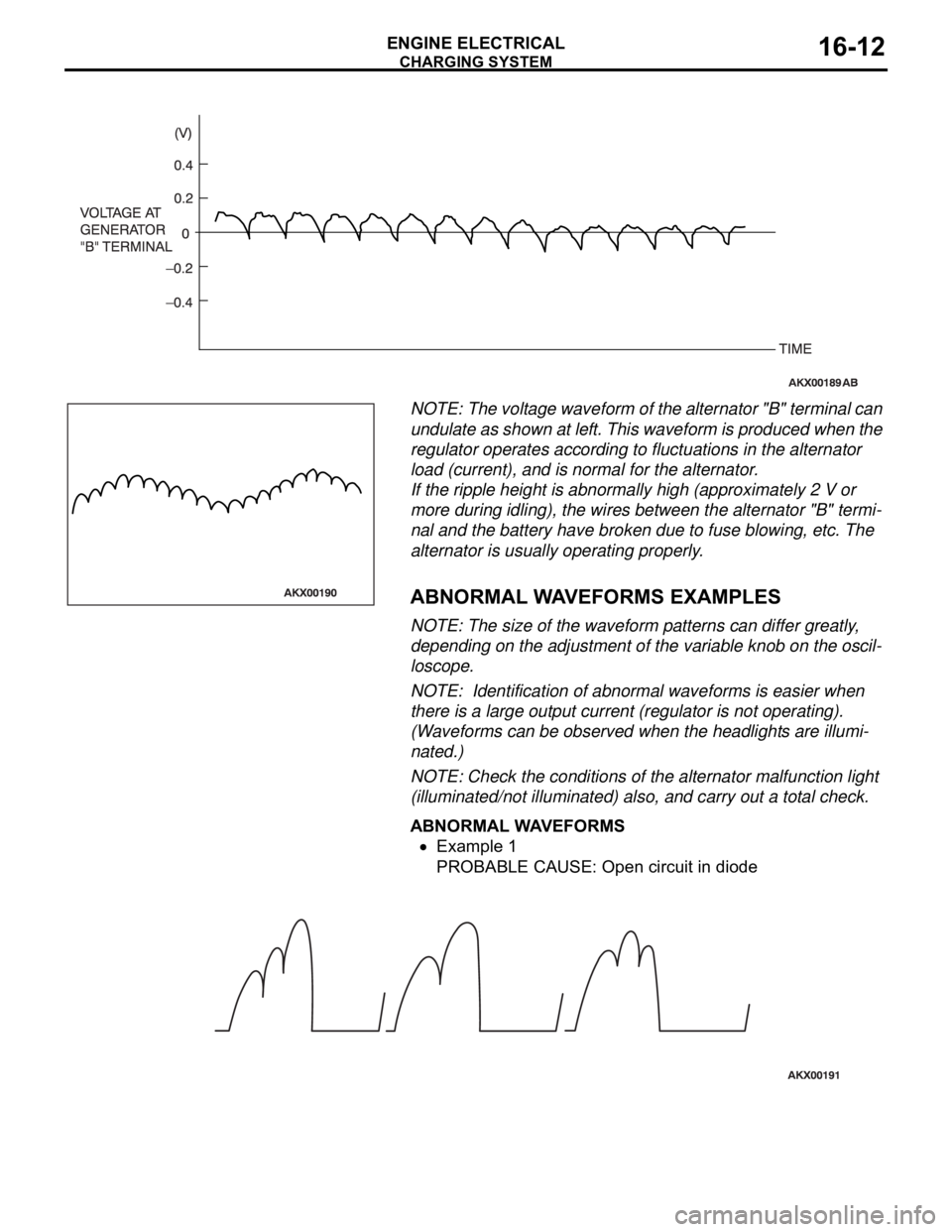
NOTE: The voltage waveform of the alternator "B" terminal can
undulate as shown at left. This waveform is produced when the
regulator operates according to fluctuations in the alternator
load (current), and is normal for the alternator.
If the ripple height is abnormally high (approximately 2 V or
more during idling), the wires between the alternator "B" termi-
nal and the battery have broken due to fuse blowing, etc. The
alternator is usually operating properly.
.
ABNORMAL WAVEFORMS EXAMPLES
NOTE: The size of the waveform patterns can differ greatly,
depending on the adjustment of the variable knob on the oscil-
loscope.
NOTE: Identification of abnormal waveforms is easier when
there is a large output current (regulator is not operating).
(Waveforms can be observed when the headlights are illumi-
nated.)
NOTE: Check the conditions of the alternator malfunction light
(illuminated/not illuminated) also, and carry out a total check.
ABNORMAL WAVEFORMS
Example 1
PROBABLE CAUSE: Open circuit in diode
Page 1068 of 1500
42-1
GROUP 42
BODY
CONTENTS
HOOD . . . . . . . . . . . . . . . . . . . . .
42-4
BODY DIAGNOSIS . . . . . . . . . . . .
42-4
INTRODUCTION TO HOOD DIAGNOSIS42-4
HOOD DIAGNOSTIC TROUBLESHOOTING
STRATEGY . . . . . . . . . . . . . . . . . . . . . . 42-4
SYMPTOM CHART . . . . . . . . . . . . . . . . 42-4
SYMPTOM PROCEDURES . . . . . . . . . 42-4
ON-VEHICLE SERVICE. . . . . . . . .42-6
ADJUSTMENT OF CLEARANCE
AROUND HOOD . . . . . . . . . . . . . . . . . . 42-6
ALIGNMENT OF HOOD LATCH AND
STRIKER . . . . . . . . . . . . . . . . . . . . . . . . 42-6
ADJUSTMENT OF HOOD HEIGHT . . . 42-7
HOOD . . . . . . . . . . . . . . . . . . . . . . .42-8
REMOVAL AND INSTALLATION . . . . . 42-8
FENDER . . . . . . . . . . . . . . . . . . .42-10
REMOVAL AND INSTALLATION .
42-10
FUEL FILLER LID . . . . . . . . . . .42-11
REMOVAL AND INSTALLATION .
42-11
STRUT TOWER BAR . . . . . . . . 42-12
REMOVAL AND INSTALLATION .
42-12
WINDOW GLASS . . . . . . . . . . . 42-12
GENERAL . . . . . . . . . . . . . . . . . . . .
42-12
WINDOW GLASS DIAGNOSIS . . .42-14
INTRODUCTION TO WINDOW GLASS
DIAGNOSIS . . . . . . . . . . . . . . . . . . . . . . 42-14
WINDOW GLASS DIAGNOSTIC
TROUBLESHOOTING STRATEGY . . . . 42-14
WINDOW GLASS DIAGNOSTIC TROUBLE
SYMPTOM CHART . . . . . . . . . . . . . . . . 42-14
SYMPTOM PROCEDURES . . . . . . . . . . 42-14
SPECIAL TOOL . . . . . . . . . . . . . . .42-14
WINDSHIELD . . . . . . . . . . . . . . . . .42-15
REMOVAL AND INSTALLATION . . . . . . 42-15
REAR WINDOW GLASS . . . . . . . .42-20
REMOVAL AND INSTALLATION . . . . . . 42-20
Continued on next page
Page 1069 of 1500
BODY42-2
DOOR . . . . . . . . . . . . . . . . . . . . . . . . .42-23
GENERAL DESCRIPTION . . . . . .
42-23
CENTRAL DOOR LOCKING SYSTEM
DIAGNOSIS . . . . . . . . . . . . . . . . . . . . . . 42-23
POWER WINDOW DIAGNOSIS . . . . . . 42-23
DOOR DIAGNOSIS . . . . . . . . . . . . . . . . 42-23
INTRODUCTION TO GLASS AND DOOR
DIAGNOSIS . . . . . . . . . . . . . . . . . . . . . . 42-23
GLASS AND DOOR DIAGNOSTIC
TROUBLESHOOTING STRATEGY . . . 42-23
SYMPTOM CHART . . . . . . . . . . . . . . . . 42-24
SYMPTOM PROCEDURES . . . . . . . . . 42-24
HOW TO LOCATE WIND NOISE . . . . . 42-27
SPECIAL TOOLS. . . . . . . . . . . . . .42-28
ON-VEHICLE SERVICE. . . . . . . . .42-30
DOOR FIT ADJUSTMENT. . . . . . . . . . . 42-30
DOOR WINDOW GLASS ADJUSTMENT42-31
GLASS SLIDING MECHANISM CHECK
AND ADJUSTMENT . . . . . . . . . . . . . . . 42-32
POWER WINDOW TIMER FUNCTION
CHECK . . . . . . . . . . . . . . . . . . . . . . . . . 42-32
POWER WINDOW OPERATING
CURRENT CHECK . . . . . . . . . . . . . . . . 42-33
POWER WINDOW RELAY CHECK . . . 42-33
CIRCUIT BREAKER (INCORPORATED IN
THE POWER WINDOW MOTOR)
INSPECTION . . . . . . . . . . . . . . . . . . . . . 42-34
POWER WINDOW CHECK . . . . . . . . . . 42-34
CENTRAL DOOR LOCKING SYSTEM
INSPECTION . . . . . . . . . . . . . . . . . . . . . 42-34
DOOR OUTSIDE HANDLE PLAY CHECK42-35
DOOR INSIDE HANDLE PLAY CHECK 42-35
DOOR ASSEMBLY . . . . . . . . . . . .42-37
REMOVAL AND INSTALLATION . . . . . 42-37
INSPECTION . . . . . . . . . . . . . . . . . . . . . 42-38
DOOR GLASS AND REGULATOR42-39
REMOVAL AND INSTALLATION . . . . . 42-39
INSPECTION . . . . . . . . . . . . . . . . . . . . . 42-43
DOOR HANDLE AND LATCH . . . .42-46
REMOVAL AND INSTALLATION . . . . . 42-46
INSPECTION . . . . . . . . . . . . . . . . . . . . . 42-49
WINDOW GLASS RUNCHANNEL
AND DOOR OPENING
WEATHERSTRIP . . . . . . . . . . . . . .
42-52
REMOVAL AND INSTALLATION . . . . . . 42-52
TRUNK LID. . . . . . . . . . . . . . . . 42-60
TRUNK LID DIAGNOSIS . . . . . . . .
42-60
INTRODUCTION TO TRUNK LID
DIAGNOSIS . . . . . . . . . . . . . . . . . . . . . . 42-60
TRUNK LID DIAGNOSTIC
TROUBLESHOOTING STRATEGY . . . . 42-60
SYMPTOM CHART . . . . . . . . . . . . . . . . 42-60
SYMPTOM PROCEDURES . . . . . . . . . . 42-60
ON-VEHICLE SERVICE . . . . . . . . .42-61
ADJUSTMENT OF CLEARANCE
AROUND TRUNK LID . . . . . . . . . . . . . . 42-61
TRUNK LID LATCH ADJUSTMENT. . . . 42-61
TRUNK LID HEIGHT ADJUSTMENT . . . 42-62
TRUNK LID . . . . . . . . . . . . . . . . . . .42-63
REMOVAL AND INSTALLATION . . . . . . 42-63
INSPECTION . . . . . . . . . . . . . . . . . . . . . 42-65
KEYLESS ENTRY SYSTEM 42-67
GENERAL DESCRIPTION . . . . . . .
42-67
KEYLESS ENTRY SYSTEM
DIAGNOSIS . . . . . . . . . . . . . . . . . .
42-68
SPECIAL TOOL . . . . . . . . . . . . . . .42-68
ON-VEHICLE SERVICE . . . . . . . . .42-69
TRANSMITTER BATTERY CHECK . . . . 42-69
HOW TO REPLACE THE TRANSMITTER
BATTERY . . . . . . . . . . . . . . . . . . . . . . . . 42-70
KEYLESS ENTRY SYSTEM INSPECTION42-71
KEYLESS ENTRY SYSTEM TIMER LOCK
FUNCTION INSPECTION . . . . . . . . . . . 42-71
ENABLING/DISABLING THE
ANSWERBACK FUNCTION . . . . . . . . . 42-72
HOW TO REGISTER SECRET CODE . 42-73
Continued on next page
Page 1071 of 1500
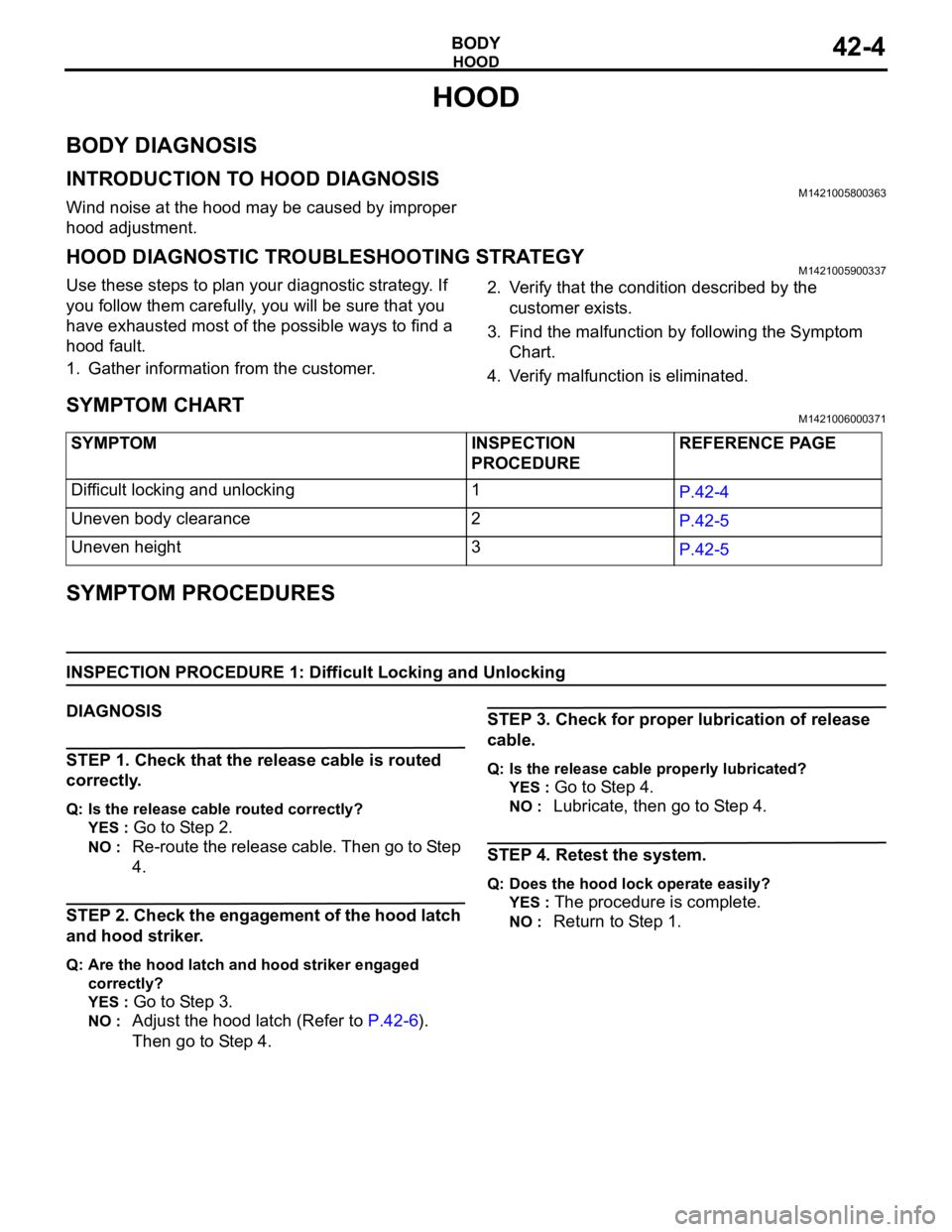
HOOD
BODY42-4
HOOD
BODY DIAGNOSIS
INTRODUCTION TO HOOD DIAGNOSISM1421005800363
Wind noise at the hood may be caused by improper
hood adjustment.
HOOD DIAGNOSTIC TROUBLESHOOTING STRATEGYM1421005900337
Use these steps to plan your diagnostic strategy. If
you follow them carefully, you will be sure that you
have exhausted most of the possible ways to find a
hood fault.
1. Gather information from the customer.2. Verify that the condition described by the
customer exists.
3. Find the malfunction by following the Symptom
Chart.
4. Verify malfunction is eliminated.
SYMPTOM CHARTM1421006000371
SYMPTOM PROCEDURES
INSPECTION PROCEDURE 1: Difficult Locking and Unlocking
DIAGNOSIS
STEP 1. Check that the release cable is routed
correctly.
Q: Is the release cable routed correctly?
YES :
Go to Step 2.
NO : Re-route the release cable. Then go to Step
4.
STEP 2. Check the engagement of the hood latch
and hood striker.
Q: Are the hood latch and hood striker engaged
correctly?
YES :
Go to Step 3.
NO : Adjust the hood latch (Refer to P.42-6).
Then go to Step 4.
STEP 3. Check for proper lubrication of release
cable.
Q: Is the release cable properly lubricated?
YES :
Go to Step 4.
NO : Lubricate, then go to Step 4.
STEP 4. Retest the system.
Q: Does the hood lock operate easily?
YES :
The procedure is complete.
NO : Return to Step 1. SYMPTOM INSPECTION
PROCEDUREREFERENCE PAGE
Difficult locking and unlocking 1
P.42-4
Uneven body clearance 2
P.42-5
Uneven height 3
P.42-5