belt MITSUBISHI ASX 2009 1.G Owner's Manual
[x] Cancel search | Manufacturer: MITSUBISHI, Model Year: 2009, Model line: ASX, Model: MITSUBISHI ASX 2009 1.GPages: 368, PDF Size: 8.13 MB
Page 74 of 368
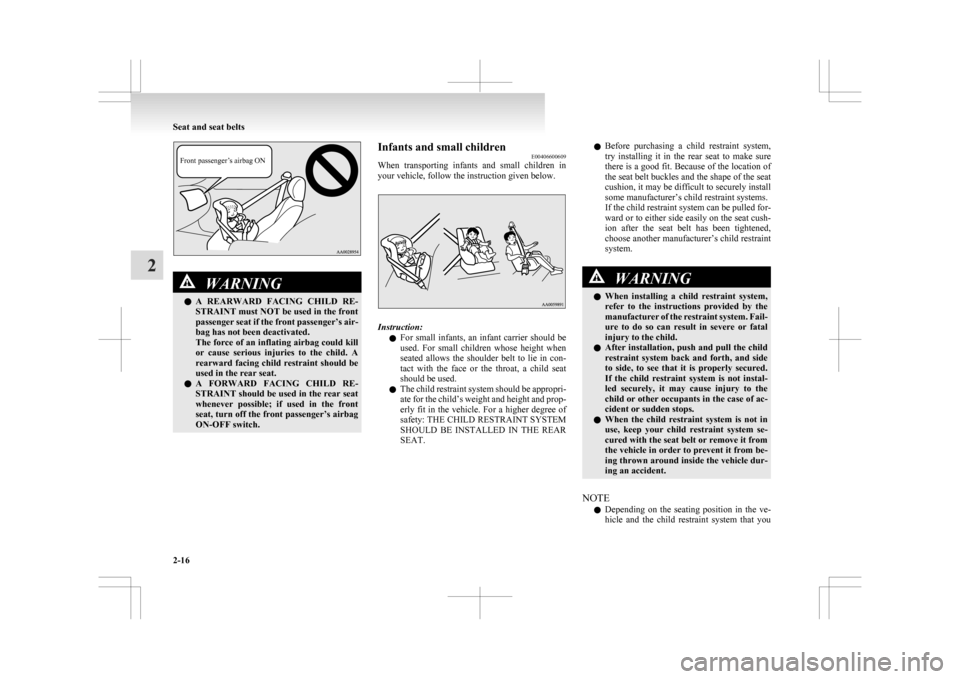
Front passenger’s airbag ONWARNING
l A
REARWARD FACING CHILD RE-
STRAINT must NOT be used in the front
passenger seat if the front passenger’s air-
bag has not been deactivated.
The force of an inflating airbag could kill
or cause serious injuries to the child. A
rearward facing child restraint should be
used in the rear seat.
l A FORWARD FACING CHILD RE-
STRAINT should be used in the rear seat
whenever possible; if used in the front
seat, turn off the front passenger’s airbag
ON-OFF switch. Infants and small children
E00406600609
When
transporting infants and small children in
your vehicle, follow the instruction given below. Instruction:
l For
small infants, an infant carrier should be
used. For small children whose height when
seated allows the shoulder belt to lie in con-
tact with the face or the throat, a child seat
should be used.
l The child restraint system should be appropri-
ate for the child’s weight and height and prop-
erly fit in the vehicle. For a higher degree of
safety: THE CHILD RESTRAINT SYSTEM
SHOULD BE INSTALLED IN THE REAR
SEAT. l
Before
purchasing a child restraint system,
try installing it in the rear seat to make sure
there is a good fit. Because of the location of
the seat belt buckles and the shape of the seat
cushion, it may be difficult to securely install
some manufacturer’s child restraint systems.
If the child restraint system can be pulled for-
ward or to either side easily on the seat cush-
ion after the seat belt has been tightened,
choose another manufacturer’s child restraint
system. WARNING
l When
installing a child restraint system,
refer to the instructions provided by the
manufacturer of the restraint system. Fail-
ure to do so can result in severe or fatal
injury to the child.
l After installation, push and pull the child
restraint system back and forth, and side
to side, to see that it is properly secured.
If the child restraint system is not instal-
led securely, it may cause injury to the
child or other occupants in the case of ac-
cident or sudden stops.
l When the child restraint system is not in
use, keep your child restraint system se-
cured with the seat belt or remove it from
the vehicle in order to prevent it from be-
ing thrown around inside the vehicle dur-
ing an accident.
NOTE l Depending
on the seating position in the ve-
hicle and the child restraint system that you Seat and seat belts
2-16
2
Page 75 of 368
have, the child restraint can be attached us-
ing one of the following two locations:
• To
the lower anchorage in the rear seat
ONLY if the child restraint has ISOFIX
mountings (See page 2-18).
• To the seat belt (See pages 2-10, 2-23).
Older children E00406700277
Children who have outgrown the child restraint sys-
tem should be seated in the rear seat and wear com-
bination lap shoulder belt.
The lap portion of the belt should be snug and posi-
tioned
low on the abdomen so that it is below the
top of the hip-bone. Otherwise, the belt could in-
trude into the child’s abdomen during an accident
and cause injury. Seat and seat belts
2-17 2
Page 76 of 368
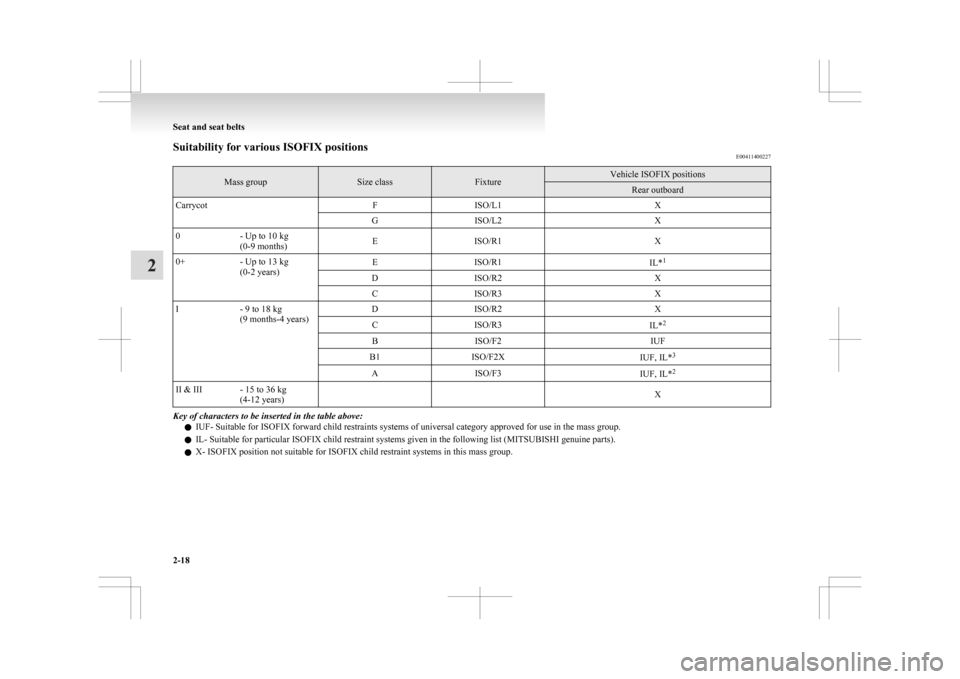
Suitability for various ISOFIX positions
E00411400227Mass group Size class Fixture Vehicle ISOFIX positions
Rear outboard
Carrycot FISO/L1 X
G ISO/L2 X
0 - Up to 10 kg
(0-9 months) E
ISO/R1 X
0+ - Up to 13 kg
(0-2 years) E
ISO/R1
IL*1
D ISO/R2 X
C ISO/R3 X
I - 9 to 18 kg
(9 months-4 years) D
ISO/R2 X
C ISO/R3
IL*2
B ISO/F2 IUF
B1 ISO/F2X
IUF, IL*3
A ISO/F3
IUF, IL*2
II & III - 15 to 36 kg (4-12 years)
XKey of characters to be inserted in the table above:
l IUF- Suitable for ISOFIX forward child restraints systems of universal category approved for use in the mass group.
l IL- Suitable for particular ISOFIX child restraint systems given in the following list (
MITSUBISHI genuine parts).
l X- ISOFIX position not suitable for ISOFIX child restraint systems in this mass group. Seat and seat belts
2-18
2
Page 77 of 368
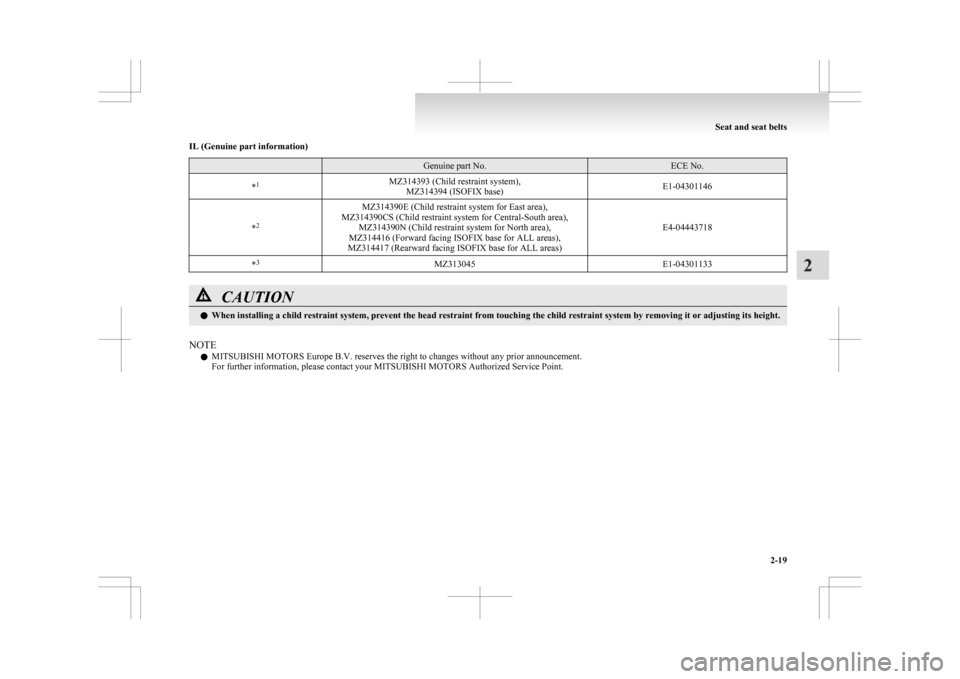
IL (Genuine part information)
Genuine part No. ECE No.
* 1
MZ314393 (Child restraint system),
MZ314394 (ISOFIX base) E1-04301146
* 2 MZ314390E (Child restraint system for East area),
MZ314390CS (Child restraint system for Central-South area), MZ314390N (Child restraint system for North area),
MZ314416 (Forward facing ISOFIX base for ALL areas),
MZ314417 (Rearward facing ISOFIX base for ALL areas) E4-04443718
* 3
MZ313045 E1-04301133CAUTION
l
When installing a child restraint system, prevent the head restraint from touching the child restraint system by removing it or adjusting its height.
NOTE l MITSUBISHI MOTORS
Europe B.V. reserves the right to changes without any prior announcement.
For further information, please contact your MITSUBISHI MOTORS Authorized Service Point. Seat and seat belts
2-19 2
Page 78 of 368
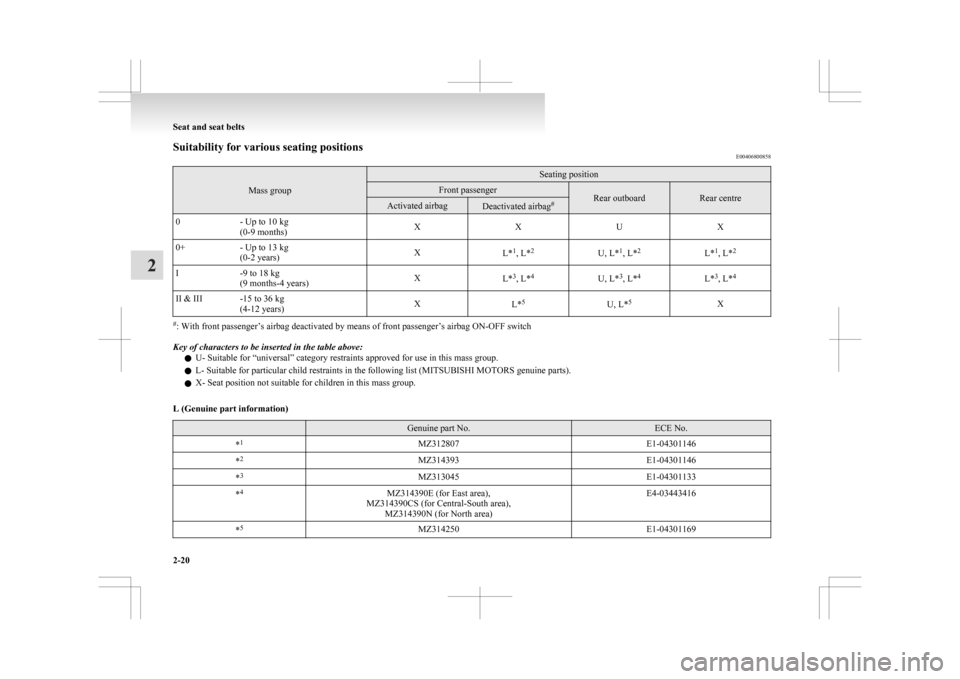
Suitability for various seating positions
E00406800858Mass group Seating position
Front passenger
Rear outboard Rear centre
Activated airbag
Deactivated airbag
#
0 - Up to 10 kg
(0-9 months) X
XUX
0+ - Up to 13 kg
(0-2 years) X
L*1
, L* 2
U, L*1
, L* 2
L*1
, L* 2
I -9 to 18 kg
(9 months-4 years) X
L*3
, L* 4
U, L*3
, L* 4
L*3
, L* 4
II & III -15 to 36 kg (4-12 years) X
L*5
U, L*5
X#
: With front passenger’s airbag deactivated by means of front passenger’s airbag ON-OFF switch
Key of characters to be inserted in the table above:
l U- Suitable for “universal” category restraints approved for use in this mass group.
l L- Suitable for particular child restraints in the following list (
MITSUBISHI MOTORS genuine parts).
l X- Seat position not suitable for children in this mass group.
L (Genuine part information) Genuine part No. ECE No.
* 1
MZ312807 E1-04301146
* 2
MZ314393 E1-04301146
* 3
MZ313045 E1-04301133
* 4
MZ314390E (for East area),
MZ314390CS (for Central-South area), MZ314390N (for North area) E4-03443416
* 5
MZ314250 E1-04301169Seat and seat belts
2-20
2
Page 79 of 368
CAUTION
l
When installing a child restraint system, prevent the head restraint from touching the child restraint system by removing it or adjusting its height.
NOTE l There is no applicable
MITSUBISHI MOTORS Genuine Parts to the Mass Group “0-Up to 10 kg”.
MITSUBISHI MOTORS Europe B.V. reserves the right to changes without any prior announcement.
For further information, please contact your MITSUBISHI MOTORS Authorized Service Point. Seat and seat belts
2-21 2
Page 80 of 368
Installing a child restraint system to
the lower anchorage (ISOFIX child re-
straint mountings) and tether anchor-
age
E00406900673
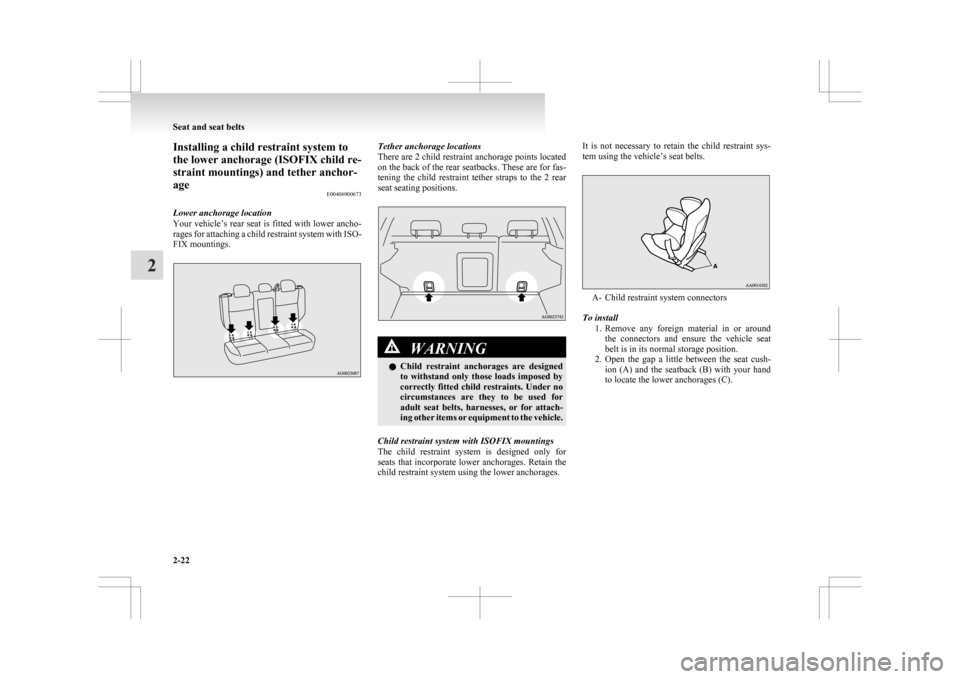
Lower anchorage location
Your
vehicle’s rear seat is fitted with lower ancho-
rages for attaching a child restraint system with ISO-
FIX mountings. Tether anchorage locations
There
are 2 child restraint anchorage points located
on the back of the rear seatbacks. These are for fas-
tening the child restraint tether straps to the 2 rear
seat seating positions. WARNING
l Child
restraint anchorages are designed
to withstand only those loads imposed by
correctly fitted child restraints. Under no
circumstances are they to be used for
adult seat belts, harnesses, or for attach-
ing other items or equipment to the vehicle.
Child restraint system with ISOFIX mountings
The
child restraint system is designed only for
seats that incorporate lower anchorages. Retain the
child restraint system using the lower anchorages. It is not necessary to retain the child restraint sys-
tem using the vehicle’s seat belts.
A- Child restraint system connectors
To install 1. Remove
any foreign material in or around
the connectors and ensure the vehicle seat
belt is in its normal storage position.
2. Open the gap a little between the seat cush- ion (A) and the seatback (B) with your hand
to locate the lower anchorages (C). Seat and seat belts
2-22
2
Page 81 of 368
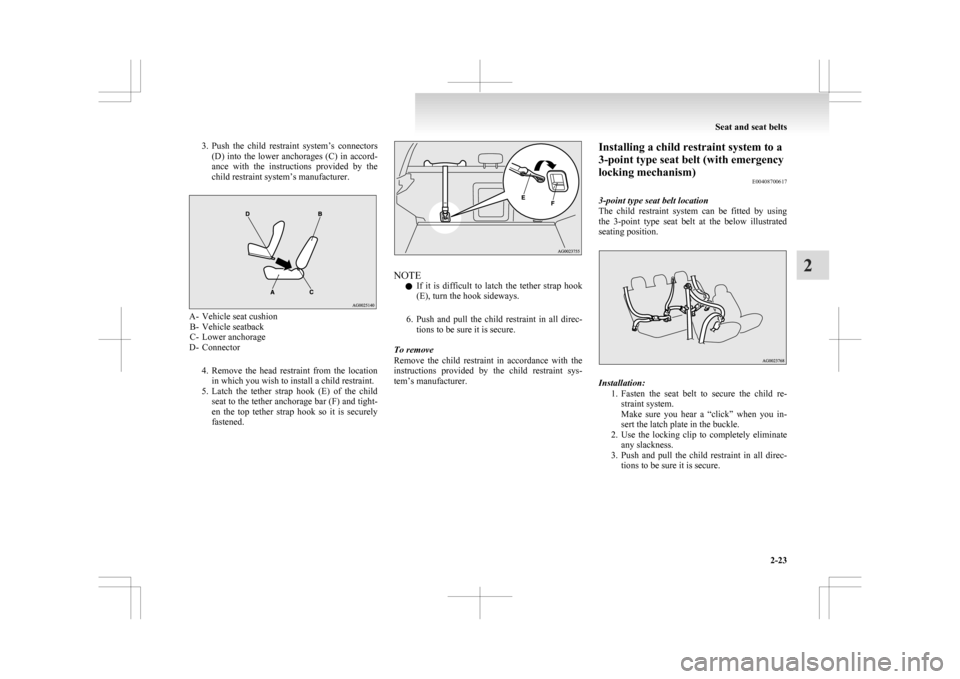
3. Push the child restraint system’s connectors
(D) into the lower anchorages (C) in accord-
ance with the instructions provided by the
child restraint system’s manufacturer. A- Vehicle seat cushion
B-
Vehicle seatback
C- Lower anchorage
D- Connector
4. Remove the head restraint from the locationin which you wish to install a child restraint.
5. Latch the tether strap hook (E) of the child seat to the tether anchorage bar (F) and tight-
en the top tether strap hook so it is securely
fastened. NOTE
l If
it is difficult to latch the tether strap hook
(E), turn the hook sideways.
6. Push and pull the child restraint in all direc- tions to be sure it is secure.
To remove
Remove the child restraint in accordance with the
instructions provided by the child restraint sys-
tem’s manufacturer. Installing a child restraint system to a
3-point type seat belt (with emergency
locking mechanism)
E00408700617
3-point type seat belt location
The
child restraint system can be fitted by using
the 3-point type seat belt at the below illustrated
seating position. Installation:
1. Fasten
the seat belt to secure the child re-
straint system.
Make sure you hear a “click” when you in-
sert the latch plate in the buckle.
2. Use the locking clip to completely eliminate any slackness.
3. Push and pull the child restraint in all direc- tions to be sure it is secure. Seat and seat belts
2-23 2
Page 82 of 368
WARNING
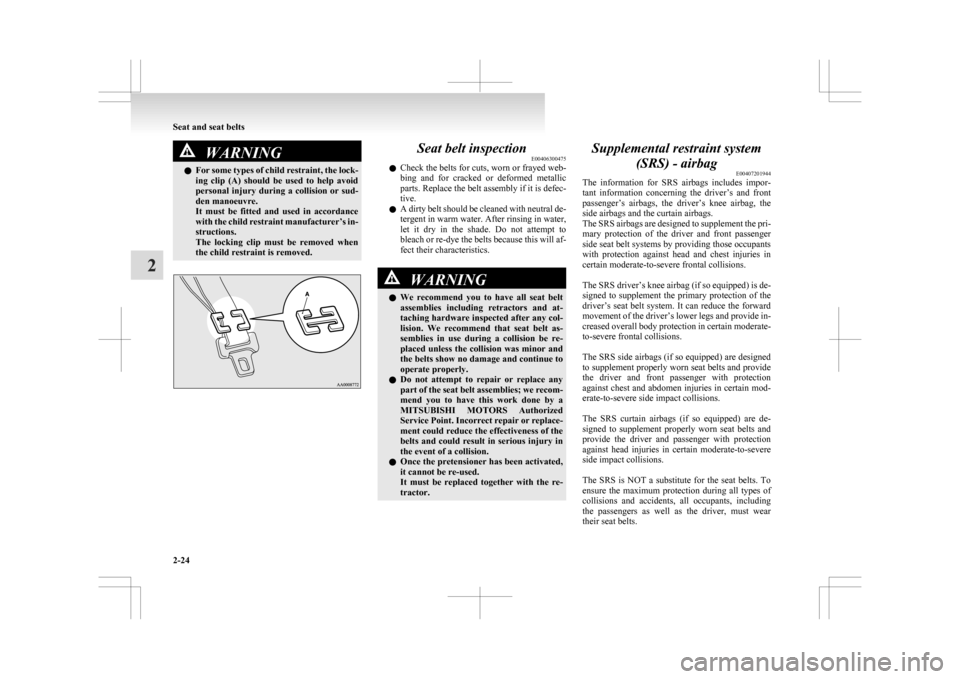
l For some types of child restraint, the lock-
ing clip (A) should be used to help avoid
personal injury during a collision or sud-
den manoeuvre.
It must be fitted and used in accordance
with the child restraint manufacturer’s in-
structions.
The locking clip must be removed when
the child restraint is removed. Seat belt inspection
E00406300475
l Check
the belts for cuts, worn or frayed web-
bing and for cracked or deformed metallic
parts. Replace the belt assembly if it is defec-
tive.
l A dirty belt should be cleaned with neutral de-
tergent in warm water. After rinsing in water,
let it dry in the shade. Do not attempt to
bleach or re-dye the belts because this will af-
fect their characteristics. WARNING
l We
recommend you to have all seat belt
assemblies including retractors and at-
taching hardware inspected after any col-
lision. We recommend that seat belt as-
semblies in use during a collision be re-
placed unless the collision was minor and
the belts show no damage and continue to
operate properly.
l Do not attempt to repair or replace any
part of the seat belt assemblies; we recom-
mend you to have this work done by a
MITSUBISHI MOTORS Authorized
Service Point. Incorrect repair or replace-
ment could reduce the effectiveness of the
belts and could result in serious injury in
the event of a collision.
l Once the pretensioner has been activated,
it cannot be re-used.
It must be replaced together with the re-
tractor. Supplemental restraint system
(SRS) - airbag E00407201944
The
information for SRS airbags includes impor-
tant information concerning the driver’s and front
passenger’s airbags, the driver’s knee airbag, the
side airbags and the curtain airbags.
The SRS airbags are designed to supplement the pri-
mary protection of the driver and front passenger
side seat belt systems by providing those occupants
with protection against head and chest injuries in
certain moderate-to-severe frontal collisions.
The SRS driver’s knee airbag (if so equipped) is de-
signed to supplement the primary protection of the
driver’s seat belt system. It can reduce the forward
movement of the driver’s lower legs and provide in-
creased overall body protection in certain moderate-
to-severe frontal collisions.
The SRS side airbags (if so equipped) are designed
to supplement properly worn seat belts and provide
the driver and front passenger with protection
against chest and abdomen injuries in certain mod-
erate-to-severe side impact collisions.
The SRS curtain airbags (if so equipped) are de-
signed to supplement properly worn seat belts and
provide the driver and passenger with protection
against head injuries in certain moderate-to-severe
side impact collisions.
The SRS is NOT a substitute for the seat belts. To
ensure the maximum protection during all types of
collisions and accidents, all occupants, including
the passengers as well as the driver, must wear
their seat belts. Seat and seat belts
2-24
2
Page 83 of 368
How the Supplemental Restraint Sys-
tem works
E00407301554
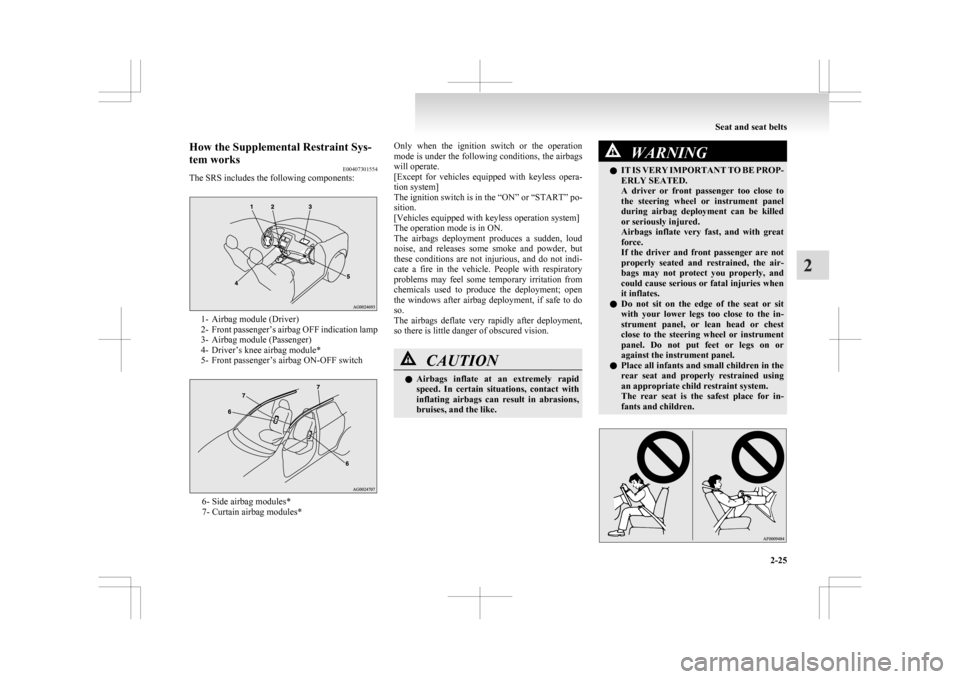
The SRS includes the following components: 1- Airbag module (Driver)
2- Front
passenger’s airbag OFF indication lamp
3- Airbag module (Passenger)
4- Driver’s knee airbag module*
5- Front passenger’s airbag ON-OFF switch 6- Side airbag modules*
7- Curtain airbag modules* Only when the ignition switch or the operation
mode
is under the following conditions, the airbags
will operate.
[Except for vehicles equipped with keyless opera-
tion system]
The ignition switch is in the “ON” or “START” po-
sition.
[Vehicles equipped with keyless operation system]
The operation mode is in ON.
The airbags deployment produces a sudden, loud
noise, and releases some smoke and powder, but
these conditions are not injurious, and do not indi-
cate a fire in the vehicle. People with respiratory
problems may feel some temporary irritation from
chemicals used to produce the deployment; open
the windows after airbag deployment, if safe to do
so.
The airbags deflate very rapidly after deployment,
so there is little danger of obscured vision. CAUTION
l
Airbags
inflate at an extremely rapid
speed. In certain situations, contact with
inflating airbags can result in abrasions,
bruises, and the like. WARNING
l IT
IS VERY IMPORTANT TO BE PROP-
ERLY SEATED.
A driver or front passenger too close to
the steering wheel or instrument panel
during airbag deployment can be killed
or seriously injured.
Airbags inflate very fast, and with great
force.
If the driver and front passenger are not
properly seated and restrained, the air-
bags may not protect you properly, and
could cause serious or fatal injuries when
it inflates.
l Do not sit on the edge of the seat or sit
with your lower legs too close to the in-
strument panel, or lean head or chest
close to the steering wheel or instrument
panel. Do not put feet or legs on or
against the instrument panel.
l Place all infants and small children in the
rear seat and properly restrained using
an appropriate child restraint system.
The rear seat is the safest place for in-
fants and children. Seat and seat belts
2-25 2