stop start MITSUBISHI ASX 2009 1.G Repair Manual
[x] Cancel search | Manufacturer: MITSUBISHI, Model Year: 2009, Model line: ASX, Model: MITSUBISHI ASX 2009 1.GPages: 368, PDF Size: 8.13 MB
Page 316 of 368
We recommend you to have the battery checked be-
fore
the start of cold weather and, if necessary,
have it charged or replaced.
This does not only ensure reliable starting, but a bat-
tery which is kept fully charged also has a longer life.
Disconnection and connection E01011000079
To disconnect the battery cable, stop the engine,
first
disconnect the negative (-) terminal and then
the positive (+) terminal.
When connecting the battery, first connect the posi-
tive (+) terminal and then the negative (-) terminal.
NOTE
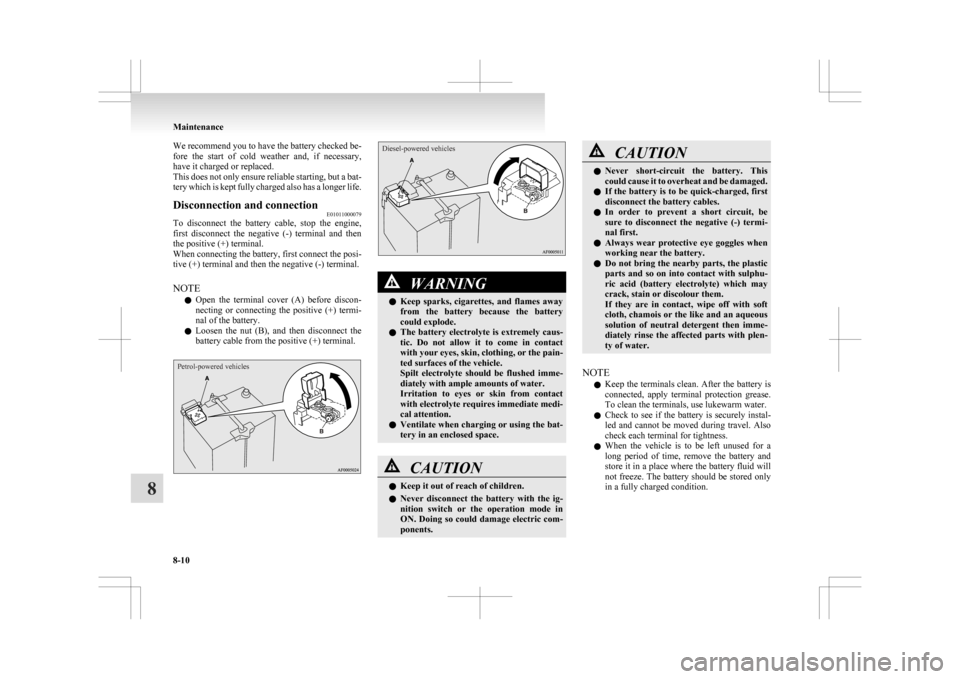
l Open the terminal cover (A) before discon-
necting or connecting the positive (+) termi-
nal of the battery.
l Loosen the nut (B), and then disconnect the
battery cable from the positive (+) terminal.
Petrol-powered vehicles
Diesel-powered vehicles WARNING
l Keep
sparks, cigarettes, and flames away
from the battery because the battery
could explode.
l The battery electrolyte is extremely caus-
tic. Do not allow it to come in contact
with your eyes, skin, clothing, or the pain-
ted surfaces of the vehicle.
Spilt electrolyte should be flushed imme-
diately with ample amounts of water.
Irritation to eyes or skin from contact
with electrolyte requires immediate medi-
cal attention.
l Ventilate when charging or using the bat-
tery in an enclosed space. CAUTION
l
Keep it out of reach of children.
l Never
disconnect the battery with the ig-
nition switch or the operation mode in
ON. Doing so could damage electric com-
ponents. CAUTION
l
Never
short-circuit the battery. This
could cause it to overheat and be damaged.
l If the battery is to be quick-charged, first
disconnect the battery cables.
l In order to prevent a short circuit, be
sure to disconnect the negative (-) termi-
nal first.
l Always wear protective eye goggles when
working near the battery.
l Do not bring the nearby parts, the plastic
parts and so on into contact with sulphu-
ric acid (battery electrolyte) which may
crack, stain or discolour them.
If they are in contact, wipe off with soft
cloth, chamois or the like and an aqueous
solution of neutral detergent then imme-
diately rinse the affected parts with plen-
ty of water.
NOTE l Keep
the terminals clean. After the battery is
connected, apply terminal protection grease.
To clean the terminals, use lukewarm water.
l Check to see if the battery is securely instal-
led and cannot be moved during travel. Also
check each terminal for tightness.
l When the vehicle is to be left unused for a
long period of time, remove the battery and
store it in a place where the battery fluid will
not freeze. The battery should be stored only
in a fully charged condition. Maintenance
8-10
8
Page 322 of 368
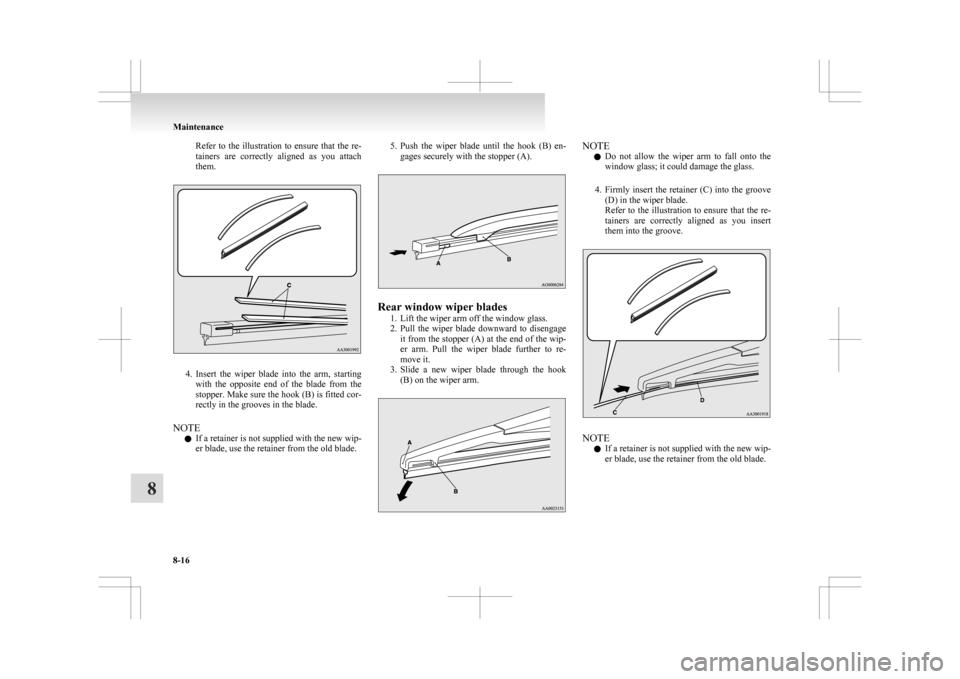
Refer to the illustration to ensure that the re-
tainers
are correctly aligned as you attach
them. 4. Insert
the wiper blade into the arm, starting
with the opposite end of the blade from the
stopper. Make sure the hook (B) is fitted cor-
rectly in the grooves in the blade.
NOTE l If a retainer is not supplied with the new wip-
er blade, use the retainer from the old blade. 5. Push
the wiper blade until the hook (B) en-
gages securely with the stopper (A). Rear window wiper blades
1.
Lift the wiper arm off the window glass.
2. Pull the wiper blade downward to disengage it from the stopper (A) at the end of the wip-
er arm. Pull the wiper blade further to re-
move it.
3. Slide a new wiper blade through the hook (B) on the wiper arm. NOTE
l Do
not allow the wiper arm to fall onto the
window glass; it could damage the glass.
4. Firmly insert the retainer (C) into the groove (D) in the wiper blade.
Refer to the illustration to ensure that the re-
tainers are correctly aligned as you insert
them into the groove. NOTE
l If
a retainer is not supplied with the new wip-
er blade, use the retainer from the old blade. Maintenance
8-16
8
Page 357 of 368

4
4-wheel drive operation 4-31
AAccessory (Installation) 04
Accessory socket 5-61
Active stability control (ASC)
4-40
Additional equipment 8-17
Air conditioning 5-03 Important operation tips for the air condition-
ing 5-09
Air purifier 5-10
Airbag 2-24
Antenna 5-39
Anti-lock brake system (ABS) 4-38 Display 4-38
Warning lamp 4-38
Ashtray 5-60
Assist grips 5-70
Audio 5-10 Error codes 5-35
External audio input function 5-32
Handling of compact discs 5-38
Steering wheel audio remote control
switches 5-33
Auto Stop & Go (AS&G) system 4-17
Automatic transmission Fluid 9-14
Selector lever operation 4-24
Selector lever position 4-25
Sports mode 4-26
BBattery 8-08
Charge warning lamp 3-42 Discharged battery (Emergency starting) 6-02
Disposal information for used batteries
06
Specification 9-11
Bluetooth® 2.0 interface 5-41
Bonnet 8-03
Bottle holder 5-69
Brake assist system 4-36
Brake Anti-lock brake 4-38
Braking 4-34
Fluid 8-07,9-14
Parking brake 4-06
Bulb capacity 8-23
C Capacities 9-14
Card holder 5-59,5-66
Cargo loads 4-52
Catalytic converter
8-02
Cautions on handling of 4-wheel drive vehi-
cles 4-33
Central door locks 1-22
Charge warning lamp 3-42
Chassis number 9-02
Check engine warning lamp 3-41
Child restraint 2-15
Child-protection rear doors 1-25
Cigarette lighter 5-60
Cleaning Exterior of your vehicle 7-03
Interior of your vehicle 7-02
Clock 5-39
Clutch Fluid 8-07
Coat hook 5-70
Combination headlamps and dipper switch 3-44
Coolant (engine) 8-06,9-14
Cruise control 4-43 Cup holder 5-68
D Daytime running lamps
Bulb capacity
8-24
Replacement 8-30
Demister (rear window) 3-57
Diesel particulate filter (DPF) 4-15
Dimensions 9-04
Dipper (High/Low beam change) 3-47
Doors Central door locks 1-22
Child-protection 1-25
Dead Lock System 1-23
Lock and unlock 1-21
Driving, alcohol and drugs 4-02
E Economical driving 4-02
Electric power steering system (EPS)
4-40
Electric window control 1-34
Electrical system 9-11
Electronic immobilizer (Anti-theft starting sys-
tem) 1-03
Electronically controlled 4WD system 4-29
Emergency starting 6-02
Emergency stop signal system 4-37
Engine specifications 9-10
Engine switch 1-11
Engine Coolant 8-06,9-14
Number 9-02
Oil 8-04
Oil and filter 9-14
Overheating 6-04
Specifications 9-10 Alphabetical index
1
Page 358 of 368

Used engine oils safety instructions and disposal
information 05
Exterior and interior lamp operation
8-17
F Fluid capacities and lubricants 9-14
Fluid
Automatic transmission fluid
9-14
Brake fluid 8-07,9-14
Clutch fluid 8-07
CVT fluid 9-14
Engine coolant 8-06,9-14
Power steering fluid 9-14
Twin Clutch SST fluid 9-14
Washer fluid 8-07,9-14
For cold and snowy weather 8-17
Front fog lamps Bulb capacity 8-24
Replacement 8-29
Switch 3-50
Front room lamp Bulb capacity 8-24
Front seat 2-03
Front turn-signal lamps Bulb capacity 8-24
Replacement 8-28
Fuel consumption 9-13
Fuel Filling the fuel tank 03
Fuel selection 02
Modification/alterations to the electrical or fuel
systems 05
Tank capacity 03
Fuses 8-18
Fusible links 8-18 GGeneral maintenance 8-17
General vehicle data
9-04
Genuine parts 05
Glove box lamp Bulb capacity 8-24
H Hazard warning flasher switch 3-50
Hazard warning indication lamps
3-40
Head restraints 2-07
Headlamp levelling switch 3-48
Headlamp washer switch 3-56
Headlamps Bulb capacity 8-23
Headlamp flasher 3-47
Replacement 8-25,8-26
Switch 3-44
Heated mirror 4-10
Heated seats 2-06
Heater 5-03
High-mounted stop lamp Bulb capacity 8-24
Replacement 8-33
Hill start assist 4-35
Hinges and latches lubrication 8-17
Horn switch 3-57
I If the vehicle breaks down 6-02
Ignition switch 4-11
Indication lamps
3-40
Information screen display 3-42
Inside rear-view mirror 4-08
Inside tailgate release 1-27 Inspection and maintenance following rough road
operation 4-33
Instruments 3-02
Interior lamps 5-62
Map lamps 5-63
J Jack 6-06
Storage 6-06
Jump starting (Emergency starting)
6-02
K Key slot 1-17
Keyless entry system 1-04,1-18
Keyless operation system 1-07
Keys 1-02
L Labeling 9-02
Lamp monitor buzzer
3-46
Leakage (Fuel, engine coolant, oil and exhaust
gas) 8-17
Licence plate lamps Bulb capacity 8-24
Replacement 8-33
Link System 5-41
Lubricants 9-14
Luggage hooks 5-70
Luggage room lamp 5-63 Bulb capacity 8-24
M Making a luggage compartment 2-08
Manual transmission 4-21
Map lamps 5-62,5-63Alphabetical index
2
Page 359 of 368

Bulb capacity 8-24
Mirror Inside rear-view mirror 4-08
Outside rear-view mirrors 4-09
Modification/alterations
to the electrical or fuel sys-
tems 05
Multi-information display 3-03
OOil
Engine oil 8-04
Manual transmission oil 9-14
Rear differential oil
9-14
Transfer oil 9-14
Operation mode 1-12
Operation under adverse driving conditions 6-22
Outside rear-view mirrors 4-09
Overheating 6-04
PParking 4-07
Parking brake 4-06
Parking brake break-in 8-15
Position lamps Bulb capacity
8-24
Replacement 8-27
Power steering Fluid 9-14
Precautions to observe when using wipers and wash-
ers 3-56
Pregnant women restraint 2-14
Puncture Tyre changing 6-12
Tyre repair kit 6-07 RRear combination lamps
Bulb capacity
8-24
Replacement 8-31
Rear differential oil 9-14
Rear fog lamp Bulb capacity 8-24
Replacement 8-31
Switch 3-51
Rear room lamp Bulb capacity 8-24
Rear shelf panel 5-69
Rear turn-signal lamps Bulb capacity 8-24
Replacement 8-31
Rear window demister switch 3-57
Rear-view camera 4-50
Rear-view mirror Inside 4-08
Outside 4-09
Refill capacities 9-14
Replacement of lamp bulbs 8-23
Reversing lamps Bulb capacity 8-24
Replacement 8-31
Reversing sensor system 4-47
Roof carrier precaution 4-53
Room lamp (front) 5-62
Room lamp (rear) 5-63
Running-in recommendations 4-04
S Safe driving techniques 4-03
Seat belt 2-10
Adjustable seat belt anchor
2-12
Child restraint 2-15 Force limiter 2-15
Inspection 2-24
Pregnant women restraint
2-14
Pretensioner 2-14
Seat Adjustment 2-03
Front seat 2-03
Head restraints 2-07
Heated seats 2-06
Making a luggage compartment 2-08
Rear seat 2-06
Security alarm system 1-28
Service precaution 8-02
Side turn-signal lamp Bulb capacity 8-24
Side turn-signal lamps Replacement 8-29
Snow tyres 8-14
Spare wheel 6-13
Spark plug 9-11
Specifications 9-02
Starting 4-13
Starting and stopping the engine 1-15
Steering Power steering fluid 9-14
Steering wheel height and reach adjust-
ment 4-08
Steering wheel lock 1-14,4-12
Stop and tail lamps Replacement 8-31
Stop lamps Bulb capacity 8-23
Storage spaces 5-65
Sun visors 5-59
Sunshade 1-36
Sunshade illumination 5-64
Supplemental restraint system 2-24 Servicing 2-34 Alphabetical index
3