brake MITSUBISHI ASX 2014 (in English) User Guide
[x] Cancel search | Manufacturer: MITSUBISHI, Model Year: 2014, Model line: ASX, Model: MITSUBISHI ASX 2014Pages: 418, PDF Size: 14.02 MB
Page 138 of 418
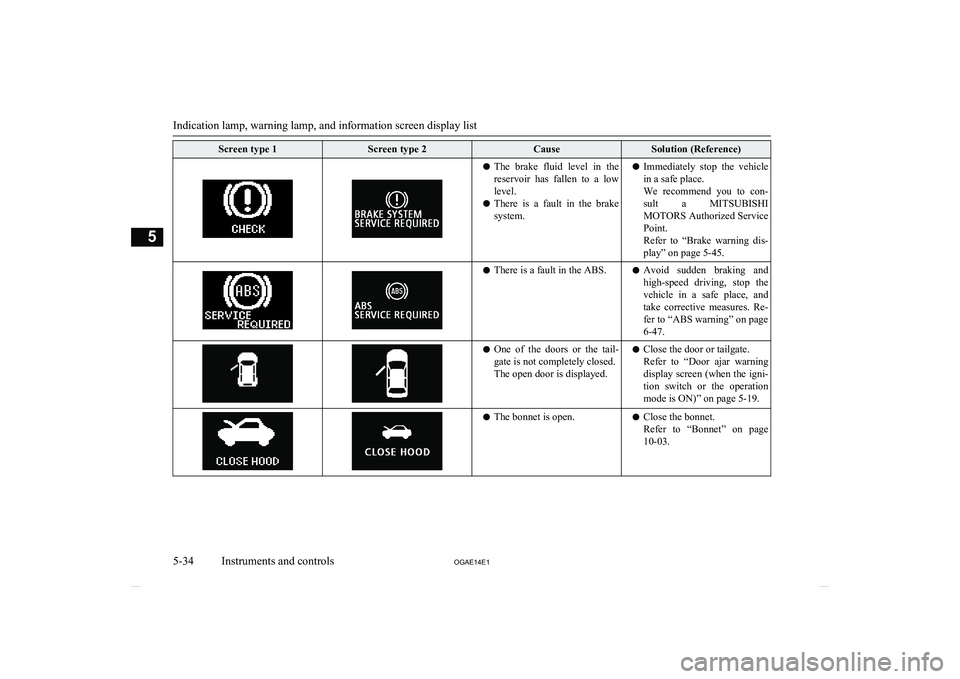
Screen type 1Screen type 2CauseSolution (Reference)lThe brake fluid level in the
reservoir has fallen to a low level.
l There is a fault in the brake
system.l Immediately stop the vehicle
in a safe place.
We recommend you to con-
sult a MITSUBISHI
MOTORS Authorized Service
Point.
Refer to “Brake warning dis-
play” on page 5-45.l There is a fault in the ABS.l Avoid sudden braking and
high-speed driving, stop the vehicle in a safe place, and take corrective measures. Re-fer to “ABS warning” on page
6-47.l One of the doors or the tail-
gate is not completely closed.
The open door is displayed.l Close the door or tailgate.
Refer to “Door ajar warning
display screen (when the igni- tion switch or the operation
mode is ON)” on page 5-19.l The bonnet is open.lClose the bonnet.
Refer to “Bonnet” on page 10-03.
Indication lamp, warning lamp, and information screen display list
5-34 OGAE14E1Instruments and controls5
Page 140 of 418
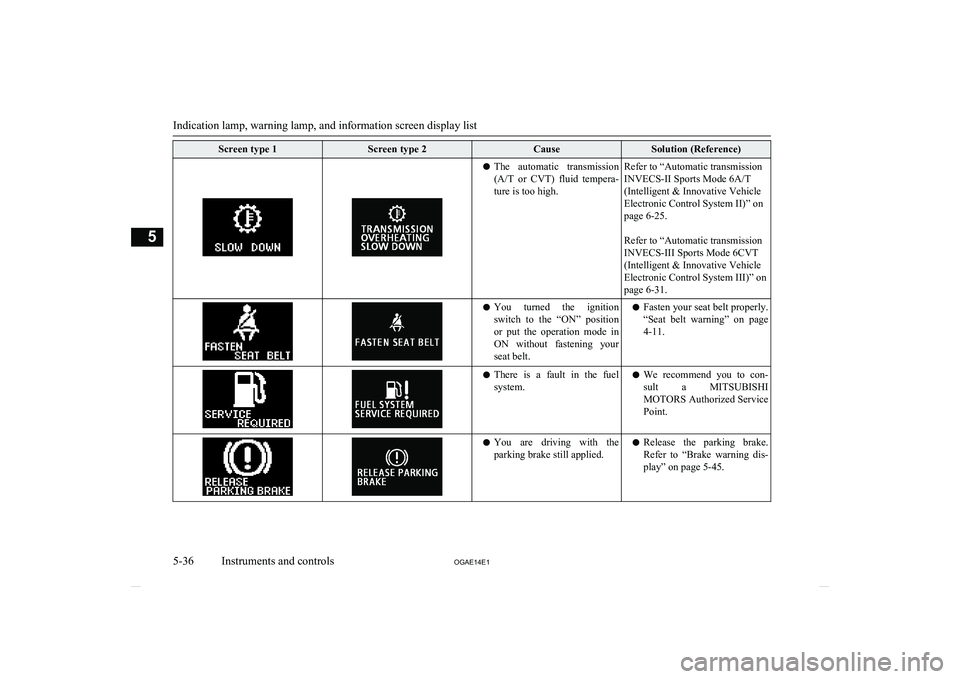
Screen type 1Screen type 2CauseSolution (Reference)lThe automatic transmission
(A/T or CVT) fluid tempera-
ture is too high.Refer to “Automatic transmission
INVECS-II Sports Mode 6A/T
(Intelligent & Innovative Vehicle
Electronic Control System II)” on
page 6-25.
Refer to “Automatic transmission
INVECS-III Sports Mode 6CVT
(Intelligent & Innovative Vehicle
Electronic Control System III)” on
page 6-31.l You turned the ignition
switch to the “ON” positionor put the operation mode in
ON without fastening your
seat belt.l Fasten your seat belt properly.
“Seat belt warning” on page
4-11.l There is a fault in the fuel
system.l We recommend you to con-
sult a MITSUBISHI
MOTORS Authorized Service
Point.l You are driving with the
parking brake still applied.l Release the parking brake.
Refer to “Brake warning dis- play” on page 5-45.
Indication lamp, warning lamp, and information screen display list
5-36 OGAE14E1Instruments and controls5
Page 144 of 418
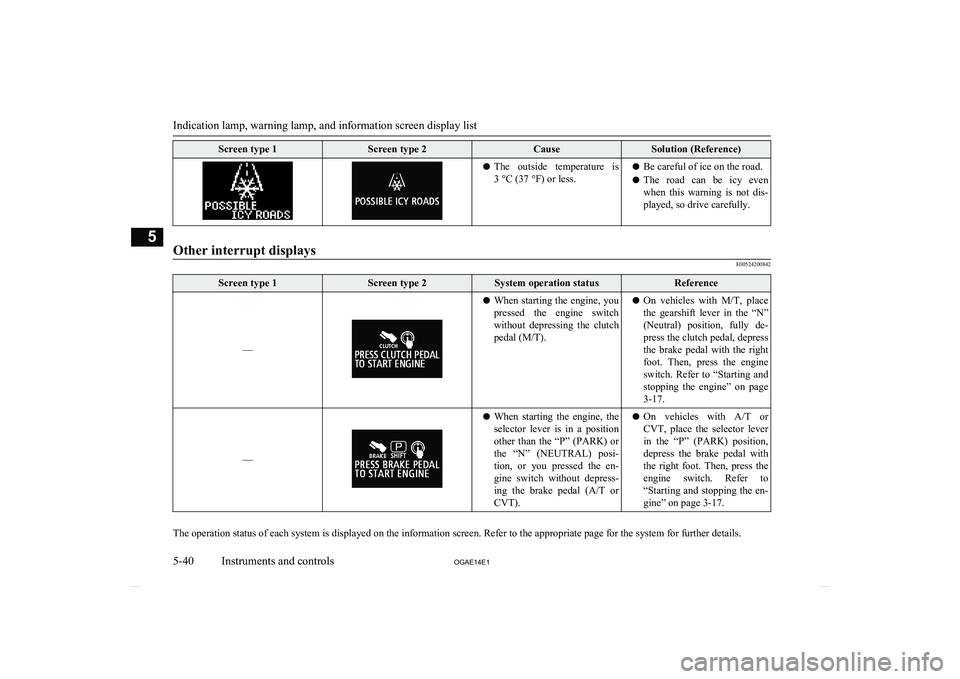
Screen type 1Screen type 2CauseSolution (Reference)lThe outside temperature is
3 °C (37 °F) or less.l Be careful of ice on the road.
l The road can be icy even
when this warning is not dis- played, so drive carefully.
Other interrupt displays
E00524200842
Screen type 1Screen type 2System operation statusReference
––
l When starting the engine, you
pressed the engine switch without depressing the clutch pedal (M/T).l On vehicles with
M/T, place
the gearshift lever in the “N” (Neutral) position, fully de- press the clutch pedal, depressthe brake pedal with the rightfoot. Then, press the engine
switch. Refer to “Starting and stopping the engine” on page
3-17.
––
l When starting the engine, the
selector lever is in a position
other than the “P” (PARK) or
the “N” (NEUTRAL) posi- tion, or you pressed the en-
gine switch without depress-
ing the brake pedal ( A/T or
CVT).l On vehicles with
A/T or
CVT, place the selector lever in the “P” (PARK) position,
depress the brake pedal with the right foot. Then, press the
engine switch. Refer to “Starting and stopping the en- gine” on page 3-17.
The operation status of each system is displayed on the information screen. Refer to the appropriate page for the system for further details.
Indication lamp, warning lamp, and information screen display list
5-40 OGAE14E1Instruments and controls5
Page 148 of 418
NOTElIf the engine is cold, the diesel preheat indi-
cation lamp is on for a longer time.
l When the engine is warm, the diesel preheat
indication lamp does not come on even if the
ignition switch is turned to the “ON” posi-
tion or the operation mode is put in ON.Warning lamps
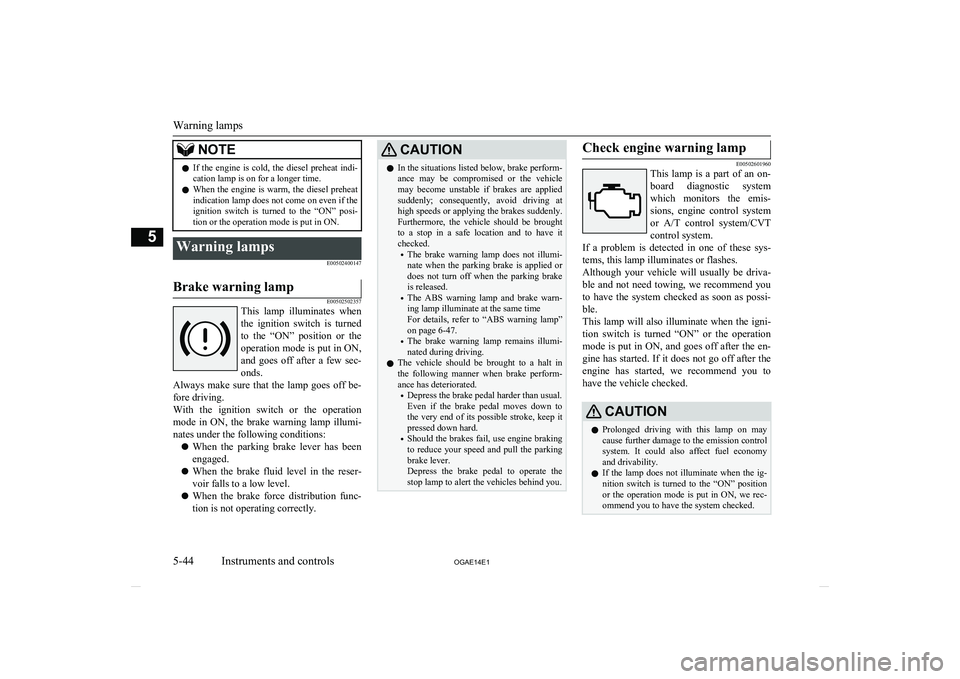
E00502400147Brake warning lamp
E00502502357
This lamp illuminates whenthe ignition switch is turnedto the “ON” position or the
operation mode is put in ON, and goes off after a few sec-onds.
Always make sure that the lamp goes off be- fore driving.
With the ignition switch or the operation mode in ON, the brake warning lamp illumi-
nates under the following conditions:
l When the parking brake lever has been
engaged.
l When the brake fluid level in the reser-
voir falls to a low level.
l When the brake force distribution func-
tion is not operating correctly.
CAUTIONl In the situations listed below, brake perform-
ance may be compromised or the vehicle may become unstable if brakes are applied
suddenly; consequently, avoid driving at
high speeds or applying the brakes suddenly. Furthermore, the vehicle should be brought
to a stop in a safe location and to have it
checked.
• The brake warning lamp does not illumi-
nate when the parking brake is applied ordoes not turn off when the parking brake is released.
• The ABS warning lamp and brake warn-
ing lamp illuminate at the same time
For details, refer to “ABS warning lamp”
on page 6-47.
• The brake warning lamp remains illumi-
nated during driving.
l The vehicle should be brought to a halt in
the following manner when brake perform- ance has deteriorated.
• Depress the brake pedal harder than usual.
Even if the brake pedal moves down to
the very end of its possible stroke, keep it
pressed down hard.
• Should the brakes fail, use engine braking
to reduce your speed and pull the parking
brake lever.
Depress the brake pedal to operate the
stop lamp to alert the vehicles behind you.Check engine warning lamp
E00502601960
This lamp is a part of an on-
board diagnostic system
which monitors the emis-
sions, engine control system or A/T control system/CVT
control system.
If a problem is detected in one of these sys- tems, this lamp illuminates or flashes.Although your vehicle will usually be driva-
ble and not need towing, we recommend you
to have the system checked as soon as possi-
ble.
This lamp will also illuminate when the igni- tion switch is turned “ON” or the operation
mode is put in ON, and goes off after the en- gine has started. If it does not go off after the
engine has started, we recommend you to have the vehicle checked.
CAUTIONl Prolonged driving with this lamp on may
cause further damage to the emission control
system. It could also affect fuel economy and drivability.
l If the lamp does not illuminate when the ig-
nition switch is turned to the “ON” position
or the operation mode is put in ON, we rec- ommend you to have the system checked.
Warning lamps
5-44 OGAE14E1Instruments and controls5
Page 149 of 418
CAUTIONlIf the lamp illuminates while the engine is
running, avoid driving at high speeds and have the system inspected by a
MITSUBISHI MOTORS Authorized Serv-
ice Point as soon as possible.
Accelerator pedal and brake pedal response may be negatively influenced under these
conditions.NOTEl The engine electronic control module ac-
commodating the onboard diagnostic system has various fault data (especially about the
exhaust emission) stored.Charge warning lamp
E00502701192
This lamp illuminates when
the ignition switch is turned“ON” or the operation mode
is put in ON, and goes off af-
ter the engine has started.
A warning is also displayed
on the multi-information display.
CAUTIONl If it illuminates while the engine is running,
there is a problem in the charging system.
Immediately park your vehicle in a safe place and we recommend you to have it
checked.Information screen display
E00524600051Fuel filter indicator display*
E00529400083
Type 1Type 2
When the ignition switch is turned to the
“ON” position or the operation mode is put in
ON, if more water than the specified limit has
accumulated in the fuel filter, the warning display is displayed on the information
screen in the multi-information display.
CAUTIONl If this warning display is displayed we rec-
ommend you to have it checked.
Prolonged driving with the warning display
shown may damage the engine.NOTEl If “REMOVE WATER IN SEPARATOR”
does not go out or appears frequently after
removing the water, we recommend you to consult a MITSUBISHI MOTORS Author-
ized Service Point.Brake warning display
E00524700267
Type 1Type 2
Information screen display
5-45
OGAE14E1Instruments and controls5
Page 150 of 418
This warning is displayed if you drive withthe parking brake still applied. The warning lamp in the instrument cluster only illumi-
nates when the parking brake is applied.CAUTIONl If a vehicle is driven without releasing the
parking brake, the brake will be overheated, resulting in ineffective braking and possiblebrake failure.
If this warning is displayed, release the park-
ing brake.Type 1Type 2
When the ignition switch is turned to the
“ON” position or the operation mode is put in
ON, if the brake fluid is low, this warning is displayed.
The warning lamp in the instrument cluster
also illuminates.CAUTIONl If this warning stays illuminated and does
not go out while driving, there is a danger of
ineffective braking. In this case, immediate- ly park your vehicle in a safe place and we
recommend you to have it checked.
l If the brake warning display is displayed and
the brake warning lamp and the ABS warn- ing lamp are illuminated at the same time,
the braking force distribution function will not operate, so the vehicle may be destabi-
lised during sudden braking. Avoid sudden
braking and high-speed driving, stop the ve- hicle in a safe place, and we recommend you
to have it checked.
l The vehicle should be brought to a halt in
the following manner when brake perform-
ance has deteriorated.
• Depress the brake pedal harder than usual.
Even if the brake pedal moves down to the very end of its possible stroke, keep it
pressed down hard.
• Should the brakes fail, use engine braking
to reduce your speed and pull the parking
brake lever.
Depress the brake pedal to operate the
stop lamp to alert the vehicles behind you.Charge warning display
E00524800200
Type 1Type 2
If there is a fault with the charging system,
the warning display is displayed on the infor- mation screen in the multi-information dis-
play. The warning lamp in the instrument cluster also illuminates.
CAUTIONl If the warning is displayed while the engine
is running, immediately park your vehicle in
a safe place and we recommend you to have it checked.
Information screen display
5-46 OGAE14E1Instruments and controls5
Page 167 of 418
Economical driving............................................................................. 6-02
Driving, alcohol and drugs.................................................................. 6-03
Safe driving techniques....................................................................... 6-03
Running-in recommendations............................................................. 6-04 Parking brake...................................................................................... 6-06
Parking................................................................................................ 6-07
Steering wheel height and reach adjustment....................................... 6-08
Inside rear-view mirror....................................................................... 6-08 Outside rear-view mirrors................................................................... 6-09
Ignition switch.....................................................................................6-11 Steering wheel lock............................................................................. 6-13
Starting................................................................................................ 6-13 Diesel particulate filter (DPF)*........................................................... 6-16Turbocharger operation*..................................................................... 6-18Auto Stop & Go (AS&G) system*..................................................... 6-18
Manual transmission*......................................................................... 6-22 Automatic transmission INVECS-II Sports Mode 6A/T (Intelligent & Innovative Vehicle Electronic Control
System II)*......................................................................................6-25
Automatic transmission INVECS-III Sports Mode 6CVT (Intelligent & Innovative Vehicle Electronic Control
System III)*.................................................................................... 6-31
Electronically controlled 4WD system*............................................. 6-37 4-wheel drive operation...................................................................... 6-39
Inspection and maintenance following rough road operation............. 6-41
Cautions on handling of 4-wheel drive vehicles................................. 6-42
Braking................................................................................................ 6-43
Hill start assist*................................................................................... 6-44
Brake assist system............................................................................. 6-45Emergency stop signal system............................................................ 6-46
Anti-lock brake system (ABS)............................................................ 6-46
Electric power steering system (EPS)................................................. 6-49 Active stability control (ASC)*.......................................................... 6-50Cruise control*.................................................................................... 6-52
Reversing sensor system*................................................................... 6-57 Rear-view camera*............................................................................. 6-61
Cargo loads......................................................................................... 6-64Trailer towing......................................................................................6-66Starting and driving
OGAE14E16
Page 168 of 418
Economical drivingE00600101076
For economical driving, there are some tech- nical requirements that have to be met. Theprerequisite for low fuel consumption is a
properly adjusted engine. In order to achieve longer life of the vehicle and the most eco- nomical operation, we recommend you tohave the vehicle checked at regular intervals in accordance with the service standards.
Fuel economy and generation of exhaust gas
and noise are highly influenced by personal
driving habits as well as the particular operat- ing conditions. The following points shouldbe observed in order to minimize wear of
brakes, tyres and engine as well as to reduce
environmental pollution.
Starting the engine
Avoid sudden acceleration and sudden starts,
as they will increase fuel consumption.
Shifting
Shift only at an appropriate speed and engine speed. Always use the highest shift position
possible.
Selecting the 4WD drive mode
(4WD vehicles)
The drive mode-selector should be set to
“2WD” when driving on normal roads and
express ways to obtain best possible fuel
economy.
City traffic
Frequent starting and stopping increases the
average fuel consumption. Use roads with smooth traffic flow whenever possible. When driving on congested roads, avoid use of a
low shift position at high engine speeds.
Idling
The vehicle consumes fuel even during
idling. Avoid extended idling whenever pos- sible.
Speed
At higher vehicle speed, more fuel is con- sumed. Avoid driving at full speed. Even a
slight release of the accelerator pedal will save a significant amount of fuel.
Tyre inflation pressure
Check the tyre inflation pressures at regular
intervals. Low tyre inflation pressure increa-ses road resistance and fuel consumption. In addition, low tyre pressures adversely affect
tyre wear and driving stability.
Cargo loads
Do not drive with unnecessary articles in the
luggage compartment. Especially during city
driving where frequent starting and stopping is necessary, the increased weight of the ve-
hicle will greatly affect fuel consumption. Al-
so avoid driving with unnecessary luggage or carriers, etc., on the roof; the increased air re- sistance will increase fuel consumption.
Cold engine starting
Starting of a cold engine consumes more fuel.
Unnecessary fuel consumption is also caused by keeping a hot engine running. After the
engine is started, commence driving as soon
as possible.
Air conditioning
The use of the air conditioning will increase the fuel consumption.
Economical driving
6-02 OGAE14E1Starting and driving6
Page 172 of 418
Parking brakeE00600501243
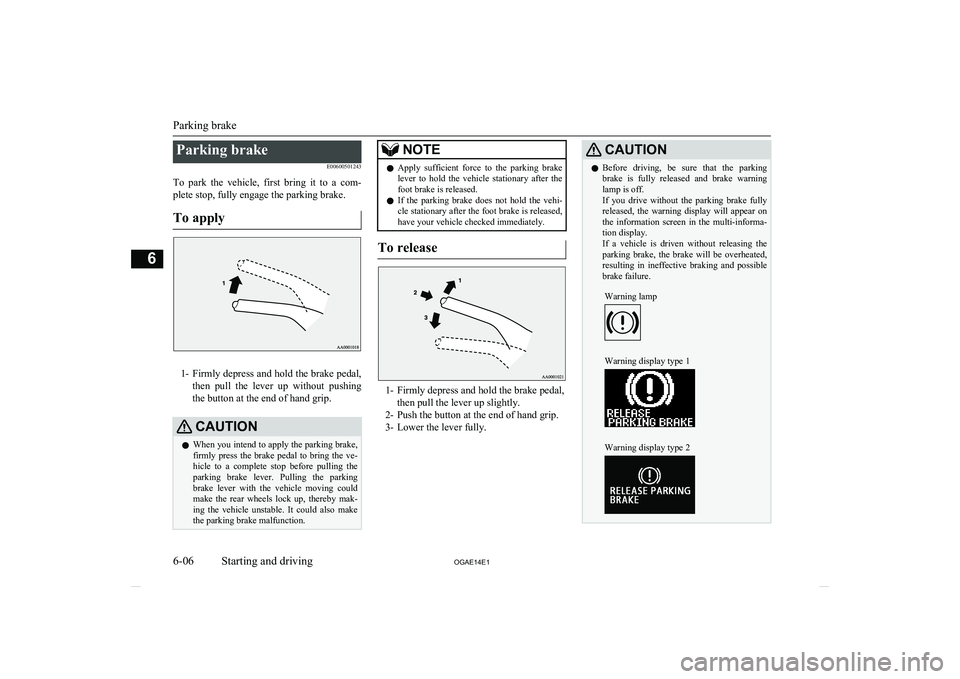
To park the vehicle, first bring it to a com- plete stop, fully engage the parking brake.
To apply
1- Firmly depress and hold the brake pedal,
then pull the lever up without pushing
the button at the end of hand grip.
CAUTIONl When you intend to apply the parking brake,
firmly press the brake pedal to bring the ve-hicle to a complete stop before pulling theparking brake lever. Pulling the parking brake lever with the vehicle moving could
make the rear wheels lock up, thereby mak- ing the vehicle unstable. It could also make
the parking brake malfunction.NOTEl Apply sufficient force to the parking brake
lever to hold the vehicle stationary after the foot brake is released.
l If the parking brake does not hold the vehi-
cle stationary after the foot brake is released,
have your vehicle checked immediately.
To release
1- Firmly depress and hold the brake pedal,
then pull the lever up slightly.
2- Push the button at the end of hand grip.
3- Lower the lever fully.
CAUTIONl Before driving, be sure that the parking
brake is fully released and brake warning lamp is off.
If you drive without the parking brake fully
released, the warning display will appear on the information screen in the multi-informa-tion display.
If a vehicle is driven without releasing the
parking brake, the brake will be overheated, resulting in ineffective braking and possible
brake failure.Warning lampWarning display type 1Warning display type 2
Parking brake
6-06 OGAE14E1Starting and driving6
Page 173 of 418
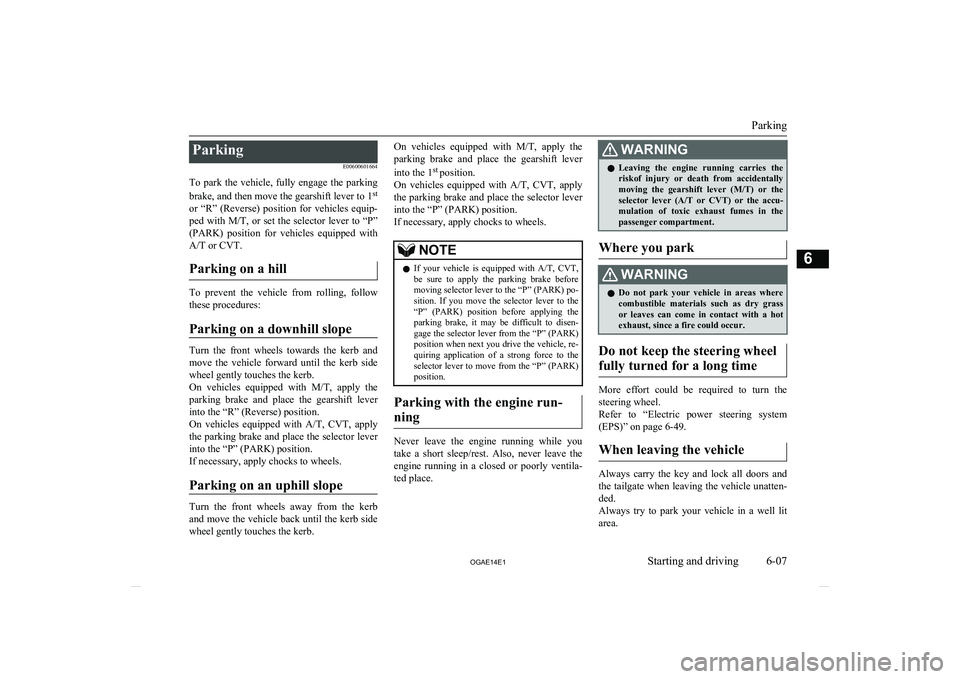
ParkingE00600601664
To park the vehicle, fully engage the parking brake, and then move the gearshift lever to 1 st
or “R” (Reverse) position for vehicles equip-
ped with M/T, or set the selector lever to “P”
(PARK) position for vehicles equipped with
A/T or CVT.
Parking on a hill
To prevent the vehicle from rolling, followthese procedures:
Parking on a downhill slope
Turn the front wheels towards the kerb and
move the vehicle forward until the kerb side wheel gently touches the kerb.
On vehicles equipped with M/T, apply the
parking brake and place the gearshift lever
into the “R” (Reverse) position.
On vehicles equipped with A/T, CVT, apply
the parking brake and place the selector lever
into the “P” (PARK) position.
If necessary, apply chocks to wheels.
Parking on an uphill slope
Turn the front wheels away from the kerb and move the vehicle back until the kerb side
wheel gently touches the kerb.
On vehicles equipped with M/T, apply the
parking brake and place the gearshift lever
into the 1 st
position.
On vehicles equipped with A/T, CVT, apply
the parking brake and place the selector lever
into the “P” (PARK) position.
If necessary, apply chocks to wheels.NOTEl If your vehicle is equipped with
A/T, CVT,
be sure to apply the parking brake before
moving selector lever to the “P” (PARK) po- sition. If you move the selector lever to the
“P” (PARK) position before applying the parking brake, it may be difficult to disen-
gage the selector lever from the “P” (PARK) position when next you drive the vehicle, re-
quiring application of a strong force to the selector lever to move from the “P” (PARK)
position.
Parking with the engine run-
ning
Never leave the engine running while you
take a short sleep/rest. Also, never leave the engine running in a closed or poorly ventila-
ted place.
WARNINGl Leaving the engine running carries the
riskof injury or death from accidentally
moving the gearshift lever ( M/T) or the
selector lever ( A/T or CVT) or the accu-
mulation of toxic exhaust fumes in the
passenger compartment.
Where you park
WARNINGl Do not park your vehicle in areas where
combustible materials such as dry grass
or leaves can come in contact with a hot exhaust, since a fire could occur.
Do not keep the steering wheel
fully turned for a long time
More effort could be required to turn the
steering wheel.
Refer to “Electric power steering system (EPS)” on page 6-49.
When leaving the vehicle
Always carry the key and lock all doors andthe tailgate when leaving the vehicle unatten- ded.
Always try to park your vehicle in a well lit
area.
Parking
6-07
OGAE14E1Starting and driving6