sport mode MITSUBISHI ASX 2014 (in English) User Guide
[x] Cancel search | Manufacturer: MITSUBISHI, Model Year: 2014, Model line: ASX, Model: MITSUBISHI ASX 2014Pages: 418, PDF Size: 14.02 MB
Page 196 of 418
Operation of the A/T
E00604200704
CAUTIONlBefore selecting a gear with the engine run-
ning and the vehicle stationary, fully depressthe brake pedal to prevent the vehicle from
creeping.
The vehicle will begin to move as soon as the gear is engaged, especially when the en-
gine speed is high, at fast idle or with the air conditioning operating, the brakes should
only be released when you are ready to drive
away.
l Depress the brake pedal with the right foot at
all times.
Using the left foot could cause driver move- ment delay in case of an emergency.
l To prevent sudden acceleration, never race
the engine when shifting from the “P”
(PARK) or “N” (NEUTRAL) position.
l Operating the accelerator pedal while the
other foot is resting on the brake pedal will affect braking efficiency and may cause pre-
mature wear of brake pads.
l Use the selector lever in the correct shift po-
sition in accordance with driving conditions.
Never coast downhill backward with the se-
lector lever in the “D” (DRIVE) or sports mode position or coast forward with the se-
lector lever in the “R” (REVERSE) position.
The engine may stop and the unexpected in- crease in brake pedal effort and steeringwheel weight could lead to an accidentCAUTIONl Do not race the engine with brake pedal
pressed when the vehicle is stationary.
This can damage the A/T.
Also, when you depress the accelerator ped- al while holding down the brake pedal withthe selector lever in the “D” (DRIVE) posi-
tion, the engine revolutions may not rise as high as when performing the same operation
with the selector lever in the “N” (NEU-
TRAL) position.Passing acceleration
E00604500358
To gain extra acceleration in “D” (DRIVE)
position, push the accelerator to the floor.The A/T will automatically downshift.
NOTEl In “Sports mode”, downshifts do not take
place when the accelerator is depressed all
the way to the floor.Uphill/downhill driving
E00610500207
DRIVING UPHILL
The transmission prevents unnecessary up-
shifts even when the accelerator pedal is re- leased and ensures smooth driving.
DRIVING DOWNHILL
According to the conditions, the transmission
will automatically shift to a lower gear to achieve stronger engine braking. This may
help reduce your need to use the service
brake.
Waiting
E00604600388
For short waiting periods, such as at traffic signals, the vehicle can be left in gear and held stationary with the service brake.
For longer waiting periods with the engine
running, place the selector lever in the “N” (NEUTRAL) position and apply the parking
brake, while holding the vehicle stationary with the service brake.
CAUTIONl Never hold the vehicle stationary while in
gear on a hill with the accelerator, always
apply the parking brake and/or service
brake.Parking
E00604700305
To park the vehicle, first bring it to a com-
plete stop, fully engage the parking brake,and then move the selector lever to the “P”
(PARK) position.
Automatic transmission INVECS-II Sports Mode 6A/T (Intelligent & Innovative Vehicle Electronic Control System II)*
6-30 OGAE14E1Starting and driving6
Page 197 of 418
If you are going to leave the vehicle unatten-
ded, always switch off the engine and carry the key.NOTEl On a slope, be sure to apply the parking
brake before moving the selector lever to the
“P” (PARK) position. If you move the selec- tor lever to the “P” (PARK) position before applying the parking brake, it may be diffi-
cult to disengage the selector lever from the
“P” (PARK) position when next you drive the vehicle, requiring application of a strong
force to the selector lever to move from the
“P” (PARK) position.When the A/T makes no speed
change
E00604800742
If the transmission does not change speeds
while driving, or your vehicle does not pick up enough speed when starting on an uphillslope, it may be that there is something un-
usual happening in the transmission, causing a safety device to activate. We recommendyou to have your vehicle checked as soon as
possible.
Automatic transmission
INVECS-III Sports Mode
6CVT (Intelligent &
Innovative Vehicle
Electronic Control System
III)* E00602100262
The CVT will automatically and continuous- ly change its gear ratio depending on road
and driving conditions. This helps achieve
smooth driving and excellent fuel efficiency.
Also you can manually shift up and shift down the transmission. Refer to “Sports
mode” on page 6-34.Selector lever operation
E00602200221
The CVT selects an optimum gear ratio auto- matically, depending on the speed of the ve-
hicle and the position of the accelerator ped- al.
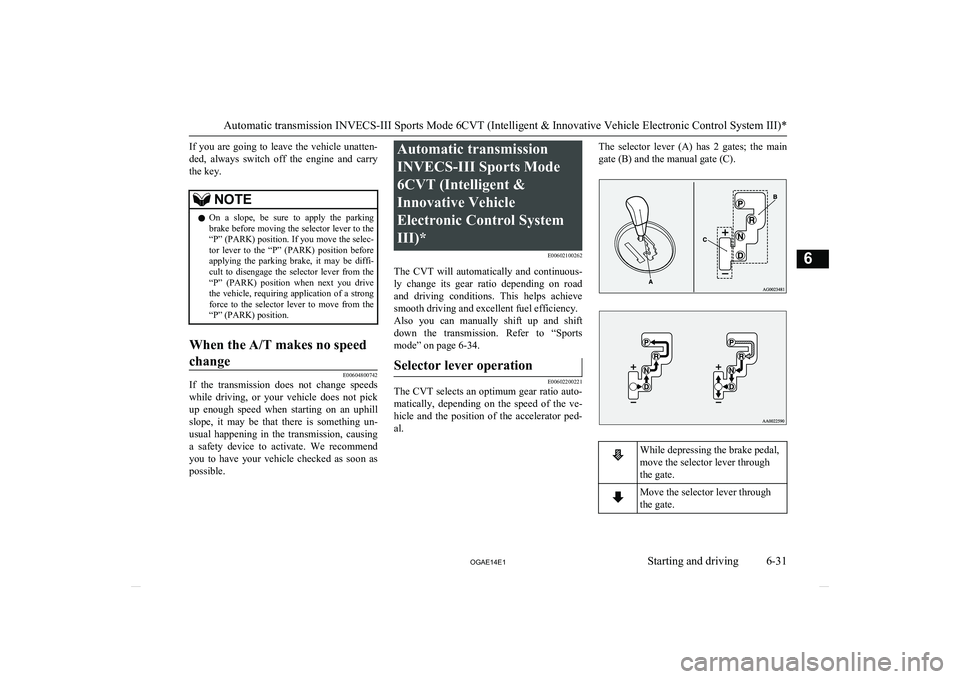
The selector lever (A) has 2 gates; the main
gate (B) and the manual gate (C).While depressing the brake pedal,
move the selector lever through
the gate.Move the selector lever through
the gate.
Automatic transmission INVECS-III Sports Mode 6CVT (Intelligent & Innovative Vehicle Electronic Control System III)*
6-31
OGAE14E1Starting and driving6
Page 198 of 418
WARNINGlAlways depress the brake pedal when
shifting the selector lever into the other position from the “P” (PARK) or “N”(NEUTRAL) position.
Never put your foot on the accelerator
pedal while shifting the selector lever from the “P” (PARK) or “N” (NEU-
TRAL) position.NOTEl To avoid erroneous operation, move the se-
lector lever firmly into each position and
briefly hold it there. Always check the posi- tion shown by the selector lever position dis-
play after moving the selector lever.
l If the brake pedal is not depressed and held,
the shift-lock device activates to prevent the selector lever from being moved from the “P” (PARK) position.When the selector lever cannot
be shifted from the “P” (PARK)position
E00629000312
When the selector lever cannot be shifted
from the “P” (PARK) position to another po-
sition while the brake pedal is pressed and
held down with the ignition switch or the op- eration mode in ON, the battery may be flator the shift-lock mechanism may be malfunc-
tioning. Immediately have your vehicle checked by a MITSUBISHI MOTORS Au-
thorized Service Point.
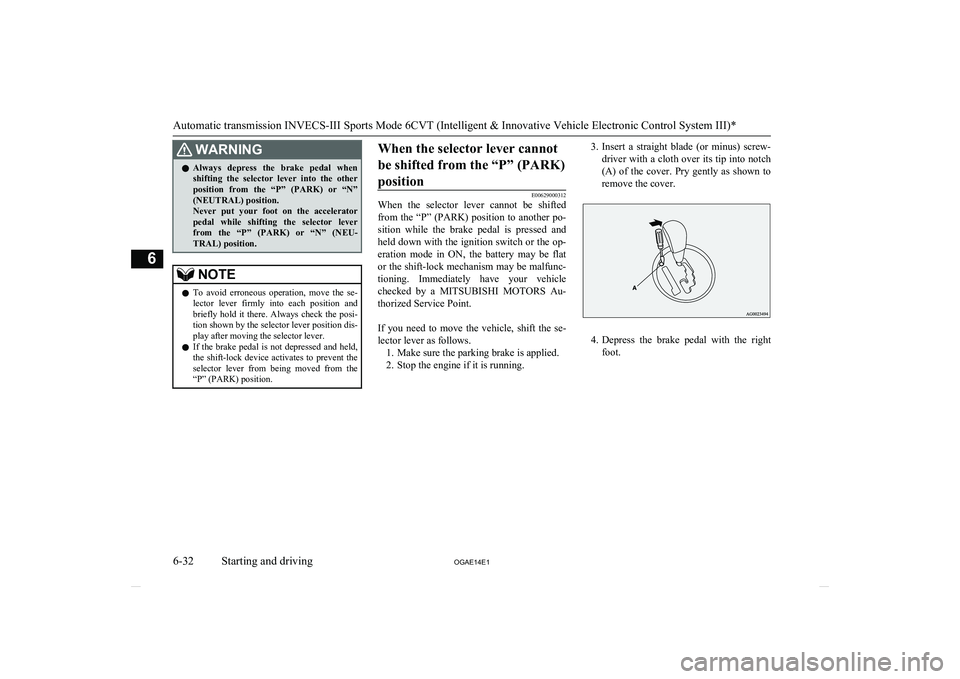
If you need to move the vehicle, shift the se- lector lever as follows. 1. Make sure the parking brake is applied.
2. Stop the engine if it is running.
3. Insert a straight blade (or minus) screw-
driver with a cloth over its tip into notch
(A) of the cover. Pry gently as shown to remove the cover.
4. Depress the brake pedal with the right
foot.
Automatic transmission INVECS-III Sports Mode 6CVT (Intelligent & Innovative Vehicle Electronic Control System III)*
6-32 OGAE14E1Starting and driving6
Page 199 of 418
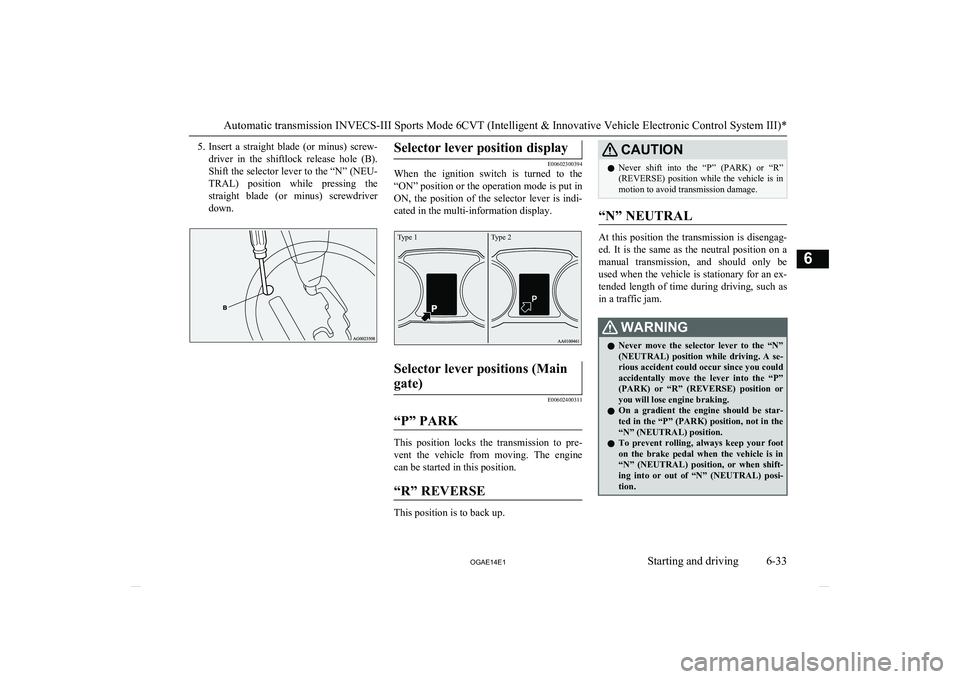
5.Insert a straight blade (or minus) screw-
driver in the shiftlock release hole (B). Shift the selector lever to the “N” (NEU-
TRAL) position while pressing the straight blade (or minus) screwdriver down.Selector lever position display
E00602300394
When the ignition switch is turned to the
“ON” position or the operation mode is put in ON, the position of the selector lever is indi-
cated in the multi-information display.
Type 1Type 2Selector lever positions (Main
gate)
E00602400311
“P” PARK
This position locks the transmission to pre- vent the vehicle from moving. The engine
can be started in this position.
“R” REVERSE
This position is to back up.
CAUTIONl Never shift into the “P” (PARK) or “R”
(REVERSE) position while the vehicle is in motion to avoid transmission damage.
“N” NEUTRAL
At this position the transmission is disengag-
ed. It is the same as the neutral position on amanual transmission, and should only be used when the vehicle is stationary for an ex-
tended length of time during driving, such as
in a traffic jam.
WARNINGl Never move the selector lever to the “N”
(NEUTRAL) position while driving. A se- rious accident could occur since you could
accidentally move the lever into the “P” (PARK) or “R” (REVERSE) position or
you will lose engine braking.
l On a gradient the engine should be star-
ted in the “P” (PARK) position, not in the
“N” (NEUTRAL) position.
l To prevent rolling, always keep your foot
on the brake pedal when the vehicle is in “N” (NEUTRAL) position, or when shift- ing into or out of “N” (NEUTRAL) posi-
tion.
Automatic transmission INVECS-III Sports Mode 6CVT (Intelligent & Innovative Vehicle Electronic Control System III)*
6-33
OGAE14E1Starting and driving6
Page 200 of 418
“D” DRIVE
This position is used for most city and high-way driving. The transmission will automati-
cally and continuously change its gear radio depending on road and driving conditions.
CAUTIONl To prevent transmission damage, never shift
into the “D” (DRIVE) position from the “R” (REVERSE) position while the vehicle is inmotion.Sports mode
E00602500194
Whether the vehicle is stationary or in mo-
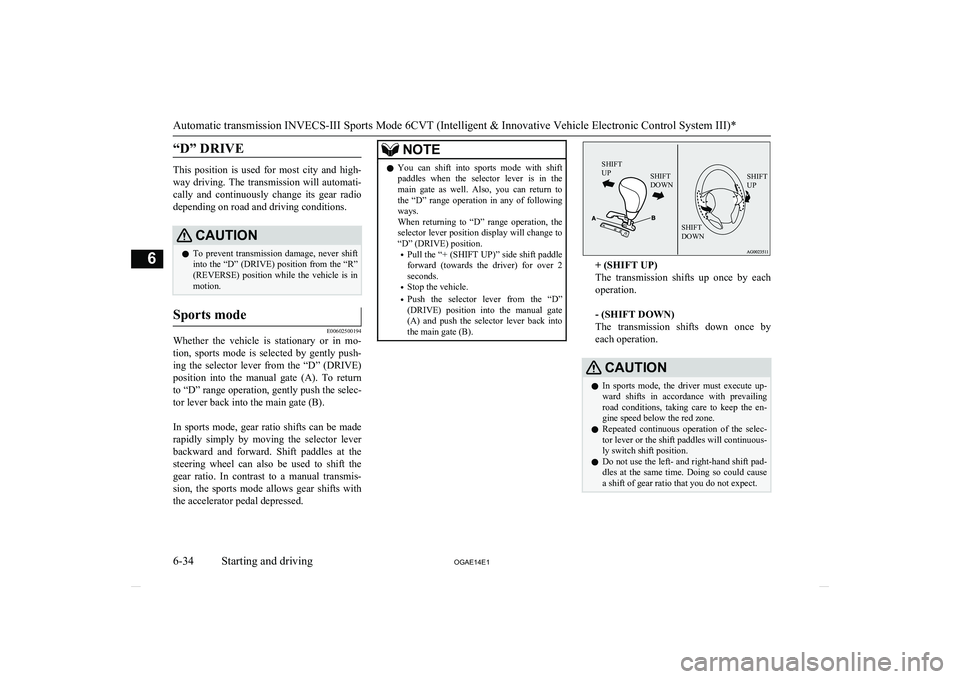
tion, sports mode is selected by gently push-ing the selector lever from the “D” (DRIVE)
position into the manual gate (A). To return to “D” range operation, gently push the selec-tor lever back into the main gate (B).
In sports mode, gear ratio shifts can be made
rapidly simply by moving the selector lever backward and forward. Shift paddles at thesteering wheel can also be used to shift the
gear ratio. In contrast to a manual transmis- sion, the sports mode allows gear shifts with
the accelerator pedal depressed.
NOTEl You can shift into sports mode with shift
paddles when the selector lever is in the main gate as well. Also, you can return to
the “D” range operation in any of following ways.
When returning to “D” range operation, the selector lever position display will change to
“D” (DRIVE) position.
• Pull the “+ (SHIFT UP)” side shift paddle
forward (towards the driver) for over 2 seconds.
• Stop the vehicle.
• Push the selector lever from the “D”
(DRIVE) position into the manual gate
(A) and push the selector lever back into
the main gate (B).SHIFT
UPSHIFT
DOWNSHIFT
UPSHIFT
DOWN
+ (SHIFT UP)
The transmission shifts up once by each operation.
- (SHIFT DOWN)
The transmission shifts down once by
each operation.
CAUTIONl In sports mode, the driver must execute up-
ward shifts in accordance with prevailingroad conditions, taking care to keep the en-
gine speed below the red zone.
l Repeated continuous operation of the selec-
tor lever or the shift paddles will continuous- ly switch shift position.
l Do not use the left- and right-hand shift pad-
dles at the same time. Doing so could cause a shift of gear ratio that you do not expect.
Automatic transmission INVECS-III Sports Mode 6CVT (Intelligent & Innovative Vehicle Electronic Control System III)*
6-34 OGAE14E1Starting and driving6
Page 201 of 418
NOTElThe upward shift may be made automatical-
ly in sports mode when the engine revolu-
tions rises and approaches the tachometer’s
red zone (the red-coloured part of the tach- ometer dial).
l In sports mode, only the 6 forward gears can
be selected. To reverse or park the vehicle, move the selector lever to the “R” (RE-
VERSE) or “P” (PARK) position as re- quired.
l To maintain good running performance, the
transmission may refuse to perform an up- shift when the selector lever is moved to the“+ (SHIFT UP)” position at certain vehicle
speeds. Also, to prevent over-revving of the engine, the transmission may refuse to per-
form a downshift when the lever is moved to
the “- (SHIFT DOWN)” position at certain vehicle speeds. When this happens, a buzzer
sounds to indicate that a downshift is not go-
ing to take place.
l In sports mode, downward shifts are made
automatically when the vehicle slows down.
When the vehicle stops, 1 st
gear is automati-
cally selected.Sports mode display
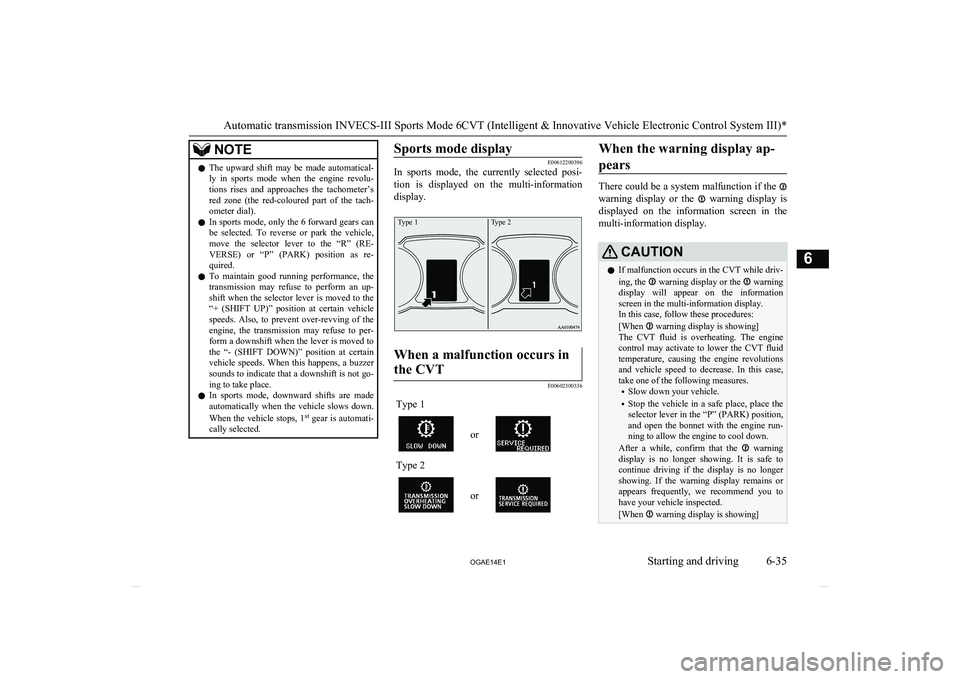
E00612200396
In sports mode, the currently selected posi-
tion is displayed on the multi-information
display.
Type 1Type 2When a malfunction occurs in
the CVT
E00602300336
Type 1
or
Type 2
orWhen the warning display ap-
pears
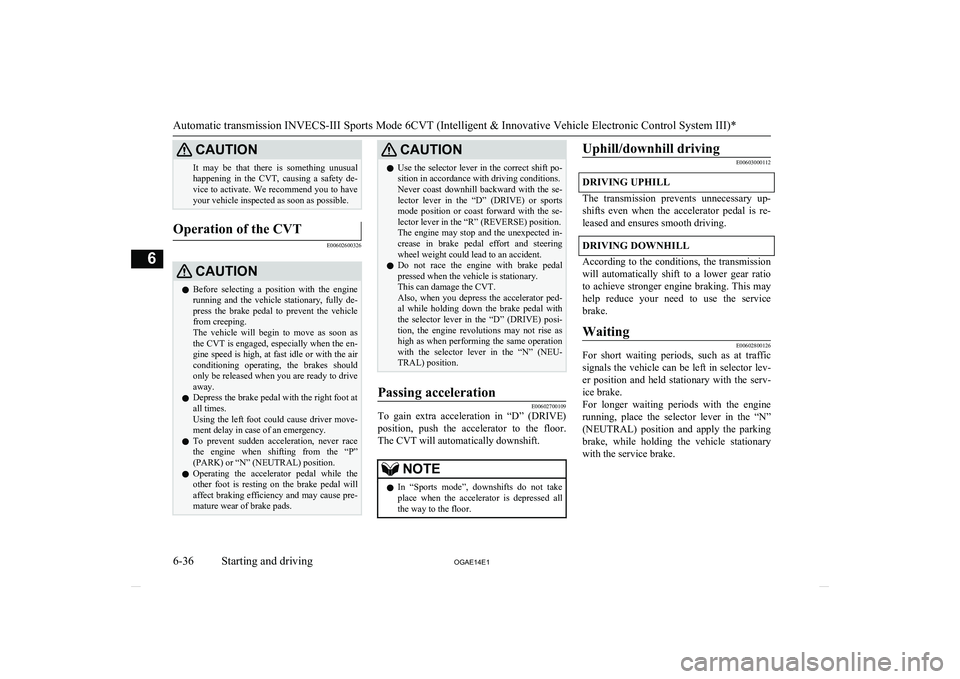
There could be a system malfunction if the
warning display or the warning display is
displayed on the information screen in the
multi-information display.
CAUTIONl If malfunction occurs in the CVT while driv-
ing, the warning display or the warning
display will appear on the information screen in the multi-information display.
In this case, follow these procedures:
[When
warning display is showing]
The CVT fluid is overheating. The engine control may activate to lower the CVT fluid
temperature, causing the engine revolutions
and vehicle speed to decrease. In this case, take one of the following measures.
• Slow down your vehicle.
• Stop the vehicle in a safe place, place the
selector lever in the “P” (PARK) position,
and open the bonnet with the engine run-
ning to allow the engine to cool down.
After a while, confirm that the
warning
display is no longer showing. It is safe to
continue driving if the display is no longer showing. If the warning display remains orappears frequently, we recommend you to have your vehicle inspected.
[When
warning display is showing]
Automatic transmission INVECS-III Sports Mode 6CVT (Intelligent & Innovative Vehicle Electronic Control System III)*
6-35
OGAE14E1Starting and driving6
Page 202 of 418
CAUTIONIt may be that there is something unusualhappening in the CVT, causing a safety de-
vice to activate. We recommend you to have your vehicle inspected as soon as possible.Operation of the CVT
E00602600326
CAUTIONl Before selecting a position with the engine
running and the vehicle stationary, fully de-
press the brake pedal to prevent the vehicle from creeping.
The vehicle will begin to move as soon as
the CVT is engaged, especially when the en- gine speed is high, at fast idle or with the air conditioning operating, the brakes should
only be released when you are ready to drive
away.
l Depress the brake pedal with the right foot at
all times.
Using the left foot could cause driver move- ment delay in case of an emergency.
l To prevent sudden acceleration, never race
the engine when shifting from the “P”
(PARK) or “N” (NEUTRAL) position.
l Operating the accelerator pedal while the
other foot is resting on the brake pedal will affect braking efficiency and may cause pre-
mature wear of brake pads.CAUTIONl Use the selector lever in the correct shift po-
sition in accordance with driving conditions.
Never coast downhill backward with the se-
lector lever in the “D” (DRIVE) or sports mode position or coast forward with the se- lector lever in the “R” (REVERSE) position.The engine may stop and the unexpected in-
crease in brake pedal effort and steering wheel weight could lead to an accident.
l Do not race the engine with brake pedal
pressed when the vehicle is stationary.
This can damage the CVT.
Also, when you depress the accelerator ped-
al while holding down the brake pedal with the selector lever in the “D” (DRIVE) posi-
tion, the engine revolutions may not rise as high as when performing the same operation
with the selector lever in the “N” (NEU-
TRAL) position.Passing acceleration
E00602700109
To gain extra acceleration in “D” (DRIVE)
position, push the accelerator to the floor.The CVT will automatically downshift.
NOTEl In “Sports mode”, downshifts do not take
place when the accelerator is depressed all
the way to the floor.Uphill/downhill driving
E00603000112
DRIVING UPHILL
The transmission prevents unnecessary up-
shifts even when the accelerator pedal is re- leased and ensures smooth driving.
DRIVING DOWNHILL
According to the conditions, the transmission
will automatically shift to a lower gear ratio to achieve stronger engine braking. This mayhelp reduce your need to use the service brake.
Waiting
E00602800126
For short waiting periods, such as at trafficsignals the vehicle can be left in selector lev-er position and held stationary with the serv-
ice brake.
For longer waiting periods with the engine running, place the selector lever in the “N”
(NEUTRAL) position and apply the parking
brake, while holding the vehicle stationary with the service brake.
Automatic transmission INVECS-III Sports Mode 6CVT (Intelligent & Innovative Vehicle Electronic Control System III)*
6-36 OGAE14E1Starting and driving6
Page 233 of 418
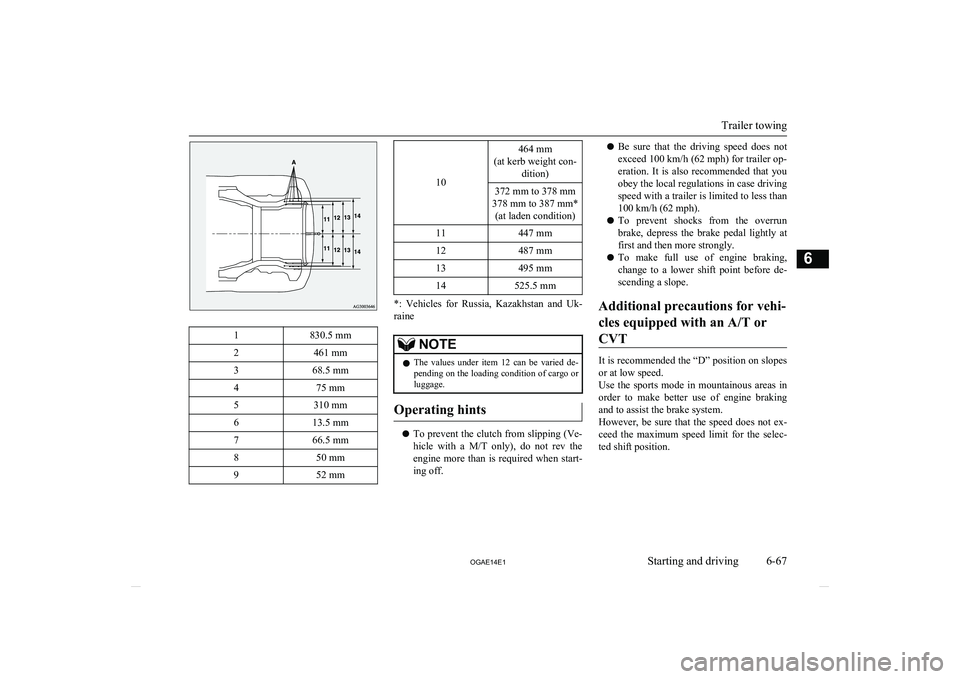
1830.5 mm2461 mm368.5 mm475 mm5310 mm613.5 mm766.5 mm850 mm952 mm
10
464 mm
(at kerb weight con- dition)372 mm to 378 mm
378 mm to 387 mm* (at laden condition)11447 mm12487 mm13495 mm14525.5 mm
*: Vehicles for Russia, Kazakhstan and Uk-
raine
NOTEl The values under item 12 can be varied de-
pending on the loading condition of cargo orluggage.
Operating hints
l To prevent the clutch from slipping (Ve-
hicle with a M/T only), do not rev the
engine more than is required when start- ing off.
l Be sure that the driving speed does not
exceed 100 km/h (62 mph) for trailer op-
eration. It is also recommended that you obey the local regulations in case driving
speed with a trailer is limited to less than
100 km/h (62 mph).
l To prevent shocks from the overrun
brake, depress the brake pedal lightly at first and then more strongly.
l To make full use of engine braking,
change to a lower shift point before de- scending a slope.
Additional precautions for vehi- cles equipped with an A/T orCVT
It is recommended the “D” position on slopes
or at low speed.
Use the sports mode in mountainous areas in order to make better use of engine braking
and to assist the brake system.
However, be sure that the speed does not ex-
ceed the maximum speed limit for the selec-ted shift position.
Trailer towing
6-67
OGAE14E1Starting and driving6
Page 337 of 418
lInspection of the vehicle’s underside re-
veals that oil or some other fluid is leak- ing.
If a wheel gets stuck in a ditch, do not try to tow the vehicle.
Please contact your MITSUBISHI MOTORS
Authorized Service Point or a commercial tow truck service for assistance.
Only when you cannot receive a towing serv-
ice from a MITSUBISHI MOTORS Author-
ized Service Point or commercial tow truck service, tow your vehicle carefully in accord-
ance with the instructions given in “Emer- gency towing” in this part.
The regulations concerning towing may dif-
fer from country to country. It is recommen-
ded that you obey the regulations of the area where you are driving your vehicle. Towing the vehicle by a tow
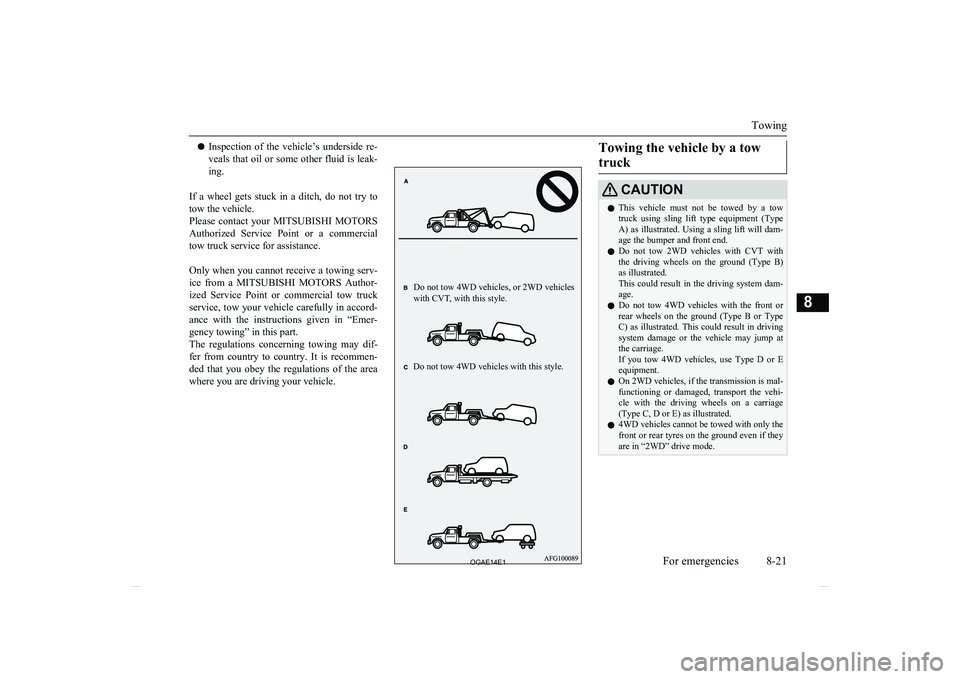
truckCAUTIONl This vehicle must not be towed by a tow
truck using sling lift type equipment (Type A) as illustrated. Using a sling lift will dam-age the bumper and front end.
l Do not tow 2WD vehicles with CVT with
the driving wheels on the ground (Type B) as illustrated.
This could result in the driving system dam- age.
l Do not tow 4WD vehicles with the front or
rear wheels on the ground (Type B or Type C) as illustrated. This could result in drivingsystem damage or the vehicle may jump at
the carriage.
If you tow 4WD vehicles, use Type D or E
equipment.
l On 2WD vehicles, if the transmission is mal-
functioning or damaged, transport the vehi- cle with the driving wheels on a carriage (Type C, D or E) as illustrated.
l 4WD vehicles cannot be towed with only the
front or rear tyres on the ground even if they
are in “2WD” drive mode.
Towing
8-21
OGAE14E1For emergencies8Do not tow 4WD vehicles, or 2WD vehicles
with CVT, with this style.
Do not tow 4WD vehicles with this style.
Page 338 of 418
![MITSUBISHI ASX 2014 (in English) User Guide CAUTIONl[For 2WD vehicles equipped with the Active
Stability Control (ASC)]
If the vehicle is towed with the ignition switch in the “ON” position or the operation
mode in ON and only the fr](/img/19/34863/w960_34863-337.png "MITSUBISHI ASX 2014 (in English) User Guide CAUTIONl[For 2WD vehicles equipped with the Active
Stability Control (ASC)]
If the vehicle is towed with the ignition switch in the “ON” position or the operation
mode in ON and only the fr")
CAUTIONl[For 2WD vehicles equipped with the Active
Stability Control (ASC)]
If the vehicle is towed with the ignition switch in the “ON” position or the operation
mode in ON and only the front wheels or on- ly the rear wheels raised off the ground (Type B or C), the ASC may operate, result-
ing in an accident.
When towing the vehicle with the rear wheels raised, turn the ignition switch to the
“ACC” position or put the operation mode in ACC.
When towing the vehicle with the front wheels raised, keep the ignition switch or the
operation mode as follows.
[Except for vehicles equipped with keyless operation system]
The ignition switch is in the “LOCK” or
“ACC” position.
[Vehicles equipped with keyless operation system]
The operation mode is in OFF or ACC.
Towing with rear wheels off the
ground (Type B)
Place the gearshift lever in the “N” (Neutral) position.
Turn the ignition switch to the “ACC” posi-
tion or put the operation mode in ACC and secure the steering wheel in a straight-ahead
position with a rope or tiedown strap. Never place the ignition switch in the “LOCK” po-sition or put the operation mode in OFF when towing.
Towing with front wheels off the ground (Type C)
Release the parking brake.
Place the gearshift lever in the “N” (Neutral) position ( M/T) or the selector lever in the
“N” (NEUTRAL) position (CVT).
Emergency towing
If towing service is not available in an emer-
gency, your vehicle may be temporarily tow- ed by a rope secured to the towing hook.If your vehicle is to be towed by another ve-
hicle or if your vehicle tows another vehicle, pay careful attention to the following points:
If your vehicle is to be towed byanother vehicle
1. The front towing hook (A) is located as
shown in the illustration. Secure the tow
rope to the front towing hook.
NOTEl Do not use the tie-down hooks (B) for tow-
ing. These hooks are provided only for thepurpose of transporting the vehicle itself.
Using any part other than the designated
towing hook (A) could result in damage to
the vehicle body.
l Using a wire rope or metal chain can result
in damage to the vehicle body. It is best to
use a non-metallic rope. If you use a wire
rope or metal chain, wrap it with cloth at any point where it touches the vehicle body.
l Take care that the tow rope is kept as hori-
zontal as possible. An angled tow rope can damage the vehicle body.
2. Keep the engine running.
If the engine is not running, perform the
following operation to unlock the steer- ing wheel.
[Except for vehicles with keyless opera-
tion system]
Towing
8-22 OGAE14E1For emergencies8