ECU MITSUBISHI ASX 2014 (in English) Owner's Guide
[x] Cancel search | Manufacturer: MITSUBISHI, Model Year: 2014, Model line: ASX, Model: MITSUBISHI ASX 2014Pages: 418, PDF Size: 14.02 MB
Page 315 of 418
Luggage hooksE00715700537
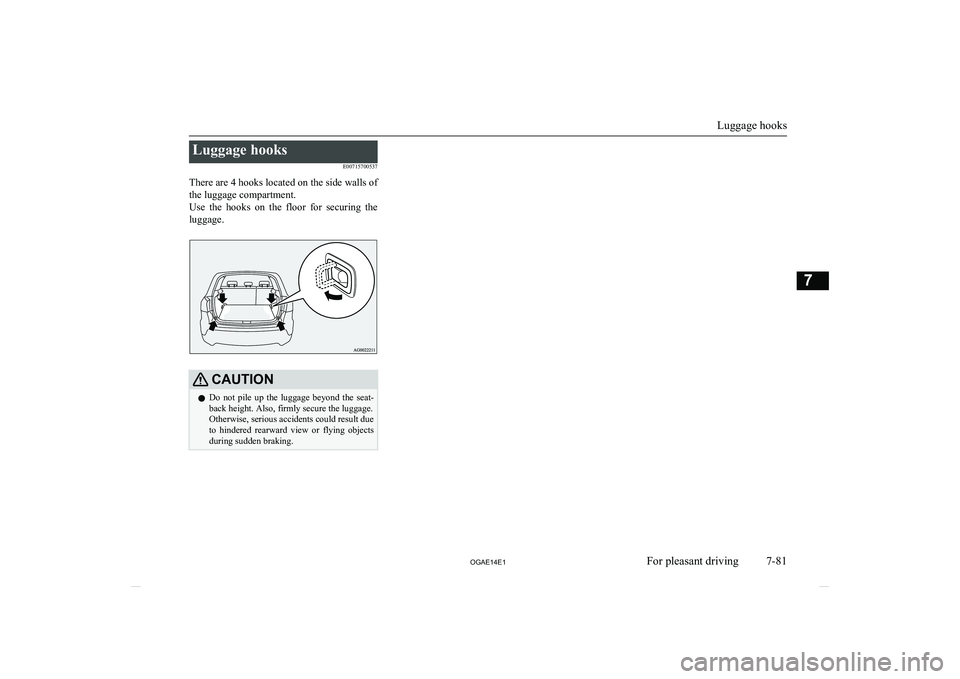
There are 4 hooks located on the side walls of
the luggage compartment.
Use the hooks on the floor for securing the luggage.CAUTIONl Do not pile up the luggage beyond the seat-
back height. Also, firmly secure the luggage.
Otherwise, serious accidents could result due
to hindered rearward view or flying objects
during sudden braking.
Luggage hooks
7-81
OGAE14E1For pleasant driving7
Page 326 of 418
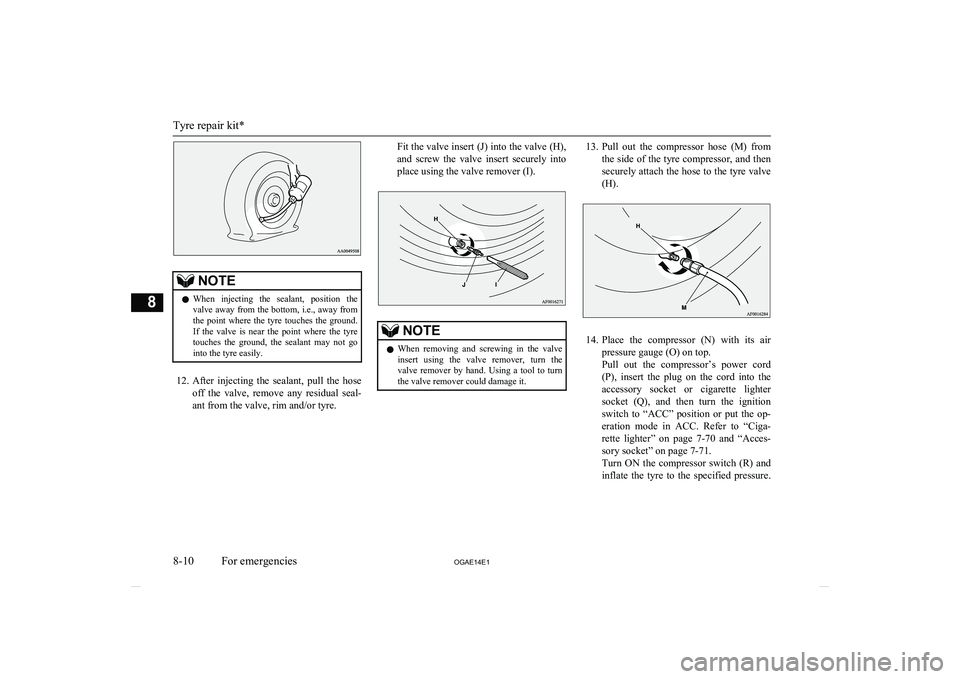
NOTElWhen injecting the sealant, position the
valve away from the bottom, i.e., away from
the point where the tyre touches the ground. If the valve is near the point where the tyre touches the ground, the sealant may not gointo the tyre easily.
12. After injecting the sealant, pull the hose
off the valve, remove any residual seal- ant from the valve, rim and/or tyre.
Fit the valve insert (J) into the valve (H),
and screw the valve insert securely into
place using the valve remover (I).NOTEl When removing and screwing in the valve
insert using the valve remover, turn the valve remover by hand. Using a tool to turn the valve remover could damage it.13. Pull out the compressor hose (M) from
the side of the tyre compressor, and then
securely attach the hose to the tyre valve (H).
14. Place the compressor (N) with its air
pressure gauge (O) on top.
Pull out the compressor’s power cord (P), insert the plug on the cord into the
accessory socket or cigarette lighter socket (Q), and then turn the ignition
switch to “ACC” position or put the op- eration mode in ACC. Refer to “Ciga-
rette lighter” on page 7-70 and “Acces-
sory socket” on page 7-71.
Turn ON the compressor switch (R) and
inflate the tyre to the specified pressure.
Tyre repair kit*
8-10 OGAE14E1For emergencies8
Page 338 of 418
![MITSUBISHI ASX 2014 (in English) Owners Guide CAUTIONl[For 2WD vehicles equipped with the Active
Stability Control (ASC)]
If the vehicle is towed with the ignition switch in the “ON” position or the operation
mode in ON and only the fr](/img/19/34863/w960_34863-337.png "MITSUBISHI ASX 2014 (in English) Owners Guide CAUTIONl[For 2WD vehicles equipped with the Active
Stability Control (ASC)]
If the vehicle is towed with the ignition switch in the “ON” position or the operation
mode in ON and only the fr")
CAUTIONl[For 2WD vehicles equipped with the Active
Stability Control (ASC)]
If the vehicle is towed with the ignition switch in the “ON” position or the operation
mode in ON and only the front wheels or on- ly the rear wheels raised off the ground (Type B or C), the ASC may operate, result-
ing in an accident.
When towing the vehicle with the rear wheels raised, turn the ignition switch to the
“ACC” position or put the operation mode in ACC.
When towing the vehicle with the front wheels raised, keep the ignition switch or the
operation mode as follows.
[Except for vehicles equipped with keyless operation system]
The ignition switch is in the “LOCK” or
“ACC” position.
[Vehicles equipped with keyless operation system]
The operation mode is in OFF or ACC.
Towing with rear wheels off the
ground (Type B)
Place the gearshift lever in the “N” (Neutral) position.
Turn the ignition switch to the “ACC” posi-
tion or put the operation mode in ACC and secure the steering wheel in a straight-ahead
position with a rope or tiedown strap. Never place the ignition switch in the “LOCK” po-sition or put the operation mode in OFF when towing.
Towing with front wheels off the ground (Type C)
Release the parking brake.
Place the gearshift lever in the “N” (Neutral) position ( M/T) or the selector lever in the
“N” (NEUTRAL) position (CVT).
Emergency towing
If towing service is not available in an emer-
gency, your vehicle may be temporarily tow- ed by a rope secured to the towing hook.If your vehicle is to be towed by another ve-
hicle or if your vehicle tows another vehicle, pay careful attention to the following points:
If your vehicle is to be towed byanother vehicle
1. The front towing hook (A) is located as
shown in the illustration. Secure the tow
rope to the front towing hook.
NOTEl Do not use the tie-down hooks (B) for tow-
ing. These hooks are provided only for thepurpose of transporting the vehicle itself.
Using any part other than the designated
towing hook (A) could result in damage to
the vehicle body.
l Using a wire rope or metal chain can result
in damage to the vehicle body. It is best to
use a non-metallic rope. If you use a wire
rope or metal chain, wrap it with cloth at any point where it touches the vehicle body.
l Take care that the tow rope is kept as hori-
zontal as possible. An angled tow rope can damage the vehicle body.
2. Keep the engine running.
If the engine is not running, perform the
following operation to unlock the steer- ing wheel.
[Except for vehicles with keyless opera-
tion system]
Towing
8-22 OGAE14E1For emergencies8
Page 346 of 418
CAUTIONTherefore;• Maintain a distance of approx. 70 cm
or
more between the vehicle body and the
washing nozzle.
• When washing around the door glass,
hold the nozzle at a distance of more than
70 cm and at right angles to the glass sur-
face.
l After washing the vehicle, drive the vehicle
slowly while lightly depressing the brake
pedal several times in order to dry out the brakes.
Leaving the brakes wet could result in re- duced braking performance. Also, there is a
possibility that they could freeze up or be- come inoperative due to rust, rendering the
vehicle unable to move.
l When using an automatic car wash, pay at-
tention to the following items, referring to the operation manual or consulting a car
wash operator. If the following procedure is not followed, it could result in damage to your vehicle.
• The outside mirrors are retracted.
• The antenna is removed.
• The wiper arms are secured in place with
tape.
• If your vehicle is equipped with a rear
spoiler or roof rails, consult a car wash operator before using the car wash.
• If your vehicle has rain sensor wipers,
place the wiper switch lever in the “OFF” position to deactivate the rain sensor.During cold weather
Salt and other chemicals spread on the roads
in some areas in winter can have a harmful effect on the vehicle body. You should there-
fore wash the vehicle as often as possible in accordance with our care-instructions. It is
recommended to have a preservative applied
and the underfloor protection checked before and after the cold weather season.
After washing your vehicle, wipe off all wa- terdrops from the rubber parts around thedoors to prevent the doors from freezing.
NOTEl To prevent freezing of the weatherstripping
on the doors, bonnet, etc., they should be treated with silicone spray.Waxing
E00901000863
Waxing the vehicle will help prevent the ad-
herence of dust and road chemicals to the
paintwork. Apply a wax solution after wash- ing the vehicle, or at least once every three
months to assist displacing of water.
Do not wax your vehicle in direct sunlight.
You should wax after the surfaces have
cooled.
CAUTIONl Waxes containing high abrasive compounds
should not be used. Such waxes remove rust and stains effectively from the paintwork but
they are harmful to the lustre on the painted
surface and the plated surface.
Further, they are harmful to glossy surfaces such as grille, garnish, mouldings, etc.
l Do not use petrol or paint thinners to remove
road tar or other contamination to the pain-
ted surface.
l Do not apply wax to sections that have a
black mat paint coating, as doing so could cause uneven discolouration, spots or stains.
If wax gets on such areas, wipe it off using
lukewarm water and a soft cloth.Polishing
E00901100066
The vehicle should only be polished if the
paintwork has become stained or lost its lus- tre. Do not polish parts with a mat coating
and the plastic bumpers. Doing so could cause stains or damage the finish.
Damaged paint
E00901200201
Small cracks and scratches in the paint coat
should be touched up as soon as possible
with MITSUBISHI MOTORS GENUINE
touch-up paint to prevent corrosion.
Cleaning the exterior of your vehicle
9-04 OGAE14E1Vehicle care9
Page 352 of 418
CAUTIONlNote that the support bar may disengage the
bonnet if the open bonnet is lifted by astrong wind.
l After inserting the support bar into the slot,
make sure the bar supports the bonnet se-
curely from falling down on to your head or body.
To close
1. Unlatch the support bar and clip it in its
holder.
2. Slowly lower the bonnet to a position
about 20 cm above the closed position,
then let it drop.
3. Make sure the bonnet is securely locked
by softly lifting the centre of the bonnet.
CAUTIONl Be careful that hands or fingers are not trap-
ped when closing the bonnet.
l Before driving, make sure that the bonnet is
securely locked. An incompletely locked bonnet can suddenly open while driving.
This can be extremely dangerous.NOTEl If this does not close the bonnet, release it
from a slightly higher position.
l Do not press down the bonnet hard with a
hand as it may damage the bonnet.
l For vehicles equipped with the security
alarm system, if you drive with the bonnet left open, warning display is displayed on the information screen in the multi-informa-tion display.Type 1Type 2Engine oil
E01000404097
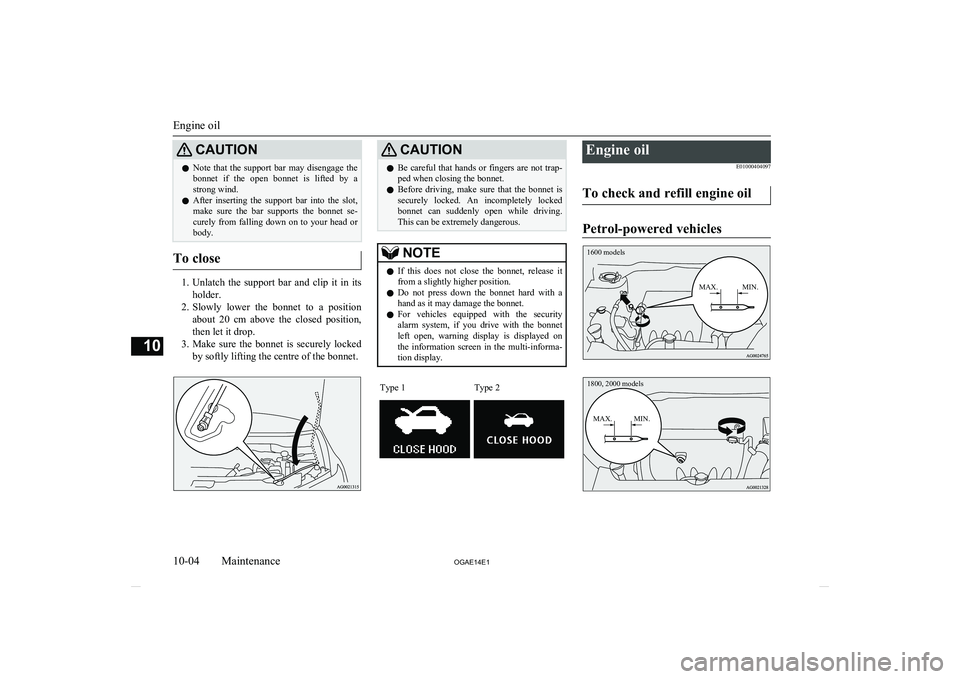
To check and refill engine oil
Petrol-powered vehicles
1600 modelsMAX.MIN.1800, 2000 modelsMAX.MIN.
Engine oil
10-04 OGAE14E1Maintenance10
Page 353 of 418
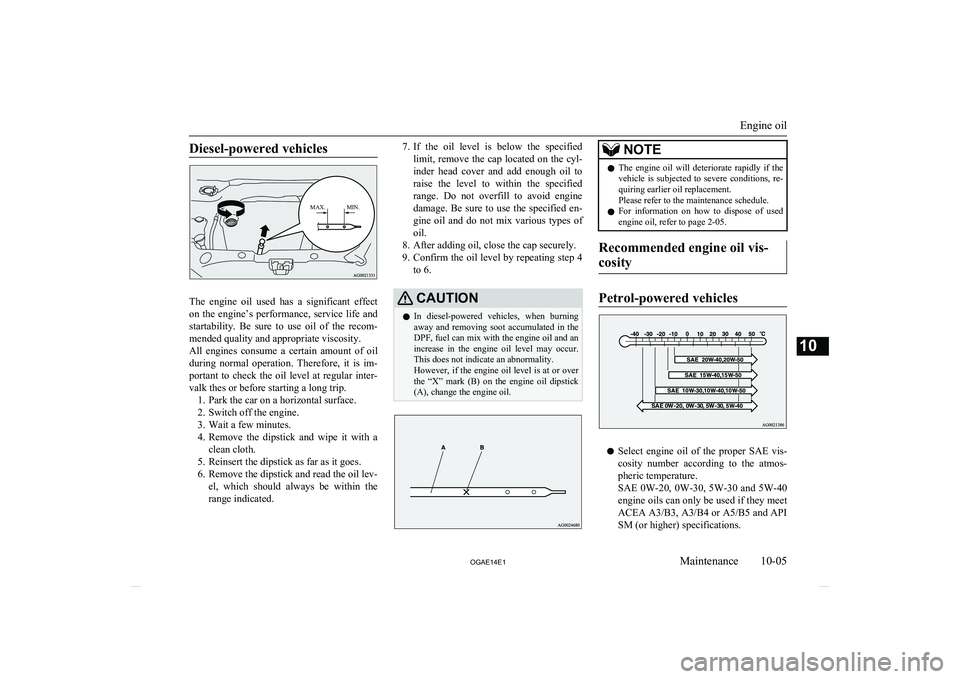
Diesel-powered vehicles
MAX.MIN.
The engine oil used has a significant effecton the engine’s performance, service life and
startability. Be sure to use oil of the recom- mended quality and appropriate viscosity.
All engines consume a certain amount of oil during normal operation. Therefore, it is im-portant to check the oil level at regular inter-
valk thes or before starting a long trip. 1. Park the car on a horizontal surface.
2. Switch off the engine.
3. Wait a few minutes.
4. Remove the dipstick and wipe it with a
clean cloth.
5. Reinsert the dipstick as far as it goes.
6. Remove the dipstick and read the oil lev- el, which should always be within therange indicated.
7. If the oil level is below the specified
limit, remove the cap located on the cyl- inder head cover and add enough oil to
raise the level to within the specified
range. Do not overfill to avoid engine damage. Be sure to use the specified en-
gine oil and do not mix various types of
oil.
8. After adding oil, close the cap securely.
9. Confirm the oil level by repeating step 4
to 6.CAUTIONl In diesel-powered vehicles, when burning
away and removing soot accumulated in the
DPF, fuel can mix with the engine oil and an increase in the engine oil level may occur. This does not indicate an abnormality.
However, if the engine oil level is at or over the “X” mark (B) on the engine oil dipstick
(A), change the engine oil.NOTEl The engine oil will deteriorate rapidly if the
vehicle is subjected to severe conditions, re-
quiring earlier oil replacement.
Please refer to the maintenance schedule.
l For information on how to dispose of used
engine oil, refer to page 2-05.
Recommended engine oil vis-
cosity
Petrol-powered vehicles
l Select engine oil of the proper SAE vis-
cosity number according to the atmos- pheric temperature.
SAE 0W-20, 0W-30, 5W-30 and 5W-40 engine oils can only be used if they meet
ACEA A3/B3, A3/B4 or A5/B5 and API
SM (or higher) specifications.
Engine oil
10-05
OGAE14E1Maintenance10
Page 356 of 418
NOTElThe washer fluid container serves the wind-
screen, rear window and headlamps (if soequipped).
During cold weather
To ensure proper operation of the washers at
low temperatures, use a fluid containing ananti-freezing agent.
Brake fluid/Clutch fluid*
E01000800631
The brake fluid and the clutch fluid share thereservoir tank.
To check the fluid level
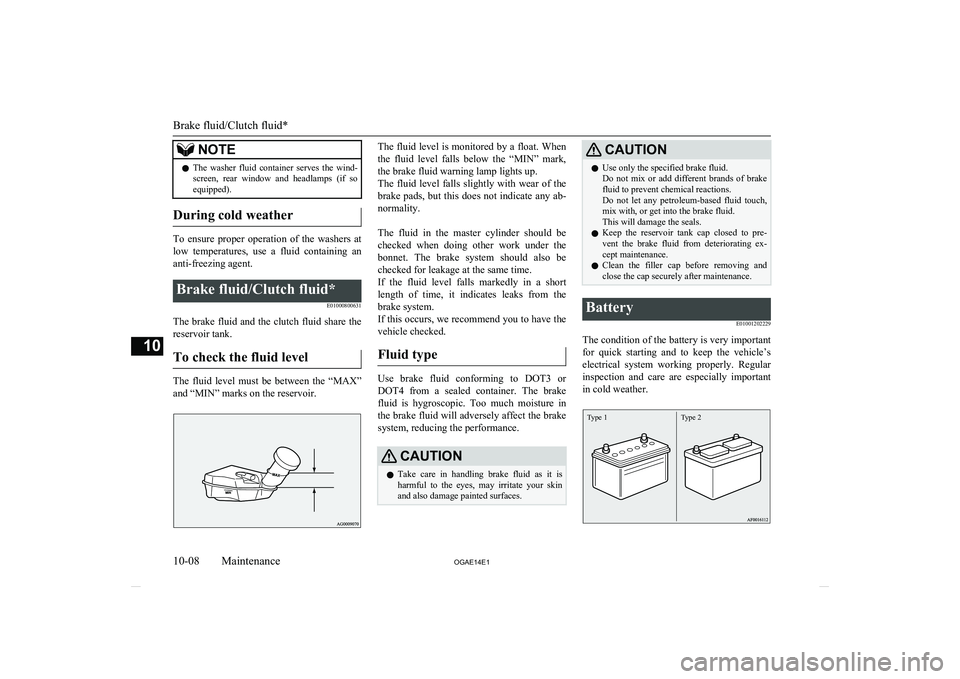
The fluid level must be between the “MAX” and “MIN” marks on the reservoir.
The fluid level is monitored by a float. When
the fluid level falls below the “MIN” mark, the brake fluid warning lamp lights up.The fluid level falls slightly with wear of the brake pads, but this does not indicate any ab-
normality.
The fluid in the master cylinder should be checked when doing other work under thebonnet. The brake system should also be checked for leakage at the same time.
If the fluid level falls markedly in a short length of time, it indicates leaks from the
brake system.
If this occurs, we recommend you to have the
vehicle checked.
Fluid type
Use brake fluid conforming to DOT3 or DOT4 from a sealed container. The brake
fluid is hygroscopic. Too much moisture in the brake fluid will adversely affect the brake
system, reducing the performance.
CAUTIONl Take care in handling brake fluid as it is
harmful to the eyes, may irritate your skin
and also damage painted surfaces.CAUTIONl Use only the specified brake fluid.
Do not mix or add different brands of brake fluid to prevent chemical reactions.
Do not let any petroleum-based fluid touch, mix with, or get into the brake fluid.
This will damage the seals.
l Keep the reservoir tank cap closed to pre-
vent the brake fluid from deteriorating ex- cept maintenance.
l Clean the filler cap before removing and
close the cap securely after maintenance.Battery
E01001202229
The condition of the battery is very important
for quick starting and to keep the vehicle’s electrical system working properly. Regularinspection and care are especially importantin cold weather.
Type 1Type 2
Brake fluid/Clutch fluid*
10-08 OGAE14E1Maintenance10
Page 359 of 418
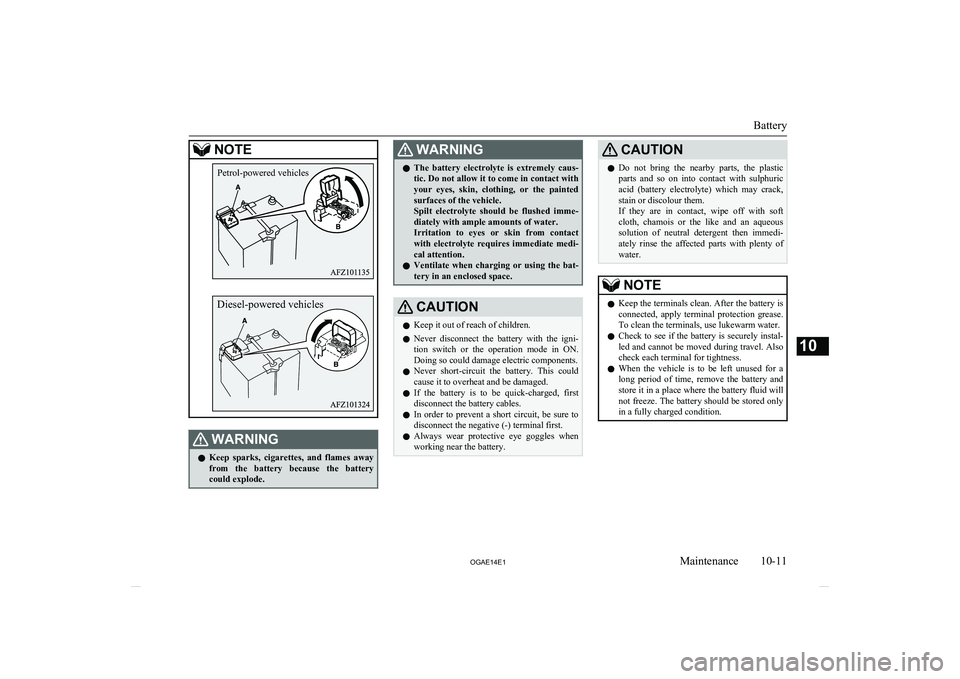
NOTEWARNINGlKeep sparks, cigarettes, and flames away
from the battery because the battery could explode.WARNINGl The battery electrolyte is extremely caus-
tic. Do not allow it to come in contact with
your eyes, skin, clothing, or the painted surfaces of the vehicle.
Spilt electrolyte should be flushed imme-
diately with ample amounts of water.
Irritation to eyes or skin from contact with electrolyte requires immediate medi-
cal attention.
l Ventilate when charging or using the bat-
tery in an enclosed space.CAUTIONl Keep it out of reach of children.
l Never disconnect the battery with the igni-
tion switch or the operation mode in ON.
Doing so could damage electric components.
l Never short-circuit the battery. This could
cause it to overheat and be damaged.
l If the battery is to be quick-charged, first
disconnect the battery cables.
l In order to prevent a short circuit, be sure to
disconnect the negative (-) terminal first.
l Always wear protective eye goggles when
working near the battery.CAUTIONl Do not bring the nearby parts, the plastic
parts and so on into contact with sulphuric acid (battery electrolyte) which may crack,
stain or discolour them.
If they are in contact, wipe off with soft cloth, chamois or the like and an aqueous
solution of neutral detergent then immedi-
ately rinse the affected parts with plenty of water.NOTEl Keep the terminals clean. After the battery is
connected, apply terminal protection grease.
To clean the terminals, use lukewarm water.
l Check to see if the battery is securely instal-
led and cannot be moved during travel. Also check each terminal for tightness.
l When the vehicle is to be left unused for a
long period of time, remove the battery and
store it in a place where the battery fluid will not freeze. The battery should be stored only in a fully charged condition.
Battery
10-11
OGAE14E1Maintenance10 Petrol-powered vehicles Diesel-powered vehicles
Page 365 of 418
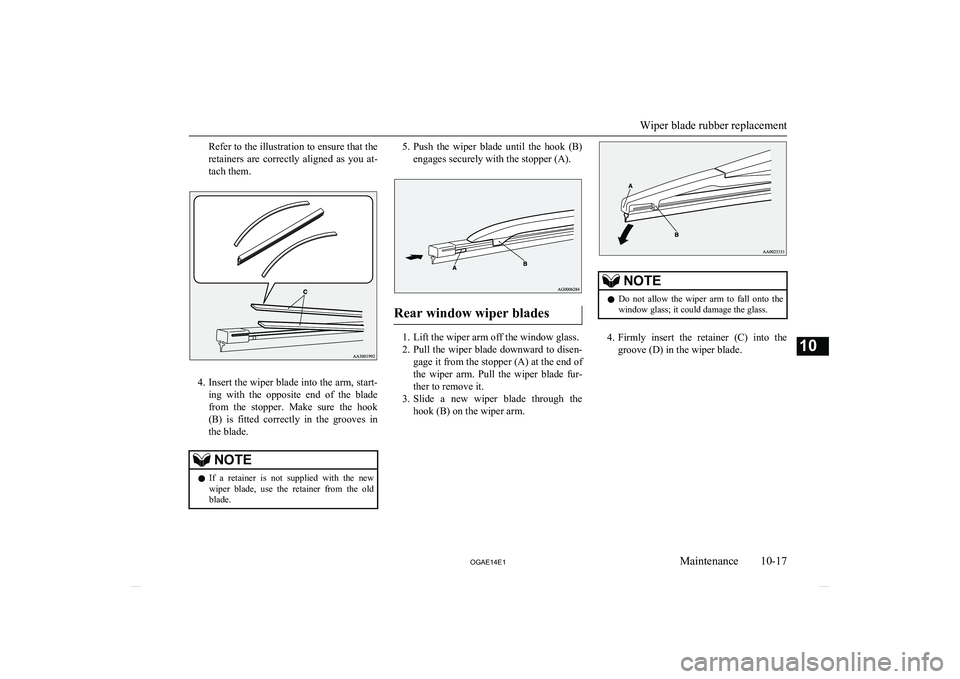
Refer to the illustration to ensure that the
retainers are correctly aligned as you at-
tach them.
4. Insert the wiper blade into the arm, start-
ing with the opposite end of the blade from the stopper. Make sure the hook(B) is fitted correctly in the grooves in
the blade.
NOTEl If a retainer is not supplied with the new
wiper blade, use the retainer from the old
blade.5. Push the wiper blade until the hook (B)
engages securely with the stopper (A).
Rear window wiper blades
1. Lift the wiper arm off the window glass.
2. Pull the wiper blade downward to disen-
gage it from the stopper (A) at the end of
the wiper arm. Pull the wiper blade fur-
ther to remove it.
3. Slide a new wiper blade through the
hook (B) on the wiper arm.
NOTEl Do not allow the wiper arm to fall onto the
window glass; it could damage the glass.
4. Firmly insert the retainer (C) into the
groove (D) in the wiper blade.
Wiper blade rubber replacement
10-17
OGAE14E1Maintenance10
Page 371 of 418
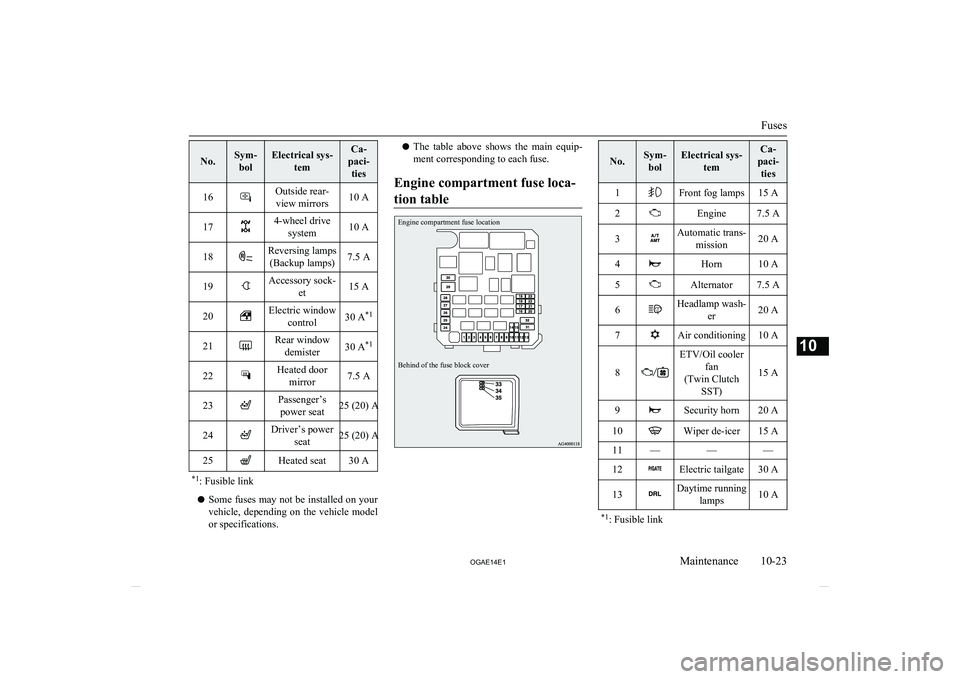
No.Sym-bolElectrical sys- temCa-
paci- ties16Outside rear-view mirrors10 A174-wheel drive system10 A18Reversing lamps(Backup lamps)7.5 A19Accessory sock- et15 A20Electric windowcontrol30 A *121Rear window
demister30 A *122Heated door
mirror7.5 A23Passenger’spower seat25 (20) A24Driver’s power seat25 (20) A25Heated seat30 A*1: Fusible link
l Some fuses may not be installed on your
vehicle, depending on the vehicle model
or specifications.
l The table above shows the main equip-
ment corresponding to each fuse.
Engine compartment fuse loca- tion tableEngine compartment fuse locationBehind of the fuse block cover
No.Sym- bolElectrical sys- temCa-
paci- ties1Front fog lamps15 A2Engine7.5 A3Automatic trans- mission20 A4Horn10 A5Alternator7.5 A6Headlamp wash- er20 A7Air conditioning10 A
8
ETV/Oil coolerfan
(Twin Clutch SST)
15 A
9Security horn20 A10Wiper de-icer15 A11———12Electric tailgate30 A13Daytime running lamps10 A*1: Fusible link
Fuses
10-23
OGAE14E1Maintenance10