Start battery MITSUBISHI CARISMA 2000 1.G Owners Manual
[x] Cancel search | Manufacturer: MITSUBISHI, Model Year: 2000, Model line: CARISMA, Model: MITSUBISHI CARISMA 2000 1.GPages: 280, PDF Size: 2.32 MB
Page 76 of 280
INSTRUMENTS AND CONTROLS
4–10
CAUTION
(3) If the lamp illuminates or flashes while the
engine is running, avoid driving at high
speeds and have the system checked at
an authorized MITSUBISHI dealer.
During vehicle operation with the lamp il-
luminated or flashing, the vehicle may not
accelerate when you depress the acceler-
ator pedal.
When the vehicle is stationary with the
lamp illuminated or flashing, you must de-
press the brake pedal more firmly than
usual since the engine idling speed is
higher than usual and the vehicle with an
automatic transmission has a stronger
tendency to creep forward.
NOTE
The engine electronic control module accommodat-
ing the onboard diagnostic system has various fault
data (especially about the exhaust emission) stored.
This data will be erased if a battery cable is discon-
nected, which will make rapid diagnosis difficult. Do
not disconnect a battery cable when the check engine
indication lamp is ON.
Oil pressure warning lamp - redED25A-Ai
This lamp illuminates when the ignition key is turned
“ON”, and goes off after the engine has started. If it il-
luminates while the engine is running, the oil pressure
is too low.
If the warning lamp illuminates while the engine is run-
ning, turn the engine off and contact your nearest
authorized MITSUBISHI dealer for inspection.
CAUTION
(1) If this lamp illuminates when the engine
oil level is not low, contact your nearest
authorized MITSUBISHI dealer for inspec-
tion.
(2) This warning lamp does not indicate the
amount of oil in the crankcase. This must
be determined by checking the oil level on
the dipstick, while the engine is switched
off.
(3) If you continue driving with low engine oil
level or with this warning lamp illumi-
nated, engine seizure may occur.
NOTE
The oil pressure warning lamp should not be treated
as an indication of the engine’s oil level. The oil level
must be checked using the dipstick.
Page 85 of 280
INSTRUMENTS AND CONTROLS
4–19
CAUTION
If the lamps are kept flashing for a
long time, the battery will be dis-
charged, resulting in hard engine
starting or no start condition at all.
Type 1
I08B119a
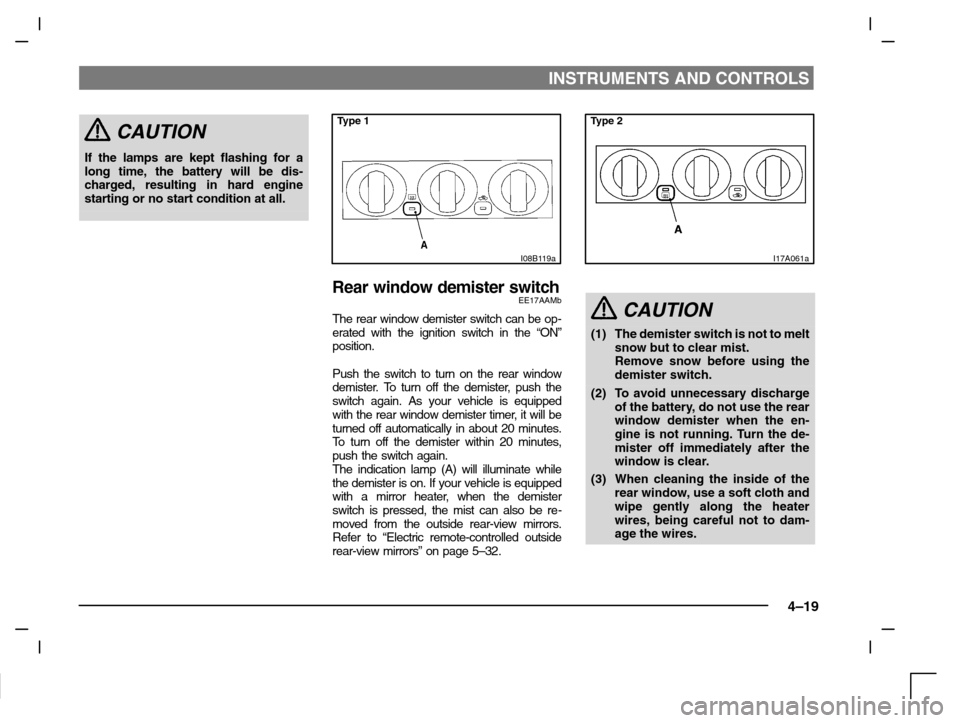
Rear window demister switchEE17AAMb
The rear window demister switch can be op-
erated with the ignition switch in the “ON”
position.
Push the switch to turn on the rear window
demister. To turn off the demister, push the
switch again. As your vehicle is equipped
with the rear window demister timer, it will be
turned off automatically in about 20 minutes.
To turn off the demister within 20 minutes,
push the switch again.
The indication lamp (A) will illuminate while
the demister is on. If your vehicle is equipped
with a mirror heater, when the demister
switch is pressed, the mist can also be re-
moved from the outside rear-view mirrors.
Refer to “Electric remote-controlled outside
rear-view mirrors” on page 5–32.
Type 2
I17A061a
CAUTION
(1) The demister switch is not to melt
snow but to clear mist.
Remove snow before using the
demister switch.
(2) To avoid unnecessary discharge
of the battery, do not use the rear
window demister when the en-
gine is not running. Turn the de-
mister off immediately after the
window is clear.
(3) When cleaning the inside of the
rear window, use a soft cloth and
wipe gently along the heater
wires, being careful not to dam-
age the wires.
Page 106 of 280
STARTING AND DRIVING
5–6
The catalytic converter itself gets hot quickly,
and may be damaged if overheated. The fol-
lowing points should be noted in order to pre-
vent the ignition of unburned petrol within the
catalytic converter.
(1) In case of the petrol-powered vehicles,
use UNLEADED PETROL ONLY of the
type of recommended in “Fuel usage”
on page 5–3.
(2) Do not drive with an extremely low fuel
level; running out of fuel could cause
damage to the catalytic converter.
(3) Do not switch OFF the ignition switch
while driving.
(4) Do not try to start the engine by pushing
the vehicle. If the battery is weak or dis-
charged, use another battery to start the
engine.
(5) In case of the petrol-powered vehicles,
do not idle the engine with any spark
plug wires disconnected or removed
such as performing diagnostic tests.
(6) Do not idle the engine for prolonged
periods during very rough idle or mal-
functioning operating conditions.
(7) Do not race the engine when turning off
the ignition switch. This will prevent the
catalytic converter from being damaged
due to unburnt fuel.(8) Stop driving the vehicle if you think the
performance is noticeably low, or that
there is unnecessary engine rotation or
any other engine trouble, such as with
the ignition, etc.
If it is impractical to stop driving immedi-
ately, reduce the speed and drive for
only a short time. Have an inspection
made by your nearest authorized MIT-
SUBISHI dealer as soon as possible.
(9) In unusual situations involving grossly
malfunctioning engine operation, a
burnt smell may indicate severe and ab-
normal catalyst overheating.
If this occurs, the vehicle should be
stopped in a safe place, the engine
switched off and the vehicle allowed to
cool. Once the engine is cool, a service,
including a tune-up to manufacturer’s
specifications, should be obtained im-
mediately.Economical drivingEC19ABC
For economical driving, there are some
technical requirements that have to be met.
The prerequisite for low fuel consumption is
a properly adjusted engine. In order to
achieve longer life of the vehicle and the
most economical operation, have the vehicle
serviced by an authorized MITSUBISHI
dealer at regular intervals in accordance with
the service standards.
Fuel economy and generation of exhaust
gas and noise are highly influenced by per-
sonal driving habits as well as the particular
operating conditions. The following points
should be observed in order to minimize
wear of brakes, tyres and engine as well as
to reduce environmental pollution.
(1)Starting
Avoid rapid acceleration and sudden
starts; such operation will result in
higher fuel consumption.
(2)Shifting
Shift only at an appropriate speed and
engine speed. Always use the highest
gear possible.
Page 111 of 280
STARTING AND DRIVING
5–11
CAUTION
(1) Do not remove the ignition key
from the ignition switch while
driving. The steering wheel will
lock, causing loss of control.
(2) If the engine is stopped while
driving, the brake servomechan-
ism will cease to function and
braking efficiency will deterio-
rate. Also, the power steering
system will not function and it will
require greater manual effort to
operate the steering.
(3) Do not leave the key in the “ON”
position for a long time when the
engine is not running, doing so
will cause the battery to be dis-
charged.
(4) Do not turn the key to the
“START” position when the en-
gine is running, doing so could
damage the starter motor.
I01B015a
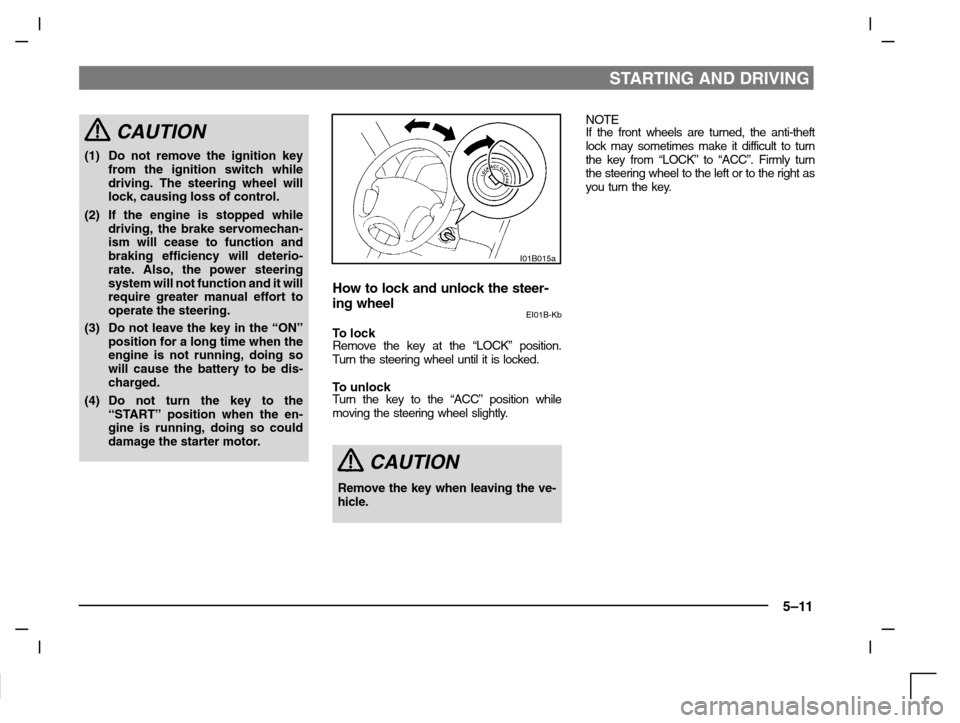
How to lock and unlock the steer-
ing wheel
EI01B-Kb
To lockRemove the key at the “LOCK” position.
Turn the steering wheel until it is locked.
To unlockTurn the key to the “ACC” position while
moving the steering wheel slightly.
CAUTION
Remove the key when leaving the ve-
hicle.
NOTEIf the front wheels are turned, the anti-theft
lock may sometimes make it difficult to turn
the key from “LOCK” to “ACC”. Firmly turn
the steering wheel to the left or to the right as
you turn the key.
Page 112 of 280
STARTING AND DRIVING
5–12
StartingEI02FAIh
Tips for starting
(1) Do not operate the starter motor con-
tinuously for anything longer than 10
seconds; doing so could run down the
battery. If the engine does not start, turn
the ignition switch back to “LOCK”, wait
a few seconds, and then try again.
Trying repeatedly with the starter mo-
tor still turning will damage the starter
mechanism.
(2) If the engine cannot be started because
the battery is weak or dead, refer to the
“Emergency starting” section for instruc-
tions on starting the engine.
(3) The engine is well warmed up if the
coolant temperature gauge needle
starts to move (the engine speed de-
creases). Extended warming - up oper-
ation will result in excessive fuel con-
sumption.
WARNING
Never run the engine in a closed or
poorly ventilated area any longer than
is needed to move your vehicle in or
out of the area. Carbon monoxide
gases are odourless and can be fatal.
CAUTION
(1) Never attempt to start the engine
by pushing or pulling the vehicle.
Especially in the automatic trans-
mission since the structure is dif-
ferent from a manual transmis-
sion, it is not possible to start the
engine by using this technique.
Never attempt this or it could
damage the automatic transmis-
sion.
(2) Do not run the engine at high rpm
or drive the vehicle at high speed
until the engine has a chance to
warm up.
(3) Release the ignition key as soon
as the engine starts to avoid dam-
aging the starter motor.
(4) If your vehicle is equipped with a
turbocharger, do not stop the en-
gine immediately after operating
the vehicle at high speeds. Allow
the engine to idle for approxi-
mately 60 seconds or more to
give the turbocharger a chance to
cool down.
NOTE
After replacing the battery, the electronic
control system data for the engine, auto-
matic transmission, etc., will be erased. As a
result, the engine speed may become un-
stable and shift shocks may occur.
If the engine speed becomes unstable, initial
engine adjustments will need to be per-
formed.
Refer to the section ”What to do if the engine
speed becomes unstable after the battery is
replaced” on page 8–22.
Shift shocks will become smoother after sev-
eral changes in speed.
Page 117 of 280
STARTING AND DRIVING
5–17
NOTE
During running–in period or immediately
after reconnection of the battery cable, there
may be a case where gearshifts are not
made smoothly. This does not indicate a
faulty transmission.
Gearshifts will become smooth after the
transmission has been shifted several times
by the electronic control system.
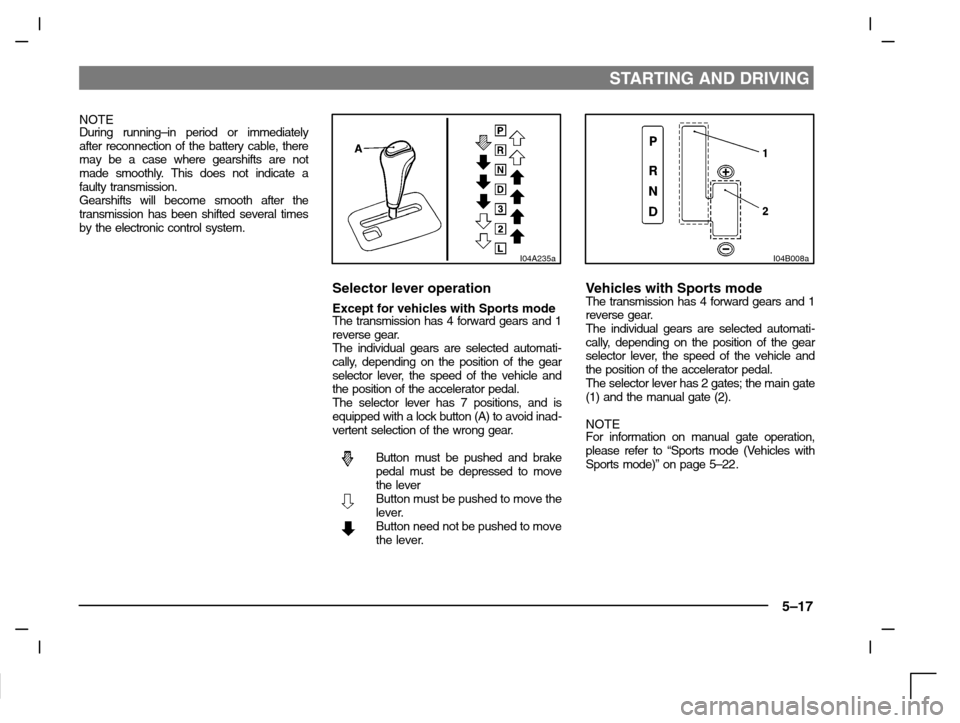
I04A235a
Selector lever operation
Except for vehicles with Sports modeThe transmission has 4 forward gears and 1
reverse gear.
The individual gears are selected automati-
cally, depending on the position of the gear
selector lever, the speed of the vehicle and
the position of the accelerator pedal.
The selector lever has 7 positions, and is
equipped with a lock button (A) to avoid inad-
vertent selection of the wrong gear.
Button must be pushed and brake
pedal must be depressed to move
the lever
Button must be pushed to move the
lever.
Button need not be pushed to move
the lever.
I04B008a
Vehicles with Sports modeThe transmission has 4 forward gears and 1
reverse gear.
The individual gears are selected automati-
cally, depending on the position of the gear
selector lever, the speed of the vehicle and
the position of the accelerator pedal.
The selector lever has 2 gates; the main gate
(1) and the manual gate (2).
NOTE
For information on manual gate operation,
please refer to “Sports mode (Vehicles with
Sports mode)” on page 5–22.
Page 129 of 280
STARTING AND DRIVING
5–29
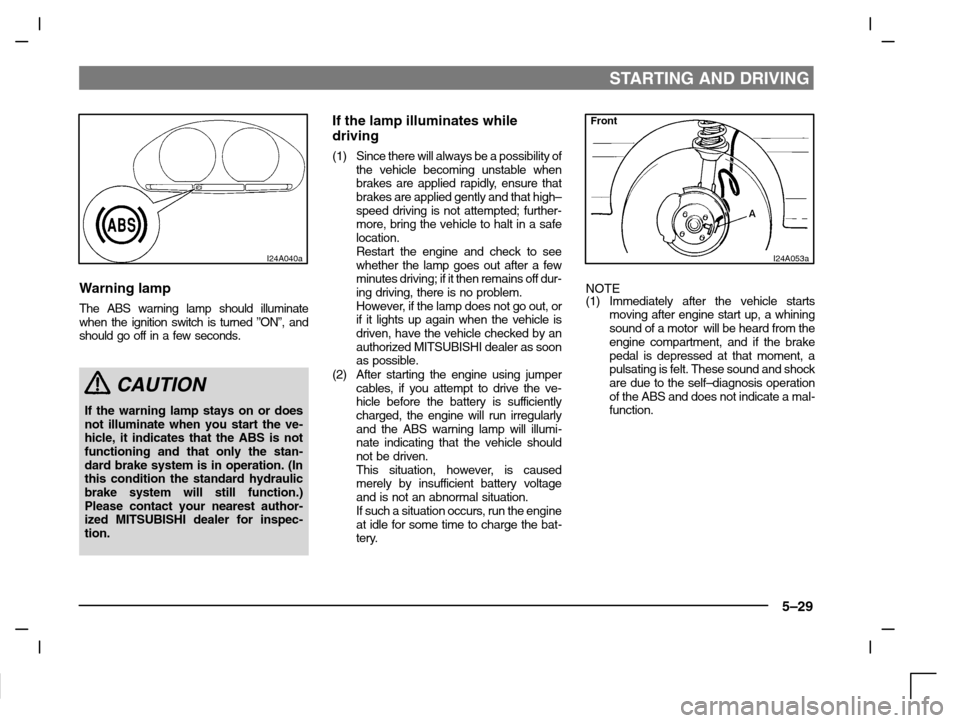
I24A040a
Warning lamp
The ABS warning lamp should illuminate
when the ignition switch is turned ”ON”, and
should go off in a few seconds.
CAUTION
If the warning lamp stays on or does
not illuminate when you start the ve-
hicle, it indicates that the ABS is not
functioning and that only the stan-
dard brake system is in operation. (In
this condition the standard hydraulic
brake system will still function.)
Please contact your nearest author-
ized MITSUBISHI dealer for inspec-
tion.
If the lamp illuminates while
driving
(1) Since there will always be a possibility of
the vehicle becoming unstable when
brakes are applied rapidly, ensure that
brakes are applied gently and that high–
speed driving is not attempted; further-
more, bring the vehicle to halt in a safe
location.
Restart the engine and check to see
whether the lamp goes out after a few
minutes driving; if it then remains off dur-
ing driving, there is no problem.
However, if the lamp does not go out, or
if it lights up again when the vehicle is
driven, have the vehicle checked by an
authorized MITSUBISHI dealer as soon
as possible.
(2) After starting the engine using jumper
cables, if you attempt to drive the ve-
hicle before the battery is sufficiently
charged, the engine will run irregularly
and the ABS warning lamp will illumi-
nate indicating that the vehicle should
not be driven.
This situation, however, is caused
merely by insufficient battery voltage
and is not an abnormal situation.
If such a situation occurs, run the engine
at idle for some time to charge the bat-
tery.
Front
I24A053a
NOTE
(1) Immediately after the vehicle starts
moving after engine start up, a whining
sound of a motor will be heard from the
engine compartment, and if the brake
pedal is depressed at that moment, a
pulsating is felt. These sound and shock
are due to the self–diagnosis operation
of the ABS and does not indicate a mal-
function.
Page 201 of 280
For emergencies
If the vehicle breaks down 8–2. . . . . . . . . . . . . . . . .
Operation under adverse driving conditions 8–2. .
Tools and jack 8–3. . . . . . . . . . . . . . . . . . . . . . . . . . . .
Jacking up the vehicle 8–4. . . . . . . . . . . . . . . . . . . . .
Spare wheel 8–6. . . . . . . . . . . . . . . . . . . . . . . . . . . . . .
Wheel covers* 8–8. . . . . . . . . . . . . . . . . . . . . . . . . . . .
If a tyre is punctured 8–9. . . . . . . . . . . . . . . . . . . . . .
Towing 8–12. . . . . . . . . . . . . . . . . . . . . . . . . . . . . . . . . .
Engine overheating 8–15. . . . . . . . . . . . . . . . . . . . . . .
Emergency starting 8–17. . . . . . . . . . . . . . . . . . . . . .
Bleeding the fuel system
(diesel-powered vehicles only) 8–21. . . . . . . . . . . . .
Removal of water from the fuel filter
(diesel-powered vehicles only) 8–21. . . . . . . . . . . . .
What to do if the engine speed becomes
unstable after the battery is replaced: 8–22. . . . . .
Fuses 8–22. . . . . . . . . . . . . . . . . . . . . . . . . . . . . . . . . . .
Changing a fuse 8–25. . . . . . . . . . . . . . . . . . . . . . . . .
Replacement of lamp bulbs 8–26. . . . . . . . . . . . . . .
Page 217 of 280
FOR EMERGENCIES
8–17
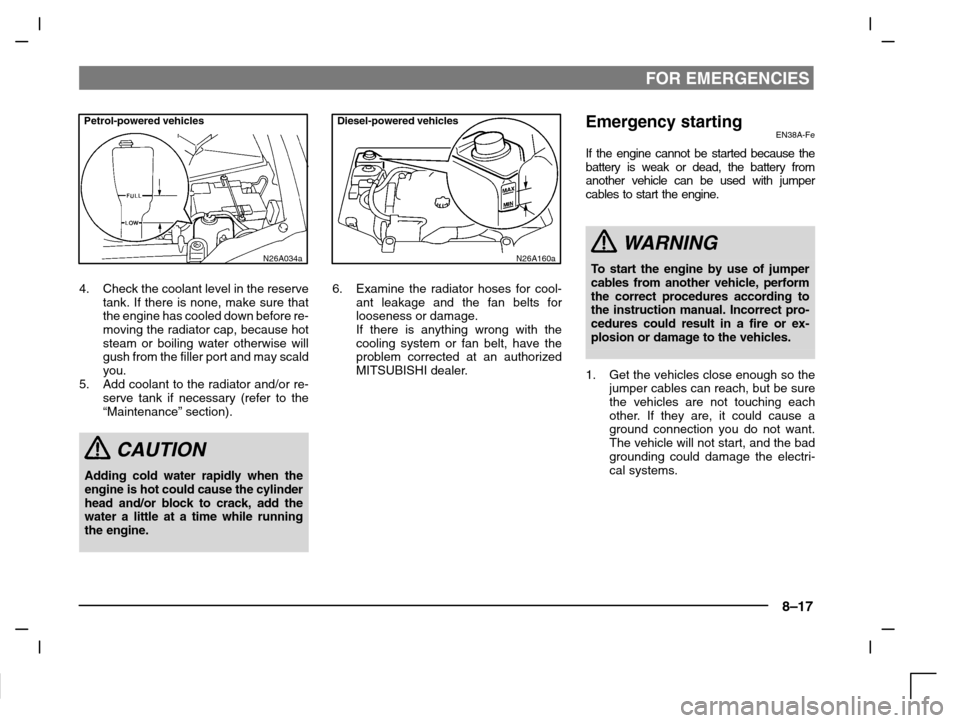
Petrol-powered vehicles
N26A034a
4. Check the coolant level in the reserve
tank. If there is none, make sure that
the engine has cooled down before re-
moving the radiator cap, because hot
steam or boiling water otherwise will
gush from the filler port and may scald
you.
5. Add coolant to the radiator and/or re-
serve tank if necessary (refer to the
“Maintenance” section).
CAUTION
Adding cold water rapidly when the
engine is hot could cause the cylinder
head and/or block to crack, add the
water a little at a time while running
the engine.
Diesel-powered vehicles
N26A160a
6. Examine the radiator hoses for cool-
ant leakage and the fan belts for
looseness or damage.
If there is anything wrong with the
cooling system or fan belt, have the
problem corrected at an authorized
MITSUBISHI dealer.
Emergency startingEN38A-Fe
If the engine cannot be started because the
battery is weak or dead, the battery from
another vehicle can be used with jumper
cables to start the engine.
WARNING
To start the engine by use of jumper
cables from another vehicle, perform
the correct procedures according to
the instruction manual. Incorrect pro-
cedures could result in a fire or ex-
plosion or damage to the vehicles.
1. Get the vehicles close enough so the
jumper cables can reach, but be sure
the vehicles are not touching each
other. If they are, it could cause a
ground connection you do not want.
The vehicle will not start, and the bad
grounding could damage the electri-
cal systems.
Page 218 of 280
FOR EMERGENCIES
8–18
CAUTION
Check the other vehicle. It must have
a 12-volt battery.
If the other system isn’t 12-volt, short-
ing can damage both vehicles.
2. You could be injured if the vehicles roll.
Set the parking brake firmly on each
vehicle. Put an automatic trans-
mission in “P” (PARK) or a manual
transmission in “N” (Neutral). Turn off
the ignition switch.
WARNING
Tu r n o f f t h e ignition on both vehicles
beforehand. Use care to make sure
that the cables or your clothes do not
get caught by the fan or drive belt.
Personal injury could result.
NOTE
Turn off all lamps, heater and other electrical
loads. This will avoid sparks and help save
both batteries.
3. Make sure battery electrolyte is at the
proper level.
Refer to “Battery” on page 9–7.
WARNING
If electrolyte fluid is not visible, or ap-
pears to be frozen, do not attempt
jump starting!
A battery might rupture or explode if
the temperature is below the freezing
point or if it is not filled to the proper
level.
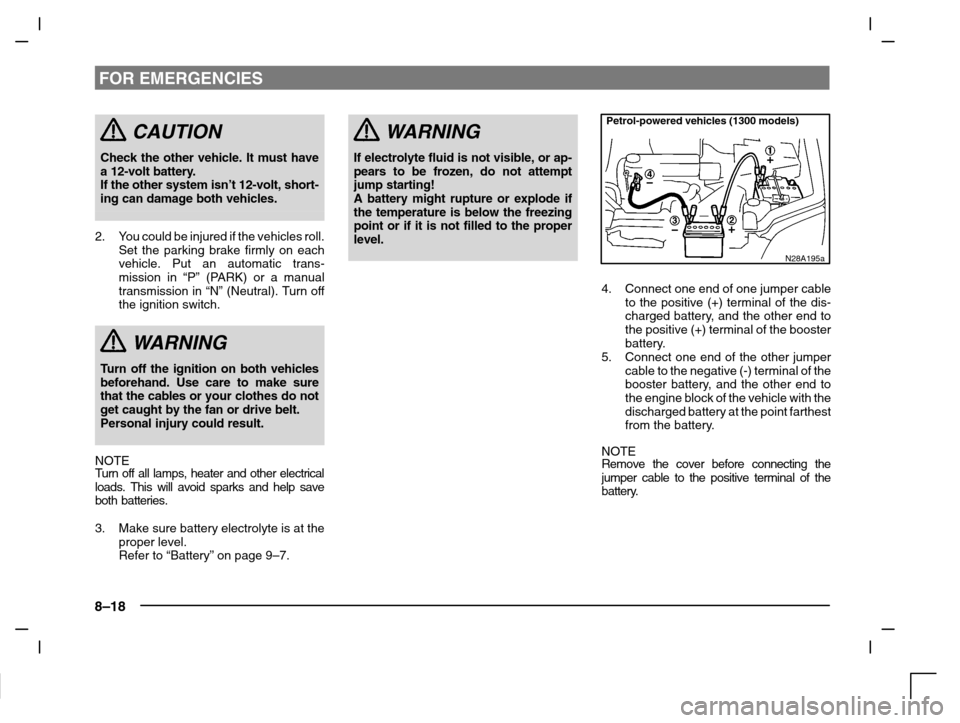
Petrol-powered vehicles (1300 models)
N28A195a
4. Connect one end of one jumper cable
to the positive (+) terminal of the dis-
charged battery, and the other end to
the positive (+) terminal of the booster
battery.
5. Connect one end of the other jumper
cable to the negative (-) terminal of the
booster battery, and the other end to
the engine block of the vehicle with the
discharged battery at the point farthest
from the battery.
NOTE
Remove the cover before connecting the
jumper cable to the positive terminal of the
battery.