replace MITSUBISHI COLT 2008 (in English) User Guide
[x] Cancel search | Manufacturer: MITSUBISHI, Model Year: 2008, Model line: COLT, Model: MITSUBISHI COLT 2008Pages: 450, PDF Size: 14.57 MB
Page 238 of 450
5-22 For pleasant driving
5Important operation tips for the air
conditioning
E00708300661
●Park the vehicle in the shade.
Parking in hot sun will make the inside of the vehicle
extremely hot, and it will requir e more to cool the interior.
If it is necessary to park in the sun, open the windows for
the first few minutes of the air conditioning operation to
expel the hot air.
● Close the windows while the air conditioning is in use.
The entry of outside air through open windows will
reduce the cooling efficiency.
● Too much cooling is not good for health. The inside air
temperature should only be 5 to 6 °C below the outside air
temperature.
● When operating the system, ma ke sure the air intake,
located in front of the windscreen, is free of obstructions
such as leaves and snow. Leav es collected in the air-intake
plenum may reduce air flow and plug the plenum water
drains.
Air conditioning system refrigerant and
lubricant recommendations
If the air conditioning seems less effective than usual, the cause
might be a refrigerant leak. We recommend that you have the
system inspected.
The air conditioning system in your vehicle must be charged
with the refrigerant HFC-134a and the lubricant ND-OIL8.
Use of any other refrigerant or lubricant will cause severe dam-
age, resulting in the need to replace your vehicle’s entire air
conditioning system. The release of refrigerant into the atmos-
phere should be prevented.
It is recommended that the refr igerant be recovered and recy-
cled for further use.
During a long p eriod of disuse
The air conditioning should be operated for at least five min-
utes each week, even in cold w eather. This is to prevent poor
lubrication of the internal parts of the compressor and to main-
tain the air conditioning in the best operating condition.
Page 239 of 450
For pleasant driving5-23
5
Air purifier
E00708400024
An air filter has been incorporat
ed into this air conditioning so
that dirt and dust ar e cleaned from the air.
Replace the air filter periodically as its ability to clean the air
will be reduced as it collects pollen and dirt. For the mainte-
nance interval, refer to the “SERVICE BOOKLET”.
NOTE● Operation in certain conditions such as driving on a dusty
road and frequent use of th e air conditioning can lead to
reduction of service life of the filter. When the air flow
rate suddenly drops or when the windscreen or windows
start to fog up easily, the air filter requires replacement.
We recommend you to have it checked.
Page 246 of 450
5-30 For pleasant driving
5
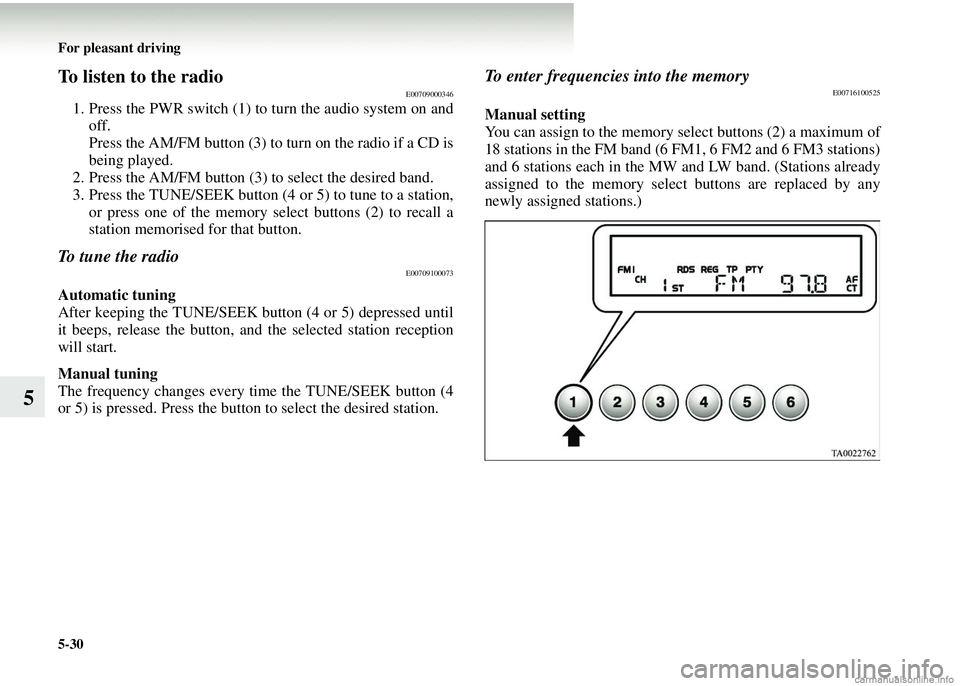
To listen to the radioE00709000346
1. Press the PWR switch (1) to turn the audio system on andoff.
Press the AM/FM button (3) to turn on the radio if a CD is
being played.
2. Press the AM/FM button (3) to select the desired band.
3. Press the TUNE/SEEK button (4 or 5) to tune to a station,
or press one of the memory select buttons (2) to recall a
station memorised for that button.
To tune the radioE00709100073
Automatic tuning
After keeping the TUNE/SEEK button (4 or 5) depressed until
it beeps, release the button, an d the selected station reception
will start.
Manual tuning
The frequency changes every time the TUNE/SEEK button (4
or 5) is pressed. Press the button to select the desired station.
To enter frequencies into the memoryE00716100525
Manual setting
You can assign to the memory select buttons (2) a maximum of
18 stations in the FM band (6 FM1, 6 FM2 and 6 FM3 stations)
and 6 stations each in the MW and LW band. (Stations already
assigned to the memory select buttons are replaced by any
newly assigned stations.)
Page 247 of 450
For pleasant driving5-31
5
Follow the steps described below.1. Press either the TUNE/SEEK button (4 or 5) to tune the frequency to be entered in the memory.
2. Press one of the memory select buttons (2) for 2 seconds or longer. The sound will be momentarily interrupted
while the frequency is being entered into the memory.
The number of the button corresponding to the entry in the
memory and the frequency are displayed.
3. The preset memory setting is retrieved by pressing the
button and then releasing it within 2 seconds.
Automatic setting
With the method, all manually set stations in the band currently
selected for reception are replaced with stations in the same
band that are automatically selected in order of signal strength.
The radio automatically selects 6 stations in the FM band (FM3
station only) and 6 stations each in the MW and LW band.
Follow the steps described below. 1. With the radio mode selected, hold down the AM/FM but- ton (3) for 2 seconds or longer. The 6 stations with the
best signal strength will automatically be assigned to the
memory select buttons (2), wi th the lowest-frequency sta-
tion being assigned to the lowest-number button.
2. When you subsequently press a memory select button to select a channel number, the ra dio will begin receiving the
station assigned to that number.
NOTE● If you press the AM/FM button (3) for 2 seconds or longer
while tuning in the FM1 or FM2 band, the radio will auto-
matically switch to the FM 3 band, where the automatic
seeking/storing will be activated.
Page 310 of 450
6-20 For emergencies
6
18. After driving for 10 minutes, check the tyre pressure usingthe air pressure gauge on the compressor. (Refer to “Tyre
inflation pressures” on page 8-19.) If the tyre pressure has
apparently not dropped, the emergency repair procedure is
complete. You must still not exceed a speed of 80 km/h
(50 mph). Observe local speed limits.
NOTE●If the tyre pressure has dropped below the specified level
when you check it at the end of the repair procedure, do
not drive the vehicle any fu rther. Contact a MITSUBISHI
MOTORS Authorized Service Point or another specialist.
● In cold conditions (when th e ambient temperature is 0 °C
or lower), the time and driving distance necessary for
completion of the repair can be longer than in warmer
conditions, meaning that the tyre pressure can drop below
the specified level even when you have inflated the tyre a
second time and subsequently driven the vehicle. If this
happens, inflate the tyre to the specified pressure once
more, drive for about 10 minutes or 5 km (3 miles), then
check the tyre pressure again. If the tyre pressure has
again dropped below the specified level, stop driving the
vehicle and contact a MITS UBISHI MOTORS Author-
ized Service Point or another specialist. 19. Then immediately drive wi
th great care to a MITSUBI-
SHI MOTORS Authorized Service Point or another spe-
cialist and have a tyre repair/replacement performed.
NOTE● Please give the empty sealant bottle to your MITSUBISHI
MOTORS Authorized Service Point when you purchase
new sealant, or dispose of the sealant bottle according to
national regulations for the disposal of chemical waste.
● A tyre in which puncture sealant has been used should
ideally be replaced with a new one. If you wish to have
such a tyre properly repaired for reuse, please contact a
MITSUBISHI MOTORS Authorized Service Point or
another specialist. Note that a proper repair is impossible
following an emergency repair if the puncture hole cannot
be located.
● Wipe away any sealant that gets on the wheel. Provided
the valve is replaced with a new one, the wheel can be
reused.
CAUTION!
●Be sure to check the tyre pressure for confirmation
that the emergency repair procedure is complete.
Page 315 of 450
For emergencies6-25
6
8. Slowly turn the jack handle until the tyre is raised slightlyoff the ground surface. Spare wheel*
E00801101206
Check the air pressure of the spare tyre frequently and make
sure it is ready for emergency use at any time.
Maintaining the spare wheel at the highest specified air pres-
sure will ensure that it can al ways be used under any conditions
(city/high-speed driving, varying load weight, etc.).
The spare wheel is stored ben eath the luggage floor board of
the luggage compartment.
Compact spare wheel
The compact spare tyre is desi gned to save space in the lug-
gage compartment and its lighter weight makes it easier to use
if a flat tyre occurs.
WARNING!
● Stop jacking up the vehicle as soon as the tyre is
raised off the ground. It is dangerous to raise the
vehicle any higher.
● Do not get under your vehi cle while using the jack.
●Do not bump the raised vehicle or leave it sitting on
the jack for a long time. Both are very dangerous.
●Do not use a jack except th e one that came with your
vehicle.
● The jack should not be us ed for any purpose other
than to change a tyre.
● No one should be in you r vehicle when using the
jack.
● Do not start or run the en gine while your vehicle is
on the jack.
● Do not turn the raised wh eel. The tyres still on the
ground could turn and make your vehicle fall off the
jack.
CAUTION!
● The pressure should be periodically checked and
maintained at the specified pressure while the tyre is
stowed.
Driving with insufficient ty re pressure can lead to an
accident. If you have no choice but to drive with
insufficient tyre pressure , keep your speed down and
inflate the tyre to the correct pressure as soon as
possible. (Refer to “Tyre inflation pressures” on
page 8-19.)
● The compact spare wheel is for temporary use only
and should be removed as soon as the original wheel
can be repaired or replaced.
Page 316 of 450
6-26 For emergencies
6
●The vehicle must not be driven at speeds in excess of
80 km/h (50 mph) while using the compact spare
wheel.
● The compact spare tyre is not as good as a standard
tyre in controllability and stability. When the com-
pact spare tyre is used, avoid quick starts, sudden
braking and sharp steering.
●Avoid driving through au tomatic vehicle washers
and over obstacles that could possibly damage the
vehicle’s undercarriage. Because the compact spare
wheel is smaller than th e original wheel, ground
clearance is slightly reduced.
● The compact spare wheel is specifically designed for
your vehicle and it should not be used on any other
vehicle.
CAUTION!CAUTION!
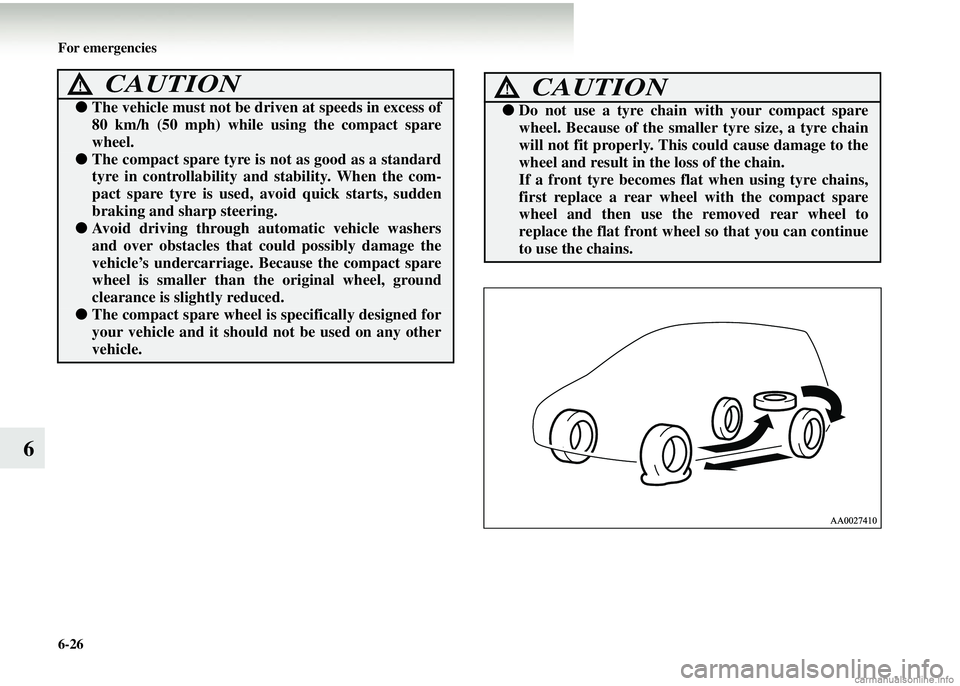
● Do not use a tyre chain with your compact spare
wheel. Because of the small er tyre size, a tyre chain
will not fit properly. This could cause damage to the
wheel and result in the loss of the chain.
If a front tyre becomes flat when using tyre chains,
first replace a rear wheel with the compact spare
wheel and then use the removed rear wheel to
replace the flat front wheel so that you can continue
to use the chains.
Page 317 of 450
For emergencies6-27
6
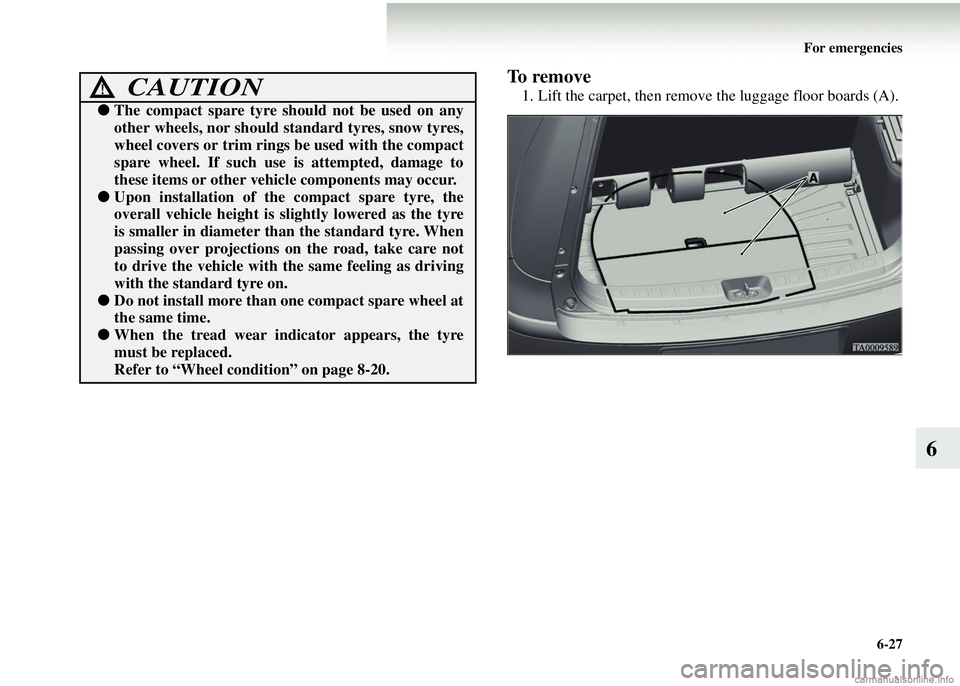
To remove
1. Lift the carpet, then remove the luggage floor boards (A).CAUTION!
●The compact spare tyre should not be used on any
other wheels, nor should st andard tyres, snow tyres,
wheel covers or trim rings be used with the compact
spare wheel. If such use is attempted, damage to
these items or other vehi cle components may occur.
●Upon installation of the compact spare tyre, the
overall vehicle height is sl ightly lowered as the tyre
is smaller in diameter than the standard tyre. When
passing over projections on the road, take care not
to drive the vehicle with th e same feeling as driving
with the standard tyre on.
● Do not install more than one compact spare wheel at
the same time.
●When the tread wear indi cator appears, the tyre
must be replaced.
Refer to “Wheel condit ion” on page 8-20.
Page 324 of 450
6-34 For emergencies
6
Wheel covers*E00801300298
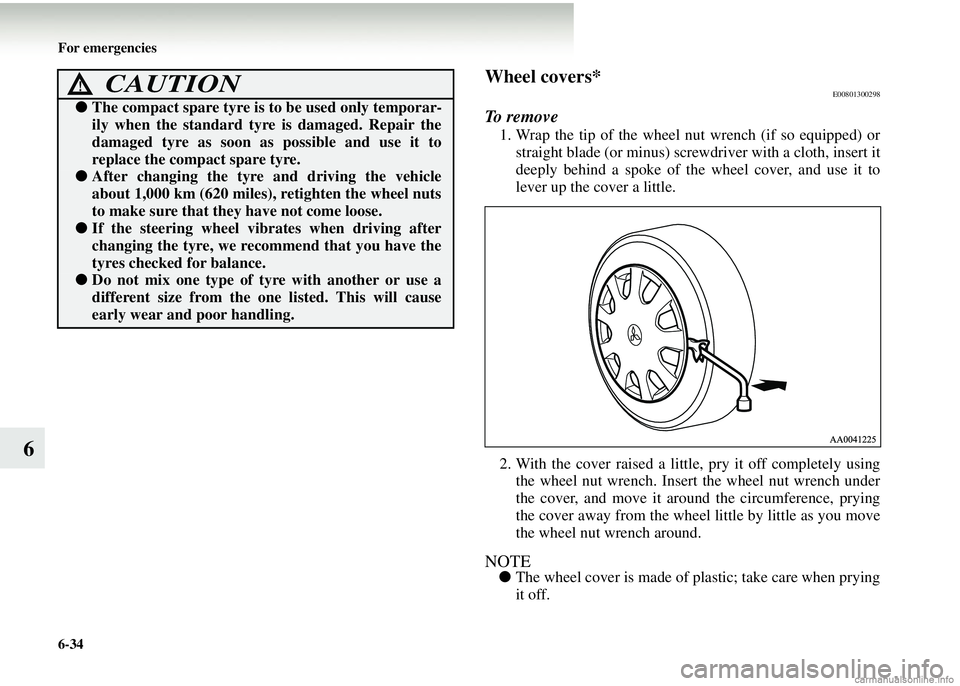
To remove
1. Wrap the tip of the wheel nut wrench (if so equipped) or
straight blade (or minus) screwdriver with a cloth, insert it
deeply behind a spoke of the wheel cover, and use it to
lever up the cover a little.
2. With the cover raised a little, pry it off completely using the wheel nut wrench. Insert the wheel nut wrench under
the cover, and move it around the circumference, prying
the cover away from the wheel little by little as you move
the wheel nut wrench around.
NOTE● The wheel cover is made of pl astic; take care when prying
it off.
● The compact spare tyre is to be used only temporar-
ily when the standard tyre is damaged. Repair the
damaged tyre as soon as possible and use it to
replace the compact spare tyre.
● After changing the tyre and driving the vehicle
about 1,000 km (620 miles) , retighten the wheel nuts
to make sure that they have not come loose.
● If the steering wheel vibr ates when driving after
changing the tyre, we recommend that you have the
tyres checked for balance.
● Do not mix one type of tyre with another or use a
different size from the one listed. This will cause
early wear and poor handling.
CAUTION!
Page 342 of 450
7-8 Vehicle care
7
Window glassE00901600104
The window glass can normally be cleaned using only a
sponge and water.
Glass cleaner can be used to re move oil, grease, dead insects,
etc. After washing the glass, wi pe dry with a clean, dry, soft
cloth. Never use the same cloth to wipe the window glass as
would be used to wipe the paintwork; wax from the painted
surfaces could adhere to the gl ass and reduce its transparency
and visibility.
NOTE● To clean the inside of the tailgate window, always use a
soft cloth and wipe the window glass along the demister
heater element so as not to cause damage.
Wiper bladesE00901700017
Use a soft cloth and glass cleaner to remove grease, dead
insects, etc., from the wiper blades. Replace the wiper blades
when they no longer wipe properly. (Refer to page 8-25.)
Engine compartmentE00902100265
Clean the engine compartment at the beginning and end of
winter. Pay particular attention to flanges, crevices and periph-
eral parts where dust containing road chemicals and other cor-
rosive materials might collect.
If salt and other chemicals ar e used on the roads in your area,
clean the engine compartment at least every three months.
Never spray or splash water on the electrical components in the
engine compartment, as this may cause damage.
Do not bring the nearby parts, the plastic parts and so on into
contact with sulphuric acid (bat tery electrolyte) which may
crack, stain or discolour them.
If they are in contact, wipe off with soft cloth, chamois or the
like and an aqueous solution of neutral detergent then immedi-
ately rinse the affected pa rts with plenty of water.
CAUTION!
●If your vehicle has rain sensor wipers, place the
wiper switch lever in th e “ ” (OFF) position to
deactivate the rain sensor before washing the wind-
screen. Otherwise, the wip ers will operate in the
presence of water spray on the windscreen and may
get damaged as a result.