are MITSUBISHI COLT 2009 10.G Owners Manual
[x] Cancel search | Manufacturer: MITSUBISHI, Model Year: 2009, Model line: COLT, Model: MITSUBISHI COLT 2009 10.GPages: 273, PDF Size: 17.28 MB
Page 180 of 273
Downloaded from www.Manualslib.com manuals search engine Storage spacesE00713101244CAUTIONlNever leave lighters, cans of carbonated
drink, and spectacles in the cabin when
parking the vehicle in hot sunshine. The
cabin will become extremely hot, so light-
ers and other flammable items may catch
fire and unopened drink cans (including
beer cans) may rupture. The heat may al-
so deform or crack plastic spectacle len-
ses and other spectacle parts that are
made of plastic.
l Keep the lids of storage spaces closed
while driving the vehicle. A lid or the con-
tents of a storage space could otherwise
cause injuries.
NOTE
l Do not leave valuables in any storage space
when leaving the vehicle.
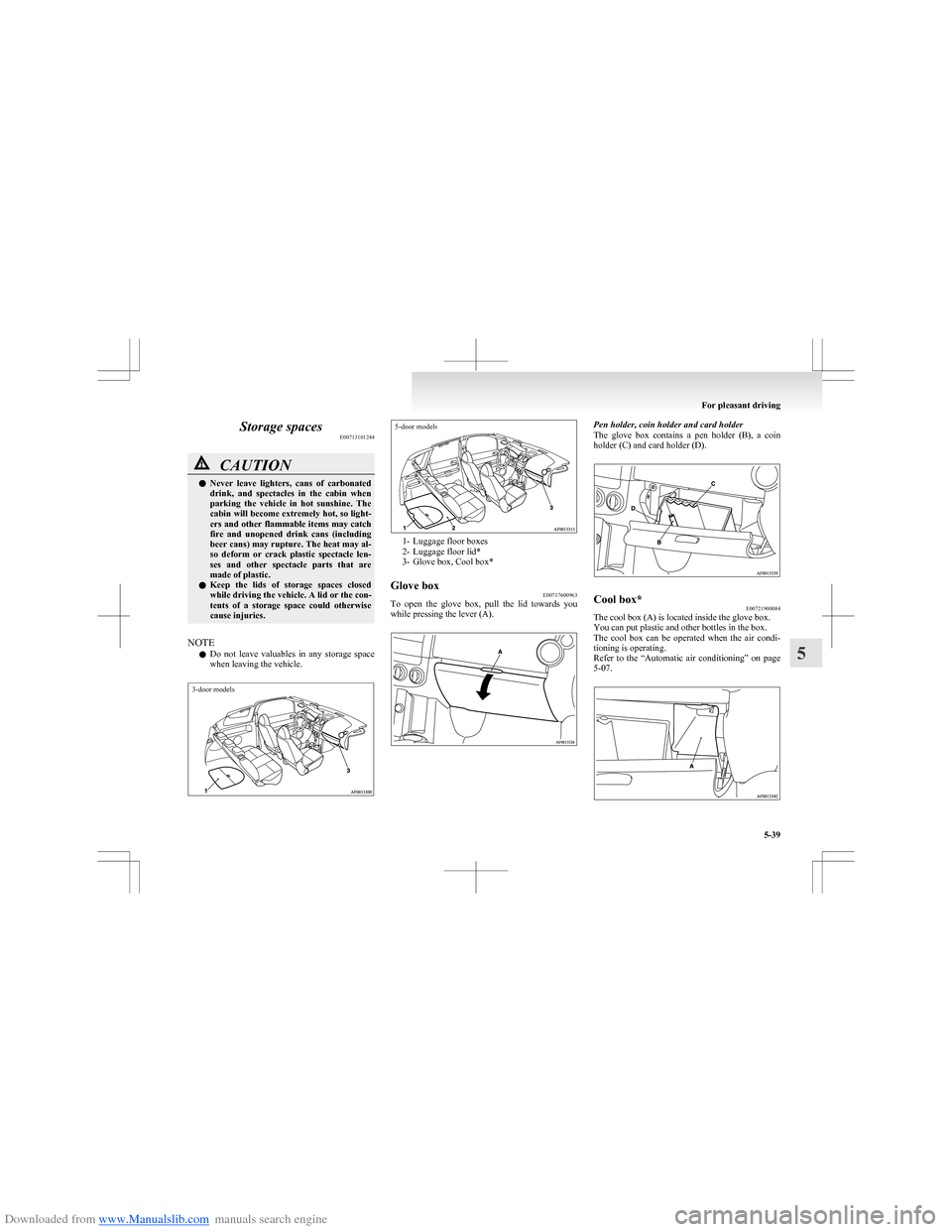
3-door models5-door models
1- Luggage floor boxes
2- Luggage floor lid*
3- Glove box, Cool box*
Glove box E00717600963
To open the glove box, pull the lid towards you
while pressing the lever (A).
Pen holder, coin holder and card holder
The glove box contains a pen holder (B), a coin
holder (C) and card holder (D).Cool box* E00721900084
The cool box (A) is located inside the glove box.
You can put plastic and other bottles in the box.
The cool box can be operated when the air condi-
tioning is operating.
Refer to the “Automatic air conditioning” on page
5-07.
For pleasant driving
5-39
5
Page 183 of 273
Downloaded from www.Manualslib.com manuals search engine Cup holderE00714500671CAUTIONlDo not drink beverages while driving the
vehicle; doing so could distract you and
result in an accident.
l Beverages can spill owing to vibration or
other movement during vehicle operation
or owing to opening and closing of the
rear doors. Be careful not to get scalded
by a hot beverage if it spills.
For the front seat
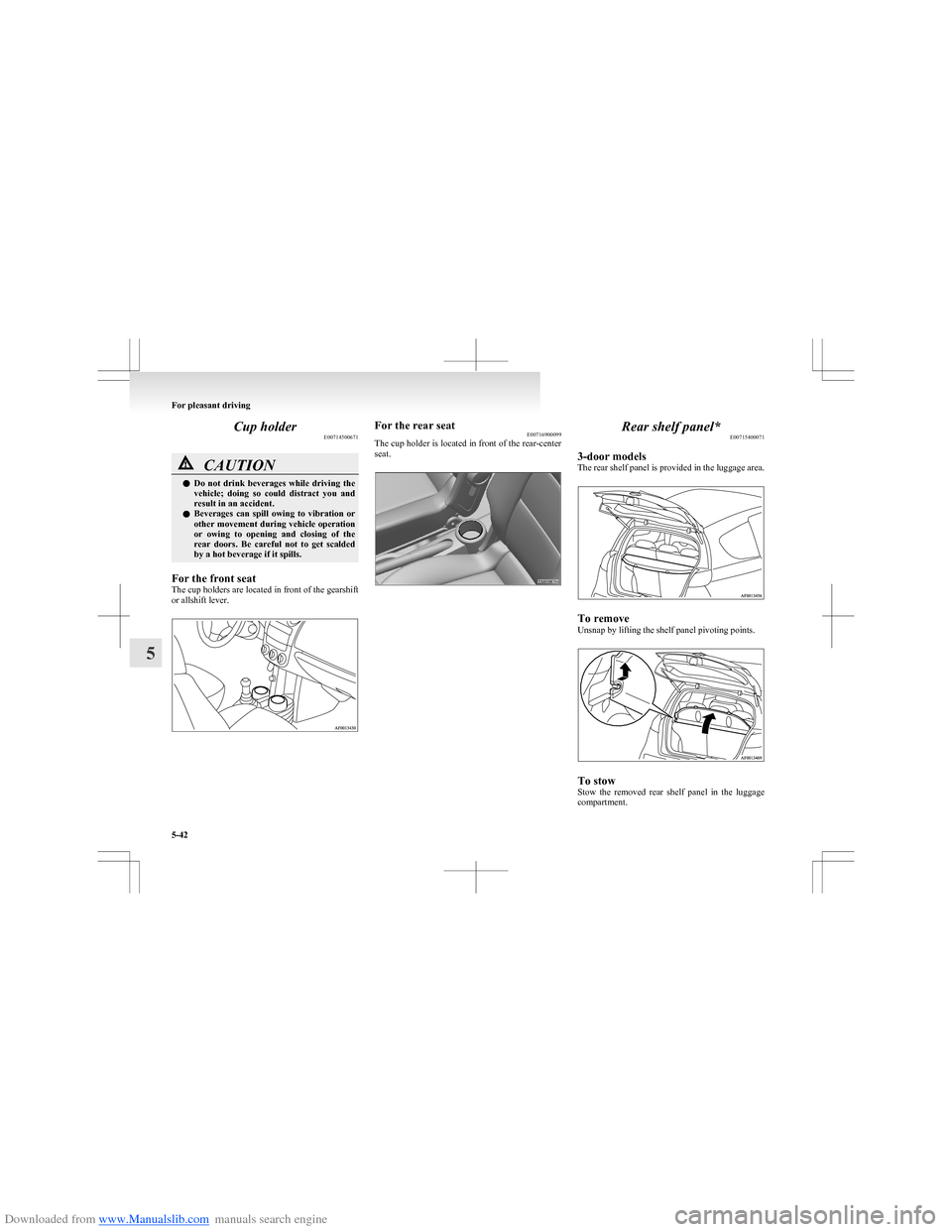
The cup holders are located in front of the gearshift
or allshift lever.
For the rear seat E00716900099
The cup holder is located in front of the rear-center
seat.Rear shelf panel* E00715400071
3-door models
The rear shelf panel is provided in the luggage area.
To remove
Unsnap by lifting the shelf panel pivoting points.
To stow
Stow the removed rear shelf panel in the luggage
compartment.
For pleasant driving
5-42
5
Page 184 of 273
Downloaded from www.Manualslib.com manuals search engine NOTEl Do not place heavy luggage (more than
about 1 kg) on the rear shelf panel.
5-door models
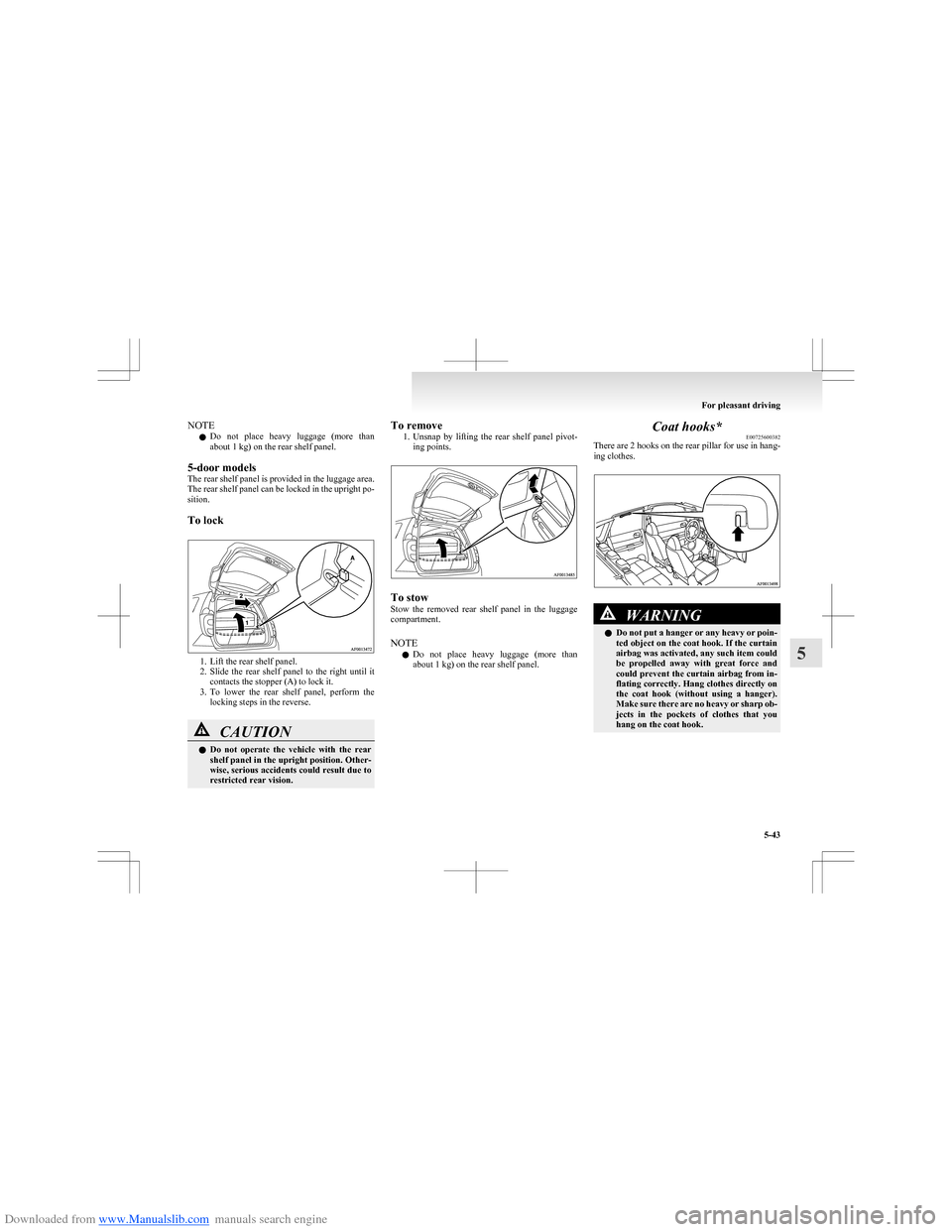
The rear shelf panel is provided in the luggage area.
The rear shelf panel can be locked in the upright po-
sition.
To lock
1. Lift the rear shelf panel.
2. Slide the rear shelf panel to the right until it
contacts the stopper (A) to lock it.
3. To lower the rear shelf panel, perform the
locking steps in the reverse.
CAUTIONl Do not operate the vehicle with the rear
shelf panel in the upright position. Other-
wise, serious accidents could result due to
restricted rear vision.To remove
1.Unsnap by lifting the rear shelf panel pivot-
ing points.
To stow
Stow the removed rear shelf panel in the luggage
compartment.
NOTE l Do not place heavy luggage (more than
about 1 kg) on the rear shelf panel.
Coat hooks* E00725600382
There are 2 hooks on the rear pillar for use in hang-
ing clothes.WARNINGl Do not put a hanger or any heavy or poin-
ted object on the coat hook. If the curtain
airbag was activated, any such item could
be propelled away with great force and
could prevent the curtain airbag from in-
flating correctly. Hang clothes directly on
the coat hook (without using a hanger).
Make sure there are no heavy or sharp ob-
jects in the pockets of clothes that you
hang on the coat hook.
For pleasant driving
5-43
5
Page 186 of 273
Downloaded from www.Manualslib.com manuals search engine If the vehicle breaks down............................................................ 6-02
Emergency starting ....................................................................... 6-02
Engine overheating ....................................................................... 6-04
Tools, jack and tyre repair kit* ..................................................... 6-06
Jacking up the vehicle...................................................................6-12
Spare wheel*.................................................................................6-13
How to change a tyre .................................................................... 6-15
Towing .......................................................................................... 6-18
Operation under adverse driving conditions .................................6-22For emergencies6
Page 187 of 273
Downloaded from www.Manualslib.com manuals search engine If the vehicle breaks downE00800101254
If the vehicle breaks down on the road, move it to
the shoulder and use the hazard warning flashers and/
or the warning triangle etc.
Refer to “Hazard warning flasher switch” on page
3-23.
If the engine stops/fails
Vehicle operation and control are affected if the en-
gine stops.
Before moving the vehicle to a safe area, be aware
of the following:
l The brake booster becomes inoperative and
the pedal effort will increase. Press down the
brake pedal harder than usual.
l Since the power steering system is no longer
operative, the steering wheel feels heavy
when turning it.Emergency starting E00800501900
If the engine cannot be started because the battery
is weak or dead, the battery from another vehicle
can be used with jumper cables to start the engine.WARNINGl To start the engine using jumper cables
connected to another vehicle, perform the
correct procedures according to the in-
struction below. Incorrect procedures
could result in a fire or explosion or dam-
age to the vehicles.
1. Get the vehicles close enough so the jumper
cables can reach, but be sure the vehicles
aren’t touching each other.
If they are, it could cause a ground connec-
tion you don’t want. The vehicle will not
start, and the bad grounding could damage
the electrical systems.
CAUTIONl Check the other vehicle. It must have a 12-
volt battery.
If the other system isn’t 12-volt, shorting
can damage both vehicles.2. You could be injured if the vehicles move.
Set the parking brake firmly on each vehicle.
Put an automatic transmission in “P”
(PARK) or a manual transmission and an au-
tomated manual transmission in “N” (Neu-
tral). With an automated manual transmis-
sion vehicle, confirm that “N” is shown by
the allshift indicator display. Turn off the ig-
nition switch.WARNINGl Turn off the ignition on both vehicles be-
forehand. Make sure that the cables or
your clothes cannot be caught by the fan
or drive belt. Personal injury could result.
NOTE
l Turn off all lamps, heater and other electrical
loads. This will avoid sparks and help save
both batteries.
3. Make sure battery electrolyte is at the proper
level. Refer to “Battery” on page 8-10.
WARNINGl If electrolyte fluid is not visible, or ap-
pears to be frozen, Do Not Attempt Jump
Starting!
A battery might rupture or explode if the
temperature is below the freezing point
or if it is not filled to the proper level.
For emergencies
6-02
6
Page 188 of 273
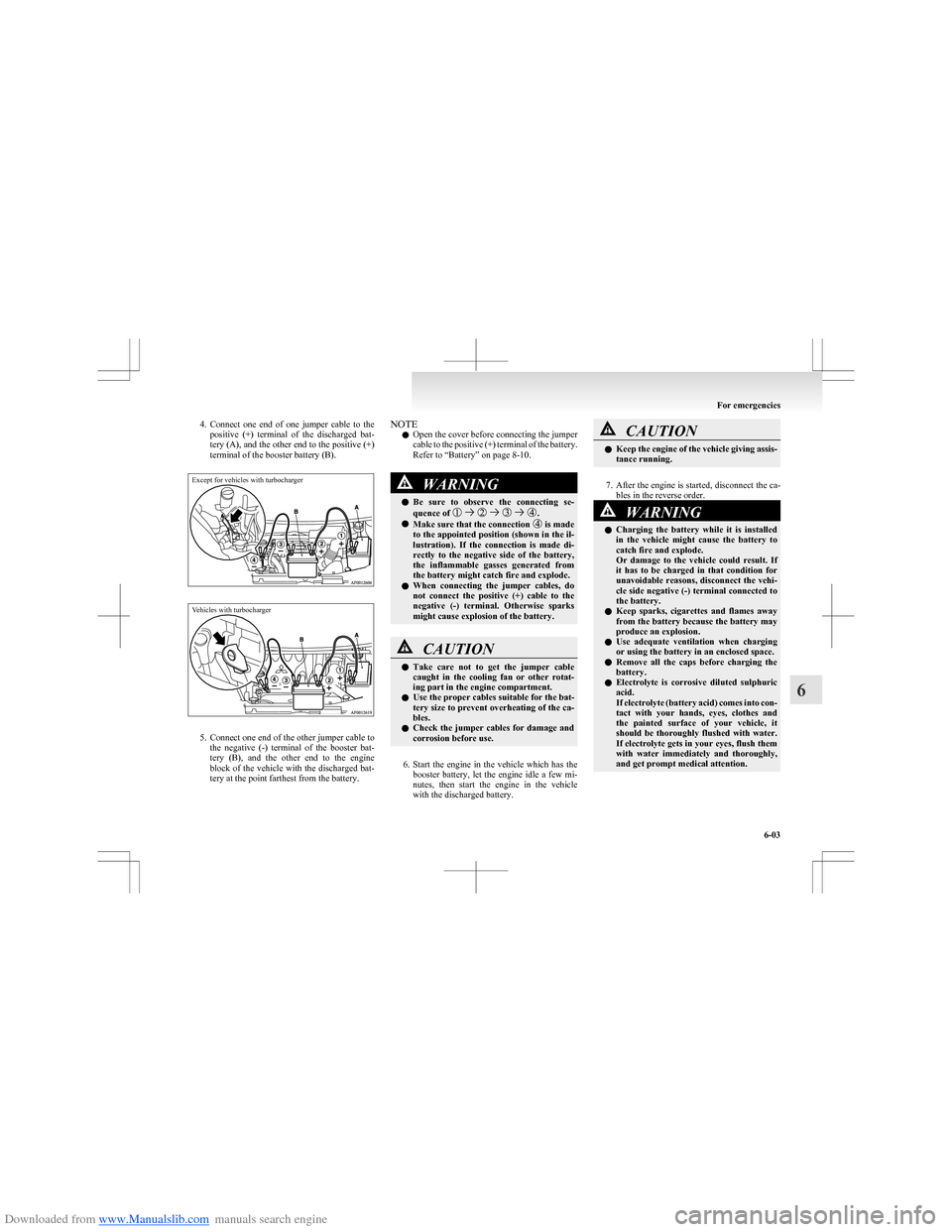
Downloaded from www.Manualslib.com manuals search engine 4.Connect one end of one jumper cable to the
positive (+) terminal of the discharged bat-
tery (A), and the other end to the positive (+)
terminal of the booster battery (B).Except for vehicles with turbochargerVehicles with turbocharger
5. Connect one end of the other jumper cable to
the negative (-) terminal of the booster bat-
tery (B), and the other end to the engine
block of the vehicle with the discharged bat-
tery at the point farthest from the battery.
NOTE
l Open the cover before connecting the jumper
cable to the positive (+) terminal of the battery.
Refer to “Battery” on page 8-10.WARNINGl Be sure to observe the connecting se-
quence of .
l Make sure that the connection is made
to the appointed position (shown in the il-
lustration). If the connection is made di-
rectly to the negative side of the battery,
the inflammable gasses generated from
the battery might catch fire and explode.
l When connecting the jumper cables, do
not connect the positive (+) cable to the
negative (-) terminal. Otherwise sparks
might cause explosion of the battery.
CAUTIONl Take care not to get the jumper cable
caught in the cooling fan or other rotat-
ing part in the engine compartment.
l Use the proper cables suitable for the bat-
tery size to prevent overheating of the ca-
bles.
l Check the jumper cables for damage and
corrosion before use.
6. Start the engine in the vehicle which has the
booster battery, let the engine idle a few mi-
nutes, then start the engine in the vehicle
with the discharged battery.
CAUTIONl Keep the engine of the vehicle giving assis-
tance running.
7. After the engine is started, disconnect the ca-
bles in the reverse order.
8.
WARNINGl Charging the battery while it is installed
in the vehicle might cause the battery to
catch fire and explode.
Or damage to the vehicle could result. If
it has to be charged in that condition for
unavoidable reasons, disconnect the vehi-
cle side negative (-) terminal connected to
the battery.
l Keep sparks, cigarettes and flames away
from the battery because the battery may
produce an explosion.
l Use adequate ventilation when charging
or using the battery in an enclosed space.
l Remove all the caps before charging the
battery.
l Electrolyte is corrosive diluted sulphuric
acid.
If electrolyte (battery acid) comes into con-
tact with your hands, eyes, clothes and
the painted surface of your vehicle, it
should be thoroughly flushed with water.
If electrolyte gets in your eyes, flush them
with water immediately and thoroughly,
and get prompt medical attention.
For emergencies
6-03
6
Page 189 of 273
Downloaded from www.Manualslib.com manuals search engine CAUTIONlDo not attempt to start the engine by pull-
ing or pushing the vehicle.
It could damage your vehicle.
l Always wear protective eye goggles when
working near the battery.
l Keep the battery out of the reach of chil-
dren.
NOTE
l If the vehicle is put in motion without fully
charging the battery, it might cause the loss
of smooth engine operation and the anti-lock
brake warning lamp to illuminate. Refer to
“ Anti-lock brake system (ABS)” on page
4-27.
l For Clear Tec models, press the “Auto Stop
& Go (AS&G) OFF” switch to deactivate the
Auto Stop & Go (AS&G) system and pre-
vent the engine from automatically stopping
before the battery is sufficiently charged. Re-
fer to “To deactivate” on page 4-16.
Engine overheating E00800601839
If the high coolant temperature warning lamp flash-
es during the engine is running, the engine may be
overheating. If this occurs, take the following cor-
rective measures: 1. Stop the vehicle in a safe place.
2. Check whether steam is coming from the en-
gine compartment.
[ If steam does not come from the engine com-
partment]
With the engine still running, raise the bon-
net to ventilate the engine compartment.
NOTE l For Clear Tec models, press the “Auto Stop
& Go (AS&G) OFF” switch to deactivate the
Auto Stop & Go (AS&G) system before stop-
ping the vehicle. Refer to “To deactivate” on
page 4-16.
[If steam is coming from the engine compart-
ment]
Stop the engine, and when the steam stops,
raise the bonnet to ventilate the engine com-
partment. Restart the engine.WARNINGl Do not open the bonnet while steam is com-
ing from the engine compartment. It
could cause steam or hot water to spurt
out, causing burns. Hot water could spurt
out even when there is no steam coming
out, and some parts will be very hot. Be
very careful when opening the bonnet.WARNINGl Be careful of hot steam, which could blow
off the reserve tank cap.
l Do not attempt to remove the radiator
cap while the engine is hot.
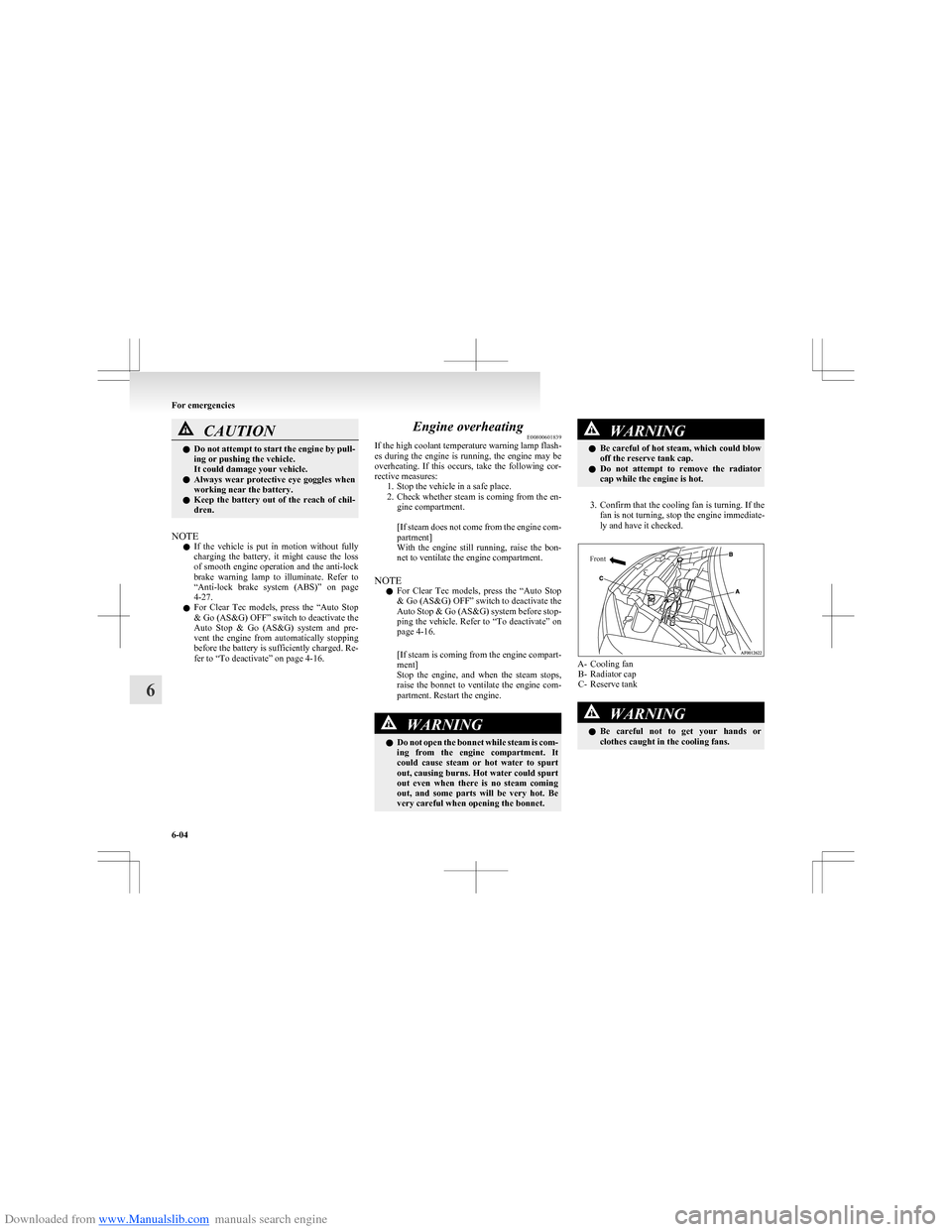
3. Confirm that the cooling fan is turning. If the
fan is not turning, stop the engine immediate-
ly and have it checked.
Front
A- Cooling fan B- Radiator cap
C- Reserve tank
WARNINGl Be careful not to get your hands or
clothes caught in the cooling fans.
For emergencies
6-04
6
Page 191 of 273
Downloaded from www.Manualslib.com manuals search engine Tools, jack and tyre repair kit*E00800901089
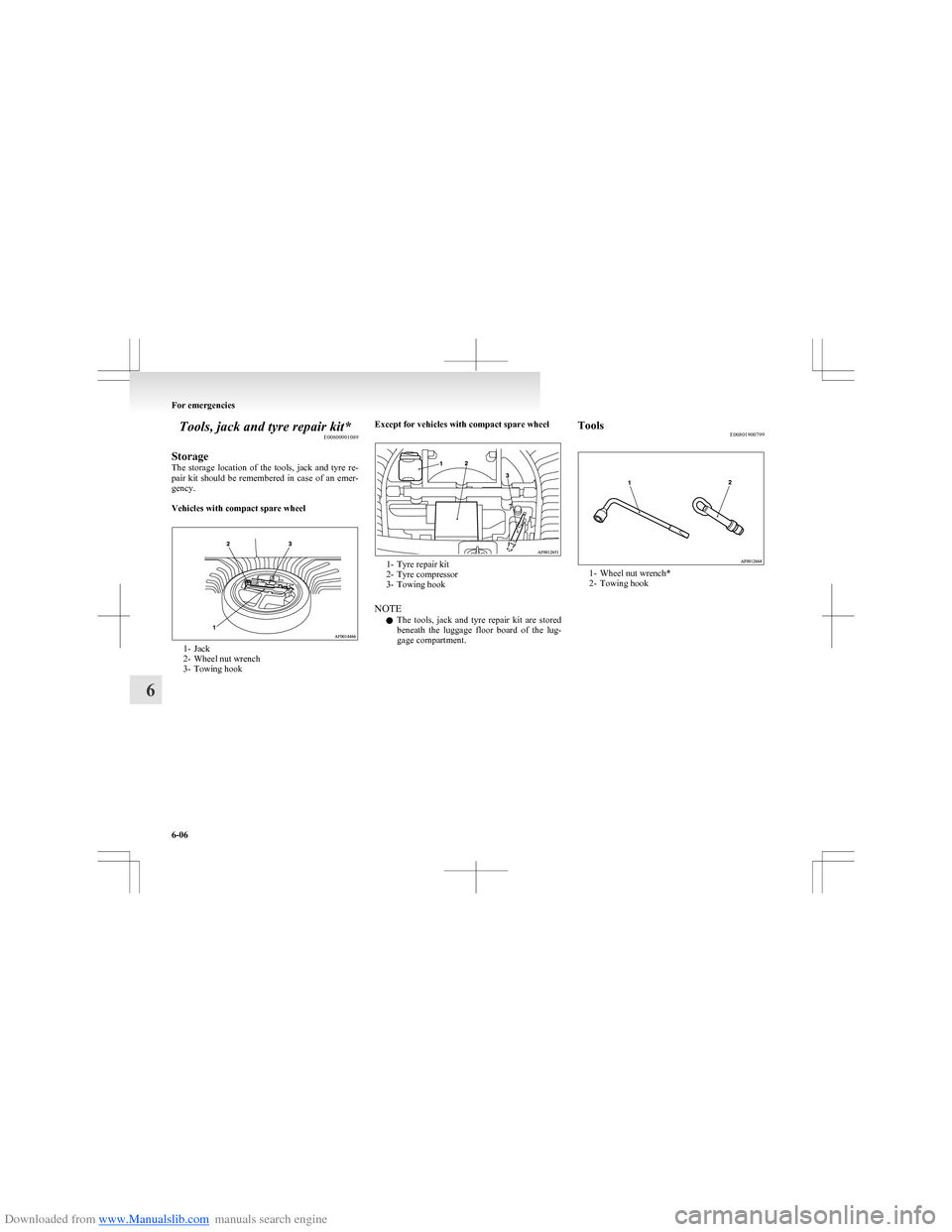
Storage
The storage location of the tools, jack and tyre re-
pair kit should be remembered in case of an emer-
gency.
Vehicles with compact spare wheel
1- Jack
2- Wheel nut wrench
3- Towing hook
Except for vehicles with compact spare wheel
1- Tyre repair kit
2- Tyre compressor
3- Towing hook
NOTE l The tools, jack and tyre repair kit are stored
beneath the luggage floor board of the lug-
gage compartment.
Tools E00801900799
1- Wheel nut wrench*
2- Towing hook
For emergencies
6-06
6
Page 192 of 273
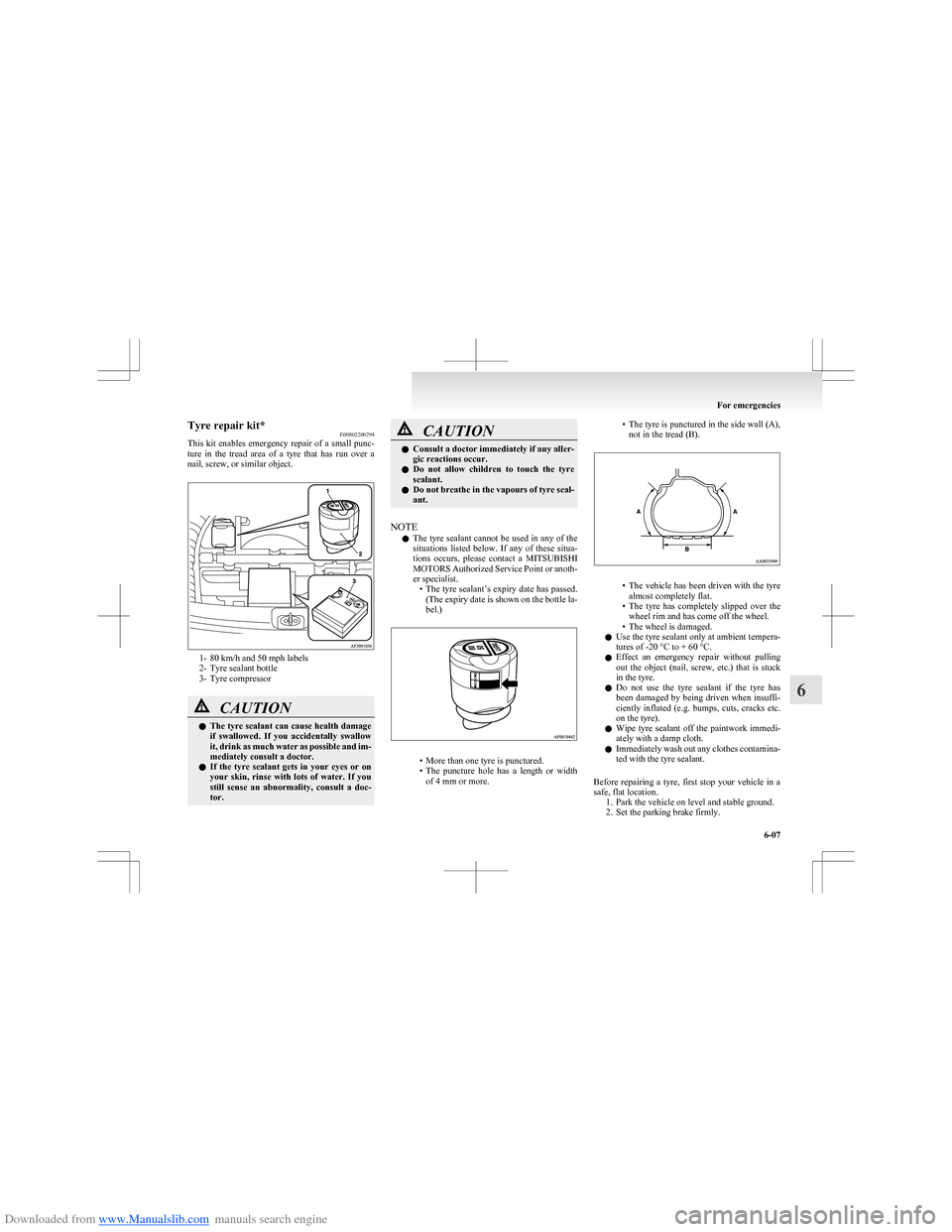
Downloaded from www.Manualslib.com manuals search engine Tyre repair kit*E00802200294
This kit enables emergency repair of a small punc-
ture in the tread area of a tyre that has run over a
nail, screw, or similar object.
1- 80 km/h and 50 mph labels
2- Tyre sealant bottle
3- Tyre compressor
CAUTIONl The tyre sealant can cause health damage
if swallowed. If you accidentally swallow
it, drink as much water as possible and im-
mediately consult a doctor.
l If the tyre sealant gets in your eyes or on
your skin, rinse with lots of water. If you
still sense an abnormality, consult a doc-
tor.CAUTIONl Consult a doctor immediately if any aller-
gic reactions occur.
l Do not allow children to touch the tyre
sealant.
l Do not breathe in the vapours of tyre seal-
ant.
NOTE
l The tyre sealant cannot be used in any of the
situations listed below. If any of these situa-
tions occurs, please contact a MITSUBISHI
MOTORS Authorized Service Point or anoth-
er specialist. •The tyre sealant’s expiry date has passed.
(The expiry date is shown on the bottle la-
bel.)
• More than one tyre is punctured.
• The puncture hole has a length or width
of 4 mm or more.
• The tyre is punctured in the side wall (A), not in the tread (B).
•The vehicle has been driven with the tyre
almost completely flat.
• The tyre has completely slipped over the
wheel rim and has come off the wheel.
• The wheel is damaged.
l Use the tyre sealant only at ambient tempera-
tures of -20 °C to + 60 °C.
l Effect an emergency repair without pulling
out the object (nail, screw, etc.) that is stuck
in the tyre.
l Do not use the tyre sealant if the tyre has
been damaged by being driven when insuffi-
ciently inflated (e.g. bumps, cuts, cracks etc.
on the tyre).
l Wipe tyre sealant off the paintwork immedi-
ately with a damp cloth.
l Immediately wash out any clothes contamina-
ted with the tyre sealant.
Before repairing a tyre, first stop your vehicle in a
safe, flat location. 1. Park the vehicle on level and stable ground.
2. Set the parking brake firmly.
For emergencies
6-07
6
Page 194 of 273
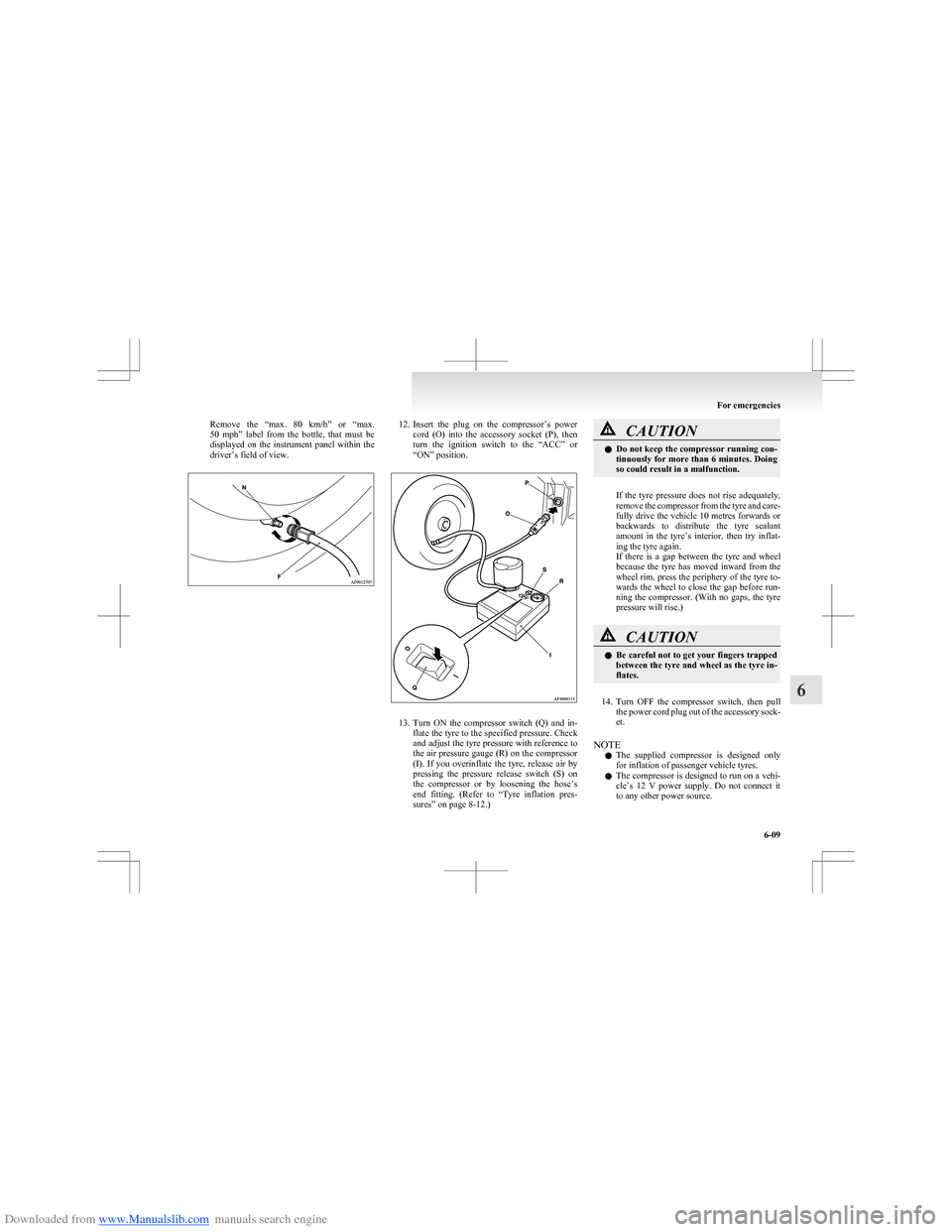
Downloaded from www.Manualslib.com manuals search engine Remove the “max. 80 km/h” or “max.
50 mph ” label from the bottle, that must be
displayed on the instrument panel within the
driver’s field of view.12. Insert the plug on the compressor’s power
cord (O) into the accessory socket (P), then
turn the ignition switch to the “ACC” or
“ON” position.
13. Turn ON the compressor switch (Q) and in-
flate the tyre to the specified pressure. Check
and adjust the tyre pressure with reference to
the air pressure gauge (R) on the compressor
(I). If you overinflate the tyre, release air by
pressing the pressure release switch (S) on
the compressor or by loosening the hose’s
end fitting. (Refer to “Tyre inflation pres-
sures” on page 8-12.)
CAUTIONl Do not keep the compressor running con-
tinuously for more than 6 minutes. Doing
so could result in a malfunction.
If the tyre pressure does not rise adequately,
remove the compressor from the tyre and care-
fully drive the vehicle 10 metres forwards or
backwards to distribute the tyre sealant
amount in the tyre’s interior, then try inflat-
ing the tyre again.
If there is a gap between the tyre and wheel
because the tyre has moved inward from the
wheel rim, press the periphery of the tyre to-
wards the wheel to close the gap before run-
ning the compressor. (With no gaps, the tyre
pressure will rise.)
CAUTIONl Be careful not to get your fingers trapped
between the tyre and wheel as the tyre in-
flates.
14. Turn OFF the compressor switch, then pull
the power cord plug out of the accessory sock-
et.
NOTE l The supplied compressor is designed only
for inflation of passenger vehicle tyres.
l The compressor is designed to run on a vehi-
cle’s 12 V power supply. Do not connect it
to any other power source.
For emergencies
6-09
6