battery MITSUBISHI COLT 2009 10.G Owner's Manual
[x] Cancel search | Manufacturer: MITSUBISHI, Model Year: 2009, Model line: COLT, Model: MITSUBISHI COLT 2009 10.GPages: 273, PDF Size: 17.28 MB
Page 178 of 273
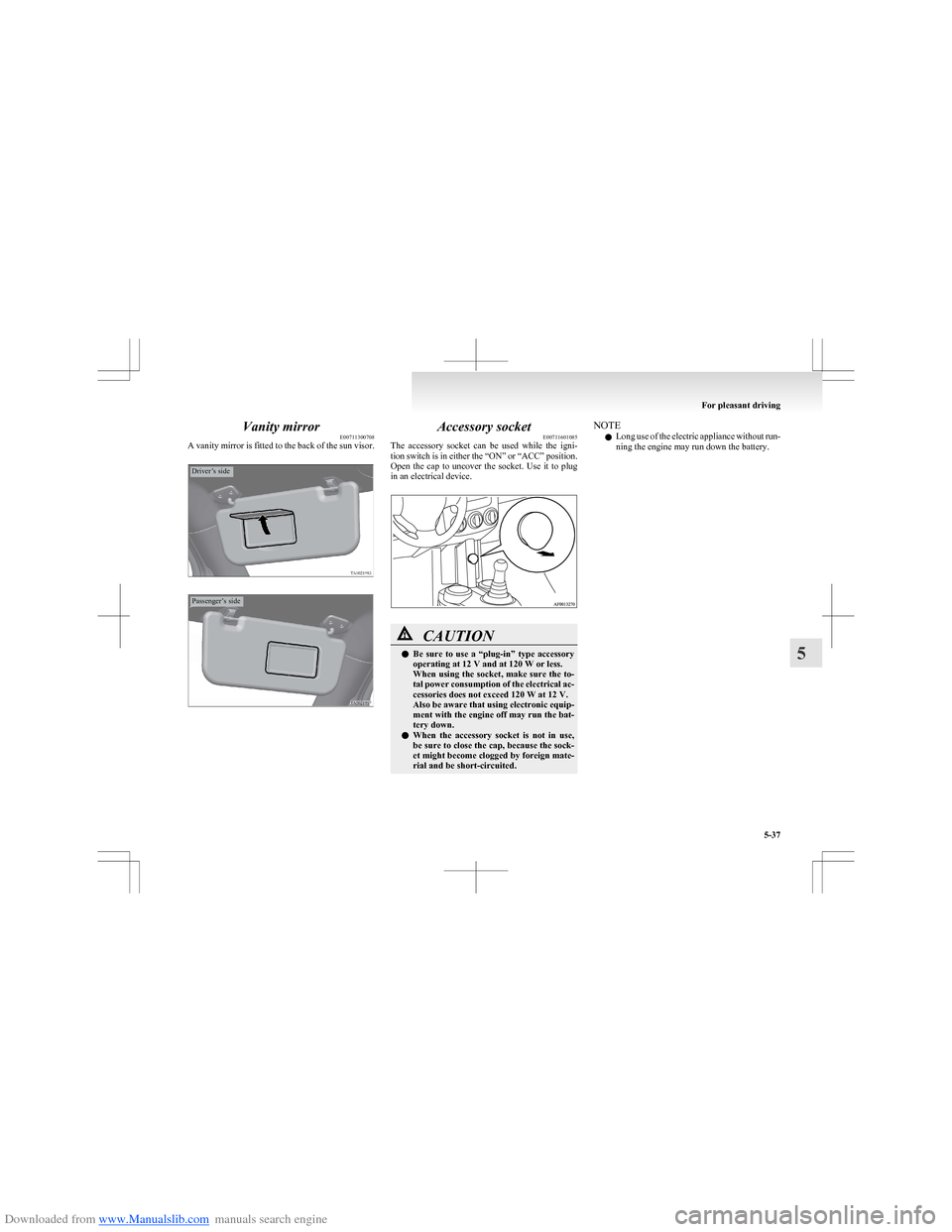
Downloaded from www.Manualslib.com manuals search engine Vanity mirrorE00711300708
A vanity mirror is fitted to the back of the sun visor.
Driver’s sidePassenger’s side
Accessory socket E00711601085
The accessory socket can be used while the igni-
tion switch is in either the “ON” or “ACC” position.
Open the cap to uncover the socket. Use it to plug
in an electrical device.CAUTIONl Be sure to use a “plug-in” type accessory
operating at 12 V and at 120 W or less.
When using the socket, make sure the to-
tal power consumption of the electrical ac-
cessories does not exceed 120 W at 12 V.
Also be aware that using electronic equip-
ment with the engine off may run the bat-
tery down.
l When the accessory socket is not in use,
be sure to close the cap, because the sock-
et might become clogged by foreign mate-
rial and be short-circuited.NOTE
l Long use of the electric appliance without run-
ning the engine may run down the battery.
For pleasant driving
5-37
5
Page 179 of 273
Downloaded from www.Manualslib.com manuals search engine Interior lampsE00712000799
The interior lamps go on when a door or tailgate is
opened.
When all doors and tailgate are closed, the interior
lamps are illuminated and dimmed gradually for 15
seconds then go out.
However, the interior lamps go out immediately
without being dimmed in the following cases:
l The ignition switch is turned “ON”.
l All doors and tailgate are locked using the
key mechanism of the driver’s door, the lock
knob of the driver’s door, or the remote con-
trol switch of the keyless entry system.
NOTE l The dimming period is adjustable.
For further information, we recommend you
to consult a MITSUBISHI MOTORS Author-
ized Service Point.
l If you leave the lamps on without running
the engine, you will run down the battery. Be-
fore you leave the vehicle, make sure that all
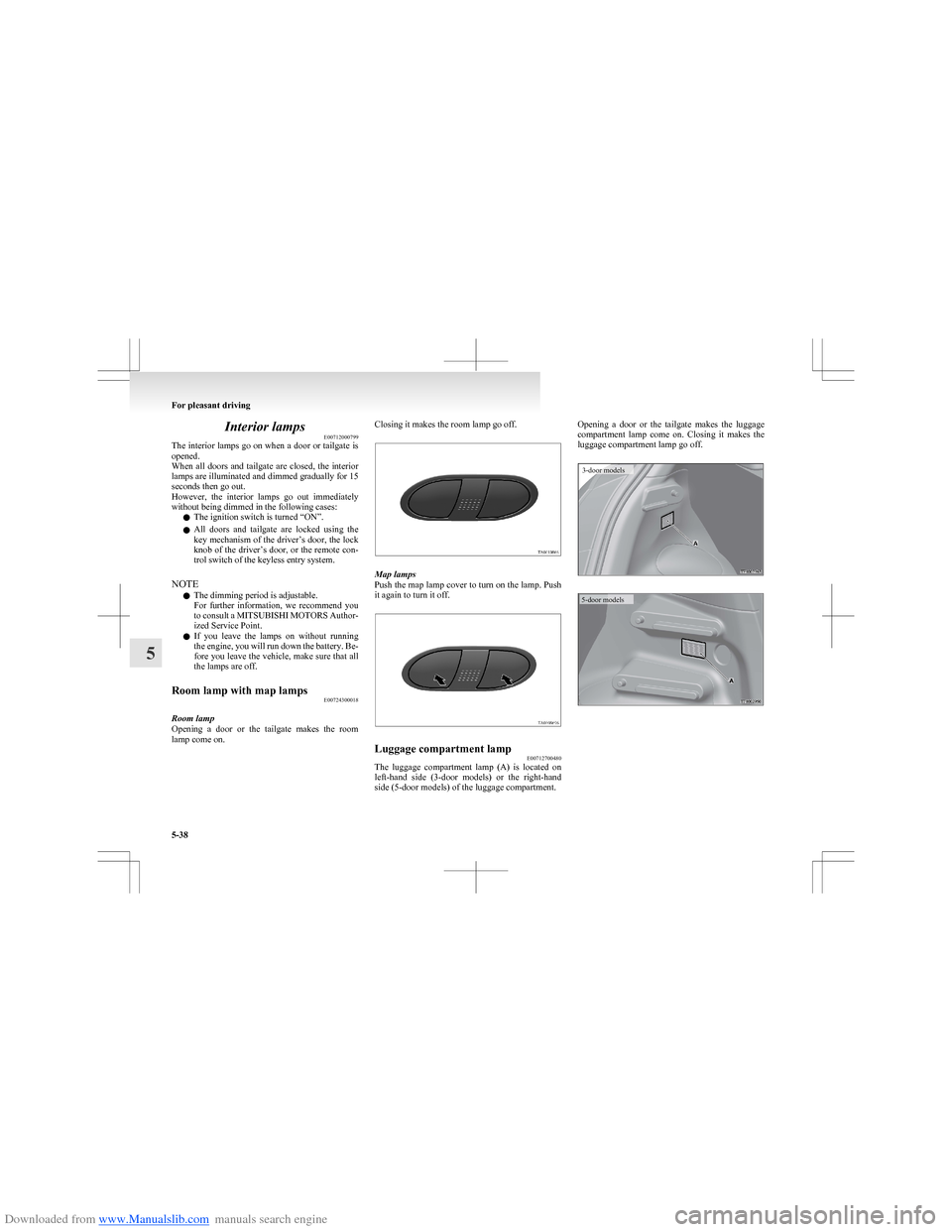
the lamps are off.Room lamp with map lamps E00724300018
Room lamp
Opening a door or the tailgate makes the room
lamp come on.
Closing it makes the room lamp go off.
Map lamps
Push the map lamp cover to turn on the lamp. Push
it again to turn it off.
Luggage compartment lamp E00712700480
The luggage compartment lamp (A) is located on
left-hand side (3-door models) or the right-hand
side (5-door models) of the luggage compartment.
Opening a door or the tailgate makes the luggage
compartment lamp come on. Closing it makes the
luggage compartment lamp go off.3-door models5-door models
For pleasant driving
5-38
5
Page 187 of 273
Downloaded from www.Manualslib.com manuals search engine If the vehicle breaks downE00800101254
If the vehicle breaks down on the road, move it to
the shoulder and use the hazard warning flashers and/
or the warning triangle etc.
Refer to “Hazard warning flasher switch” on page
3-23.
If the engine stops/fails
Vehicle operation and control are affected if the en-
gine stops.
Before moving the vehicle to a safe area, be aware
of the following:
l The brake booster becomes inoperative and
the pedal effort will increase. Press down the
brake pedal harder than usual.
l Since the power steering system is no longer
operative, the steering wheel feels heavy
when turning it.Emergency starting E00800501900
If the engine cannot be started because the battery
is weak or dead, the battery from another vehicle
can be used with jumper cables to start the engine.WARNINGl To start the engine using jumper cables
connected to another vehicle, perform the
correct procedures according to the in-
struction below. Incorrect procedures
could result in a fire or explosion or dam-
age to the vehicles.
1. Get the vehicles close enough so the jumper
cables can reach, but be sure the vehicles
aren’t touching each other.
If they are, it could cause a ground connec-
tion you don’t want. The vehicle will not
start, and the bad grounding could damage
the electrical systems.
CAUTIONl Check the other vehicle. It must have a 12-
volt battery.
If the other system isn’t 12-volt, shorting
can damage both vehicles.2. You could be injured if the vehicles move.
Set the parking brake firmly on each vehicle.
Put an automatic transmission in “P”
(PARK) or a manual transmission and an au-
tomated manual transmission in “N” (Neu-
tral). With an automated manual transmis-
sion vehicle, confirm that “N” is shown by
the allshift indicator display. Turn off the ig-
nition switch.WARNINGl Turn off the ignition on both vehicles be-
forehand. Make sure that the cables or
your clothes cannot be caught by the fan
or drive belt. Personal injury could result.
NOTE
l Turn off all lamps, heater and other electrical
loads. This will avoid sparks and help save
both batteries.
3. Make sure battery electrolyte is at the proper
level. Refer to “Battery” on page 8-10.
WARNINGl If electrolyte fluid is not visible, or ap-
pears to be frozen, Do Not Attempt Jump
Starting!
A battery might rupture or explode if the
temperature is below the freezing point
or if it is not filled to the proper level.
For emergencies
6-02
6
Page 188 of 273
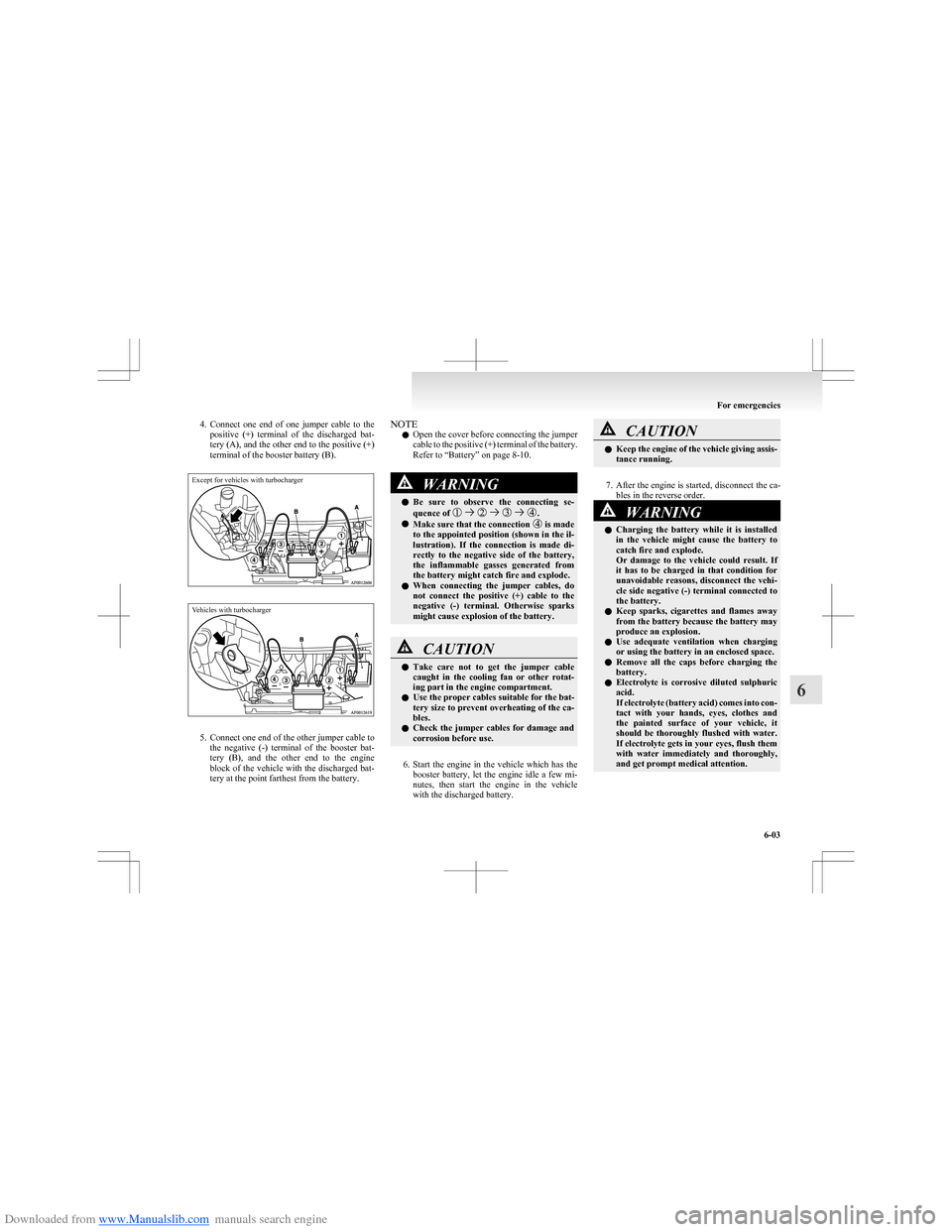
Downloaded from www.Manualslib.com manuals search engine 4.Connect one end of one jumper cable to the
positive (+) terminal of the discharged bat-
tery (A), and the other end to the positive (+)
terminal of the booster battery (B).Except for vehicles with turbochargerVehicles with turbocharger
5. Connect one end of the other jumper cable to
the negative (-) terminal of the booster bat-
tery (B), and the other end to the engine
block of the vehicle with the discharged bat-
tery at the point farthest from the battery.
NOTE
l Open the cover before connecting the jumper
cable to the positive (+) terminal of the battery.
Refer to “Battery” on page 8-10.WARNINGl Be sure to observe the connecting se-
quence of .
l Make sure that the connection is made
to the appointed position (shown in the il-
lustration). If the connection is made di-
rectly to the negative side of the battery,
the inflammable gasses generated from
the battery might catch fire and explode.
l When connecting the jumper cables, do
not connect the positive (+) cable to the
negative (-) terminal. Otherwise sparks
might cause explosion of the battery.
CAUTIONl Take care not to get the jumper cable
caught in the cooling fan or other rotat-
ing part in the engine compartment.
l Use the proper cables suitable for the bat-
tery size to prevent overheating of the ca-
bles.
l Check the jumper cables for damage and
corrosion before use.
6. Start the engine in the vehicle which has the
booster battery, let the engine idle a few mi-
nutes, then start the engine in the vehicle
with the discharged battery.
CAUTIONl Keep the engine of the vehicle giving assis-
tance running.
7. After the engine is started, disconnect the ca-
bles in the reverse order.
8.
WARNINGl Charging the battery while it is installed
in the vehicle might cause the battery to
catch fire and explode.
Or damage to the vehicle could result. If
it has to be charged in that condition for
unavoidable reasons, disconnect the vehi-
cle side negative (-) terminal connected to
the battery.
l Keep sparks, cigarettes and flames away
from the battery because the battery may
produce an explosion.
l Use adequate ventilation when charging
or using the battery in an enclosed space.
l Remove all the caps before charging the
battery.
l Electrolyte is corrosive diluted sulphuric
acid.
If electrolyte (battery acid) comes into con-
tact with your hands, eyes, clothes and
the painted surface of your vehicle, it
should be thoroughly flushed with water.
If electrolyte gets in your eyes, flush them
with water immediately and thoroughly,
and get prompt medical attention.
For emergencies
6-03
6
Page 189 of 273
Downloaded from www.Manualslib.com manuals search engine CAUTIONlDo not attempt to start the engine by pull-
ing or pushing the vehicle.
It could damage your vehicle.
l Always wear protective eye goggles when
working near the battery.
l Keep the battery out of the reach of chil-
dren.
NOTE
l If the vehicle is put in motion without fully
charging the battery, it might cause the loss
of smooth engine operation and the anti-lock
brake warning lamp to illuminate. Refer to
“ Anti-lock brake system (ABS)” on page
4-27.
l For Clear Tec models, press the “Auto Stop
& Go (AS&G) OFF” switch to deactivate the
Auto Stop & Go (AS&G) system and pre-
vent the engine from automatically stopping
before the battery is sufficiently charged. Re-
fer to “To deactivate” on page 4-16.
Engine overheating E00800601839
If the high coolant temperature warning lamp flash-
es during the engine is running, the engine may be
overheating. If this occurs, take the following cor-
rective measures: 1. Stop the vehicle in a safe place.
2. Check whether steam is coming from the en-
gine compartment.
[ If steam does not come from the engine com-
partment]
With the engine still running, raise the bon-
net to ventilate the engine compartment.
NOTE l For Clear Tec models, press the “Auto Stop
& Go (AS&G) OFF” switch to deactivate the
Auto Stop & Go (AS&G) system before stop-
ping the vehicle. Refer to “To deactivate” on
page 4-16.
[If steam is coming from the engine compart-
ment]
Stop the engine, and when the steam stops,
raise the bonnet to ventilate the engine com-
partment. Restart the engine.WARNINGl Do not open the bonnet while steam is com-
ing from the engine compartment. It
could cause steam or hot water to spurt
out, causing burns. Hot water could spurt
out even when there is no steam coming
out, and some parts will be very hot. Be
very careful when opening the bonnet.WARNINGl Be careful of hot steam, which could blow
off the reserve tank cap.
l Do not attempt to remove the radiator
cap while the engine is hot.
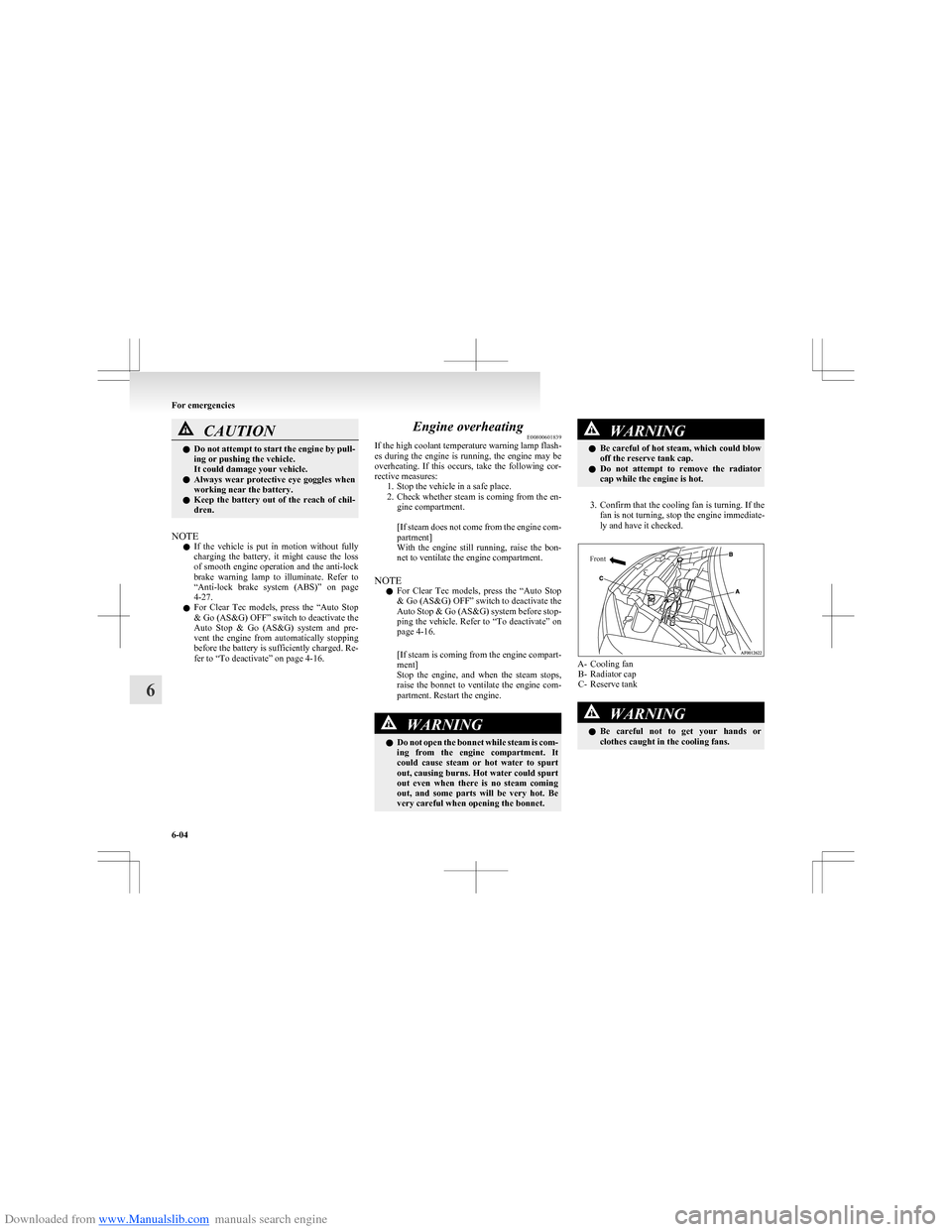
3. Confirm that the cooling fan is turning. If the
fan is not turning, stop the engine immediate-
ly and have it checked.
Front
A- Cooling fan B- Radiator cap
C- Reserve tank
WARNINGl Be careful not to get your hands or
clothes caught in the cooling fans.
For emergencies
6-04
6
Page 212 of 273
Downloaded from www.Manualslib.com manuals search engine CAUTIONlDo not bring the plastic parts into contact
with petrol, light oil, brake fluids, engine
oils, greases, paint thinners, and sulphu-
ric acid (battery electrolyte) which may
crack, stain or discolour the plastic parts.
If they touch the plastic parts, wipe them
off with soft cloth, chamois or the like
and an aqueous solution of neutral deter-
gent then immediately rinse the affected
parts with water.Chrome parts E00901400014
In order to prevent spots and corrosion of chrome
parts, wash with water, dry thoroughly, and apply a
special protective coating. This should be done
more frequently in winter.
Aluminium wheels* E00901500086
1.Remove dirt using a sponge while sprinkling
water on the wheel.
2. Use neutral detergent on any dirt that cannot
be removed easily with water.
Rinse off the neutral detergent after washing
the wheel.
3. Dry the wheel thoroughly using a chamois
leather or a soft cloth.
CAUTIONl Do not use a brush or other hard imple-
ment on the wheels.
Doing so could scratch the wheels.CAUTIONl Do not use any cleaner that contains an
abrasive substance or is acidic or alka-
line. Doing so could cause the coating on
the wheels to peel or become discoloured
or stained.
l Do not directly apply hot water using a
steam cleaner or by any other means.
l Contact with seawater and road deicer
can cause corrosion. Rinse off such sub-
stances as soon as possible.Window glass E00901600104
The window glass can normally be cleaned using
only a sponge and water.
Glass cleaner can be used to remove oil, grease,
dead insects, etc. After washing the glass, wipe dry
with a clean, dry, soft cloth. Never use the same
cloth to wipe the window glass as would be used to
wipe the paintwork; wax from the painted surfaces
could adhere to the glass and reduce its transparen-
cy and visibility.
CAUTIONl If your vehicle has rain sensor wipers,
place the wiper switch lever in the “”
(OFF) position to deactivate the rain sen-
sor before washing the windscreen. Oth-
erwise, the wipers will operate in the pres-
ence of water spray on the windscreen
and may get damaged as a result.NOTE
l To clean the inside of the tailgate window, al-
ways use a soft cloth and wipe the window
glass along the demister heater element so as
not to cause damage.Wiper blades E00901700017
Use a soft cloth and glass cleaner to remove grease,
dead insects, etc., from the wiper blades. Replace
the wiper blades when they no longer wipe proper-
ly. (Refer to page 8-16.)
Engine compartment E00902100265
Clean the engine compartment at the beginning and
end of winter. Pay particular attention to flanges,
crevices and peripheral parts where dust containing
road chemicals and other corrosive materials might
collect.
If salt and other chemicals are used on the roads in
your area, clean the engine compartment at least ev-
ery three months.
Never spray or splash water on the electrical com-
ponents in the engine compartment, as this may
cause damage.
Do not bring the nearby parts, the plastic parts and
so on into contact with sulphuric acid (battery elec-
trolyte) which may crack, stain or discolour them.
If they are in contact, wipe off with soft cloth, cha-
mois or the like and an aqueous solution of neutral
detergent then immediately rinse the affected parts
with plenty of water.
Vehicle care
7-05
7
Page 214 of 273
Downloaded from www.Manualslib.com manuals search engine Service precautions....................................................................... 8-02
Catalytic converter ........................................................................ 8-02
Bonnet ........................................................................................... 8-03
Engine oil ...................................................................................... 8-05
Engine coolant .............................................................................. 8-07
Washer fluid ................................................................................. 8-09
Brake fluid/Clutch fluid* .............................................................. 8-09
Battery .......................................................................................... 8-10
Tyres ............................................................................................. 8-11
Clutch pedal free play* ................................................................. 8-15
Brake pedal free play .................................................................... 8-16
Parking brake lever stroke ............................................................ 8-16
Wiper blades ................................................................................. 8-16
General maintenance .................................................................... 8-18
For cold and snowy weather ......................................................... 8-18
Fusible links .................................................................................. 8-19
Fuses ............................................................................................. 8-19
Replacement of lamp bulbs .......................................................... 8-23Maintenance8
Page 215 of 273
Downloaded from www.Manualslib.com manuals search engine Service precautionsE01000100458
Adequate care of your vehicle at regular intervals
serves to preserve the value and appearance as long
as possible.
Maintenance items as described in this owner’s man-
ual can be performed by the owner.
We recommend you to have the periodic inspection
and maintenance performed by a MITSUBISHI
MOTORS Authorized Service Point or another spe-
cialist. In the event a malfunction or other problem
is discovered, we recommend you to have it
checked and repaired. This section contains infor-
mation on inspection maintenance procedures that
you can do yourself. Follow the instructions and
cautions for each of the various procedures.WARNINGl When checking or servicing the inside of
the engine compartment, make sure the
engine is switched off and has had a
chance to cool down.
l If it is necessary to do work in the engine
compartment with the engine running, be
especially careful that your clothing, hair,
etc., does not become caught by the fans,
drive belts, or other moving parts.
l The fan may turn on automatically even
if the engine is not running; turn the igni-
tion key to “LOCK” position and remove
the key to ensure safety while you work
in the engine compartment.
l Do not smoke, cause sparks or allow open
flames around fuel or battery. The fumes
are flammable.WARNINGl Be extremely cautious when working
around the battery. It contains poisonous
and corrosive sulphuric acid.
l Do not get under your vehicle with just
the body jack supporting it. Always use
automotive jack stands.
l Improper handling of components and
materials used in the vehicle can endan-
ger your personal safety. We recommend
you to consult a specialist for necessary in-
formation.Catalytic converter E01000201140
For ordinary use, there are no particular precau-
tions except that of using unleaded petrol.
The exhaust gas scavenging devices used with the
catalytic converter are extremely efficient for the re-
duction of noxious gases. The catalytic converter is
installed in the exhaust system.
It is important to keep the engine properly tuned to
ensure proper catalyst operation and prevent possi-
ble catalyst damage.CAUTIONl Damage to the catalytic converter can re-
sult if your vehicle is not kept in proper
operating condition. In the event of an en-
gine malfunction particularly involving
engine misfire or other apparent loss of
performance, have your vehicle serviced
promptly. Continued operation of your ve-
hicle with a severe overheated condition
may result in possible damage to the con-
verter and vehicle.WARNINGl As with any vehicle, do not park or oper-
ate this vehicle in areas where combusti-
ble materials such as dry grass or leaves
can come in contact with a hot exhaust
since a fire could occur.
l Paint should not be applied to the catalyt-
ic converter.
Maintenance
8-02
8
Page 216 of 273
Downloaded from www.Manualslib.com manuals search engine The catalytic converter itself gets hot quickly, and
may be damaged if overheated. The following
points should be noted in order to prevent the igni-
tion of unburned petrol within the catalytic convert-
er.
l Use UNLEADED PETROL ONLY of the
type recommended in “Fuel selection” on
page 02.
l Do not drive with an extremely low fuel lev-
el; running out of fuel could cause damage to
the catalytic converter.
l Do not attempt to start the engine by pushing
the vehicle. If the battery is weak or dis-
charged, use another battery to start the en-
gine.
l Do not idle the engine with any spark plug
wires disconnected or removed such as per-
forming diagnostic tests.
l Do not idle the engine for prolonged periods
during very rough idle or malfunctioning op-
erating conditions.
l Do not race the engine when turning off the
ignition switch. This will cause the catalytic
converter to be damaged due to contact with
unburnt fuel.
l Stop driving the vehicle if you think the per-
formance is noticeably low, or if the engine
has a malfunction such as with the ignition,
etc.
If it is impractical to stop driving immediate-
ly, reduce the speed and drive for only a
short time. We recommend you to have your
vehicle inspected as soon as possible.l In unusual situations involving grossly mal-
functioning engine operation, a burnt smell
may indicate severe and abnormal catalyst
overheating.
If this occurs, the vehicle should be stopped
in a safe place, the engine switched off and
the vehicle allowed to cool. Once the engine
is cool, a service, including a tune-up to man-
ufacturer’s specifications, should be obtained
immediately.Bonnet E01000302470
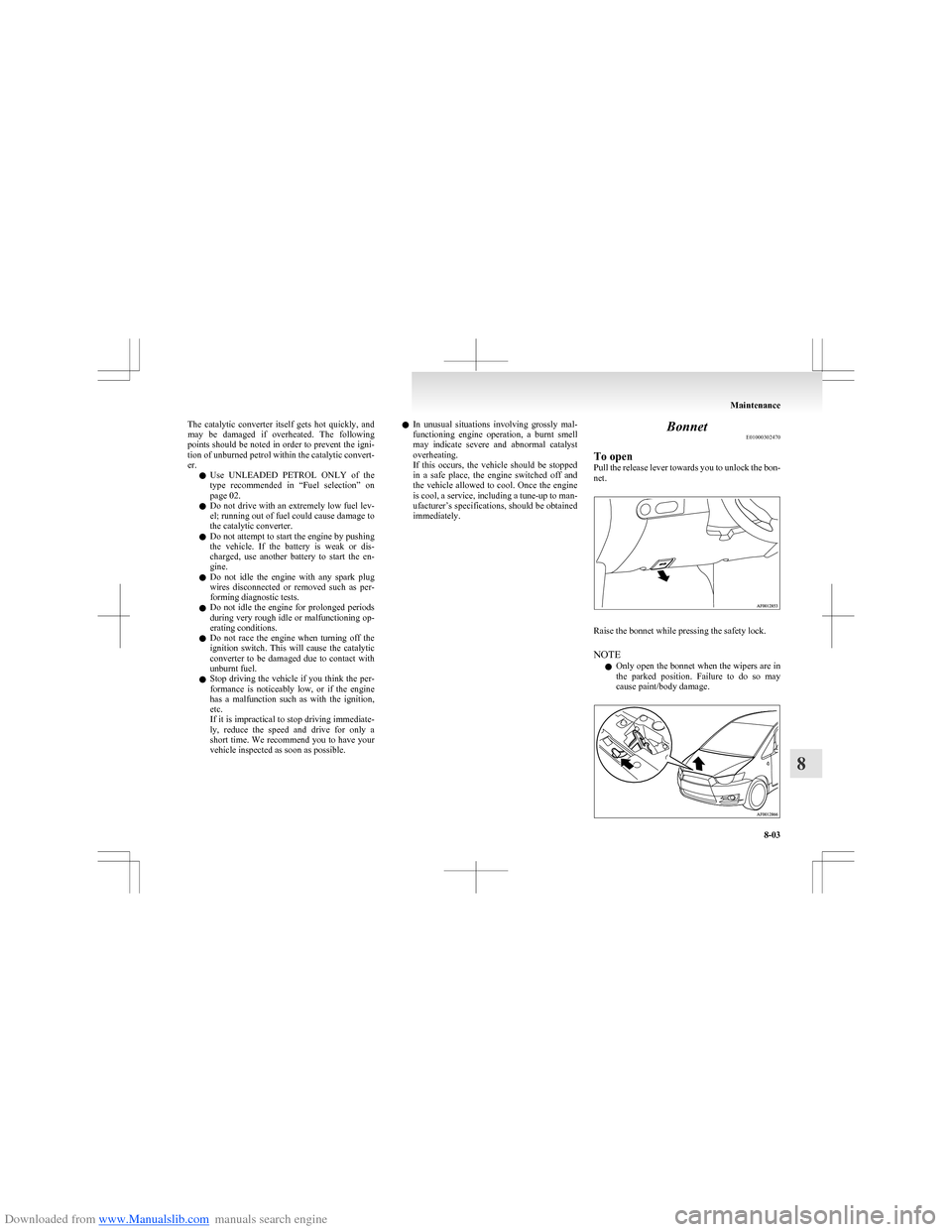
To open
Pull the release lever towards you to unlock the bon-
net.
Raise the bonnet while pressing the safety lock.
NOTE l Only open the bonnet when the wipers are in
the parked position. Failure to do so may
cause paint/body damage.
Maintenance
8-03
8
Page 223 of 273
Downloaded from www.Manualslib.com manuals search engine BatteryE01001202160
The condition of the battery is very important for
quick starting of the engine and proper functioning
of the vehicle’s electrical system. Regular inspec-
tion and care are especially important in cold weath-
er.
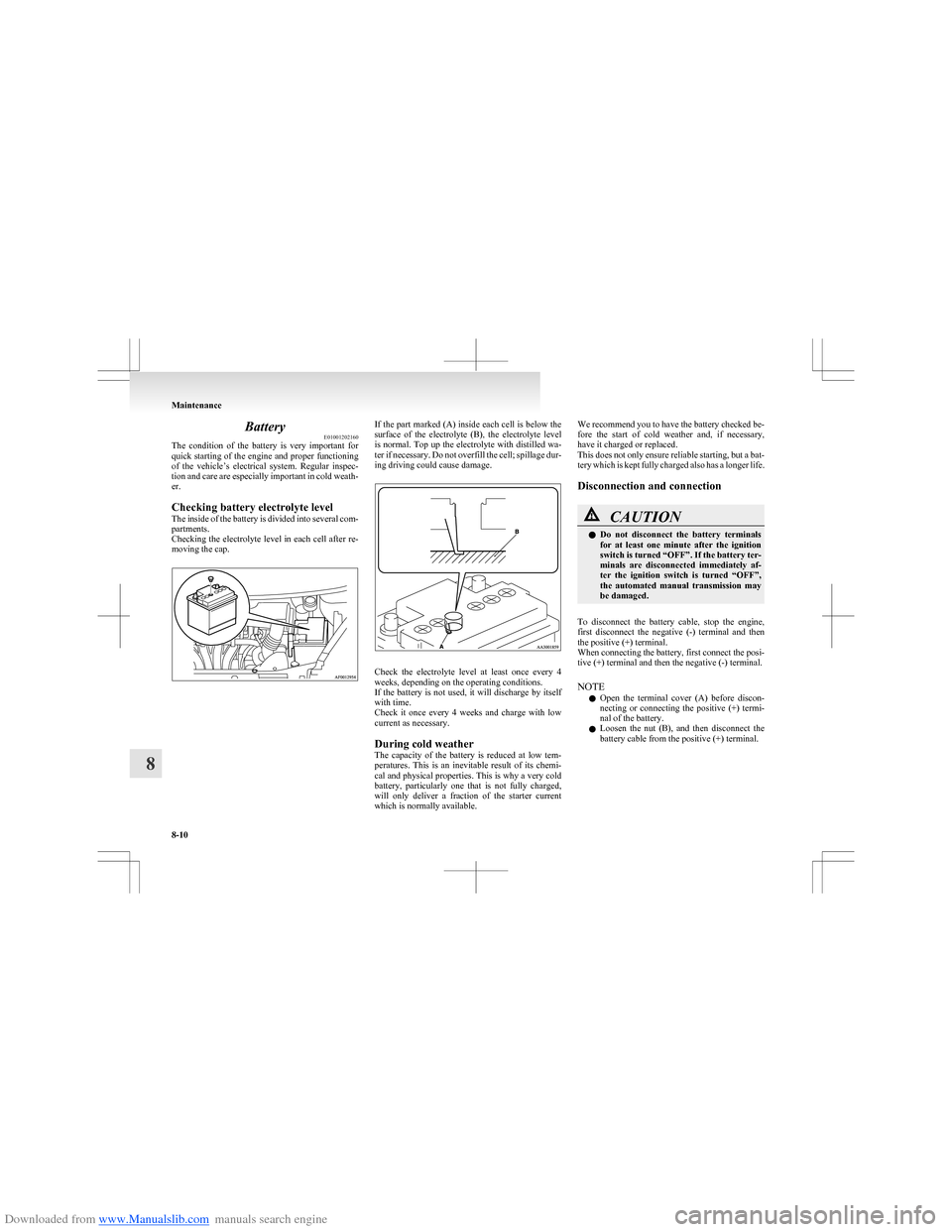
Checking battery electrolyte level
The inside of the battery is divided into several com-
partments.
Checking the electrolyte level in each cell after re-
moving the cap.If the part marked (A) inside each cell is below the
surface of the electrolyte (B), the electrolyte level
is normal. Top up the electrolyte with distilled wa-
ter if necessary. Do not overfill the cell; spillage dur-
ing driving could cause damage.
Check the electrolyte level at least once every 4
weeks, depending on the operating conditions.
If the battery is not used, it will discharge by itself
with time.
Check it once every 4 weeks and charge with low
current as necessary.
During cold weather
The capacity of the battery is reduced at low tem-
peratures. This is an inevitable result of its chemi-
cal and physical properties. This is why a very cold
battery, particularly one that is not fully charged,
will only deliver a fraction of the starter current
which is normally available.
We recommend you to have the battery checked be-
fore the start of cold weather and, if necessary,
have it charged or replaced.
This does not only ensure reliable starting, but a bat-
tery which is kept fully charged also has a longer life.
Disconnection and connectionCAUTIONl Do not disconnect the battery terminals
for at least one minute after the ignition
switch is turned “OFF”. If the battery ter-
minals are disconnected immediately af-
ter the ignition switch is turned “OFF”,
the automated manual transmission may
be damaged.
To disconnect the battery cable, stop the engine,
first disconnect the negative (-) terminal and then
the positive (+) terminal.
When connecting the battery, first connect the posi-
tive (+) terminal and then the negative (-) terminal.
NOTE l Open the terminal cover (A) before discon-
necting or connecting the positive (+) termi-
nal of the battery.
l Loosen the nut (B), and then disconnect the
battery cable from the positive (+) terminal.
Maintenance
8-10
8