ignition MITSUBISHI COLT 2009 10.G Service Manual
[x] Cancel search | Manufacturer: MITSUBISHI, Model Year: 2009, Model line: COLT, Model: MITSUBISHI COLT 2009 10.GPages: 273, PDF Size: 17.28 MB
Page 113 of 273
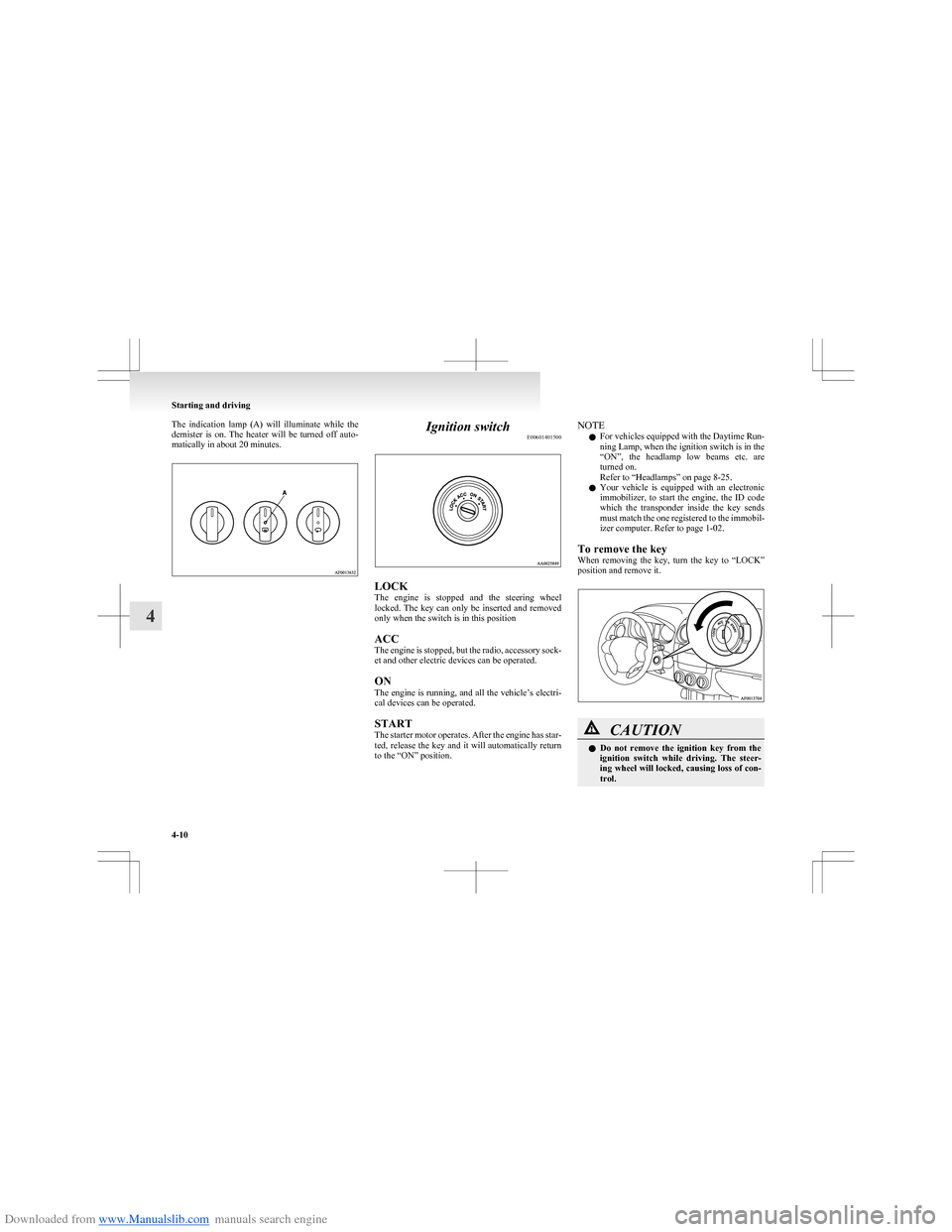
Downloaded from www.Manualslib.com manuals search engine The indication lamp (A) will illuminate while the
demister is on. The heater will be turned off auto-
matically in about 20 minutes.Ignition switch E00601401500
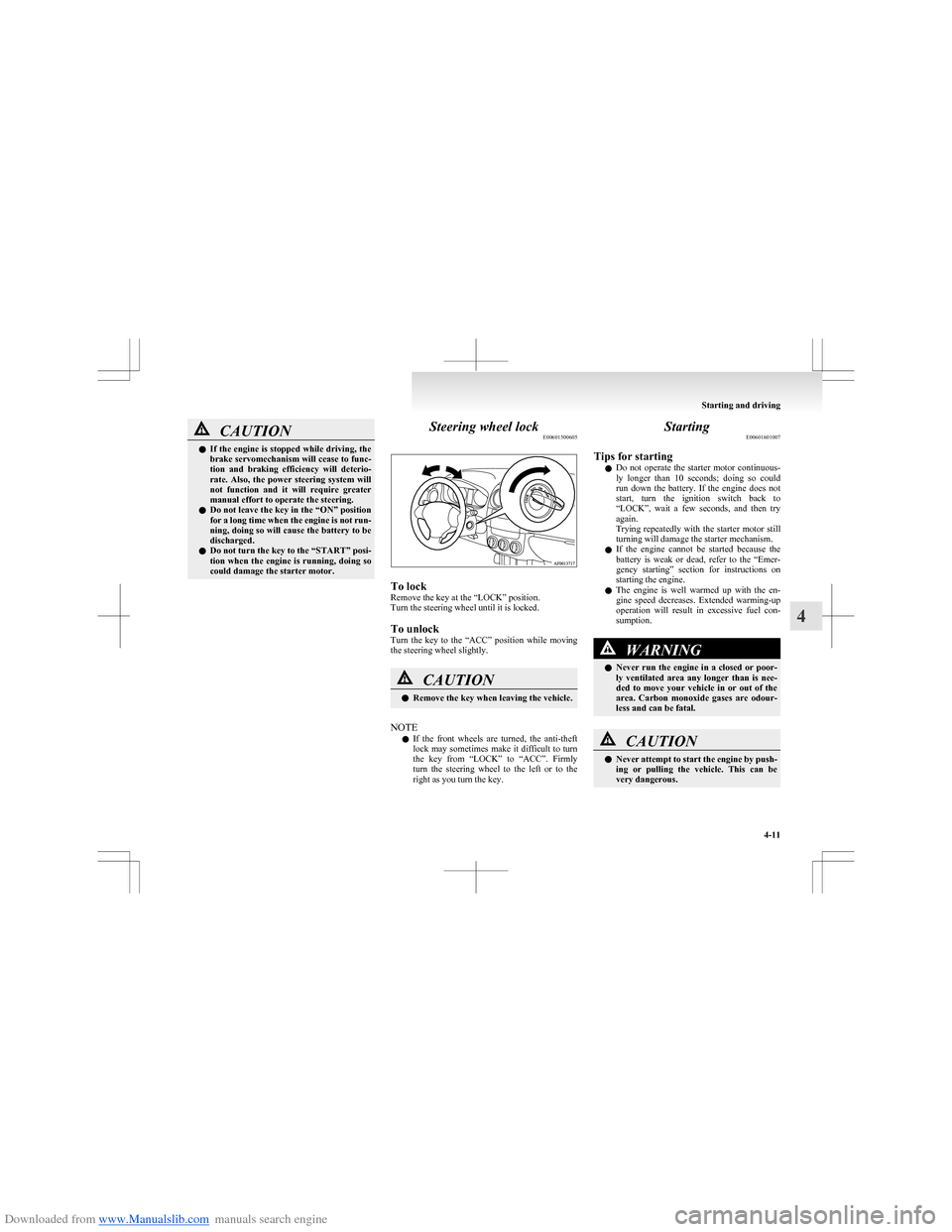
LOCK
The engine is stopped and the steering wheel
locked. The key can only be inserted and removed
only when the switch is in this position
ACC
The engine is stopped, but the radio, accessory sock-
et and other electric devices can be operated.
ON
The engine is running, and all the vehicle’s electri-
cal devices can be operated.
START
The starter motor operates. After the engine has star-
ted, release the key and it will automatically return
to the “ON” position.
NOTE
l For vehicles equipped with the Daytime Run-
ning Lamp, when the ignition switch is in the
“ON”, the headlamp low beams etc. are
turned on.
Refer to “Headlamps” on page 8-25.
l Your vehicle is equipped with an electronic
immobilizer, to start the engine, the ID code
which the transponder inside the key sends
must match the one registered to the immobil-
izer computer. Refer to page 1-02.
To remove the key
When removing the key, turn the key to “LOCK”
position and remove it.CAUTIONl Do not remove the ignition key from the
ignition switch while driving. The steer-
ing wheel will locked, causing loss of con-
trol.
Starting and driving
4-10
4
Page 114 of 273
Downloaded from www.Manualslib.com manuals search engine CAUTIONlIf the engine is stopped while driving, the
brake servomechanism will cease to func-
tion and braking efficiency will deterio-
rate. Also, the power steering system will
not function and it will require greater
manual effort to operate the steering.
l Do not leave the key in the “ON” position
for a long time when the engine is not run-
ning, doing so will cause the battery to be
discharged.
l Do not turn the key to the “START” posi-
tion when the engine is running, doing so
could damage the starter motor.Steering wheel lock E00601500605
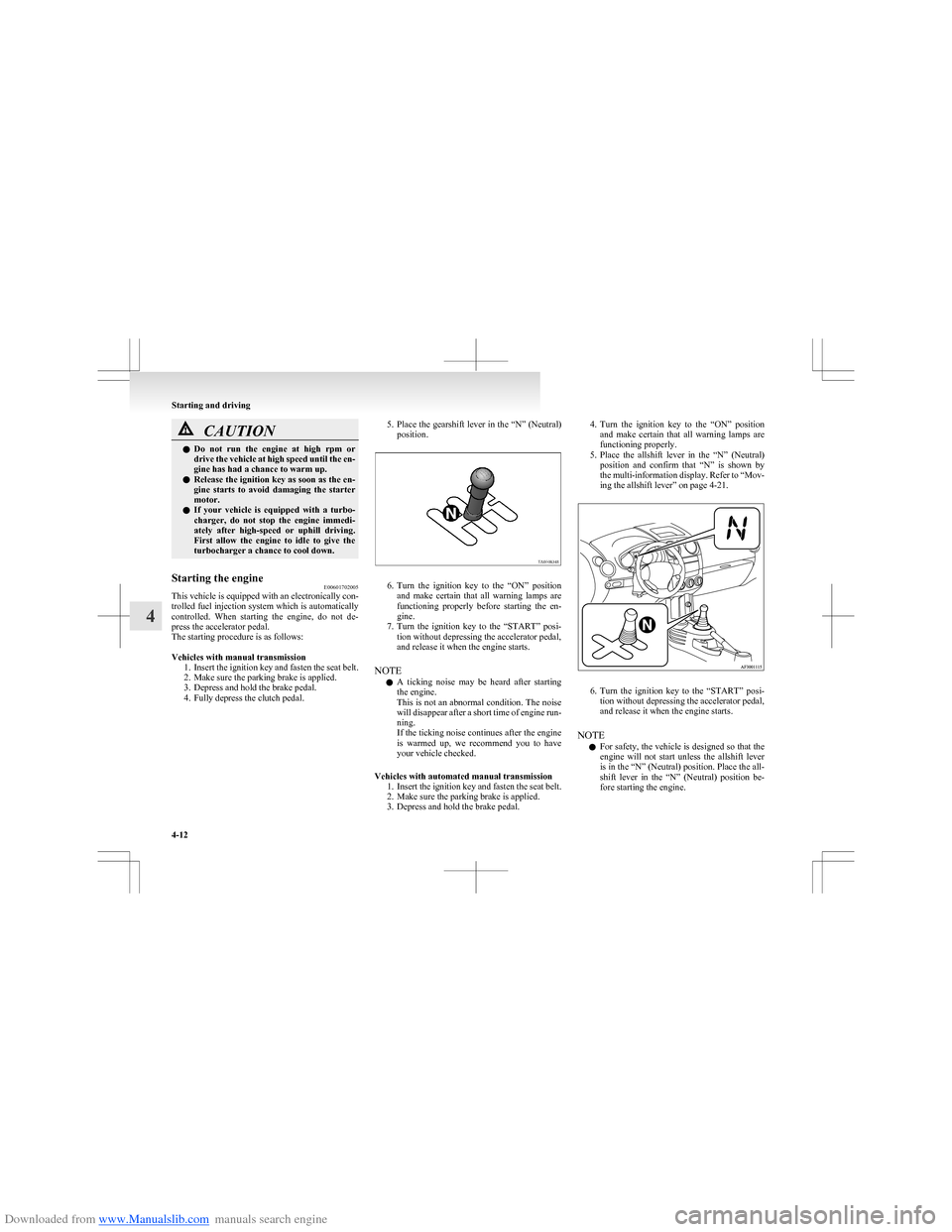
To lock
Remove the key at the “LOCK” position.
Turn the steering wheel until it is locked.
To unlock
Turn the key to the “ACC” position while moving
the steering wheel slightly.
CAUTIONl Remove the key when leaving the vehicle.
NOTE
l If the front wheels are turned, the anti-theft
lock may sometimes make it difficult to turn
the key from “LOCK” to “ACC”. Firmly
turn the steering wheel to the left or to the
right as you turn the key.
Starting E00601601007
Tips for starting l Do not operate the starter motor continuous-
ly longer than 10 seconds; doing so could
run down the battery. If the engine does not
start, turn the ignition switch back to
“LOCK”, wait a few seconds, and then try
again.
Trying repeatedly with the starter motor still
turning will damage the starter mechanism.
l If the engine cannot be started because the
battery is weak or dead, refer to the “Emer-
gency starting” section for instructions on
starting the engine.
l The engine is well warmed up with the en-
gine speed decreases. Extended warming-up
operation will result in excessive fuel con-
sumption.WARNINGl Never run the engine in a closed or poor-
ly ventilated area any longer than is nee-
ded to move your vehicle in or out of the
area. Carbon monoxide gases are odour-
less and can be fatal.CAUTIONl Never attempt to start the engine by push-
ing or pulling the vehicle. This can be
very dangerous.
Starting and driving
4-11
4
Page 115 of 273
Downloaded from www.Manualslib.com manuals search engine CAUTIONlDo not run the engine at high rpm or
drive the vehicle at high speed until the en-
gine has had a chance to warm up.
l Release the ignition key as soon as the en-
gine starts to avoid damaging the starter
motor.
l If your vehicle is equipped with a turbo-
charger, do not stop the engine immedi-
ately after high-speed or uphill driving.
First allow the engine to idle to give the
turbocharger a chance to cool down.Starting the engine E00601702005
This vehicle is equipped with an electronically con-
trolled fuel injection system which is automatically
controlled. When starting the engine, do not de-
press the accelerator pedal.
The starting procedure is as follows:
Vehicles with manual transmission 1.Insert the ignition key and fasten the seat belt.
2. Make sure the parking brake is applied.
3. Depress and hold the brake pedal.
4. Fully depress the clutch pedal.
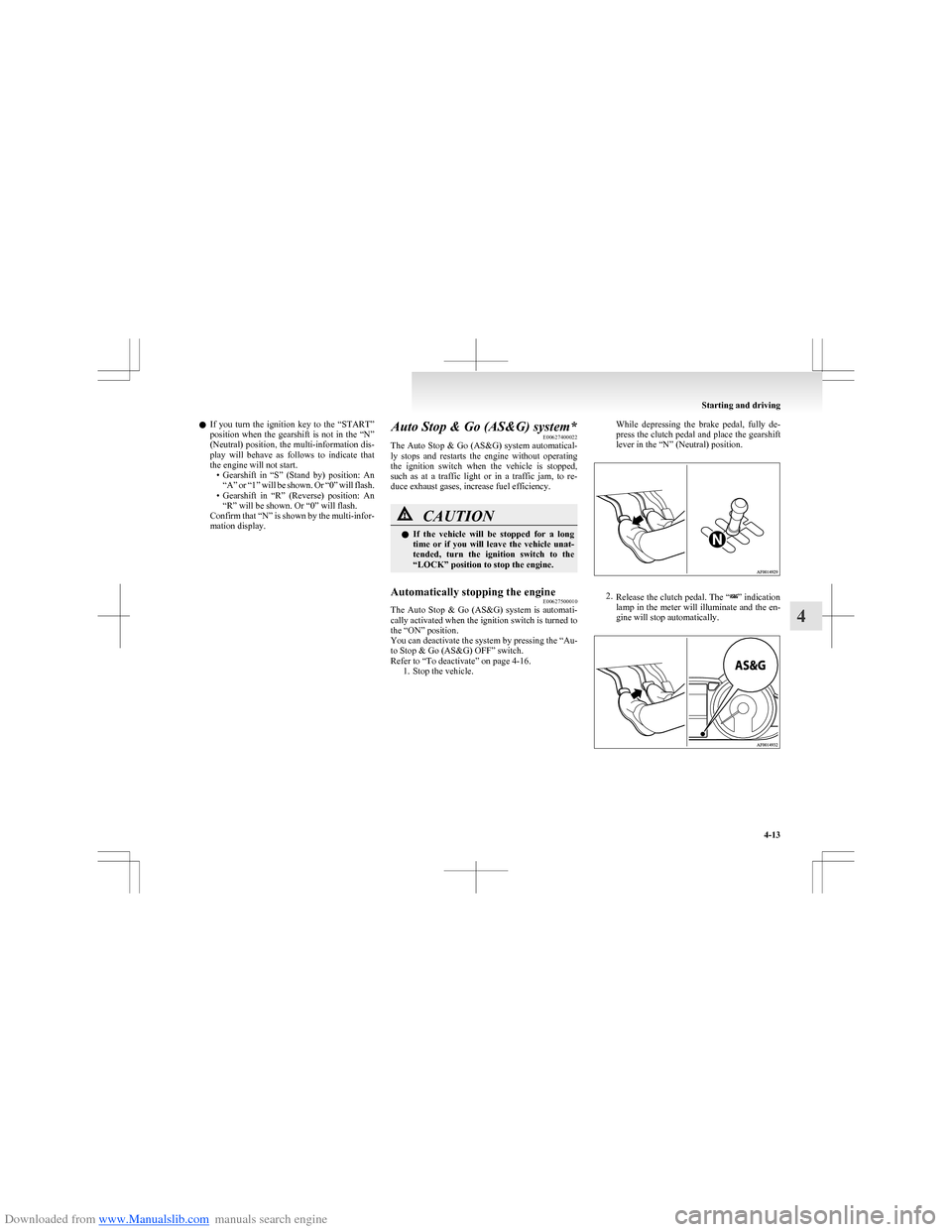
5. Place the gearshift lever in the “N” (Neutral)
position.
6. Turn the ignition key to the “ON” position
and make certain that all warning lamps are
functioning properly before starting the en-
gine.
7. Turn the ignition key to the “START” posi-
tion without depressing the accelerator pedal,
and release it when the engine starts.
NOTE l A ticking noise may be heard after starting
the engine.
This is not an abnormal condition. The noise
will disappear after a short time of engine run-
ning.
If the ticking noise continues after the engine
is warmed up, we recommend you to have
your vehicle checked.
Vehicles with automated manual transmission 1.Insert the ignition key and fasten the seat belt.
2. Make sure the parking brake is applied.
3. Depress and hold the brake pedal.
4. Turn the ignition key to the “ON” position
and make certain that all warning lamps are
functioning properly.
5. Place the allshift lever in the “N” (Neutral)
position and confirm that “N” is shown by
the multi-information display. Refer to “Mov-
ing the allshift lever” on page 4-21.
6. Turn the ignition key to the “START” posi-
tion without depressing the accelerator pedal,
and release it when the engine starts.
NOTE l For safety, the vehicle is designed so that the
engine will not start unless the allshift lever
is in the “N” (Neutral) position. Place the all-
shift lever in the “N” (Neutral) position be-
fore starting the engine.
Starting and driving
4-12
4
Page 116 of 273
Downloaded from www.Manualslib.com manuals search engine lIf you turn the ignition key to the “START”
position when the gearshift is not in the “N”
(Neutral) position, the multi-information dis-
play will behave as follows to indicate that
the engine will not start. •Gearshift in “S” (Stand by) position: An
“A” or “1” will be shown. Or “0” will flash.
• Gearshift in “R” (Reverse) position: An
“R” will be shown. Or “0” will flash.
Confirm that “N” is shown by the multi-infor-
mation display.Auto Stop & Go (AS&G) system* E00627400022
The Auto Stop & Go (AS&G) system automatical-
ly stops and restarts the engine without operating
the ignition switch when the vehicle is stopped,
such as at a traffic light or in a traffic jam, to re-
duce exhaust gases, increase fuel efficiency.CAUTIONl If the vehicle will be stopped for a long
time or if you will leave the vehicle unat-
tended, turn the ignition switch to the
“LOCK” position to stop the engine.Automatically stopping the engine E00627500010
The Auto Stop & Go (AS&G) system is automati-
cally activated when the ignition switch is turned to
the “ON” position.
You can deactivate the system by pressing the “Au-
to Stop & Go (AS&G) OFF” switch.
Refer to “To deactivate” on page 4-16. 1. Stop the vehicle.
While depressing the brake pedal, fully de-
press the clutch pedal and place the gearshift
lever in the “N” (Neutral) position.
2. Release the clutch pedal. The “” indication
lamp in the meter will illuminate and the en-
gine will stop automatically.
Starting and driving
4-13
4
Page 117 of 273
Downloaded from www.Manualslib.com manuals search engine NOTEl Under normal conditions, the “
”
indication
lamp will also illuminate for a few seconds
when the ignition switch is turned to the
“ON” position.
l The brake booster becomes inoperative and
the pedal effort will increase when the en-
gine is stopped automatically.
If the vehicle is moving, press down the
brake pedal harder than usual.CAUTIONl Observe the following precautions when
the engine is stopped automatically. Oth-
erwise, an unexpected accident might oc-
cur when the engine restarts automatical-
ly. •Do not depress the accelerator pedal
to race the engine while the vehicle is
stopped (regardless of whether the en-
gine is running or stopped).
Otherwise, an unexpected accident
might occur when the engine restarts
automatically.CAUTION• Do not leave the driver’s seat or open
the bonnet.
If the driver’s seat belt is unfastened
or if the bonnet is opened, the “
” in-
dication lamp will blink to inform the
driver. If this occurs, the engine will
not restart automatically even if the
clutch pedal is depressed, the seat belt
is refastened, and the bonnet is closed.
While depressing the brake pedal,
fully depress the clutch pedal and
turn the ignition switch to the
“START” position to start the engine.
For details, refer to “Starting the en-
gine” on page 4-12.
• Do not move the gearshift lever to a po-
sition other than the “N” (Neutral) po-
sition.
If the gearshift lever is moved to a po-
sition other than the “N” (Neutral) po-
sition, the “
” indication lamp blinks
and the buzzer sounds.
If the gearshift lever is returned to the
“N” (Neutral) position, the lamp stops
blinking and the buzzer stops sound-
ing. The engine will not restart if the
gearshift lever is in a position other
than the “N” (Neutral) position.
NOTE
l In the following cases, the Auto Stop & Go
(AS&G) system will not operate and the en-
gine will not stop automatically even if the ve-
hicle is stopped. • Driver’s seat belt is not fastened
• Bonnet is open
• After the engine restarts automatically,
the vehicle speed has not exceeded ap-
proximately 5 km/h (3 mph)
• Brake booster vacuum pressure is low be- cause the brake pedal is depressed repeat-
edly or depressed harder than usual
• After the ignition switch is turned from
the “LOCK” position to the “START” po-
sition, approximately 3 minutes or more
have not elapsed
• After the ignition switch is turned from
the “ON” position to the “START” posi-
tion, approximately 30 seconds or more
have not elapsed.
• After the engine restarts automatically,
the vehicle stops again within 10 seconds
• Engine coolant temperature is low
• Ambient temperature is lower than ap-
proximately 3°C
• Air conditioner is operating and passen-
ger compartment has not sufficiently
cooled (for vehicles with automatic air
conditioning)
• Mode selection dial is set to the demister
position (for vehicles with automatic air
conditioning)
Refer to “For quick demisting” on page
5-10.
• Electric power consumption is high, such
as when the rear window demister or oth-
er electrical components are operating or
the blower speed is set to a high setting
• Battery voltage or battery performance is
low
• Check engine warning lamp is illumina-
ted or the “
” indication lamp is blinking
[For vehicles with automatic air conditioning]
Starting and driving
4-14
4
Page 118 of 273
Downloaded from www.Manualslib.com manuals search engine lIf the Auto Stop & Go (AS&G) system oper-
ates while the air conditioner is operating,
both the engine and the air conditioning com-
pressor will stop. Therefore, only the blower
will operate.
l If air is flowing from the demister and the en-
gine is stopped automatically, it is recommen-
ded to set the mode selection dial to the De-
mister/Face or Foot/Demister position.
Refer to “Changing the mode selection” on
pages 5-02, 5-02.
l If the air conditioner is operating, set the tem-
perature control dial to 22°C or higher to
lengthen the time that the engine is stopped
automatically.
l If the air conditioner is operating when the
ambient temperature is high, such as during
the summer, change the air selection from out-
side air to recirculated air to lengthen the
time that the engine is stopped automatically.Automatically restarting the engine E00627600066
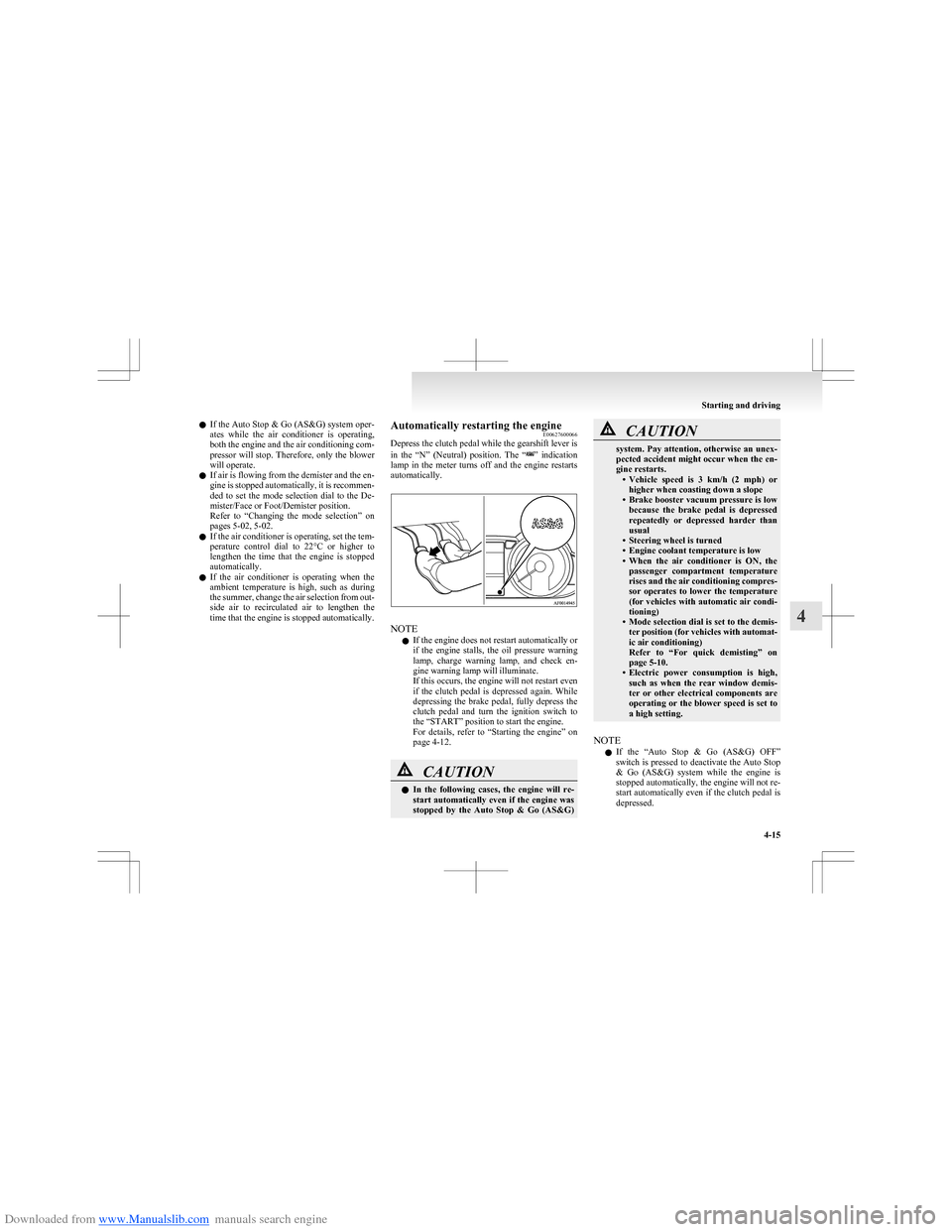
Depress the clutch pedal while the gearshift lever is
in the “N” (Neutral) position. The “
” indication
lamp in the meter turns off and the engine restarts
automatically.
NOTE
l If the engine does not restart automatically or
if the engine stalls, the oil pressure warning
lamp, charge warning lamp, and check en-
gine warning lamp will illuminate.
If this occurs, the engine will not restart even
if the clutch pedal is depressed again. While
depressing the brake pedal, fully depress the
clutch pedal and turn the ignition switch to
the “START” position to start the engine.
For details, refer to “Starting the engine” on
page 4-12.
CAUTIONl In the following cases, the engine will re-
start automatically even if the engine was
stopped by the Auto Stop & Go (AS&G)CAUTIONsystem. Pay attention, otherwise an unex-
pected accident might occur when the en-
gine restarts. •Vehicle speed is 3 km/h (2 mph) or
higher when coasting down a slope
• Brake booster vacuum pressure is low
because the brake pedal is depressed
repeatedly or depressed harder than
usual
• Steering wheel is turned
• Engine coolant temperature is low
• When the air conditioner is ON, the
passenger compartment temperature
rises and the air conditioning compres-
sor operates to lower the temperature
(for vehicles with automatic air condi-
tioning)
• Mode selection dial is set to the demis-
ter position (for vehicles with automat-
ic air conditioning)
Refer to “For quick demisting” on
page 5-10.
• Electric power consumption is high,
such as when the rear window demis-
ter or other electrical components are
operating or the blower speed is set to
a high setting.
NOTE
l If the “Auto Stop & Go (AS&G) OFF”
switch is pressed to deactivate the Auto Stop
& Go (AS&G) system while the engine is
stopped automatically, the engine will not re-
start automatically even if the clutch pedal is
depressed.
Starting and driving
4-15
4
Page 119 of 273
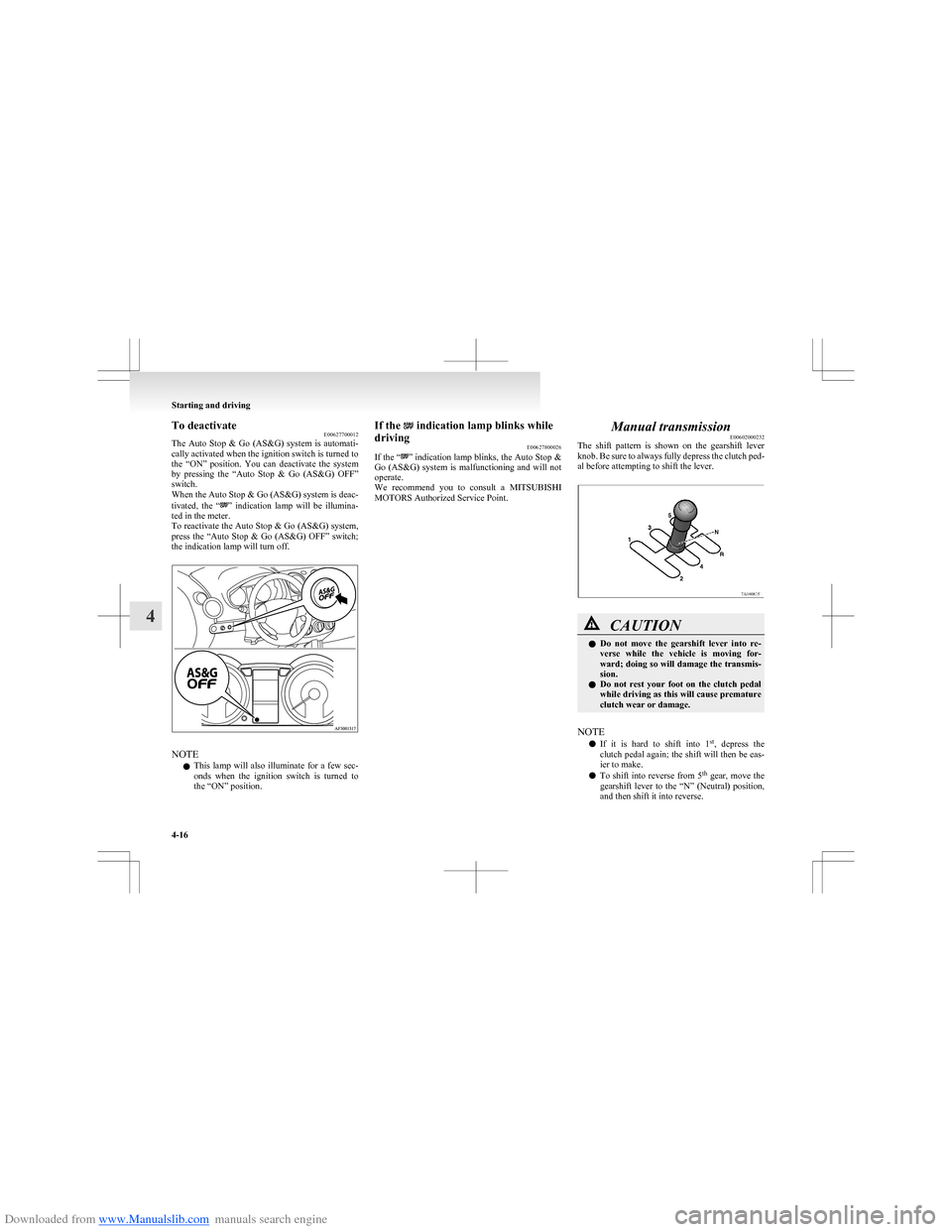
Downloaded from www.Manualslib.com manuals search engine To deactivateE00627700012
The Auto Stop & Go (AS&G) system is automati-
cally activated when the ignition switch is turned to
the “ON” position. You can deactivate the system
by pressing the “Auto Stop & Go (AS&G) OFF”
switch.
When the Auto Stop & Go (AS&G) system is deac-
tivated, the “
” indication lamp will be illumina-
ted in the meter.
To reactivate the Auto Stop & Go (AS&G) system,
press the “Auto Stop & Go (AS&G) OFF” switch;
the indication lamp will turn off.
NOTE
l This lamp will also illuminate for a few sec-
onds when the ignition switch is turned to
the “ON” position.
If the indication lamp blinks while
driving E00627800026
If the “
” indication lamp blinks, the Auto Stop &
Go (AS&G) system is malfunctioning and will not
operate.
We recommend you to consult a MITSUBISHI
MOTORS Authorized Service Point.
Manual transmission E00602000232
The shift pattern is shown on the gearshift lever
knob. Be sure to always fully depress the clutch ped-
al before attempting to shift the lever.CAUTIONl Do not move the gearshift lever into re-
verse while the vehicle is moving for-
ward; doing so will damage the transmis-
sion.
l Do not rest your foot on the clutch pedal
while driving as this will cause premature
clutch wear or damage.
NOTE
l If it is hard to shift into 1 st
, depress the
clutch pedal again; the shift will then be eas-
ier to make.
l To shift into reverse from
5th
gear, move the
gearshift lever to the “N” (Neutral) position,
and then shift it into reverse.
Starting and driving
4-16
4
Page 124 of 273
Downloaded from www.Manualslib.com manuals search engine Moving the allshift leverE00612700014
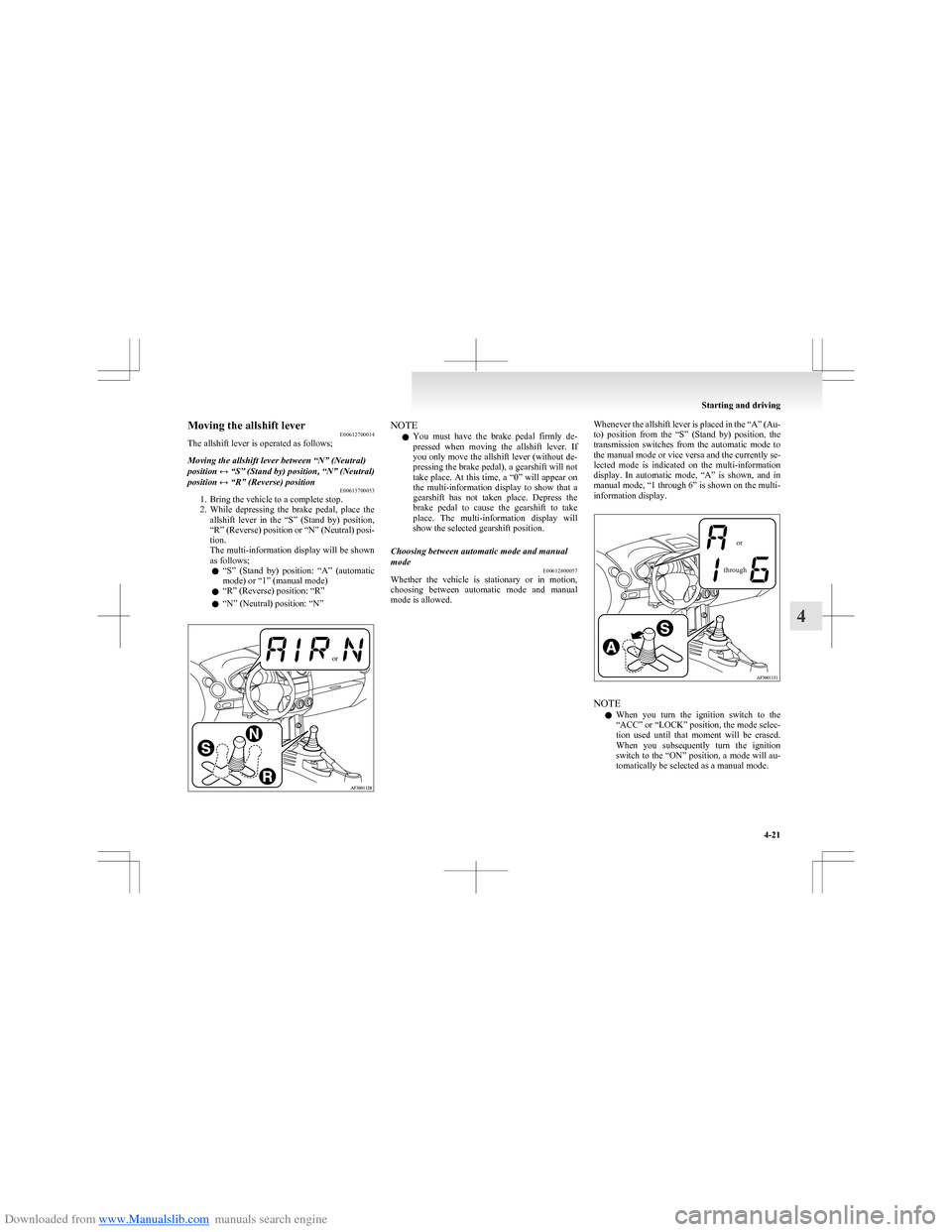
The allshift lever is operated as follows;Moving the allshift lever between “N” (Neutral)
position ↔ “S” (Stand by) position, “N” (Neutral)
position ↔ “R” (Reverse) position E00613700053
1. Bring the vehicle to a complete stop.
2. While depressing the brake pedal, place the
allshift lever in the “S” (Stand by) position,
“R” (Reverse) position or “N” (Neutral) posi-
tion.
The multi-information display will be shown
as follows;
l “
S” (Stand by) position: “A” (automatic
mode) or “1” (manual mode)
l “R” (Reverse) position: “R”
l “N” (Neutral) position: “N”
orNOTE
l You must have the brake pedal firmly de-
pressed when moving the allshift lever. If
you only move the allshift lever (without de-
pressing the brake pedal), a gearshift will not
take place. At this time, a “0” will appear on
the multi-information display to show that a
gearshift has not taken place. Depress the
brake pedal to cause the gearshift to take
place. The multi-information display will
show the selected gearshift position.Choosing between automatic mode and manual
mode E00612800057
Whether the vehicle is stationary or in motion,
choosing between automatic mode and manual
mode is allowed.
Whenever the allshift lever is placed in the “A” (Au-
to) position from the “S” (Stand by) position, the
transmission switches from the automatic mode to
the manual mode or vice versa and the currently se-
lected mode is indicated on the multi-information
display. In automatic mode, “A” is shown, and in
manual mode, “1 through 6” is shown on the multi-
information display.orthrough
NOTE
l When you turn the ignition switch to the
“ACC” or “LOCK” position, the mode selec-
tion used until that moment will be erased.
When you subsequently turn the ignition
switch to the “ON” position, a mode will au-
tomatically be selected as a manual mode.
Starting and driving
4-21
4
Page 128 of 273
Downloaded from www.Manualslib.com manuals search engine CAUTIONlWhen leaving the vehicle, be sure to stop
the engine and remove the key from the
ignition switch. If you were to leave the en-
gine running with the allshift lever in the
“S” (Stand by) or “R” position, the trans-
mission’s creep effect could cause the ve-
hicle to move by itself. Also, the vehicle
could suddenly move if you accidentally
pressed the accelerator pedal when get-
ting back in the vehicle.
NOTE
l Sit in the correct position for driving even if
you plan to move just a short distance. Make
sure you are able to depress the brake pedal
and accelerator pedal properly.
l Reversing involves twisting to look rearward
in a position that makes operation of the ped-
als more difficult. Make sure you are able to
depress the brake pedal.
Braking E00607001801
All the parts of the brake system are critical to safe-
ty. We recommend you to have the vehicle
checked at regular intervals according to the serv-
ice booklet.CAUTIONl Avoid driving habits that cause heavy
braking and never “ride” the brakes by
resting your foot on the brake pedal
while driving.
It causes brake overheating and fade.
Brake system
The service brake is divided into two brake cir-
cuits. And your vehicle is equipped with power
brakes. If one brake circuit fails, the other is availa-
ble to stop the vehicle. If you should lose the pow-
er assist for some reason, the brakes will still work.
In these situations, even if the brake pedal moves
down to the very end of its possible stroke or re-
sists being depressed, keep depressing the brake ped-
al down harder and further than usual; stop driving
as soon as possible and have the brake system re-
paired.
WARNINGl Do not turn off the engine while your ve-
hicle is in motion. If you turn off the en-
gine while driving, the power assistance
for the braking system will stop working
and your brakes will not work effectively.WARNINGl If the power assist is lost or if either
brake hydraulic system stops working
properly, have your vehicle checked im-
mediately.
Warning lamp
The brake warning lamp illuminates to indicate a
fault in the braking system. Read “Brake warning
lamp” on page 3-17.
When brakes are wet
Check the brake system while driving at a low
speed immediately after starting, especially when
the brakes are wet, to confirm they work normally.
A film of water can be formed on the brake discs
or brake drums and prevent normal braking after
driving in heavy rain or through large puddles, or
after the vehicle is washed. If this occurs, dry the
brakes out by driving slowly while lightly depress-
ing the brake pedal.
When driving downhill
It is important to take advantage of the engine brak-
ing by shifting to a lower shift position while driv-
ing on steep downhill roads in order to prevent the
brakes from overheating.
Starting and driving
4-25
4
Page 131 of 273
Downloaded from www.Manualslib.com manuals search engine lOperation of ABS is not restricted to situa-
tions where brakes are applied suddenly.
This system may also operate to prevent
wheel lock when you are driving over man-
holes, steel road-work plates, or the vehicle
is driven over steps or level differences in
the road, road markings, or other surfaces
which are difficult for the wheels to grip.
l When the ABS is activated, you may feel the
brake pedal pulsating and hear a characteris-
tic noise. Also at this time, it may feel as if
the pedal attempts to resist being depressed.
In this situation, to let the ABS work for
you, just hold the brake pedal down more
firmly. Do not pump the brake. This will
result in reduced braking performance.CAUTIONl Even the ABS cannot prevent the natural
laws of physics from acting on the vehi-
cle. It cannot for instance avoid accidents
that may result from excessive speed on
bends or following another vehicle too
closely or aquaplaning. It should remain
the driver’s task to observe safety precau-
tions to judge speeds and brake applica-
tions correctly in such conditions.
l Be sure to use tyres of the same type and
size on 4 wheels.
If tyre types or sizes are mixed, ABS may
not function properly.CAUTIONl Never install a limited-slip differential,
which is not MITSUBISHI MOTORS gen-
uine parts, as the ABS may not function
properly.
We recommend to consult a
MITSUBISHI MOTORS Authorized
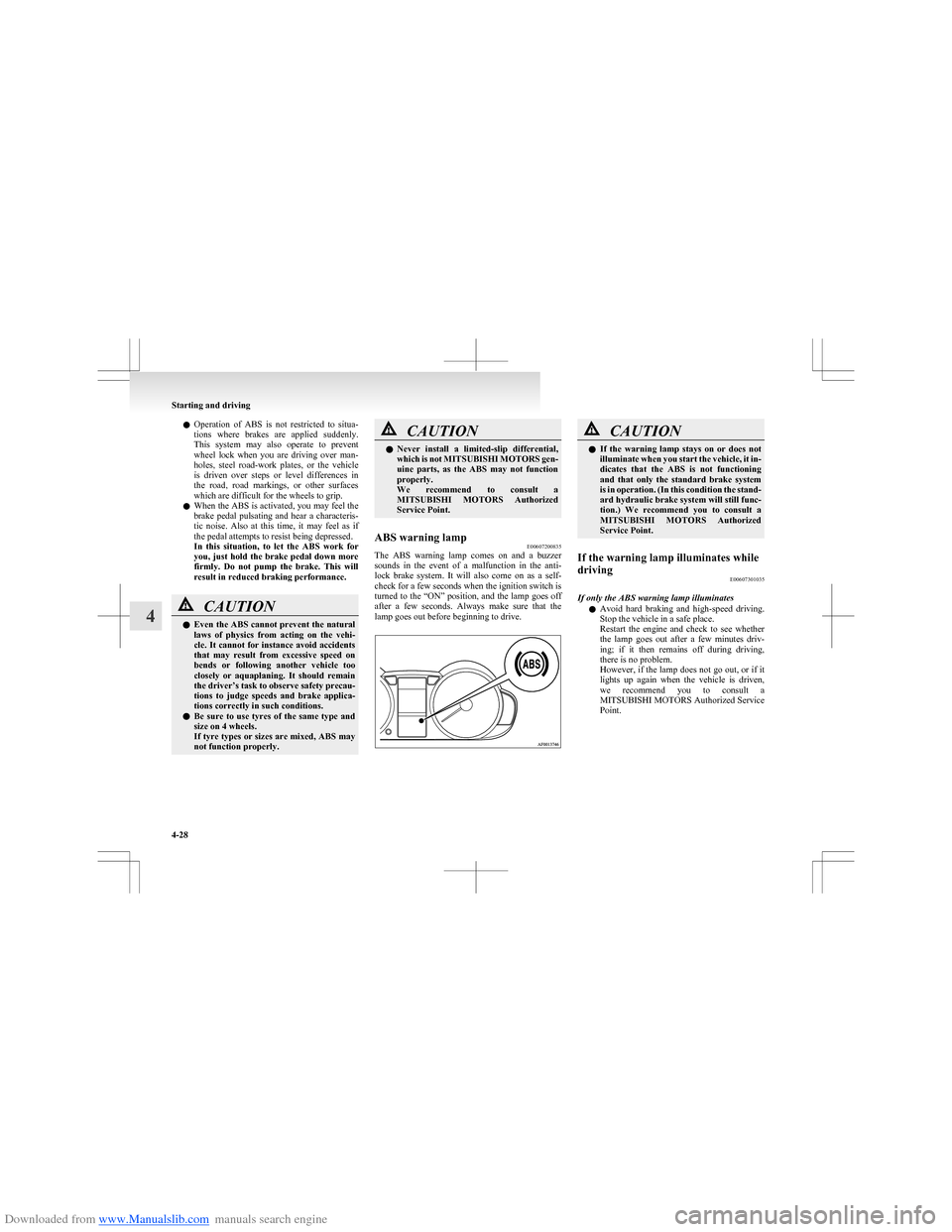
Service Point.ABS warning lamp E00607200835
The ABS warning lamp comes on and a buzzer
sounds in the event of a malfunction in the anti-
lock brake system. It will also come on as a self-
check for a few seconds when the ignition switch is
turned to the “ON” position, and the lamp goes off
after a few seconds. Always make sure that the
lamp goes out before beginning to drive.
CAUTIONl If the warning lamp stays on or does not
illuminate when you start the vehicle, it in-
dicates that the ABS is not functioning
and that only the standard brake system
is in operation. (In this condition the stand-
ard hydraulic brake system will still func-
tion.) We recommend you to consult a
MITSUBISHI MOTORS Authorized
Service Point.If the warning lamp illuminates while
driving E00607301035
If only the ABS warning lamp illuminates
l Avoid hard braking and high-speed driving.
Stop the vehicle in a safe place.
Restart the engine and check to see whether
the lamp goes out after a few minutes driv-
ing; if it then remains off during driving,
there is no problem.
However, if the lamp does not go out, or if it
lights up again when the vehicle is driven,
we recommend you to consult a
MITSUBISHI MOTORS Authorized Service
Point.
Starting and driving
4-28
4