parking brake MITSUBISHI ECLIPSE 1991 User Guide
[x] Cancel search | Manufacturer: MITSUBISHI, Model Year: 1991, Model line: ECLIPSE, Model: MITSUBISHI ECLIPSE 1991Pages: 1216, PDF Size: 67.42 MB
Page 144 of 1216
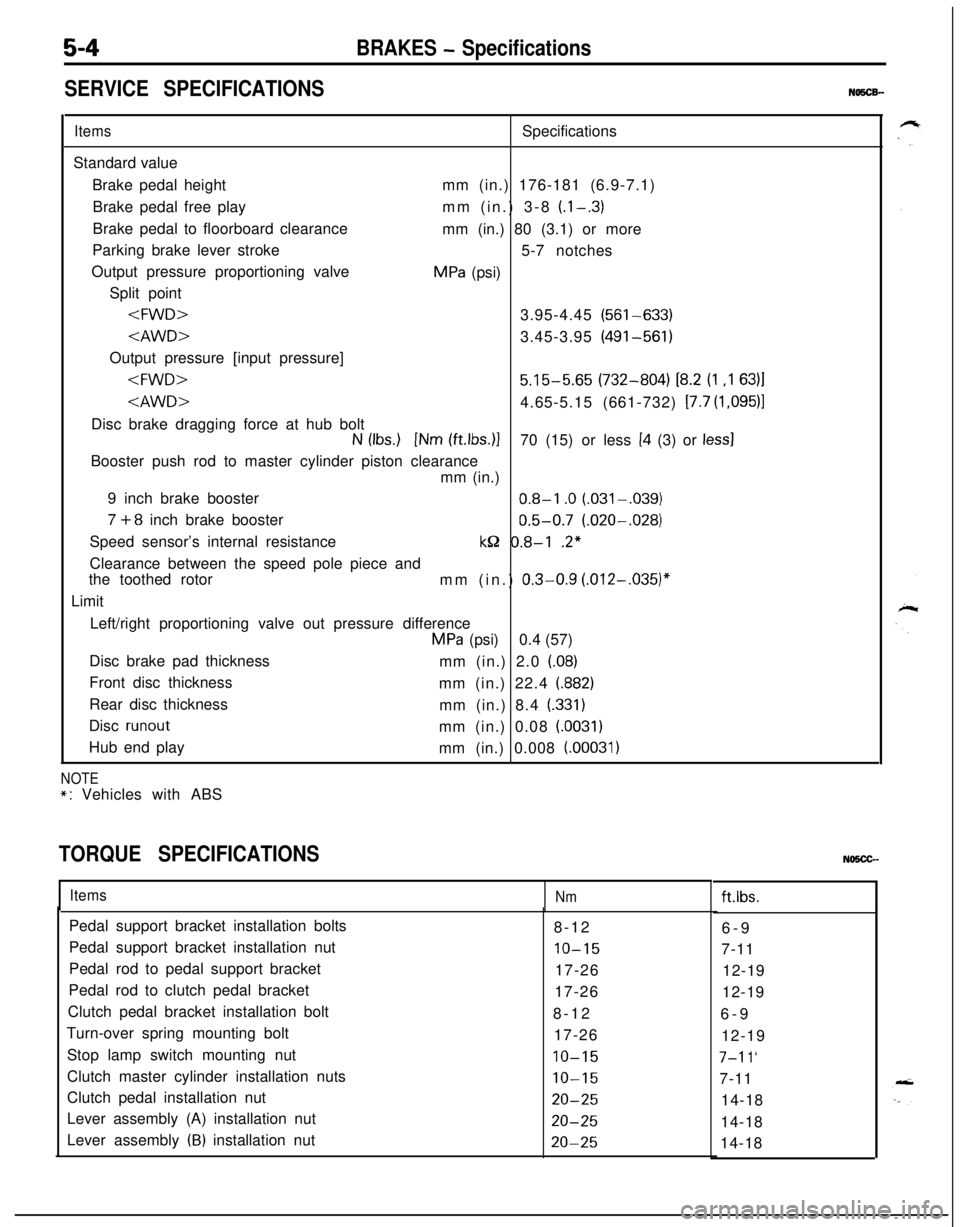
5-4BRAKES - Specifications
SERVICE SPECIFICATIONS
NO5CB-
ItemsSpecifications
Standard value
Brake pedal heightmm (in.) 176-181 (6.9-7.1)
Brake pedal free playmm (in.) 3-8
(l-.3)Brake pedal to floorboard clearance
mm (in.) 80 (3.1) or more
Parking brake lever stroke
5-7 notches
Output pressure proportioning valve
MPa (psi)
Split point
Output pressure [input pressure]
N (Ibs.) [Nm (ftlbs.)]70 (15) or less [4 (3) or less1Booster push rod to master cylinder piston clearance
mm (in.)
9 inch brake booster
0.8-l .O (.031-,039)
7
+8 inch brake booster0.5-0.7 (.020-.028)
Speed sensor’s internal resistance
kQ 0.8-l .2*
Clearance between the speed pole piece and
the toothed rotor
mm (in.)
0.3-0.9 (.012-,035)”Limit
Left/right proportioning valve out pressure difference
MPa (psi)0.4 (57)
Disc brake pad thickness
mm (in.) 2.0 (08)
Front disc thickness
mm (in.) 22.4 (882)
Rear disc thickness
mm (in.) 8.4
(.331)Disc
runoutmm (in.) 0.08 (.0031)Hub end play
mm (in.) 0.008
(.00031)
NOTE
*: Vehicles with ABS
TORQUE SPECIFICATIONS
ItemsNmft.lbs.
Pedal support bracket installation bolts
8-12
6-9
Pedal support bracket installation nut
IO-157-11
Pedal rod to pedal support bracket
17-26
12-19
Pedal rod to clutch pedal bracket
17-26
12-19
Clutch pedal bracket installation bolt
8-12
6-9
Turn-over spring mounting bolt
17-26
12-19
Stop lamp switch mounting nut
IO-157-l 1‘Clutch master cylinder installation nuts
10-157-11
Clutch pedal installation nut
20-2514-18
Lever assembly (A) installation nut
20-2514-18
Lever assembly
(B) installation nut20-2514-18
Page 145 of 1216
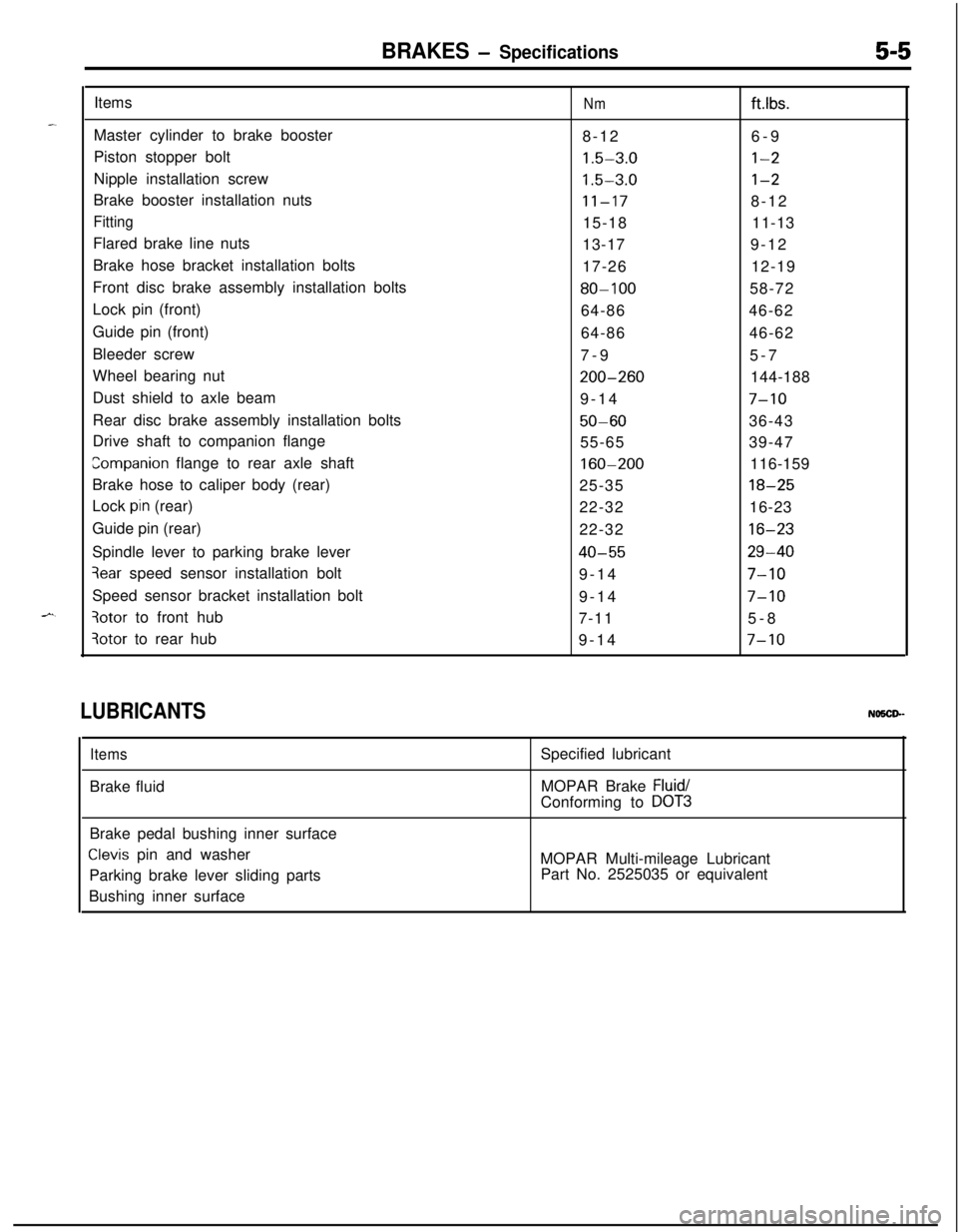
BRAKES - Specifications5-5Items
Nmftlbs.Master cylinder to brake booster
8-126-9
Piston stopper bolt
1.5-3.0l-2Nipple installation screw
1.5-3.0l-2Brake booster installation nuts
11-178-12
Fitting15-1811-13
Flared brake line nuts
13-179-12
Brake hose bracket installation bolts
17-2612-19
Front disc brake assembly installation bolts
80-10058-72
Lock pin (front)
64-8646-62
Guide pin (front)
64-8646-62
Bleeder screw
7-95-7
Wheel bearing nut
200-260144-188
Dust shield to axle beam
9-14
7-10Rear disc brake assembly installation bolts
50-6036-43
Drive shaft to companion flange
55-6539-47
companion flange to rear axle shaft160-200116-159
Brake hose to caliper body (rear)
25-35
18-25Lock
pin (rear)
22-3216-23
Guide pin (rear)
22-32
16-23Spindle lever to parking brake lever
40-5529-40
3ear speed sensor installation bolt
9-147-10Speed sensor bracket installation bolt
9-14
7-10
3otor to front hub
7-115-8
3otor to rear hub
9-147-10
LUBRICANTSNO5CP-
ItemsBrake fluidSpecified lubricant
MOPAR Brake
Fluid/Conforming to
DOT3Brake pedal bushing inner surface
Clevis pin and washer
Parking brake lever sliding parts
Bushing inner surfaceMOPAR Multi-mileage Lubricant
Part No. 2525035 or equivalent
Page 182 of 1216
5-42BRAKES - Service Adjustment Procedures
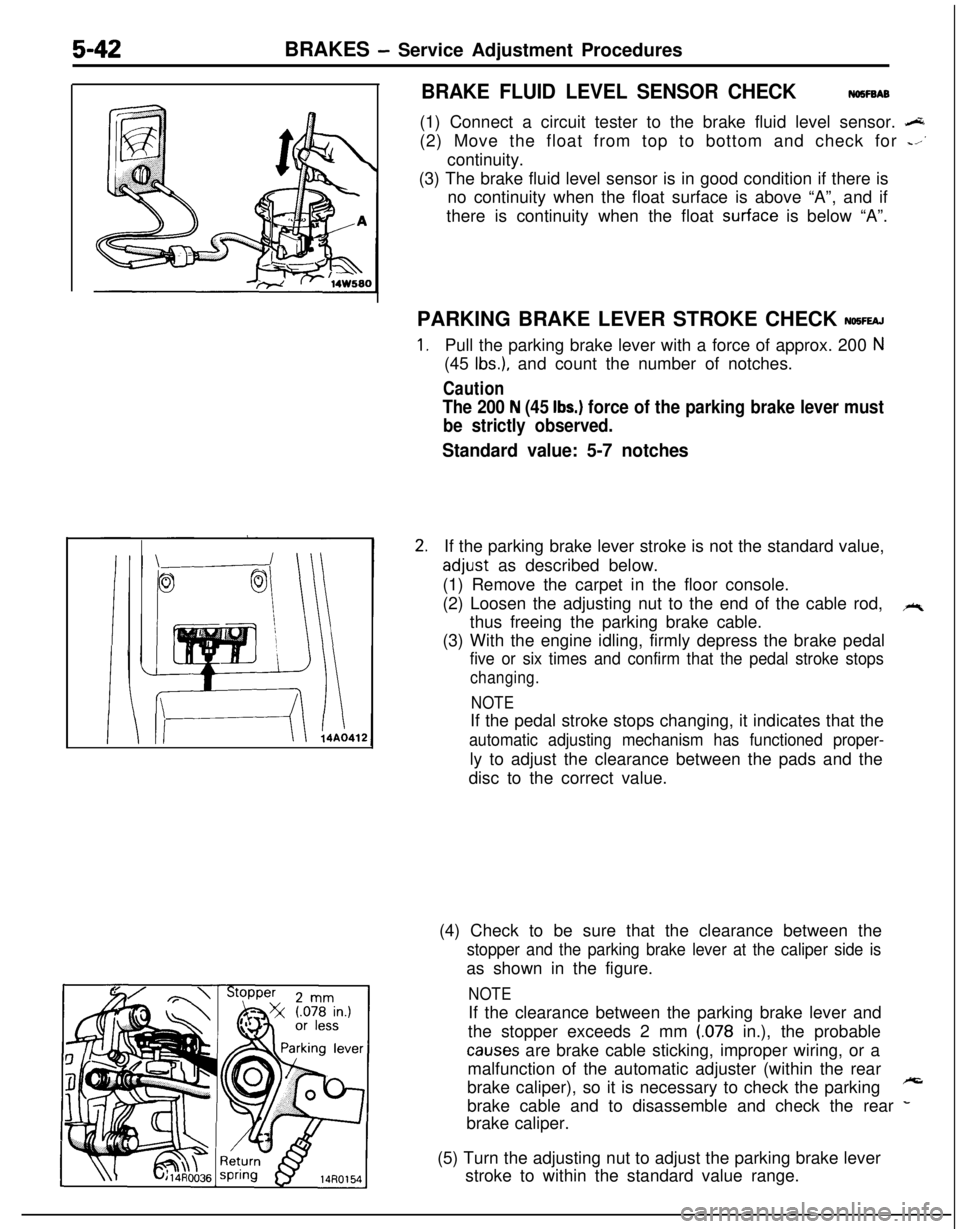
BRAKE FLUID LEVEL SENSOR CHECKNO5FBAB(1) Connect a circuit tester to the brake fluid level sensor.
4(2) Move the float from top to bottom and check for
.-,’continuity.
(3) The brake fluid level sensor is in good condition if there is
no continuity when the float surface is above “A”, and if
there is continuity when the float
surface is below “A”.
PARKING BRAKE LEVER STROKE CHECK NWFEAJ
1.Pull the parking brake lever with a force of approx. 200 N(45
Ibs.), and count the number of notches.
Caution
The 200 N (45 Ibs.) force of the parking brake lever must
be strictly observed.
Standard value: 5-7 notches
2.If the parking brake lever stroke is not the standard value,
adjust as described below.
(1) Remove the carpet in the floor console.
(2) Loosen the adjusting nut to the end of the cable rod,
fithus freeing the parking brake cable.
(3) With the engine idling, firmly depress the brake pedal
five or six times and confirm that the pedal stroke stops
changing.
NOTEIf the pedal stroke stops changing, it indicates that the
automatic adjusting mechanism has functioned proper-ly to adjust the clearance between the pads and the
disc to the correct value.
(4) Check to be sure that the clearance between the
stopper and the parking brake lever at the caliper side isas shown in the figure.
NOTEIf the clearance between the parking brake lever and
the stopper exceeds 2 mm
(078 in.), the probable
causes are brake cable sticking, improper wiring, or a
malfunction of the automatic adjuster (within the rear
brake caliper), so it is necessary to check the parking
-brake cable and to disassemble and check the rear
-brake caliper.
(5) Turn the adjusting nut to adjust the parking brake lever
stroke to within the standard value range.
Page 183 of 1216
BRAKES - Service Adjustment Procedures5-43When engine is
stoppedNo good
0
wtwo061
VV;Videngine is
t4uoo60
Caution
If the number of brake lever notches engaged is less
than the standard value, the cable has been pulledexcessively, and failure of the automatic adjuster
mechanism will result. Be sure tti adjust it to within the
standard value.(6) After making the adjustment, check to be sure that there is
no play between the adjusting nut and the pin. Also check
to be sure that the adjusting nut is securely held at the nut
holder.(7) After adjusting the lever stroke, jack up the rear of the
vehicle.(8) With the parking brake lever in the released position, turn
the rear wheel to confirm that the rear brakes are not
dragging.
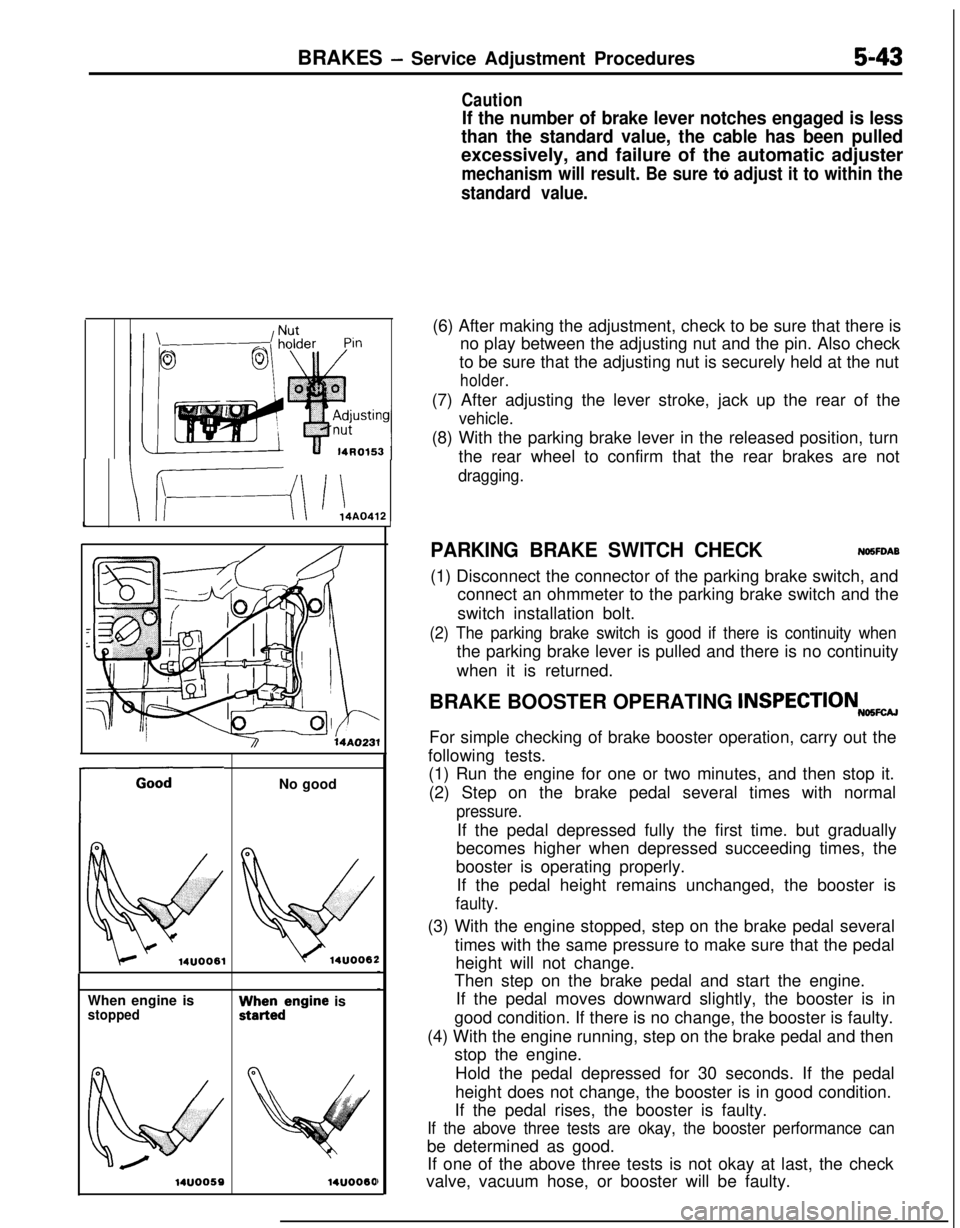
PARKING BRAKE SWITCH CHECKN05FDAB
(1) Disconnect the connector of the parking brake switch, and
connect an ohmmeter to the parking brake switch and the
switch installation bolt.
(2) The parking brake switch is good if there is continuity whenthe parking brake lever is pulled and there is no continuity
when it is returned.
BRAKE BOOSTER OPERATING
lNSPECTIONNoSFcuFor simple checking of brake booster operation, carry out the
following tests.
(1) Run the engine for one or two minutes, and then stop it.
(2) Step on the brake pedal several times with normal
pressure.If the pedal depressed fully the first time. but gradually
becomes higher when depressed succeeding times, the
booster is operating properly.
If the pedal height remains unchanged, the booster is
faulty.(3) With the engine stopped, step on the brake pedal several
times with the same pressure to make sure that the pedal
height will not change.
Then step on the brake pedal and start the engine.
If the pedal moves downward slightly, the booster is in
good condition. If there is no change, the booster is faulty.
(4) With the engine running, step on the brake pedal and then
stop the engine.
Hold the pedal depressed for 30 seconds. If the pedal
height does not change, the booster is in good condition.
If the pedal rises, the booster is faulty.
If the above three tests are okay, the booster performance canbe determined as good.
If one of the above three tests is not okay at last, the check
valve, vacuum hose, or booster will be faulty.
Page 188 of 1216
5-48BRAKES - Service Adjustment Procedures
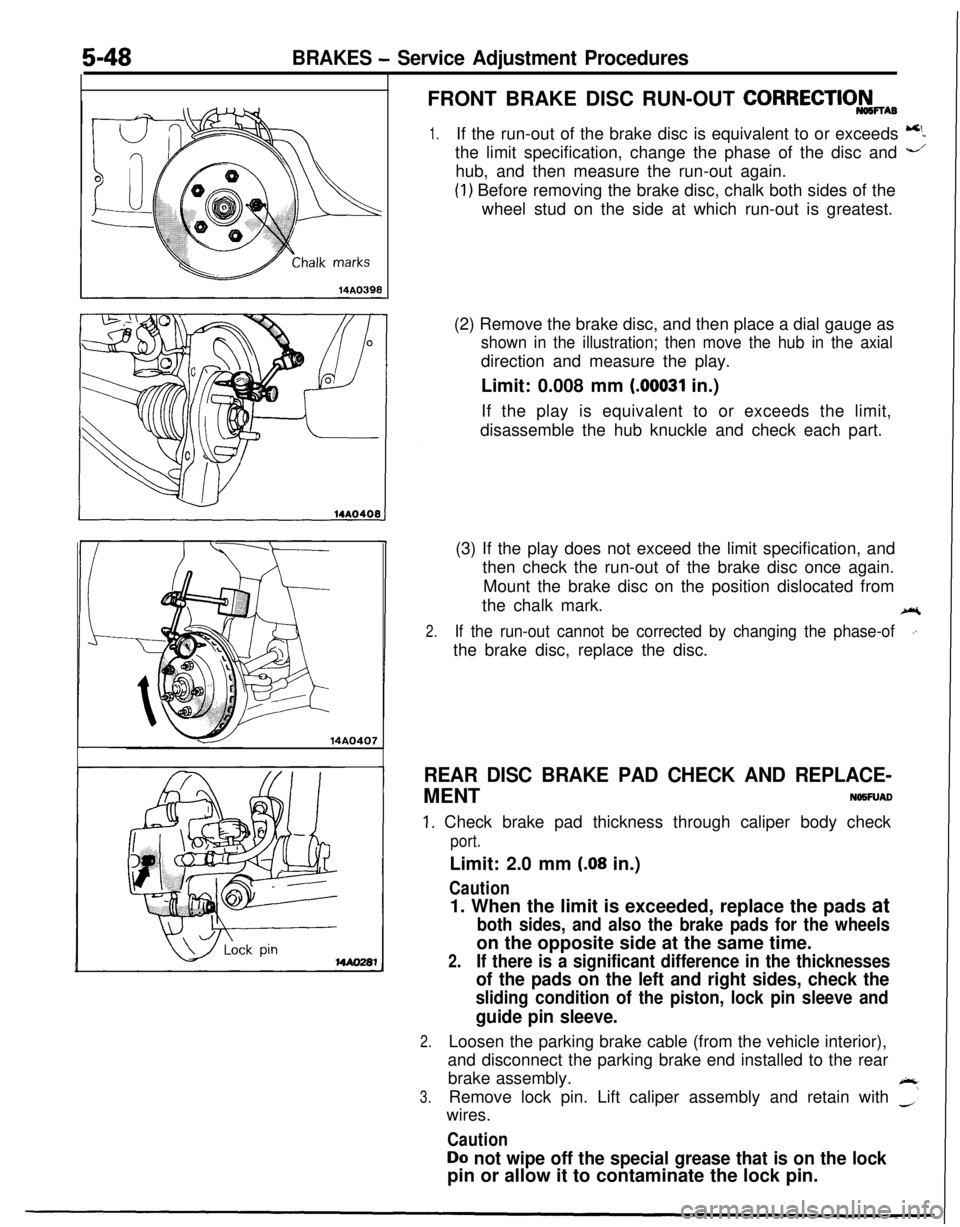
14A0407FRONT BRAKE DISC RUN-OUT
CORRECTIO&wAB
1.If the run-out of the brake disc is equivalent to or exceeds 5the limit specification, change the phase of the disc and
-’hub, and then measure the run-out again.
(1) Before removing the brake disc, chalk both sides of the
wheel stud on the side at which run-out is greatest.
(2) Remove the brake disc, and then place a dial gauge as
shown in the illustration; then move the hub in the axialdirection and measure the play.
Limit: 0.008 mm
(00031 in.)
If the play is equivalent to or exceeds the limit,
disassemble the hub knuckle and check each part.
(3) If the play does not exceed the limit specification, and
then check the run-out of the brake disc once again.
Mount the brake disc on the position dislocated from
the chalk mark.
ei
2.If the run-out cannot be corrected by changing the phase-ofI’the brake disc, replace the disc.
REAR DISC BRAKE PAD CHECK AND REPLACE-MENT
NO5FUAD
1. Check brake pad thickness through caliper body check
port.Limit: 2.0 mm
(.08 in.)
Caution1. When the limit is exceeded, replace the pads at
both sides, and also the brake pads for the wheelson the opposite side at the same time.
2.If there is a significant difference in the thicknesses
of the pads on the left and right sides, check the
sliding condition of the piston, lock pin sleeve and
guide pin sleeve.
2.Loosen the parking brake cable (from the vehicle interior),
and disconnect the parking brake end installed to the rear
brake assembly.
A
3.Remove lock pin. Lift caliper assembly and retain with -‘wires.
Caution
Do not wipe off the special grease that is on the lockpin or allow it to contaminate the lock pin.
Page 189 of 1216
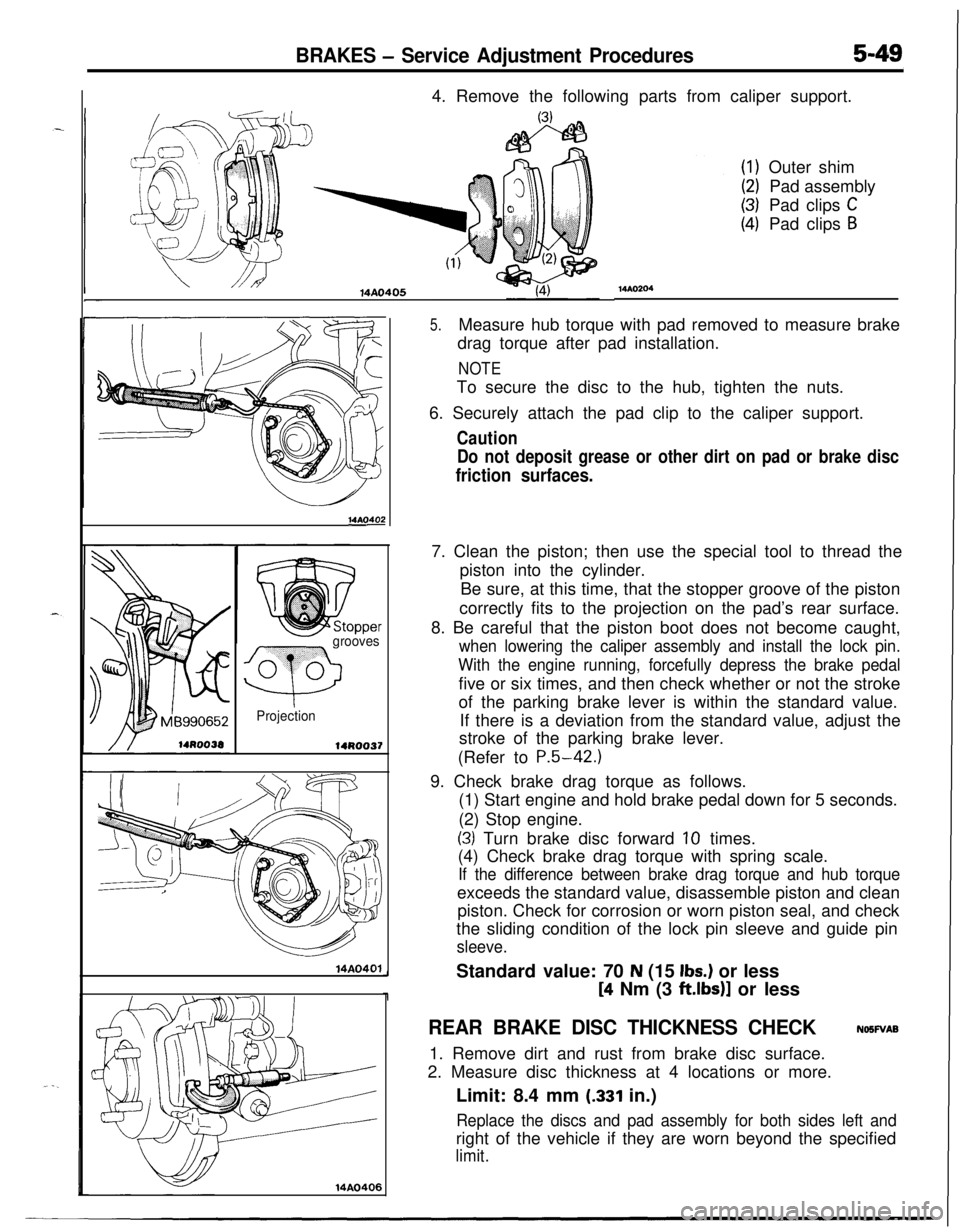
BRAKES - Service Adjustment Procedures5-494. Remove the following parts from caliper support.
14AO405
14AOs
grooves
Q
0 0
Projection
14R0037
14A0401
14AO406
MAO204Outer shim
Pad assembly
Pad clips
CPad clips
B
5.Measure hub torque with pad removed to measure brake
drag torque after pad installation.
NOTETo secure the disc to the hub, tighten the nuts.
6. Securely attach the pad clip to the caliper support.
Caution
Do not deposit grease or other dirt on pad or brake disc
friction surfaces.7. Clean the piston; then use the special tool to thread the
piston into the cylinder.
Be sure, at this time, that the stopper groove of the piston
correctly fits to the projection on the pad’s rear surface.
8. Be careful that the piston boot does not become caught,
when lowering the caliper assembly and install the lock pin.
With the engine running, forcefully depress the brake pedalfive or six times, and then check whether or not the stroke
of the parking brake lever is within the standard value.
If there is a deviation from the standard value, adjust the
stroke of the parking brake lever.
(Refer to
P.5-42.)9. Check brake drag torque as follows.
(1) Start engine and hold brake pedal down for 5 seconds.
(2) Stop engine.
(3) Turn brake disc forward 10 times.
(4) Check brake drag torque with spring scale.
If the difference between brake drag torque and hub torqueexceeds the standard value, disassemble piston and clean
piston. Check for corrosion or worn piston seal, and check
the sliding condition of the lock pin sleeve and guide pin
sleeve.Standard value: 70
N (15 Ibs.) or less
[4 Nm (3 ft.lbs)] or less
REAR BRAKE DISC THICKNESS CHECKNOSWAB
1. Remove dirt and rust from brake disc surface.
2. Measure disc thickness at 4 locations or more.
Limit: 8.4 mm
(.331 in.)
Replace the discs and pad assembly for both sides left andright of the vehicle if they are worn beyond the specified
limit.
Page 191 of 1216
![MITSUBISHI ECLIPSE 1991 User Guide BRAKES - Service Adjustment Procedures5-51E.C.U. terminal
ILow gear idle condition
[Speed: 5-6 km (3.1-3.16
mph)]Approx.
5V
14A0580When increasing speed
[Speed:
15-20 km (9.3-12.4 mph11OBSERVATION](/img/19/57104/w960_57104-190.png "MITSUBISHI ECLIPSE 1991 User Guide BRAKES - Service Adjustment Procedures5-51E.C.U. terminal
ILow gear idle condition
[Speed: 5-6 km (3.1-3.16
mph)]Approx.
5V
14A0580When increasing speed
[Speed:
15-20 km (9.3-12.4 mph11OBSERVATION")
BRAKES - Service Adjustment Procedures5-51E.C.U. terminal
ILow gear idle condition
[Speed: 5-6 km (3.1-3.16
mph)]Approx.
5V
14A0580When increasing speed
[Speed:
15-20 km (9.3-12.4 mph11OBSERVATION OF WHEEL SPEED SENSOR
OUTPUT VOLTAGE VARIATIONS
(1) Jack up the vehicle and release the parking brake.
(2) Disconnect the electronic control unit harness connector,
and measure the speed sensor output voltage at the
vehicle side harness connector.
(3) With an AWD model, put the shift lever in
1st (MTT) or L(A/T) position, rotate the wheels and observe the wave
shape for each wheel. With an FWD model, put the shift
lever in
1st (M/T) or L (AiT) position, rotate the wheels and
observe the wave shape for the front wheels; for the rear
wheels, rotate the wheels by hand and monitor the wave
shape.
NOTEIt is also
allright to actually drive the car.
ISpeed sensor
E.C.U. terminal No.I
IFront leftI14-15I
IFront right31-33I
IRear right28-30I
IRear left1 10-11IWhen wheel speed is slow, the output voltage is low
and it gets higher as the speed increases.
Wave shape monitoring points
IS THE OUTPUTVOLTAGE (AMPLITUDE) TOO LOW OR ISTHERE NO OUTPUT VOLTAGE?
If it is too low, check each wheel speed sensor,
With FWD rear wheels, check the sensor gap.
IS THERE VARIATION IN THE WAVE SHAPE AMPLITUDE?
If the flicker of the amplitude is large, consider shaking
of the axle hub.
IS THERE NOISE IN THE WAVE SHAPE OR DISTORTION?Broken or disconnected wire due to vibration or
installation malfunction of the wheel speed sensor.
Check rotor teeth meshing, breaks, etc.
Approx. 1 OV
14A0501
Page 210 of 1216
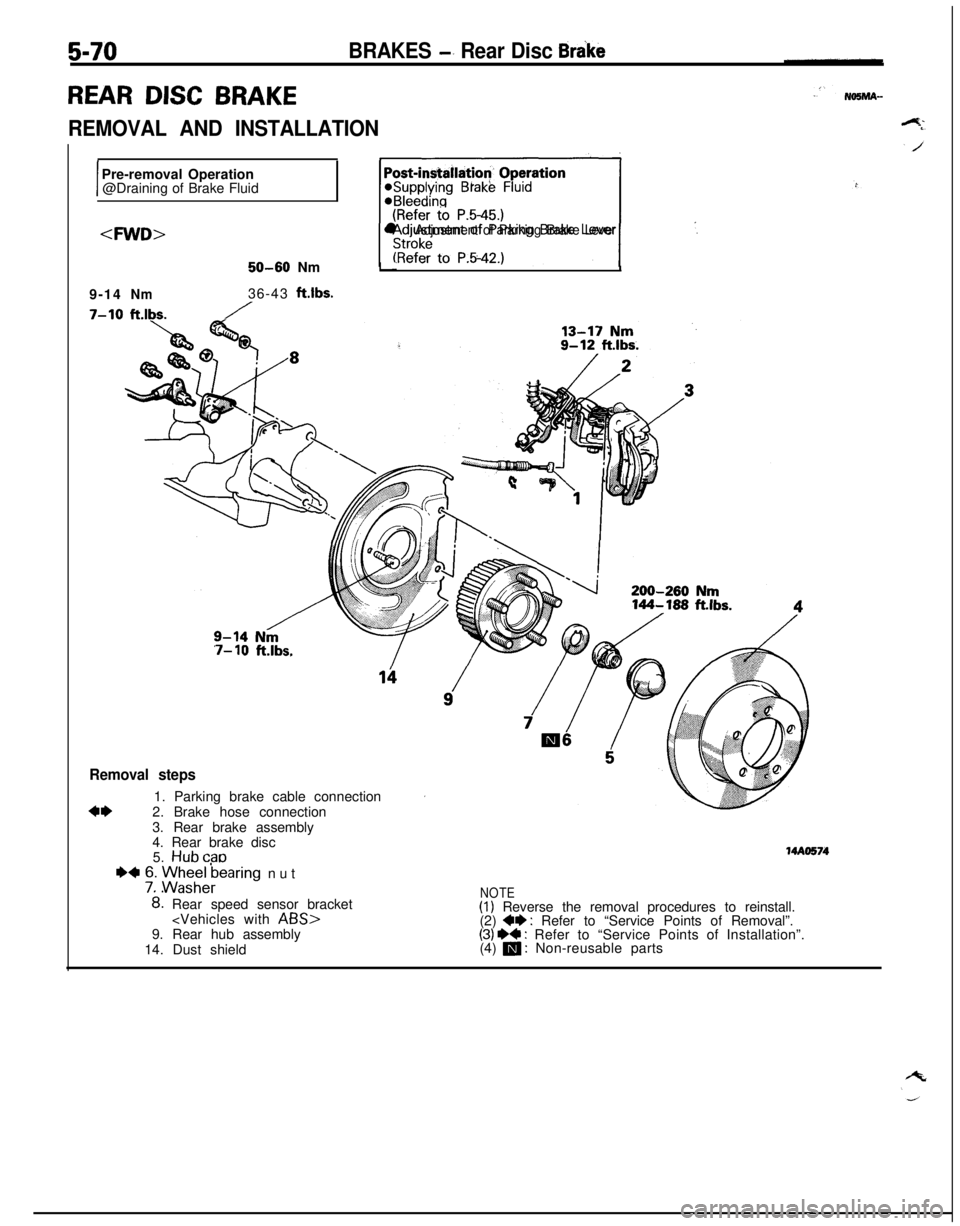
5-70
REAR DISC BRAKE
BRAKES -’ Rear Disc Brake
REMOVAL AND INSTALLATION
IPre-removal Operation
@Draining of Brake Fluid
~1 ,.
l Adjustment of Parking Brake Lever
1.150-60Nm
9-14
Nm36-43ft.lbs.
7-10ft.lbs./
7- 10ft.lbs.
Removal steps
4*1. Parking brake cable connection
2. Brake hose connection
3. Rear brake assembly
4. Rear brake disc
5.
Hubcab
+4 76. ME;AFearing nut
8: Rear speed sensor bracket
14. Dust shield
NOTE(1) Reverse the removal procedures to reinstall.
(2) +* : Refer to “Service Points of Removal”.(3) ** : Refer to “Service Points of Installation”.
(4) m : Non-reusable parts
MAO574
Page 211 of 1216
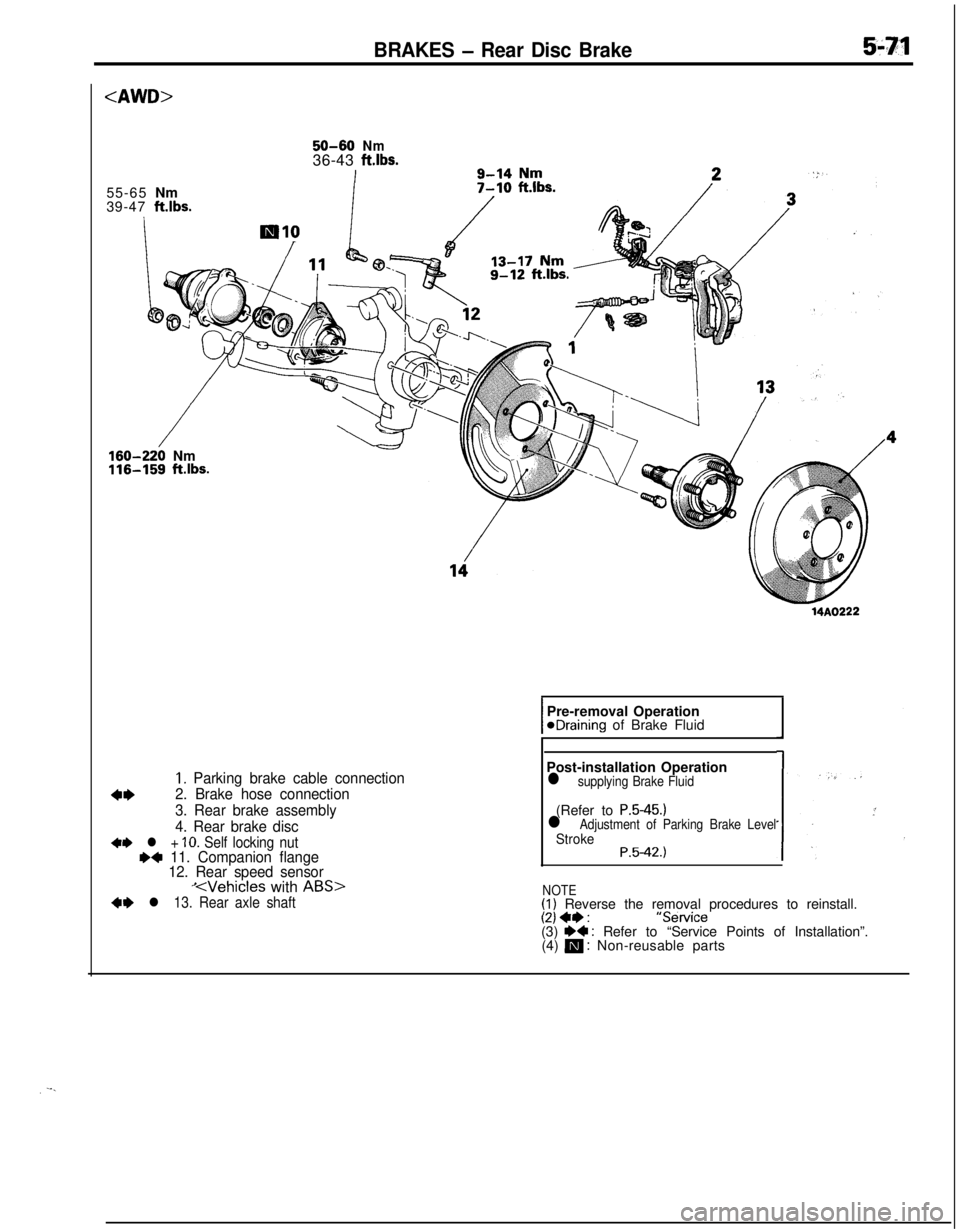
BRAKES - Rear Disc Brake59q!l
50-60Nm36-43ft.lbs.9-14Nm55-65Nm
39-47
klbs.
/160-220 Nm116-159 ft.lbs.14A0222
1. Parking brake cable connection
4*2. Brake hose connection
3. Rear brake assembly
4. Rear brake disc
+e l + IO. Self locking nutr)+ 11. Companion flange
12. Rear speed sensor
KVehicles with ABS>+e l 13. Rear axle shaftPre-removal Operation
@Draining of Brake Fluid
Post-installation Operation
l supplying Brake Fluid(Refer to
P.5-45.)l Adjustment of Parking Brake LevelStrokeP.5-42.)
NOTE
(1) Reverse the removal procedures to reinstall.(2) +e:“Service
(3) I)+ : Refer to “Service Points of Installation”.
(4) m : Non-reusable parts
Page 213 of 1216
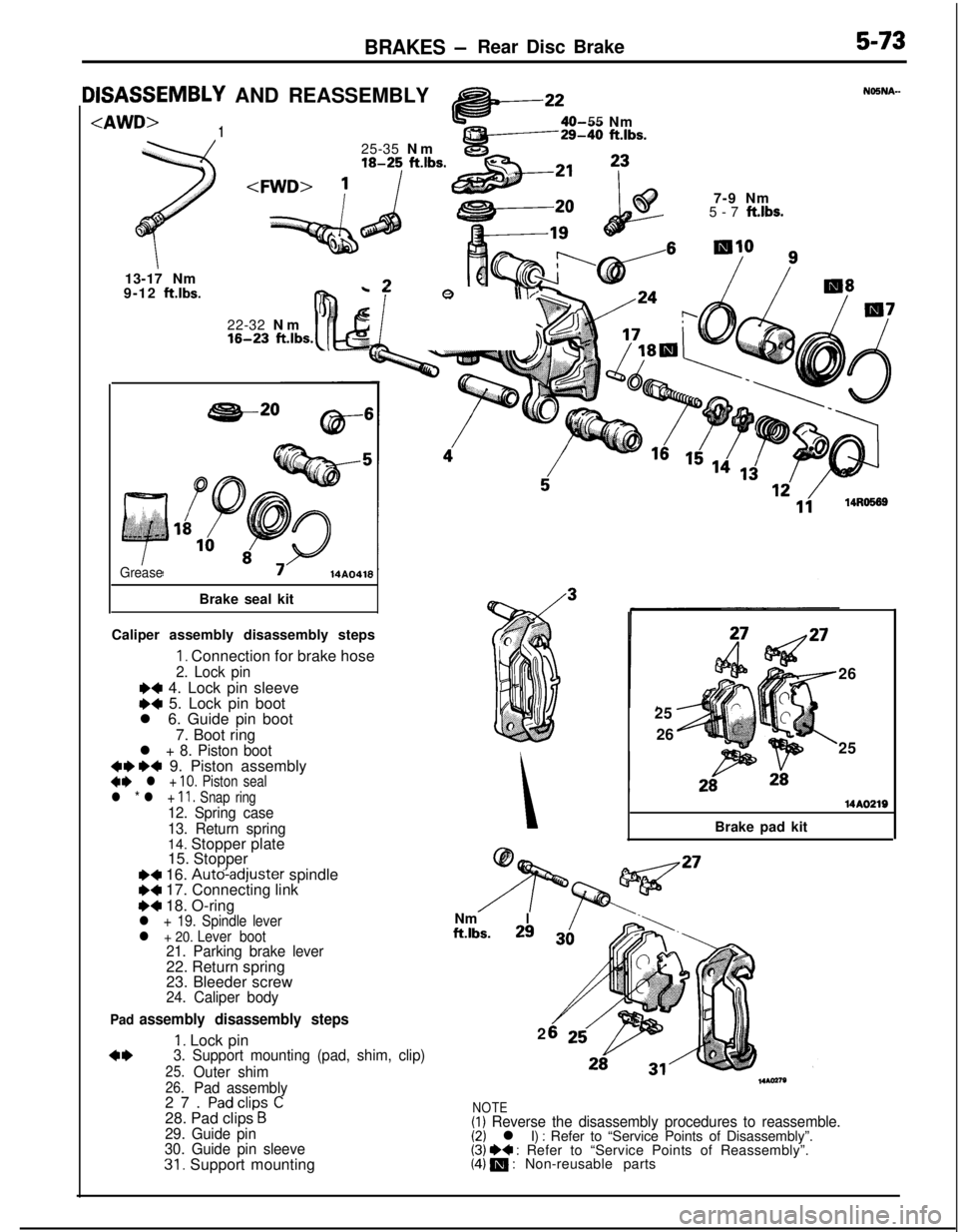
BRAKES -Rear Disc Brake5-73
IISASSEMBLY AND REASSEMBLY
125-35 Nm
18-25 ft.lbs.
;
I13-17 Nm
9-12
ftlbs.
c*:O55 Nm29-40 ft.lbs.22-32 Nm
16-23 fi.J,,s.b- Q \\T;17-9 Nm
5-7
ft.lbs.
GreaseBrake seal kit
Caliper assembly disassembly steps
1. Connection for brake hose
2. Lock pin
N 4. Lock pin sleeveM 5. Lock pin boot
l 6. Guide pin boot
7. Boot ring
l + 8. Piston boot+e W+ 9. Piston assembly** l + 10. Piston seal
l * l + Il. Snap ring12. Spring case
13. Return spring14. Stopper plate
15. Stopper
~~ 16. Auto-adjuster spindleI)+ 17. Connecting link
I)+ 18. O-ringl + 19. Spindle leverl + 20. Lever boot21. Parking brake lever22. Return spring
23. Bleeder screw
24. Caliper body
Pad
assembly disassembly steps
1. Lock pinNm
Iftlbs.293.2
*I)3. Support mounting (pad, shim, clip)
25.Outer shim26.Pad assembly27. Padclips C28. Pad clips BNOTE
29. Guide pin
30. Guide pin sleeve
31. Support mounting
(I) Reverse the disassembly procedures to reassemble.(2) l I) : Refer to “Service Points of Disassembly”.(3) H : Refer to “Service Points of Reassembly”.(4) 19 : Non-reusable parts26
25
26
25
Brake pad kit
14AO219