tire pressure MITSUBISHI ECLIPSE 1991 User Guide
[x] Cancel search | Manufacturer: MITSUBISHI, Model Year: 1991, Model line: ECLIPSE, Model: MITSUBISHI ECLIPSE 1991Pages: 1216, PDF Size: 67.42 MB
Page 1039 of 1216
22-l-.
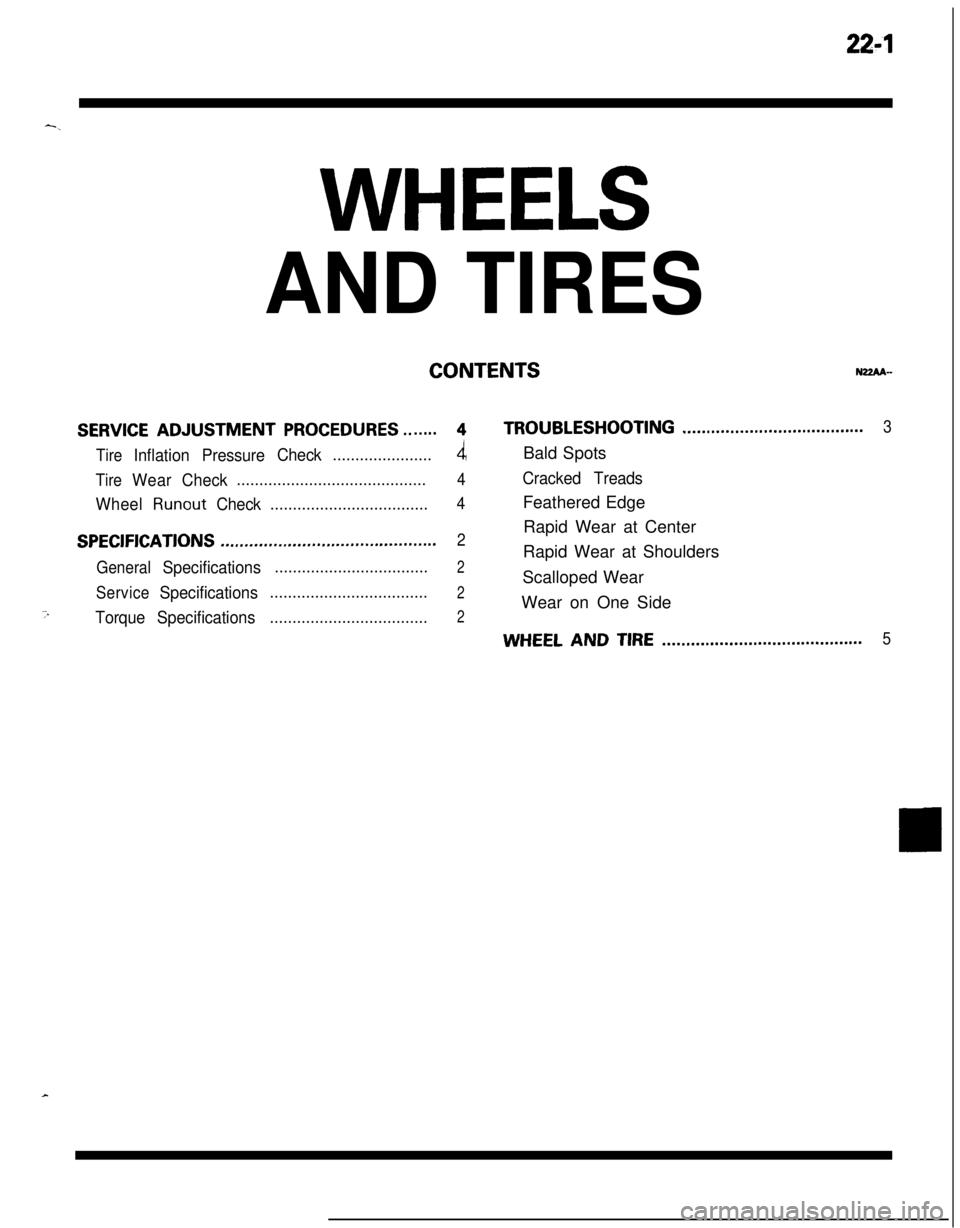
WHEELS
AND TIRES
CONTENTSNZZAA-
SERVICE ADJUSTMENT PROCEDURES.......4TROUBLESHOOTING......................................3
Tire
InflationPressureCheck......................4Bald Spots
TireWearCheck..........................................4Cracked Treads
Wheel
RunoutCheck...................................4Feathered Edge
SPECIFICATIONSRapid Wear at Center.............................................2
General
Specifications..................................2Rapid Wear at Shoulders
ServiceSpecificationsScalloped Wear...................................2Wear on One Side
7TorqueSpecifications...................................2
WHEEL AND TIRE..........................................5
Page 1040 of 1216
5 22-2WHEELS AND TIRES - Specifications
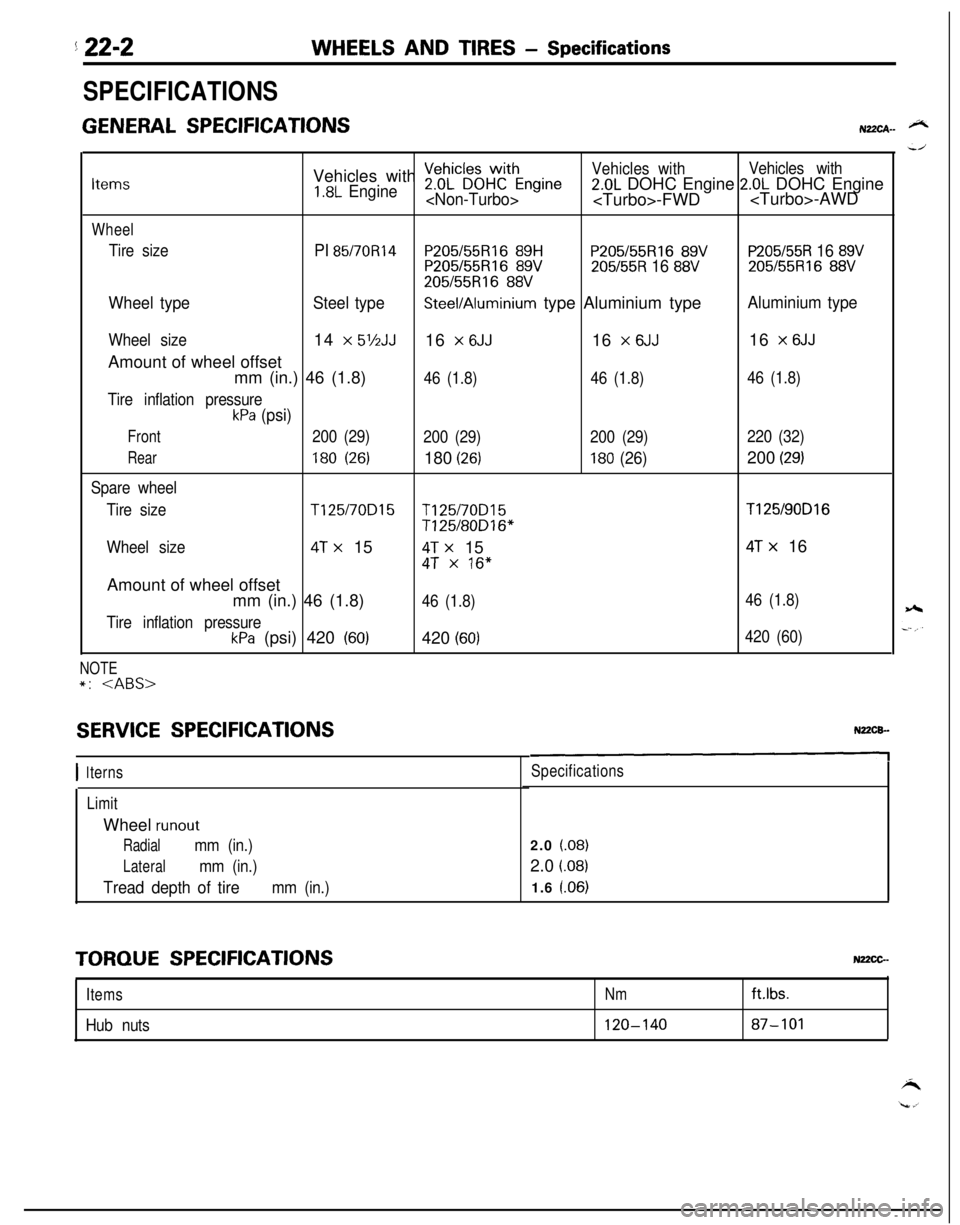
SPECIFICATIONS
GENERAL SPECIFICATIONSN22CA- @NVehicles with
~eDhL”~~HWCthEngineVehicles withVehicles withItems1.8L Engine2.0L DOHC Engine 2.0L DOHC Engine
Wheel
Tire sizePI 85/70R14P205155Rl6 89HP205/55R16 89VP205/55R 16 89VP205155R16 89V205/55R 16 88V205/55R16 88V
205/55R16 88V
Wheel typeSteel typeSteel/Aluminium type Aluminium typeAluminium type
Wheel size14 x 5’/2JJ16 x 6JJ16 x 6JJ16 x 6JJAmount of wheel offset
mm (in.) 46 (1.8)
46 (1.8)46 (1.8)46 (1.8)
Tire inflation pressure
kPa (psi)
Front200 (29)
200 (29)200 (29)220 (32)
Rear180 (26)180 (26)180 (26)200 (29)
Spare wheel
Tire size
T125/70D15T125/70D15T125/90D16
T125/80D16*
Wheel size
4T x 154T x 154T x 16
4T x 16”Amount of wheel offset
mm (in.) 46 (1.8)
46 (1.8)46 (1.8)
Tire inflation pressure
kPa (psi) 420 (60)420 (60)420 (60)
NOTE*:
SERVICE SPECIFICATIONS
I 1terns
LimitWheel
runout
Radialmm (in.)
Lateralmm (in.)
Tread depth of tiremm (in.)
Specifications2.0
(.08)2.0
i.08)1.6 l.06)
TORQUE SPECIFICATIONSNz2cG-
ItemsNm
Hub nuts120-140ftlbs.87-101
Page 1041 of 1216
WHEELS AND TIRES - Troubleshooting22-3
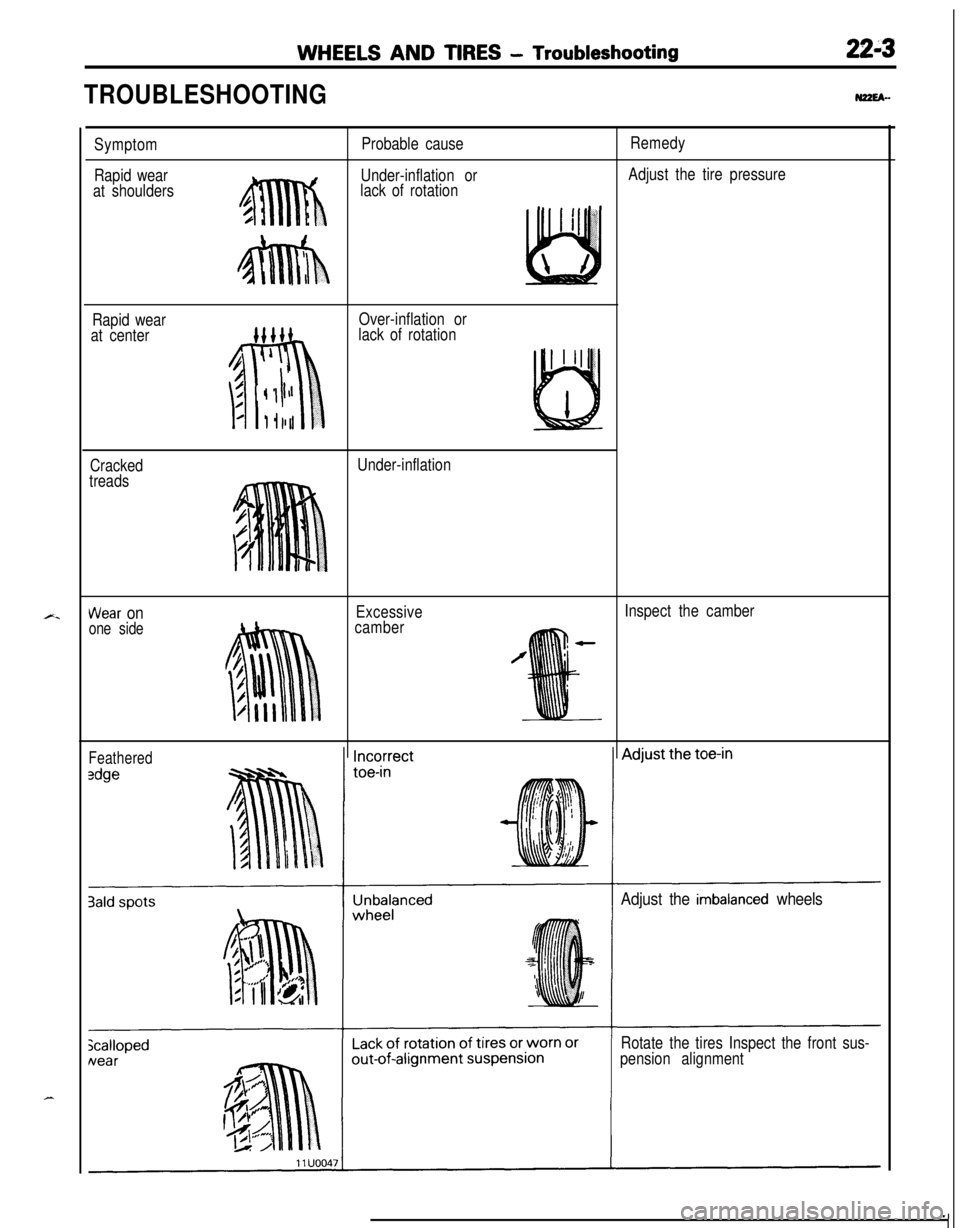
TROUBLESHOOTINGN22EA-
Symptom
Rapid wear
at shouldersProbable cause
Under-inflation or
lack of rotationRemedy
Adjust the tire pressure
Rapid wear
at centerOver-inflation or
lack of rotation
Cracked
treadsUnder-inflation
Wear onone side
Excessive
camberInspect the camber
Feathered
Adjust the imbalanced wheels
Rotate the tires Inspect the front sus-
pension alignment
Page 1042 of 1216
22-4WHEELS AND TIRES - Service Adjustment Procedures
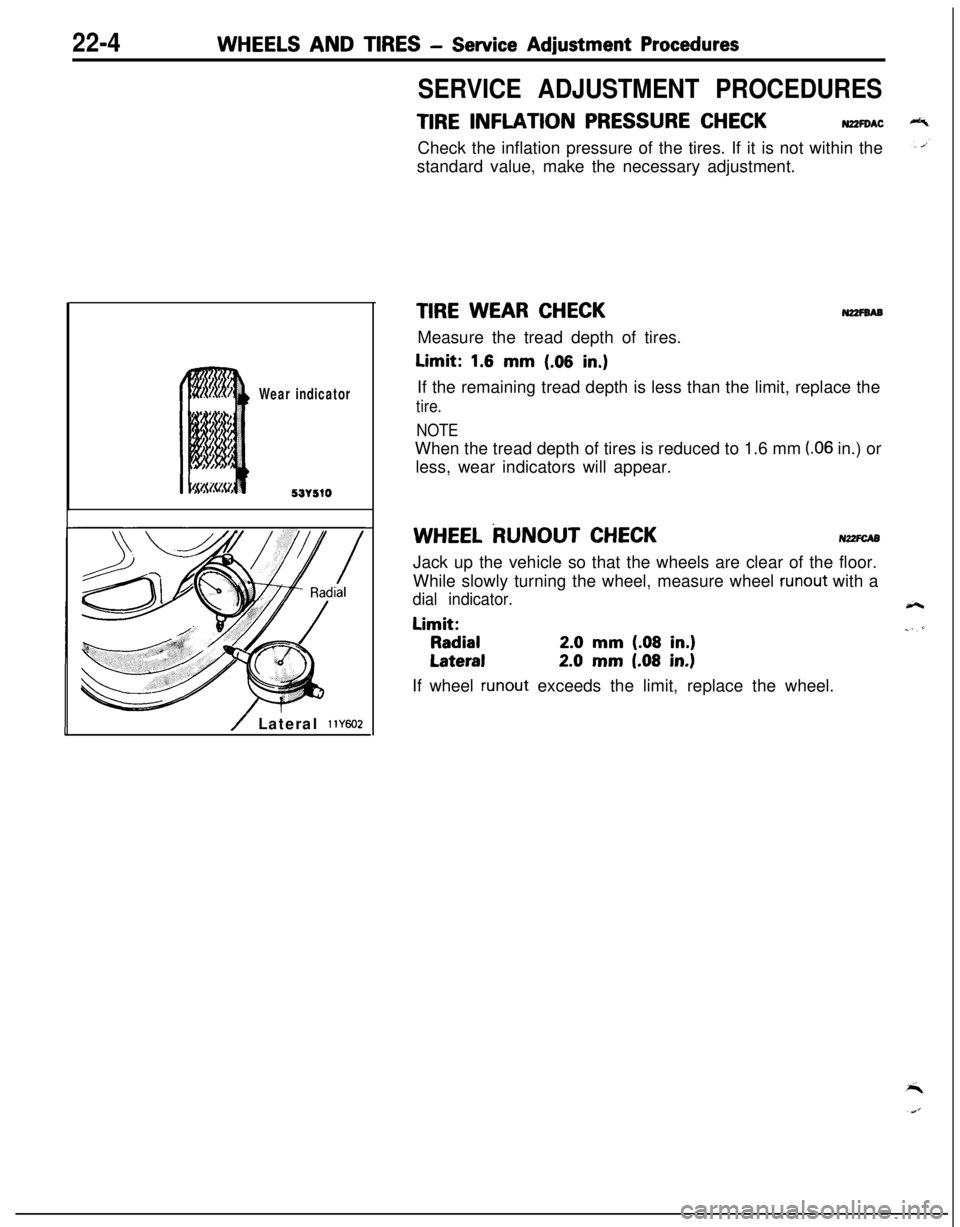
Wear indicator
53r510
/ Lateral 11Y602
SERVICE ADJUSTMENT PROCEDURES
TIRE INFLATION PRESSURE CHECKN2ZFOACCheck the inflation pressure of the tires. If it is not within the
standard value, make the necessary adjustment.
TIRE WEAR CHECKN2zFsABMeasure the tread depth of tires.Limit:
1.6 mm (.06 in,)If the remaining tread depth is less than the limit, replace the
tire.
NOTEWhen the tread depth of tires is reduced to 1.6 mm
(.06 in.) or
less, wear indicators will appear.
WHEEL RUNOUT CHECKNZ2FCA5Jack up the vehicle so that the wheels are clear of the floor.
While slowly turning the wheel, measure wheel
runout with a
dial indicator.Limit:
Radial2.0 mm (.08 in.)
Lateral2.0 mm (.08 in.)If wheel
runout exceeds the limit, replace the wheel.
Page 1044 of 1216
22-6WHEELS AND TIRES - Wheel and Tire
INSTRUCTIONS FOR ALUMINUM TYPE
WHEELSUzzGfM
1. Aluminum is vulnerable to alkalies. If a vehicle
washing detergent has been used, or salt from
sea water or road chemicals has adhered, washthe vehicle as soon as possible. After washing
the vehicle, apply body or wheel wax to the
aluminum type wheels to prevent corrosion.
2. When cleaning the vehicle with steam, do not
direct steam onto the aluminum type wheels.
When tightening nuts for aluminum type
wheels, particularly observe the following:
(1) Clean the hub surface of aluminum type
wheels.(2) After finger-tightening wheel nuts, tighten
them to specifications.
(3) Do not use an impact wrench or push the
wrench by foot to tighten the wheel nuts.
(4) Do not apply oil to the threaded portions.
INSTRUCTIONS FOR TIRE CHAINS AND
SNOW TIRESNZZGGAA
1.Use tire chains only on front wheels. Do not usetire chains on rear wheels.
2. When using snow tires, use them on all four
wheels for maneuverability and safety.
INSTRUCTIONS FOR COMPACT SPARE
TIRE;c.1. The compact spare tire is designed to. save
space in the luggage compartment, and its
L’lighter weight makes it easier to use if a fiat tire
occurs.
2.The following instructions for the compact sparetire should be observed.
(1) Check the inflation pressure after installing
the spare, and adjust to the specified pres-
sure.(2) Avoid driving through automatic car washes
and over obstacles that could possibly dam-
age the vehicle’s undercarriage. Because
the tire is smaller than the original tire, car
ground clearance is slightly reduced.
(3) The compact spare tire should not be used
on any other wheels, nor should standard
tires, snow tires, wheel covers or trim rings
be used with the compact spare wheel. If
such use is attempted, damage to these
items or other vehicle components may
occur.
Page 1094 of 1216
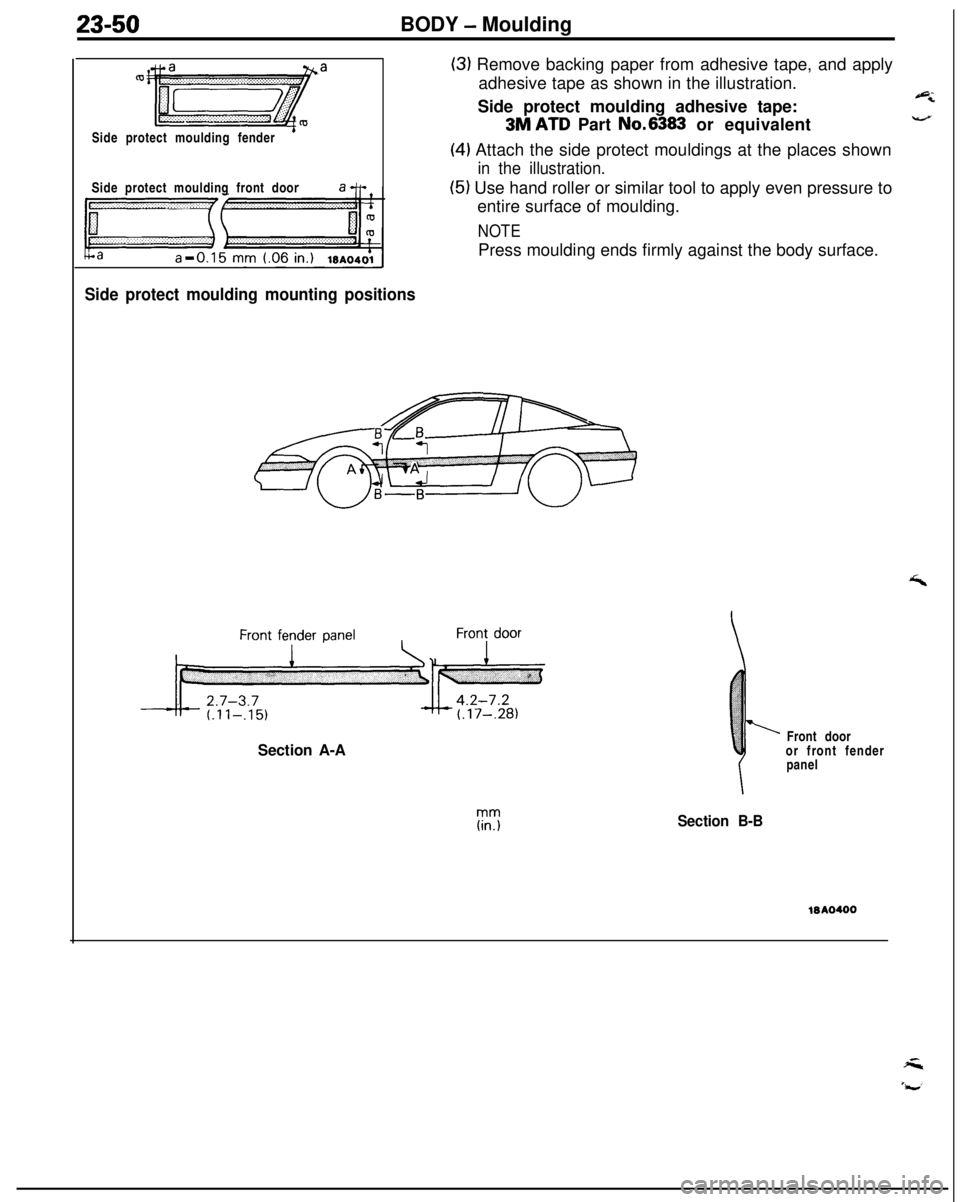
23-50BODY - Moulding
Side protect moulding fender
’Side protect moulding front door
Side protect moulding mounting positions
(3) Remove backing paper from adhesive tape, and apply
adhesive tape as shown in the illustration.
Side protect moulding adhesive tape:
6
3M ATD Part No.6383 or equivalentV
(4) Attach the side protect mouldings at the places shown
in the illustration.
(5) Use hand roller or similar tool to apply even pressure to
entire surface of moulding.
NOTEPress moulding ends firmly against the body surface.
Section A-AFront door
or front fender
ipanel
Section B-BWA0400
Page 1119 of 1216
BODY - Aero Parts23-75
\18A0245
16A0765
18A041618A041C
SERVICE POINTS OF REMOVAL
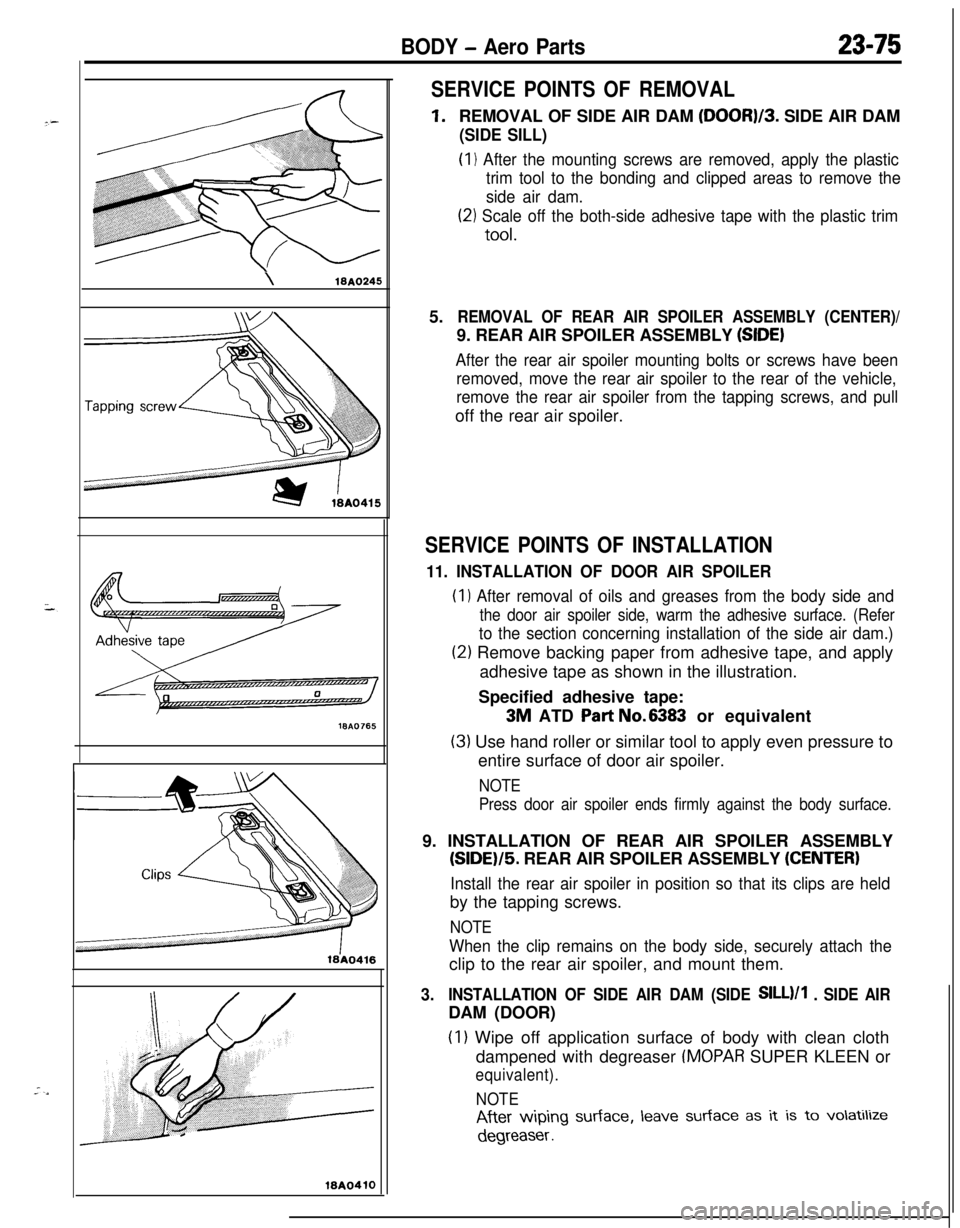
1.REMOVAL OF SIDE AIR DAM (DOOR)/3. SIDE AIR DAM
(SIDE SILL)(I
1 After the mounting screws are removed, apply the plastic
trim tool to the bonding and clipped areas to remove the
side air dam.
(21 Scale off the both-side adhesive tape with the plastic trim
tool.5.
REMOVAL OF REAR AIR SPOILER ASSEMBLY (CENTER)/9. REAR AIR SPOILER ASSEMBLY
(SIDE)
After the rear air spoiler mounting bolts or screws have been
removed, move the rear air spoiler to the rear of the vehicle,
remove the rear air spoiler from the tapping screws, and pulloff the rear air spoiler.
SERVICE POINTS OF INSTALLATION
11. INSTALLATION OF DOOR AIR SPOILER(I
1 After removal of oils and greases from the body side and
the door air spoiler side, warm the adhesive surface. (Refer
to the section concerning installation of the side air dam.)
(2) Remove backing paper from adhesive tape, and apply
adhesive tape as shown in the illustration.
Specified adhesive tape:
3M ATD Part No.6383 or equivalent
(3) Use hand roller or similar tool to apply even pressure to
entire surface of door air spoiler.
NOTE
Press door air spoiler ends firmly against the body surface.9. INSTALLATION OF REAR AIR SPOILER ASSEMBLY
(SIDE)/5. REAR AIR SPOILER ASSEMBLY (CENTER)
Install the rear air spoiler in position so that its clips are heldby the tapping screws.
NOTE
When the clip remains on the body side, securely attach theclip to the rear air spoiler, and mount them.
3.INSTALLATION OF SIDE AIR DAM (SIDE SILL)/1 . SIDE AIRDAM (DOOR)
(I 1 Wipe off application surface of body with clean cloth
dampened with degreaser
IMOPAR SUPER KLEEN or
equivalent).
NOTE
After wiping surface, leave surface as it is to volatilize
degreaser .
Page 1120 of 1216
23-76BODY - Aero Parts
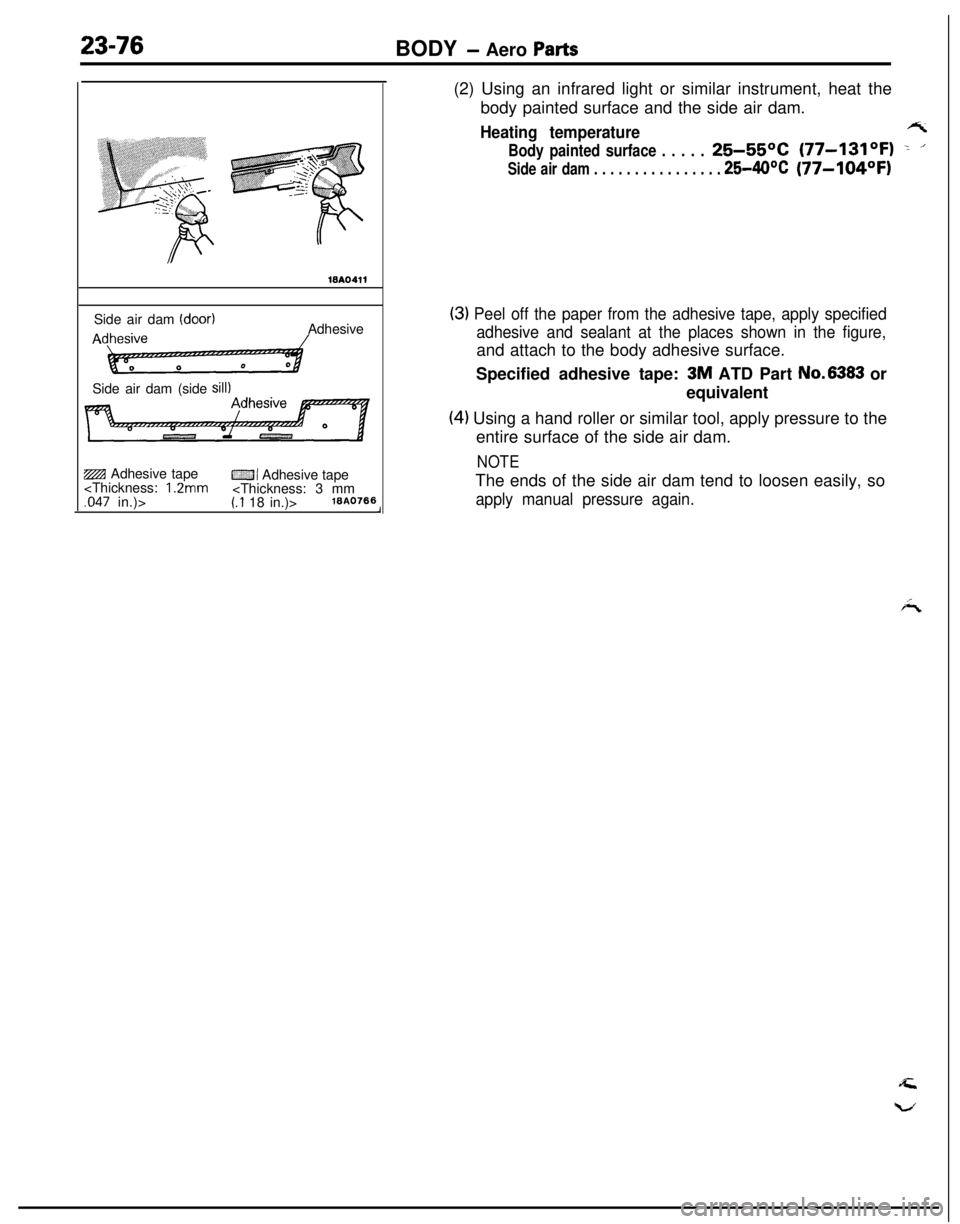
WA0411Side air dam
(door)AAdhesive
Side air dam (side
sill)ZBI Adhesive tape
CZJI Adhesive tape
body painted surface and the side air dam.
Heating temperaturert
Body painted surface . . . . .25-55OC (77-131OF) -. ’
Side air dam . . . . . . . . . . . . . . . . 25-40°C(77-104OFI
(3) Peel off the paper from the adhesive tape, apply specified
adhesive and sealant at the places shown in the figure,and attach to the body adhesive surface.
Specified adhesive tape:
3M ATD Part No.6383 or
equivalent
(4) Using a hand roller or similar tool, apply pressure to the
entire surface of the side air dam.
NOTEThe ends of the side air dam tend to loosen easily, so
apply manual pressure again.
Page 1163 of 1216
-.
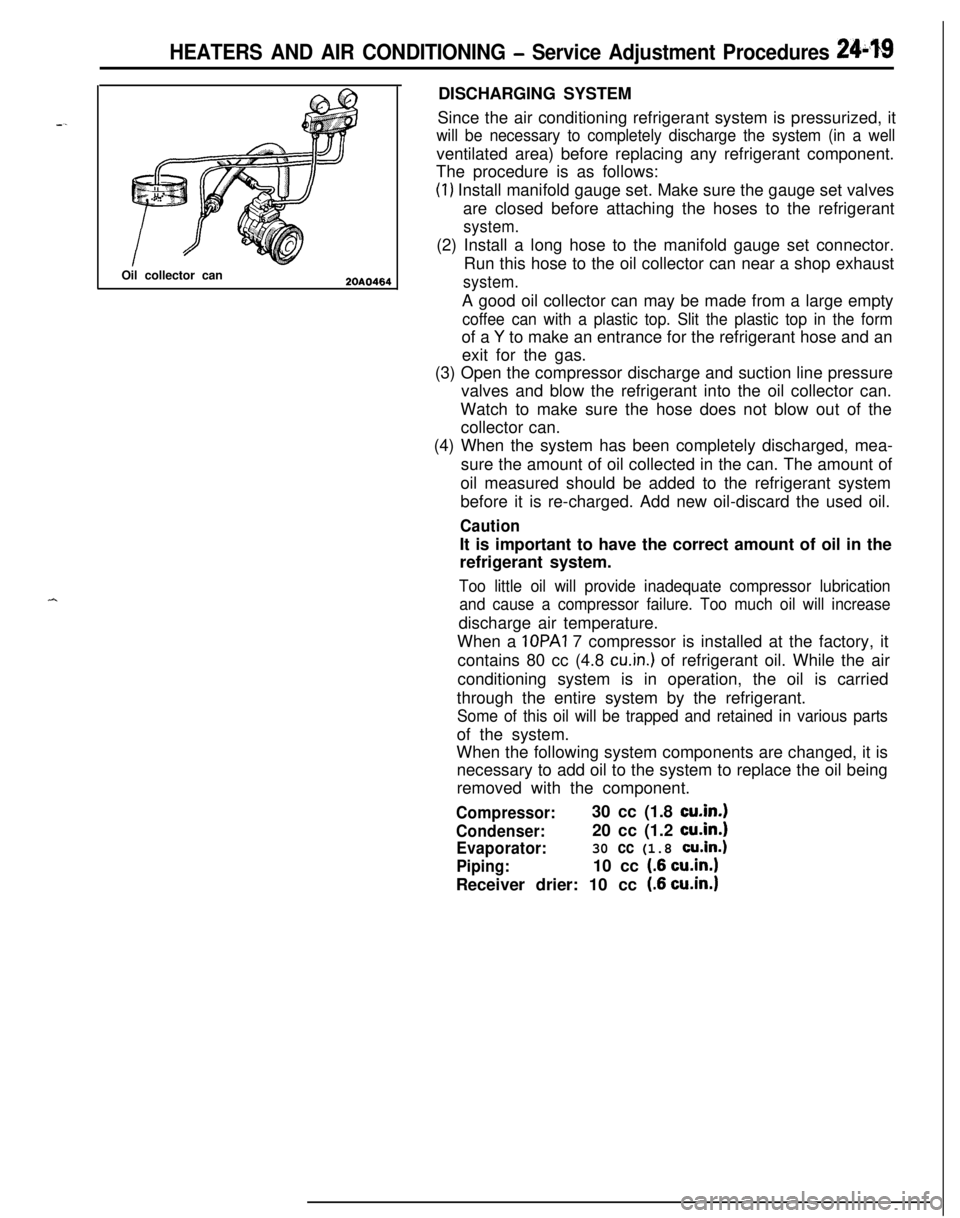
HEATERS AND AIR CONDITIONING - Service Adjustment Procedures 241$19Oil collector can
2OAO464DISCHARGING SYSTEM
Since the air conditioning refrigerant system is pressurized, it
will be necessary to completely discharge the system (in a wellventilated area) before replacing any refrigerant component.
The procedure is as follows:
(1) Install manifold gauge set. Make sure the gauge set valves
are closed before attaching the hoses to the refrigerant
system.(2) Install a long hose to the manifold gauge set connector.
Run this hose to the oil collector can near a shop exhaust
system.A good oil collector can may be made from a large empty
coffee can with a plastic top. Slit the plastic top in the formof a
Y to make an entrance for the refrigerant hose and an
exit for the gas.
(3) Open the compressor discharge and suction line pressure
valves and blow the refrigerant into the oil collector can.
Watch to make sure the hose does not blow out of the
collector can.
(4) When the system has been completely discharged, mea-
sure the amount of oil collected in the can. The amount of
oil measured should be added to the refrigerant system
before it is re-charged. Add new oil-discard the used oil.
CautionIt is important to have the correct amount of oil in the
refrigerant system.
Too little oil will provide inadequate compressor lubrication
and cause a compressor failure. Too much oil will increasedischarge air temperature.
When a IOPAI 7 compressor is installed at the factory, it
contains 80 cc (4.8
cu.in.) of refrigerant oil. While the air
conditioning system is in operation, the oil is carried
through the entire system by the refrigerant.
Some of this oil will be trapped and retained in various partsof the system.
When the following system components are changed, it is
necessary to add oil to the system to replace the oil being
removed with the component.
Compressor:30 cc (1.8 cu.in.1
Condenser:20 cc (1.2 cu.in.1
Evaporator:30 cc (1.8 cu.in.)
Piping:10 cc (.6 cu.in.1Receiver drier: 10 cc
(.6 cu.in.1
Page 1166 of 1216
24-22 HEATERS AND AIR CONDITIONING - Service Adjustment Procedures(9) Charge through the suction side of the system by slowly
opening the suction manifold valve. Adjust the valve as
necessary so charging pressure does not exceed 345
kPa 6(50 psi). Maintain the temperature of the water in the pan w’
by adding warm water as necessary.
Note the weight of water added, to ensure accuracy when
determining amount of refrigerant added to system.
(lO)When specified refrigerant charge Max. 925
g (32 oz.) has
entered the system, close the gauge set manifold valves,
refrigerant manifold valves, and
reconnnect wiring. Each
can contains 397
g (14 oz.) of R-l 2. Use 2 l/2 cans.
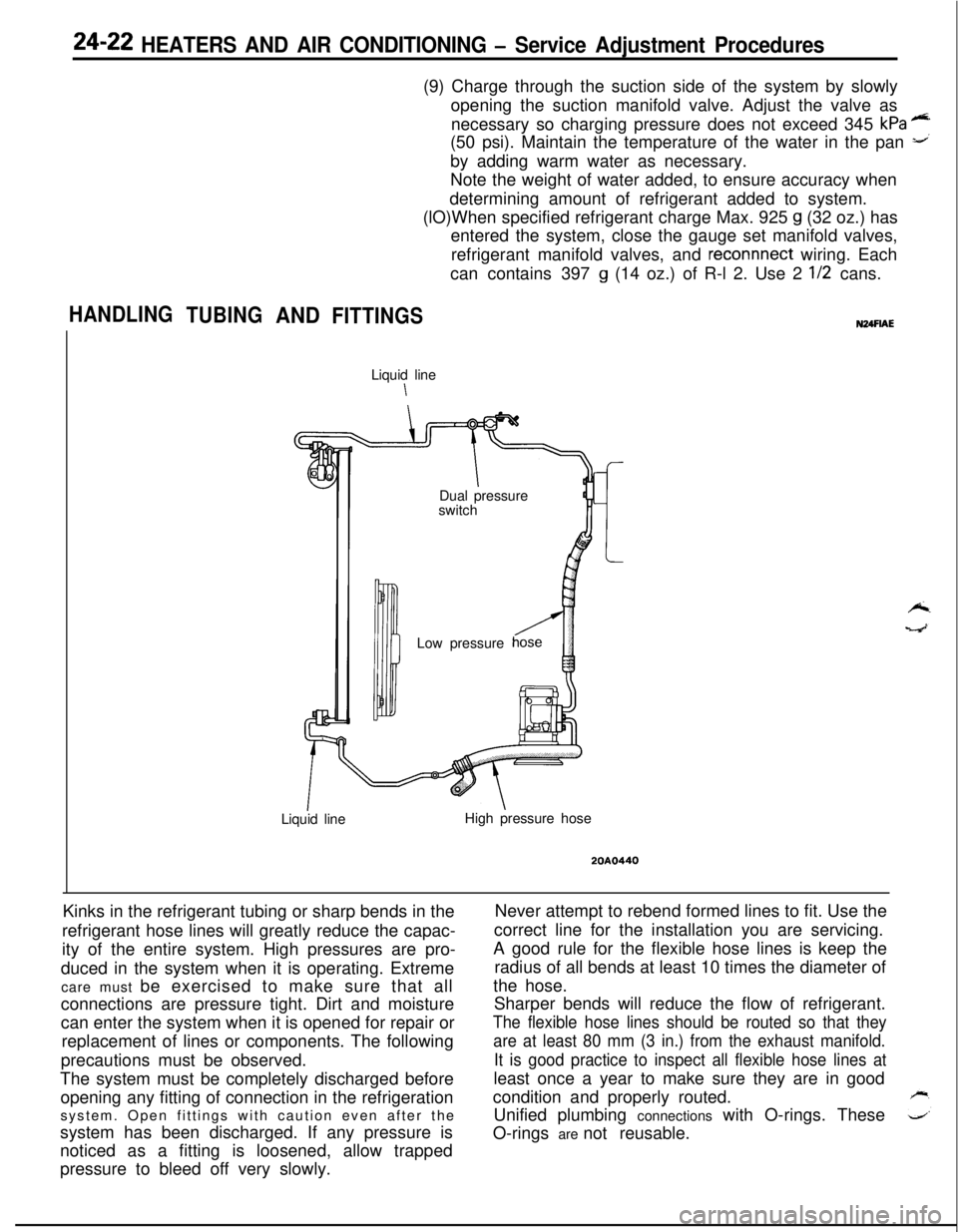
HANDLING
TUBINGANDFITTINGSLiquid line
\
IDual pressure
switch
Low pressure
Liquid lineHigh pressure hose
20A0440Kinks in the refrigerant tubing or sharp bends in the
refrigerant hose lines will greatly reduce the capac-
ity of the entire system. High pressures are pro-
duced in the system when it is operating. Extreme
care must be exercised to make sure that all
connections are pressure tight. Dirt and moisture
can enter the system when it is opened for repair or
replacement of lines or components. The following
precautions must be observed.
The system must be completely discharged before
opening any fitting of connection in the refrigeration
system. Open fittings with caution even after the
system has been discharged. If any pressure is
noticed as a fitting is loosened, allow trapped
pressure to bleed off very slowly.Never attempt to rebend formed lines to fit. Use the
correct line for the installation you are servicing.
A good rule for the flexible hose lines is keep the
radius of all bends at least 10 times the diameter of
the hose.
Sharper bends will reduce the flow of refrigerant.
The flexible hose lines should be routed so that they
are at least 80 mm (3 in.) from the exhaust manifold.
It is good practice to inspect all flexible hose lines atleast once a year to make sure they are in good
condition and properly routed.
Unified plumbing connections with O-rings. These
O-rings are not reusable.