brake MITSUBISHI ECLIPSE CROSS 2020 Owner's Manual (in English)
[x] Cancel search | Manufacturer: MITSUBISHI, Model Year: 2020, Model line: ECLIPSE CROSS, Model: MITSUBISHI ECLIPSE CROSS 2020Pages: 427, PDF Size: 78.05 MB
Page 7 of 427
Instruments and controls 1-3 Overview
1
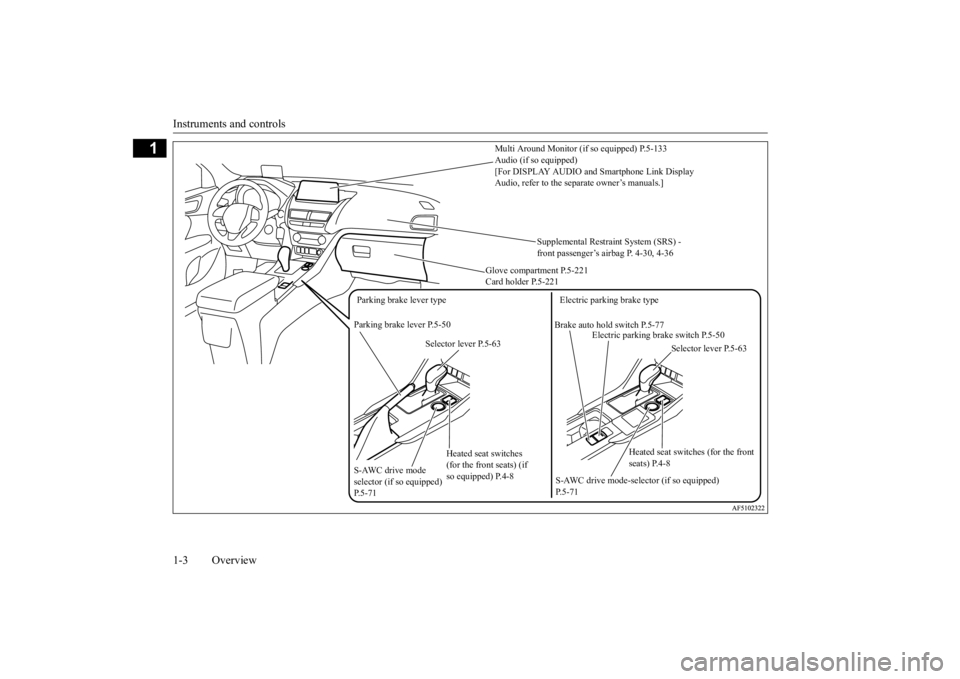
Supplemental Restraint System (SRS) - front passenger’s airbag P. 4-30, 4-36
Glove compartment P.5-221 Card holder P.5-221
S-AWC drive mode-selec
tor (if so equipped)
P.5-71
Parking brake lever P.5-50
Heated seat switches (for the front seats) P.4-8
Selector lever P.5-63
Brake auto hold switch P.5-77
S-AWC drive mode selector (if so equipped)P.5-71
Electric parking brake type
Parking brake lever type
Heated seat switches (for the front seats) (if so equipped) P.4-8
Electric parking brake switch P.5-50
Selector lever P.5-63
Multi Around Monitor (if
so equipped) P.5-133
Audio (if so equipped) [For DISPLAY AUDIO and Smartphone Link Display Audio, refer to the sepa
rate owner’s manuals.]
BK0277700US.bo
ok 3 ページ 2019年3月8日 金曜日 午前9時23分
Page 14 of 427
2-1
2
If this warning light comes on or
flashes while you’re driving...
Quick index
N00200702380
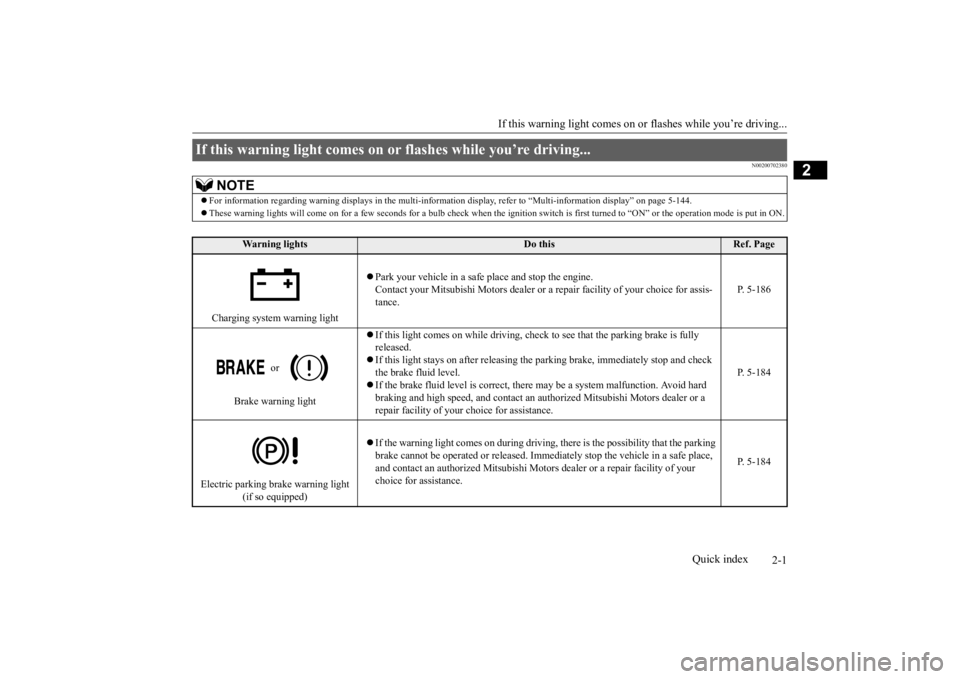
If this warning light comes on or flashes while you’re driving...
NOTE
For information regarding warning displays in the multi-informat
ion display, refer to “Multi-information display” on page 5-144
.
These warning lights will come on for a few seconds for a bulb check
when the ignition switch is first turned to “ON” or the op
eration mode is put in ON.
Wa r n i n g l i g h t s
Do this
Ref. Page
Charging system warning light
Park your vehicle in a safe place and stop the engine. Contact your Mitsubishi Motors dealer or
a repair facility of your choice for assis-
tance.
P. 5-186
or
Brake warning light
If this light comes on while driving, check to see that the parking brake is fully released. If this light stays on after releasing the parking brake, immediately stop and check the brake fluid level. If the brake fluid level is correct, there may be a system malfunction. Avoid hard braking and high speed, and contact an aut
horized Mitsubishi Mo
tors dealer or a
repair facility of your choice for assistance.
P. 5-184
Electric parking brake warning light
(if so equipped)
If the warning light comes on during driving, th
ere is the possibility that the parking
brake cannot be operated or released. Immediately stop the vehicle in a safe place, and contact an authorized Mitsubishi Moto
rs dealer or a repair facility of your
choice for assistance.
P. 5-184
BK0277700US.bo
ok 1 ページ 2019年3月8日 金曜日 午前9時23分
Page 17 of 427
If this problem occurs... 2-4 Quick index
2
N00200902148
If this problem occurs...
Problem
Do this
Ref. Page
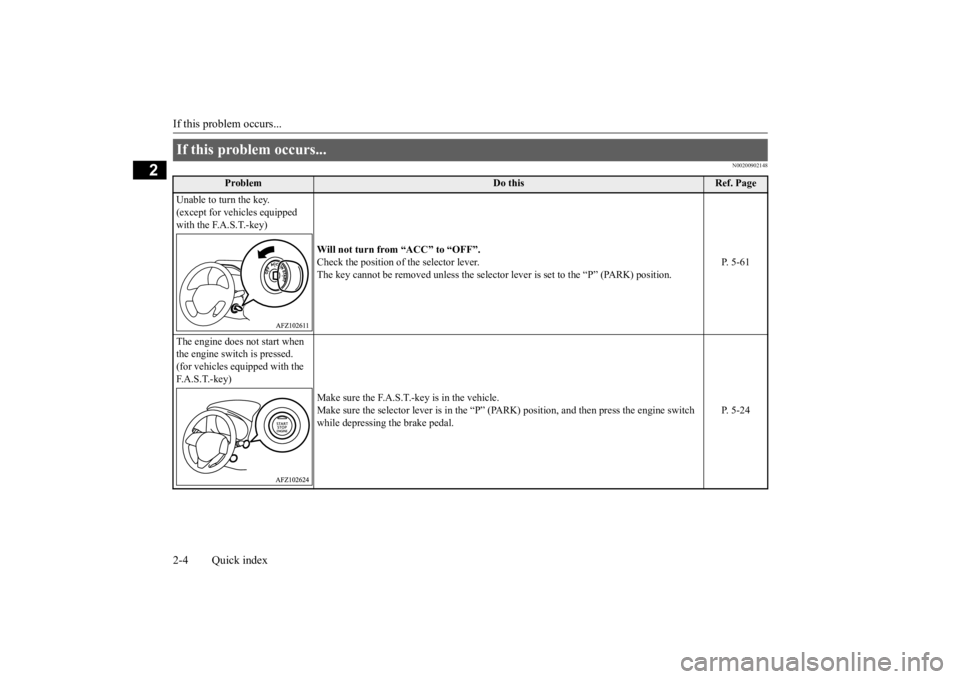
Unable to turn the key. (except for vehicles equipped with the F.A.S.T.-key)
Will not turn from “ACC” to “OFF”. Check the position of the selector lever. The key cannot be removed unless the selector
lever is set to the “P” (PARK) position.
P. 5-61
The engine does not start when the engine switch is pressed.(for vehicles equipped with the F. A . S . T. - k e y )
Make sure the F.A.S.T.-key is in the vehicle. Make sure the selector lever is in the “P” (PAR
K) position, and then press the engine switch
while depressing the brake pedal.
P. 5-24
BK0277700US.bo
ok 4 ページ 2019年3月8日 金曜日 午前9時23分
Page 18 of 427

If this problem occurs...
Quick index 2-5
2
The engine does not start and the operation mode cannot be changed to OFF. (for vehicles equipped with the F.A.S.T.-key)
1. Move the selector lever to the “P” (PARK)
position, and then change the operation mode
to OFF. 2. One of the other causes could be low battery
voltage. If this occurs, the keyless entry sys-
tem and the F.A.S.T.-key operation will also no
t operate. Contact an authorized Mitsubishi
Motors dealer or a repair facility of your choice.
P. 5-20
The F.A.S.T.-key does not oper- ate.(for vehicles equipped with the F. A . S . T. - k e y )
Touch the portion of the F.A.S.T.-key to the engine
switch, and then start the engine or change
the operation mode. Use the emergency key to lock and unlock the driver’s door.
P. 5-26, 5-27
Cannot shift the selector lever from the “P” (PARK) position.
Shift the selector lever while pressing the brake pedal. Check that the ignition switch or the operation mode is in ON.
P. 5-63
The windows are fogged up.
Push the defogger switch to
change to the “ ” position.
P. 7-3, 7-9, 7-13, 7-18,
7-22
The engine does not start. The lights do not come on. The lights are dim.The horn does not honk. The horn sound is weak.
Have the battery checked. Recharge or replace as needed.
P. 8-2, 9-10
Problem
Do this
Ref. Page
BK0277700US.bo
ok 5 ページ 2019年3月8日 金曜日 午前9時23分
Page 20 of 427
If this problem occurs...
Quick index 2-7
2
WA R N I N G When attempting to rock your vehicle out of
a stuck position, be sure that no one is
near the vehicle. The rocking motion may c
ause the vehicle to
suddenly lurch forward or backward, possibly injuring bystanders. Avoid revving the engine or spinning the
wheels. Prolonged efforts to free a stuck ve
hicle may result in overheating and transa
xle failure.
If the vehicle remains stuck after several rocking at
tempts, have a towing service pull the vehicle out.
Problem
Do this
Ref. Page
The brakes are not functioning properly after crossing a puddle or stream.
Dry out the brakes by driving slowly while lightly pressing the brake pedal.
P. 5-74, 6-5
The continuously variable trans- mission (CVT) makes no shift change when accelerating. The initial movement of the vehicle is slow when the vehicle starts moving.
There may be a problem in the CVT. If the or warning display on the multi-inform
ation display will not turn off, or if they
come on frequently, immediately have the vehicle
checked at your nearest Mitsubishi Motors
dealer.
P. 5-68
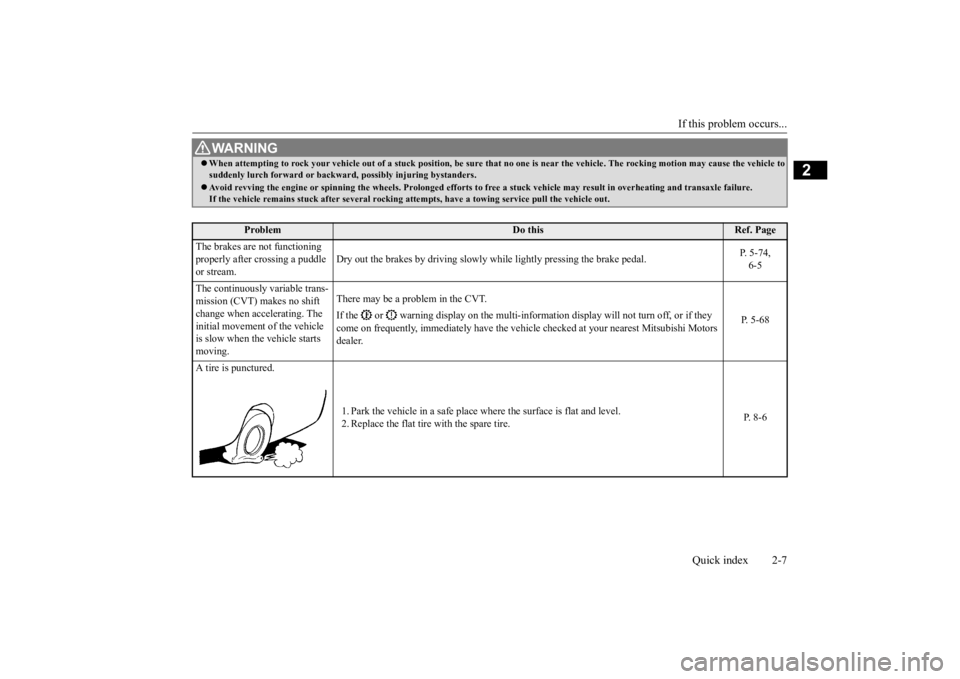
A tire is punctured.
1. Park the vehicle in a safe place where the surface is flat and level. 2. Replace the flat tire with the spare tire.
P. 8-6
BK0277700US.bo
ok 7 ページ 2019年3月8日 金曜日 午前9時23分
Page 35 of 427

Event Data Recording 3-14 General information
3
However, you can add to the future perfor- mance and economy of your vehicle by observing the follow
ing precautions during
the first 300 miles (500 km).Drive your vehicle at moderate speeds during the break-in period. Avoid revving the engine. Avoid rough driving such as sudden starts, sudden acceleration, prolonged high- speed driving and sudden braking. These actions would have a detrimental effect onthe engine and lead to increased fuel andoil consumption; this could ultimately result in the malfunction of engine com- ponents. Be particularly careful to avoidfull acceleration while in low shift posi- tion (low gears). Do not overload the vehicle. Stay within the seating capacity. Refer to “Cargo load precautions” on page 6-10. Refrain from towing a trailer or other vehicle. Refer to “Trailer towing” on page 6-11.
N00302700059
This vehicle is equipped with an event datarecorder (EDR).The main purpose of an EDR is to record, in certain crash or near crash-like situations,
such as an airbag deployment or hitting a road obstacle, data that will assist in under- standing how a vehicle’s systems performed. The EDR is designed to record data related tovehicle dynamics and safety systems for a short period of time, typically 30 seconds or less. The EDR in this vehicle is designed to record such data as: How various systems in your vehicle were operating; Whether or not the driver and front pas- senger safety belts were buckled/fastened; How far (if at all) the driver was depress- ing the accelerator and/or brake pedal; and, How fast the vehicle was traveling.
These data can help provide a better under- standing of the circumstances in which crashes and injuries occur.
To read data recorded by an EDR, special equipment is required, and access to the vehi- cle or the EDR is needed. In addition to the vehicle manufacturer, other parties, such aslaw enforcement, that have the special equip- ment, can read the information if they have access to the vehicle or the EDR.
Event Data Recording
NOTE
EDR data are recorded by your vehicle only if a non-trivial crash situation occurs; no data are recorded by the EDR under normal driv- ing conditions and no personal data (e.g., name, gender, age, and crash location) arerecorded. However, other parties, such as law enforcement, could combine the EDR data with the type of personally identifyingdata routinely acquired during a crash inves- tigation.
BK0277700US.bo
ok 14 ページ 2019年3月8日 金曜日 午前9時23分
Page 66 of 427
Supplemental Restraint System (SRS) - airbag
Seat and restraint systems 4-31
4
in both side impact and rollover type acci- dents. The SRS airbags are NOT
a substitute for use
of the seat belts. For maximum protection in all types of accidents, seat belts mustALWAYS be worn by everyone who drives or rides in this vehicle (with infants and small children in an appropriate child restraint sys-tem in the rear seat, and older children buck- led in the rear seat). Refer to “Child restraint systems” on page 4-22.
WA R N I N G IT IS VERY IMPORTANT TO ALWAYS WEAR YOUR SEAT BELT PROPERLYEVEN WITH AN AIRBAG.• Seat belts help keep the driver and pas-sengers properly positioned. This reduces the risk of injury in all collisions, and reduces the risk of serious injuries ordeath when the airbags inflate. During sudden braking just before a col- lision, an unrestrained or improperlyrestrained driver or front passenger can move forward into direct contact with, or within close proximity to, the airbag when it begins to inflate. The beginning stage of airbag inflation isthe most forceful and can cause serious injuries or death if the occupant comes in contact with the airbag at this time.
• Seat belts reduce the risk of injury in rear impact collisions, and in lower- speed frontal collisions because the air- bags are not designed to inflate in those situations.• Seat belts reduce the risk of beingthrown from your vehicle in a collision orrollover.
IT IS VERY IMPORTANT TO BE PROP- ERLY SEATED.• A driver or front passenger sitting tooclose to the steering wheel or instrument panel during airbag deployment can be seriously injured or killed.• Airbags inflate very quickly and withgreat force. If the driver and front pas-senger are not properly seated and restrained, the airbag may not provide the proper protection, and can causeserious injuries or de
ath when it inflates.
• To reduce the risk to the driver of serious injury or death due to a deploying driver’s airbag, always properly wear your seat belt and adjust the driver’s seatas far back as possible, maintaining a position that still allows the driver to have good control of the steering wheel, brake, accelerator, and other vehicle con- trols.WA R N I N G
• To reduce the risk to the front passenger of serious injury or death from a deploy- ing passenger’s airbag, make sure the passenger always wears the seat belt properly, remains seated upright and allthe way back in the seat, and positions the seat as far back as possible.• Seat all infants and children in the rearseat, properly restrained in an appropri- ate child restraint system.
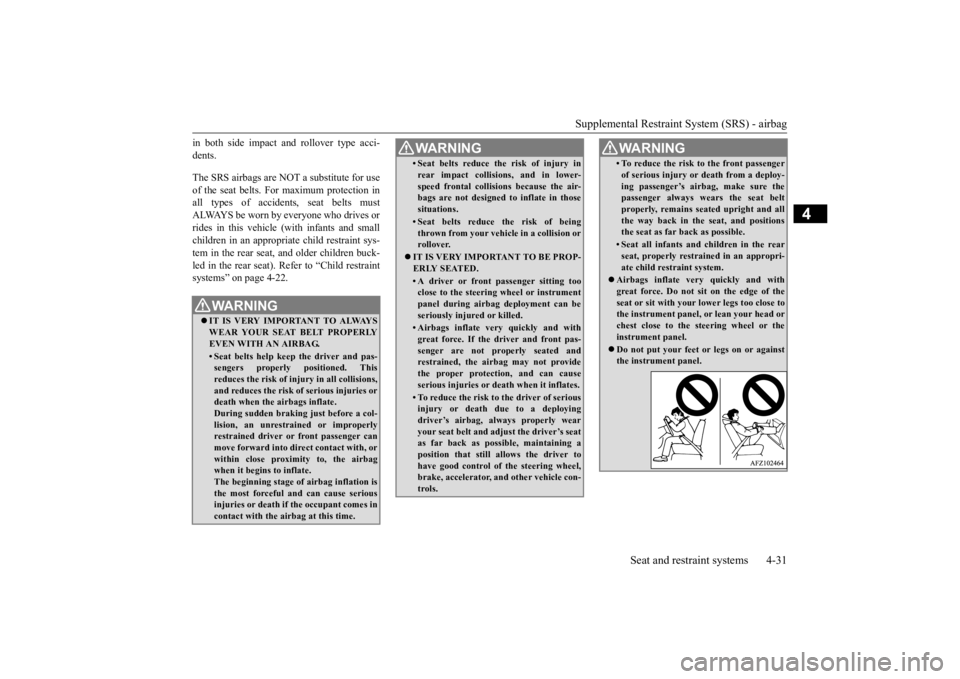
Airbags inflate very quickly and with great force. Do not sit on the edge of theseat or sit with your lower legs too close to the instrument panel, or lean your head or chest close to the steering wheel or theinstrument panel. Do not put your feet or legs on or against the instrument panel.WA R N I N G
BK0277700US.bo
ok 31 ページ 2019年3月8日 金曜日 午前9時23分
Page 101 of 427
Free-hand Advanced Security Transmitter (F.A.S.T.-key) (if so equipped) 5-20 Features and controls
5
N00568001136
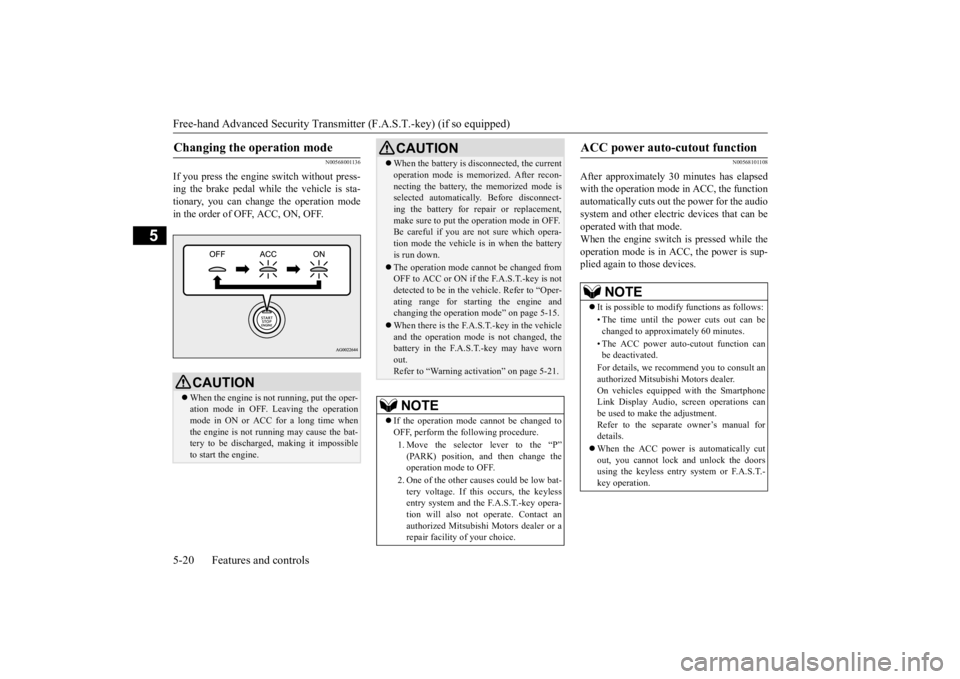
If you press the engine switch without press- ing the brake pedal while the vehicle is sta-tionary, you can change the operation mode in the order of OFF, ACC, ON, OFF.
N00568101108
After approximately 30 minutes has elapsed with the operation mode in ACC, the functionautomatically cuts out the power for the audio system and other electric devices that can be operated with that mode.When the engine switch is pressed while the operation mode is in ACC, the power is sup- plied again to those devices.
Changing the operation mode
CAUTION When the engine is not running, put the oper- ation mode in OFF. Leaving the operationmode in ON or ACC for a long time when the engine is not running may cause the bat- tery to be discharged, making it impossibleto start the engine.
When the battery is disconnected, the current operation mode is memorized. After recon- necting the battery, the memorized mode is selected automatically. Before disconnect- ing the battery for repair or replacement,make sure to put the operation mode in OFF. Be careful if you are not sure which opera- tion mode the vehicle is in when the batteryis run down. The operation mode cannot be changed from OFF to ACC or ON if th
e F.A.S.T.-key is not
detected to be in the vehicle. Refer to “Oper- ating range for starting the engine andchanging the operation mode” on page 5-15. When there is the F.A.S.T.-key in the vehicle and the operation mode is not changed, the battery in the F.A.S.T.-key may have worn out.Refer to “Warning activation” on page 5-21.NOTE
If the operation mode cannot be changed to OFF, perform the following procedure. 1. Move the selector lever to the “P” (PARK) position, and then change the operation mode to OFF. 2. One of the other causes could be low bat- tery voltage. If this occurs, the keyless entry system and the F.A.S.T.-key opera- tion will also not operate. Contact anauthorized Mitsubishi Motors dealer or a repair facility of your choice.CAUTION
ACC power auto-cutout function
NOTE
It is possible to modify functions as follows: • The time until the power cuts out can be changed to approximately 60 minutes. • The ACC power auto-cutout function can be deactivated. For details, we recommend you to consult an authorized Mitsubishi Motors dealer. On vehicles equipped with the SmartphoneLink Display Audio, screen operations can be used to make the adjustment. Refer to the separate owner’s manual fordetails. When the ACC power is automatically cut out, you cannot lock and unlock the doors using the keyless entry system or F.A.S.T.- key operation.
BK0277700US.bo
ok 20 ページ 2019年3月8日 金曜日 午前9時23分
Page 106 of 427
Free-hand Advanced Security Transmit
ter (F.A.S.T.-key) (if so equipped)
Features and controls 5-25
5
The engine is warmed up enough for driv- ing when the bar graph of engine coolant temperature display starts to move. Refer to “Engine coolant temperature display”on page 5-150.
Your vehicle is equipped with an electroni- cally controlled fuel injection system. This system automatically controls fuel injection.There is usually no need to depress the accel- erator pedal when starting the engine. To prevent battery drain, wait a few secondsbetween attempts to restart the engine.
1. Make sure all occupants are properly seated with seat belts fastened. 2. Make sure the parking brake is applied. 3. Press and hold the brake pedal downfirmly with your right foot. 4. Make sure the selector lever is in the “P” (PARK) position. 5. Press the engine switch. 6. Confirm that all warning lights and warn- ing displays are functioning properly.
After several attempts, you may experience that the engine still does not start. 1. Make sure that all electric devices, such as lights, air conditioning blower and rearwindow defogger, are turned off. 2. While depressing the brake pedal, press the accelerator pedal halfway and hold itthere, then crank the engine. Release the accelerator pedal, immediately after the engine starts.
WA R N I N G Never run the engine in a closed or poorly ventilated area any longer than is needed to move your vehicle out of the area. Car-bon monoxide gas, which is odorless and extremely poisonous, could build up and cause serious injury or death.CAUTION Do not push-start the vehicle.Do not run the engine at high rpms or drive at high speeds until the engine has had a chance to warm up.
Starting the engine
NOTE
After the engine has not started for a while, the brake pedal effort needed to start theengine may become greater. If this occurs, depress the brake pedal more firmly than usual.NOTE
The engine can only be started when the selector lever is in the “P” (PARK) or “N”(NEUTRAL) position. For safety reasons, the engine should be started when the selector lever is in the “P”(PARK) position in which the driving wheels lock.
NOTE
Minor noises may be heard on engine start- up. These will disappear as the engine warms up.
When the engine is hard to start
BK0277700US.bo
ok 25 ページ 2019年3月8日 金曜日 午前9時23分
Page 107 of 427
Free-hand Advanced Security Transmitter (F.A.S.T.-key) (if so equipped) 5-26 Features and controls
5
3. If the engine still will not start, the engine could be flooded with too much gasoline. While depressing the brake pedal, push the accelerator pedal all the way downand hold it there, then press the engine switch to crank the engine. If the engine does not start after 5 to 6 seconds, pushthe engine switch to stop cranking the engine, and release the accelerator pedal. Put the operation mode in OFF. Wait afew seconds, and then press the engineswitch to crank the engine again while depressing the brake pedal, but do not push the accelerator pedal. If the enginefails to start, repeat these procedures. If the engine still will not start, contact your local Mitsubishi Motors dealer or a repairfacility of your choice for assistance.
Startability of the engine with an ambient temperature of -22 °F (-30 °C) or lower When the ambient temperature is -22 °F (-30°C) or lower, it may not be possible to start from a standstill even with the selector lever in the “D” (DRIVE) or “R” (REVERSE)position. This phenomenon occurs because the trans- axle has not warmed up sufficiently; it doesnot indicate a problem. If this occurs, place the selector lever in the “P” (PARK) position and let the engine idle for at least 10 minutes.
The transaxle will warm up, and you will be able to start normally. Do not leave the vehicle during warm-up operation.
N00568201053
1. Stop the vehicle.2. Fully engage the parking brake while depressing the brake pedal. 3. Move the selector lever to the “P”(PARK) position, and then press the engine switch to stop the engine.
N00568301113
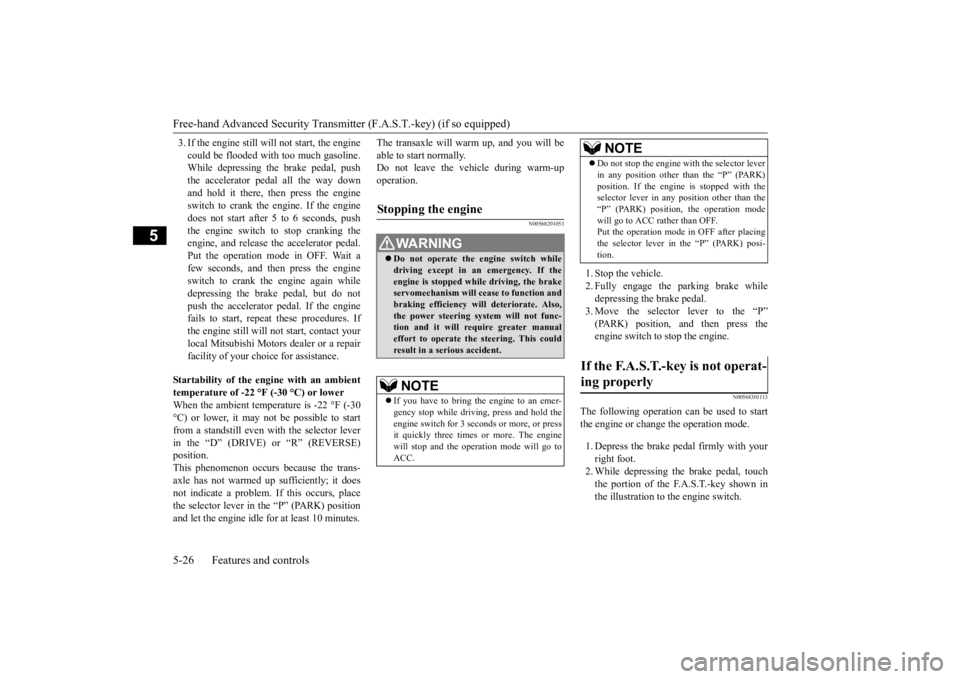
The following operation can be used to start the engine or change the operation mode. 1. Depress the brake pe
dal firmly with your
right foot. 2. While depressing the brake pedal, touch the portion of the F.A.S.T.-key shown inthe illustration to the engine switch.
Stopping the engine
WA R N I N G Do not operate the engine switch while driving except in an emergency. If the engine is stopped while driving, the brake servomechanism will cease to function andbraking efficiency will deteriorate. Also, the power steering system will not func- tion and it will require greater manualeffort to operate the steering. This could result in a serious accident.NOTE
If you have to bring the engine to an emer- gency stop while driving, press and hold the engine switch for 3 seco
nds or more, or press
it quickly three times or more. The enginewill stop and the operation mode will go to ACC.
Do not stop the engine with the selector lever in any position other than the “P” (PARK) position. If the engine is stopped with the selector lever in any position other than the “P” (PARK) position, the operation modewill go to ACC rather than OFF. Put the operation mode in OFF after placing the selector lever in the “P” (PARK) posi-tion.
If the F.A.S.T.-key is not operat- ing properly
NOTE
BK0277700US.bo
ok 26 ページ 2019年3月8日 金曜日 午前9時23分