coolant temperature MITSUBISHI ENDEAVOR 2004 Service Owner's Manual
[x] Cancel search | Manufacturer: MITSUBISHI, Model Year: 2004, Model line: ENDEAVOR, Model: MITSUBISHI ENDEAVOR 2004Pages: 3870, PDF Size: 98.47 MB
Page 1530 of 3870
Courtesy of MITSUBISHI MOTOR SALES OF AMERICA
.
MANIFOLD VACUUM CHECK 1. Start the engine and allow it to warm up until the temperature of the engine
coolant reaches 80 - 95°C (176 - 203°F).
2. Connect an engine tachometer.
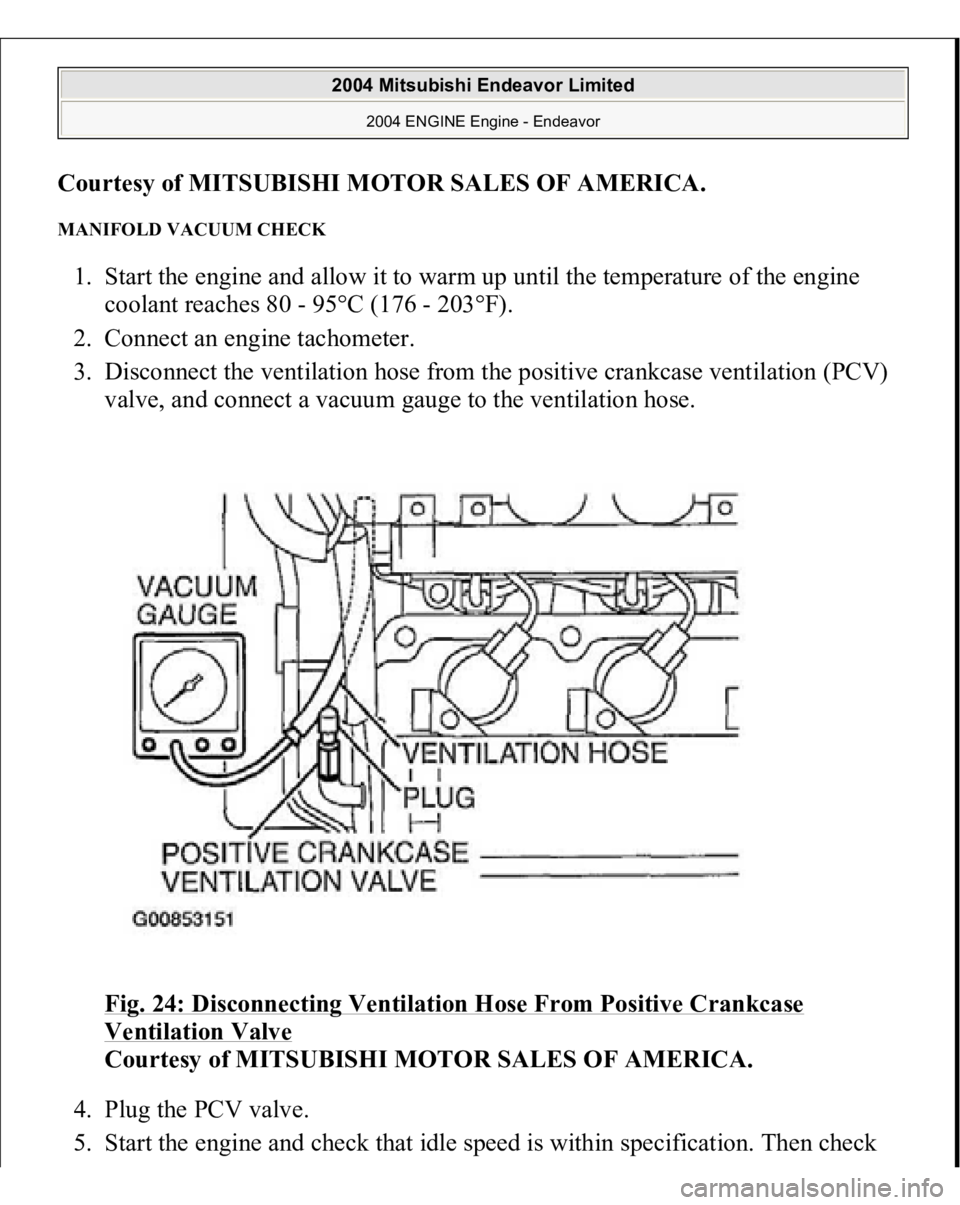
3. Disconnect the ventilation hose from the positive crankcase ventilation (PCV)
valve, and connect a vacuum gauge to the ventilation hose.
Fig. 24: Disconnecting Ventilation Hose From Positive Crankcase
Ventilation Valve
Courtesy of MITSUBISHI MOTOR SALES OF AMERICA.
4. Plug the PCV valve.
5. Start the en
gine and check that idle s
peed is within s
pecification. Then check
2004 Mitsubishi Endeavor Limited
2004 ENGINE Engine - Endeavor
Page 2002 of 3870
INTRODUCTION TO HEATER, AIR CONDITIONING AND VENTILATION DIAGNOSISAir is drawn into the heater assembly from either the outside, or from the inside of
the passenger cabin if DEFROST, maximum cooling or RECIRCULATION are
selected. The air is then forced through the evaporator where heat is removed,
cooling and de-humidifying the air. Depending on the temperature selected, a
portion of this air is then forced through the heater core to achieve the selected
discharge temperature.
If the system does not cool properly, look for a problem with the refrigerant, blower
or air distribution systems. If the system does not heat properly, look for a problem
with the coolant, blower or air distribution systems. In either case all system fuses,
circuit breaker and relays should be checked. HEATER, AIR CONDITIONING AND VENTILATION DIAGNOSTIC TROUBLESHOOTING
STRATEGY Use these steps to plan your diagnostic strategy. If you follow them carefully, you
will be sure that you have exhausted most of the possible ways to find a heater, air
conditioning and ventilation fault.
1. Gather information from the customer.
2. Verify that the condition described by the customer exists.
3. Find the malfunction by following
SYMPTOM CHART
4. Verify that the malfunction is eliminated.
DIAGNOSTIC FUNCTION HOW TO CONNECT THE SCAN TOOL (MUT-III) REQUIRED SPECIAL TOOL:
MB991958: Scan Tool (MUT-III Sub Assembly)
MB991824: Vehicle Communication Interface (V.C.I.) MB991827: MUT-III USB Cable MB991910: MUT-III Main Harness A (Vehicles with CAN
communication system)
2004 Mitsubishi Endeavor LS
2004 HVAC Heater Air Conditioning, Ventilation - Endeavor
Page 2378 of 3870
FAN CONTROL RELAY CONTINUITY CHART
IDLE-UP OPERATION CHECK 1. Before inspection and adjustment, set vehicle in the following condition:
Engine coolant temperature: 80 - 90 °C (176.0 - 194.0 °F) Lights, electric cooling fan and accessories: OFF Transmission: Neutral ("N" or "P" position) Steering wheel: Straightforward
2. Check whether or not the idle speed is the standard value.
Refer to
CURB IDLE SPEED CHECK
.
Standard value: 680 +/- 50 r/min
3. Turn on the air conditioning switch and the blower speed selection dial. Engine
idling speed should be within the standard value:
Standard value
At low pressure: 680 +/- 50 r/min
At middle pressure: 730 +/- 50 r/min
At high pressure: 750 +/- 50 r/min
BATTERY VOLTAGE
TESTER
CONNECTION
SPECIFIED
CONDITION
Not applied
2 - 4
Open circuit
Connect terminal 1 to the
positive battery terminal
Connect terminal 3 to the
negative battery terminal
2 - 4
Less than 2 ohms
NOTE: The powertrain control module determines whether the
A/C load is low or high according to the output signal
2004 Mitsubishi Endeavor LS
2004 HVAC Heater Air Conditioning, Ventilation - Endeavor