oil change MITSUBISHI ENDEAVOR 2004 Service Repair Manual
[x] Cancel search | Manufacturer: MITSUBISHI, Model Year: 2004, Model line: ENDEAVOR, Model: MITSUBISHI ENDEAVOR 2004Pages: 3870, PDF Size: 98.47 MB
Page 456 of 3870
2004 TRANSMISSION
Automatic Transaxle Overhaul - Endeavor
GENERAL INFORMATION This automatic transaxle is made up of the following main parts.
The gear train is made up of 3 multi-plate clutches, 2 multi-plate brakes and 2
planetary gears made up of a sun gear, carrier, pinion gear and annulus gear.
The torque converter employs a 3 element, 1 step, 2 phase lock-up clutch.
The cases consist of a converter housing, transaxle case, rear cover and a valve
body cover.
Parts related to oil pressure regulation are the oil pump, which pressurizes the oil;
the regulator, which controls the pressure setting; the solenoid valves, which
changes the oil pressure with electrical signals; the pressure control valve, which
controls the oil pressure coming from the solenoid valve that effects each clutch and
brake; each kind of valve, which carry out the retention of the oil pressure through
the lines; and finally the valve body, which houses all the valves. SECTIONAL VIEW < F4A5A >
2004 Mitsubishi Endeavor XLS
2004 TRANSMISSION Automatic Transaxle Overhaul - Endeavor
2004 Mitsubishi Endeavor XLS
2004 TRANSMISSION Automatic Transaxle Overhaul - Endeavor
Page 1524 of 3870
Mixture Check)
Courtesy of MITSUBISHI MOTOR SALES OF AMERICA.
3. Check that the basic ignition timing is within the standard value.
Standard value: 5° BTDC+/-3°
4. Start the engine and increase the engine speed to 2,500 r/min for 2 minutes.
5. Set the CO, HC tester.
6. Check the CO contents and the HC contents at idle.
Standard value:
CO contents: 0.5% or less
HC contents: 100 ppm or less
7. If the CO and HC contents do not remain inside the standard value, check the
following items:
Diagnostic output Closed-loop control (When the closed-loop control is carried out normally, the
output signal of the heated oxygen sensor changes between 0 - 400 mV and
600 - 1,000 mV at idle.) Fuel pressures Injector Ignition coil, spark plug EGR system and EGR valve leak Evaporative emission system Compression pressure
COMPRESSION PRESSURE CHECK Re
quired S
pecial Tool
:
NOTE: Replace the catalytic converter when the CO and HC
contents do not remain inside the standard value, even
though the result of the inspection is normal for all items.
2004 Mitsubishi Endeavor Limited
2004 ENGINE Engine - Endeavor
Page 1531 of 3870
the vacuum gauge reading.
Idle speed: 680+/-100 r/min
Minimum limit: 60 kPa (18 in Hg)
LASH ADJUSTER CHECK If an abnormal noise (chattering noise) suspected to be caused by malfunction of the
lash adjuster is produced immediately after starting the engine and does not
disappear, perform the following check.
1. Start the engine.
2. Check if the abnormal noise produced immediately after starting the engine,
changes with the change in the engine speed.
If the abnormal noise is not produced immediately after starting the engine or it
does not change with the engine speed, the lash adjuster is not the cause for the
noise.
Therefore, investigate other causes. The abnormal noise is probably caused by
some other parts than the engine proper if it does not change with the engine
speed. (In this case, the lash adjuster is in good condition.)NOTE: An abnormal noise due to malfunction of the lash adjuster
is produced immediately after starting the engine and
changes with the engine speed, irrespective of the engine
load. If, the abnormal noise is not produced immediately
after starting the engine or does not change with the engine
speed, or it changes with the engine load, the lash adjuster
is not the cause for the abnormal noise.
NOTE: When the lash adjuster is malfunctioning, the abnormal
noise is rarely eliminated by continuing the warming-up of
the engine at idle speed.
However, the abnormal noise may disappear only when
seizure is caused by oil sludge in the engine whose oil is
not maintained properly.
2004 Mitsubishi Endeavor Limited
2004 ENGINE Engine - Endeavor
Page 1532 of 3870
3. With the engine idling, change the engine load (shift from N to D range, for
example) to make sure that there is no change in the level of abnormal noise.
If there is a change in the level of abnormal noise, suspect a tapping noise due
to worn crankshaft bearing or connecting rod bearing (In this case, the lash
adjuster is in good condition.).
4. After completion of warm-up, run the engine at idle to check for abnormal
noise.
If the noise is reduced or disappears, clean the lash adjuster (Refer to
ROCKER ARMS AND CAMSHAFT
). As it is suspected that the noise is
due to seizure of the lash adjuster. If there is no change in the level of the
abnormal noise, proceed to step 5.
5. Run the engine to bleed the lash adjuster system (Refer to LASH ADJUSTER
CHECK
.).
6. If the abnormal noise does not disappear after air bleeding operation, clean the
lash adjuster (Refer to ROCKER ARMS AND CAMSHAFT
).
Bleeding lash adjuster system 1. Check engine oil and add or change oil if required. NOTE: Parkin
g the vehicle on a
grade for a lon
g time ma
y decrease
oil in the lash adjuster, causing air to enter the high
pressure chamber when starting the engine.
NOTE: After parking for many hours, oil may run out from the oil
passage and take time before oil is supplied to the lash
adjuster, causing air to enter the high pressure chamber.
NOTE: In the above cases, abnormal noise can be eliminated by
bleeding the lash adjuster system.
NOTE: If the engine oil level is low, air is sucked from the oil
2004 Mitsubishi Endeavor Limited
2004 ENGINE Engine - Endeavor
Page 1534 of 3870
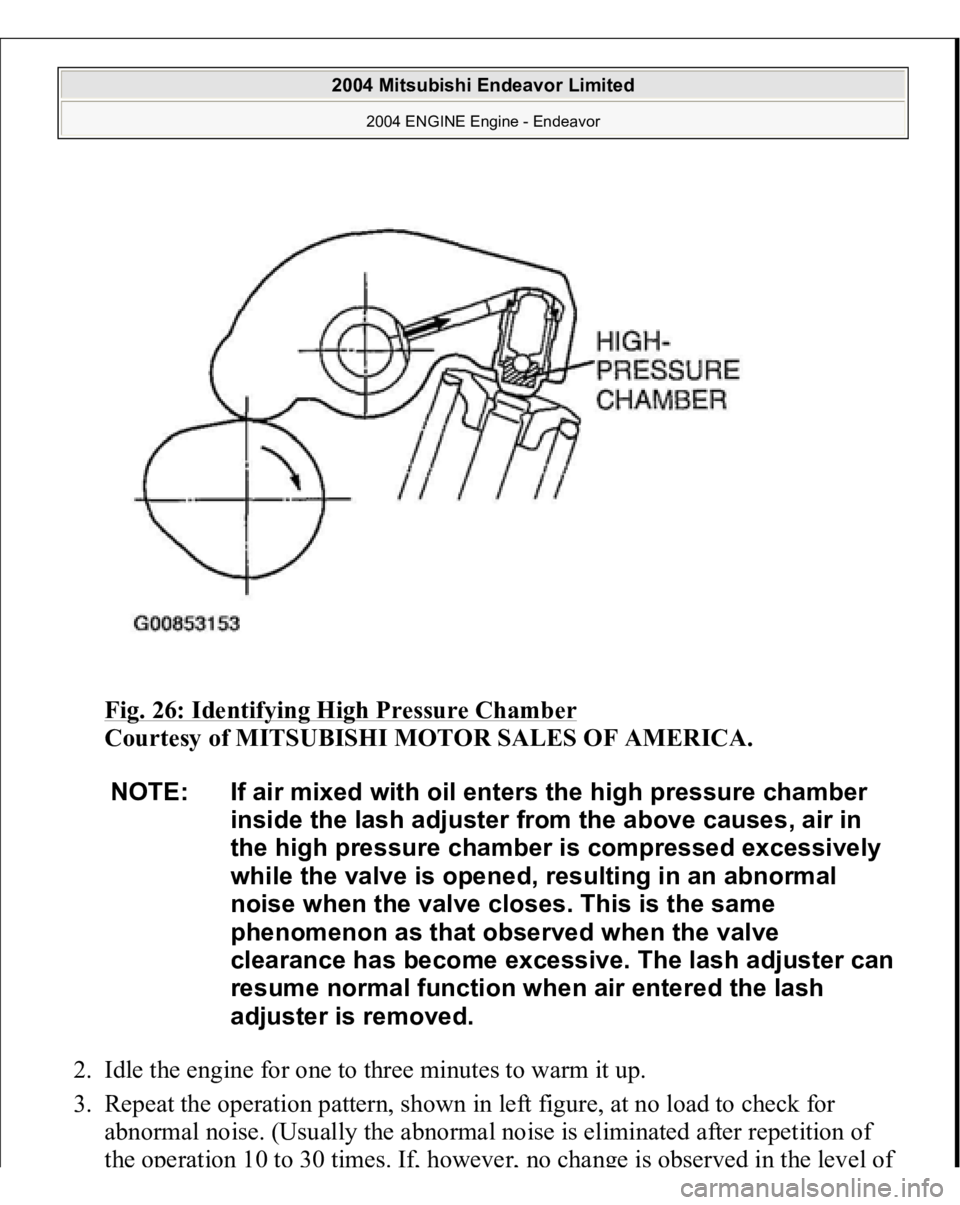
Fig. 26: Identifying High Pressure Chamber
Courtesy of MITSUBISHI MOTOR SALES OF AMERICA.
2. Idle the engine for one to three minutes to warm it up.
3. Repeat the operation pattern, shown in left figure, at no load to check for
abnormal noise. (Usually the abnormal noise is eliminated after repetition of
the ope
ration 1
0 to 30 tim
es.
If, howeve
r, no change is obse
rved
in
the leve
l of
NOTE: If air mixed with oil enters the high pressure chamber
inside the lash adjuster from the above causes, air in
the high pressure chamber is compressed excessively
while the valve is opened, resulting in an abnormal
noise when the valve closes. This is the same
phenomenon as that observed when the valve
clearance has become excessive. The lash adjuster can
resume normal function when air entered the lash
adjuster is removed.
2004 Mitsubishi Endeavor Limited
2004 ENGINE Engine - Endeavor
Page 2365 of 3870
DISCHARGING SYSTEM Use the refrigerant recovery unit to discharge refrigerant gas from the system. REFILLING OF OIL IN THE A/C SYSTEM Too little oil will provide inadequate compressor lubrication and cause a
compressor failure. Too much oil will increase discharge air temperature.
When a compressor is installed at the factory, it contains 140 cm
3 (4.7 fl.oz) of
refrigerant oil. While the A/C system is in operation, the oil is carried through the
entire system by the refrigerant. Some of this oil will be trapped and retained in
various parts of the system.
When the following system components are changed, it is necessary to add oil to
the system to replace the oil being removed with the component.
Compressor oil: SUN PAG 56
Quantity:
Evaporator: 60
cm
3 (2.0 fl.oz)
Condenser:
15 cm
3 (0.5 fl.oz)
Suction hose: 10 cm3 (0.3 fl.oz)
PERFORMANCE TEST The vehicles to be tested should be parked out of direct sunlight.
1. Close the high and low-pressure valve of the gauge manifold.
2. Connect the charging hose (blue) to the low-pressure valve and connect the
UNIT
.
NOTE: Refer to the REFRIGERANT RECOVERY AND RECYCLING
UNIT'S INSTRUCTION MANUAL FOR OPERATION OF THE UNIT
.
2004 Mitsubishi Endeavor LS
2004 HVAC Heater Air Conditioning, Ventilation - Endeavor
Page 2856 of 3870
Perform air bleeding procedure as necessary after replacing the steering gear, oil
pump or the steering fluid lines.
1. Raise and support the front wheels.
2. Disconnect the ignition coil connectors (Refer to IGNITION COIL
).
3. Turn the steering wheel all the way to the left and right five or six times while
using the starter motor to crank the engine intermittently several times (for 15
to 20 seconds).
4. Connect the ignition coil connectors (Refer to IGNITION COIL
).
5. Start the engine and allow to idle.
6. Turn the steering wheel to the left and right until there are no air bubbles in the
oil reservoir.
7. Confirm that the fluid is not milky, and that the level is between the high and
low dipstick marks.
8. Confirm that there is very little change in the fluid level when the steering
wheel is turned left and right.
9. Confirm that the change in the fluid level is no more than 5 mm (0.2 inch)
when the en
gine is sto
pped.
CAUTION: Perform air bleeding only while cranking the
engine. Do not perform air bleeding while the
en
gine is runnin
g. If
you do so, air in the fluid will
be increased and air bleeding will become more
difficult. During air bleeding, refill the steering
fluid so that the level never falls below the lower
mark on the dipstick.
CAUTION: If the fluid level rises suddenly after the engine is
stopped, the air has not been completely bled. If
air bleeding is not complete, there will be
abnormal noises from the pump and the flow-
control valve, and this condition could reduce
the life of the power steering components.
2004 Mitsubishi Endeavor LS
2004 STEERING Power Steering - Endeavor
Page 2857 of 3870
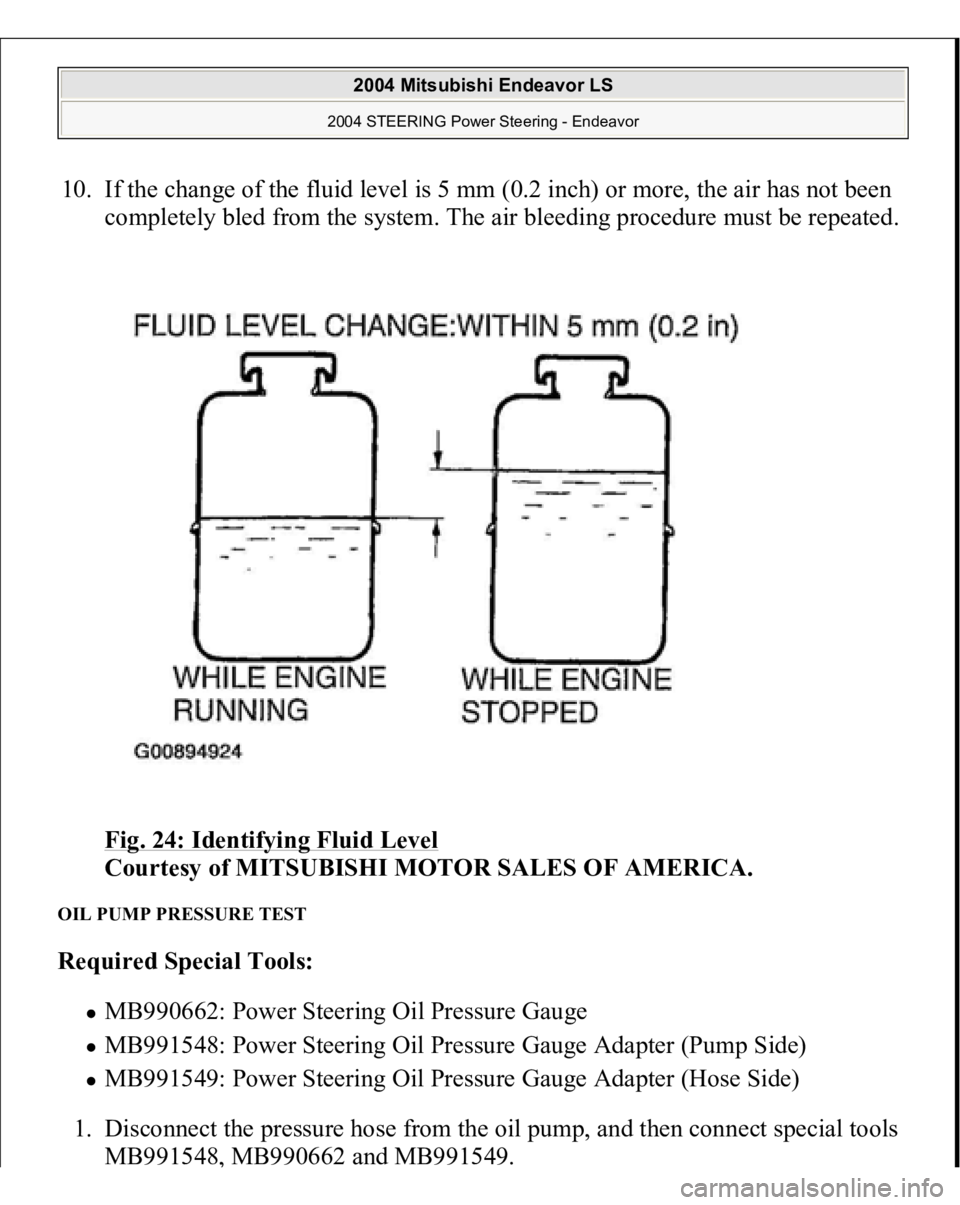
10. If the change of the fluid level is 5 mm (0.2 inch) or more, the air has not been
completely bled from the system. The air bleeding procedure must be repeated.
Fig. 24: Identifying Fluid Level
Courtesy of MITSUBISHI MOTOR SALES OF AMERICA.
OIL PUMP PRESSURE TEST Required Special Tools:
MB990662: Power Steering Oil Pressure Gauge MB991548: Power Steering Oil Pressure Gauge Adapter (Pump Side) MB991549: Power Steering Oil Pressure Gauge Adapter (Hose Side)
1. Disconnect the pressure hose from the oil pump, and then connect special tools
MB991548
, MB990662 and MB991549.
2004 Mitsubishi Endeavor LS
2004 STEERING Power Steering - Endeavor