engine MITSUBISHI GALANT 1989 Service Repair Manual
[x] Cancel search | Manufacturer: MITSUBISHI, Model Year: 1989, Model line: GALANT, Model: MITSUBISHI GALANT 1989Pages: 1273, PDF Size: 37.62 MB
Page 1189 of 1273
35-68SERVICE BRAKES - Service Adjustment Procedures
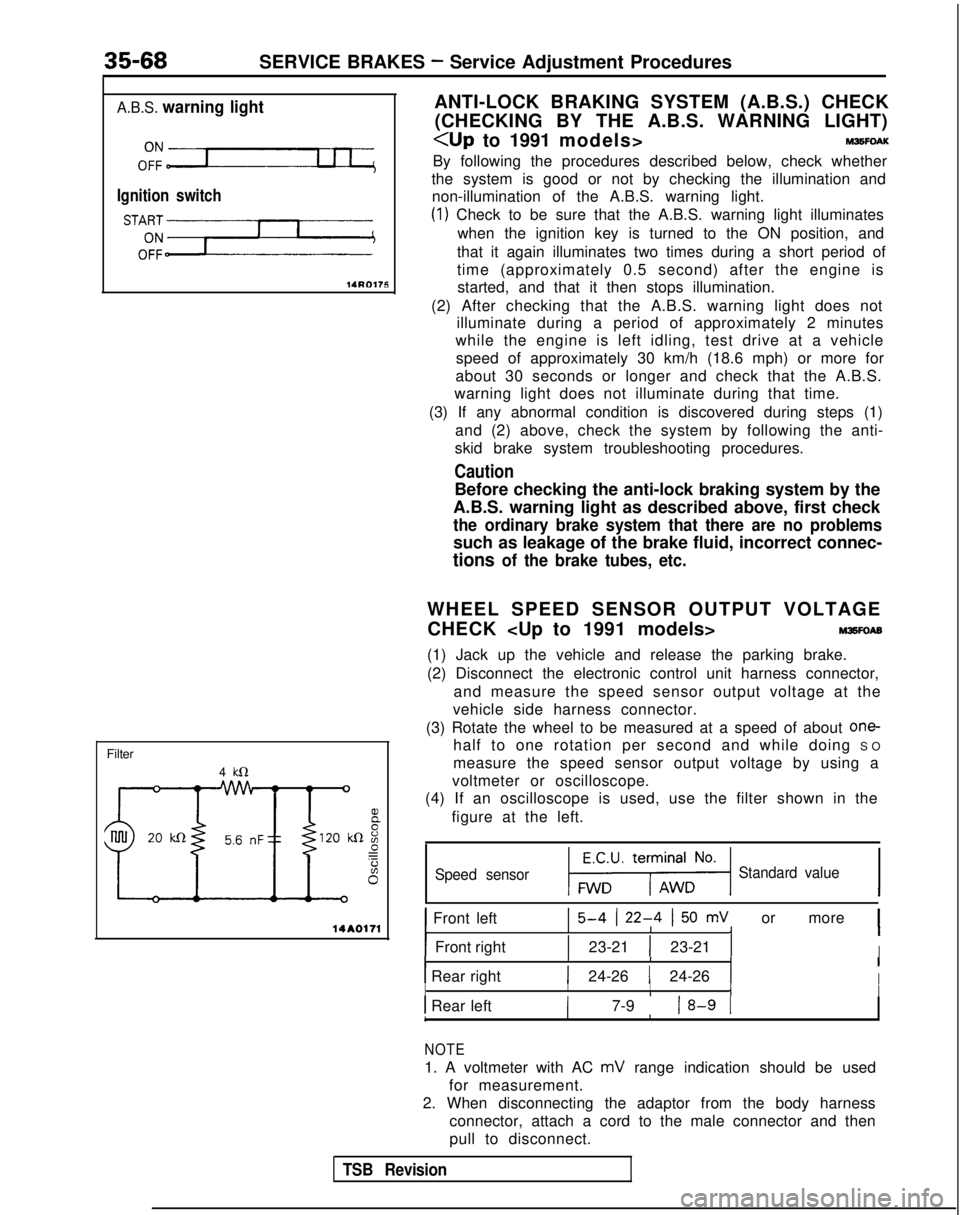
A.B.S. warning light
Ignition switch
sT;!i;%
lARD175
Filter4
kR
14A0171
ANTI-LOCK BRAKING SYSTEM (A.B.S.) CHECK
(CHECKING BY THE A.B.S. WARNING LIGHT)
By following the procedures described below, check whether
the system is good or not by checking the illumination and non-illumination of the A.B.S. warning light.
(1) Check to be sure that the A.B.S. warning light illuminates
when the ignition key is turned to the ON position, and
that it again illuminates two times during a short period of
time (approximately 0.5 second) after the engine is started, and that it then stops illumination.
(2) After checking that the A.B.S. warning light does not illuminate during a period of approximately 2 minutes
while the engine is left idling, test drive at a vehicle
speed of approximately 30 km/h (18.6 mph) or more for
about 30 seconds or longer and check that the A.B.S.
warning light does not illuminate during that time.
(3) If any abnormal condition is discovered during steps (1) and (2) above, check the system by following the anti-
skid brake system troubleshooting procedures.
Caution
Before checking the anti-lock braking system by the
A.B.S. warning light as described above, first check
the ordinary brake system that there are no problems
such as leakage of the brake fluid, incorrect connec-
tions of the brake tubes, etc.
WHEEL SPEED SENSOR OUTPUT VOLTAGE
CHECK
M3sFoAE
(1) Jack up the vehicle and release the parking brake.
(2) Disconnect the electronic control unit harness connector,
and measure the speed sensor output voltage at the
vehicle side harness connector.
(3) Rotate the wheel to be measured at a speed of about
one-
half to one rotation per second and while doing S
O
measure the speed sensor output voltage by using a
voltmeter or oscilloscope.
(4) If an oscilloscope is used, use the filter shown in the
figure at the left.
Speed sensor1-1 Standard value
1 Front left15-4 (22-4 I50 mV or more 1IIIII
IFront rightI1 23-21 1 23-21 1IIIII1 Rear right1 24-26 1 24-26 1II IIIIII Rear left( 7-9 18-9 1IIII1
NOTE
1. A voltmeter with AC mV range indication should be used
for measurement.
2. When disconnecting the adaptor from the body harness connector, attach a cord to the male connector and then
pull to disconnect.
TSB Revision
Page 1191 of 1273
35-70SERVICE BRAKES- Service Adjustment Procedures
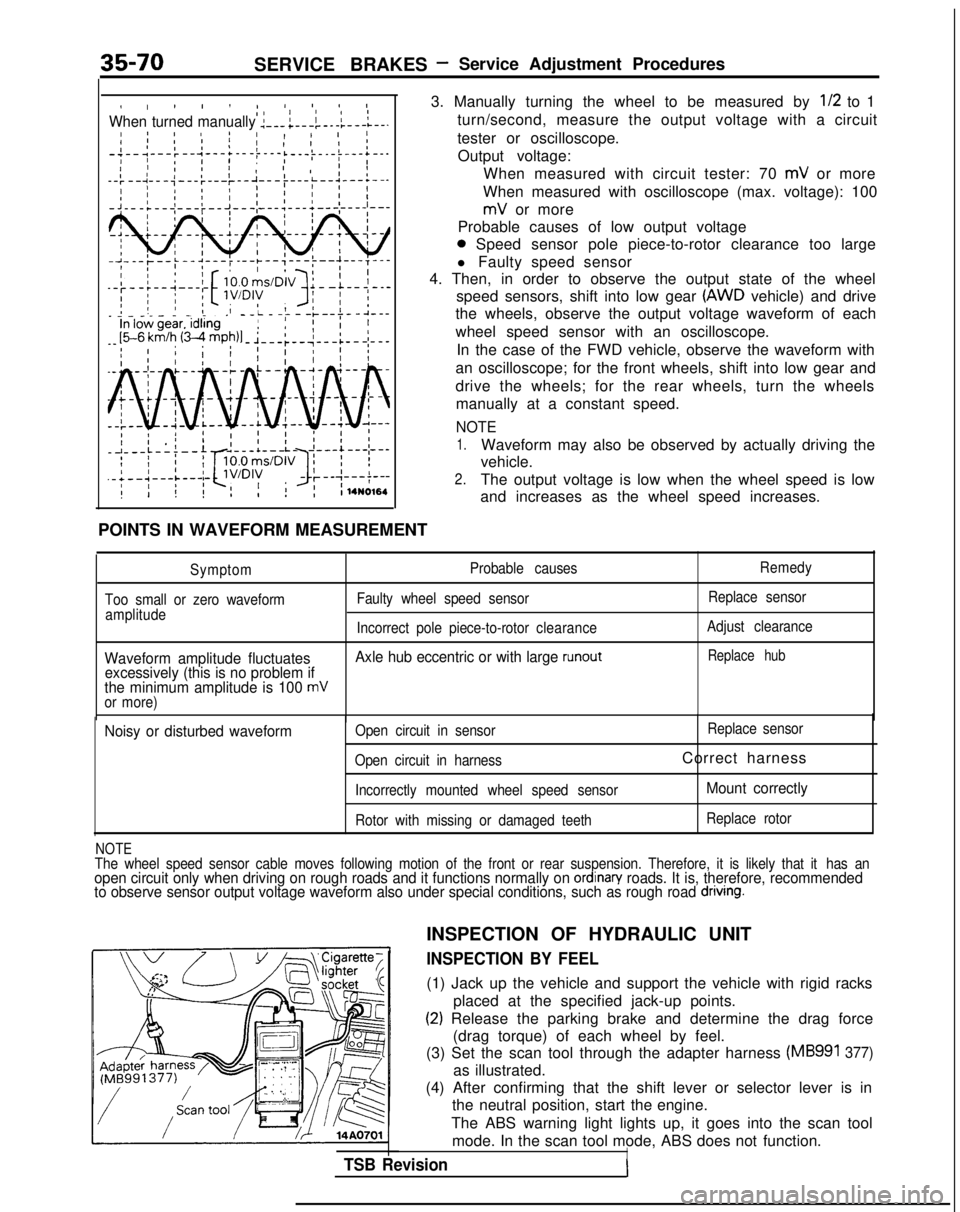
I, ! I ! I4 IO II IIWhen turned manually :---;---i-.-l---L--.I 8 ! IaI 1 11 1 II ’I 1’ I I I;-;--1---:--‘---+---t---i ’I IL---)-.-i---+--.II ’ I I 1 , 1 ,I
--:--~---;---:---~--~--
POINTS IN WAVEFORM MEASUREMENT
3. Manually turning the wheel to be measured by
l/2 to 1
turn/second, measure the output voltage with a circuit
tester or oscilloscope. Output voltage: When measured with circuit tester: 70
mV or more
When measured with oscilloscope (max. voltage): 100
mV or more
Probable causes of low output voltage
0 Speed sensor pole piece-to-rotor clearance too large
l Faulty speed sensor
4. Then, in order to observe the output state of the wheel
speed sensors, shift into low gear
(AWD vehicle) and drive
the wheels, observe the output voltage waveform of each
wheel speed sensor with an oscilloscope.
In the case of the FWD vehicle, observe the waveform with
an oscilloscope; for the front wheels, shift into low gear and
drive the wheels; for the rear wheels, turn the wheels manually at a constant speed.
NOTE
1.Waveform may also be observed by actually driving the
vehicle.
2.The output voltage is low when the wheel speed is low
and increases as the wheel speed increases.
Symptom
Too small or zero waveform amplitude Probable causes
Faulty wheel speed sensor Remedy
Replace sensor
Incorrect pole piece-to-rotor clearanceAdjust clearance
Waveform amplitude fluctuates Axle hub eccentric or with large runoutReplace hub
excessively (this is no problem if
the minimum amplitude is 100 mVor more)
Noisy or disturbed waveformOpen circuit in sensor Replace
sensor
Open circuit in harness
Correct harness
Incorrectly mounted wheel speed sensorMount correctly
Rotor with missing or damaged teeth Replace rotor
NOTEThe wheel speed sensor cable moves following motion of the front or rear\
suspension. Therefore, it is likely that it
has anopen circuit only when driving on rough roads and it functions normally \
on ordinan/ roads. It is, therefore, recommended
to observe sensor output voltage waveform also under special conditions,\
such as rough road dnvlng.
TSB Revision
INSPECTION OF HYDRAULIC UNIT
INSPECTION BY FEEL
(1) Jack up the vehicle and support the vehicle with rigid racks
placed at the specified jack-up points.
(2) Release the parking brake and determine the drag force(drag torque) of each wheel by feel.
(3) Set the scan tool through the adapter harness
(MB991 377)
as illustrated.
(4) After confirming that the shift lever or selector lever is in the neutral position, start the engine.
The ABS warning light lights up, it goes into the scan tool mode. In the scan tool mode, ABS does not function.
I
Page 1193 of 1273
35-72SERVICE BRAKES - Service Adjustment Procedures
14AO701 1
INSPECTION BY USING BRAKE FORCE TESTER
NOTE
(1) The brake force tester roller and tire must be dry during thetest.
(2) When testing the front brakes, apply the parking brake and when testing the rear brakes, apply chocks to the front
wheels to lock them.
(1) Place the front or rear wheels on the brake force tester
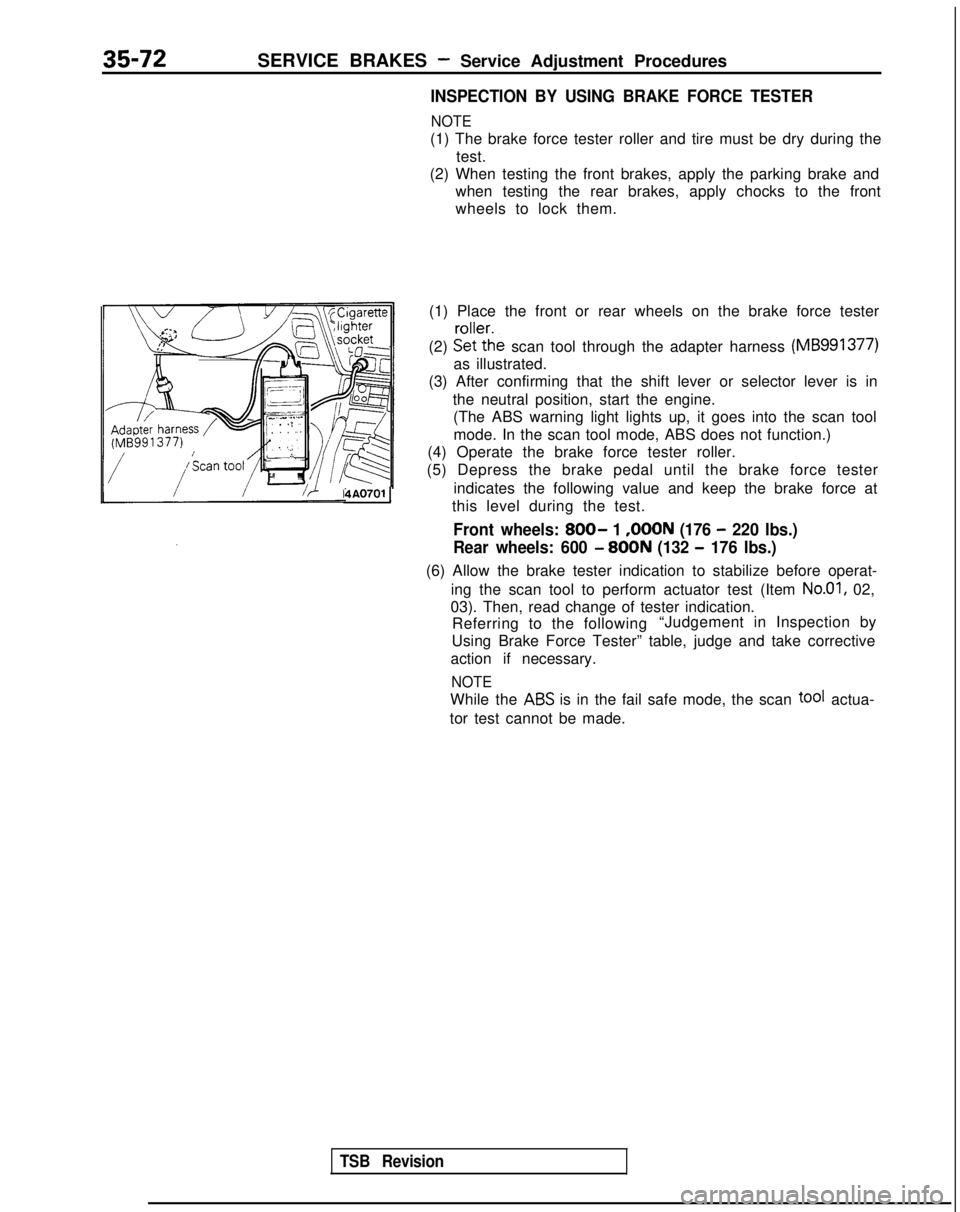
(2) &(%:he
scan tool through the adapter harness (MB991377)
as illustrated.
(3) After confirming that the shift lever or selector lever is in
the neutral position, start the engine.(The ABS warning light lights up, it goes into the scan tool
mode. In the scan tool mode, ABS does not function.)
(4) Operate the brake force tester roller.
(5) Depress the brake pedal until the brake force tester
indicates the following value and keep the brake force at
this level during the test.
Front wheels: 800- 1 ,OOON (176 - 220 Ibs.)
Rear wheels: 600
- 800N (132 - 176 Ibs.)
(6) Allow the brake tester indication to stabilize before operat-
ing the scan tool to perform actuator test (Item
No.01, 02,
03). Then, read change of tester indication. Referring to the following “Judgement in Inspection by
Using Brake Force Tester” table, judge and take corrective
action if necessary.
NOTE
While the ABS is in the fail safe mode, the scan tOOf actua-
tor test cannot be made.
TSB Revision
Page 1196 of 1273
SERVICE BRAKES -Service Adjustment Procedures35-75
14AO197
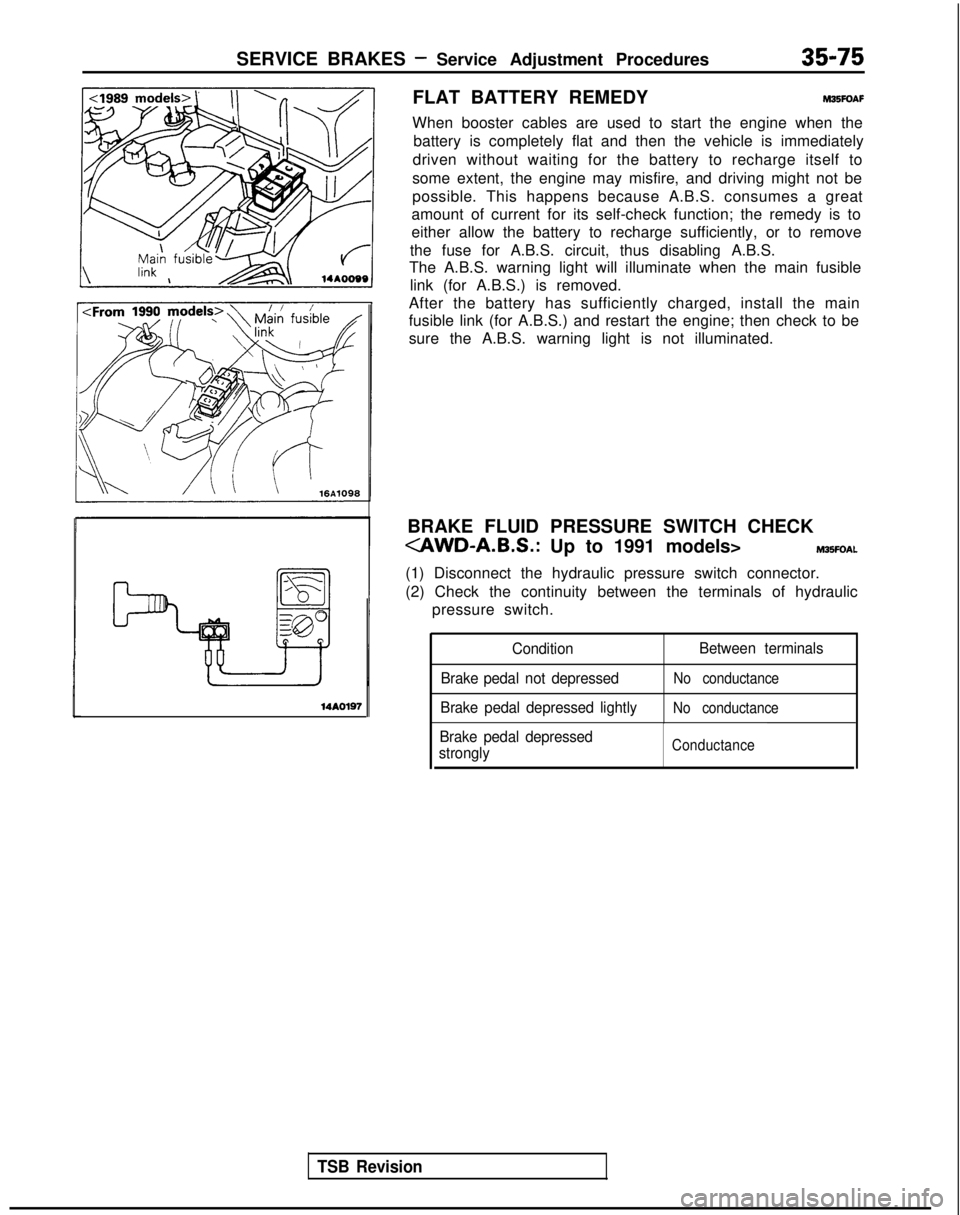
FLAT BATTERY REMEDYM35FOAF
When booster cables are used to start the engine when the
battery is completely flat and then the vehicle is immediately
driven without waiting for the battery to recharge itself to
some extent, the engine may misfire, and driving might not be
possible. This happens because A.B.S. consumes a great
amount of current for its self-check function; the remedy is to
either allow the battery to recharge sufficiently, or to remove
the fuse for A.B.S. circuit, thus disabling A.B.S.
The A.B.S. warning light will illuminate when the main fusible
link (for A.B.S.) is removed.
After the battery has sufficiently charged, install the main
fusible link (for A.B.S.) and restart the engine; then check to be
sure the A.B.S. warning light is not illuminated.
TSB Revision
BRAKE FLUID PRESSURE SWITCH CHECK
(1) Disconnect the hydraulic pressure switch connector.
(2) Check the continuity between the terminals of hydraulic pressure switch.
Condition Between terminals
Brake pedal not depressed
No conductance
Brake pedal depressed lightlyNo conductance
Brake pedal depressed
stronglyConductance
Page 1207 of 1273
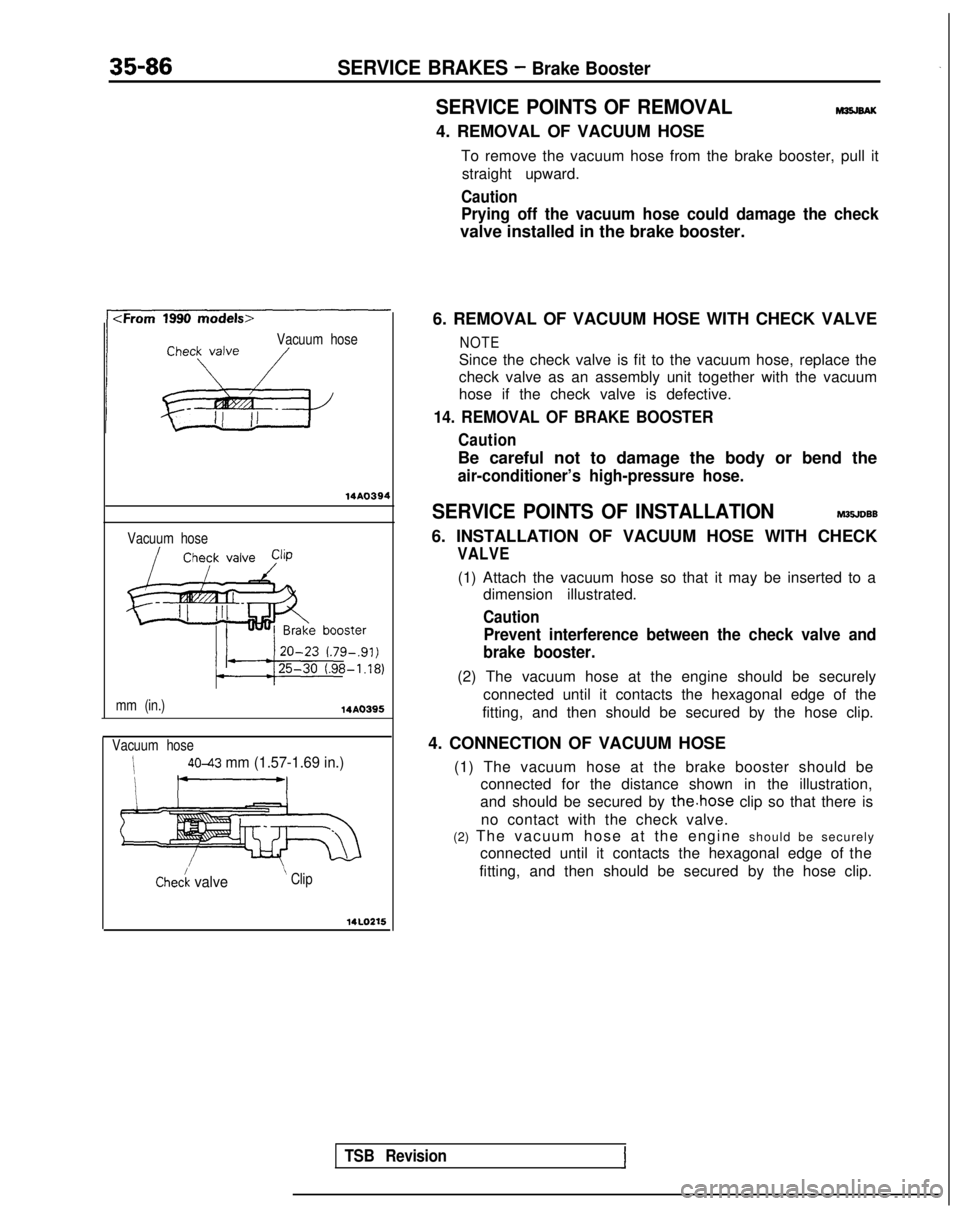
35-86SERVICE BRAKES - Brake Booster
SERVICE POINTS OF REMOVALM35JBAK
4. REMOVAL OF VACUUM HOSETo remove the vacuum hose from the brake booster, pull itstraight upward.
Caution
Prying off the vacuum hose could damage the check
valve installed in the brake booster.
Vacuum hose
14AO394
Vacuum hose
mm (in.)
14A0395
Vacuum hose
i4043 mm (1.57-1.69 in.)
I I__/
Chec/k valve ’ Clip
14LOZ15
6. REMOVAL OF VACUUM HOSE WITH CHECK VALVE
NOTE
Since the check valve is fit to the vacuum hose, replace the
check valve as an assembly unit together with the vacuum
hose if the check valve is defective.
14. REMOVAL OF BRAKE BOOSTER
Caution
Be careful not to damage the body or bend the
air-conditioner’s high-pressure hose.
SERVICE POINTS OF INSTALLATIONM35JDBB
6. INSTALLATION OF VACUUM HOSE WITH CHECK
VALVE
(1) Attach the vacuum hose so that it may be inserted to a
dimension illustrated.
Caution
Prevent interference between the check valve and
brake booster.
(2) The vacuum hose at the engine should be securely
connected until it contacts the hexagonal edge of the
fitting, and then should be secured by the hose clip.
4. CONNECTION OF VACUUM HOSE (1) The vacuum hose at the brake booster should be connected for the distance shown in the illustration,
and should be secured by
the.hose clip so that there is
no contact with the check valve.
(2) The vacuum hose at the engine should be securel
y
connected until it contacts the hexagonal edge of the
fitting, and then should be secured by the hose clip.
TSB Revision
Page 1216 of 1273
SERVICE BRAKES - Front Disc Brake35-95
INSPECTIONM35LcAD
l
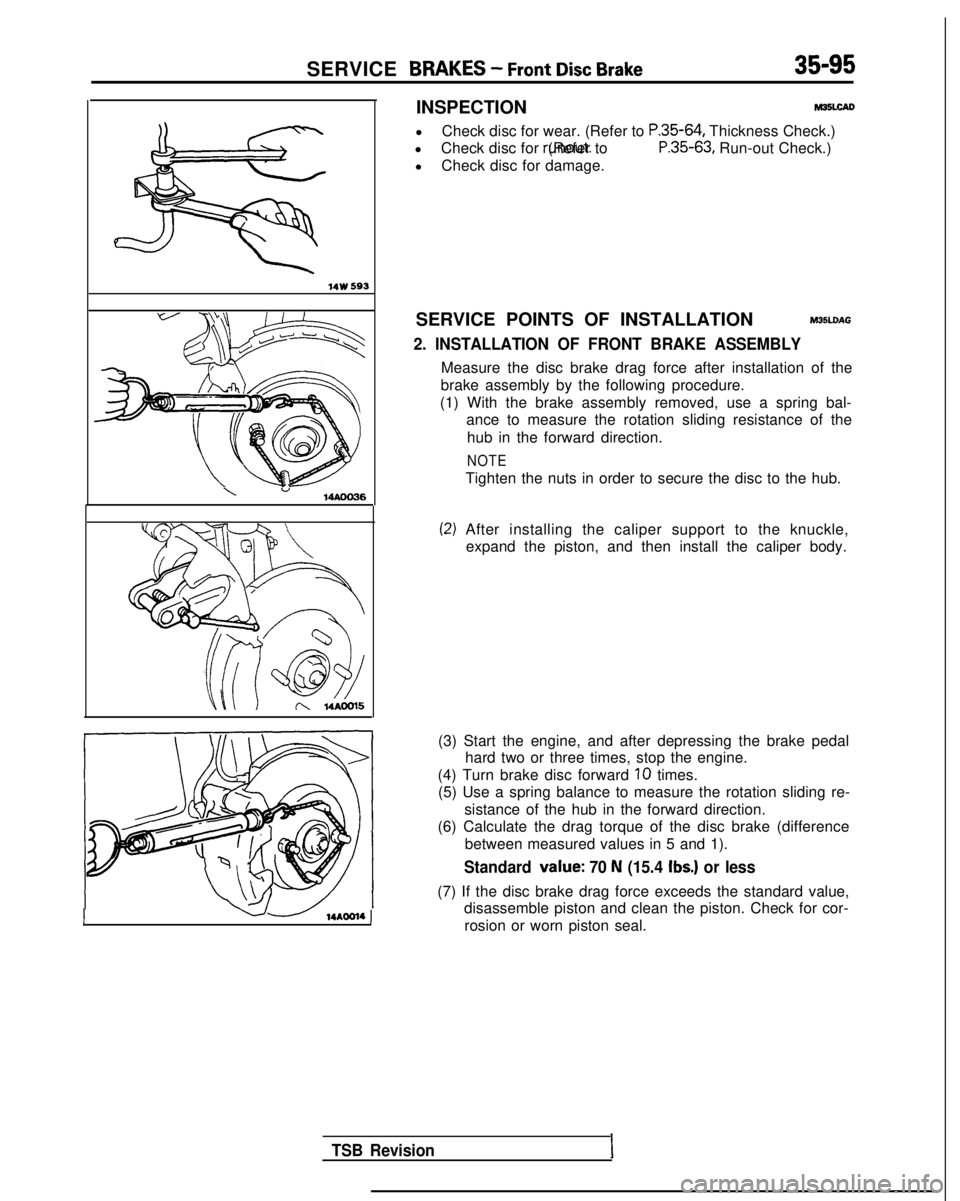
Check disc for wear. (Refer to P.35-64, Thickness Check.)
l Check disc for runout. (Refer to
P.35-63, Run-out Check.)
l Check disc for damage.
14w 593
\ ”14AOO36
SERVICE POINTS OF INSTALLATIONM35LDAG
2. INSTALLATION OF FRONT BRAKE ASSEMBLY
Measure the disc brake drag force after installation of the
brake assembly by the following procedure.
(1) With the brake assembly removed, use a spring bal- ance to measure the rotation sliding resistance of the
hub in the forward direction.
NOTE
Tighten the nuts in order to secure the disc to the hub.
(2) After installing the caliper support to the knuckle, expand the piston, and then install the caliper body.
I14AOOl4 1
(3) Start the engine, and after depressing the brake pedal hard two or three times, stop the engine.
(4) Turn brake disc forward
10 times.
(5) Use a spring balance to measure the rotation sliding re-
sistance of the hub in the forward direction.
(6) Calculate the drag torque of the disc brake (difference
between measured values in 5 and 1).
Standard value: 70 N (15.4 Ibs.) or less
(7) If the disc brake drag force exceeds the standard value,disassemble piston and clean the piston. Check for cor-
rosion or worn piston seal.
TSB RevisionI
Page 1242 of 1273
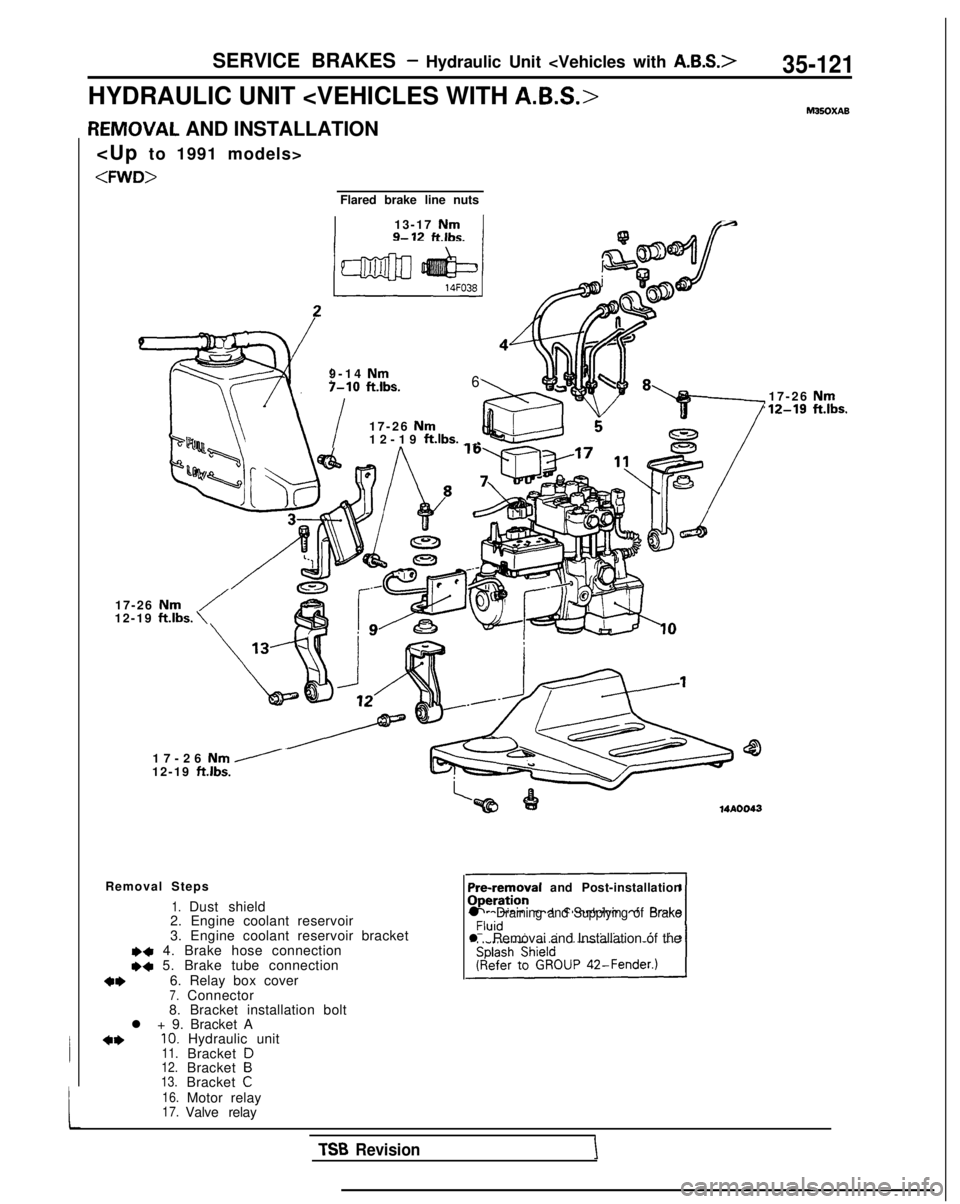
SERVICE BRAKES - Hydraulic Unit
HYDRAULIC UNIT
L
IEMOVAL AND INSTALLATION
Flared brake line nuts
I13-17 NmA9- 12ftlbs.I@
9-14 Nm7-10
ft.lbs.6
i
17-26 Nm12-19
ft.lbs.
_ _
17-26 Nm/12-19 ft.lbs.
\
17-26 Nm /12-19 ft.lbs.
Removal Steps
1.Dust shield
2. Engine coolant reservoir
3. Engine coolant reservoir bracket
I)+ 4. Brake hose connectionI)+ 5. Brake tube connection
*I)6. Relay box cover7.Connector
8. Bracket installation bolt
l + 9. Bracket A
+*10. Hydraulic unit11.Bracket D
12.Bracket B13.Bracket C
16.
Motor relay17.Valve relay Pre-removal
and Post-installation
l Draining and Supplying of Brake
l Removai and Installation of the 17-26
Nm,12-19 ft.lbs.
TSB RevisionI
Page 1243 of 1273
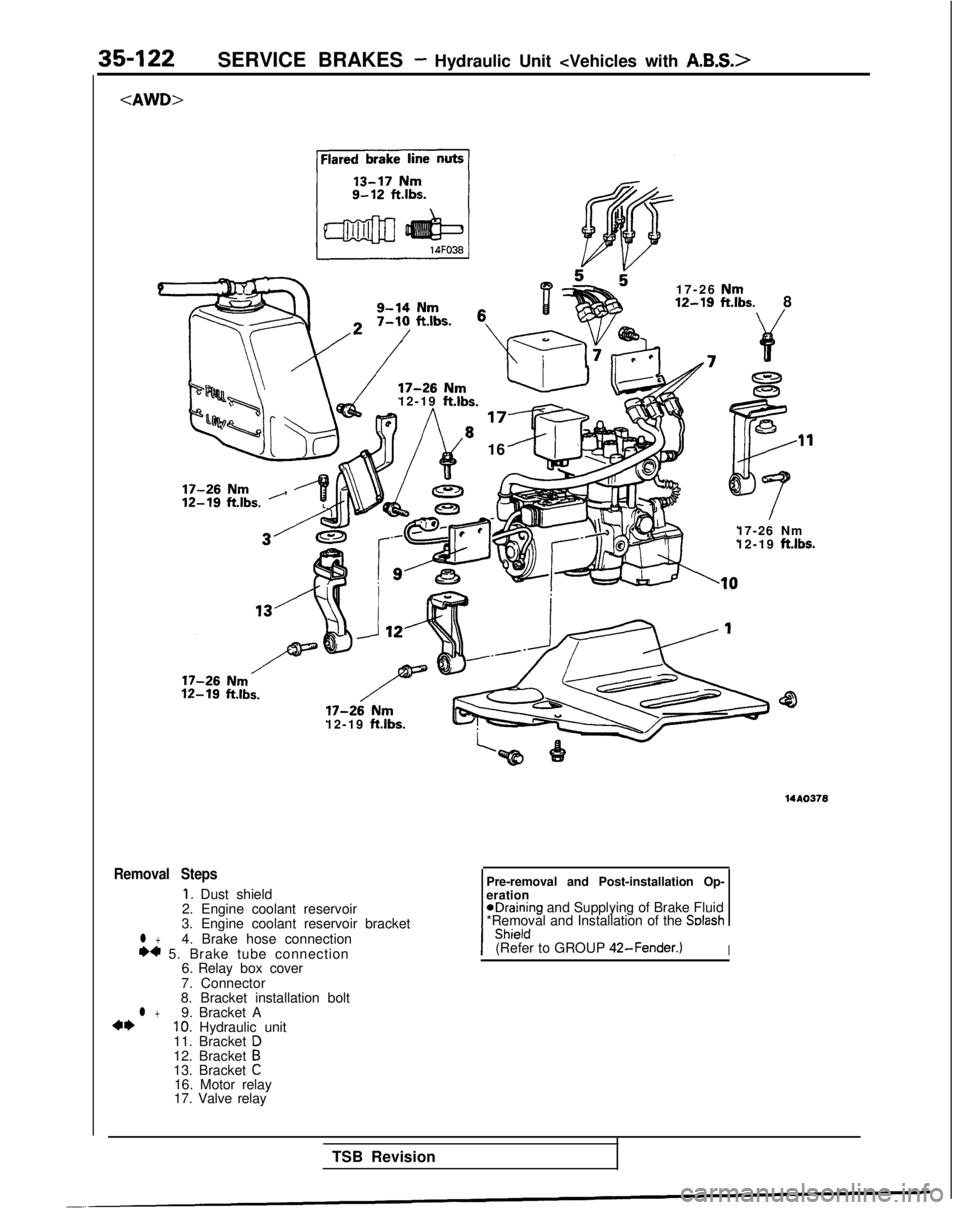
35-122SERVICE BRAKES - Hydraulic Unit
9-14 Nm
17-26 Nm12-19 ft.lbs.
8
17-26 Nm12-19 ft.lbs.
16
17-26 Nm
,
17-26 Nm
12-19 ft.lbs.
17-26
Nm12-19
ft.lbs.
12-19
ft.lbs.
Removal Steps
I. Dust shield
2. Engine coolant reservoir
l +3. Engine coolant reservoir bracket
4. Brake hose connection
W 5. Brake tube connection 6. Relay box cover
7. Connector
8. Bracket installation bolt
l +9. Bracket A4*IO. Hydraulic unit
11. Bracket D12. Bracket B13. Bracket C16. Motor relay
17. Valve relay Pre-removal and Post-installation Op-
eration
eDraining and Supplying of Brake Fluid
*Removal and Installation of the Solash
(Refer to GROUP 42-Fender.)I
TSB Revision
Page 1244 of 1273
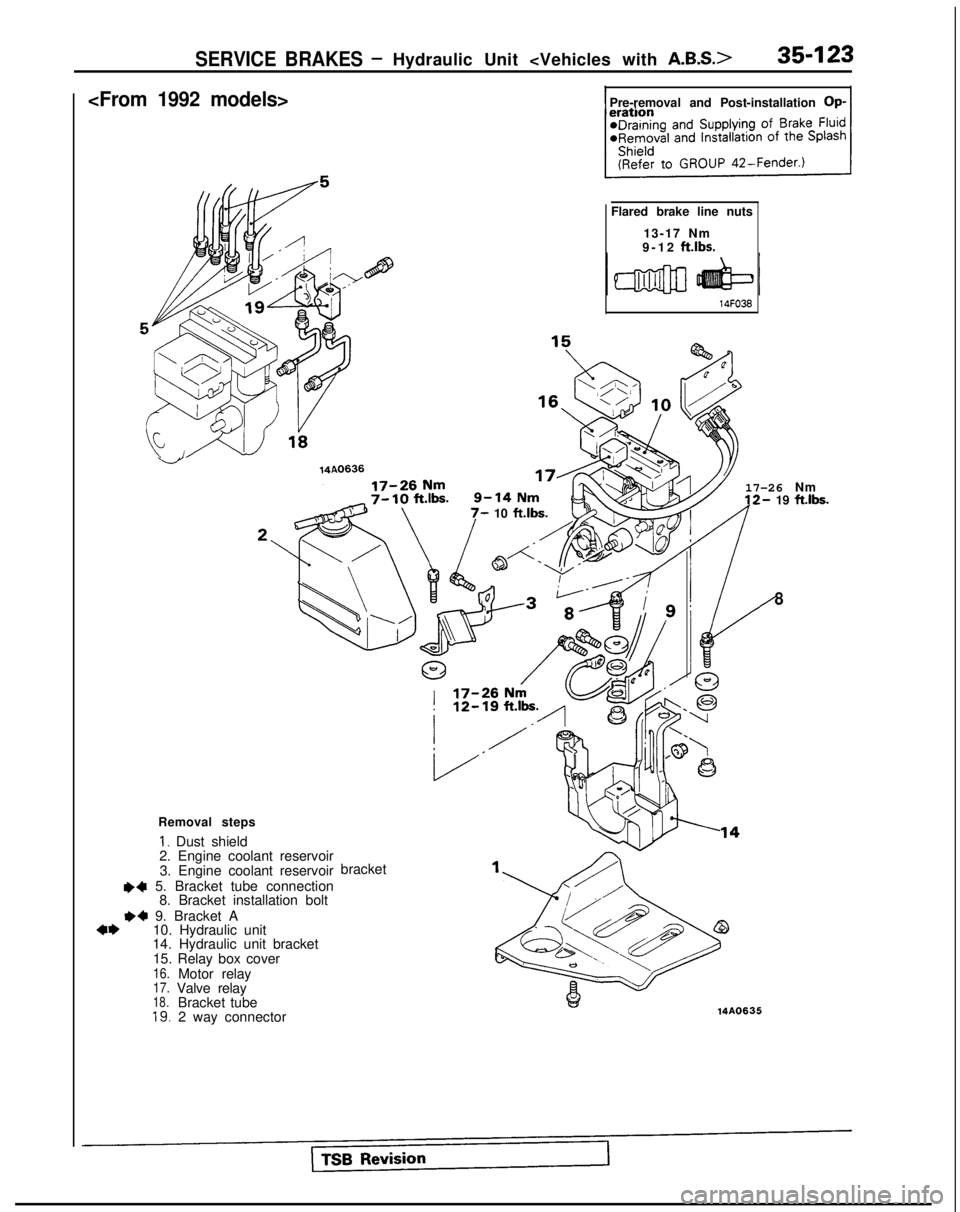
SERVICE BRAKES -Hydraulic Unit
w1480636
Pre-removal and Post-installation Op-
Flared brake line nuts 13-17 Nm
9-12 ft.lbs.
14FO38
17-26 Nm12- 19
ft.lbs.7- 10
ft.lbs.
Removal steps
I. Dust shield
2. Engine coolant reservoir
3. Engine coolant reservoir
++ 5. Bracket tube connection 8. Bracket installation bolt
~~ 9. Bracket A4*10. Hydraulic unit
14. Hydraulic unit bracket
15. Relay box cover
16.Motor relay17.Valve relay18.Bracket tube19.2 way connector bracket
8
Page 1257 of 1273
36-2PARKING BRAKES - Specifications/Troubleshooting/Service Adjustment Procedures
SPECIFICATIONS
GENERAL SPECIFICATIONS
ItemsSpecifications
TypeMechanical brake acting on rear wheels
Parking brake lever typeLever type
Cable arrangementV-type
SERVICE SPECIFICATION
Items
Standard value
Parking brake lever stroke Specifications5-7 notches
TROUBLESHOOTING
Symptom
Probable cause Remedy
Poor parking brake
function +Worn brake pad Poor condition of brake pad surface Replace
Parking brake cable sticking
Auto-adjuster malfunction Adjust
Excessive parking brake lever stroke
Adjust the parking brake lever
stroke or check the parking
brake cable arrangement
I
i
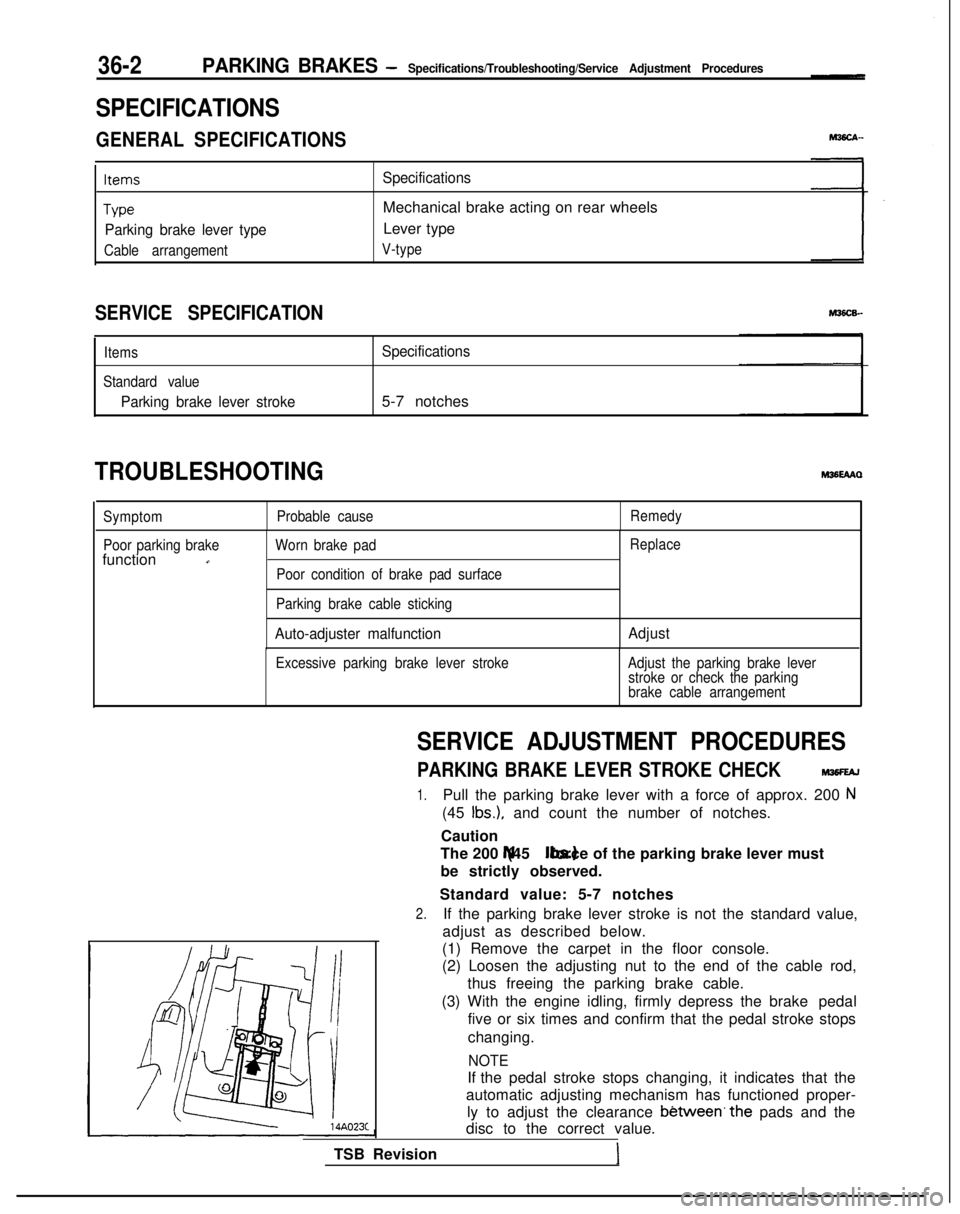
!14A023C
SERVICE ADJUSTMENT PROCEDURES
PARKING BRAKE LEVER STROKE CHECKM~~FEAJ
1.Pull the parking brake lever with a force of approx. 200 N
(45 Ibs.), and count the number of notches.
Caution
The 200 N (45 Ibs.) force of the parking brake lever must
be strictly observed.
Standard value: 5-7 notches
2.If the parking brake lever stroke is not the standard value,
adjust as described below.
(1) Remove the carpet in the floor console.
(2) Loosen the adjusting nut to the end of the cable rod,
thus freeing the parking brake cable.
(3) With the engine idling, firmly depress the brake pedal
five or six times and confirm that the pedal stroke stops
changing.
NOTE
If the pedal stroke stops changing, it indicates that the
automatic adjusting mechanism has functioned proper- ly to adjust the clearance
b&ween’the pads and the
disc to the correct value.
TSB Revision