battery MITSUBISHI GRANDIS 2008 (in English) Owner's Guide
[x] Cancel search | Manufacturer: MITSUBISHI, Model Year: 2008, Model line: GRANDIS, Model: MITSUBISHI GRANDIS 2008Pages: 458, PDF Size: 18.52 MB
Page 356 of 458
7-8 Vehicle care
7
Wiper blades
E00901700017
Use a soft cloth and glass cleaner to remove grease, dead
insects, etc., from the wiper blades. Replace the wiper blades
when they no longer wipe properly. (Refer to page 8-29.)Cleaning the sunroof*
E00901800018
Clean the inside of the sunroof with a soft cloth. Hard deposits
should be wiped away with a cloth dipped in warm, neutral
detergent solution. Wipe away the solution with a sponge
dipped in fresh water.NOTE●The surface treatment on the inside of the glass may be
removed if hard cloth or organic solvent (benzine, thinner,
etc.) is used.
Engine compartment
E00902100265
Clean the engine compartment at the beginning and end of
winter. Pay particular attention to flanges, crevices and periph-
eral parts where dust containing road chemicals and other cor-
rosive materials might collect.
If salt and other chemicals are used on the roads in your area,
clean the engine compartment at least every three months.
Never spray or splash water on the electrical components in the
engine compartment, as this may cause damage.
Do not bring the nearby parts, the plastic parts and so on into
contact with sulphuric acid (battery electrolyte) which may
crack, stain or discolour them.
If they are in contact, wipe off with soft cloth, chamois or the
like and an aqueous solution of neutral detergent then immedi-
ately rinse the affected parts with plenty of water.
BK-XP08E1ENUK.en-uk.book Page 8 Monday, August 13, 2007 2:20 PM
Page 357 of 458
8
Maintenance
Service precautions . . . . . . . . . . . . . . . . . . . . . . . .8- 2
Catalytic converter . . . . . . . . . . . . . . . . . . . . . . . . .8- 3
Bonnet . . . . . . . . . . . . . . . . . . . . . . . . . . . . . . . . . .8- 4
Engine oil . . . . . . . . . . . . . . . . . . . . . . . . . . . . . . . .8- 7
Engine coolant . . . . . . . . . . . . . . . . . . . . . . . . . . . .8- 10
Automatic transmission fluid* . . . . . . . . . . . . . . . .8- 13
Washer fluid . . . . . . . . . . . . . . . . . . . . . . . . . . . . . .8- 14
Brake fluid/Clutch fluid* . . . . . . . . . . . . . . . . . . . .8- 14
Power steering fluid . . . . . . . . . . . . . . . . . . . . . . . .8- 15
Battery . . . . . . . . . . . . . . . . . . . . . . . . . . . . . . . . . .8- 16
Tyres . . . . . . . . . . . . . . . . . . . . . . . . . . . . . . . . . . . .8- 21
Clutch pedal free play* . . . . . . . . . . . . . . . . . . . . .8- 27
Brake pedal free play . . . . . . . . . . . . . . . . . . . . . . .8- 28
Parking brake lever stroke . . . . . . . . . . . . . . . . . . .8- 28
Wiper blades . . . . . . . . . . . . . . . . . . . . . . . . . . . . .8- 29
General maintenance . . . . . . . . . . . . . . . . . . . . . . .8- 31
For cold and snow weather . . . . . . . . . . . . . . . . . .8- 32
Fuse links . . . . . . . . . . . . . . . . . . . . . . . . . . . . . . . .8- 33
Fuses . . . . . . . . . . . . . . . . . . . . . . . . . . . . . . . . . . .8- 33
Replacement of lamp bulbs . . . . . . . . . . . . . . . . . .8- 43
BK-XP08E1ENUK.en-uk.book Page 1 Monday, August 13, 2007 2:20 PM
Page 358 of 458
8-2 Maintenance
8Service precautions
E01000100328
Adequate care of your vehicle at regular intervals serves to pre-
serve the value and appearance as long as possible.
Maintenance items as described in this owner’s manual can be
performed by the owner.
Maintenance items as described in this Owner’s Manual can be
performed by the owner.
We recommend you to have the periodic inspection and main-
tenance performed by a MITSUBISHI MOTORS Authorized
Service Point or another specialist. In the event a malfunction
or other problem is discovered, we recommend you to have it
checked and repaired. This section contains information on
inspection maintenance procedures that you can do yourself.
Follow the instructions and cautions for each of the various
procedures.
WARNING
!●When checking or servicing the inside of the engine
compartment, make sure the engine is switched off
and has had a chance to cool down.●If it is necessary to do work in the engine compart-
ment with the engine running, be especially careful
that your clothing, hair, etc., does not become caught
by the fan, drive belts, or other moving parts.●The fan may turn on automatically even if the
engine is not running; turn the ignition key to
“LOCK” position and remove the key to ensure
safety while you work in the engine compartment.●Do not smoke, cause sparks or allow open flames
around fuel or battery. The fumes are flammable.
●Be extremely cautious when working around the
battery. It contains poisonous and corrosive sulphu-
ric acid.●Do not get under your vehicle with just the body
jack supporting it. Always use automotive jack
stands.●Improper handling of components and materials
used in the vehicle can endanger your personal
safety. We recommend you to consult a specialist for
necessary information.
WARNING
!
BK-XP08E1ENUK.en-uk.book Page 2 Monday, August 13, 2007 2:20 PM
Page 359 of 458
Maintenance
8-3
8 Catalytic converter
E01000200752
For ordinary use, there are no particular precautions except that
of using unleaded petrol.
The exhaust gas scavenging devices used with the catalytic
converter are extremely efficient for the reduction of noxious
gases. The catalytic converter is installed in the exhaust sys-
tem.
It is important to keep the engine properly tuned to ensure
proper catalyst operation and prevent possible catalyst damage.The catalytic converter itself gets hot quickly, and may be dam-
aged if overheated. The following points should be noted in
order to prevent the ignition of unburned petrol within the cata-
lytic converter.
●Use UNLEADED PETROL ONLY of the type recom-
mended in “Fuel selection” on page 2.
●Do not drive with an extremely low fuel level; running out
of fuel could cause damage to the catalytic converter.
●Do not try to start the engine by pushing the vehicle. If the
battery is weak or discharged, use another battery to start
the engine.
●Do not idle the engine with any spark plug wires discon-
nected or removed such as performing diagnostic tests.
●Do not idle the engine for prolonged periods during very
rough idle or malfunctioning operating conditions.
●Do not race the engine when turning off the ignition
switch. This will cause the catalytic converter to be dam-
aged due to contact with unburnt fuel.
●Stop driving the vehicle if you think the performance is
noticeably low, or that there is unnecessary engine rota-
tion, or any other engine trouble, such as with the ignition,
etc.
If it is impractical to stop driving immediately, reduce the
speed and drive for only a short time. We recommend you
to have your vehicle inspected as soon as possible.
CAUTION
!●Damage to the catalytic converter can result if your
vehicle is not kept in proper operating condition. In
the event of an engine malfunction particularly
involving engine misfire or other apparent loss of
performance have your vehicle serviced promptly.
Continued operation of your vehicle with a severe
overheated condition may result in possible damage
to the converter and vehicle.
WARNING
!●As with any vehicle, do not park or operate this
vehicle in areas where combustible materials such as
dry grass or leaves can come in contact with the hot
exhaust since fire could occur.●Paint should not be applied to the catalytic con-
verter.
BK-XP08E1ENUK.en-uk.book Page 3 Monday, August 13, 2007 2:20 PM
Page 372 of 458
8-16 Maintenance
8
To check the fluid levelCheck the fluid level in the reservoir while the engine is idling.
Check to make certain that the power steering fluid level is
always between the “MAX” and “MIN” level markings on the
fluid reservoir and refill the fluid, if necessary.Recommended fluidUse “Genuine MITSUBISHI Power Steering Fluid” or “ATF
DEXRON III / DEXRON II”.
Battery
E01001201277
The condition of the battery is very important for quick starting
of the engine and proper functioning of the vehicle’s electrical
system. Regular inspection and care are especially important in
cold weather.NOTE●After replacing the battery, the electronic control system
data for the automatic transmission, etc., will be erased.
As a result, shift shocks may occur.
Shift shocks will become smoother after several changes
in speed.
●Memory data for settings made by the user may be erased
when the battery is replaced. If this happens, establish the
settings again using the relevant procedures.
BK-XP08E1ENUK.en-uk.book Page 16 Monday, August 13, 2007 2:20 PM
Page 373 of 458
Maintenance
8-17
8
Checking battery electrolyte level
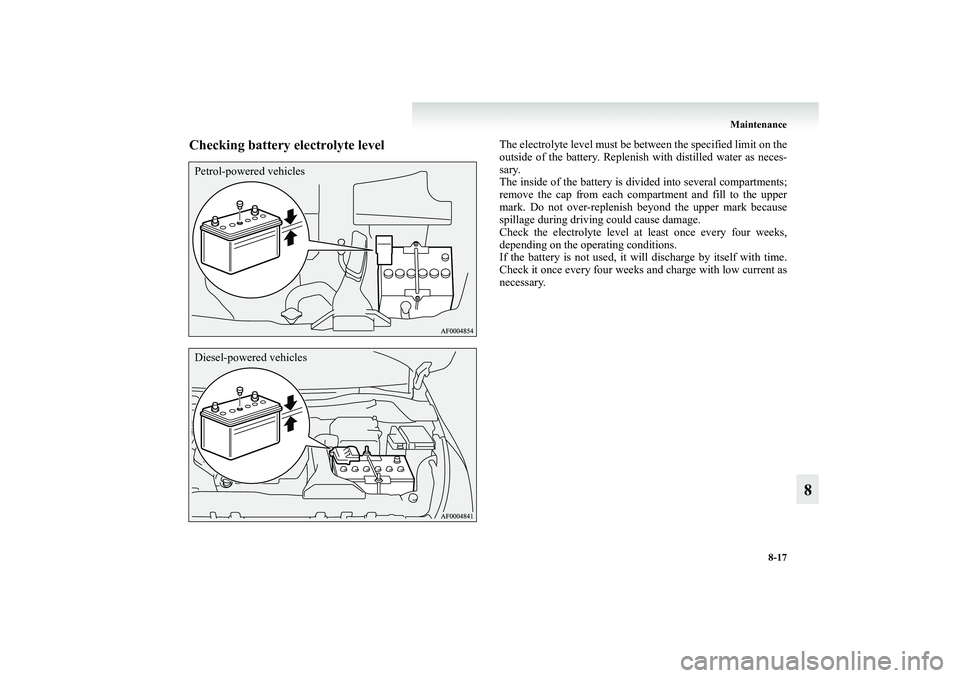
The electrolyte level must be between the specified limit on the
outside of the battery. Replenish with distilled water as neces-
sary.
The inside of the battery is divided into several compartments;
remove the cap from each compartment and fill to the upper
mark. Do not over-replenish beyond the upper mark because
spillage during driving could cause damage.
Check the electrolyte level at least once every four weeks,
depending on the operating conditions.
If the battery is not used, it will discharge by itself with time.
Check it once every four weeks and charge with low current as
necessary.
Petrol-powered vehiclesDiesel-powered vehicles
BK-XP08E1ENUK.en-uk.book Page 17 Monday, August 13, 2007 2:20 PM
Page 374 of 458
8-18 Maintenance
8
During cold weatherThe capacity of the battery is reduced at low temperatures. This
is an inevitable result of its chemical and physical properties.
This is why a very cold battery, particularly one that is not fully
charged anyway, will only deliver a fraction of the starter cur-
rent which is normally available.
We recommend you to have the battery checked before the start
of cold weather and, if necessary, have it charged or replaced.
This does not only ensures reliable starting, but a battery which
is kept fully charged also has a longer life.Disconnection and connectionTo disconnect the battery cable, stop the engine, first discon-
nect the negative (–) terminal and then the positive (+) termi-
nal. When connecting the battery, first connect the positive (+)
terminal and then the negative (–) terminal.
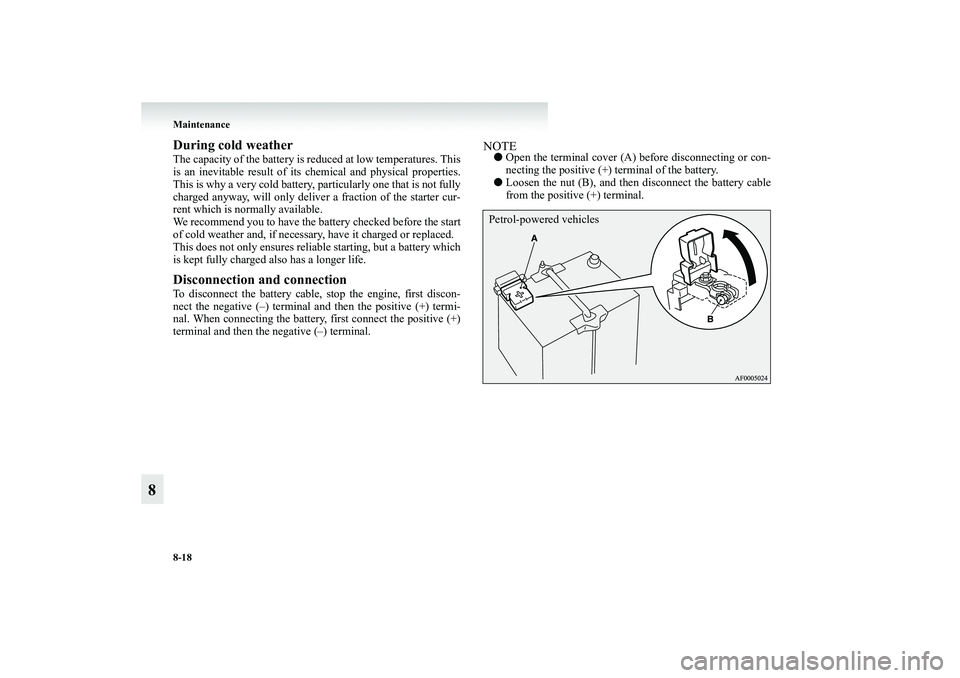
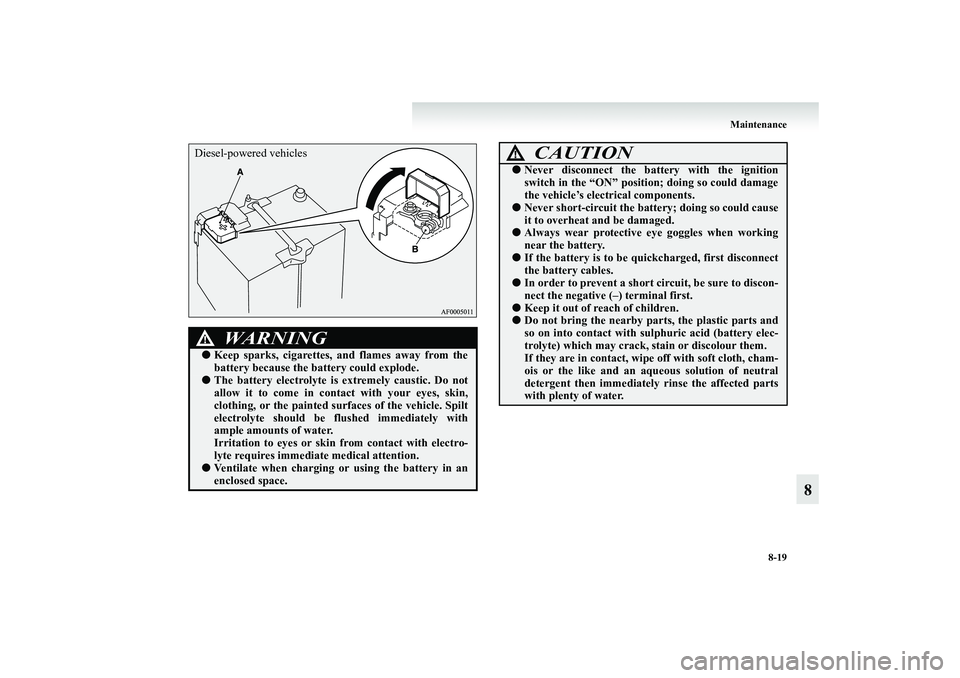
NOTE●Open the terminal cover (A) before disconnecting or con-
necting the positive (+) terminal of the battery.
●Loosen the nut (B), and then disconnect the battery cable
from the positive (+) terminal.Petrol-powered vehicles
BK-XP08E1ENUK.en-uk.book Page 18 Monday, August 13, 2007 2:20 PM
Page 375 of 458
Maintenance
8-19
8
WARNING
!●Keep sparks, cigarettes, and flames away from the
battery because the battery could explode.●The battery electrolyte is extremely caustic. Do not
allow it to come in contact with your eyes, skin,
clothing, or the painted surfaces of the vehicle. Spilt
electrolyte should be flushed immediately with
ample amounts of water.
Irritation to eyes or skin from contact with electro-
lyte requires immediate medical attention.●Ventilate when charging or using the battery in an
enclosed space.Diesel-powered vehicles
CAUTION
!●Never disconnect the battery with the ignition
switch in the “ON” position; doing so could damage
the vehicle’s electrical components.●Never short-circuit the battery; doing so could cause
it to overheat and be damaged.●Always wear protective eye goggles when working
near the battery.●If the battery is to be quickcharged, first disconnect
the battery cables.●In order to prevent a short circuit, be sure to discon-
nect the negative (–) terminal first.●Keep it out of reach of children.●Do not bring the nearby parts, the plastic parts and
so on into contact with sulphuric acid (battery elec-
trolyte) which may crack, stain or discolour them.
If they are in contact, wipe off with soft cloth, cham-
ois or the like and an aqueous solution of neutral
detergent then immediately rinse the affected parts
with plenty of water.
BK-XP08E1ENUK.en-uk.book Page 19 Monday, August 13, 2007 2:20 PM
Page 376 of 458
8-20 Maintenance
8
NOTE●Keep the terminals clean. After the battery is connected,
apply terminal protection grease. To clean the terminals,
use lukewarm water.
●Check to see if the battery is securely installed and cannot
be moved during travel. Also check each terminal for
tightness.
●When the vehicle is to be left unused for a long period of
time, remove the battery and store it in a place where the
battery fluid will not freeze. The battery should be stored
only in a fully charged condition.
BK-XP08E1ENUK.en-uk.book Page 20 Monday, August 13, 2007 2:20 PM
Page 394 of 458
8-38 Maintenance
8
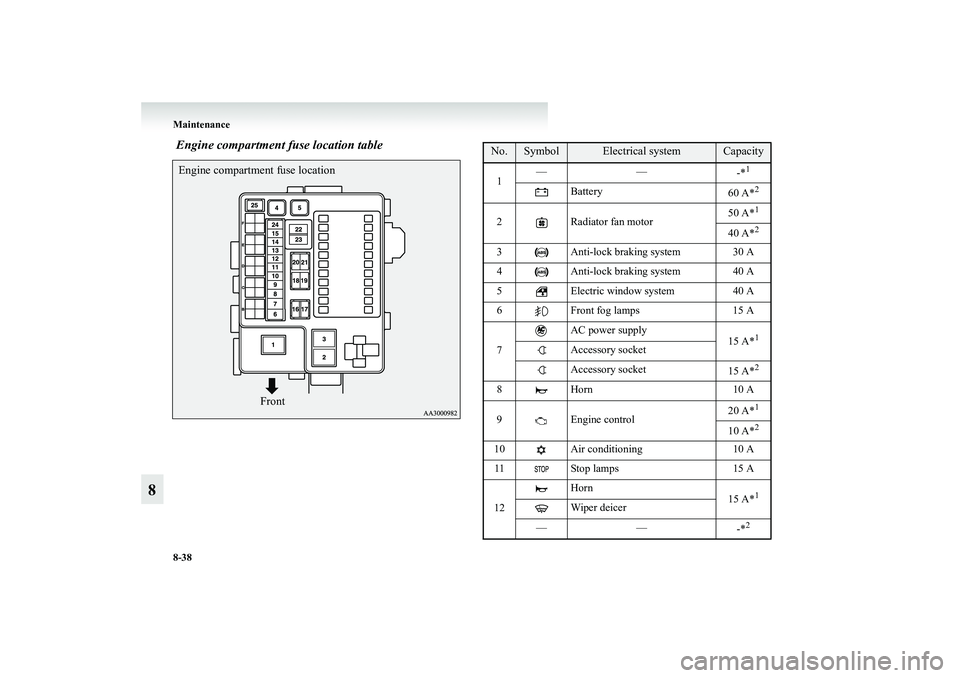
Engine compartment fuse location tableEngine compartment fuse location
Front
No.
Symbol
Electrical system
Capacity
1——
-*
1
Battery
60 A*
2
2 Radiator fan motor50 A*
1
40 A*
2
3 Anti-lock braking system 30 A
4 Anti-lock braking system 40 A
5 Electric window system 40 A
6 Front fog lamps 15 A
7AC power supply
15 A*
1
Accessory socket
Accessory socket
15 A*
2
8Horn 10 A
9 Engine control20 A*
1
10 A*
2
10 Air conditioning 10 A
11 Stop lamps 15 A
12Horn
15 A*
1
Wiper deicer
——
-*
2
BK-XP08E1ENUK.en-uk.book Page 38 Monday, August 13, 2007 2:20 PM