weight MITSUBISHI GRANDIS 2008 Owner's Manual (in English)
[x] Cancel search | Manufacturer: MITSUBISHI, Model Year: 2008, Model line: GRANDIS, Model: MITSUBISHI GRANDIS 2008Pages: 458, PDF Size: 18.52 MB
Page 71 of 458
Seat and seat belts
2-23
2
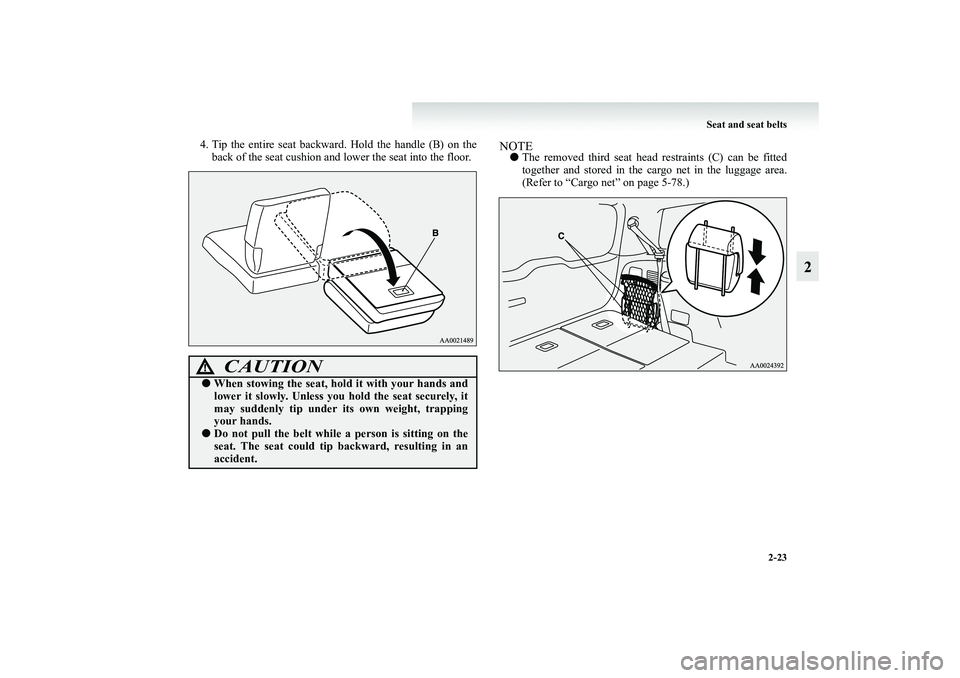
4. Tip the entire seat backward. Hold the handle (B) on the
back of the seat cushion and lower the seat into the floor.
NOTE●The removed third seat head restraints (C) can be fitted
together and stored in the cargo net in the luggage area.
(Refer to “Cargo net” on page 5-78.)
CAUTION
!●When stowing the seat, hold it with your hands and
lower it slowly. Unless you hold the seat securely, it
may suddenly tip under its own weight, trapping
your hands.●Do not pull the belt while a person is sitting on the
seat. The seat could tip backward, resulting in an
accident.
BK-XP08E1ENUK.en-uk.book Page 23 Monday, August 13, 2007 2:20 PM
Page 84 of 458
2-36 Seat and seat belts
2
When the ignition key is turned to the “ON” position, the warn-
ing lamp will come on and a tone will sound for about 6 sec-
onds. If the front seat belt remains unfastened approximately
1 minute later, the warning lamp will flash and the tone sound
intermittently (each 12 seconds) when the vehicle is driven. If
the passenger subsequently unfastens the seat belt while driv-
ing, the warning lamp and tone will issue further warnings.
And if the seat belt remains unfastened, the warning lamp and
tone will issue further warnings each time the vehicle starts
moving from a stop. When the seat belt is fastened, the warn-
ings will stop. NOTE●When luggage is placed on the front passenger seat, a sen-
sor in the seat cushion may, depending on the weight and
position of the luggage, cause the warning tone to sound
and the warning lamp to come on.
Adjustable seat belt anchor (front seats)
E00405000433
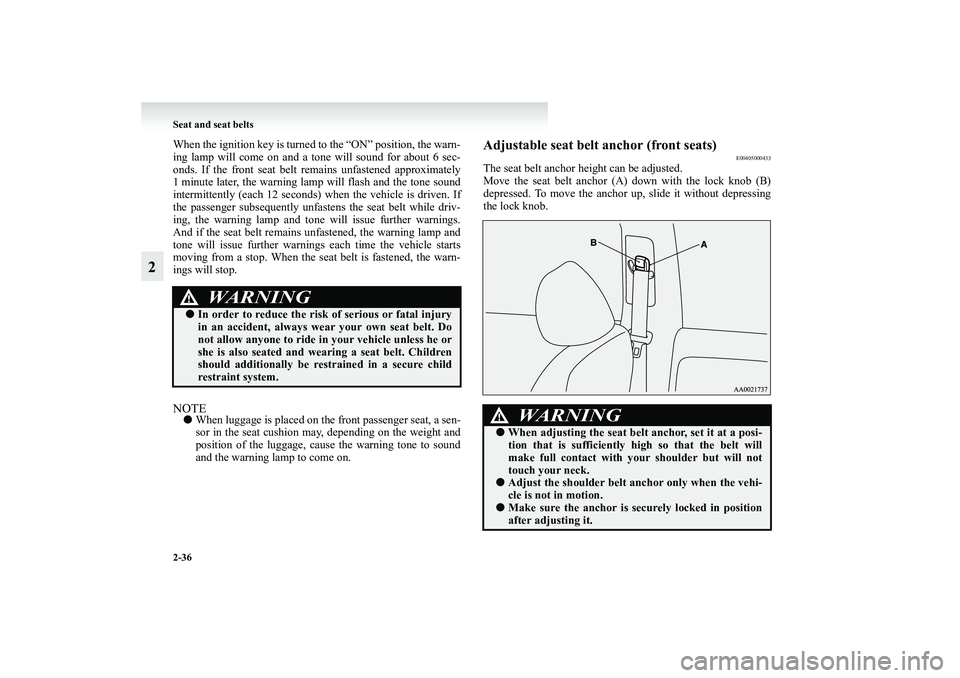
The seat belt anchor height can be adjusted.
Move the seat belt anchor (A) down with the lock knob (B)
depressed. To move the anchor up, slide it without depressing
the lock knob.
WARNING
!●In order to reduce the risk of serious or fatal injury
in an accident, always wear your own seat belt. Do
not allow anyone to ride in your vehicle unless he or
she is also seated and wearing a seat belt. Children
should additionally be restrained in a secure child
restraint system.
WARNING
!●When adjusting the seat belt anchor, set it at a posi-
tion that is sufficiently high so that the belt will
make full contact with your shoulder but will not
touch your neck.●Adjust the shoulder belt anchor only when the vehi-
cle is not in motion.●Make sure the anchor is securely locked in position
after adjusting it.
BK-XP08E1ENUK.en-uk.book Page 36 Monday, August 13, 2007 2:20 PM
Page 91 of 458
Seat and seat belts
2-43
2
Infants and small children
E00406600579
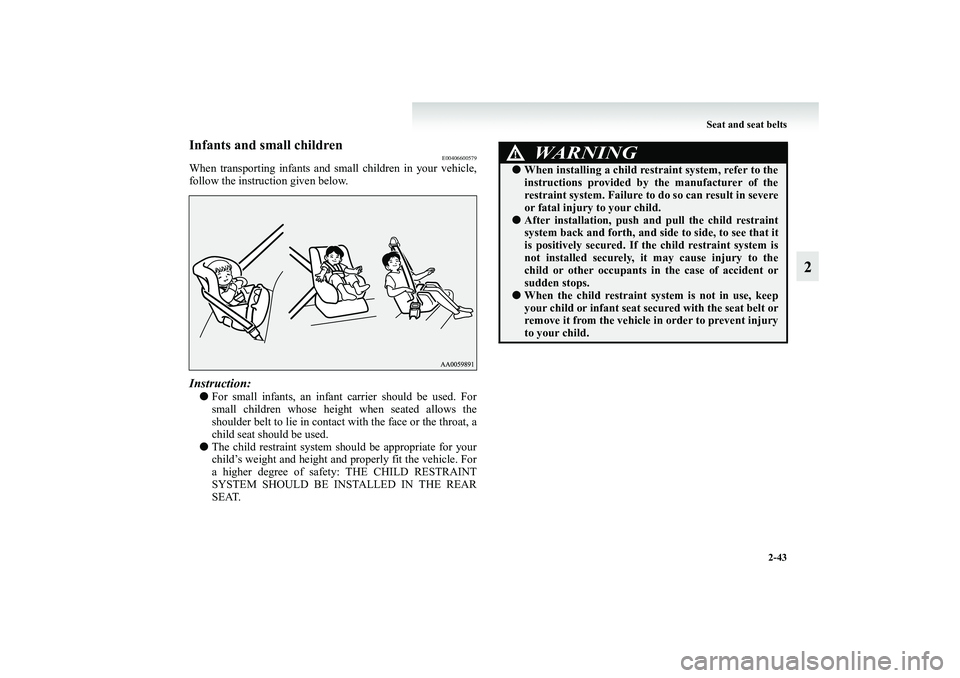
When transporting infants and small children in your vehicle,
follow the instruction given below.Instruction:●For small infants, an infant carrier should be used. For
small children whose height when seated allows the
shoulder belt to lie in contact with the face or the throat, a
child seat should be used.
●The child restraint system should be appropriate for your
child’s weight and height and properly fit the vehicle. For
a higher degree of safety: THE CHILD RESTRAINT
SYSTEM SHOULD BE INSTALLED IN THE REAR
SEAT.
WARNING
!●When installing a child restraint system, refer to the
instructions provided by the manufacturer of the
restraint system. Failure to do so can result in severe
or fatal injury to your child.●After installation, push and pull the child restraint
system back and forth, and side to side, to see that it
is positively secured. If the child restraint system is
not installed securely, it may cause injury to the
child or other occupants in the case of accident or
sudden stops.●When the child restraint system is not in use, keep
your child or infant seat secured with the seat belt or
remove it from the vehicle in order to prevent injury
to your child.
BK-XP08E1ENUK.en-uk.book Page 43 Monday, August 13, 2007 2:20 PM
Page 174 of 458

4-2 Starting and driving
4Economical driving
E00600100372
For economical driving, there are some technical requirements
that have to be met. The prerequisite for low fuel consumption
is a properly adjusted engine. In order to achieve longer life of
the vehicle and the most economical operation, we recommend
you have the vehicle checked at regular intervals in accordance
with the service standards.
Fuel economy and generation of exhaust gas and noise are
highly influenced by personal driving habits as well as the par-
ticular operating conditions. The following points should be
observed in order to minimize wear of brakes, tyres and engine
as well as to reduce environmental pollution.StartingAvoid rapid acceleration and sudden starts; such operation will
result in higher fuel consumption.ShiftingShift only at an appropriate speed and engine speed. Always
use the highest gear possible.City trafficFrequent starting and stopping increases the average fuel con-
sumption. Use roads with smooth traffic flow whenever possi-
ble. When driving on congested roads, avoid use of a low gear
at high engine speeds.IdlingThe vehicle consumes fuel even during idling. Avoid extended
idling whenever possible.
SpeedThe higher the vehicle speed, the more fuel consumed. Avoid
driving at full speed. Even a slight release of the accelerator
pedal will save a significant amount of fuel.Tyre inflation pressureCheck the tyre inflation pressures at regular intervals. Low tyre
inflation pressure increases road resistance and fuel consump-
tion. In addition, low tyre pressures adversely affect tyre wear
and driving stability.LoadDo not drive with unnecessary articles in the luggage compart-
ment. Especially during city driving where frequent starting
and stopping is necessary, the increased weight of the vehicle
will greatly affect fuel consumption. Also avoid driving with
unnecessary luggage, etc., on the roof; the increased air resist-
ance will increase fuel consumption.Cold engine startingStarting of a cold engine consumes more fuel.
Unnecessary fuel consumption is also caused by keeping a hot
engine running. After the engine is started, commence driving
as soon as possible.Air conditioningThe use of the air conditioning will increase the fuel consump-
tion.
BK-XP08E1ENUK.en-uk.book Page 2 Monday, August 13, 2007 2:20 PM
Page 231 of 458

Starting and driving
4-59
4
Roof carrier precaution
NOTE●To prevent wind noise or reduction in fuel economy,
remove the roof carrier when not in use.
●Before using an automatic car wash, check with the
attendant to determine if the roof carrier should be
removed.
●Be sure that adequate clearance is maintained for raising
the sunroof (if so equipped) and/or the tailgate when
installing a roof carrier.
CAUTION
!●Make sure that the weight of the luggage does not
exceed the allowable roof load.
If the allowable roof load is exceeded, this may cause
damage to the vehicle.
The roof load is the total allowable load on the roof
(the weight of the roof carrier plus the weight of lug-
gage placed on the roof carrier).
For specific figures, please refer to “Maximum roof
load” on page 9-8.●When luggage is loaded onto the vehicle, please
make sure to drive slowly and avoid excessive
maneuvers such as sudden braking or quick turn-
ing.
In addition, place the luggage on the carrier so that
its weight is distributed evenly with the heaviest
items on the bottom. Do not load items that are
wider than the roof carrier.
The additional weight on the roof could raise the
vehicle’s centre of gravity and affect vehicle han-
dling characteristics.
As a result, driving errors or emergency maneuvers
could lead to a loss of control and result in an acci-
dent.
●Before driving and after travelling a short distance,
always check the load to make sure it is securely fas-
tened to the roof carrier.
Check periodically during your travel that the load
remains secure. If the load is not secure, it could fall
from the vehicle and damage your vehicle, another
vehicle or create road hazard.
CAUTION
!
BK-XP08E1ENUK.en-uk.book Page 59 Monday, August 13, 2007 2:20 PM
Page 232 of 458
4-60 Starting and driving
4Trailer towing
E00610000172
In order to tow a trailer with your vehicle, have a trailer towing
device mounted that meets all relevant regulations in your area.
Consult a MITSUBISHI MOTORS Authorized Service Point.
The regulations concerning the towing of a trailer may differ
from country to country. You are advised to obey the regula-
tions in each area.NOTE●If you are going to tow a trailer, pay careful attention to
the following points.Maximum towable weight with brake and maxi-
mum trailer-nose weightNever exceed the maximum towable weight with brake and the
maximum trailer-nose weight as listed in the specifications.
(Refer to page 9-8)
If you tow a trailer at an altitude of more than 1,000 m above
sea-level, reduce your weight by 10 % of the gross combina-
tion weight for every increase of 1,000 m above sea-level, as
the engine output is lowered owing to decrease in atmospheric
pressure.
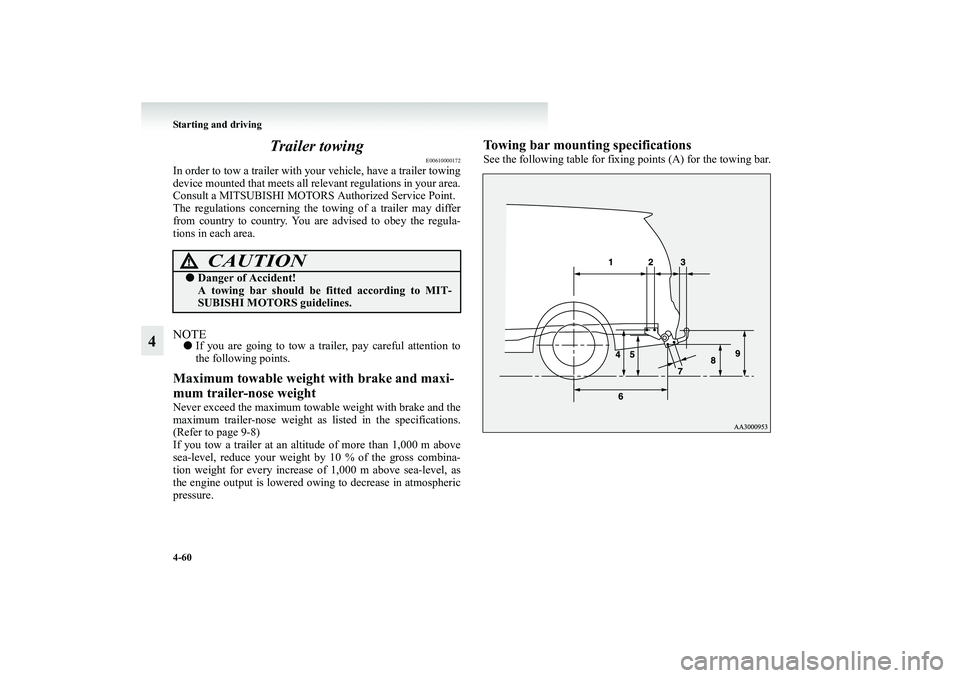
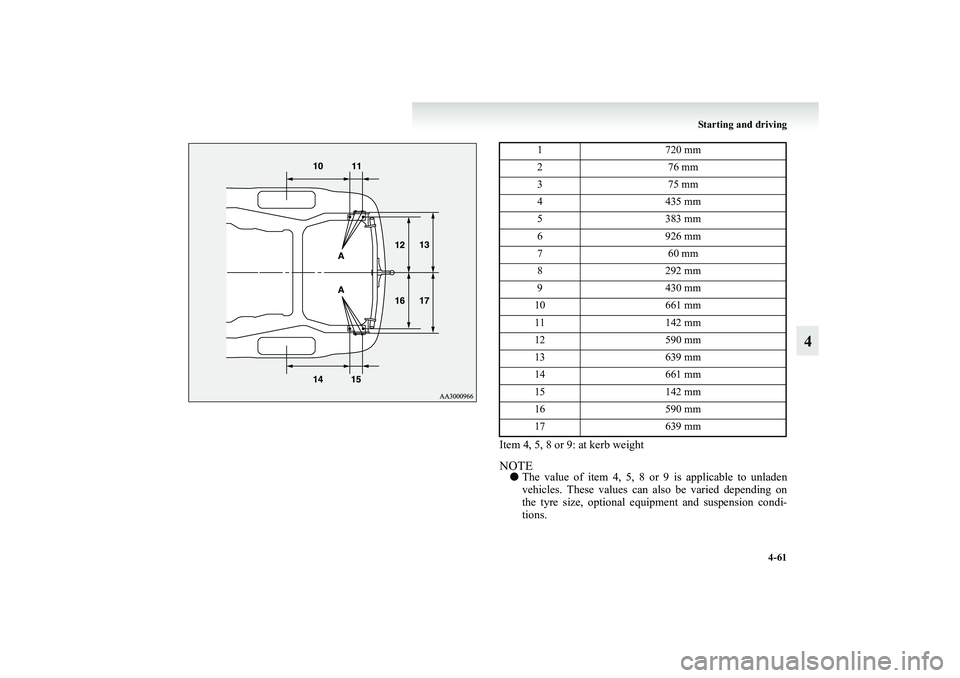
Towing bar mounting specificationsSee the following table for fixing points (A) for the towing bar.
CAUTION
!●Danger of Accident!
A towing bar should be fitted according to MIT-
SUBISHI MOTORS guidelines.
BK-XP08E1ENUK.en-uk.book Page 60 Monday, August 13, 2007 2:20 PM
Page 233 of 458
Starting and driving
4-61
4
Item 4, 5, 8 or 9: at kerb weightNOTE●The value of item 4, 5, 8 or 9 is applicable to unladen
vehicles. These values can also be varied depending on
the tyre size, optional equipment and suspension condi-
tions.
1 720 mm
2 76 mm
3 75 mm
4 435 mm
5 383 mm
6 926 mm
7 60 mm
8 292 mm
9 430 mm
10 661 mm
11 142 mm
12 590 mm
13 639 mm
14 661 mm
15 142 mm
16 590 mm
17 639 mm
BK-XP08E1ENUK.en-uk.book Page 61 Monday, August 13, 2007 2:20 PM
Page 234 of 458
4-62 Starting and driving
4
Operating hints●Do not let the clutch slip (vehicles with M/T only) and do
not increase the engine speed more than necessary when
starting.
●Be sure that the driving speed does not exceed the
100 km/h (62 mph) for trailer operation.
It is also recommended that you obey the local regulations
in case driving speed with a trailer is limited to less than
100 km/h (62 mph).
●To prevent shocks from the overrun brake, depress the
brake pedal lightly at first and then more strongly.
●To make full use of engine braking, change to a lower
gear before descending a slope.
●The body, brakes, clutch, and chassis will be under addi-
tional strain when towing a trailer.
●The heavier weight and higher rolling and air resistance
will increase fuel consumption.Additional precautions for vehicles equipped with A/TThe 2nd gear (in sports mode) is recommended on slopes or at
low speed. Use the 1st gear (in sports mode) in mountainous
areas in order to make better use of engine braking and to assist
the brake system. However, be sure that the speed does not
exceed the maximum speed limit for the selected gear.BK-XP08E1ENUK.en-uk.book Page 62 Monday, August 13, 2007 2:20 PM
Page 309 of 458

For pleasant driving
5-75
5
2. Adjust the position of the second seat as necessary, then
attach the hooks (E) to the bottom of the head restraint.
(Refer to “To adjust forward or backward” on page 2-9
and “To recline the seatback” on page 2-10.)NOTE●Do not weight the tonneau cover with a piece of luggage.
To remove1. Remove the cover from the mounting grooves, and the
cover will be rolled back into the retracted position.
2. Remove the hooks from the head restraint.
3. Move one of the sliders (A) towards the inside of the vehi-
cle, and lift it to remove the tonneau cover.
BK-XP08E1ENUK.en-uk.book Page 75 Monday, August 13, 2007 2:20 PM
Page 328 of 458

6-16 For emergencies
6Spare wheel
E00801101176
Check the air pressure of the spare tyre frequently and make
sure it is ready for emergency use at any time.
Maintaining the spare wheel at the highest specified air pres-
sure will ensure that it can always be used under any conditions
(city/high-speed driving, varying load weight, etc.).
The spare wheel is stored under the rear of the body.Compact spare wheelThe compact spare tyre is designed to save space in the lug-
gage compartment and its lighter weight makes it easier to use
if a flat tyre occurs.
CAUTION
!●The pressure should be periodically checked and
maintained at the specified pressure while the tyre is
stowed.
Driving with an insufficient tyre pressure can lead to
an accident. If you have no choice but to drive with
an insufficient tyre pressure, keep your speed down
and inflate the tyre to the correct pressure as soon as
possible. (Refer to “Tyre inflation pressures” on
page 8-21.)●The compact spare wheel is for temporary use only
and should be removed as soon as the original wheel
can be repaired or replaced.●The vehicle must not be driven at speeds in excess of
80 km/h (50 mph) while using the compact spare
wheel.
●The compact spare tyre is not as good as a standard
tyre in controllability and stability. When the com-
pact spare tyre is used, avoid quick starts, sudden
braking and sharp steering.●Avoid driving through automatic vehicle washers
and over obstacles that could possibly damage the
vehicle’s undercarriage. Because the compact spare
wheel is smaller than the original wheel, the ground
clearance is slightly reduced.●The compact spare wheel is specifically designed for
your vehicle and it should not be used on any other
vehicle.
CAUTION
!
BK-XP08E1ENUK.en-uk.book Page 16 Monday, August 13, 2007 2:20 PM