warning MITSUBISHI I-MIEV 2011 Owner's Manual
[x] Cancel search | Manufacturer: MITSUBISHI, Model Year: 2011, Model line: I-MIEV, Model: MITSUBISHI I-MIEV 2011Pages: 193, PDF Size: 12.2 MB
Page 44 of 193
CAUTION
l
Do not place heavy objects on the seat or
stick pins, needles, or other pointed ob-
jects into it.
l Do not use a blanket, cushion, or other ma-
terial with high heat insulation properties
on the seat while using the heater; this
might cause the heater element to overheat
l Do not use benzine, kerosene, petrol, alco-
hol or other organic solvents when clean-
ing the seat. Doing so could damage not
only the seat cover, but also the heater el-
ement.
l If water or any other liquid is spilled on
the seat, allow it to dry thoroughly before
attempting to use the heater.
l Turn the heater off immediately if it ap-
pears to be malfunctioning during use. Rear seat
E00401300353 WARNING
l When
a person sits in the rear seat, pull
up the head restraint to a height at which
it locks in position. Be sure to make this
adjustment before starting to drive. Seri-
ous injuries could otherwise be suffered
as the result of an impact. Refer to “Head
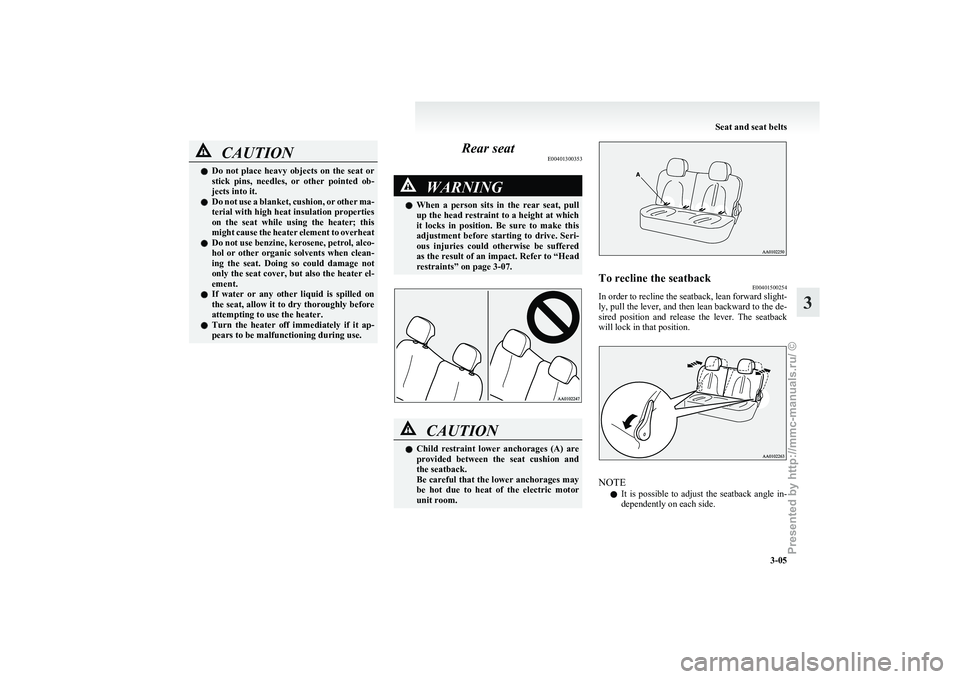
restraints” on page 3-07. CAUTION
l
Child
restraint lower anchorages (A) are
provided between the seat cushion and
the seatback.
Be careful that the lower anchorages may
be hot due to heat of the electric motor
unit room. To recline the seatback
E00401500254
In order to recline the seatback, lean forward slight-
ly,
pull the lever, and then lean backward to the de-
sired position and release the lever. The seatback
will lock in that position. NOTE
l It
is possible to adjust the seatback angle in-
dependently on each side. Seat and seat belts
3-05 3
Presented by http://mmc-manuals.ru/ \251
Page 46 of 193
Head restraints
E00403301497WARNING
l Driving without the head restraints in
place can cause you and your passengers
serious injury or death in an accident. To
reduce the risk of injury in an accident, al-
ways make sure the head restraints are in-
stalled and properly positioned when the
seat is occupied.
l Never place a cushion or similar device
on the seatback. This can adversely affect
head restraint performance by increasing
the distance between your head and the
restraint.
To adjust height
Adjust
the head restraint height so that the centre
of the head restraint is as close as possible to eye
level to reduce the chances of injury in the event of
collision. Any person too tall for the head restraint
to reach their seated eye level, should adjust the re-
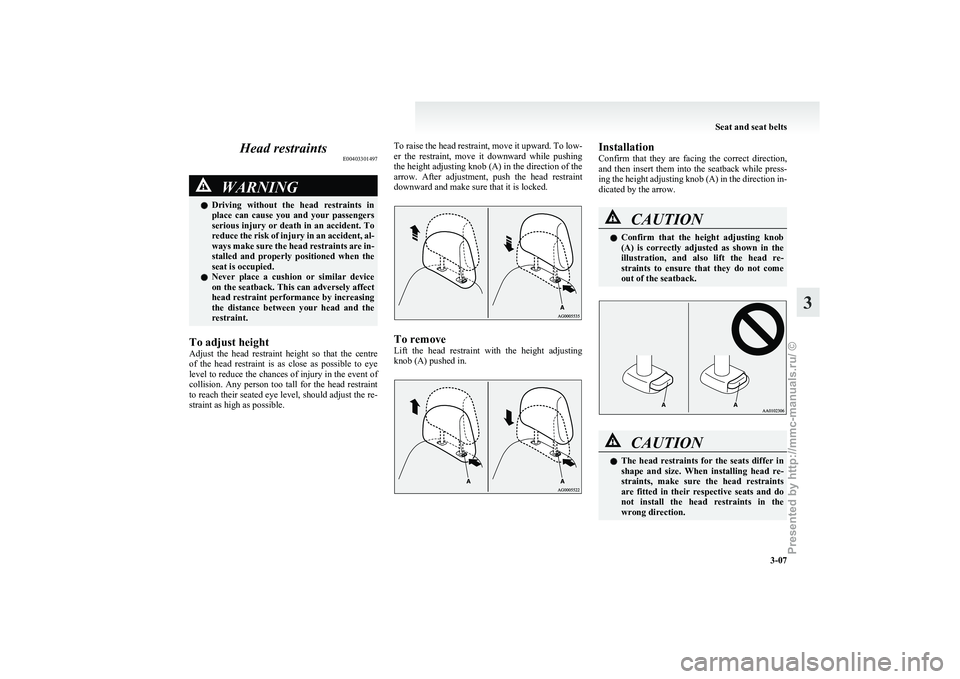
straint as high as possible. To raise the head restraint, move it upward. To low-
er
the restraint, move it downward while pushing
the height adjusting knob (A) in the direction of the
arrow. After adjustment, push the head restraint
downward and make sure that it is locked. To remove
Lift
the head restraint with the height adjusting
knob (A) pushed in. Installation
Confirm
that they are facing the correct direction,
and then insert them into the seatback while press-
ing the height adjusting knob (A) in the direction in-
dicated by the arrow. CAUTION
l
Confirm
that the height adjusting knob
(A) is correctly adjusted as shown in the
illustration, and also lift the head re-
straints to ensure that they do not come
out of the seatback. CAUTION
l
The
head restraints for the seats differ in
shape and size. When installing head re-
straints, make sure the head restraints
are fitted in their respective seats and do
not install the head restraints in the
wrong direction. Seat and seat belts
3-07 3
Presented by http://mmc-manuals.ru/ \251
Page 47 of 193
Seat belts
E00404800636
To
protect you and your passengers in the event of
an accident, it is most important that the seat belts
be worn correctly while driving.
The front seat belts have a pretensioner system.
These belts are used the same way as a convention-
al seat belt.
Refer to “Seat belt pretensioner system and force
limiter system” on page 3-11 WARNING
l Always
place the shoulder belt over your
shoulder and across your chest. Never
put it behind you or under your arm.
l One seat belt should be used by only one
person. Doing otherwise can be dangerous.
l The seat belt will provide its wearer with
maximum protection if the recliner seat-
back is placed in fully upright position.
When the seatback is reclined, there is
greater risk that the passenger will slide
under the belt, especially in a forward im-
pact accident, and may be injured by the
belt or by striking the instrument panel
or seatbacks.
l Seat belts should always be worn by ev-
ery adult who drives or rides in this vehi-
cle, and by all children who are tall
enough to wear seat belts properly.
Other children should always use proper
child restraint systems.
l Remove any twists when using the belt. WARNING
l No
modifications or additions should be
made by the user which will either pre-
vent the seat belt adjusting devices from
operating to remove slack, or prevent the
seat belt assembly from being adjusted to
remove slack.
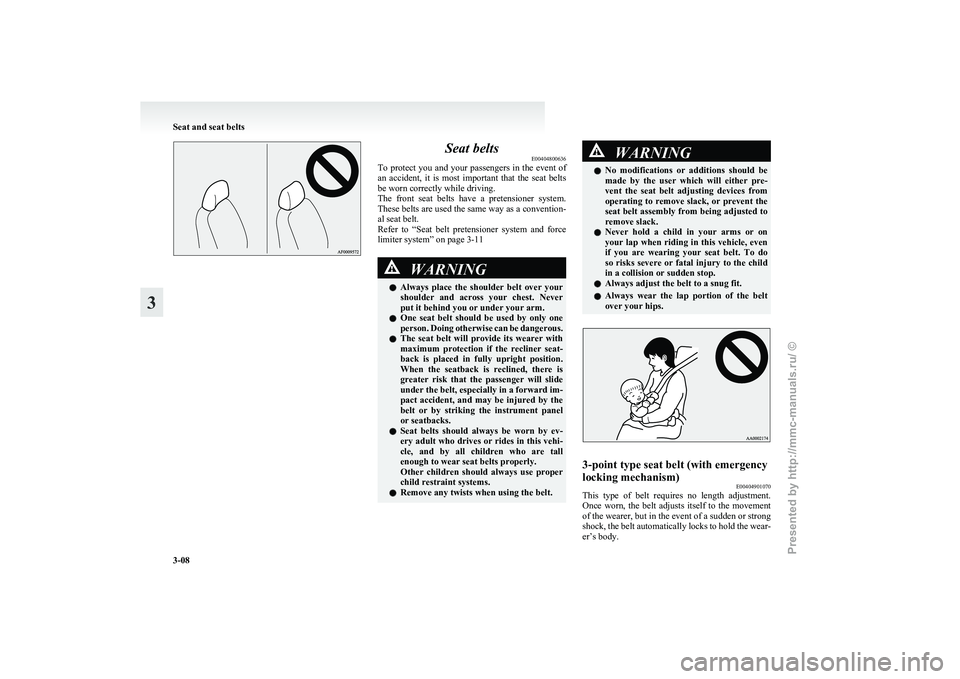
l Never hold a child in your arms or on
your lap when riding in this vehicle, even
if you are wearing your seat belt. To do
so risks severe or fatal injury to the child
in a collision or sudden stop.
l Always adjust the belt to a snug fit.
l Always wear the lap portion of the belt
over your hips. 3-point type seat belt (with emergency
locking mechanism)
E00404901070
This type of belt requires no length adjustment.
Once
worn, the belt adjusts itself to the movement
of the wearer, but in the event of a sudden or strong
shock, the belt automatically locks to hold the wear-
er’s body. Seat and seat belts
3-08
3
Presented by http://mmc-manuals.ru/ \251
Page 48 of 193
NOTE
l You
can check if the belt locks by pulling it
forward quickly.
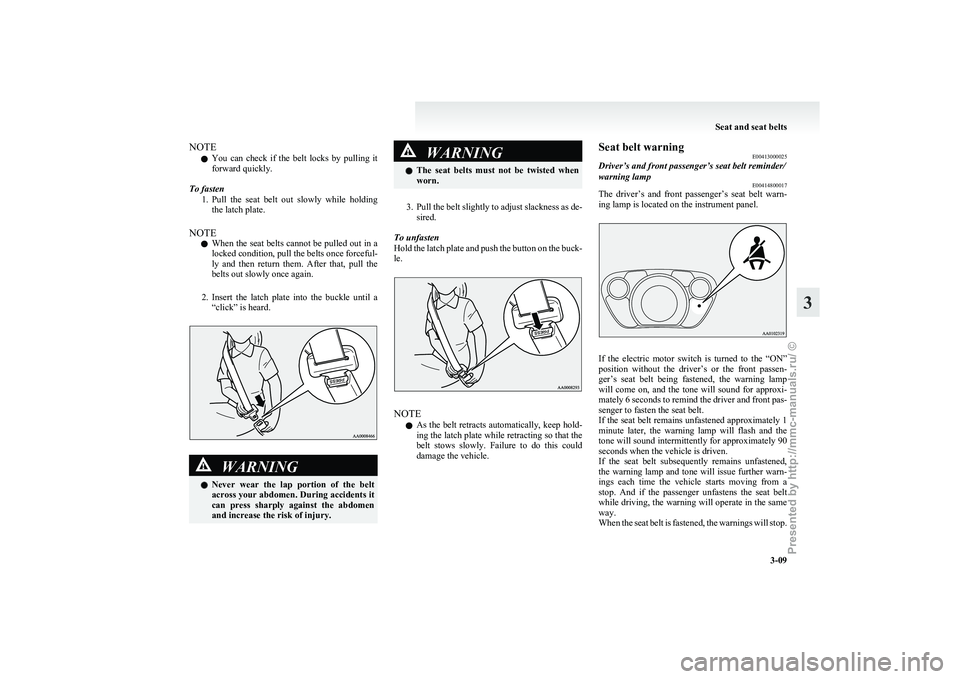
To fasten 1. Pull the seat belt out slowly while holdingthe latch plate.
NOTE l When the seat belts cannot be pulled out in a
locked condition, pull the belts once forceful-
ly and then return them. After that, pull the
belts out slowly once again.
2. Insert the latch plate into the buckle until a “click” is heard. WARNING
l Never
wear the lap portion of the belt
across your abdomen. During accidents it
can press sharply against the abdomen
and increase the risk of injury. WARNING
l The
seat belts must not be twisted when
worn.
3. Pull
the belt slightly to adjust slackness as de- sired.
To unfasten
Hold the latch plate and push the button on the buck-
le. NOTE
l As
the belt retracts automatically, keep hold-
ing the latch plate while retracting so that the
belt stows slowly. Failure to do this could
damage the vehicle. Seat belt warning
E00413000025
Driver’s and front passenger’s seat belt reminder/
warning lamp E00414800017
The driver’s and front passenger’s seat belt warn-
ing lamp is located on the instrument panel. If the electric motor switch is turned to the “ON”
position
without the driver’s or the front passen-
ger’s seat belt being fastened, the warning lamp
will come on, and the tone will sound for approxi-
mately 6 seconds to remind the driver and front pas-
senger to fasten the seat belt.
If the seat belt remains unfastened approximately 1
minute later, the warning lamp will flash and the
tone will sound intermittently for approximately 90
seconds when the vehicle is driven.
If the seat belt subsequently remains unfastened,
the warning lamp and tone will issue further warn-
ings each time the vehicle starts moving from a
stop. And if the passenger unfastens the seat belt
while driving, the warning will operate in the same
way.
When the seat belt is fastened, the warnings will stop. Seat and seat belts
3-09 3
Presented by http://mmc-manuals.ru/ \251
Page 49 of 193
NOTE
l For
the front passenger seat, the warning func-
tion works only while a person is sitting on
the seat.
l When luggage is placed on the front passen-
ger seat, a sensor in the seat cushion may, de-
pending on the weight and position of the lug-
gage, cause the warning tone to sound and
the warning lamp to come on.
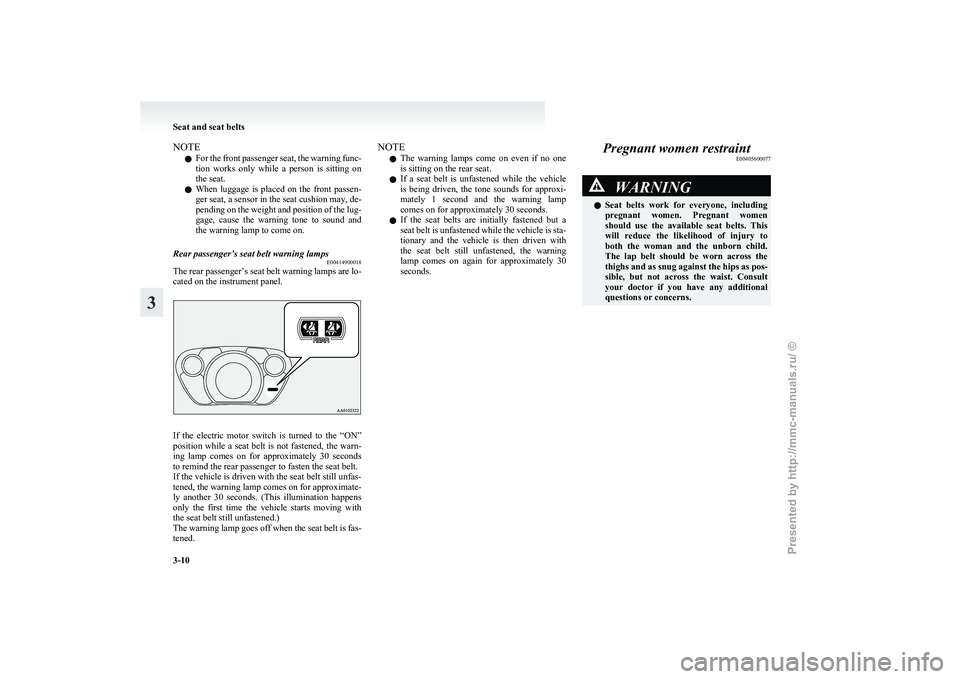
Rear passenger’s seat belt warning lamps E00414900018
The rear passenger’s seat belt warning lamps are lo-
cated on the instrument panel. If the electric motor switch is turned to the “ON”
position
while a seat belt is not fastened, the warn-
ing lamp comes on for approximately 30 seconds
to remind the rear passenger to fasten the seat belt.
If the vehicle is driven with the seat belt still unfas-
tened, the warning lamp comes on for approximate-
ly another 30 seconds. (This illumination happens
only the first time the vehicle starts moving with
the seat belt still unfastened.)
The warning lamp goes off when the seat belt is fas-
tened. NOTE
l The
warning lamps come on even if no one
is sitting on the rear seat.
l If a seat belt is unfastened while the vehicle
is being driven, the tone sounds for approxi-
mately 1 second and the warning lamp
comes on for approximately 30 seconds.
l If the seat belts are initially fastened but a
seat belt is unfastened while the vehicle is sta-
tionary and the vehicle is then driven with
the seat belt still unfastened, the warning
lamp comes on again for approximately 30
seconds. Pregnant women restraint
E00405600077 WARNING
l Seat
belts work for everyone, including
pregnant women. Pregnant women
should use the available seat belts. This
will reduce the likelihood of injury to
both the woman and the unborn child.
The lap belt should be worn across the
thighs and as snug against the hips as pos-
sible, but not across the waist. Consult
your doctor if you have any additional
questions or concerns. Seat and seat belts
3-10
3
Presented by http://mmc-manuals.ru/ \251
Page 50 of 193
Seat belt pretensioner system and
force limiter system E00405700166
The
driver’s seat and front passenger’s seat each
have a seat belt equipped with a pretensioner system.
Pretensioner system E00405801164
The pretensioner system will retract its respective
seat
belts instantaneously, thus maximizing the seat
belt’s effectiveness, if there is a frontal impact se-
vere enough to injure the driver and/or front passen-
ger and the electric motor switch is in the “ON” or
“START” position. WARNING
l To
obtain the best results from your pre-
tensioner seat belt, make sure you have ad-
justed your seat correctly and wear your
seat belt properly. CAUTION
l
Installation
of audio equipment or re-
pairs in the vicinity of the pretensioner
seat belts or floor console must be per-
formed in line with MITSUBISHI
MOTORS guidelines. It is important to
do so because the work could affect the
pretensioner systems. CAUTION
l
If
you need to scrap the vehicle, please con-
sult a MITSUBISHI MOTORS Author-
ized Service Point. It is important to do
so because unexpected activation of the
pretensioner seat belts could cause inju-
ries.
NOTE l The
pretensioner seat belts will be activated
if the vehicle suffers a severe frontal impact,
even if the seat belts are not worn.
l The pretensioner seat belts are designed to
work only once. After the pretensioner seat
belts have been activated, we recommend
you have them replaced by a MITSUBISHI
MOTORS Authorized Service Point.
SRS warning lamp E00405900315
This warning lamp is shared by the SRS airbags
and
the pretensioner seat belts. Refer to “SRS warn-
ing lamp” on page 3-29.
Force limiter system E00406000209
In the event of a collision, each force limiter sys-
tem
will effectively absorb the load applied to the
seat belt to minimize the impact to the passenger. Child restraint
E00406401747
When
transporting children in your vehicle, some
type of child restraint system should always be
used according to the size of the child. This is re-
quired by law in most countries.
The regulations concerning driving with children in
the front seat may differ from country to country.
You are advised to comply with the relevant regula-
tions. WARNING
l When
possible, put children in the rear
seat. Accident statistics indicate that chil-
dren of all sizes and ages are safer when
properly restrained in the rear seat rath-
er than in the front seat.
l Holding a child in your arms is no substi-
tute for a restraint system. Failure to use
a proper restraint system can result in se-
vere or fatal injury to the child.
l Each child restraint device or fixing is to
be used only by one child. Seat and seat belts
3-11 3
Presented by http://mmc-manuals.ru/ \251
Page 51 of 193
Caution for installing the child re-
straint on vehicles with a front passen-
ger airbag
E00406500318
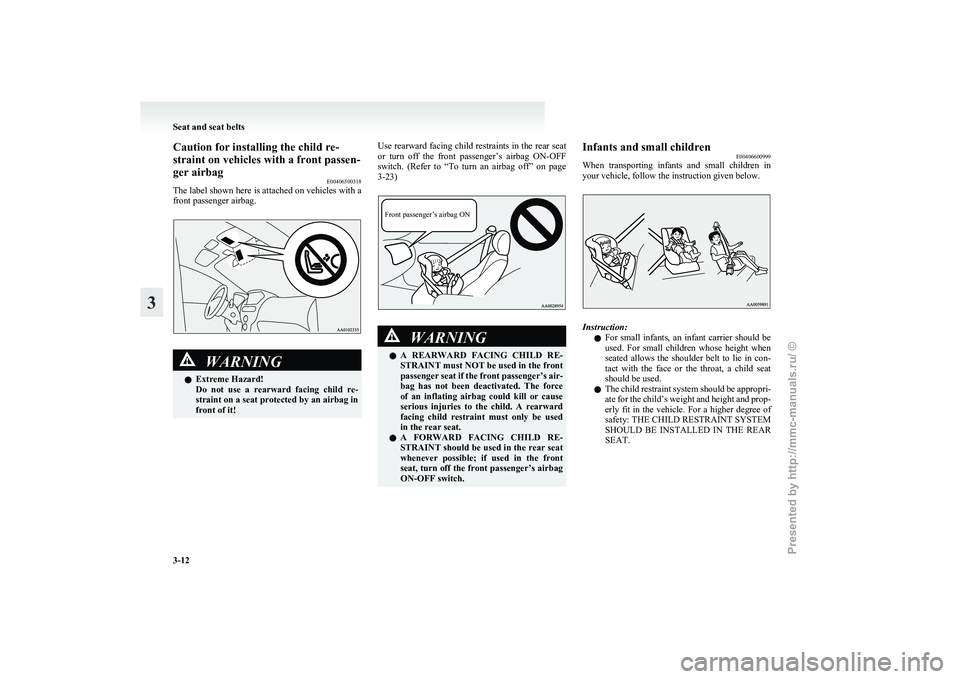
The
label shown here is attached on vehicles with a
front passenger airbag. WARNING
l Extreme Hazard!
Do
not use a rearward facing child re-
straint on a seat protected by an airbag in
front of it! Use rearward facing child restraints in the rear seat
or
turn off the front passenger’s airbag ON-OFF
switch. (Refer to “To turn an airbag off” on page
3-23)
Front passenger’s airbag ON WARNING
l A
REARWARD FACING CHILD RE-
STRAINT must NOT be used in the front
passenger seat if the front passenger’s air-
bag has not been deactivated. The force
of an inflating airbag could kill or cause
serious injuries to the child. A rearward
facing child restraint must only be used
in the rear seat.
l A FORWARD FACING CHILD RE-
STRAINT should be used in the rear seat
whenever possible; if used in the front
seat, turn off the front passenger’s airbag
ON-OFF switch. Infants and small children
E00406600999
When
transporting infants and small children in
your vehicle, follow the instruction given below. Instruction:
l For
small infants, an infant carrier should be
used. For small children whose height when
seated allows the shoulder belt to lie in con-
tact with the face or the throat, a child seat
should be used.
l The child restraint system should be appropri-
ate for the child’s weight and height and prop-
erly fit in the vehicle. For a higher degree of
safety: THE CHILD RESTRAINT SYSTEM
SHOULD BE INSTALLED IN THE REAR
SEAT. Seat and seat belts
3-12
3
Presented by http://mmc-manuals.ru/ \251
Page 52 of 193
NOTE
l Before
purchasing a child restraint system,
try installing it in the rear seat to make sure
there is a good fit. Because of the location of
the seat belt buckles and the shape of the seat
cushion, it may be difficult to securely install
some manufacturer’s child restraint systems.
If the child restraint system can be pulled for-
ward or to either side easily on the seat cush-
ion after the seat belt has been tightened,
choose another manufacturer’s child restraint
system. WARNING
l When
installing a child restraint system,
refer to the instructions provided by the
manufacturer of the restraint system. Fail-
ure to do so can result in severe or fatal
injury to the child.
l After installation, push and pull the child
restraint system back and forth, and side
to side, to see that it is properly secured.
If the child restraint system is not instal-
led securely, it may cause injury to the
child or other occupants in case of an ac-
cident or sudden stops.
l When the child restraint system is not in
use, keep your child restraint system se-
cured with the seat belt or remove it from
the vehicle in order to prevent it from be-
ing thrown around inside the vehicle dur-
ing an accident.
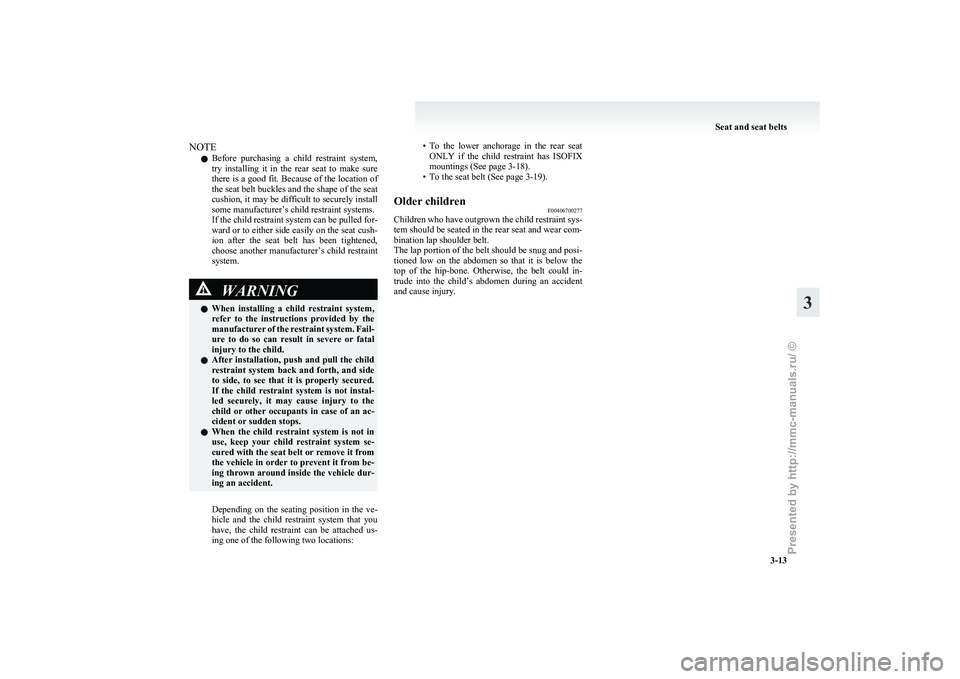
Depending on the seating position in the ve-
hicle
and the child restraint system that you
have, the child restraint can be attached us-
ing one of the following two locations: • To
the lower anchorage in the rear seat
ONLY if the child restraint has ISOFIX
mountings (See page 3-18).
• To the seat belt (See page 3-19).
Older children E00406700277
Children who have outgrown the child restraint sys-
tem should be seated in the rear seat and wear com-
bination lap shoulder belt.
The lap portion of the belt should be snug and posi-
tioned
low on the abdomen so that it is below the
top of the hip-bone. Otherwise, the belt could in-
trude into the child’s abdomen during an accident
and cause injury. Seat and seat belts
3-13 3
Presented by http://mmc-manuals.ru/ \251
Page 57 of 193
Installing a child restraint system to
the lower anchorage (ISOFIX child re-
straint mountings) and tether anchor-
age
E00406900703
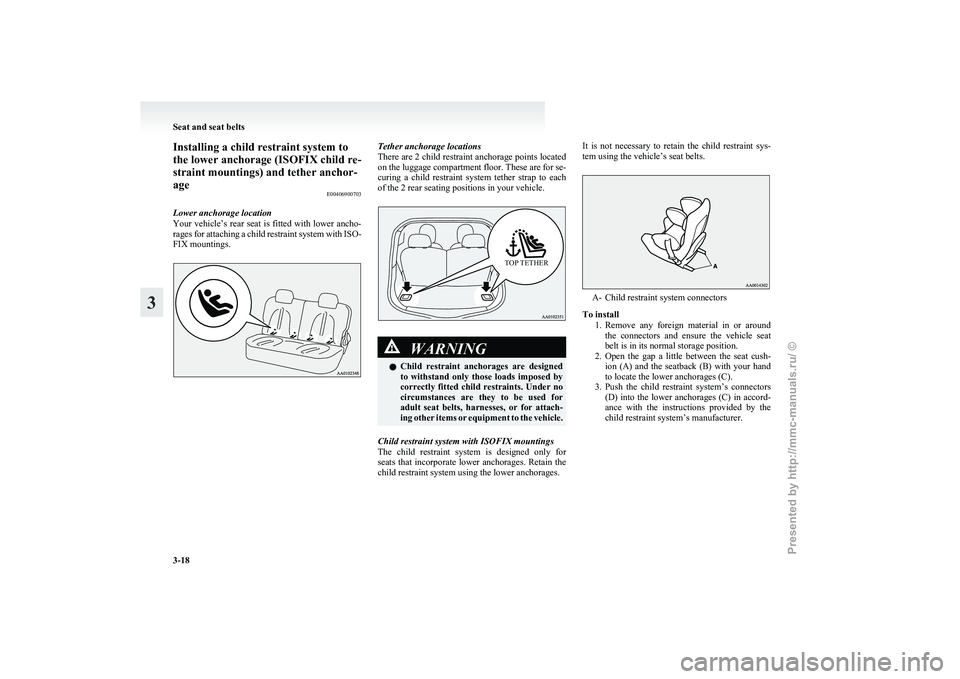
Lower anchorage location
Your
vehicle’s rear seat is fitted with lower ancho-
rages for attaching a child restraint system with ISO-
FIX mountings. Tether anchorage locations
There
are 2 child restraint anchorage points located
on the luggage compartment floor. These are for se-
curing a child restraint system tether strap to each
of the 2 rear seating positions in your vehicle.
TOP TETHER WARNING
l Child
restraint anchorages are designed
to withstand only those loads imposed by
correctly fitted child restraints. Under no
circumstances are they to be used for
adult seat belts, harnesses, or for attach-
ing other items or equipment to the vehicle.
Child restraint system with ISOFIX mountings
The
child restraint system is designed only for
seats that incorporate lower anchorages. Retain the
child restraint system using the lower anchorages. It is not necessary to retain the child restraint sys-
tem using the vehicle’s seat belts.
A- Child restraint system connectors
To install 1. Remove
any foreign material in or around
the connectors and ensure the vehicle seat
belt is in its normal storage position.
2. Open the gap a little between the seat cush- ion (A) and the seatback (B) with your hand
to locate the lower anchorages (C).
3. Push the child restraint system’s connectors (D) into the lower anchorages (C) in accord-
ance with the instructions provided by the
child restraint system’s manufacturer. Seat and seat belts
3-18
3
Presented by http://mmc-manuals.ru/ \251
Page 59 of 193
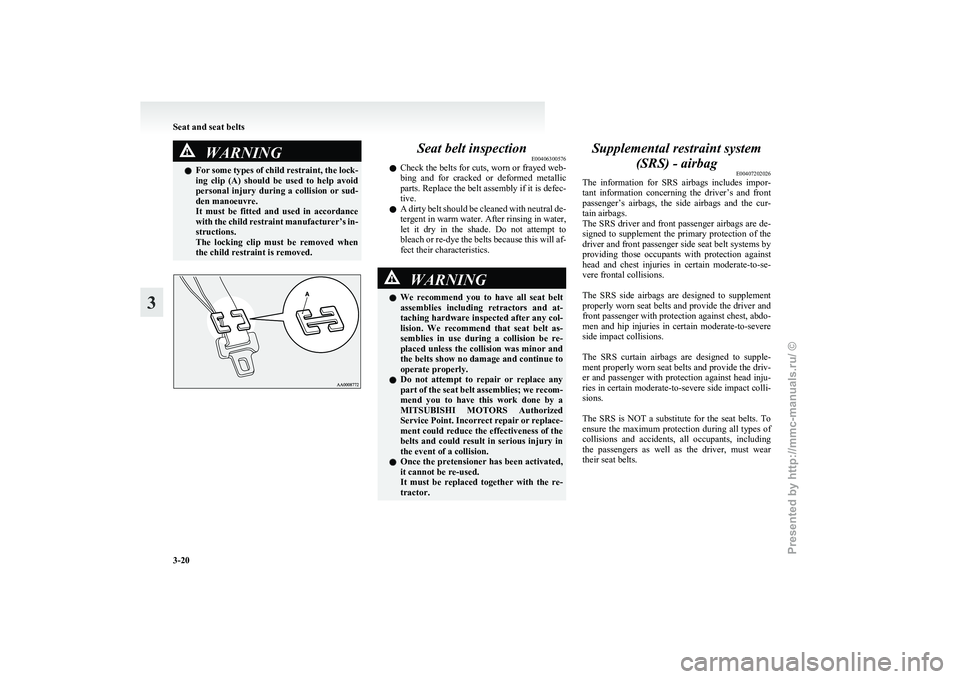
WARNING
l For some types of child restraint, the lock-
ing clip (A) should be used to help avoid
personal injury during a collision or sud-
den manoeuvre.
It must be fitted and used in accordance
with the child restraint manufacturer’s in-
structions.
The locking clip must be removed when
the child restraint is removed. Seat belt inspection
E00406300576
l Check
the belts for cuts, worn or frayed web-
bing and for cracked or deformed metallic
parts. Replace the belt assembly if it is defec-
tive.
l A dirty belt should be cleaned with neutral de-
tergent in warm water. After rinsing in water,
let it dry in the shade. Do not attempt to
bleach or re-dye the belts because this will af-
fect their characteristics. WARNING
l We
recommend you to have all seat belt
assemblies including retractors and at-
taching hardware inspected after any col-
lision. We recommend that seat belt as-
semblies in use during a collision be re-
placed unless the collision was minor and
the belts show no damage and continue to
operate properly.
l Do not attempt to repair or replace any
part of the seat belt assemblies; we recom-
mend you to have this work done by a
MITSUBISHI MOTORS Authorized
Service Point. Incorrect repair or replace-
ment could reduce the effectiveness of the
belts and could result in serious injury in
the event of a collision.
l Once the pretensioner has been activated,
it cannot be re-used.
It must be replaced together with the re-
tractor. Supplemental restraint system
(SRS) - airbag E00407202026
The
information for SRS airbags includes impor-
tant information concerning the driver’s and front
passenger’s airbags, the side airbags and the cur-
tain airbags.
The SRS driver and front passenger airbags are de-
signed to supplement the primary protection of the
driver and front passenger side seat belt systems by
providing those occupants with protection against
head and chest injuries in certain moderate-to-se-
vere frontal collisions.
The SRS side airbags are designed to supplement
properly worn seat belts and provide the driver and
front passenger with protection against chest, abdo-
men and hip injuries in certain moderate-to-severe
side impact collisions.
The SRS curtain airbags are designed to supple-
ment properly worn seat belts and provide the driv-
er and passenger with protection against head inju-
ries in certain moderate-to-severe side impact colli-
sions.
The SRS is NOT a substitute for the seat belts. To
ensure the maximum protection during all types of
collisions and accidents, all occupants, including
the passengers as well as the driver, must wear
their seat belts. Seat and seat belts
3-20
3
Presented by http://mmc-manuals.ru/ \251