seats MITSUBISHI iMiEV 2014 1.G User Guide
[x] Cancel search | Manufacturer: MITSUBISHI, Model Year: 2014, Model line: iMiEV, Model: MITSUBISHI iMiEV 2014 1.GPages: 262, PDF Size: 26.84 MB
Page 81 of 262
Seat belt use during pregnancy 4-12 Seat and restraint systems
4
N00406700087
When your seat belt, even fully extended, is not long enough, a seat belt extender must be
obtained. The extender may be used for either of the front seats.
N00406800121
Seat belts work for everyone, including preg-nant women. Like al
l occupants, pregnant
women are more likely to be seriously injured
or killed in an accide
nt if they do not wear
seat belts.
N00417700667
The driver’s and front passenger’s seats eachhave a seat belt equippe
d with a pre-tensioner
system. The driver and front pa
ssenger seat belts are
equipped with a seat belt pre-tensioner sys- tem. In moderate-to-seve
re front or side colli-
sions, this system ope
rates simultaneously
with the deployment of the front airbags, side airbags or curtain airbags. The seat belt pre-tensi
oners are located within
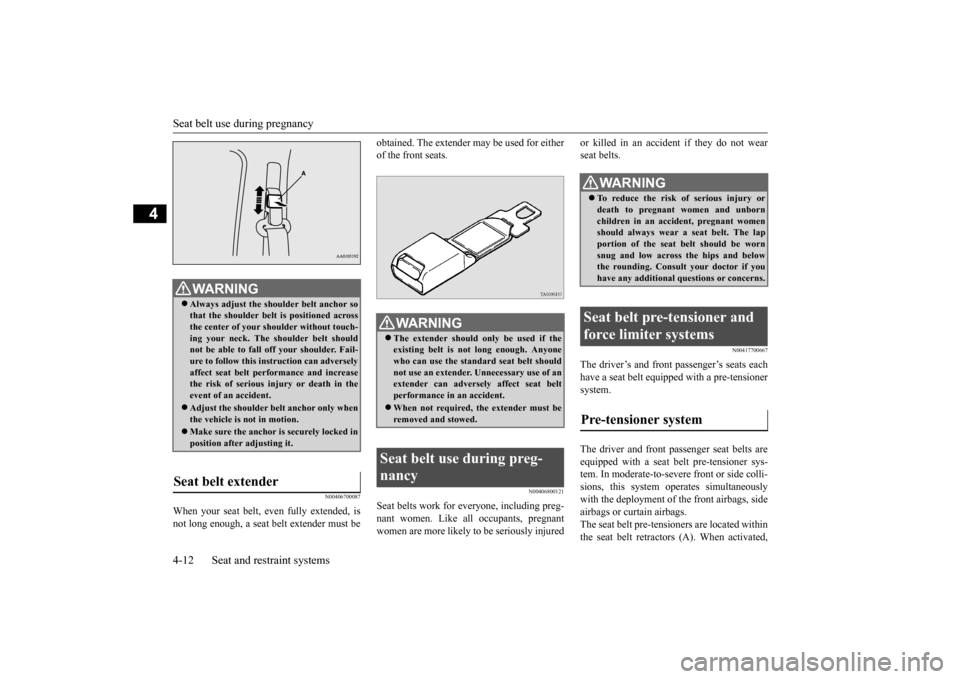
the seat belt retractors (A). When activated,
WA R N I N G Always adjust the shou
lder belt anchor so
that the shoulder belt
is positioned across
the center of your shoulder without touch- ing your neck. The sh
oulder belt should
not be able to fall off your shoulder. Fail-ure to follow this instruction can adversely affect seat belt performance and increase the risk of serious in
jury or death in the
event of an accident. Adjust the shoulder be
lt anchor only when
the vehicle is not in motion. Make sure the anchor is securely locked in position after adjusting it.
Seat belt extender
WA R N I N G The extender should only be used if the existing belt is not long enough. Anyonewho can use the standard seat belt should not use an extender.
Unnecessary use of an
extender can adversel
y affect seat belt
performance in an accident. When not required, the extender must be removed and stowed.
Seat belt use during preg- nancy
WA R N I N G To reduce the risk of serious injury or death to pregnant women and unborn children in an accident, pregnant women should always wear
a seat belt. The lap
portion of the seat belt should be worn snug and low across the hips and below the rounding. Consult your doctor if youhave any additional qu
estions or concerns.
Seat belt pre-tensioner and force limiter systems Pre-tensioner system
BK0209800US.book 12 ページ 2014年1月14日 火曜日 午前9時26分
Page 83 of 262
Child restraint systems 4-14 Seat and restraint systems
4
Child restraint systems specifically designed for infants and small children are offered byseveral manufacturers
. Choose only a child
restraint system with a label certifying that it complies with Federal Motor Vehicle SafetyStandard 213 (FMVSS 213) or Motor Vehicle Restraint Systems and Booster Seats Safety Regulations (RSSR). Look for the manufac-turer’s statement of compliance on the box and child restraint system itself. The child restraint system should be appropri- ate for your child’s we
ight and height, and
should properly fit you
r vehicle’s seat.
For detail information, refer to the instructionmanual accompanying the child restraint sys- tem. All children should be
properly restrained in
a restraint device that
offers the maximum
protection for their size and age. Be sure to check local, state, or provincial requirements for child size and age that mayvary from the recommendations listed below. Children less than 1 year old and who weigh 22 pounds (10 kg) or less MUST ride in a rear-facing child safety seat thatMUST ONLY be used in the rear seat.
Children older than 1 year of age and who weigh less than 40 pounds (18 kg) or whoare less than 40 inches (100 cm) tall must be in a forward-facing restraint used only in the rear seat. Children who weigh more than 40 pounds (18 kg) or who are more than 40 inches (100 cm) tall, regardless of age, shoulduse a suitable child seat or a booster seat in the rear seat until the vehicle’s lap/shoulder belt fits them properly.
Guidelines for child restraint system selection
WA R N I N G All children must be seated in the rear seat, and properly restrained. Accident statistics
show that children of
all sizes and ages are safer when properlyrestrained in the rear seat, rather than in the front seat.
Any child who is too large to use a child restraint system should ride in the rearseat and wear the la
p and shoulder belt
properly. The shoulder belt must be posi- tioned over the shou
lder and across the
chest, not across their neck, and with thelap belt positioned low on the child’s hips, not across their stomach. If necessary, a booster seat should be used to help achievea proper seat belt fi
t. Follow the booster
seat manufacturer’s instructions. Only use a booster seat that is certified as comply-ing with Federal Motor Vehicle Safety Standards or Motor Vehicle Restraint Sys- tems and Booster Seats Safety Regula-tions. Never hold an infant
or child in your arms
or on your lap when ri
ding in this vehicle,
even when you are we
aring your seat belt.
Never place any part of the seat belt youare wearing around an infant or child. Failure to follow these simple instructions creates a risk of serious injury or death toyour child in the event of an accident or sudden stop.WA R N I N G
BK0209800US.book 14 ページ 2014年1月14日 火曜日 午前9時26分
Page 89 of 262
Maintenance and inspection of seat belts 4-20 Seat and restraint systems
4
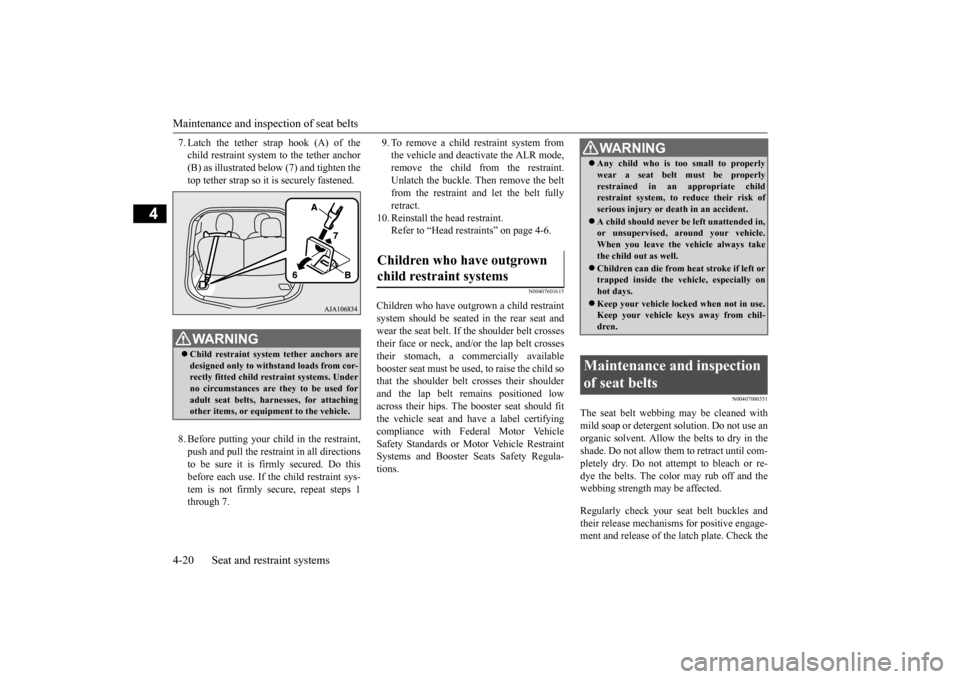
7. Latch the tether strap hook (A) of the child restraint system to the tether anchor(B) as illustrated below (7) and tighten the top tether strap so it is securely fastened. 8. Before putting your child in the restraint, push and pull the restraint in all directions to be sure it is firmly secured. Do thisbefore each use. If
the child restraint sys-
tem is not firmly se
cure, repeat steps 1
through 7.
9. To remove a child restraint system from the vehicle and deac
tivate the ALR mode,
remove the child from the restraint. Unlatch the buckle. Th
en remove the belt
from the restraint and let the belt fullyretract.
10. Reinstall the head restraint.
Refer to “Head restraints” on page 4-6.
N00407601615
Children who have outgrown a child restraint system should be seated in the rear seat and wear the seat belt. If the shoulder belt crossestheir face or neck, and/
or the lap belt crosses
their stomach, a commercially available booster seat must be used, to raise the child sothat the shoulder belt
crosses their shoulder
and the lap belt remains positioned low across their hips. The booster seat should fitthe vehicle seat and ha
ve a label certifying
compliance with Federal Motor Vehicle Safety Standards or Mo
tor Vehicle Restraint
Systems and Booster Seats Safety Regula- tions.
N00407000351
The seat belt webbing may be cleaned withmild soap or detergent solution. Do not use an organic solvent. Allow the belts to dry in theshade. Do not allow them to retract until com- pletely dry. Do not attempt to bleach or re- dye the belts. The color may rub off and thewebbing strength may be affected. Regularly check your seat belt buckles and their release mechanisms for positive engage- ment and release of the latch plate. Check the
WA R N I N G Child restraint system tether anchors are designed only to with
stand loads from cor-
rectly fitted child restraint systems. Underno circumstances are they to be used for adult seat belts, harnesses, for attaching other items, or equipment to the vehicle.
Children who have outgrown child restraint systems
WA R N I N G Any child who is too small to properly wear a seat belt
must be properly
restrained in an appropriate childrestraint system, to reduce their risk of serious injury or de
ath in an
accident.
A child should never be
left unattended in,
or unsupervised, around your vehicle. When you leave the
vehicle always take
the child out as well. Children can die from heat stroke if left or trapped inside the vehicle, especially on hot days. Keep your vehicle locked when not in use. Keep your vehicle keys away from chil- dren.
Maintenance and inspection of seat belts
BK0209800US.book 20 ページ 2014年1月14日 火曜日 午前9時26分
Page 90 of 262
Supplemental Restraint System (SRS) - airbag
Seat and restraint systems 4-21
4
retractors for automatic locking when in the Automatic Locking Retractor function. The entire seat belt assembly should be replaced if the webbing shows any obvious cuts, tears, increase in thickness in any sec- tion of the webbing from broken fibers, orsevere fading from sunlig
ht. All of these con-
ditions indicate a weakening of the belt, which may adversely affe
ct seat belt perfor-
mance in an accident.
N00407701775
This vehicle is equippe
d with a Supplemental
Restraint System (SRS), which includes air-bags for the driver and passengers. The SRS front airbags are designed to supple- ment the primary protection of the driver and front passenger seat
belt systems by provid-
ing those occupants w
ith protection against
head and chest injuries
in certain moderate to
severe frontal
collisions.
The SRS front airbags, together with sensors at the front of the
vehicle and sensors
attached to the front seats, form an advanced airbag system. The SRS side airbags and the curtain airbags are also designed to supp
lement the seat belts.
The SRS side airbags provide the driver and front passenger with pr
otection against chest,
abdomen and hip injuries by deploying the bag on the side impacted in moderate to severe side impact collisions. The SRS cur-tain airbags provide the driver and passengers on the front seat and rear seat with protection against head injuries by deploying a bag onthe side impacted in m
oderate to severe side
impact collisions. The SRS airbags are NOT a substitute for use of the seat belts. For maximum protection inall types of accident
s, seat belts must
ALWAYS be worn by everyone who drives or rides in this vehicle
(with infants and small
children in an appropriate child restraint sys- tem in the rear seat, and older children buck- led in the rear seat). Re
fer to “Child restraint
systems” on page 4-13.
WA R N I N G Do not attempt to repair or replace any part of the seat belt assemblies. This workshould be done by a certified i-MiEV dealer. Failure to have a certified i-MiEV dealer perform the work could reduce theeffectiveness of the belts and could result in a serious injury or
death in an accident.
Supplemental Restraint Sys- tem (SRS) - airbag
WA R N I N G IT IS VERY IMPORTANT TO ALWAYS WEAR YOUR SEAT BELT PROPERLYEVEN WITH AN AIRBAG.• Seat belts help keep the driver and pas-sengers properly positioned. Thisreduces the risk of injury in all collisions, and reduces the risk of serious injuries or death when the
airbags inflate.
During sudden braking just before a col- lision, an unrestra
ined or
improperly
restrained driver or passengers can moveforward into direct contact with, or within close proximi
ty to, the airbag
when it begins to inflate.The beginning stage of
airbag inflation is
the most forceful and can cause serious injuries or death if the occupant comes incontact with the airbag at this time. • Seat belts reduce the risk of injury inrollovers, rear impact collisions, and in lower-speed frontal collisions, because the airbags are not de
signed to inflate in
those situations.• Seat belts reduce the risk of beingthrown from your vehi
cle in a collision or
rollover.
IT IS VERY IMPORTANT TO BE PROP- ERLY SEATED.• A driver or front passenger sitting tooclose to the steering wheel or instrument panel during airbag deployment can beseriously injured or killed.
BK0209800US.book 21 ページ 2014年1月14日 火曜日 午前9時26分
Page 93 of 262
Supplemental Restraint System (SRS) - airbag 4-24 Seat and restraint systems
4
When airbags deploy, so
me smoke is released
accompanied by a loud noise. The smoke isnot harmful, but do not intentionally inhale the smoke as it may ca
use temporary irrita-
tion to people with respiratory problems. After deployment, the airbags will quickly deflate, so quickly th
at some people may not
even realize the airbags inflated. Airbag inflation does
not prevent the driver
from seeing or being able
to steer the vehicle,
and does not prevent people from leaving the vehicle.
N00418600227
This vehicle is equipped with an event data recorder (EDR). The main purpose of an EDR is to record, incertain crash or near crash-like situations, such as an airbag deployment or hitting a road obstacle, data that
will assist in under-
standing how a vehicle’s systems performed. The EDR is designed to
record data related to
vehicle dynamics and sa
fety systems for a
short period of time,
typically 30 seconds or
less. The EDR in this vehicle is designed to record such data as: How various systems
in your vehicle were
operating; Whether or not the driver safety belt was buckled/fastened; How far (if at all) the driver was depress- ing the accelerator and/or brake pedal; and, How fast the vehicle was traveling.
These data can help provide a better under- standing of the circumstances in which crashes and injuries occur. To read data recorded
by an EDR, special
equipment is required, a
nd access to the vehi-
cle or the EDR is needed. In addition to the vehicle manufacturer, ot
her parties, such as
law enforcement, that have the special equip- ment, can read the information if they have access to the vehicle or the EDR.
N00417900210
The driver’s seat position sensor is attachedto the seat rail and provides the airbag control unit with information on the seat’s fore-aft position. The airbag control unit controlsdeployment of the driver’s front airbag in accordance with the information it receives from this sensor.If there is a problem involving the driver’s seat position sensor, the SRS warning light in the instrument panel will come on. Refer to“SRS warning light” on page 4-26.
CAUTION Airbags inflate very quickly and with great force. In certain situ
ations, contact with an
inflating airbag may cause small cuts, abra- sions, and bruises.
Event Data Recording
NOTE
EDR data are recorded by your vehicle only if a non-trivial crash situation occurs; no dataare recorded by the EDR under normal driv- ing conditions and no
personal data (e.g.,
name, gender, age, and crash location) arerecorded. However, other parties, such as law enforcement, could combine the EDR data with the type of personally identifyingdata routinely acquire
d during a crash inves-
tigation.
Driver’s seat position sensor
WA R N I N G If the SRS warning
light comes on, have
the vehicle inspected by a certified i-MiEV dealer as soon
as possible.
Please observe the following instructions to ensure that the driver’s seat position sensor can operate correctly.• Adjust the seat to the correct position,and sit well back
against the seatback.
Refer to “Front seats” on page 4-3.• Do not recline the seatback more thannecessary when driving.
BK0209800US.book 24 ページ 2014年1月14日 火曜日 午前9時26分
Page 94 of 262
Supplemental Restraint System (SRS) - airbag
Seat and restraint systems 4-25
4
N00418000351
The passenger’s seat oc
cupant classification
sensor system is attach
ed to the front passen-
ger seat cushion and provides the airbag con- trol unit with information regarding theoccupant on the front passenger seat. The air- bag control unit controls deployment of the passenger’s front airbag in accordance withthe information it receives from this system. The passenger’s front ai
rbag will not deploy
in an impact when the system senses no occu-pant on the front passenger’s seat or a child in a child restraint system. In this case, the pas- senger’s airbag off i
ndicator will come on.
Refer to “Passenger’s ai
rbag off indicator” on
page 4-25. If there is a problem involving the passen-ger’s seat occupant cl
assification sensor sys-
tem, the SRS warning light in the instrument panel will come on. Refer to “SRS warninglight” page 4-26.
N00418100310
The passenger’s airbag off indicator islocated in the instrument panel.
• Do not place metallic objects or luggage under the front seat.
If the vehicle is involved in a severe impact, have the SRS sensor inspected by a certified i-MiEV deal
er as soon as possi-
ble.
Passenger’s seat occupant clas- sification sensor system
WA R N I N G
WA R N I N G If any of the follow
ing conditions occur,
you should immediatel
y have your vehicle
inspected by a certified i-MiEV dealer assoon as possible:• The SRS warning light does not initiallycome on when the electric motor switch is turned to the “ON” or “START” posi- tion.• The SRS warning light does not go outafter several seconds.• The SRS warning li
ght comes on while
you are driving.
To ensure that the passenger’s seat occu- pant classification sensor system can sensecorrectly, observe the following instruc- tions. Failure to follow these instructions can adversely affect
the performance of
the passenger’s airbag system.• Adjust the seat to the correct position,and sit well back
against the seatback.
Refer to “Front seats” on page 4-3.• Do not recline the seatback more thannecessary.• Never have more than one person (adultor child) sitting
on the seat.
• Do not place anything between the seat and the floor console.• When attaching a chil
d restraint system,
secure it firmly.• Do not place luggage
or other objects on
the seat.• Do not use a seat cover or a cushion.
• Do not modify or re
place the seat and
seat belt.• Do not place luggage or other objects under the seat.• Do not place and use
an electronic device
such as a computer on the seat.• Do not place heavy objects on the seat orstick pins, needles, or other objects into it.• Do not remove the seat cushion skin.• If any liquid is spilled on the seat, wipe it and dry the seat
immediately.
If the vehicle is involved in a severe impact, have the SRS sensors inspected by a certified i-MiEV deal
er as soon as possi-
ble.
Passenger’s airbag off indicator
WA R N I N G
BK0209800US.book 25 ページ 2014年1月14日 火曜日 午前9時26分
Page 101 of 262
Supplemental Restraint System (SRS) - airbag 4-32 Seat and restraint systems
4
WA R N I N G In order to reduce the risk of injury from a deploying side airbag, do not allow any rear seat passengers to hold onto the back of either front seat. Special care should betaken with children. Do not place any objects near or around the front of either front seatback. Such objects can interfere with proper side air- bag deployment and cause injury duringdeployment of the side airbag. Do not place stickers,
labels or additional
trim on the back of either front seat. They can interfere with proper side airbag deployment. Do not install seat cove
rs or re-cover seats
that have side airbag
s. Covers can inter-
fere with proper si
de airbag deployment
and adversely affect
side airbag perfor-
mance.
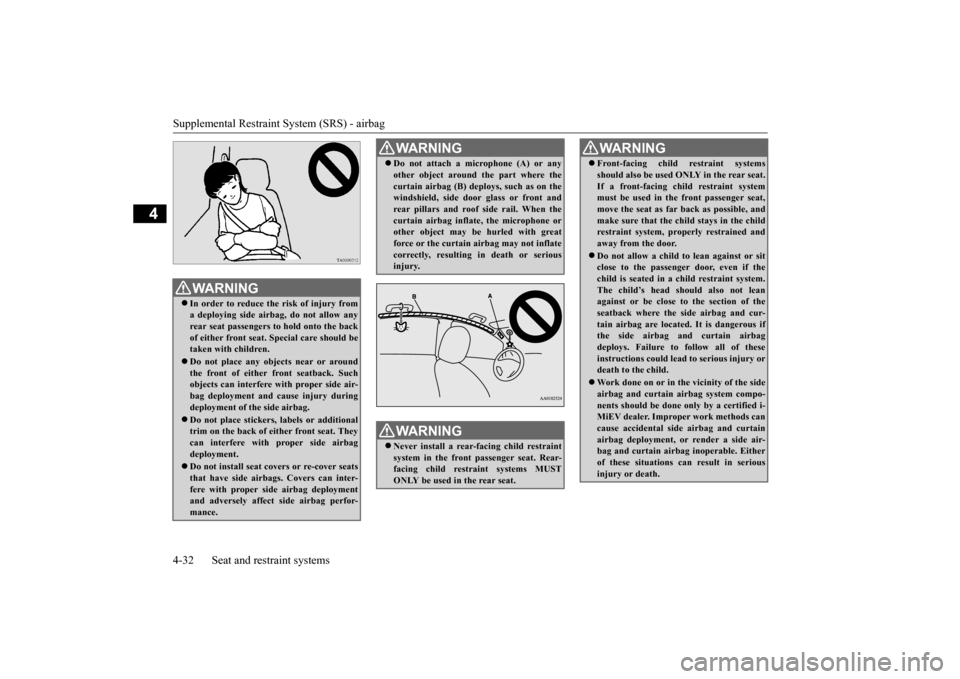
Do not attach a microphone (A) or any other object around the part where thecurtain airbag (B) depl
oys, such as on the
windshield, side door glass or front and rear pillars and roof
side rail. When the
curtain airbag inflate,
the microphone or
other object may be
hurled with great
force or the curtain airbag may not inflate correctly, resulting in death or seriousinjury. WA R N I N G Never install a rear-facing child restraint system in the front passenger seat. Rear- facing child restraint systems MUST ONLY be used in the rear seat.WA R N I N G
Front-facing child restraint systems should also be used ON
LY in the rear seat.
If a front-facing child restraint systemmust be used in the front passenger seat, move the seat as far back as possible, and make sure that the child stays in the childrestraint system, properly restrained and away from the door. Do not allow a child to
lean against or sit
close to the passenger door, even if the child is seated in a child restraint system.The child’s head sh
ould also not lean
against or be close to the section of the seatback where the side airbag and cur-tain airbag are located. It is dangerous if the side airbag an
d curtain airbag
deploys. Failure to follow all of theseinstructions could lead to serious injury or death to the child. Work done on or in th
e vicinity of the side
airbag and curtain airbag system compo- nents should be done only by a certified i-MiEV dealer. Improper
work methods can
cause accidental side
airbag and curtain
airbag deployment, or
render a side air-
bag and curtain airb
ag inoperable. Either
of these situations can result in serious injury or death.WA R N I N G
BK0209800US.book 32 ページ 2014年1月14日 火曜日 午前9時26分
Page 104 of 262
Supplemental Restraint System (SRS) - airbag
Seat and restraint systems 4-35
4
N00408600370
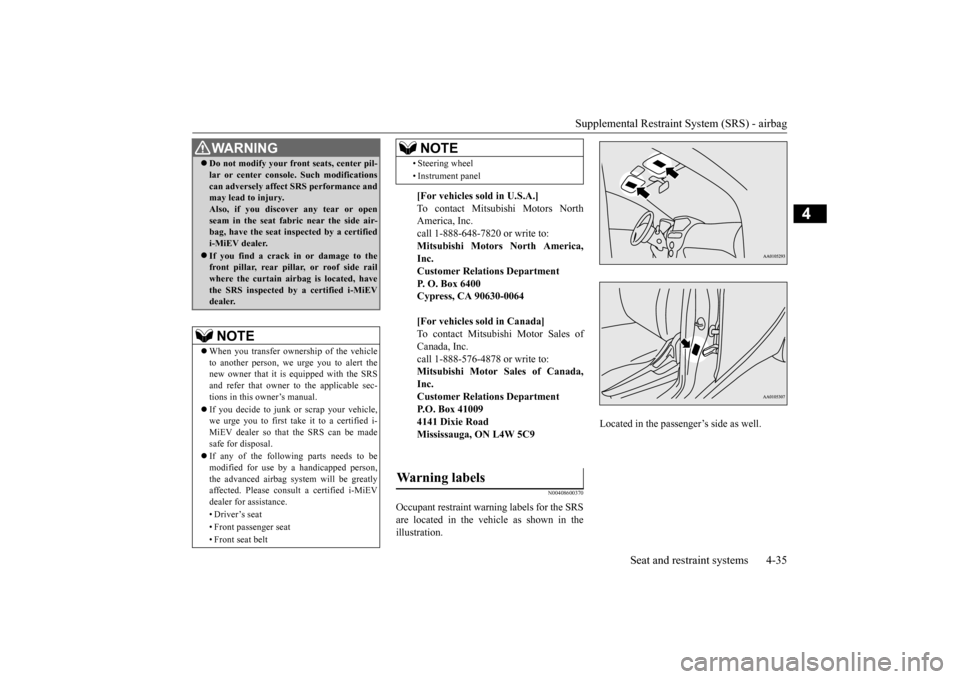
Occupant restraint warn
ing labels for the SRS
are located in the vehicle as shown in the illustration.
Located in the passenger’s side as well.
Do not modify your front seats, center pil- lar or center console. Such modificationscan adversely affect
SRS performance and
may lead to injury. Also, if you discove
r any tear or open
seam in the seat fabr
ic near the side air-
bag, have the seat in
spected by a certified
i-MiEV dealer. If you find a crack in
or damage to the
front pillar, rear pill
ar, or roof side rail
where the curtain airbag is located, havethe SRS inspected by a certified i-MiEV dealer.NOTE
When you transfer ownership of the vehicle to another person, we urge you to alert the new owner that it is
equipped with the SRS
and refer that owner to the applicable sec- tions in this
owner’s manual.
If you decide to junk or scrap your vehicle, we urge you to first take it to a certified i- MiEV dealer so that the SRS can be madesafe for disposal. If any of the following parts needs to be modified for use by
a handicapped person,
the advanced airbag sy
stem will be greatly
affected. Please consult a certified i-MiEV dealer for assistance. •Driver’s seat • Front passenger seat • Front seat beltWA R N I N G
• Steering wheel • Instrument panel[For vehicles sold in U.S.A.] To contact Mitsubishi Motors North America, Inc.call 1-888-648-7820 or write to: Mitsubishi Motors North America, Inc.Customer Relations Department P. O. Box 6400 Cypress, CA 90630-0064 [For vehicles sold in Canada] To contact Mitsubishi Motor Sales ofCanada, Inc. call 1-888-576-4878 or write to: Mitsubishi Motor Sales of Canada,Inc. Customer Relations Department P.O. Box 410094141 Dixie Road Mississauga, ON L4W 5C9
Warning labels
NOTE
BK0209800US.book 35 ページ 2014年1月14日 火曜日 午前9時26分
Page 164 of 262
Vehicle preparatio
n before driving
Driving safety 6-3
6
from moving forward
and possibly interfering
with the operation of the pedals, Mitsubishigenuine floor mats are recommended.
N00628700063
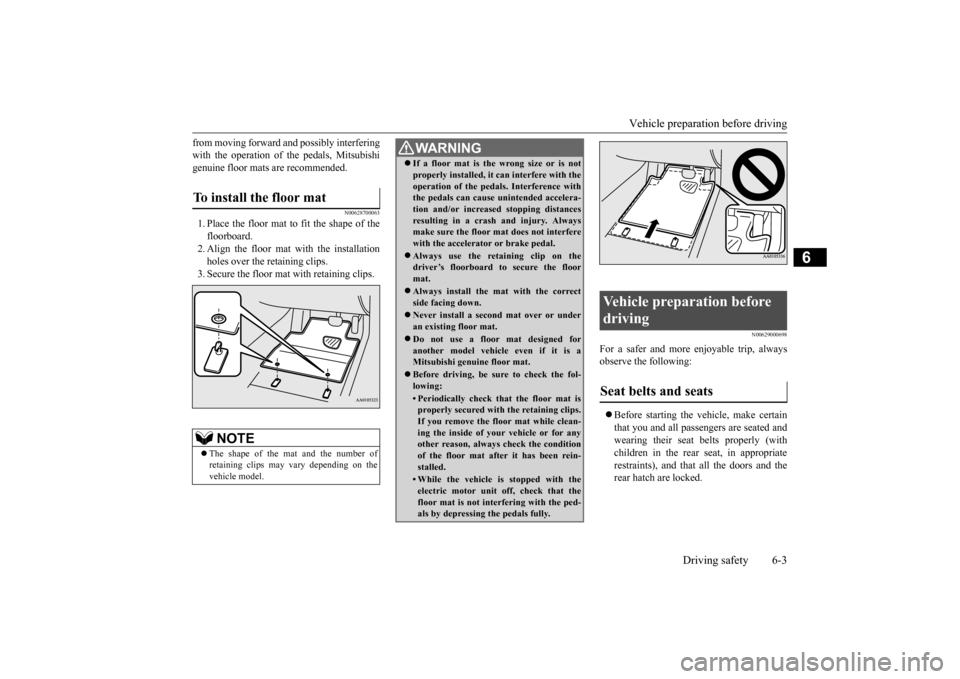
1. Place the floor mat to fit the shape of thefloorboard. 2. Align the floor mat with the installation holes over the retaining clips. 3. Secure the floor mat with retaining clips.
N00629000698
For a safer and more enjoyable trip, always observe the following: Before starting the ve
hicle, make certain
that you and all passengers are seated andwearing their seat belts properly (with children in the rear seat, in appropriate restraints), and that all the doors and therear hatch are locked.
To install the floor mat
NOTE
The shape of the mat and the number of retaining clips may
vary depending on the
vehicle model.
WA R N I N G If a floor mat is the
wrong size or is not
properly installed, it can interfere with theoperation of the pedals. Interference withthe pedals can cause unintended accelera- tion and/or increased stopping distances resulting in a cras
h and injury. Always
make sure the floor mat does not interfere with the accelerator or brake pedal. Always use the reta
ining clip on the
driver’s floorboard to secure the floor mat. Always install the mat with the correct side facing down. Never install a second
mat over or under
an existing floor mat. Do not use a floor mat designed for another model vehicle even if it is aMitsubishi genuine floor mat. Before driving, be sure to check the fol- lowing:• Periodically check that the floor mat isproperly secured with the retaining clips. If you remove the floor mat while clean- ing the inside of you
r vehicle or for any
other reason, always check the condition of the floor mat after it has been rein- stalled.• While the vehicle is stopped with theelectric motor unit off, check that thefloor mat is not interfering with the ped- als by depressing the pedals fully.
Vehicle preparation before driving Seat belts and seats
BK0209800US.book 3 ページ 2014年1月14日 火曜日 午前9時26分
Page 168 of 262
Loading information Driving safety 6-7
6
N00629900411
It is very importa
nt to know how much
weight your vehicle can carry. This weight is called the vehicle capacity weight andincludes the weight of all occupants, cargo and non-factory-installed options. The tire and loading information placard located onthe driver’s door sill of your vehicle will show how much weight it may properly carry. It is important to famil
iarize yourself with the
following terms before loading your vehicle: Vehicle maximum load on the tire: load on an individual tire that is determined bydistributing to each axle its share of the maximum loaded vehicle weight and dividing by two. Vehicle normal load on the tire: load on an individual tire that is determined by dis- tributing to each axle its share of the curbweight, accessory weight, and normal occupant weight and dividing by two.
Maximum loaded vehi
cle weight: the sum
of -(a) Curb weight; (b) Accessory weight; (c) Vehicle capacity weight; and(d) Production options weight. Curb weight: the weight of a motor vehi- cle with standard equipment including themaximum capacity of
oil, and coolant.
Accessory weight: the combined weight (in excess of those st
andard items which
may be replaced) of automatic transmis- sion, power steering, power brakes, powerwindows, power seats,
radio, and heater,
to the extent that these items are available as factory- installe
d equipment (whether
installed or not). Vehicle capacity weight: the rated cargo and luggage load plus 150 lbs (68 kg)
*
times the vehicle’s designated seating capacity. Production options weight: the combined weight of those installed regular produc- tion options weighing over 5 lbs (2.3 kg) in excess of those standard items whichthey replace, not prev
iously considered in
curb weight or accessory weight, includ- ing heavy duty brakes,
ride levelers, roof
rack, heavy duty battery, and special trim. Normal occupant weight: 150 lbs (68 kg)
*
times the number of specified occupants.(In your vehicle the number is 2)
Occupant distribution: distribution of occupants in a vehicle as specified. (Inyour vehicle the distribution is 2 in front seat)
N00630100370
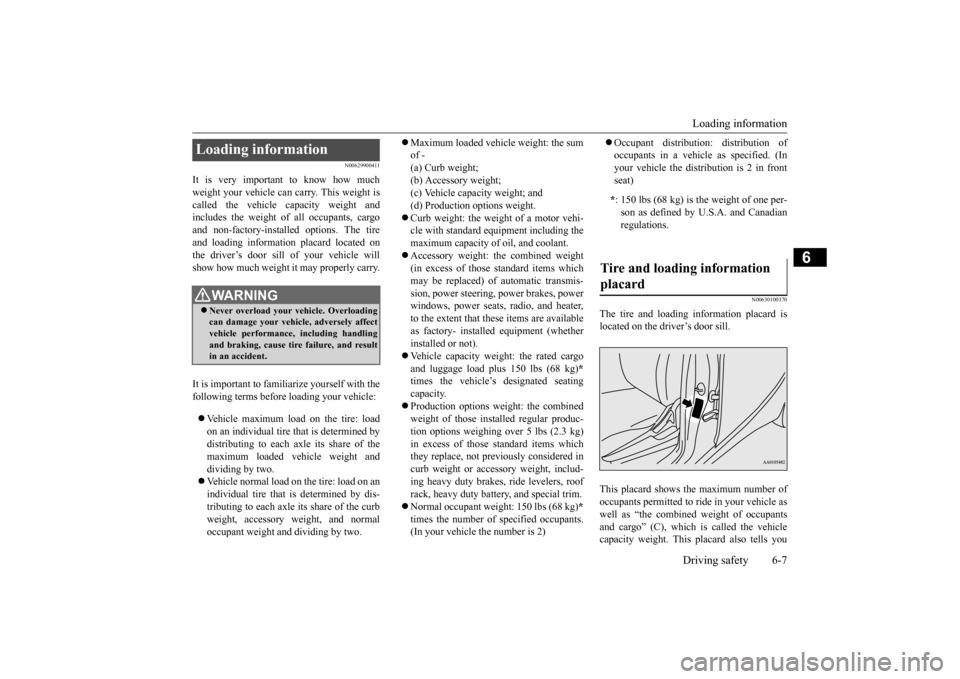
The tire and loading information placard is located on the driver’s door sill. This placard shows the maximum number of occupants permitted to
ride in your vehicle as
well as “the combined
weight of occupants
and cargo” (C), which
is called the vehicle
capacity weight. This
placard also tells you
Loading information
WA R N I N GNever overload your ve
hicle. Overloading
can damage your vehicl
e, adversely affect
vehicle performance, including handlingand braking, cause tire failure, and result in an accident.
* : 150 lbs (68 kg) is the weight of one per- son as defined by U.
S.A. and Canadian
regulations.
Tire and loading information placard
BK0209800US.book 7 ページ 2014年1月14日 火曜日 午前9時26分