tow MITSUBISHI iMiEV 2014 1.G User Guide
[x] Cancel search | Manufacturer: MITSUBISHI, Model Year: 2014, Model line: iMiEV, Model: MITSUBISHI iMiEV 2014 1.GPages: 262, PDF Size: 26.84 MB
Page 135 of 262
Tire pressure monitoring system 5-30 Features and controls
5
N00546900053
The indicators should illuminate when the electric motor switch is turned to the “ON” position, and should turn
off after a few sec-
onds.If the indicator stays on
or does not illuminate
when the electric motor switch is turned to the “ON” position, have the vehicle inspectedby a certified i-MiEV de
aler as soon as possi-
ble. indicator blinks when the ASC is operat- ing. indicator is illuminated when the ASC is deactivated.
N00530201537
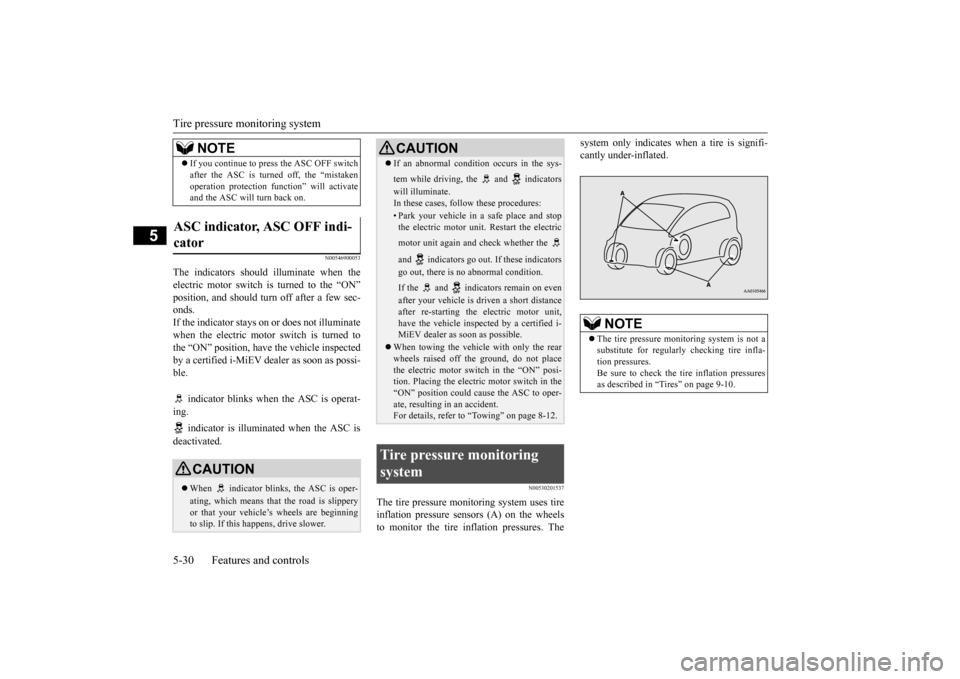
The tire pressure monitoring system uses tire inflation pressure sensors (A) on the wheels to monitor the tire inflation pressures. The
system only indicates wh
en a tire is signifi-
cantly under-inflated.
If you continue to press the ASC OFF switch after the ASC is turned off, the “mistakenoperation protection f
unction” will activate
and the ASC will turn back on.
ASC indicator, ASC OFF indi- cator
CAUTION When indicator blinks, the ASC is oper- ating, which means that the road is slippery or that your vehicle’
s wheels are beginning
to slip. If this happens, drive slower.NOTE
CAUTION If an abnormal condition occurs in the sys- tem while driving, the and indicators will illuminate. In these cases, follow these procedures:• Park your vehicle in
a safe place and stop
the electric motor unit. Restart the electric motor unit again and check whether the and indicators go out
. If these indicators
go out, there is no abnormal condition. If the and indicators remain on even after your vehicle is driven a short distance after re-starting the electric motor unit, have the vehicle inspected by a certified i- MiEV dealer as soon as possible.
When towing the vehicle with only the rear wheels raised off the ground, do not placethe electric motor switch in the “ON” posi- tion. Placing the electric motor switch in the “ON” position could ca
use the ASC to oper-
ate, resulting in an accident. For details, refer to
“Towing” on page 8-12.
Tire pressure monitoring system
NOTE
The tire pressure monitoring system is not a substitute for regularly
checking tire infla-
tion pressures. Be sure to check the tire inflation pressures as described in “Tires” on page 9-10.
BK0209800US.book 30 ページ 2014年1月14日 火曜日 午前9時26分
Page 151 of 262
Turn signal lever 5-46 Features and controls
5
and license plate lights) will stay on and will not turn off automatically.
N00549800213
If the driver’s door is opened with the key removed from the electric motor switch while the lights are on, the buzzer will sound toremind you to turn off the lights. The lights and buzzer will turn off automati- cally.Or you can turn the combination headlights and dimmer switch to the “OFF” position to stop the buzzer.
N00549900155
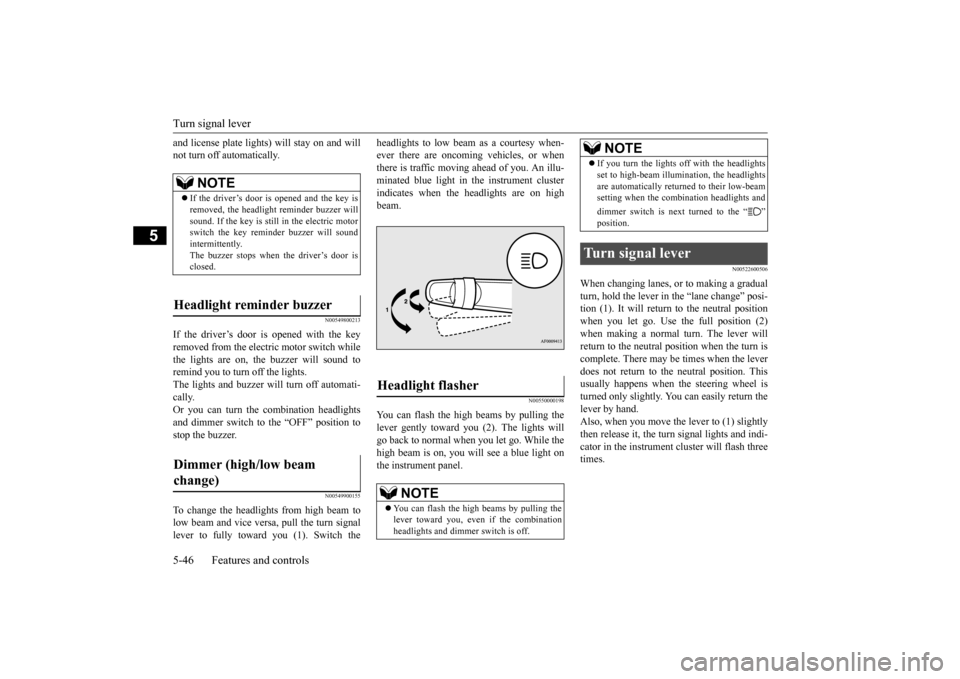
To change the headlights from high beam tolow beam and vice vers
a, pull the turn signal
lever to fully toward you (1). Switch the
headlights to low beam
as a courtesy when-
ever there are oncoming vehicles, or whenthere is traffic moving ahead of you. An illu- minated blue light in
the instrument cluster
indicates when the headlights are on highbeam.
N00550000198
You can flash the high beams by pulling thelever gently toward you (2). The lights willgo back to normal when you let go. While the high beam is on, you will see a blue light on the instrument panel.
N00522600506
When changing lanes, or to making a gradual turn, hold the lever in the “lane change” posi- tion (1). It will return
to the neutral position
when you let go. Use the full position (2) when making a normal turn. The lever will return to the neutral position when the turn iscomplete. There may be times when the lever does not return to the neutral position. This usually happens when the steering wheel isturned only slightly. You can easily return the lever by hand. Also, when you move the lever to (1) slightlythen release it, the turn signal lights and indi- cator in the instrument cluster will flash three times.
NOTE
If the driver’s door is opened and the key is removed, the headlight
reminder
buzzer will
sound. If the key is still
in the electric motor
switch the key remind
er buzzer will sound
intermittently. The buzzer stops when the driver’s door is closed.
Headlight reminder buzzer Dimmer (high/low beam change)
Headlight flasher
NOTE
You can flash the high beams by pulling the lever toward you, even if the combination headlights and dimmer switch is off.
If you turn the lights off with the headlights set to high-beam illumin
ation, the headlights
are automatically returned to their low-beamsetting when the combination headlights and dimmer switch is next turned to the “ ” position.
Turn signal lever
NOTE
BK0209800US.book 46 ページ 2014年1月14日 火曜日 午前9時26分
Page 154 of 262
Wiper and washer switch
Features and controls 5-49
5
N00504600272
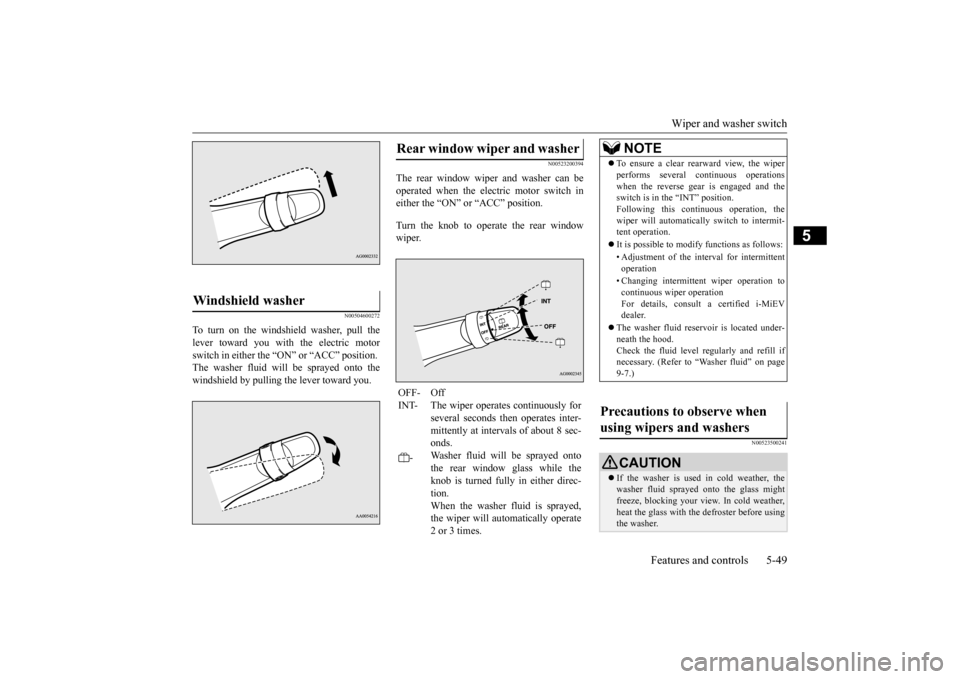
To turn on the windshield washer, pull the lever toward you with the electric motor switch in either the “ON” or “ACC” position. The washer fluid will be sprayed onto thewindshield by pulling th
e lever toward you.
N00523200394
The rear window wiper and washer can be operated when the electric motor switch in either the “ON” or “ACC” position. Turn the knob to operate the rear window wiper.
N00523500241
Windshield washer
Rear window wiper and washer OFF- OffINT- The wiper operates continuously for
several seconds then operates inter- mittently at intervals of about 8 sec- onds.
-
Washer fluid will
be sprayed onto
the rear window glass while the knob is turned fully in either direc-tion. When the washer fluid is sprayed, the wiper will automatically operate2 or 3 times.
NOTE
To ensure a clear rearward view, the wiper performs several continuous operationswhen the reverse gear is engaged and theswitch is in the “INT” position. Following this continuous operation, the wiper will automatically switch to intermit-tent operation. It is possible to modi
fy functions as follows:
• Adjustment of the interval for intermittent operation • Changing intermittent
wiper operation to
continuous wiper operationFor details, consult a certified i-MiEV dealer.
The washer fluid rese
rvoir is located under-
neath the hood. Check the fluid level re
gularly and refill if
necessary. (Refer to
“Washer fluid” on page
9-7.)
Precautions to observe when using wipers and washers
CAUTION If the washer is used in cold weather, the washer fluid sprayed onto the glass might freeze, blocking your vi
ew. In cold weather,
heat the glass with the
defroster before using
the washer.
BK0209800US.book 49 ページ 2014年1月14日 火曜日 午前9時26分
Page 160 of 262
Cup holder
Features and controls 5-55
5
N00551500259
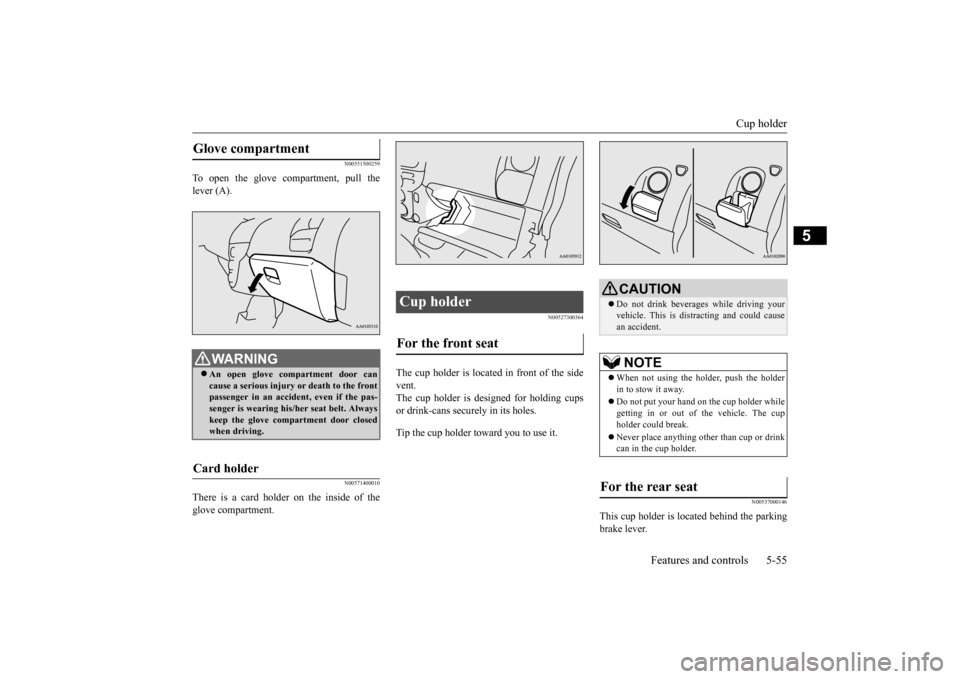
To open the glove compartment, pull the lever (A).
N00571400010
There is a card holder on the inside of theglove compartment.
N00527300364
The cup holder is located in front of the side vent. The cup holder is de
signed for holding cups
or drink-cans secu
rely in its holes.
Tip the cup holder toward you to use it.
N00537000146
This cup holder is located behind the parking brake lever.
Glove compartment
WA R N I N G An open glove compartment door can cause a serious injury or death to the frontpassenger in an accident, even if the pas- senger is wearing his/her seat belt. Always keep the glove comp
artment door closed
when driving.
Card holder
Cup holder For the front seat
CAUTION Do not drink beverages while driving your vehicle. This is dist
racting and could cause
an accident.NOTE
When not using the holder, push the holder in to stow it away. Do not put your hand on the cup holder while getting in or out of
the vehicle. The cup
holder could break. Never place anything other than cup or drink can in the cup holder.
For the rear seat
BK0209800US.book 55 ページ 2014年1月14日 火曜日 午前9時26分
Page 162 of 262

6
Driving safetyEconomical driving ..........................................................................6-2 Driving, alcohol and drugs ..
...........
...........
...........
...........
...........
.....6-2
Floor mat ..........................................................................................6-2Vehicle preparation before driving ..................................................6-3 Safe driving techniques ....................................................................6-4 Driving during cold weather ............................................................6-5Braking ............................................................................................6-5 Parking .............................................................................................6-6 Loading information ........................................................................6-7Cargo loads ....................................................................................6-10 Trailer towing ................................................................................6-10 Dinghy towing ............
...........
...........
...........
...........
.........
.........
.....6-10
BK0209800US.book 1 ページ 2014年1月14日 火曜日 午前9時26分
Page 167 of 262
Parking 6-6 Driving safety
6
effective use of the re
generative brake and
prevent the service brake from overheating.If the brake pedal is continuously or fre- quently depressed on downhill roads, the ser- vice brake could overheat and the brakeperformance will be reduced.
N00629600317
When parking on a hill, set the parking brake, and turn the front wheels toward the curb on a downhill, or away from the curb on an uphill.If necessary, apply
chocks to wheels.
Never leave the electric motor unit running while you take a short sleep/rest.
Your front bumper can be damaged if you scrape it over curbs or parking stop blocks. Be careful when traveling up or down steep slopes where your bumper can scrape theroad. Always remove the key from the electric motor switch and lock all doors and the lift- gate when leaving
the vehicle unattended.
Always try to park your vehicle in a well litarea. More effort could be required to turn the steering wheel. Refer to “Electric power steering system(EPS)” on page 5-27.
NOTE
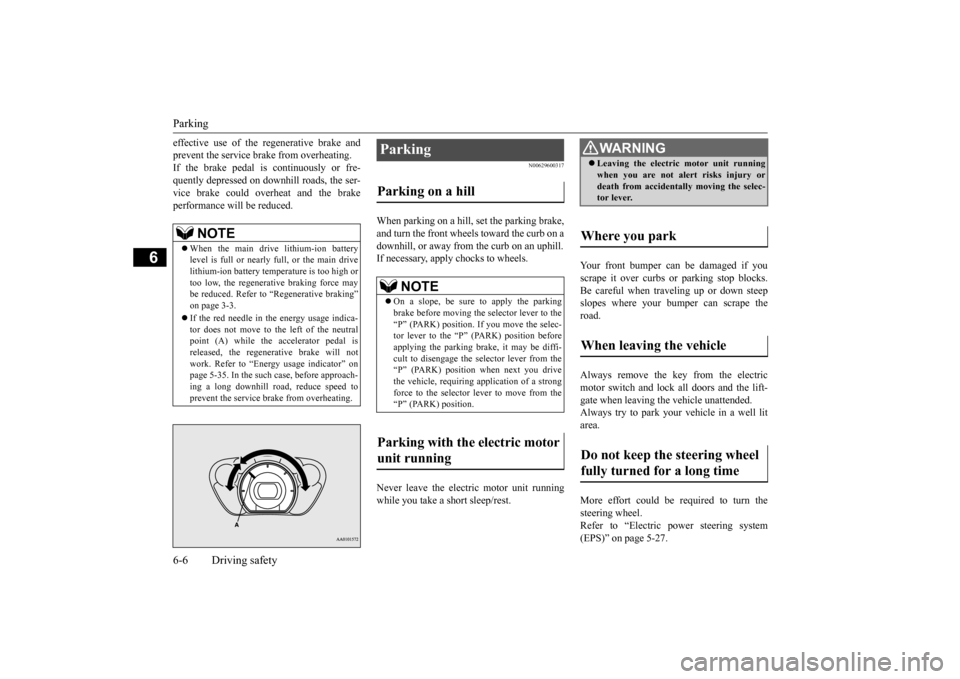
When the main drive lithium-ion battery level is full or nearly full, or the main drivelithium-ion battery temperature is too high or too low, the regenerative braking force may be reduced. Refer to “Regenerative braking”on page 3-3. If the red needle in the energy usage indica- tor does not move to the left of the neutral point (A) while the accelerator pedal is released, the regenera
tive brake will not
work. Refer to “Ener
gy usage indicator” on
page 5-35. In the such case, before approach- ing a long downhill road, reduce speed toprevent the service brake from overheating.
Parking Parking on a hill
NOTE
On a slope, be sure to apply the parking brake before moving the selector lever to the“P” (PARK) position. If you move the selec- tor lever to the “P” (PARK) position before applying the parking br
ake, it may be diffi-
cult to disengage the
selector lever from the
“P” (PARK) position when next you drive the vehicle, requiring a
pplication of a strong
force to the selector lever to move from the “P” (PARK) position.
Parking with the electric motor unit running
WA R N I N G Leaving the electric motor unit running when you are not alert risks injury ordeath from accidental
ly moving the selec-
tor lever.
Where you park When leaving the vehicle Do not keep the steering wheel fully turned for a long time
BK0209800US.book 6 ページ 2014年1月14日 火曜日 午前9時26分
Page 169 of 262
Loading information 6-8 Driving safety
6
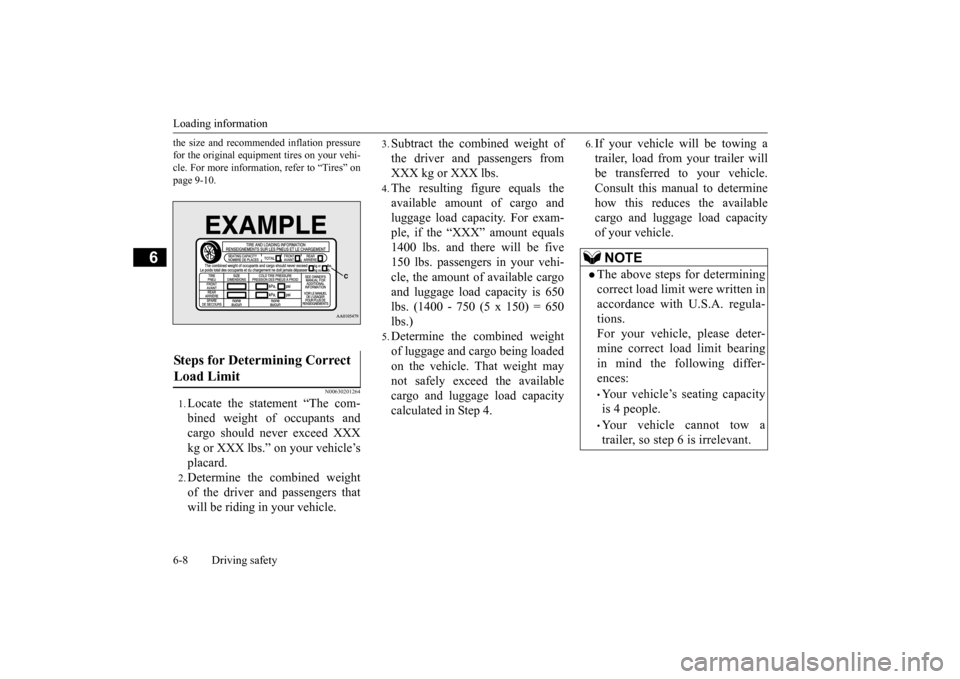
the size and recomme
nded inflation pressure
for the original equipment tires on your vehi-cle. For more informati
on, refer to “Tires” on
page 9-10.
N00630201264
1.Locate the statement “The com- bined weight of occupants and cargo should never exceed XXXkg or XXX lbs.” on your vehicle’s placard.2.Determine the combined weight of the driver and passengers that will be riding in your vehicle.
3.Subtract the combined weight of the driver and passengers from XXX kg or XXX lbs.4.The resulting figure equals the available amount of cargo and luggage load capacity. For exam- ple, if the “XXX” amount equals1400 lbs. and there will be five 150 lbs. passengers in your vehi- cle, the amount of available cargoand luggage load
capacity is 650
lbs. (1400 - 750 (5 x 150) = 650 lbs.)5.Determine the combined weight of luggage and cargo being loaded on the vehicle. That weight maynot safely exceed the available cargo and luggage load capacity calculated in Step 4.
6.If your vehicle will be towing atrailer, load from your trailer will be transferred to your vehicle. Consult this manual to determinehow this reduces the available cargo and luggage load capacity of your vehicle.
Steps for Determining Correct Load Limit
NOTE
The above steps for determining correct load limit were written in accordance with U.S.A. regula- tions.For your vehicle, please deter- mine correct load limit bearing in mind the following differ-ences:•Your vehicle’s seating capacityis 4 people.•Your vehicle cannot tow atrailer, so step 6 is irrelevant.
BK0209800US.book 8 ページ 2014年1月14日 火曜日 午前9時26分
Page 171 of 262
Cargo loads 6-10 Driving safety
6
N00629700510
To determine the cargo load capacity for your vehicle, subtract the
weight of all vehicle
occupants from the vehi
cle capacity weight.
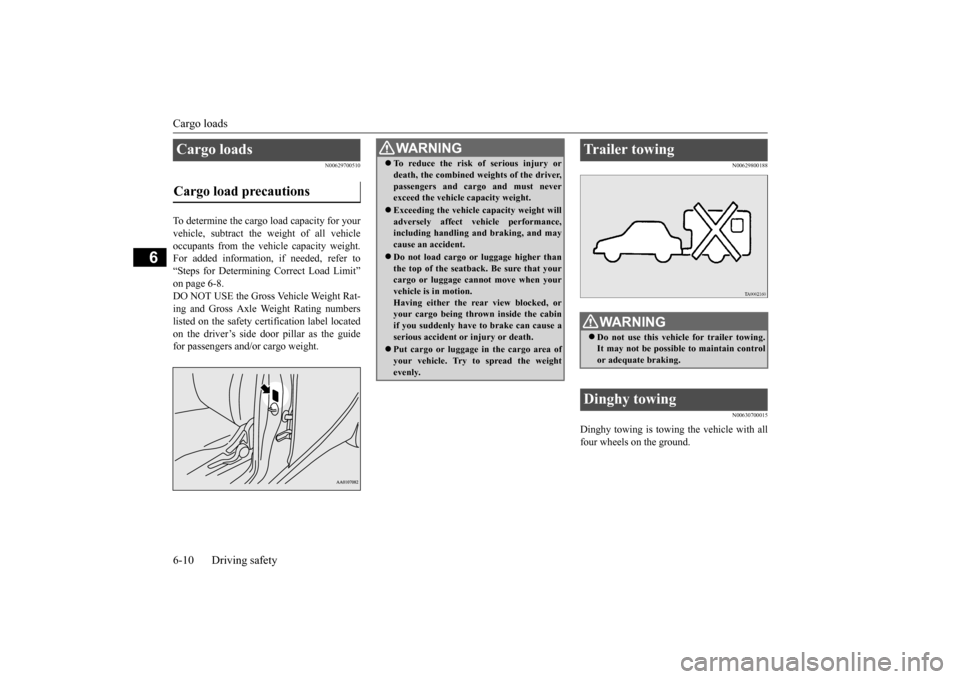
For added information, if needed, refer to “Steps for Determining Correct Load Limit” on page 6-8. DO NOT USE the Gross Vehicle Weight Rat- ing and Gross Axle Weight Rating numberslisted on the safety certification label located on the driver’s side door pillar as the guide for passengers and/or cargo weight.
N00629800188 N00630700015
Dinghy towing is towing the vehicle with all four wheels on the ground.
Cargo loads Cargo load precautions
WA R N I N G To reduce the risk of serious injury or death, the combined weights of the driver,passengers and cargo and must neverexceed the vehicle capacity weight. Exceeding the vehicle capacity weight will adversely affect ve
hicle performance,
including handling and braking, and may cause an accident. Do not load cargo or luggage higher than the top of the seatback. Be sure that yourcargo or luggage cann
ot move when your
vehicle is in motion. Having either the re
ar view blocked, or
your cargo being thrown
inside the cabin
if you suddenly have to brake can cause a serious accident or
injury or death.
Put cargo or luggage in the cargo area of your vehicle. Try to spread the weightevenly.
Trailer towing
WA R N I N G Do not use this vehicle for trailer towing. It may not be possible to maintain control or adequate braking.
Dinghy towing
BK0209800US.book 10 ページ 2014年1月14日 火曜日 午前9時26分
Page 172 of 262
Dinghy towing
Driving safety 6-11
6
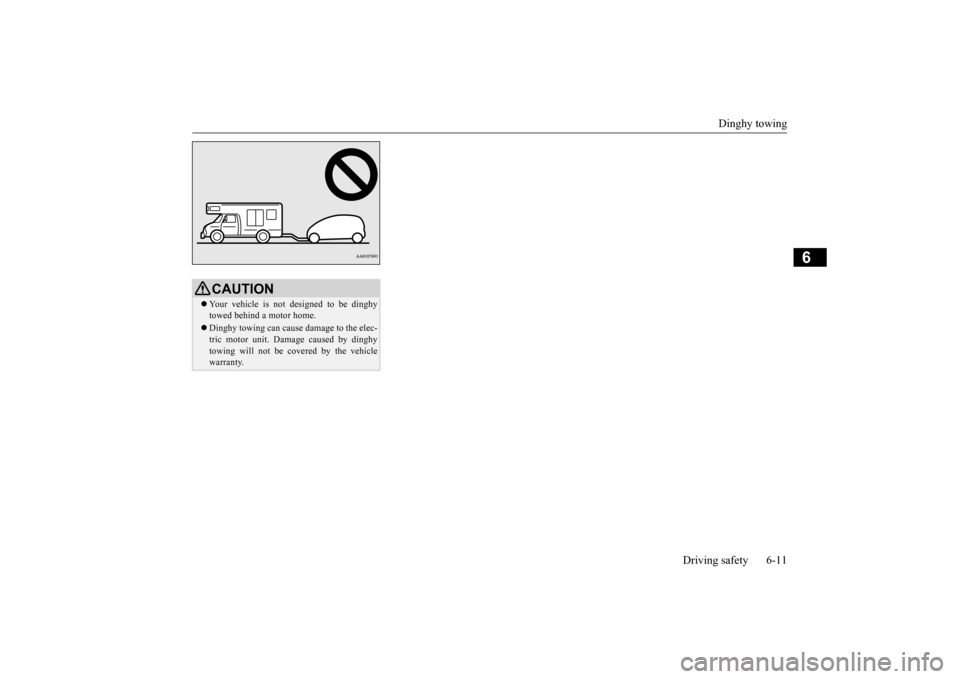
CAUTION Your vehicle is not
designed to be dinghy
towed behind a motor home. Dinghy towing can cause damage to the elec- tric motor unit. Damage caused by dinghytowing will not be covered by the vehicle warranty.
BK0209800US.book 11 ページ 2014年1月14日 火曜日 午前9時26分
Page 194 of 262
Handling of compact discs Comfort controls 7-21
7
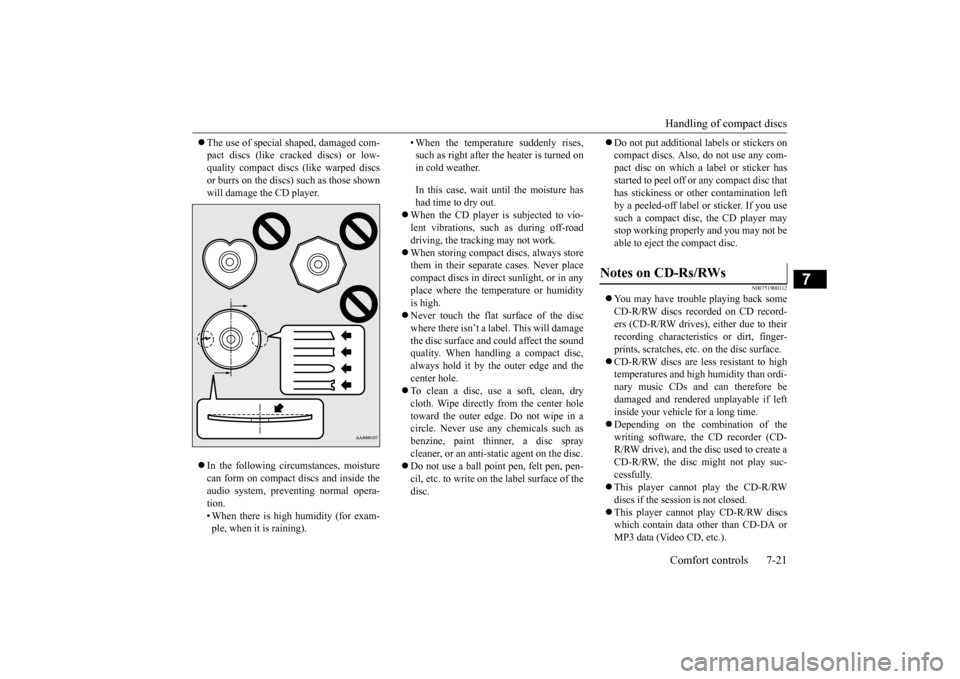
The use of special shaped, damaged com- pact discs (like cracked discs) or low-quality compact discs (like warped discs or burrs on the discs)
such as those shown
will damage the CD player. In the following circumstances, moisture can form on compact discs and inside the audio system, preventing normal opera-tion. • When there is high humidity (for exam- ple, when it is raining).
• When the temperature suddenly rises, such as right after the heater is turned onin cold weather. In this case, wait until the moisture has had time to dry out.
When the CD player is subjected to vio- lent vibrations, such as during off-road driving, the tracking may not work. When storing compact discs, always store them in their separate
cases. Never place
compact discs in direct sunlight, or in any place where the temperature or humidity is high. Never touch the flat surface of the disc where there isn’t a label. This will damage the disc surface and
could affect the sound
quality. When handli
ng a compact disc,
always hold it by the outer edge and the center hole. To clean a disc, use a soft, clean, dry cloth. Wipe directly
from the center hole
toward the outer edge. Do not wipe in a circle. Never use any chemicals such asbenzine, paint thinner, a disc spray cleaner, or an anti-static agent on the disc. Do not use a ball point pen, felt pen, pen- cil, etc. to write on the label surface of the disc.
Do not put additional la
bels or stickers on
compact discs. Also, do not use any com-pact disc on which a label or sticker has started to peel off or any compact disc that has stickiness or ot
her contamination left
by a peeled-off label or sticker. If you use such a compact disc, the CD player may stop working properly and you may not beable to eject the compact disc.
N00751900112
You may have trouble playing back some CD-R/RW discs recorded on CD record- ers (CD-R/RW drives), either due to theirrecording characterist
ics or dirt, finger-
prints, scratches, etc.
on the disc surface.
CD-R/RW discs are less resistant to high temperatures and high humidity than ordi- nary music CDs and can therefore be damaged and rendered unplayable if leftinside your vehicle for a long time. Depending on the combination of the writing software, the CD recorder (CD-R/RW drive), and the disc used to create a CD-R/RW, the disc might not play suc- cessfully. This player cannot play the CD-R/RW discs if the sessi
on is not closed.
This player cannot play CD-R/RW discs which contain data other than CD-DA or MP3 data (Video CD, etc.).
Notes on CD-Rs/RWs
BK0209800US.book 21 ページ 2014年1月14日 火曜日 午前9時26分