battery MITSUBISHI iMiEV 2014 1.G Owner's Manual
[x] Cancel search | Manufacturer: MITSUBISHI, Model Year: 2014, Model line: iMiEV, Model: MITSUBISHI iMiEV 2014 1.GPages: 262, PDF Size: 26.84 MB
Page 37 of 262
EV charging cable 3-22 General information/Charging
3
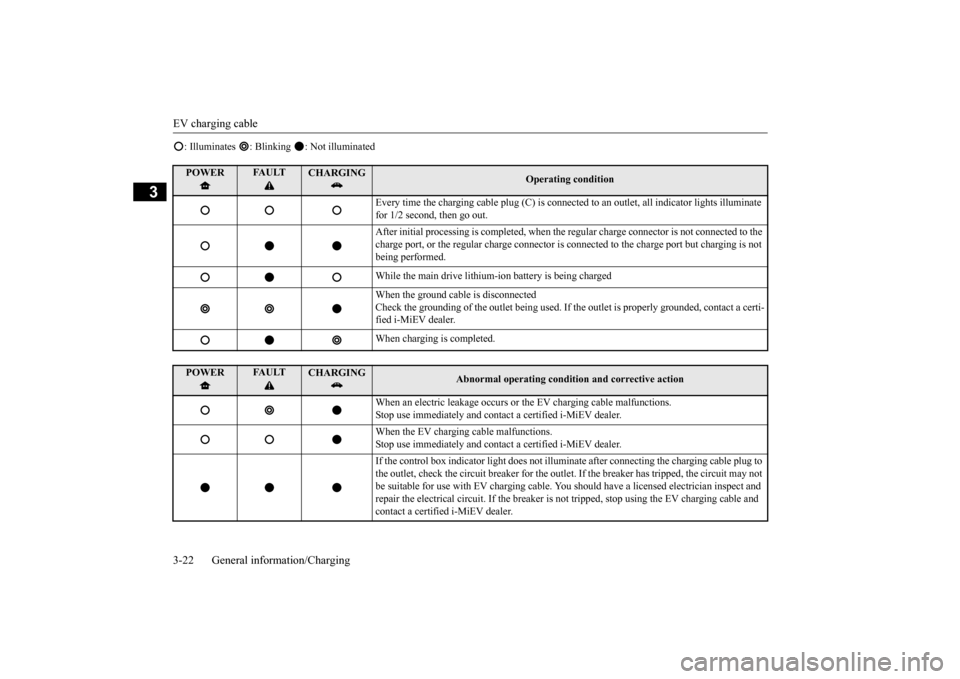
: Illuminates : Blinking : Not illuminatedPOWER
FAULT
CHARGING
Operating condition
Every time the charging cable plug (C) is connected
to an outlet, all indicator lights illuminate
for 1/2 second, then go out. After initial processing is comple
ted, when the regular charge c
onnector is not connected to the
charge port, or the regular charge connector is
connected to the charge port but charging is not
being performed. While the main drive lithium-i
on battery is being charged
When the ground cable is disconnected Check the grounding of the outlet being used. If
the outlet is properly gr
ounded, contact a certi-
fied i-MiEV dealer. When charging is completed.
POWER
FAULT
CHARGING
Abnormal operating conditi
on and corrective action
When an electric leakage occurs or the EV charging cable malfunctions. Stop use immediately and contac
t a certified i-MiEV dealer.
When the EV chargi
ng cable malfunctions.
Stop use immediately and contac
t a certified i-MiEV dealer.
If the control box indicator light
does not illuminate after connect
ing the charging cable plug to
the outlet, check the circuit breaker for the outlet.
If the breaker has tripped, the circuit may not
be suitable for use with EV charging cable. Y
ou should have a licensed
electrician inspect and
repair the electrical circuit. If the breaker is
not tripped, stop using the EV charging cable and
contact a certifie
d i-MiEV dealer.
BK0209800US.book 22 ページ 2014年1月14日 火曜日 午前9時26分
Page 38 of 262
EV charging cable
General information/Charging 3-23
3
N01202901041
FCC Notice: This equi
pment has been tested
and found to comply with the limits for aClass B digital device,
pursuant to part 15 of
the FCC Rules. These limits are designed to provide reasonable prot
ection against harmful
interference in a residential installation. This equipment generates, uses and can radi- ate radio frequency energy and, if notinstalled and used in accordance with the instructions, may caus
e harmful interference
to radio communications.However, there is no guarantee that interfer- ence will not occur in a particular installation. If this equipment does
cause harmful interfer-
ence to radio or tele
vision reception, which
can be determined by turning the equipment off and on, the user is encouraged to try tocorrect the interference by
one or more of the
following measures:
WA R N I N G Improper use of the
EV charging cable
can result in a fire, property damage, andserious injury or death.Carefully read instructions regarding “Precautions during
charging the main
drive lithium-ion battery” on page 3-14and on “Regular charging (charging method with rated AC 120 V outlet)” on page 3-15 and describe
d in this section
and follow them. Always use an outlet protected by a ground-fault circuit interrupter, rated for 15A or more, and that
is connected to a
dedicated branch circuit. Never use an extension cable or conver- sion adapter. When using a non-wate
rproof outlet, take
care to avoid contact
with rainwater dur-
ing charging. Never connect or disconnect the plug with a wet hand. Make sure that the plug is inserted all the way into the socket before use. Continued charging with a plug not completely inserted or pulled
halfway out of the
socket may result in a risk of overheating or fire. If the indictors show the EV charging cable malfunctions as described below, stop using the EV charging cable and con-tact a certified i-MiEV dealer. Never disassemble the EV charging cable or attempt to open
the control box.
NOTE
All indicators are illuminated momentarily for confirming operation when the chargingcable plug is inserted into an outlet. Afterthat, the POWER indi
cator is continuously
illuminated and the CH
ARGING indicator is
continuously blinking. The CHARGING indicator will start to blink when charging is completed. The POWERindicator is continuous
ly illuminated while
charging cable plug is in
serted into an outlet.
Handling and storing the con- trol box
CAUTION Use the method shown below to help secure the control box and to prevent the plug from being pulled halfway out of the socket duringcharging.NOTE
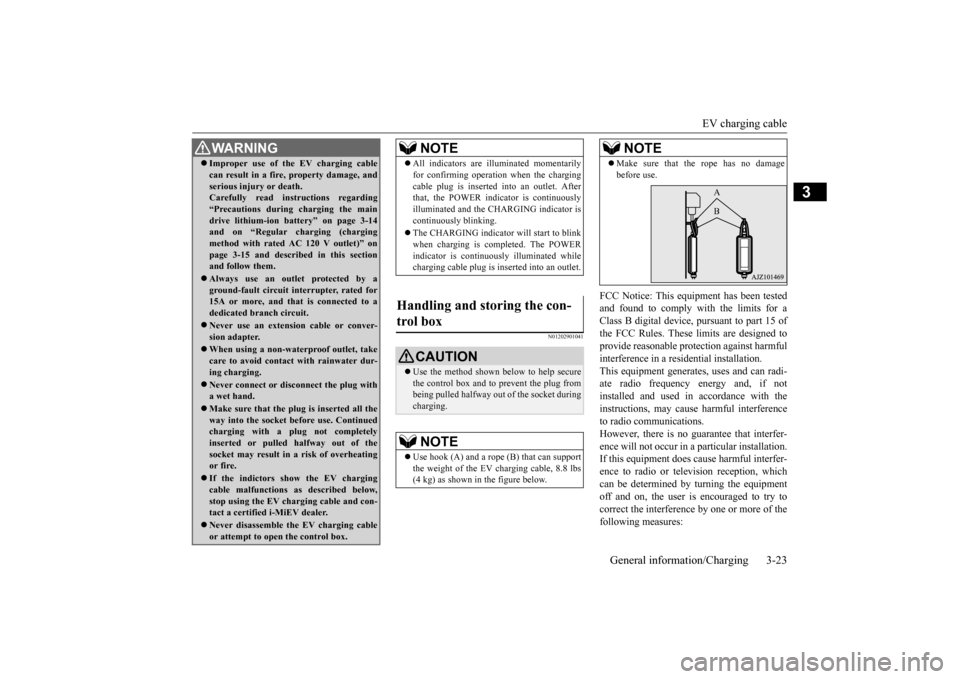
Use hook (A) and a rope (B) that can support the weight of the EV charging cable, 8.8 lbs (4 kg) as shown in the figure below.
Make sure that the rope has no damage before use.NOTE
A B
BK0209800US.book 23 ページ 2014年1月14日 火曜日 午前9時26分
Page 39 of 262
Regular charging (using 240V Electric Vehicle Supply Equipment) 3-24 General information/Charging
3
Reorient or relocate the receiving antenna. Increase the separation between the equipment and receiver. Connect the equipment into an outlet on a circuit different from that to which thereceiver is connected. Consult the dealer or an experienced radio/TV technician for help.
ICES Notice: This Class B digital apparatus complies with Canadian ICES-003.
N01203000013
1. Gently wipe outside surface of the EV charging cable with ga
uze or a similar soft
cloth soaked with a mild soap and watersolution. 2. Wipe off all detergent with a soft cloth dipped in fresh water and thoroughlywrung out. 3. Wipe all moisture off and dry in a shaded, well-ventilated area.
N01216100018
You can charge your vehicle through the reg-ular charging port using 240V Electric Vehi-cle Supply Equipment (EVSE) compatible with i-MiEV. Carefully read instructions on “Precautionsduring charging the main drive lithium-ion battery” on page 3-14,
described in this sec-
tion.For connecting/disconne
cting the charging
connector to/from the vehicle, follow instruc-
tions for the regular charging (charging method with rated AC
120V outlet) on page
3-15. Also follow inst
ructions provided with
the 240V EVSE.
N01203301026
Your vehicle is equipped with the quickcharging port. The quick charge port is com- patible with most CHAdeMO
* (Japanese
industry standard) connectors on charging stations. * : Charging stations using this standard are UL certified and safe to use in the US. Improper charging can result in a fire, prop- erty damage, and serious injury or death.
Cleaning the EV charging cable
WA R N I N G Before cleaning, be sure to remove the charging cable plug from the socket andthe regular charging plug from the vehi- cle. Do not connect or disconnect the plug with a wet hand. Doing so can cause anelectric shock.
Never expose the metal terminal of the regular charge connector or the chargingcable plug to water or neutral detergent.Water or detergent entering into the plugs can cause a fire or
an electric shock.
CAUTIONNever use benzine, petrol, organic solvents, acid, or alkaline solvents to clean the charg- ing cable. Doing so c
ould cause deformation,
discolour, or malfunction. Also, these sub- stances may be present
in various cleaners,
so check carefully before use.
Regular charging (using 240V Electric Vehicle Sup-ply Equipment)
WA R N I N G
CAUTION Be sure to use a 240V EVSE compatible with i-MiEV. Use of a non-compatible 240V EVSE may not charge the main drive lith-ium-ion battery correctly
or may damage the
main drive lithium-ion battery.NOTE
The 240V EVSE compatib
le with i-MiEV is
available separately. Contact a certified i-MiEV dealer.
Quick charging (charging method with quick charger)
BK0209800US.book 24 ページ 2014年1月14日 火曜日 午前9時26分
Page 40 of 262
Quick charging (charging method with quick charger)
General information/Charging 3-25
3
Carefully read instru
ctions on “Precautions
during charging the main drive lithium-ionbattery” on page 3-14,
described in this sec-
tion and also instructions for a quick charger you uses, and follow them.
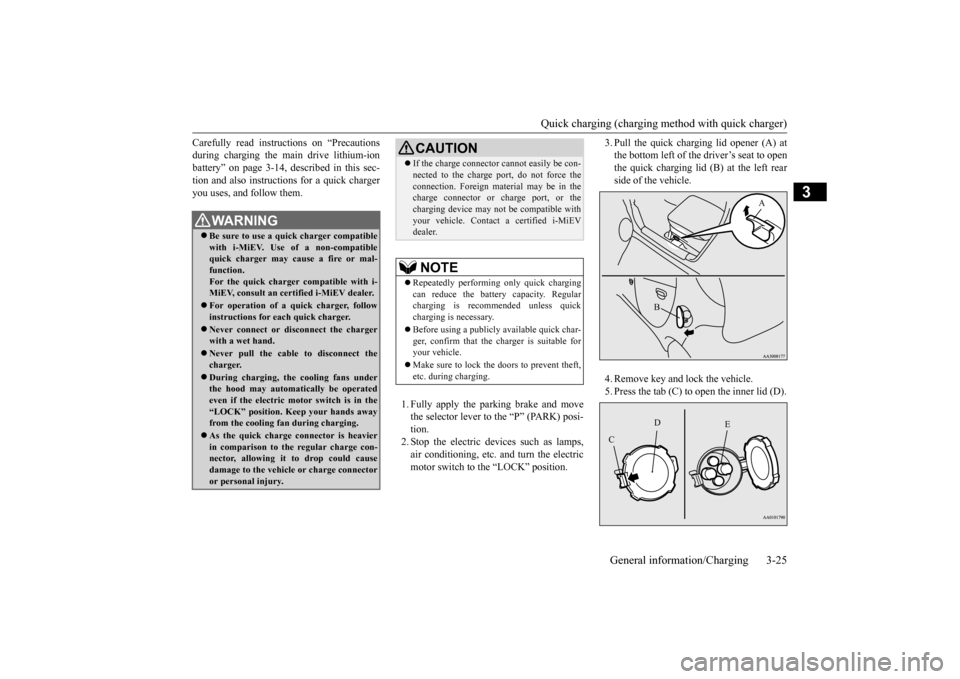
1. Fully apply the parking brake and move the selector lever to the “P” (PARK) posi-tion. 2. Stop the electric devices such as lamps, air conditioning, etc.
and turn the electric
motor switch to the “LOCK” position.
3. Pull the quick charging lid opener (A) at the bottom left of the driver’s seat to openthe quick charging lid (B) at the left rear side of the vehicle. 4. Remove key and lock the vehicle. 5. Press the tab (C) to open the inner lid (D).
WA R N I N G Be sure to use a qu
ick charger compatible
with i-MiEV. Use of a non-compatible quick charger may cause a fire or mal- function.For the quick charger compatible with i- MiEV, consult an certified i-MiEV dealer. For operation of a quick charger, follow instructions for each quick charger. Never connect or disc
onnect the charger
with a wet hand. Never pull the cable to disconnect the charger. During charging, the
cooling fans under
the hood may automa
tically be operated
even if the electric motor switch is in the“LOCK” position. Ke
ep your hands away
from the cooling fan during charging. As the quick charge connector is heavier in comparison to th
e regular charge con-
nector, allowing it to drop could causedamage to the vehicl
e or charge connector
or personal injury.
CAUTION If the charge connector cannot easily be con- nected to the charge port, do not force theconnection. Foreign mate
rial may be in the
charge connector or charge port, or the charging device may not
be compatible with
your vehicle. Contact a certified i-MiEVdealer.NOTE
Repeatedly performi
ng only quick charging
can reduce the batter
y capacity. Regular
charging is recommended unless quickcharging is necessary. Before using a publicly
available quick char-
ger, confirm that the charger is suitable for your vehicle. Make sure to lock the doors to prevent theft, etc. during charging.
A
B
E
D
C
BK0209800US.book 25 ページ 2014年1月14日 火曜日 午前9時26分
Page 41 of 262
Quick charging (charging method with quick charger) 3-26 General information/Charging
3
6. Insert the quick charge connector com- pletely into the quick charge port to begincharging. For connecting and di
sconnecting, follow
the instruction manual for each quickcharger.
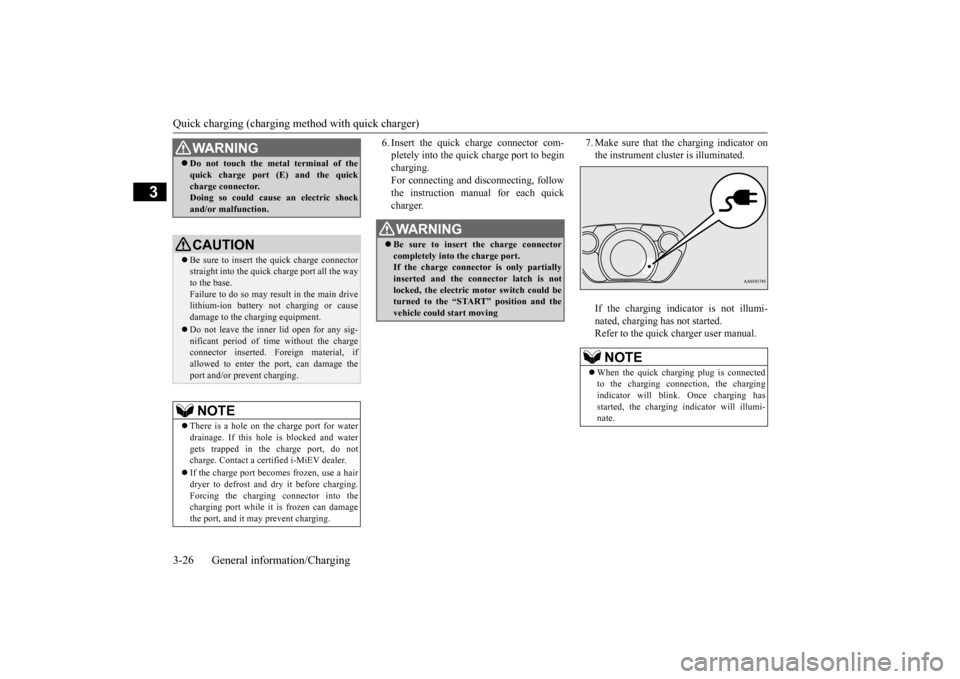
7. Make sure that the charging indicator on the instrument cluster is illuminated. If the charging indicator is not illumi- nated, charging has not started. Refer to the quick charger user manual.
WA R N I N G Do not touch the metal terminal of the quick charge port (E) and the quickcharge connector.Doing so could cause an electric shock and/or malfunction.CAUTION Be sure to insert the quick charge connector straight into the quick charge port all the wayto the base. Failure to do so may result in the main drive lithium-ion battery not charging or causedamage to the charging equipment. Do not leave the inner lid open for any sig- nificant period of ti
me without the charge
connector inserted.
Foreign material, if
allowed to enter the port, can damage theport and/or prevent charging.NOTE
There is a hole on the charge port for water drainage. If this hole
is blocked and water
gets trapped in the charge port, do not charge. Contact a certified i-MiEV dealer. If the charge port becomes frozen, use a hair dryer to defrost and dry it before charging.Forcing the charging connector into the charging port while it
is frozen can damage
the port, and it may prevent charging.
WA R N I N G Be sure to insert the charge connector completely into the charge port. If the charge connector is only partially inserted and the connector latch is notlocked, the electric motor switch could be turned to the “START” position and the vehicle could start moving
NOTE
When the quick charging plug is connected to the charging connection, the chargingindicator will blink.
Once charging has
started, the charging i
ndicator will illumi-
nate.
BK0209800US.book 26 ページ 2014年1月14日 火曜日 午前9時26分
Page 42 of 262
Quick charging (charging method with quick charger)
General information/Charging 3-27
3
8. Charging is complete when the charging indicator turns off.Disconnect the quick charge connector according to the manual of the quick char- ger. 9. Close the inner lid and close the quick charging lid.
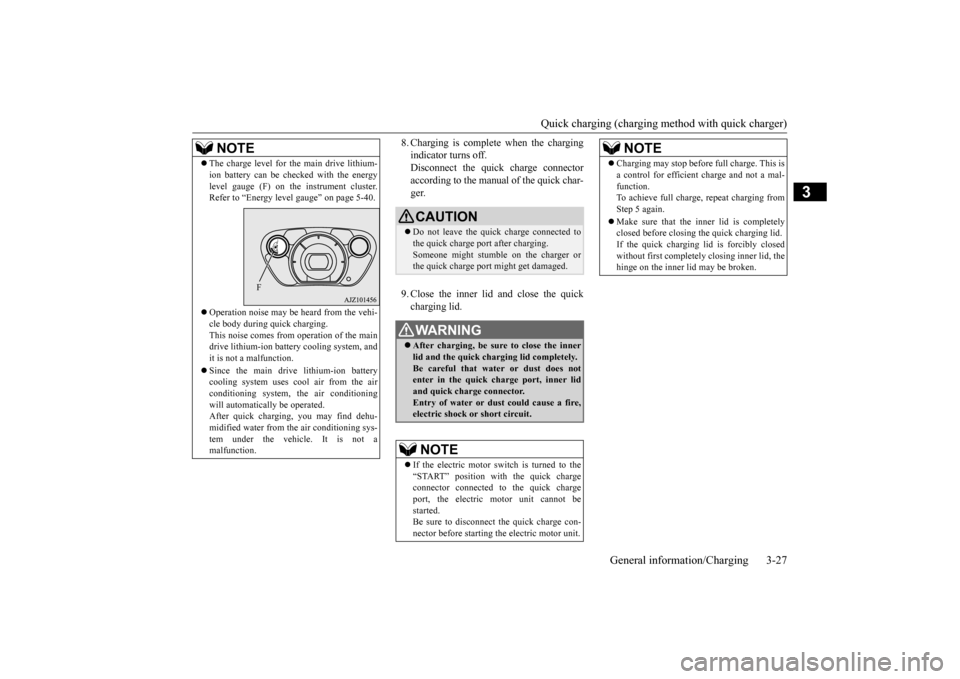
The charge level for the main drive lithium- ion battery can be checked with the energylevel gauge (F) on the
instrument cluster.
Refer to “Energy leve
l gauge” on page 5-40.
Operation noise may be heard from the vehi- cle body during quick charging.This noise comes from operation of the main drive lithium-ion batter
y cooling system, and
it is not a malfunction. Since the main driv
e lithium-ion battery
cooling system uses cool air from the airconditioning system,
the air conditioning
will automatically be operated. After quick charging, you may find dehu-midified water from
the air conditioning sys-
tem under the vehicle. It is not a malfunction.NOTE
F
CAUTION Do not leave the quick charge connected to the quick charge port after charging. Someone might stumble on the charger orthe quick charge port might get damaged.WA R N I N G After charging, be sure to close the inner lid and the quick charging lid completely.Be careful that water or dust does not enter in the quick charge port, inner lid and quick charge connector.Entry of water or dust could cause a fire, electric shock or
short circuit.
NOTE
If the electric motor switch is turned to the “START” position with the quick charge connector connected to the quick chargeport, the electric motor unit cannot be started. Be sure to disconnect
the quick charge con-
nector before starting
the electric motor unit.
Charging may stop before full charge. This is a control for efficient charge and not a mal-function.To achieve full charge, repeat charging from Step 5 again. Make sure that the inner lid is completely closed before closing the quick charging lid. If the quick charging li
d is forcibly closed
without first co
mpletely closing inner lid, the
hinge on the inner
lid may be broken.
NOTE
BK0209800US.book 27 ページ 2014年1月14日 火曜日 午前9時26分
Page 43 of 262

Charging troubleshooting guide 3-28 General information/Charging
3
N01202300022
Charging troubleshooting guide
Symptom
Possible cause
Possible solution
Charging cannot be started.
The electric motor switch is in the ON position.
Before charging, place the electric motor switch in the “LOCK” position.
The main drive lithium-ion battery is already fully charged.
Charging cannot be performed if the ma
in drive lithium-ion
battery is already
fully charged. Charging automatically turns off if the main drive lithium-ion battery is fully charged.
The temperature of the main drive lithium-ion battery
is too high or too
low to charge.
Confirm the main drive lithium-ion battery temperature. Refer to “Cautions and acti
ons to deal with intense heat” on page 3-7 and “Cau-
tions and actions to deal wi
th intense cold” on page 3-9.
The 12V starter battery is dis- charged.
The main drive lithium-ion battery can be charged if the vehicle electrical sys- tems cannot be turned on. If the battery is
discharged, charge or jump start the
12V starter battery. Refer to
“Jump-starting” on page 8-2.
The vehicle has a malf
unction. The vehicle or charger
may have a malfunction. Confir
m if the warning light on
the meter is illuminated. Confirm if the indicator on the charger is indicating a malfunction. If a warning is displayed,
stop charging and contact a certified i-
MiEV dealer.
Regular charging can- not be started.
There is no electrical power coming from the outlet.
Confirm that there has not been a power fa
ilure. Make sure the breaker is on. If
an outlet with a timer device installed
is used, power will onl
y be available at
the time set by the timer. Confirm if the POWER indicator on
the control box
is illuminated.
The charge connector is not con- nected correctly.
Confirm the charge connector
is connected correctly.
Charging Timer by MiEV remote cannot be started.
Refer to “Action to be taken when the MiEV Remote
system does not operate correctly” on page 3-48.
BK0209800US.book 28 ページ 2014年1月14日 火曜日 午前9時26分
Page 44 of 262
Charging troubleshooting guide
General information/Charging 3-29
3
Regular charging is discontinued.
There is no power coming from the outlet.
There may have been a electrical power
failure, or the
breaker may have
failed.Charging will resume when
the power source is reset.
The EV charging cable has been dis- connected.
Check that the EV charging ca
ble has not been disconnected.
The button on the regular charge connector has been pressed.
If the charge connector button is pressed
for a long period of time, charging will
be stopped. Start the charging procedure again.
The temperature of the main drive lithium-ion battery is too hot or too cold to charge.
Confirm the main drive lithium-ion battery temperature. Refer to “Cautions and actions to deal
with intense heat” on page 3-7 and “Cau-
tions and actions to deal w
ith intense cold” on page 3-9.
Charging is stopped by the regular charge timer.
Charging will stop depending on
the timer function settin
g of the regular charge
device. If you need to charge the main
drive lithium-ion battery more, start the
charging procedure again.
Quick charging cannot be started.
The charge connector is not con- nected correctly and/or not locked.
Check that the charge connector is conn
ected correctly and that it is locked.
The self-diagnostic function of the quick charge device returns a nega- tive result.
There is a possibility that the vehicle ha
s a malfunction. Stop charging and con-
tact a certified i-MiEV dealer.
The power switch of the quick char- ger is off.
Check the power switch of the quick charger.
Quick charge is discon- tinued.
Charging is stopped by the quick charge timer.
Charging will stop depending on the time
r function setting of the quick charge
device.If you need to charge
the main drive lithium-ion battery more, start the
charging procedure again.
Charging stops at 80% capacity. Charg
ing is designed to stop when the ma
in drive lithium-ion battery capacity
reaches 80%. If you need to charge the ma
in drive lithium-ion battery more than
80%, start the charging procedure again.
The power supply for the quick charger is off.
Check whether the power supply for the quick charger is off.
Symptom
Possible cause
Possible solution
BK0209800US.book 29 ページ 2014年1月14日 火曜日 午前9時26分
Page 45 of 262
High-Voltage components 3-30 General information/Charging
3
N01205700027
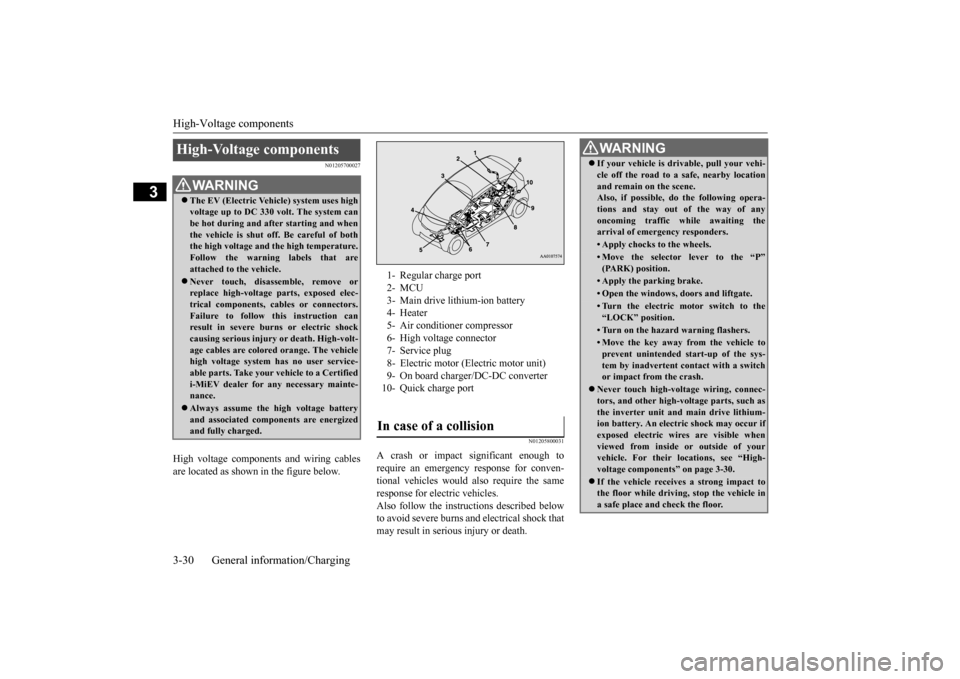
High voltage components and wiring cables are located as shown in the figure below.
N01205800031
A crash or impact significant enough to require an emergency response for conven- tional vehicles would
also require the same
response for electric vehicles. Also follow the instruct
ions described below
to avoid severe burns a
nd electrical shock that
may result in serious injury or death.
High-Voltage components
WA R N I N G The EV (Electric Vehicle) system uses high voltage up to DC 330 volt. The system canbe hot during and after starting and when the vehicle is shut off. Be careful of both the high voltage and
the high temperature.
Follow the warning labels that are attached to the vehicle. Never touch, disassemble, remove or replace high-voltage parts, exposed elec- trical components, cables or connectors.Failure to follow this instruction can result in severe burns
or electric shock
causing serious injury
or death. High-volt-
age cables are colore
d orange. Th
e vehicle
high voltage system has no user service- able parts. Take your
vehicle to a Certified
i-MiEV dealer for an
y necessary mainte-
nance. Always assume the hi
gh voltage battery
and associated compon
ents are energized
and fully charged.
1- Regular charge port 2- MCU 3- Main drive lithium-ion battery 4- Heater5- Air conditioner compressor 6- High voltage connector 7- Service plug8- Electric motor (Electric motor unit) 9- On board charger/DC-DC converter 10- Quick charge portIn case of a collision
WA R N I N G If your vehicle is dr
ivable, pull your vehi-
cle off the road to a safe, nearby locationand remain on the scene.Also, if possible, do
the follow
ing opera-
tions and stay out of the way of any oncoming traffic while awaiting thearrival of emergency responders.• Apply chocks to the wheels.• Move the selector
lever to the “P”
(PARK) position.• Apply the parking brake.• Open the windows,
doors and liftgate.
• Turn the electric motor switch to the “LOCK” position.• Turn on the hazard warning flashers.• Move the key away fr
om the vehicle to
prevent unintended start-up of the sys-tem by inadvertent contact with a switch or impact from the crash.
Never touch high-vol
tage wiring, connec-
tors, and other high-vol
tage parts, such as
the inverter unit and main drive lithium-ion battery. An electric shock may occur if exposed electric wires are visible when viewed from inside
or outside of your
vehicle. For their locations, see “High- voltage components” on page 3-30. If the vehicle receives a strong impact to the floor while driving, stop the vehicle in a safe place and check the floor.
BK0209800US.book 30 ページ 2014年1月14日 火曜日 午前9時26分
Page 46 of 262
High-Voltage components
General information/Charging 3-31
3
Leaks or damage to the main drive lith- ium-ion battery may result in a fire. If youdiscover them, contact emergency servicesimmediately. Since the fluid leak may be lithium manganite from the Lithium-ion battery, never touch any fluid leakingfrom the inside or outs
ide of the vehicle. If
the fluid contacts you
r skin or eyes, wash
it off immediately with a large amount ofwater and receive immediate medical attention to help
avoid serious injury.
If you are unable to sa
fely assess the vehi-
cle due to vehicle damage, do not touch the vehicle. Leave the vehicle and contactemergency services. Advise emergency responders that this is
an electric vehicle.
If a fire occurs in th
is vehicle,
leave the
vehicle as soon as possible and contact emergency services. Do not attempt toextinguish a fire by yourself. If the fire involves a lithium-ion battery, it will require large, sustained volumes of waterfor extinguishment. Using a small amount of water or the incorrect fire extinguisher can result in serious injury or death fromelectrical shock. When you leave the ve
hicle, if possible,
open the windows,
doors and liftgate to
prevent accumulation of poisonous/com- bustible gasses. This will also assist in therescue and fire fighting process.WA R N I N G
As with any vehicle fi
re, the byproducts of
combustion can be toxic. Do not inhalesmoke, vapors, or gas
from the vehicle.
Move to a safe distance upwind and uphill from the vehicle fire
and out of the way of
any oncoming traffic
while awaiting the
arrival of emergency responders. If you detect leaking
fluids, sparks, smoke,
flames, gurgling, popping or hissing noises originating from the
high voltage battery
compartment, contact emergency servicesimmediately. This may result in a fire. Physical damage to
the vehicle or high
voltage battery may re
sult in immediate or
delayed release of t
oxic and/or flammable
gases and fire. If your vehicle needs
to be towed, trans-
port the vehicle on a flatbed truck or towthe vehicle either with all wheels or the rear wheels (drive
wheels) off the ground.
If the rear wheels ar
e on the ground when
towing, this may cause damage to the elec- tric motors. This may also cause a fire, if wiring in the electric motor unit roombecomes damaged. Refer to “Towing” on page 8-12. Do not attempt to repair a damaged elec- tric vehicle yourself. Please contact a cer- tified i-MiEV dealer for service.WA R N I N G
In the event of an ac
cident that requires
body repair and painting, the vehicleshould be delivered to a Certified i-MiEVdealer to have the main drive lithium-ion battery and high voltage parts such as the inverter, including the attached wiringharness, removed prior to painting. If exposed to heat in the paint booth, the main drive lithium-ion battery will experi-ence battery capacity loss. A damaged main drive lithium-ion battery can also pose safety risks to untrainedmechanics and repair personnel.NOTE
The emergency shut-off
system will be acti-
vated and the high-voltage
system will auto-
matically turn off under the following conditions: • Certain front, side or rear collisions. • Certain EV (Electric Vehicle) system mal- functions.
When the emergency shut
-off system is acti-
vated, the ready indicato
r is turned off. Refer
to “Indicator and warning light package” onpage 5-41. If the emergency shut-off system activates, contact a Certifie
d i-MiEV dealer.
WA R N I N G
BK0209800US.book 31 ページ 2014年1月14日 火曜日 午前9時26分