regular charging MITSUBISHI iMiEV 2014 1.G Owner's Manual
[x] Cancel search | Manufacturer: MITSUBISHI, Model Year: 2014, Model line: iMiEV, Model: MITSUBISHI iMiEV 2014 1.GPages: 262, PDF Size: 26.84 MB
Page 40 of 262
Quick charging (charging method with quick charger)
General information/Charging 3-25
3
Carefully read instru
ctions on “Precautions
during charging the main drive lithium-ionbattery” on page 3-14,
described in this sec-
tion and also instructions for a quick charger you uses, and follow them.
1. Fully apply the parking brake and move the selector lever to the “P” (PARK) posi-tion. 2. Stop the electric devices such as lamps, air conditioning, etc.
and turn the electric
motor switch to the “LOCK” position.
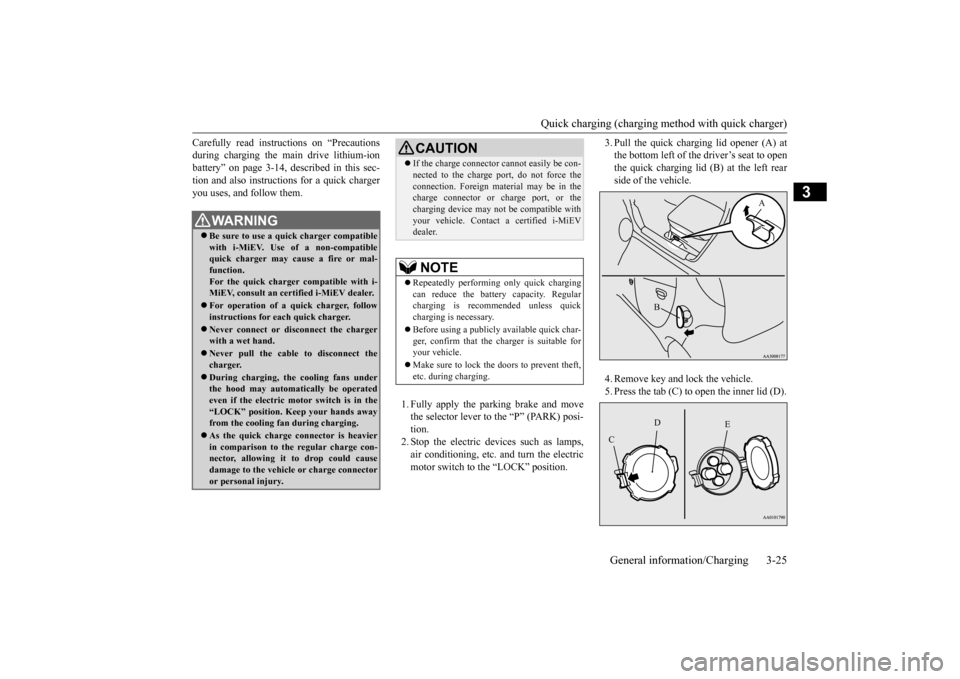
3. Pull the quick charging lid opener (A) at the bottom left of the driver’s seat to openthe quick charging lid (B) at the left rear side of the vehicle. 4. Remove key and lock the vehicle. 5. Press the tab (C) to open the inner lid (D).
WA R N I N G Be sure to use a qu
ick charger compatible
with i-MiEV. Use of a non-compatible quick charger may cause a fire or mal- function.For the quick charger compatible with i- MiEV, consult an certified i-MiEV dealer. For operation of a quick charger, follow instructions for each quick charger. Never connect or disc
onnect the charger
with a wet hand. Never pull the cable to disconnect the charger. During charging, the
cooling fans under
the hood may automa
tically be operated
even if the electric motor switch is in the“LOCK” position. Ke
ep your hands away
from the cooling fan during charging. As the quick charge connector is heavier in comparison to th
e regular charge con-
nector, allowing it to drop could causedamage to the vehicl
e or charge connector
or personal injury.
CAUTION If the charge connector cannot easily be con- nected to the charge port, do not force theconnection. Foreign mate
rial may be in the
charge connector or charge port, or the charging device may not
be compatible with
your vehicle. Contact a certified i-MiEVdealer.NOTE
Repeatedly performi
ng only quick charging
can reduce the batter
y capacity. Regular
charging is recommended unless quickcharging is necessary. Before using a publicly
available quick char-
ger, confirm that the charger is suitable for your vehicle. Make sure to lock the doors to prevent theft, etc. during charging.
A
B
E
D
C
BK0209800US.book 25 ページ 2014年1月14日 火曜日 午前9時26分
Page 43 of 262

Charging troubleshooting guide 3-28 General information/Charging
3
N01202300022
Charging troubleshooting guide
Symptom
Possible cause
Possible solution
Charging cannot be started.
The electric motor switch is in the ON position.
Before charging, place the electric motor switch in the “LOCK” position.
The main drive lithium-ion battery is already fully charged.
Charging cannot be performed if the ma
in drive lithium-ion
battery is already
fully charged. Charging automatically turns off if the main drive lithium-ion battery is fully charged.
The temperature of the main drive lithium-ion battery
is too high or too
low to charge.
Confirm the main drive lithium-ion battery temperature. Refer to “Cautions and acti
ons to deal with intense heat” on page 3-7 and “Cau-
tions and actions to deal wi
th intense cold” on page 3-9.
The 12V starter battery is dis- charged.
The main drive lithium-ion battery can be charged if the vehicle electrical sys- tems cannot be turned on. If the battery is
discharged, charge or jump start the
12V starter battery. Refer to
“Jump-starting” on page 8-2.
The vehicle has a malf
unction. The vehicle or charger
may have a malfunction. Confir
m if the warning light on
the meter is illuminated. Confirm if the indicator on the charger is indicating a malfunction. If a warning is displayed,
stop charging and contact a certified i-
MiEV dealer.
Regular charging can- not be started.
There is no electrical power coming from the outlet.
Confirm that there has not been a power fa
ilure. Make sure the breaker is on. If
an outlet with a timer device installed
is used, power will onl
y be available at
the time set by the timer. Confirm if the POWER indicator on
the control box
is illuminated.
The charge connector is not con- nected correctly.
Confirm the charge connector
is connected correctly.
Charging Timer by MiEV remote cannot be started.
Refer to “Action to be taken when the MiEV Remote
system does not operate correctly” on page 3-48.
BK0209800US.book 28 ページ 2014年1月14日 火曜日 午前9時26分
Page 44 of 262
Charging troubleshooting guide
General information/Charging 3-29
3
Regular charging is discontinued.
There is no power coming from the outlet.
There may have been a electrical power
failure, or the
breaker may have
failed.Charging will resume when
the power source is reset.
The EV charging cable has been dis- connected.
Check that the EV charging ca
ble has not been disconnected.
The button on the regular charge connector has been pressed.
If the charge connector button is pressed
for a long period of time, charging will
be stopped. Start the charging procedure again.
The temperature of the main drive lithium-ion battery is too hot or too cold to charge.
Confirm the main drive lithium-ion battery temperature. Refer to “Cautions and actions to deal
with intense heat” on page 3-7 and “Cau-
tions and actions to deal w
ith intense cold” on page 3-9.
Charging is stopped by the regular charge timer.
Charging will stop depending on
the timer function settin
g of the regular charge
device. If you need to charge the main
drive lithium-ion battery more, start the
charging procedure again.
Quick charging cannot be started.
The charge connector is not con- nected correctly and/or not locked.
Check that the charge connector is conn
ected correctly and that it is locked.
The self-diagnostic function of the quick charge device returns a nega- tive result.
There is a possibility that the vehicle ha
s a malfunction. Stop charging and con-
tact a certified i-MiEV dealer.
The power switch of the quick char- ger is off.
Check the power switch of the quick charger.
Quick charge is discon- tinued.
Charging is stopped by the quick charge timer.
Charging will stop depending on the time
r function setting of the quick charge
device.If you need to charge
the main drive lithium-ion battery more, start the
charging procedure again.
Charging stops at 80% capacity. Charg
ing is designed to stop when the ma
in drive lithium-ion battery capacity
reaches 80%. If you need to charge the ma
in drive lithium-ion battery more than
80%, start the charging procedure again.
The power supply for the quick charger is off.
Check whether the power supply for the quick charger is off.
Symptom
Possible cause
Possible solution
BK0209800US.book 29 ページ 2014年1月14日 火曜日 午前9時26分
Page 45 of 262
High-Voltage components 3-30 General information/Charging
3
N01205700027
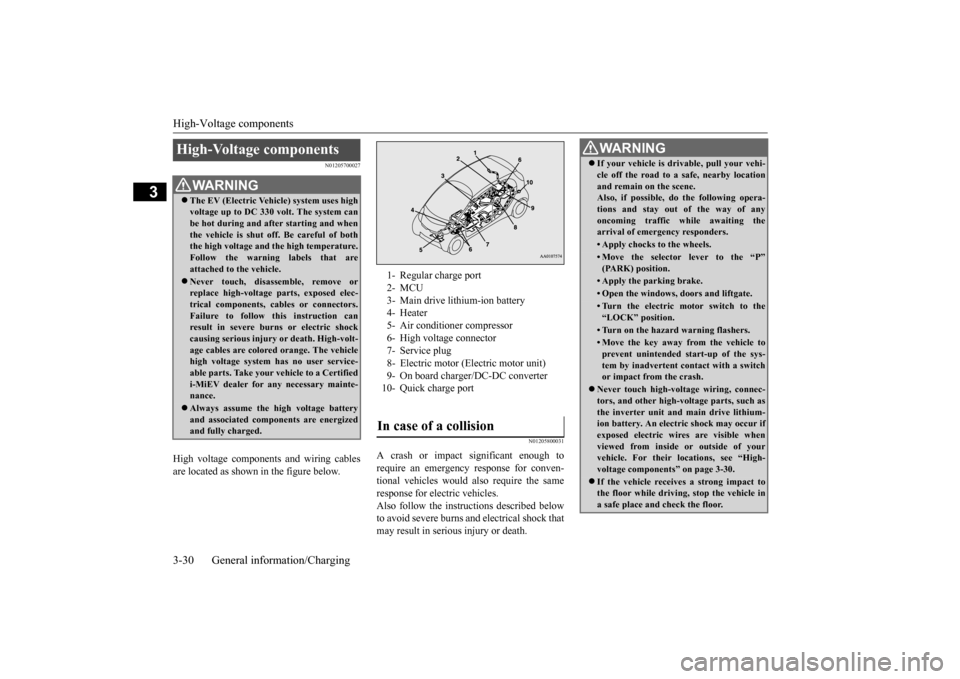
High voltage components and wiring cables are located as shown in the figure below.
N01205800031
A crash or impact significant enough to require an emergency response for conven- tional vehicles would
also require the same
response for electric vehicles. Also follow the instruct
ions described below
to avoid severe burns a
nd electrical shock that
may result in serious injury or death.
High-Voltage components
WA R N I N G The EV (Electric Vehicle) system uses high voltage up to DC 330 volt. The system canbe hot during and after starting and when the vehicle is shut off. Be careful of both the high voltage and
the high temperature.
Follow the warning labels that are attached to the vehicle. Never touch, disassemble, remove or replace high-voltage parts, exposed elec- trical components, cables or connectors.Failure to follow this instruction can result in severe burns
or electric shock
causing serious injury
or death. High-volt-
age cables are colore
d orange. Th
e vehicle
high voltage system has no user service- able parts. Take your
vehicle to a Certified
i-MiEV dealer for an
y necessary mainte-
nance. Always assume the hi
gh voltage battery
and associated compon
ents are energized
and fully charged.
1- Regular charge port 2- MCU 3- Main drive lithium-ion battery 4- Heater5- Air conditioner compressor 6- High voltage connector 7- Service plug8- Electric motor (Electric motor unit) 9- On board charger/DC-DC converter 10- Quick charge portIn case of a collision
WA R N I N G If your vehicle is dr
ivable, pull your vehi-
cle off the road to a safe, nearby locationand remain on the scene.Also, if possible, do
the follow
ing opera-
tions and stay out of the way of any oncoming traffic while awaiting thearrival of emergency responders.• Apply chocks to the wheels.• Move the selector
lever to the “P”
(PARK) position.• Apply the parking brake.• Open the windows,
doors and liftgate.
• Turn the electric motor switch to the “LOCK” position.• Turn on the hazard warning flashers.• Move the key away fr
om the vehicle to
prevent unintended start-up of the sys-tem by inadvertent contact with a switch or impact from the crash.
Never touch high-vol
tage wiring, connec-
tors, and other high-vol
tage parts, such as
the inverter unit and main drive lithium-ion battery. An electric shock may occur if exposed electric wires are visible when viewed from inside
or outside of your
vehicle. For their locations, see “High- voltage components” on page 3-30. If the vehicle receives a strong impact to the floor while driving, stop the vehicle in a safe place and check the floor.
BK0209800US.book 30 ページ 2014年1月14日 火曜日 午前9時26分
Page 47 of 262
MiEV Remote System 3-32 General information/Charging
3
N01203401043
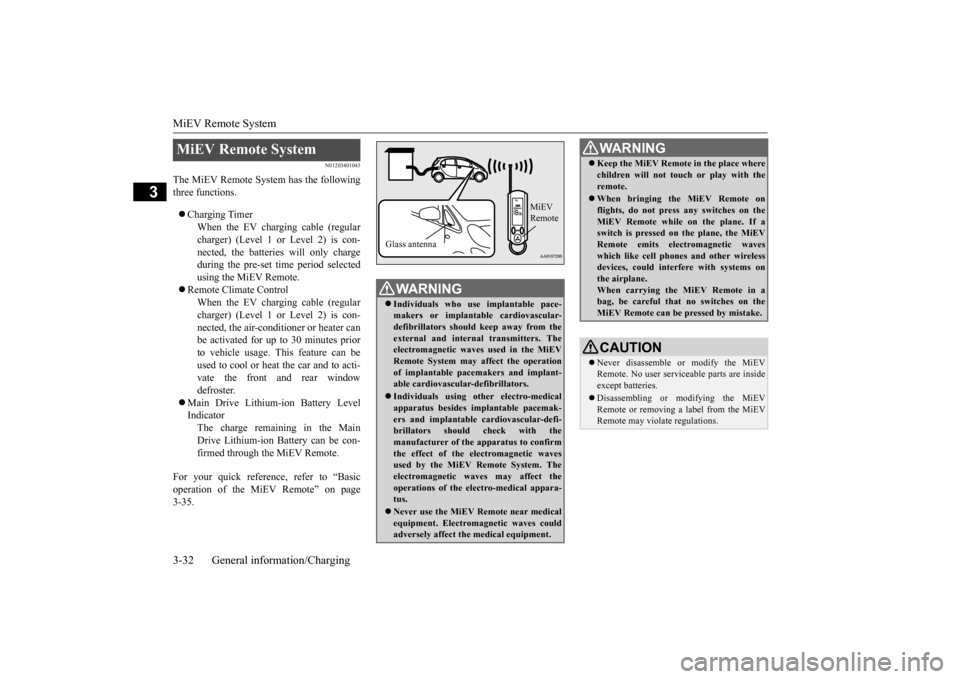
The MiEV Remote System has the following three functions. Charging Timer When the EV charging cable (regularcharger) (Level 1 or Level 2) is con- nected, the batteries will only charge during the pre-set ti
me period selected
using the MiEV Remote.
Remote Climate Control When the EV charging cable (regular charger) (Level 1 or Level 2) is con- nected, the air-conditioner or heater canbe activated for up to 30 minutes prior to vehicle usage. This feature can be used to cool or heat the car and to acti-vate the front and rear window defroster.
Main Drive Lithium-ion Battery Level Indicator The charge remaining in the Main Drive Lithium-ion Battery can be con-firmed through the MiEV Remote.
For your quick reference, refer to “Basic operation of the MiEV Remote” on page 3-35.MiEV Remote System
WA R N I N G Individuals who use
implantable pace-
makers or implanta
ble cardiovascular-
defibrillators
should keep away from the
external and internal
transmitters. The
electromagnetic wave
s used in the MiEV
Remote System may affect the operation of implantable pacemakers and implant- able cardiovascular-defibrillators. Individuals using ot
her electro-medical
apparatus besides implantable pacemak-ers and implantable
cardiovascular-defi-
brillators should
check with the
manufacturer of the apparatus to confirmthe effect of the el
ectromagnetic waves
used by the MiEV Remote System. The electromagnetic wave
s may affect the
operations of the el
ectro-medical appara-
tus. Never use the MiEV Remote near medical equipment. Electrom
agnetic waves could
adversely affect th
e medical equipment.
MiEV Remote
Glass antenna
Keep the MiEV Remote in the place where children will not touch or play with theremote. When bringing the MiEV Remote on flights, do not press any switches on theMiEV Remote while on the plane. If a switch is pressed on the plane, the MiEV Remote emits electromagnetic waveswhich like cell phones and other wireless devices, could interfere with systems on the airplane.When carrying the MiEV Remote in a bag, be careful that no switches on the MiEV Remote can be pressed by mistake.CAUTION Never disassemble or modify the MiEV Remote. No user servic
eable parts are inside
except batteries. Disassembling or modifying the MiEV Remote or removing a label from the MiEV Remote may violate regulations. WA R N I N G
BK0209800US.book 32 ページ 2014年1月14日 火曜日 午前9時26分
Page 49 of 262
MiEV Remote System 3-34 General information/Charging
3
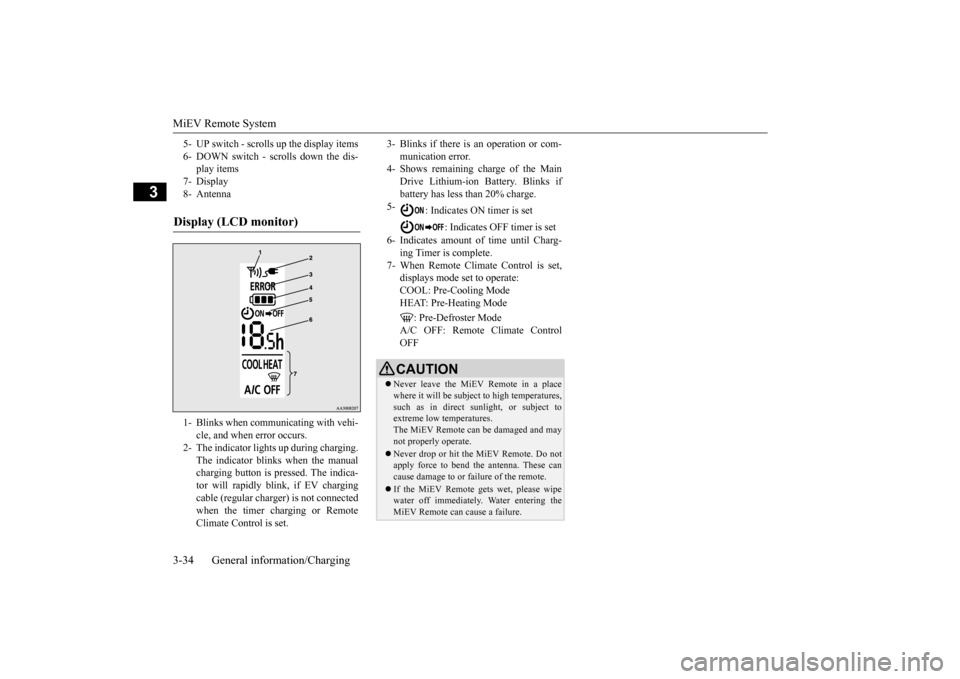
5- UP switch - scrolls up the display items 6- DOWN switch - scrolls down the dis-
play items
7- Display 8- AntennaDisplay (LCD monitor) 1- Blinks when communicating with vehi-
cle, and when error occurs.
2- The indicator lights up during charging.
The indicator blinks when the manualcharging button is pressed. The indica- tor will rapidly blink, if EV charging cable (regular charge
r) is not connected
when the timer charging or Remote Climate Control is set.
3- Blinks if there is an operation or com-
munication error.
4- Shows remaining charge of the Main
Drive Lithium-ion Battery. Blinks if battery has less than 20% charge.
5-
: Indicates ON timer is set
: Indicates OFF timer is set
6- Indicates amount of time until Charg-
ing Timer is complete.
7- When Remote Climate Control is set,
displays mode set to operate:COOL: Pre-Cooling Mode HEAT: Pre-Heating Mode
: Pre-Defroster Mode
A/C OFF: Remote Climate ControlOFFCAUTION Never leave the MiEV Remote in a place where it will be subject to high temperatures,such as in direct s
unlight, or subject to
extreme low temperatures. The MiEV Remote can
be damaged and may
not properly operate. Never drop or hit the MiEV Remote. Do not apply force to bend the antenna. These can cause damage to or fa
ilure of the remote.
If the MiEV Remote gets wet, please wipe water off immediately.
Water entering the
MiEV Remote can cause a failure.
BK0209800US.book 34 ページ 2014年1月14日 火曜日 午前9時26分
Page 51 of 262
MiEV Remote System 3-36 General information/Charging
3
N01203701020
The Charging Timer can be set as follows. ON timer: Time from the present to when charging will begin. OFF timer: Time from the start of charg- ing to the end of charging
To set the timer, the following conditions must be met. Selector lever: “P” (PARK) position Electric motor switch: “LOCK”position EV charging cable (regular charger): Con- nected
Charging Timer
WA R N I N G Improper charging can result in a fire, property damage, and serious injury or death.Before Charging Timer, carefully read and follow the instructions in “Precaution on Charging the Main Drive Lithium-ionBattery” on page 3-14 and “Regular charging (charging me
thod with rated AC
120 V outlet)” on page 3-15.NOTE
Charging Timer cannot be used with a quick charging system.
BK0209800US.book 36 ページ 2014年1月14日 火曜日 午前9時26分
Page 53 of 262
MiEV Remote System 3-38 General information/Charging
3
N01205100018
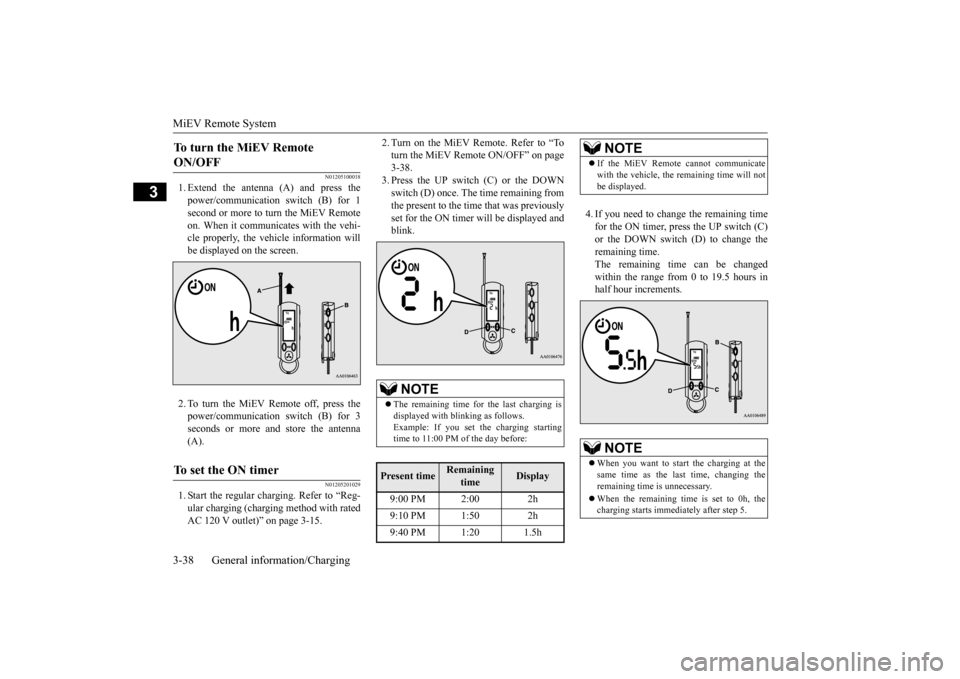
1. Extend the antenna (A) and press the power/communication switch (B) for 1 second or more to turn the MiEV Remote on. When it communicates with the vehi-cle properly, the vehicle information will be displayed on the screen. 2. To turn the MiEV Remote off, press the power/communication switch (B) for 3 seconds or more and store the antenna (A).
N01205201029
1. Start the regular charging. Refer to “Reg-ular charging (chargi
ng method with rated
AC 120 V outlet)” on page 3-15.
2. Turn on the MiEV Remote. Refer to “To turn the MiEV Remote ON/OFF” on page3-38. 3. Press the UP switch (C) or the DOWN switch (D) once. The time remaining fromthe present to the time that was previously set for the ON timer will be displayed and blink.
4. If you need to change the remaining time for the ON timer, press the UP switch (C) or the DOWN switch (D) to change the remaining time.The remaining time can be changed within the range from 0 to 19.5 hours in half hour increments.
To turn the MiEV Remote ON/OFF To set the ON timer
NOTE
The remaining time for the last charging is displayed with blinking as follows. Example: If you set the charging starting time to 11:00 PM of the day before:
Present time
Remaining
time
Display
9:00 PM 2:00 2h 9:10 PM 1:50 2h 9:40 PM 1:20 1.5h
NOTE
If the MiEV Remote
cannot communicate
with the vehicle, the remaining time will notbe displayed.NOTE
When you want to start the charging at the same time as the last time, changing the remaining time is unnecessary. When the remaining time is set to 0h, the charging starts immediately after step 5.
BK0209800US.book 38 ページ 2014年1月14日 火曜日 午前9時26分
Page 55 of 262
MiEV Remote System 3-40 General information/Charging
3
2. Press the UP switch (C) or the DOWN switch (D) once, and the remaining timefrom the present to the time set for the ON timer will be disp
layed and blink.
3. Change the remaining time to 0h by press- ing the UP switch (C) or the DOWN switch (D). 4. Press the power/communication switch(B) for less than 1 second to send the set- ting data to the vehicle. The MiEV Remote will sound mel
odies on transmis-
sion and reception. The charging will start. Refer to “Regular charging (chargingmethod with rated AC 120 V outlet)” on page 3-15. 5. Turn off the MiEV Remote. Refer to “Toturn the MiEV Remote ON/OFF” on page 3-38.
N01205301033
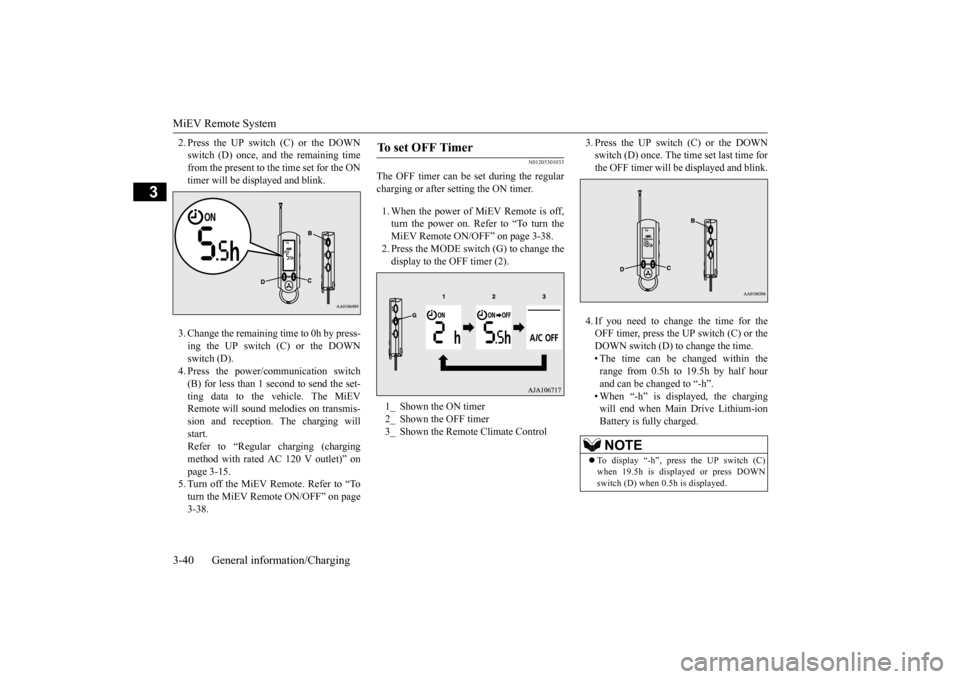
The OFF timer can be
set during the regular
charging or after setting the ON timer. 1. When the power of MiEV Remote is off, turn the power on. Refer to “To turn theMiEV Remote ON/OFF” on page 3-38. 2. Press the MODE switc
h (G) to change the
display to the OFF timer (2).
3. Press the UP switch (C) or the DOWN switch (D) once. The time set last time forthe OFF timer will be
displayed and blink.
4. If you need to change the time for the OFF timer, press the UP switch (C) or theDOWN switch (D) to change the time. • The time can be changed within the range from 0.5h to 19.5h by half hourand can be changed to “-h”. • When “-h” is displayed, the charging will end when Main Drive Lithium-ionBattery is fully charged.
To set OFF Timer 1_ Shown the ON timer2_ Shown the OFF timer3_ Shown the Remote Climate Control
NOTE
To display “-h”, press the UP switch (C) when 19.5h is displayed or press DOWN switch (D) when 0.5h is displayed.
BK0209800US.book 40 ページ 2014年1月14日 火曜日 午前9時26分
Page 58 of 262
MiEV Remote System
General information/Charging 3-43
3
N01204201035
N01204301036
The following conditions must be met to operate the Remote Climate Control. Selector lever:
P (PARK) position.
Electric motor switch: LOCK position. EV charging cable (re
gular charger): Con-
nected. Quick charging: Not used. Main Drive Lithium-ion Battery Level Indicator: Shows one bar or more. Refer to “Main Drive Lithium-ion Battery LevelIndicator” on page 3-45. All doors and the liftgate: Closed. 1. Start charging. Refer to “Regular charging (charging method with rated AC 120 V outlet)” on page 3-15.
Remote Climate Control
WA R N I N G The Remote Climate Control, even when set, cannot be relied upon to maintain safevehicle cabin temperatures while the vehi- cle is stopped or park
ed. Never leave chil-
dren or persons requiringsupervision/nursing unattended inside the vehicle. Temperature inside the vehicle could become extremely high or lowresulting in a risk of
heat stroke or hyper-
thermia that could result in death. In addition, children
can activate switches
and controls, resulting in an injury or fatal accident. While the Remote Climate Control is acti- vated, keep away from
the cooling fan
under the front hood,
since the cooling fan
may automatically operate even if the electric motor switch is in the “LOCK” position.NOTE
The Remote Climate Control works regard- less the position of the air conditioningswitch or dial on the vehicle. While the Remote Climate Control is activated, the air conditioning switch or di
al on the vehicle
will not affect operation
of the cooler, heater
or defroster.
The Remote Climate Control will automati- cally stop 30 minutes after the Remote Cli-mate Control has been set. The Remote Climate Control is operated by electric power s
upplied through the EV
charging cable (regular charger). Under the following c
onditions, the effect of
the Remote Climate Control can be decreased. • When the outside temperature is very high. • When the sunlight is strong.• When the outside temperature is very low. When Remote Climate Control is activated while charging the Main Drive Lithium-ion Battery, the time required to fully charge theMain Drive Lithium-ion Battery will become longer or the amount of charge may decrease if the OFF timer has been set. If the Main Drive Lithium-ion Battery Warming System is operated while theRemote Climate Control is activated, the Remote Climate Control will stop. When the Main Drive Lithium-ion Battery WarmingSystem stops, the Remote Climate Control will resume. Refer to “Main Drive Lithium- ion Battery Warming System” on page 3-20. While the Remote Climate Control is acti- vated, if a heated seat switch is ON, theheated seat will operate.NOTE
To operate the Remote Climate Control
WA R N I N G Improper charging can result in a fire, property damage, and serious injury ordeath. Carefully read and fo
llow instructions in
“Precaution during Charging the MainDrive Lithium-ion Battery” on page 3-14 and “Regular chargi
ng (charging method
with rated AC 120 V ou
tlet)” on page 3-15.
BK0209800US.book 43 ページ 2014年1月14日 火曜日 午前9時26分