tire size MITSUBISHI iMiEV 2016 1.G Owners Manual
[x] Cancel search | Manufacturer: MITSUBISHI, Model Year: 2016, Model line: iMiEV, Model: MITSUBISHI iMiEV 2016 1.GPages: 296, PDF Size: 7.79 MB
Page 7 of 296
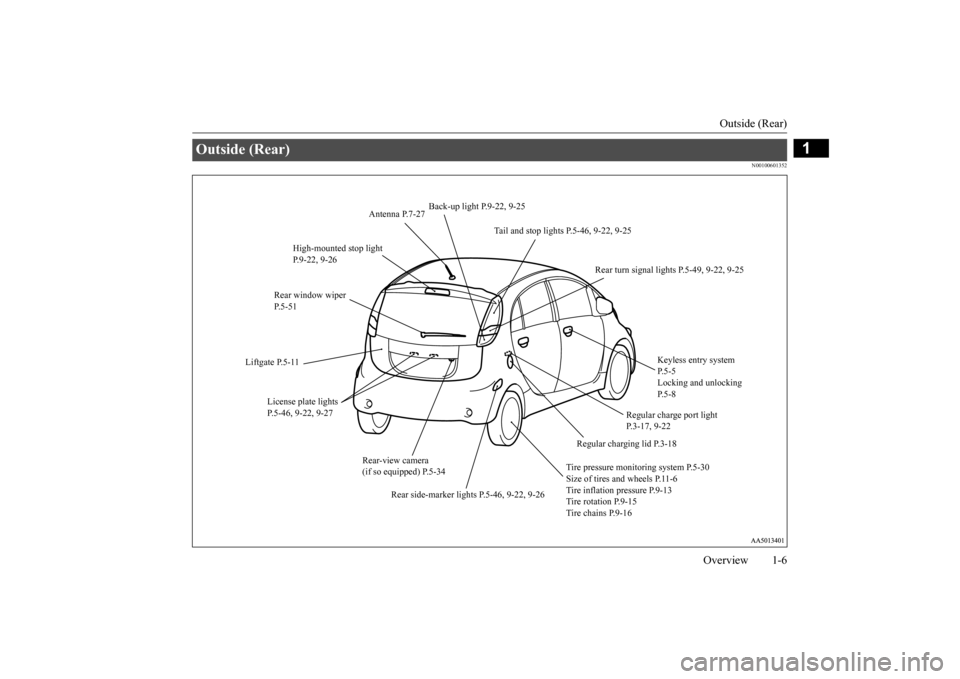
Outside (Rear)
Overview 1-6
1
N00100601352
Outside (Rear)
Back-up light P.9-22, 9-25
Antenna P.7-27
Tail and stop lights P.5-46, 9-22, 9-25
High-mounted stop light P.9-22, 9-26
Rear turn signal lights P.5-49, 9-22, 9-25
Rear window wiper P.5-51
Keyless entry system P. 5 - 5Locking and unlocking P. 5 - 8
Liftgate P.5-11
License plate lights P.5-46, 9-22, 9-27
Regular charge port light P.3-17, 9-22
Regular charging lid P.3-18 Tire pressure monitoring system P.5-30 Size of tires and wheels P.11-6 Tire inflation pressure P.9-13 Tire rotation P.9-15Tire chains P.9-16
Rear-view camera (if so equipped) P.5-34
Rear side-marker lights P.5-46, 9-22, 9-26
BK0220401US.book 6 ページ 2015年6月3日 水曜日 午前7時42分
Page 21 of 296
Modifications to and racing of your vehicle
General information/Charging 3-7
3
high quality vehicles
with an emphasis on
safety and durability. Modifications usingnon-Mitsubishi Motors genuine parts may affect the performance,
safety and/or durabil-
ity of your vehicle, a
nd may violate applica-
ble state and/or fe
deral regulations.
DAMAGE OR PERFORMANCE PROB- LEMS RESULTING FROM MODIFICA- TIONS TO OR RACING OF YOURVEHICLE ARE NOT COVERED UNDER WARRANTY. Examples of modifications to your vehicle that can cause damage or performance prob- lems include the following: Failure to use Mits
ubishi Motors genuine
parts Failure to use requi
red fluids (refer to
“Refill capacities” on page 11-7) Failure to use proper
size tires and wheels
Modification of the
suspension, electric
motor, drive train, batteries (main drive lithium-ion battery a
nd 12V starter bat-
tery), charging systems or electrical wir- ing systems Modification of any onboard com- puter/control module, including repro- gramming, or replac
ing/adding chips to
any onboard computer/control module
Review the Warranty and Maintenance Man- ual for further details
regarding warranty cov-
erage.
N01200600018
The installation of
accessories
, optional
parts, etc., should only be carried out within the limits prescribed by law in thedriving area and in accordance with the guidelines and warnin
gs contained within
the documents accompanying this vehicle.Only Mitsubishi Motors approved acces- sories should be fitt
ed to your vehicle.
Improper installation of
electrical parts
could cause fire. Refer to the “Modifica- tion/alterations to the electrical systems” Tires and wheels which do not meet spec- ifications must not be used. Refer to the “Specifi
cations” section for
information regarding wheel and tire sizes.
Due to the large number of accessory and replacement parts provided by different man- ufacturers in the market, it is not always pos- sible for a certified i-MiEV dealer to checkwhether the attachment
or installation of non-
Mitsubishi Motors genuine parts will affect the driving safety of your Mitsubishi-vehicle.
N01200700019
Mitsubishi Motors manufactures high qualityvehicles with an em
phasis on safety. It is
important to consult a
certified i-MiEV dealer
before installation of
any accessory which
Installation of accessories
CAUTIONBefore any electrical or electronic accesso- ries are installed, consult a certified i-MiEV dealer.
WA R N I N G If you choose to use a
cellular phone while
driving, you must not allow that usage todistract you in the sa
fe operation of your
vehicle. Anything, including cellular phone usage, that distracts you from the safe operation of you
r vehicle increases
your risk of an accident. Refer to and follow all local laws in your area regarding cellul
ar phone usage while
driving.
Important point! Modification/alterations to the electrical systems
BK0220401US.book 7 ページ 2015年6月3日 水曜日 午前7時42分
Page 134 of 296
Anti-lock braking system 5-26 Features and controls
5
When using the anti-lock brakes (sudden braking), steering is
slightly different
from normal driving conditions. Use the steering wheel carefully. Always keep a safe distance from the vehicle in front of you. Even if your vehi- cle is equipped with
the anti-lock braking
system, leave a greater braking distance when: • Driving on gravel or snow-covered roads. • Driving on uneven road surfaces. Operation of anti-lock braking system is not restricted to situations where brakes are applied suddenly. This system mayalso prevent the wheels from locking when you drive over manholes, steel roadwork plates, road markings, or anyuneven road surface. When the anti-lock braking system is in use, you may feel the brake pedal vibrat-ing and hear a unique sound. You may also feel as if the pedal resists being pressed.In this situation, simply hold the brake pedal down firmly. Do not pump the brake, which will result in reducedbraking performance.
An operation noise may be emitted from under the hood in the following situations.The sound is associated with checking the operations of the anti-lock braking sys- tem.At this time, you may feel a shock from the brake pedal if you depress it. These do not indicate a malfunction.• When the electric motor switch is set to the “ON” position. • When the vehicle is driven for a while after the electric motor is turned on.
The ABS can be used after the vehicle has reached a speed over approximately 6 mph (10 km/h). It stops working when the vehicle slows below approximately 3 mph(5 km/h).
N00531600661
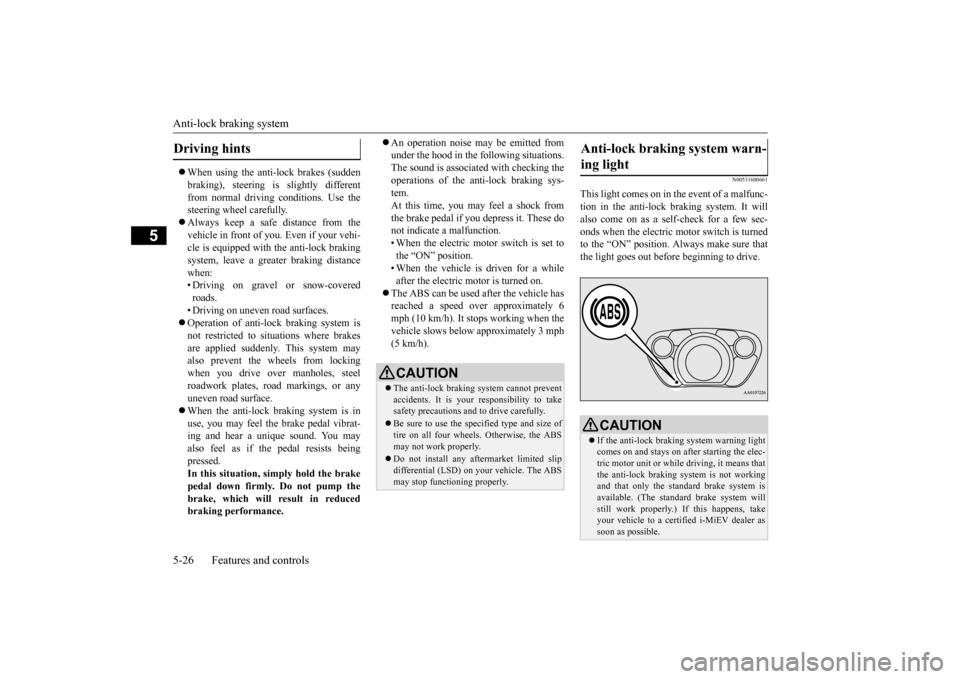
This light comes on in the event of a malfunc-tion in the anti-lock braking system. It willalso come on as a self-check for a few sec- onds when the electric motor switch is turned to the “ON” position.
Always make sure that
the light goes out befo
re beginning to drive.
Driving hints
CAUTIONThe anti-lock braking system cannot prevent accidents. It is your
responsibility to take
safety precautions and to drive carefully. Be sure to use the spec
ified type and size of
tire on all four wheels. Otherwise, the ABS may not work properly. Do not install any aftermarket limited slip differential (LSD) on your vehicle. The ABSmay stop functioning properly.
Anti-lock braking system warn- ing light
CAUTION If the anti-lock braking system warning light comes on and stays on af
ter starting the elec-
tric motor unit or while driving, it means that the anti-lock braking system is not workingand that only the standard brake system is available. (The standard brake system will still work properly.) If this happens, takeyour vehicle to a certif
ied i-MiEV dealer as
soon as possible.
BK0220401US.book 26 ページ 2015年6月3日 水曜日 午前7時42分
Page 136 of 296
Active stability control (ASC)
5
N00574400024
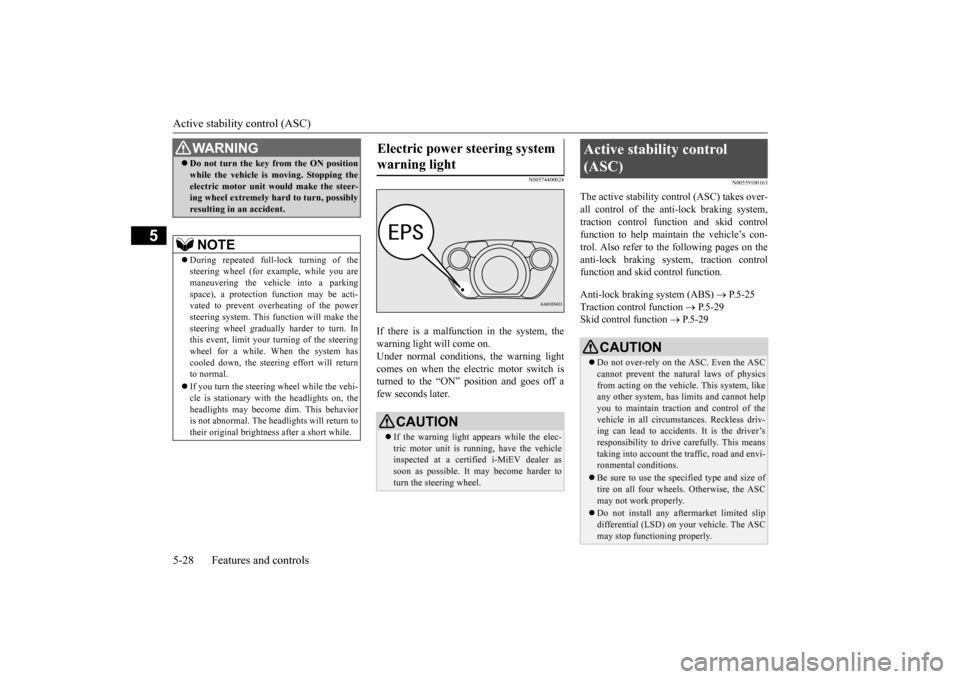
If there is a malfunction in the system, the warning light will come on.Under normal conditions
, the warning light
comes on when the electric motor switch is turned to the “ON” position and goes off afew seconds later.
N00559100163
The active stability c
ontrol (ASC) takes over-
all control of the anti-lock braking system, traction control function and skid controlfunction to help maintain the vehicle’s con- trol. Also refer to the following pages on the anti-lock braking system, traction controlfunction and skid control function. Anti-lock braking system (ABS)
P.5-25
Traction control function
P.5-29
Skid control function
P.5-29
WA R N I N GDo not turn the key from the ON position while the vehicle is moving. Stopping theelectric motor unit would make the steer-ing wheel extremely hard to turn, possibly resulting in an accident.NOTE
During repeated full-lock turning of the steering wheel (for example, while you aremaneuvering the vehicle into a parking space), a protection
function may be acti-
vated to prevent overheating of the powersteering system. This f
unction will make the
steering wheel gradually harder to turn. In this event, limit your turning of the steeringwheel for a while. When the system has cooled down, the steering effort will return to normal. If you turn the steering wheel while the vehi- cle is stationary with
the headlights on, the
headlights may become
dim. This behavior
is not abnormal. The headlights will return to their original brightne
ss after a short while.
Electric power steering system warning light
CAUTION If the warning light a
ppears while the elec-
tric motor unit is running, have the vehicle inspected at a certified i-MiEV dealer as soon as possible. It may become harder toturn the steering wheel.
Active stability control (ASC)
CAUTION Do not over-rely on the ASC. Even the ASC cannot prevent the natural laws of physics from acting on the vehicle. This system, like any other system, has li
mits and cannot help
you to maintain traction and control of the vehicle in all circumstances. Reckless driv- ing can lead to accident
s. It is the driver’s
responsibility to drive carefully. This means taking into account the tr
affic, road and envi-
ronmental conditions. Be sure to use the specified type and size of tire on all four wheels
. Otherwise, the ASC
may not work properly. Do not install any aftermarket limited slip differential (LSD) on
your vehicle. The ASC
may stop functioning properly.
BK0220401US.book 28 ページ 2015年6月3日 水曜日 午前7時42分
Page 139 of 296
Tire pressure monitoring system
Features and controls 5-31
5
N00554800136
When the electric motor switch is turned to the “ON” position, this light normally illumi- nates and goes off a
few seconds later.
If one or more of the vehicle tires is signifi-cantly under-inflated, ho
wever, this light will
remain illuminated while the electric motor switch is in the “ON” position.Refer to “If the warning light illuminates while driving” on page 5-32 and take the nec- essary measures.
Each tire, including the spare (if provided), should be checked monthly when cold andinflated to the inflation pressure recom- mended by the vehicle manufacturer on the vehicle placard or tire in
flation pressure label.
(If your vehicle has tires of a different size than the size indicate
d on the vehicle placard
or tire inflation pressure label, you shoulddetermine the proper ti
re inflation pressure
for those tires.) As an added safety fe
ature, your vehicle has
been equipped with a tire pressure monitoring system (TPMS) that illuminates a low tire pressure telltale when one or more of yourtires is significan
tly under-inflated.
Accordingly, when the low tire pressure tell- tale illuminates, you s
hould stop and check
your tires as soon as
possible, and inflate
them to the proper pressure.
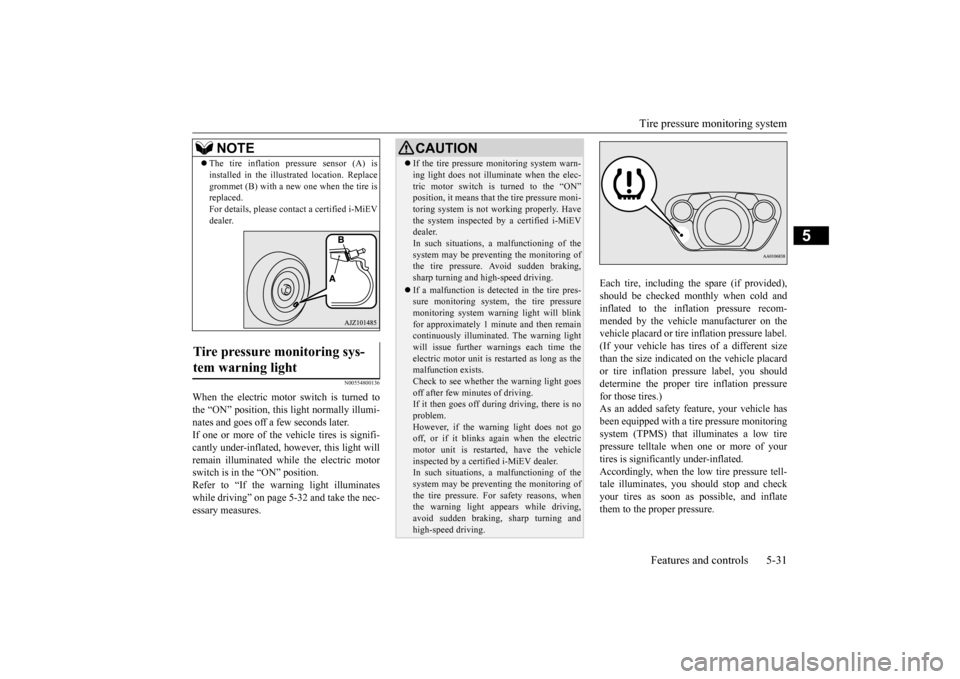
The tire inflation pressure sensor (A) is installed in the illustrated location. Replacegrommet (B) with a new one when the tire isreplaced. For details, please c
ontact a certified i-MiEV
dealer.
Tire pressure monitoring sys- tem warning light
NOTE
CAUTION If the tire pressure monitoring system warn- ing light does not illuminate when the elec-tric motor switch is turned to the “ON”
the tire pressure moni-
toring system is not working properly. Have the system inspected by a certified i-MiEVdealer. In such situations, a malfunctioning of the system may be preventing the monitoring ofthe tire pressure. Avoid sudden braking, sharp turning and high-speed driving. If a malfunction is detected in the tire pres- sure monitoring system, the tire pressure monitoring system warn
ing light will blink
for approximately 1 minute and then remain continuously illuminated. The warning light will issue further warnings each time theelectric motor unit is re
started as long as the
malfunction exists. Check to see whether
the warning light goes
off after few minutes of driving. If it then goes off during driving, there is no problem.However, if the warning light does not go off, or if it blinks again when the electric motor unit is restarte
d, have the vehicle
inspected by a certified i-MiEV dealer. In such situations, a malfunctioning of the system may be preventing the monitoring ofthe tire pressure. For safety reasons, when the warning light appears while driving, avoid sudden braking, sharp turning andhigh-speed driving.
BK0220401US.book 31 ページ 2015年6月3日 水曜日 午前7時42分
Page 197 of 296
Loading information Driving safety 6-7
6
It is important to famil
iarize yourself with the
following terms before loading your vehicle: Vehicle maximum load on the tire: load on an individual tire that is determined bydistributing to each axle its share of the maximum loaded vehicle weight and dividing by two. Vehicle normal load on the tire: load on an individual tire that is determined by dis- tributing to each axle its share of the curbweight, accessory weight, and normal occupant weight and dividing by two. Maximum loaded vehicle weight: the sum of - (a) Curb weight; (b) Accessory weight;(c) Vehicle capacity weight; and (d) Production options weight. Curb weight: the weight of a motor vehi- cle with standard e
quipment including the
maximum capacity of oil, and coolant.
Accessory weight: the combined weight (in excess of those st
andard items which
may be replaced) of automatic transmis- sion, power steering, power brakes, power windows, power seats,
radio, and heater,
to the extent that these items are available as factory- installe
d equipment (whether
installed or not). Vehicle capacity weight: the rated cargo and luggage load plus 150 lbs (68 kg)
*
times the vehicle’s designated seating capacity. Production options weight: the combined weight of those installed regular produc- tion options weighing over 5 lbs (2.3 kg) in excess of those standard items whichthey replace, not prev
iously considered in
curb weight or accessory weight, includ- ing heavy duty brakes,
ride levelers, roof
rack, heavy duty battery, and special trim. Normal occupant weight: 150 lbs (68 kg)
*
times the number of specified occupants.(In your vehicle the number is 2) Occupant distributi
on: distribution of
occupants in a vehicle as specified. (Inyour vehicle the distribution is 2 in front seat)
N00630100370
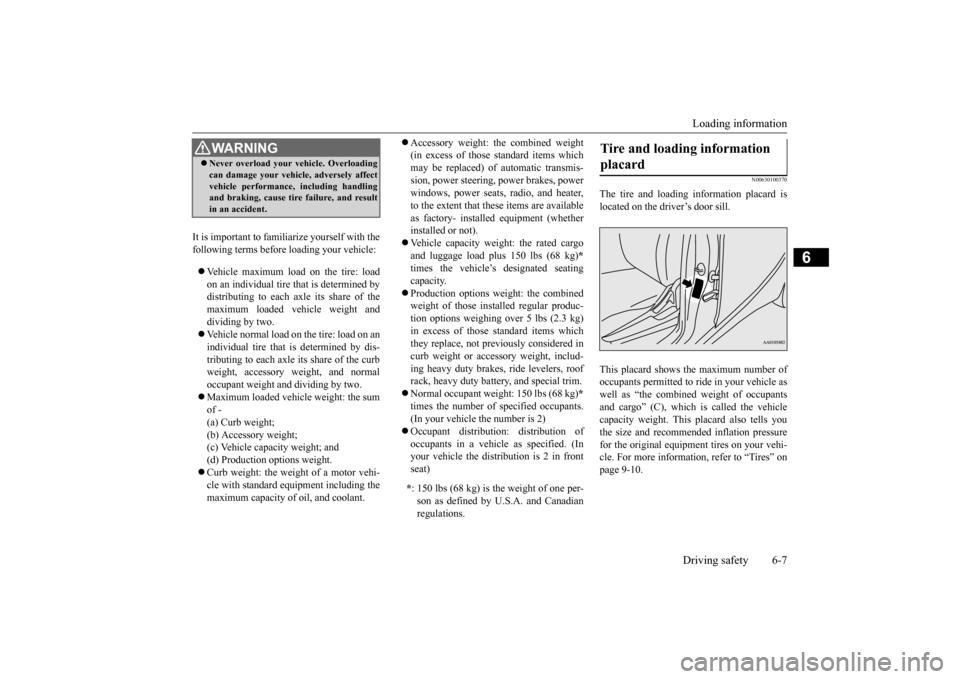
The tire and loading information placard is located on the driver’s door sill. This placard shows the maximum number of occupants permitted to
ride in your vehicle as
well as “the combined
weight of occupants
and cargo” (C), which
is called the vehicle
capacity weight. This
placard also tells you
the size and recomme
nded inflation pressure
for the original equipment tires on your vehi-cle. For more information, refer to “Tires” on page 9-10.
WA R N I N G Never overload your ve
hicle. Overloading
can damage your vehicl
e, adversely affect
vehicle performance, including handlingand braking, cause tire failure, and result in an accident.
* : 150 lbs (68 kg) is the weight of one per- son as defined by U.S.A. and Canadian regulations.
Tire and loading information placard
BK0220401US.book 7 ページ 2015年6月3日 水曜日 午前7時42分
Page 257 of 296
Tires
Vehicle care and maintenance 9-11
9
Intended outboard sidewall: • The sidewall that c
ontains a whitewall,
bears white letteri
ng or bears manufac-
turer, brand, and/or model name molding that is higher or deeper than the samemolding on the other sidewall of the tire, or • The outward facing si
dewall of an asym-
metrical tire that has a particular side that must always face outward when mounted on a vehicle.
Passenger car tire: a
tire intended for use
on passenger cars, multipurpose passen-ger vehicles, and trucks, that have a gross vehicle weight rati
ng (GVWR) of 10,000
pounds or less. Light truck (LT) tire: a tire designated by its manufacturer as primarily intended for use on lightweight truc
ks or multipurpose
passenger vehicles. Tread: portion of a tire that comes into contact with the road. Tread rib: a tread se
ction running circum-
ferentially around a tire. Tread separation: pulling away of the tread from the tire carcass. Carcass: the tire structure, except tread and sidewall rubber which, when inflated,bears the load. Sidewall: portion of
a tire between the
tread and bead.
Section width: the line
ar distance between
the exteriors of the sidewalls of aninflated tire, excluding elevations due to labeling, decoration, or protective bands. Bead: the part of the tire that is made of steel wires, wrapped
or reinforced by ply
cords and that is shaped to fit the rim. Ply: a layer of rubber-coated parallel cords. Cord: the strands forming the plies in the tire. Rim: a metal support for a tire or a tire and tube assembly upon which the tirebeads are seated. Rim diameter: nominal diameter of the bead seat. Groove: the space between two adjacent tread ribs.
EXAMPLE:P215/65R15
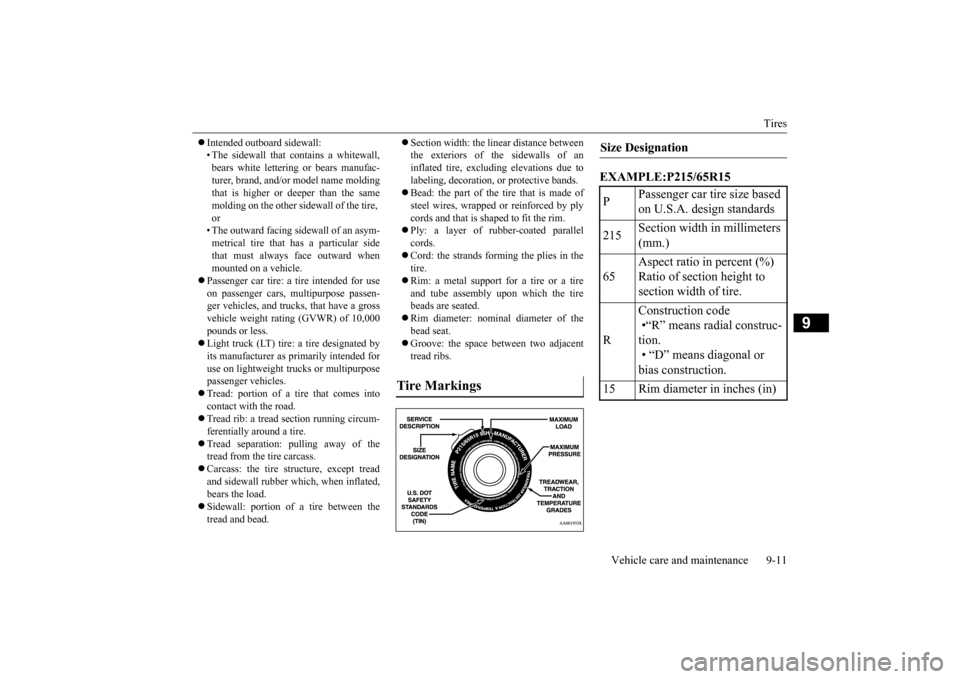
Tire Markings
Size Designation P
Passenger car tire size based on U.S.A. design standards
215
Section width in millimeters (mm.)
65
Aspect ratio in percent (%) Ratio of section height to section width of tire.
R
Construction code •“R” means radial construc- tion.
• “D” means diagonal or bias construction.
15 Rim diameter in inches (in)
BK0220401US.book 11 ページ 2015年6月3日 水曜日 午前7時42分
Page 258 of 296
Tires 9-12 Vehicle care and maintenance
9
EXAMPLE: 95H
Maximum load indicates the maxi- mum load this tire is designed to carry. Maximum Pressure indicates the maximum permissible cold tire infla-tion pressure for this tire. The TIN may be found on one or both sides of the tire but the date
NOTE
European/Japanese metric tire sizing is based on European/Jap- anese design standards. Tires designed to these standards havethe tire size molded into the sidewall beginning with the sec- tion width. The letter “P” isabsent from this tire size desig- nation. Example: 215/65R15 96H.LT (Light Truck) -metric tiresizing is based on U.S.A. designstandards. The size designation for LT-metric tires is the same as for P-metric tires except for theletters “LT” that are molded into the sidewall preceding the size designation. Example:LT235/85R16.
Service Description 95
Load index A numerical code associ- ated with the maximum load a tire can carry.
H
Speed symbol A symbol indicating the range of speeds at which a tire can carry a load corre- sponding to its
load index
under certain operating con-ditions.The maximum speed corre- sponding to the speed sym- bol should only be achieved under specified operating conditions. (i.e. tire pressure, vehicle loading, road condi-tions and posted speed lim- its)
WA R N I N GOverloading of your tire is dangerous. Overloading cancause tire failure, affect vehi- cle handling, and increase your stopping distance. Usetires of the recommended load capacity for your vehicle. Never overload them.
Maximum Pressure Tire Identification Number (TIN)
BK0220401US.book 12 ページ 2015年6月3日 水曜日 午前7時42分
Page 259 of 296

Tires
Vehicle care and maintenance 9-13
9
code may only be on one side. Look for the TIN on the outboard side of tires as mounted on the vehicle. If the TIN is not found on the outboard sidethen you will find it on the inboard side of the tire. EXAMPLE: DOT MA L9 ABCD 1504
The treadwear grade is a comparative rating based on the wear rate of the tire when testedunder controlled conditions on a specified government test course
. For example, a tire
graded 150 would wear one and one-half (11/2) times as well on the government course
as a tire graded 100. The relative performance of tires depends upon the actual conditions of their use, however, and may depart signifi-cantly from the norm due to variations in driving habits, service practices and differ- ences in road characteristics and climate. The traction grades, from highest to lowest, are AA, A, B and C. Those grades represent the tire’s ability to stop on wet pavement as measured under contro
lled conditions on
specified government te
st surfaces of asphalt
and concrete. A tire marked C may have poor traction performance. The temperature grades are A (the highest), B and C, representing the ti
re’s resistance to the
generation of heat and it
s ability to dissipate
heat when tested u
nder controlled conditions
on a specified indoor
laboratory test wheel.
Sustained high temperature can cause the material of the tire to
degenerate and reduce
tire life, and excessive temperature can lead to sudden tire failure. The grade C corre-sponds to a level of
performance which all
passenger car tires must
meet under the Fed-
eral Motor Vehicle Safety Standard No. 109.Grades B and A represent higher levels of performance on the laboratory test wheel than the minimum required by law.
N00939300873
Proper tire inflation pre
ssure is essential for
the safe and satisfac
tory operation of your
vehicle. The wrong tire pressure will cause problems in three major areas: Safety
DOT
Department of Transporta- tion This symbol certifies that the tire is in compliance with the U.S.
Department
of Transportation tire safety standards, and is approved for highway use.
MA
Code representing the tire manufacturing location. (2 digits)
L9 ABCD
Code representing the tire size. (2 digits)Code used by tire manufac- turer. (1 to 4 digits)
15
Number representing the week in which the tire was manufactured. (2 digits)
04
Number representing the year in which the tire was manufactured. (2 digits)
ature Grades Treadwear Tr a c t i o n
TemperatureTire inflation pressures
BK0220401US.book 13 ページ 2015年6月3日 水曜日 午前7時42分
Page 260 of 296
Tires 9-14 Vehicle care and maintenance
9
Too little pressure increases flexing in the tire and can cause tire failure. Too muchpressure can cause a tire to lose its ability to cushion shock. Objects on the road and potholes could then cause tire damage thatmay result in tire failure. Economy The wrong tire pressure can cause unevenwear patterns in the tire tread. These abnormal wear patterns will reduce the tread life, and the tire will have to be replaced sooner. Too little pressure also makes it harder forthe tire to roll, and this uses up more power. Ride comfort and vehicle stability The superior riding
experience built into
your vehicle partly depends on the correct tire pressure. Too mu
ch pressure gives an
uncomfortable and ja
rring ride. Too little
pressure feels as if your vehicle is slow to respond.Unequal tire pressures can make steering your vehicle uneven and unpredictable.
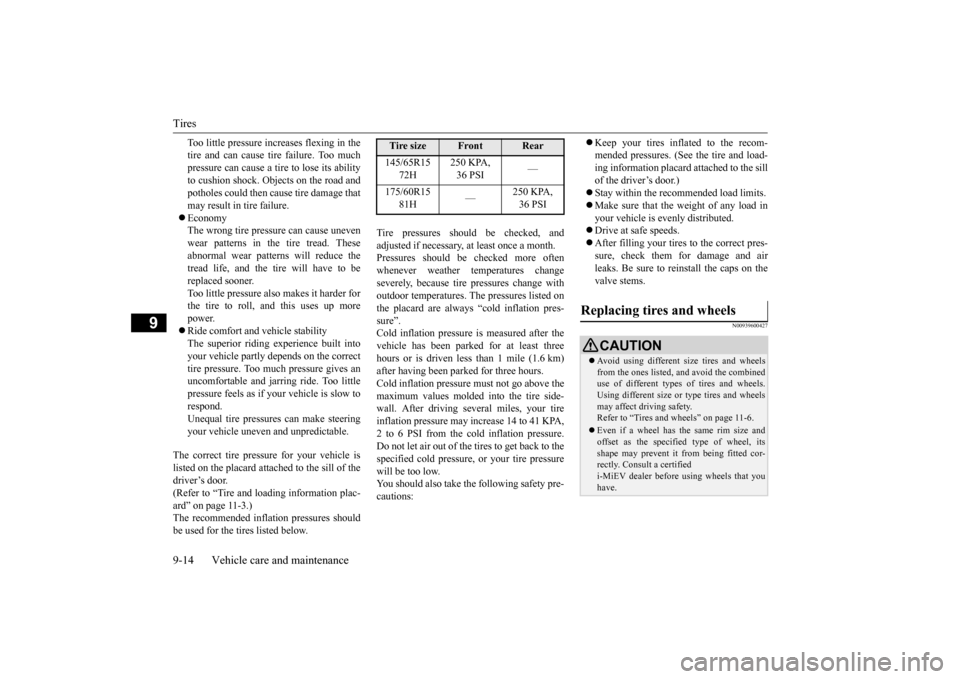
The correct tire pressure for your vehicle is listed on the placard attached to the sill of thedriver’s door. (Refer to “Tire and loading information plac- ard” on page 11-3.)The recommended inflation pressures should be used for the tires listed below.
Tire pressures should be checked, and adjusted if necessary, at least once a month.Pressures should be checked more often whenever weather temperatures change severely, becaus
e tire pressures change with
outdoor temperatures. The pressures listed on the placard are always
“cold inflation pres-
sure”.Cold inflation pressure is measured after the vehicle has been parked
for at least three
hours or is driven less than 1 mile (1.6 km)after having been parked for three hours. Cold inflation pressure must not go above the maximum values molded into the tire side-wall. After driving se
veral miles, your tire
inflation pressure may increase 14 to 41 KPA, 2 to 6 PSI from the cold inflation pressure.Do not let air out of the tires to get back to the specified cold pressure, or your tire pressure will be too low.You should also take the following safety pre- cautions:
Keep your tires inflated to the recom- mended pressures. (See the tire and load-ing information placard attached to the sill of the driver’s door.) Stay within the recommended load limits. Make sure that the weight of any load in your vehicle is evenly distributed. Drive at safe speeds. After filling your tires to the correct pres- sure, check them for damage and air leaks. Be sure to reinstall the caps on the valve stems.
N00939600427
Tire size
Front
Rear
145/65R15
72H
250 KPA, 36 PSI
—
175/60R15
81H
—
250 KPA, 36 PSI
Replacing tires and wheels
CAUTION Avoid using different size tires and wheels from the ones listed, and avoid the combined use of different types
of tires and wheels.
Using different size or
type tires and wheels
may affect driving safety. Refer to “Tires and wheels” on page 11-6. Even if a wheel has the same rim size and offset as the specifie
d type of wheel, its
shape may prevent it
from being fitted cor-
rectly. Consult a certified i-MiEV dealer before
using wheels that you
have.
BK0220401US.book 14 ページ 2015年6月3日 水曜日 午前7時42分