ECU MITSUBISHI iMiEV 2017 1.G User Guide
[x] Cancel search | Manufacturer: MITSUBISHI, Model Year: 2017, Model line: iMiEV, Model: MITSUBISHI iMiEV 2017 1.GPages: 296, PDF Size: 7.79 MB
Page 87 of 296
Child restraint systems
Seat and restraint systems 4-15
4
WA R N I N G Your vehicle is also
equipped with a front
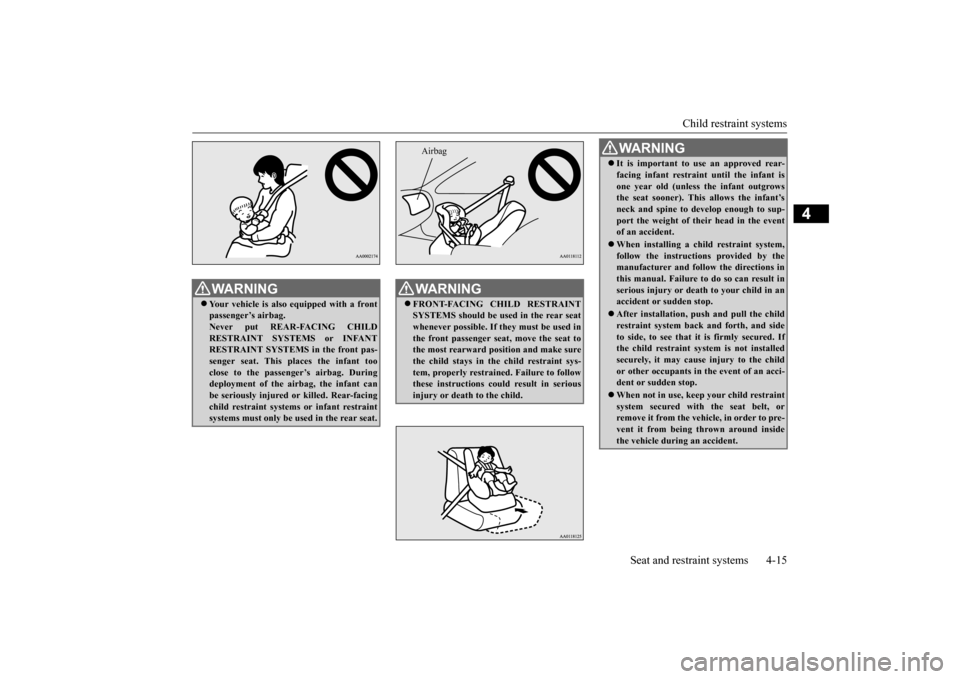
passenger’s airbag.Never put REAR-FACING CHILD RESTRAINT SYSTEMS or INFANT RESTRAINT SYSTEMS in the front pas-senger seat. This pl
aces the infant too
close to the passenger’s airbag. During deployment of the airbag, the infant canbe seriously injured or
killed. Rear-facing
child restraint systems or infant restraint systems must only be used in the rear seat.
WA R N I N G FRONT-FACING CHILD RESTRAINT SYSTEMS should be used in the rear seatwhenever possible. If they must be used in the front passenger seat, move the seat to the most rearward po
sition and make sure
the child stays in the child restraint sys- tem, properly restrained. Failure to follow these instructions could result in seriousinjury or death to the child.Airbag
WA R N I N G It is important to use an approved rear- facing infant restraint until the infant isone year old (unless
the infant outgrows
the seat sooner). This
allows the infant’s
neck and spine to de
velop enough to sup-
port the weight of their head in the eventof an accident. When installing a child restraint system, follow the instructions provided by the manufacturer and follow the directions in this manual. Failure to do so can result inserious injury or deat
h to your child in an
accident or
sudden stop.
After installation, push
and pull the child
restraint system back and forth, and side to side, to see that it is firmly secured. Ifthe child restraint system is not installed securely, it may cause injury to the child or other occupants in
the event of an acci-
dent or sudden stop. When not in use, keep your child restraint system secured with the seat belt, or remove it from the vehicle, in order to pre- vent it from being
thrown around inside
the vehicle during an accident.
BK0220401US.book 15 ページ 2015年6月3日 水曜日 午前7時42分
Page 88 of 296
Child restraint systems 4-16 Seat and restraint systems
4
N00418800144
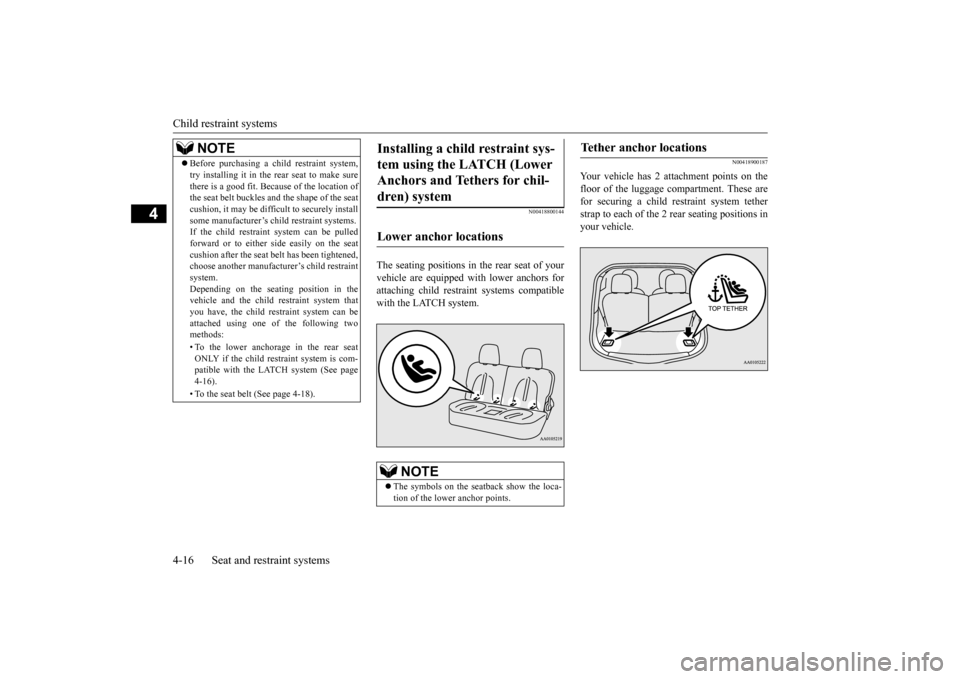
The seating positions in the rear seat of your vehicle are equipped with lower anchors for attaching child restraint systems compatible with the LATCH system.
N00418900187
Your vehicle has 2 attachment points on thefloor of the luggage compartment. These are for securing a child restraint system tetherstrap to each of the 2
rear seating positions in
your vehicle.
NOTE
Before purchasing a child restraint system, try installing it in the rear seat to make surethere is a good fit. Because of the location ofthe seat belt buckles and the shape of the seat cushion, it may be diffic
ult to securely install
some manufacturer’s child restraint systems.If the child restraint system can be pulled forward or to either side easily on the seat cushion after the seat
belt has been tightened,
choose another manufactu
rer’s child restraint
system. Depending on the seating position in thevehicle and the child restraint system that you have, the child restraint system can be attached using one of the following twomethods: • To the lower anchorage in the rear seat ONLY if the child restraint system is com- patible with the LATCH system (See page 4-16). • To the seat belt (See page 4-18).
Installing a child restraint sys- tem using the LATCH (Lower Anchors and Tethers for chil- dren) system Lower anchor locations
NOTE
The symbols on the seatback show the loca- tion of the lower anchor points.
Tether anchor locations
BK0220401US.book 16 ページ 2015年6月3日 水曜日 午前7時42分
Page 89 of 296
Child restraint systems
Seat and restraint systems 4-17
4
N00419000185 N00419100229
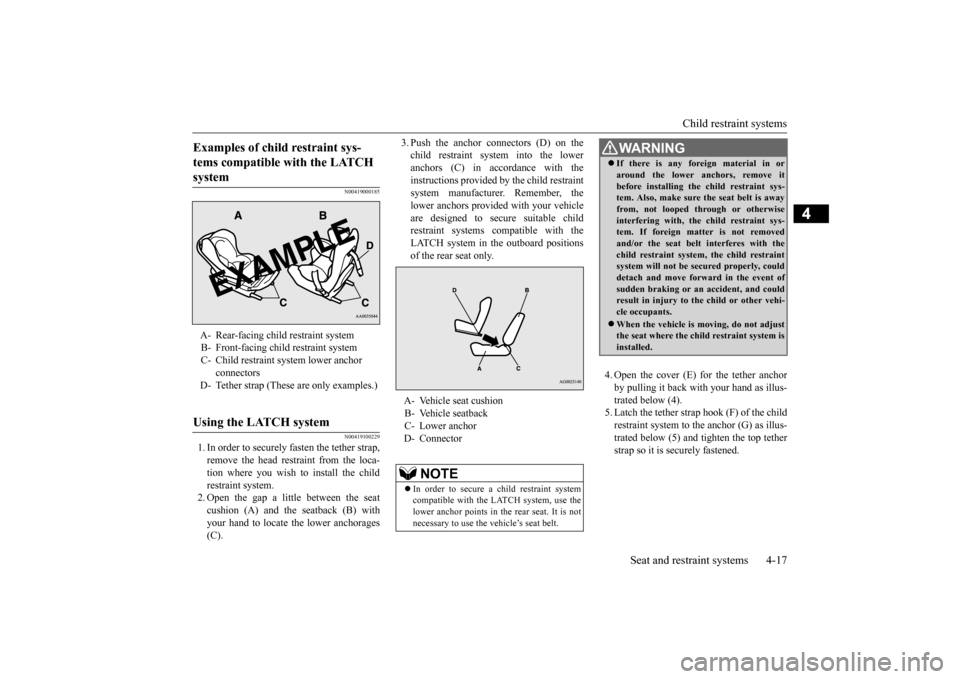
1. In order to securely fasten the tether strap, remove the head restraint from the loca-tion where you wish to install the child restraint system. 2. Open the gap a little between the seatcushion (A) and the seatback (B) with your hand to locate the lower anchorages (C).
3. Push the anchor connectors (D) on the child restraint system into the loweranchors (C) in accordance with the instructions provided by the child restraint system manufacturer. Remember, thelower anchors provided with your vehicle are designed to secure suitable child restraint systems compatible with theLATCH system in the outboard positions of the rear seat only.
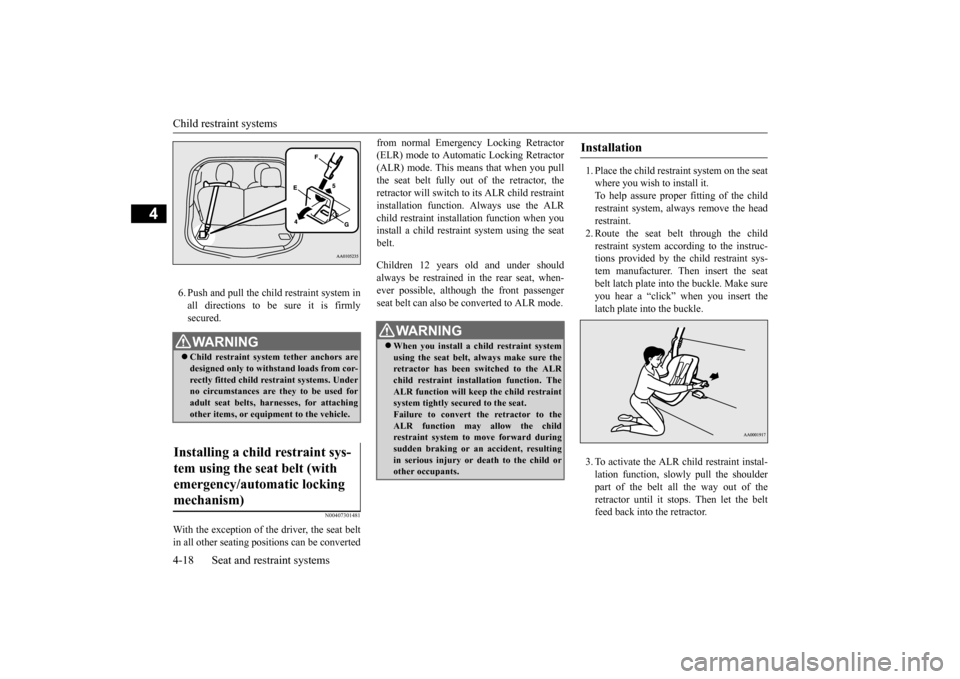
4. Open the cover (E) for the tether anchor by pulling it back with your hand as illus- trated below (4). 5. Latch the tether strap hook (F) of the childrestraint system to the anchor (G) as illus- trated below (5) and tighten the top tether strap so it is securely fastened.
Examples of child restraint sys- tems compatible with the LATCH system A- Rear-facing child
restraint system
B- Front-facing child restraint system C- Child restraint system lower anchor
connectors
D- Tether strap (These are only examples.)Using the LATCH system
A- Vehicle seat cushion B- Vehicle seatback C- Lower anchorD- Connector
NOTE
In order to secure a child restraint system compatible with the LATCH system, use thelower anchor points in th
e rear seat. It is not
necessary to use the
vehicle’s seat belt.
WA R N I N GIf there is any foreign material in or around the lower anchors, remove itbefore installing the child restraint sys-tem. Also, make sure the seat belt is away from, not looped through or otherwise interfering with, the child restraint sys-tem. If foreign matter is not removed and/or the seat belt interferes with the child restraint system, the child restraintsystem will not be secured properly, could detach and move forward in the event of sudden braking or an
accident, and could
result in injury to the child or other vehi- cle occupants. When the vehicle is moving, do not adjust the seat where the child restraint system is installed.
BK0220401US.book 17 ページ 2015年6月3日 水曜日 午前7時42分
Page 90 of 296
Child restraint systems 4-18 Seat and restraint systems
4
6. Push and pull the child restraint system in all directions to be sure it is firmly secured.
N00407301481
With the exception of the driver, the seat belt in all other seating pos
itions can be converted
from normal Emergency Locking Retractor (ELR) mode to Automatic Locking Retractor(ALR) mode. This means that when you pull the seat belt fully out of the retractor, the retractor will switch to its ALR child restraintinstallation function.
Always use the ALR
child restraint installation function when you install a child restraint system using the seatbelt. Children 12 years old and under should always be restrained in the rear seat, when- ever possible, although the front passenger seat belt can also be converted to ALR mode.
1. Place the child restraint system on the seat where you wish to install it. To help assure proper fitting of the child restraint system, alwa
ys remove the head
restraint. 2. Route the seat belt through the child restraint system according to the instruc-tions provided by the child restraint sys- tem manufacturer. Then insert the seat belt latch plate into
the buckle. Make sure
you hear a “click” when you insert the latch plate into the buckle. 3. To activate the ALR child restraint instal- lation function, slow
ly pull the shoulder
part of the belt all the way out of the retractor until it stops. Then let the beltfeed back into the retractor.
WA R N I N G Child restraint system tether anchors are designed only to with
stand loads from cor-
rectly fitted child restraint systems. Under no circumstances are they to be used for adult seat belts, harnesses, for attachingother items, or equipment to the vehicle.
Installing a child restraint sys- tem using the seat belt (with emergency/auto
matic locking
mechanism)
WA R N I N G When you install a child restraint system using the seat belt, al
ways make sure the
retractor has been switched to the ALR child restraint installation function. The ALR function will keep the child restraintsystem tightly secured to the seat. Failure to convert the retractor to the ALR function may allow the childrestraint system to move forward during sudden braking
or an accide
nt, resulting
in serious injury or
death to the child or
other occupants.
Installation
BK0220401US.book 18 ページ 2015年6月3日 水曜日 午前7時42分
Page 91 of 296
Child restraint systems
Seat and restraint systems 4-19
4
4. After the belt has re
tracted, tug on it. If
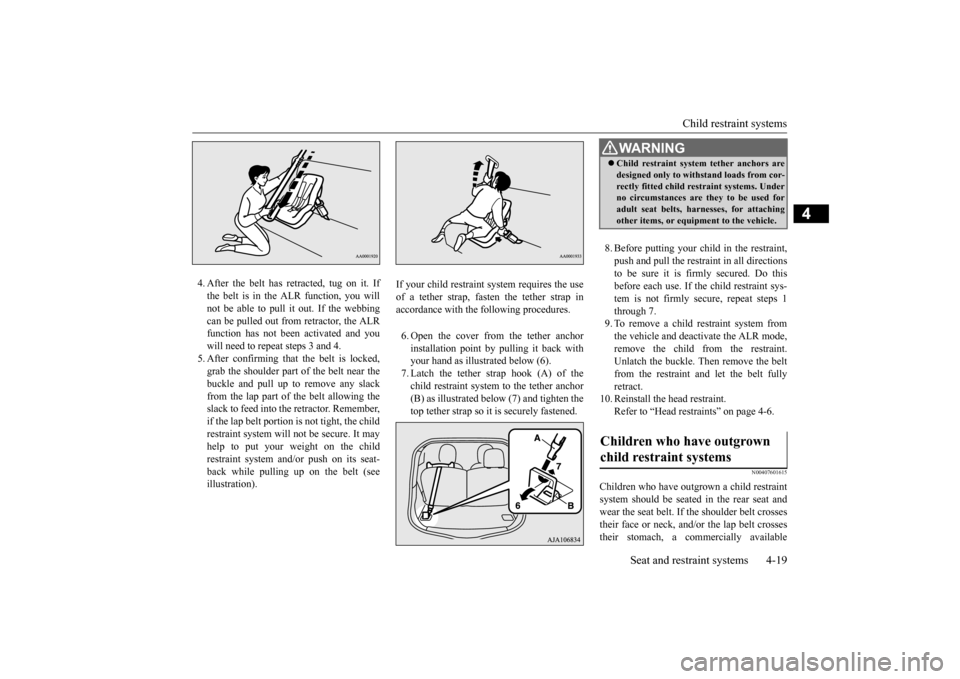
the belt is in the ALR function, you willnot be able to pull it out. If the webbing can be pulled out from retractor, the ALR function has not been activated and youwill need to repeat steps 3 and 4. 5. After confirming that the belt is locked, grab the shoulder part of the belt near thebuckle and pull up to remove any slack from the lap part of the belt allowing the slack to feed into the retractor. Remember,if the lap belt portion is not tight, the child restraint system will not be secure. It may help to put your weight on the childrestraint system and/or push on its seat- back while pulling up on the belt (see illustration).
6. Open the cover from the tether anchor installation point by
pulling it back with
your hand as illustrated below (6).7. Latch the tether strap hook (A) of the child restraint system to the tether anchor (B) as illustrated below (7) and tighten thetop tether strap so it is securely fastened.
8. Before putting your child in the restraint, push and pull the restra
int in all directions
to be sure it is firmly secured. Do this before each use. If the child restraint sys-tem is not firmly secure, repeat steps 1 through 7. 9. To remove a child restraint system fromthe vehicle and deactivate the ALR mode, remove the child from the restraint. Unlatch the buckle. Then remove the beltfrom the restraint and let the belt fully retract.
10. Reinstall the head restraint.
Refer to “Head restraints” on page 4-6.
N00407601615
Children who have outgr
own a child restraint
system should be seated in the rear seat and wear the seat belt. If the shoulder belt crossestheir face or neck, and/
or the lap belt crosses
their stomach, a commercially available
If your child restraint system requires the useof a tether strap, fasten the tether strap in accordance with the following procedures.
WA R N I N G Child restraint system tether anchors are designed only to with
stand loads from cor-
rectly fitted child restraint systems. Underno circumstances are they to be used for adult seat belts, harnesses, for attaching other items, or equipment to the vehicle.
Children who have outgrown child restraint systems
BK0220401US.book 19 ページ 2015年6月3日 水曜日 午前7時42分
Page 97 of 296
Supplemental Restraint System (SRS) - airbag
Seat and restraint systems 4-25
4
N00418100310
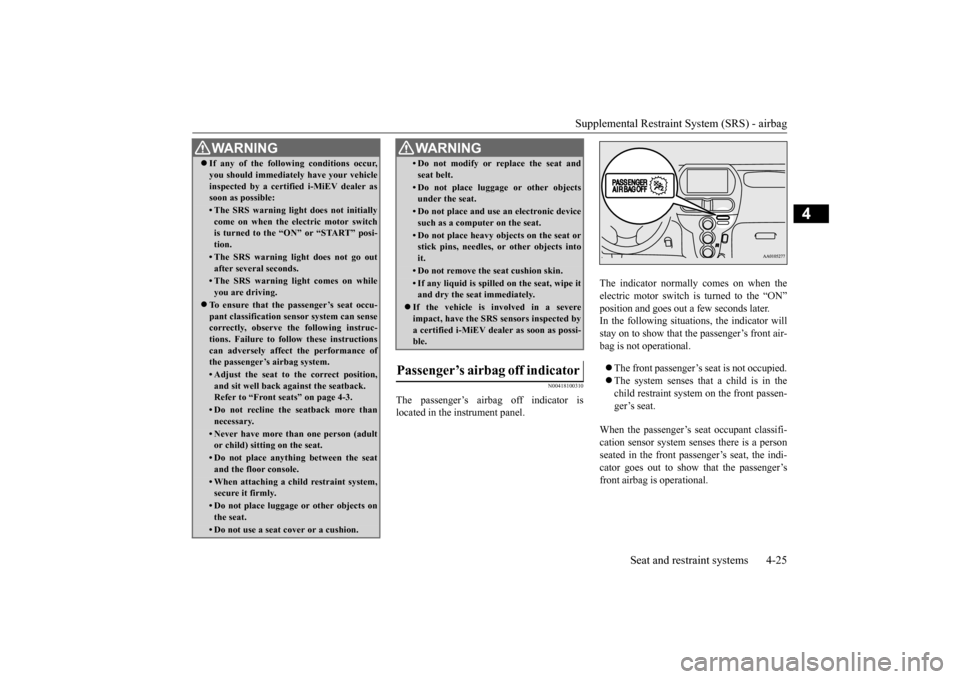
The passenger’s airbag off indicator is located in the instrument panel.
The indicator normall
y comes on when the
electric motor switch is turned to the “ON”In the following situations, the indicator will stay on to show that
the passenger’s front air-
bag is not operational. The front passenger’s seat is not occupied. The system senses that a child is in the child restraint system
on the front passen-
ger’s seat.
When the passenger’s se
at occupant classifi-
cation sensor system se
nses there is a person
seated in the front passenger’s seat, the indi-cator goes out to show that the passenger’s front airbag is operational.
WA R N I N G If any of the following conditions occur, you should immediatel
y have your vehicle
inspected by a certified i-MiEV dealer assoon as possible:• The SRS warning light does not initiallycome on when the electric motor switch is turned to the “ON” or “START” posi- tion.• The SRS warning light does not go outafter several seconds.• The SRS warning li
ght comes on while
you are driving.
To ensure that the passenger’s seat occu- pant classification sensor system can sensecorrectly, observe the following instruc- tions. Failure to follow these instructions can adversely affect
the performance of
the passenger’s airbag system.• Adjust the seat to the correct position,and sit well back
against the seatback.
Refer to “Front seats” on page 4-3.• Do not recline the seatback more thannecessary.• Never have more th
an one person (adult
or child) sittin
g on the seat.
• Do not place anything between the seat and the floor console.• When attaching a child restraint system,secure it firmly.• Do not place luggage or other objects onthe seat.• Do not use a seat cover or a cushion.
• Do not modify or replace the seat and seat belt.• Do not place luggage or other objects under the seat.• Do not place and use
an electronic device
such as a computer on the seat.• Do not place heavy objects on the seat orstick pins, needles, or other objects into it.• Do not remove the seat cushion skin.• If any liquid is spilled on the seat, wipe it and dry the seat immediately.
If the vehicle is
involved in a severe
impact, have the SRS sensors inspected by a certified i-MiEV deal
er as soon as possi-
ble.
Passenger’s airbag off indicator
WA R N I N G
BK0220401US.book 25 ページ 2015年6月3日 水曜日 午前7時42分
Page 103 of 296
Supplemental Restraint System (SRS) - airbag
Seat and restraint systems 4-31
4
N00419200204
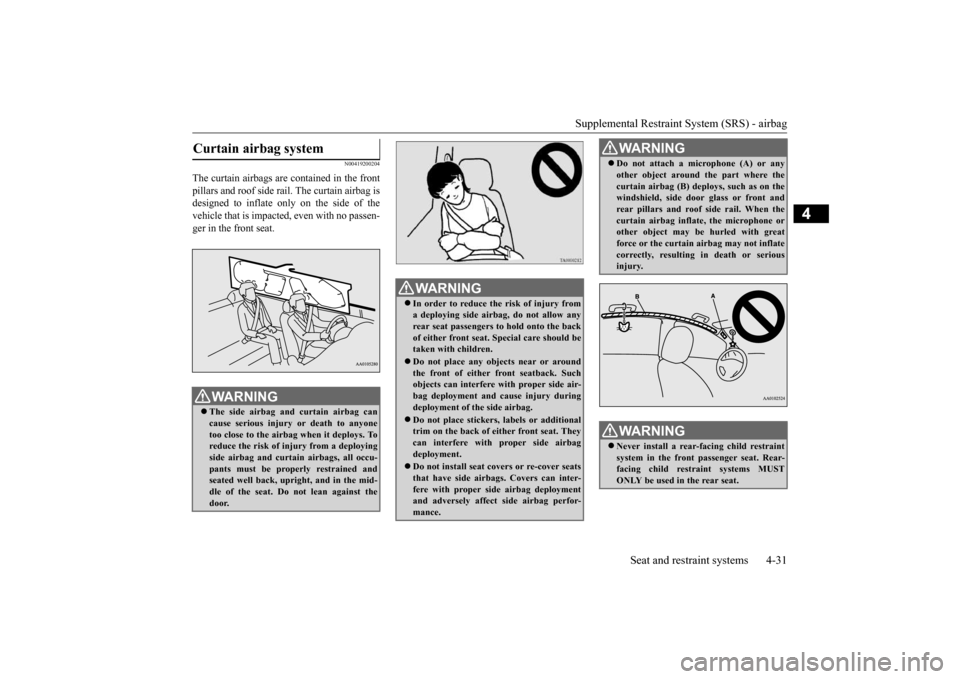
The curtain airbags are contained in the front pillars and roof side ra
il. The curtain airbag is
designed to inflate only on the side of thevehicle that is impacted
, even with no passen-
ger in the front seat.Curtain airbag system
WA R N I N G The side airbag and curtain airbag can cause serious injury
or death to anyone
too close to the airbag when it deploys. To reduce the risk of in
jury from a deploying
side airbag and curtai
n airbags, all occu-
pants must be properly restrained and seated well back, upright, and in the mid- dle of the seat. Do
not lean against the
door.
WA R N I N G In order to reduce the risk of injury from a deploying side airb
ag, do not allow any
rear seat passengers to hold onto the back of either front seat. Special care should betaken with children. Do not place any objects near or around the front of either front seatback. Such objects can interfere with proper side air- bag deployment and cause injury duringdeployment of the side airbag. Do not place stickers,
labels or additional
trim on the back of either front seat. They can interfere with proper side airbag deployment. Do not install seat c
overs or re-cover seats
that have side airbag
s. Covers can inter-
fere with proper si
de airbag deployment
and adversely affect
side airbag perfor-
mance.
Do not attach a microphone (A) or any other object around the part where thecurtain airbag (B) depl
oys, such as on the
windshield, side door glass or front and rear pillars and roof
side rail. When the
curtain airbag inflate,
the microphone or
other object may be
hurled with great
force or the curtain airbag may not inflate correctly, resulting in death or seriousinjury. WA R N I N G Never install a rear-facing child restraint system in the front passenger seat. Rear- facing child restraint systems MUST ONLY be used in the rear seat.WA R N I N G
BK0220401US.book 31 ページ 2015年6月3日 水曜日 午前7時42分
Page 111 of 296
Electronic immobilizer (Ant
i-theft starting system)
Features and controls 5-3
5
Only keys that have been programmed to the vehicle electronics can be used to start the vehicle. If you lose a key, you can order a key from a certified i-MiEV dealer by referring to the key number. To prevent vehicle theft, the ID code for thevehicle keys must be changed. Take your vehicle and al
l remaining keys to a
certified i-MiEV dealer
to have your ID code
changed. To add a key, you need to register the ID code to the vehicle. Registering the ID code can be done by a cer- tified i-MiEV dealer.
Or it can be done by
yourself (except for vehi
cles sold in Canada).
To register the ID code yourself, follow the “Customer key programming” procedurebelow.
NOTE
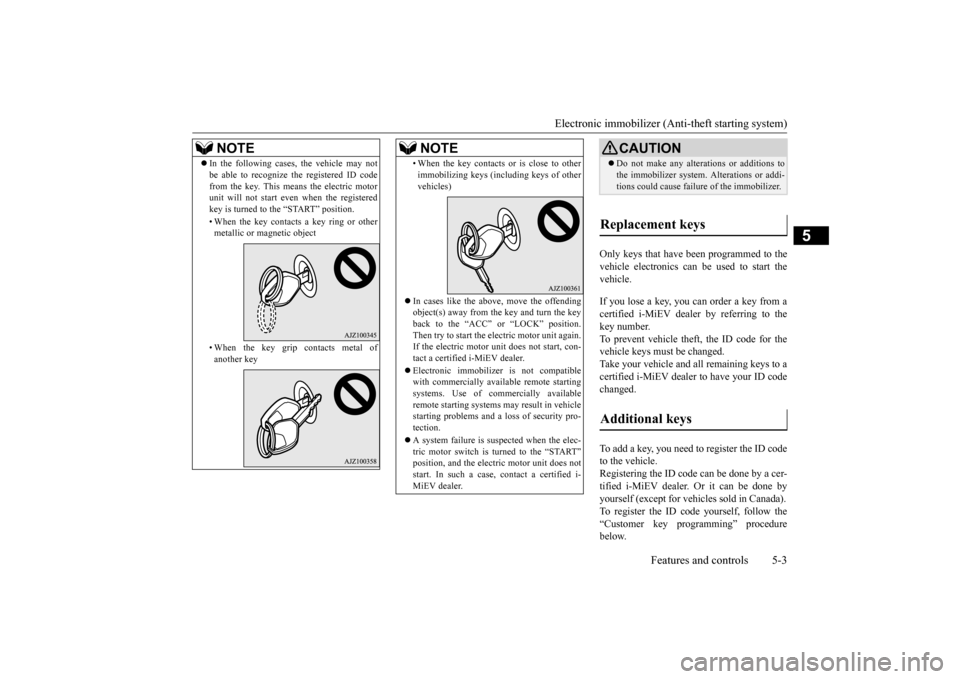
In the following cases, the vehicle may not be able to recognize
the registered ID code
from the key. This means the electric motorunit will not start even when the registered key is turned to the “START” position. • When the key contacts
a key ring or other
metallic or magnetic object • When the key grip
contacts metal of
another key
• When the key contacts
or is close to other
immobilizing keys (inc
luding keys of other
vehicles)
In cases like the above, move the offending object(s) away from the key and turn the key back to the “ACC” or “LOCK” position.Then try to start the electric motor unit again. If the electric motor unit does not start, con- tact a certified i-MiEV dealer. Electronic immobilize
r is not compatible
with commercially available remote startingsystems. Use of commercially available remote starting systems may result in vehicle starting problems
and a loss of security pro-
tection. A system failure is suspected when the elec- tric motor switch is turned to the “START”
tric motor unit does not
start. In such a case, contact a certified i-MiEV dealer.NOTE
CAUTION Do not make any altera
tions or additions to
the immobilizer system.
Alterations or addi-
tions could cause failur
e of the immobilizer.
Replacement keys Additional keys
BK0220401US.book 3 ページ 2015年6月3日 水曜日 午前7時42分
Page 116 of 296
Door locks 5-8 Features and controls
5
6. Close the remote control transmitter firmly.7. Place the remote control transmitter in the remote control transmitter case, then securely close the remote control trans-mitter case. 8. Check the keyless entry system to see that it works.
N00509200534
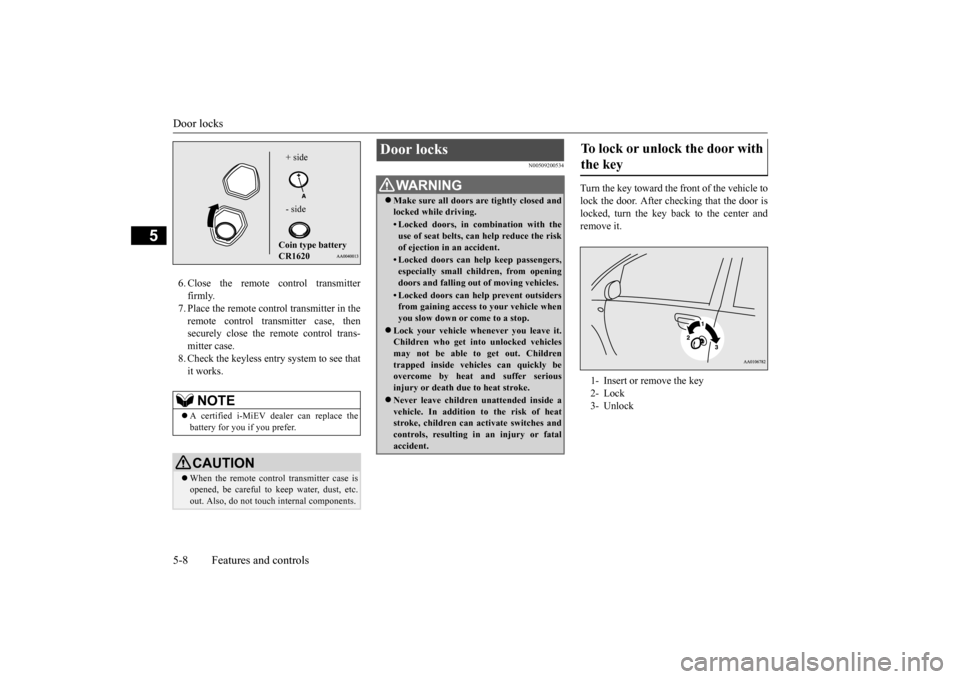
Turn the key toward the front of the vehicle to lock the door. After checking that the door is locked, turn the key back to the center andremove it.
NOTE
A certified i-MiEV dealer can replace the battery for you if you prefer. CAUTION When the remote control transmitter case is opened, be careful to
keep water, dust, etc.
out. Also, do not touch
internal components.+ side - side Coin type battery CR1620
Door locks
WA R N I N GMake sure all doors are tightly closed and locked while driving.• Locked doors, in co
mbination with the
use of seat belts, can help reduce the riskof ejection in
an accident.
• Locked doors can help keep passengers, especially small children, from opening doors and falling out
of moving vehicles.
• Locked doors can help
prevent outsiders
from gaining access to your vehicle when you slow down or come to a stop.
Lock your vehicle when
ever you leave it.
Children who get into
unlocked vehicles
may not be able to get out. Children trapped inside vehicles can quickly be overcome by heat
and suffer serious
injury or death due to heat stroke. Never leave children unattended inside a vehicle. In addition
to the risk of heat
stroke, children can activate switches and controls, resulting in an injury or fatalaccident.
To lock or unlock the door with the key 1- Insert or remove the key 2- Lock 3- Unlock
BK0220401US.book 8 ページ 2015年6月3日 水曜日 午前7時42分
Page 119 of 296
Liftgate
Features and controls 5-11
5
door can be opened using the inside door han- dle.
N00510101266
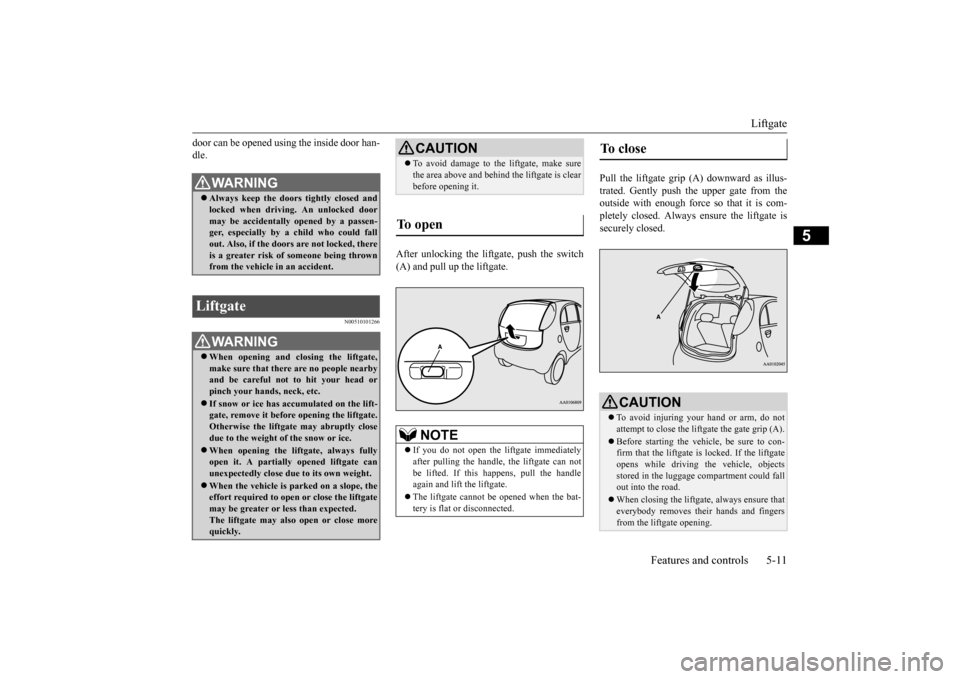
After unlocking the lift
gate, push the switch
(A) and pull up the liftgate.
Pull the liftgate grip (A) downward as illus- trated. Gently push the upper gate from the outside with enough force so that it is com-pletely closed. Always ensure the liftgate is securely closed.
WA R N I N G Always keep the door
s tightly closed and
locked when driving. An unlocked door may be accidentally
opened by a passen-
ger, especially by
a child who could fall
out. Also, if the doors are not locked, there is a greater risk of
someone being thrown
from the vehicle
in an accident.
Liftgate
WA R N I N GWhen opening and closing the liftgate, make sure that there are no people nearby and be careful not to hit your head or pinch your hands, neck, etc. If snow or ice has ac
cumulated on the lift-
gate, remove it before
opening the liftgate.
Otherwise the liftgate
may abruptly close
due to the weight of the snow or ice. When opening the lift
gate, always fully
open it. A partially opened liftgate can unexpectedly close due to its own weight. When the vehicle is parked on a slope, the effort required to open or close the liftgate may be greater or less than expected.The liftgate may also open or close more quickly.
CAUTION To avoid damage to th
e liftgate, make sure
the area above and behind
the liftgate is clear
before opening it.
To open
NOTE
If you do not open the li
ftgate immediately
after pulling the handle,
the liftgate can not
be lifted. If this happens, pull the handle again and lift
the liftgate.
The liftgate cannot be opened when the bat- tery is flat or disconnected.
To close
CAUTION To avoid injuring your hand or arm, do not attempt to close the liftgate the gate grip (A). Before starting the vehi
cle, be sure to con-
firm that the liftgate is locked. If the liftgate opens while driving the vehicle, objectsstored in the luggage compartment could fall out into the road. When closing the liftga
te, always ensure that
everybody removes their hands and fingers from the liftgate opening.
BK0220401US.book 11 ページ 2015年6月3日 水曜日 午前7時42分