light MITSUBISHI iMiEV 2017 1.G User Guide
[x] Cancel search | Manufacturer: MITSUBISHI, Model Year: 2017, Model line: iMiEV, Model: MITSUBISHI iMiEV 2017 1.GPages: 296, PDF Size: 7.79 MB
Page 17 of 296
Familiarizing yourself with i-MiEV
General information/Charging 3-3
3
N01205601036
Motion energy is converted into electric energy using the motor as a power generator. While decelerating, electric energy will becreated and used to charge to the main drive lithium-ion battery. If you lift your foot off the accelerator pedal while driving, a braking force thatequivalent to the engine braking of a gas- oline or diesel powered vehicle engine vehicle will
be generate.
For increased regenerative braking, set the selector lever to “B” (REGENERATIVE BRAKE MODE) or “ECO” (ECOMODE) as follows: • “B”: Strong regenerative braking (For downhill driving)• “ECO”: Moderate regenerative braking (For economical driving or gentle down- hill driving)
As greater brake fo
rce is applied by
depressing the brak
e pedal, increased
regenerative braking occurs. When regenerative braking produces strong brake force, the stop lights willilluminate, even if the brake pedal is not depressed.
N01200300015
Keep the brake pedal depressed until you are ready to drive. When the vehicle is inthe “D” (DRIVE), “ECO” (ECO MODE),“B” (REGENERATIVE BRAKE MODE) or
Page 19 of 296
Familiarizing yourself with i-MiEV
General information/Charging 3-5
3
N01205900016
Put the selector lever in the “B” (REGEN- ERATIVE BRAKE MODE) or “Eco” (ECOMODE) position according to the road con-dition. Using appropriate regenerative brak- ing can help increase
the cruising range.
Refer to “Regenerative braking” on page3-3.NOTE
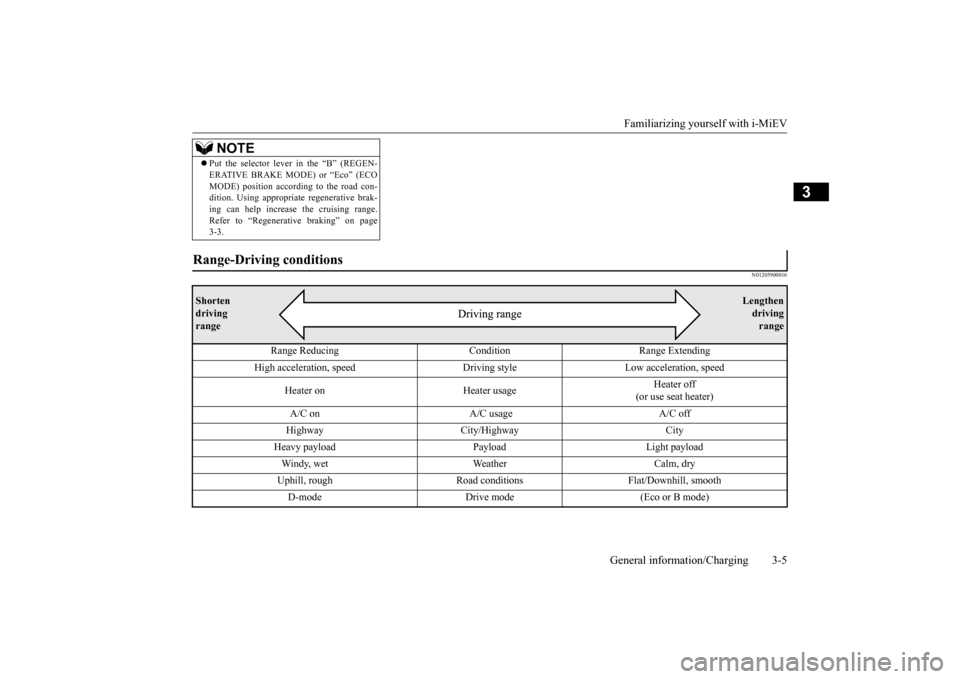
Range-Driving conditions Shorten driving range
Lengthen
driving range
Range Reducing Condition Range Extending
High acceleration, speed Driving
style Low acceleration, speed
Heater on Heater usage
Heater off
(or use seat heater)
A/C on A/C usage A/C off Highway City/Highway City
Heavy payload Payload Light payload Windy, wet Weather Calm, dry Uphill, rough Road conditio
ns Flat/Downhill, smooth
D-mode Drive mode (Eco or B mode)
BK0220401US.book 5 ページ 2015年6月3日 水曜日 午前7時42分
Page 23 of 296
Cautions and actions to deal with intense heat
General information/Charging 3-9
3
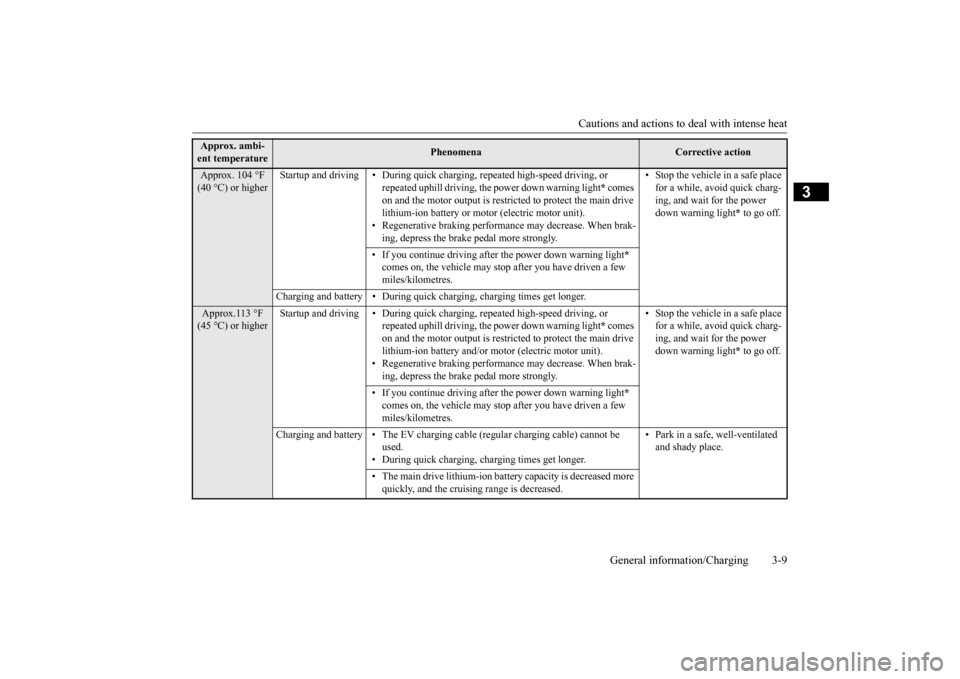
Approx. ambi- ent temperature
Phenomena
Corrective action
Approx. 104 °F (40 °C) or higher
Startup and driving •
ed high-speed driving, or
repeated uphill driving, th
e power down warning light
* comes
on and the motor output is restricted to protect the main drive lithium-ion battery or motor (electric motor unit).Regenerative braking performa
nce may decrease. When brak-
ing, depress the brak
e pedal more strongly.
• Stop the vehicle in a safe place for a while, avoid quick charg- ing, and wait for the power down warning light
* to go off.
• If you continue driving afte
r the power down warning light
*
comes on, the vehicl
e may stop after you have driven a few
miles/kilometres.
Charging and battery • During quick ch
arging, charging times get longer.
Approx.113 °F (45 °C) or higher
Startup and driving •
ed high-speed driving, or
repeated uphill driving, th
e power down warning light
* comes
on and the motor output is restricted to protect the main drive lithium-ion battery and/or motor (electric motor unit). Regenerative braking performa
nce may decrease. When brak-
ing, depress the brak
e pedal more strongly.
• Stop the vehicle in a safe place for a while, avoid quick charg-ing, and wait for the power down warning light
* to go off.
• If you continue driving afte
r the power down warning light
*
comes on, the vehicl
e may stop after you have driven a few
miles/kilometres.
Charging and battery •
charging cable) cannot be
used. During quick charging, charging times get longer.
• Park in a safe, well-ventilated and shady place.
• The main drive lithium-ion batte
ry capacity is decreased more
quickly, and the cruisi
ng range is decreased.
BK0220401US.book 9 ページ 2015年6月3日 水曜日 午前7時42分
Page 24 of 296
Cautions and actions to deal with intense cold 3-10 General information/Charging
3
N01201101033
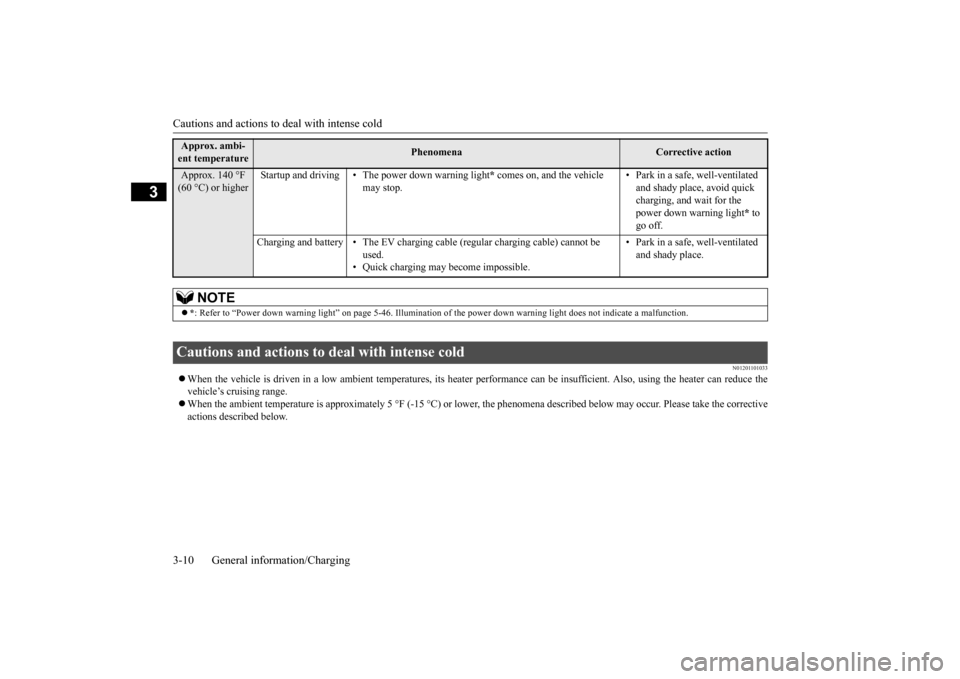
When the vehicle is driven in a low ambient temperatures, its he
ater performance can be insuffic
ient. Also, using the heater ca
n reduce the
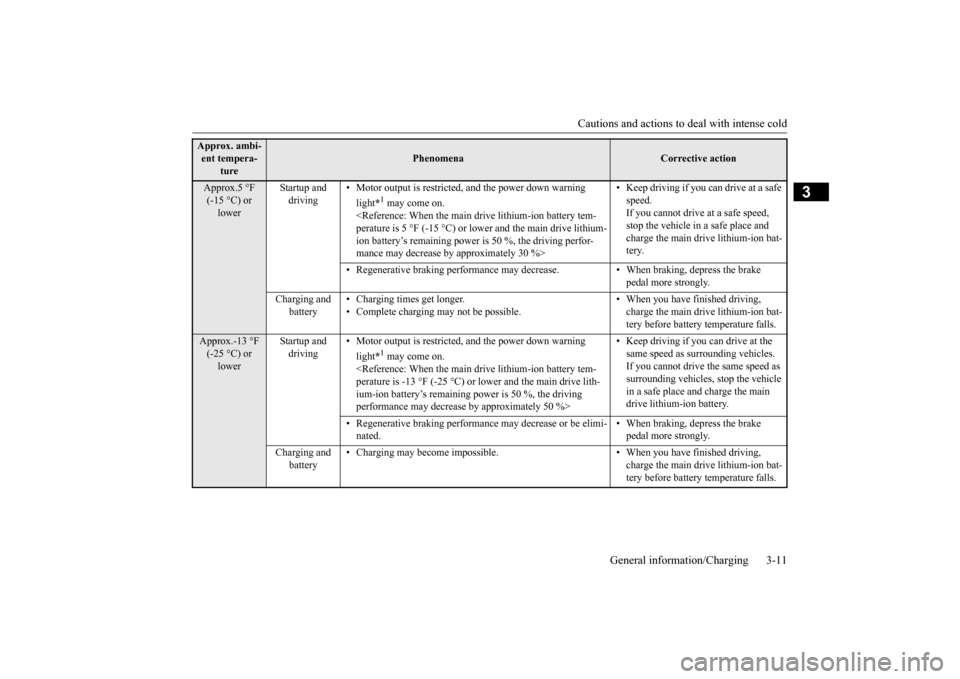
vehicle’s cruising range. When the ambient temperature is approximately 5 °F (-15 °C) or
lower, the phenomena de
scribed below may occu
r. Please take the
corrective
actions described below.Approx. 140 °F (60 °C) or higher
Startup and driving • The power down warning light
* comes on, and the vehicle
may stop.
• Park in a safe, well-ventilated and shady place, avoid quick charging, and wait for the power down warning light
* to
go off.
Charging and battery •
used.Quick charging may become impossible.
• Park in a safe, well-ventilated and shady place.
NOTE
*: Refer to “Power down warning light” on pa
ge 5-46. Illumination of the power down wa
rning light does not i
ndicate a malfunctio
n.
Cautions and actions to deal with intense cold Approx. ambi- ent temperature
Phenomena
Corrective action
BK0220401US.book 10 ページ 2015年6月3日 水曜日 午前7時42分
Page 25 of 296
Cautions and actions to deal with intense cold
General information/Charging 3-11
3
Approx. ambi- ent tempera-
ture
Phenomena
Corrective action
Approx.5 °F (-15 °C) or lower
Startup and driving
• Motor output is restricted
, and the power down warning
light
*1 may come on.
• Keep driving if you can drive at a safe speed. If you cannot drive at a safe speed, stop the vehicle in
a safe place and
charge the main drive lithium-ion bat- tery.
• Regenerative braking performance may decr
ease. • When braking, depress the brake
pedal more strongly.
Charging and
battery
• • Charging times get longer. Complete charging may not be possible.
• When you have finished driving, charge the main drive lithium-ion bat- tery before battery temperature falls.
Approx.-13 °F (-25 °C) or lower
Startup and driving
• Motor output is restricted
, and the power down warning
light
*1 may come on.
ium-ion battery’s remaining power is 50 %, the driving performance may decrease by approximately 50 %>
• Keep driving if you can drive at the same speed as su
rrounding vehicles.
If you cannot drive the same speed as surrounding vehicles, stop the vehicle in a safe place and charge the main drive lithium-ion battery.
• Regenerative braking performan
ce may decrease or be elimi-
nated.
• When braking, depress the brake pedal more strongly.
Charging and
battery
• Charging may become impossible. • W
hen you have finished driving, charge the main drive lithium-ion bat- tery before battery temperature falls.
BK0220401US.book 11 ページ 2015年6月3日 水曜日 午前7時42分
Page 26 of 296
Cautions and actions to deal with intense cold 3-12 General information/Charging
3
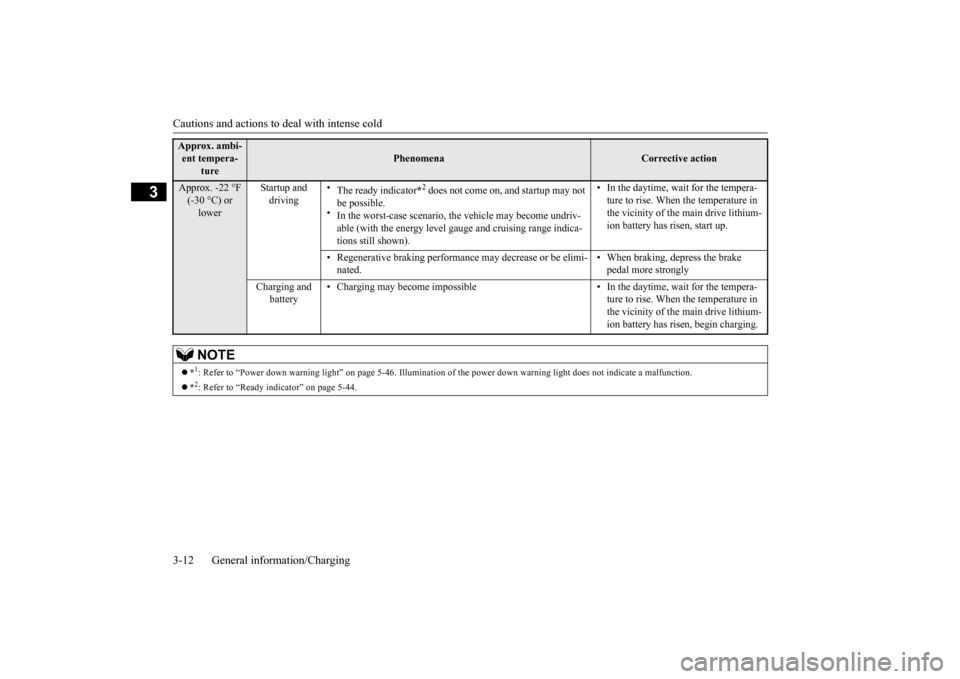
Approx. -22 °F (-30 °C) or lower
Startup and driving
• • The ready indicator
*2 does not come on, and startup may not
be possible. In the worst-case scenario,
the vehicle may become undriv-
able (with the energy level ga
uge and cruising range indica-
tions still shown).
• In the daytime, wait for the tempera- ture to rise. When the temperature in the vicinity of the main drive lithium-ion battery has risen, start up.
• Regenerative braking performance
may decrease or be elimi-
nated.
• When braking, depress the brake pedal more strongly
Charging and
battery
• Charging may become impossible • In the daytime, wait for the tempera-
ture to rise. When the temperature in the vicinity of the main drive lithium- ion battery has rise
n, begin charging.
NOTE
*1: Refer to “Power down warning light” on pa
ge 5-46. Illumination of th
e power down warning light doe
s not indicate a malfunctio
n.
*2: Refer to “Ready indicator” on page 5-44.
Approx. ambi- ent tempera-
ture
Phenomena
Corrective action
BK0220401US.book 12 ページ 2015年6月3日 水曜日 午前7時42分
Page 29 of 296
Precautions during Charging the
Main Drive Lithium-ion Battery
General information/Charging 3-15
3
N01202601051
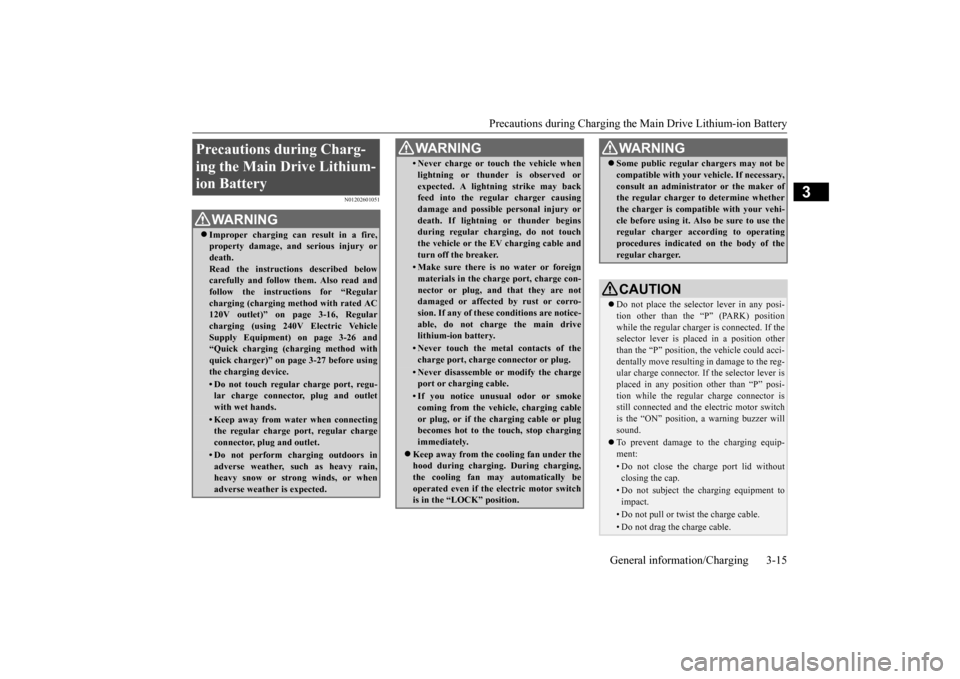
Precautions during Charg- ing the Main Drive Lithium-ion Battery
WA R N I N G Improper charging can result in a fire, property damage, and serious injury ordeath. Read the instructions described below carefully and follow them. Also read andfollow the instructions for “Regular charging (charging method with rated AC 120V outlet)” on page 3-16, Regularcharging (using 240V
Electric Vehicle
Supply Equipment)
on page 3-26 and
“Quick charging (c
harging method with
quick charger)” on p
age 3-27 before using
the charging device.• Do not touch regular charge port, regu-lar charge connecto
r, plug and outlet
with wet hands.• Keep away from wate
r when connecting
the regular charge port, regular chargeconnector, plug and outlet.• Do not perform charging outdoors inadverse weather, su
ch as heavy rain,
heavy snow or strong winds, or when adverse weather is expected.
• Never charge or to
uch the vehicle when
lightning or thunde
r is observed or
expected. A lightning strike may backfeed into the regular charger causing damage and possible
personal injury or
death. If lightnin
g or thunder begins
during regular charging, do not touch the vehicle or the EV
charging cable and
turn off the breaker.• Make sure there is no water or foreignmaterials in the char
ge port, charge con-
nector or plug, and that they are not damaged or affected by rust or corro- sion. If any of these conditions are notice-able, do not charge
the main drive
lithium-ion battery.• Never touch the metal contacts of thecharge port, charge
connector or plug.
• Never disassemble or modify the charge port or charging cable.• If you notice unus
ual odor or smoke
coming from the vehicle, charging cable or plug, or if the ch
arging cable or plug
becomes hot to the touch, stop charging immediately.
Keep away from the cooling fan under the hood during charging. During charging, the cooling fan m
ay automatically be
operated even if the electric motor switch is in the “LOCK” position. WA R N I N G
Some public regular chargers may not be compatible with your vehicle. If necessary,consult an administrator or the maker ofthe regular charger to determine whether the charger is compat
ible with
your vehi-
cle before using it. Also be sure to use theregular charger acco
rding to operating
procedures indicated on the body of the regular charger.CAUTION Do not place the select
or lever in any posi-
tion other than the “P” (PARK) positionwhile the regular charger is connected. If the selector lever is plac
ed in a position other
than the “P” position, the vehicle could acci-dentally move resulting in damage to the reg- ular charge connector. If
the selector lever is
placed in any position other than “P” posi-tion while the regular charge connector is still connected and the
electric motor switch
is the “ON” position,
a warning buzzer will
sound. To prevent damage to the charging equip- ment:• Do not close the charge port lid withoutclosing the cap.• Do not subject the charging equipment toimpact.• Do not pull or twist the charge cable.• Do not drag the charge cable.WA R N I N G
BK0220401US.book 15 ページ 2015年6月3日 水曜日 午前7時42分
Page 31 of 296
Regular charging (charging method with rated AC 120 V outlet)
General information/Charging 3-17
3
N01216200019
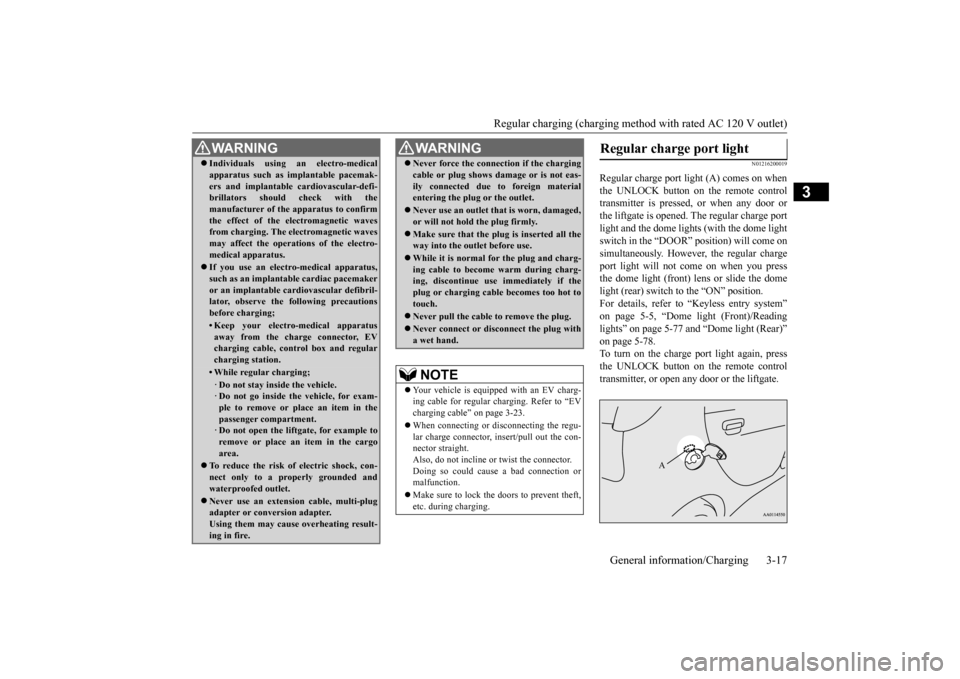
Regular charge port light (A) comes on when the UNLOCK button on the remote control transmitter is pressed, or when any door orthe liftgate is opened.
The regular charge port
light and the dome light
s (with the dome light
switch in the “DOOR” position) will come onsimultaneously. However, the regular charge port light will not
come on when you press
the dome light (front) lens or slide the dome light (rear) switch to the “ON” position. For details, refer to
“Keyless entry system”
on page 5-5, “Dome
light (Front)/Reading
lights” on page 5-77 a
nd “Dome light (Rear)”
To turn on the charge port light again, press the UNLOCK button on the remote control transmitter, or open any
door or the liftgate.
Individuals using an
electro-medical
apparatus such as implantable pacemak-ers and implantable
cardiovascular-defi-
brillators should
check with the
manufacturer of the apparatus to confirm the effect of the el
ectromagnetic waves
from charging. The el
ectromagnetic waves
may affect the operations of the electro- medical apparatus. If you use an electro-medical apparatus, such as an implanta
ble cardiac pacemaker
or an implantable ca
rdiovascular
defibril-
lator, observe the following precautions before charging;• Keep your electro-medical apparatusaway from the charge connector, EVcharging cable, control box and regular charging station.• While regular charging;· Do not stay inside the vehicle. · Do not go inside the vehicle, for exam- ple to remove or place an item in the passenger compartment.· Do not open the liftgate, for example to remove or place an item in the cargo area.
To reduce the risk of electric shock, con- nect only to a prop
erly grounded and
waterproofed outlet. Never use an extension cable, multi-plug adapter or conversion adapter. Using them may cause overheating result- ing in fire.WA R N I N G
Never force the connection if the charging cable or plug shows damage or is not eas-ily connected due to foreign materialentering the plug or the outlet. Never use an outlet that is worn, damaged, or will not hold the plug firmly. Make sure that the plug is inserted all the way into the outlet before use. While it is normal fo
r the plug and charg-
ing cable to become warm during charg- ing, discontinue use immediately if the plug or charging cable becomes too hot totouch. Never pull the cable to remove the plug.Never connect or disconnect the plug with a wet hand.NOTE
Your vehicle is equipped with an EV charg- ing cable for regular charging. Refer to “EVcharging cable” on page 3-23. When connecting or
disconnecting the regu-
lar charge connector, in
sert/pull out the con-
nector straight. Also, do not incline or twist the connector.Doing so could cause a bad connection ormalfunction. Make sure to lock the doors to prevent theft, etc. during charging.WA R N I N G
Regular charge port light
A
BK0220401US.book 17 ページ 2015年6月3日 水曜日 午前7時42分
Page 32 of 296
Regular charging (charging method with rated AC 120 V outlet)
3
N01203201041
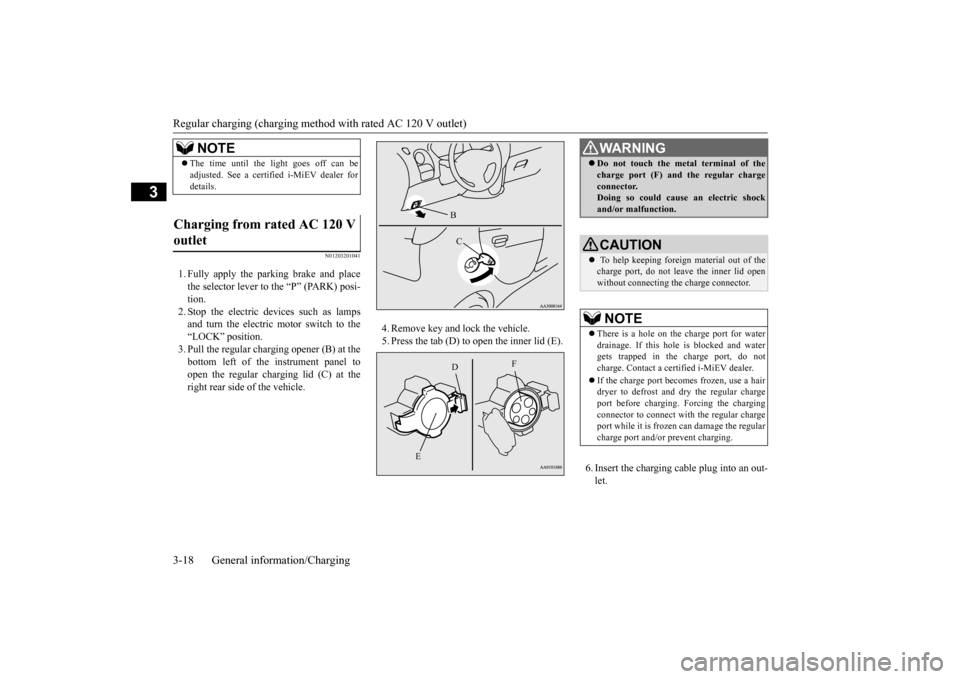
1. Fully apply the parking brake and place the selector lever to the “P” (PARK) posi- tion. 2. Stop the electric devices such as lampsand turn the electric motor switch to the “LOCK” position. 3. Pull the regular charging opener (B) at thebottom left of the instrument panel to open the regular charging lid (C) at the right rear side of the vehicle.
4. Remove key and lock the vehicle. 5. Press the tab (D) to open the inner lid (E).
6. Insert the charging cable plug into an out- let.
NOTE
The time until the light goes off can be adjusted. See a certified i-MiEV dealer fordetails.
Charging from rated AC 120 V outlet
B C
F
D
E
WA R N I N G Do not touch the metal terminal of the charge port (F) an
d the regular charge
connector.Doing so could cause an electric shock and/or malfunction.CAUTION To help keeping forei
gn material out of the
charge port, do not leave the inner lid openwithout connecting th
e charge connector.
NOTE
There is a hole on the charge port for water drainage. If this hole
is blocked and water
gets trapped in the charge port, do not charge. Contact a certified i-MiEV dealer. If the charge port becomes frozen, use a hair dryer to defrost and dry the regular chargeport before charging. Forcing the charging connector to connect w
ith the regular charge
port while it is frozen
can damage the regular
charge port and/or prevent charging.
BK0220401US.book 18 ページ 2015年6月3日 水曜日 午前7時42分
Page 38 of 296
EV charging cable 3-24 General information/Charging
3
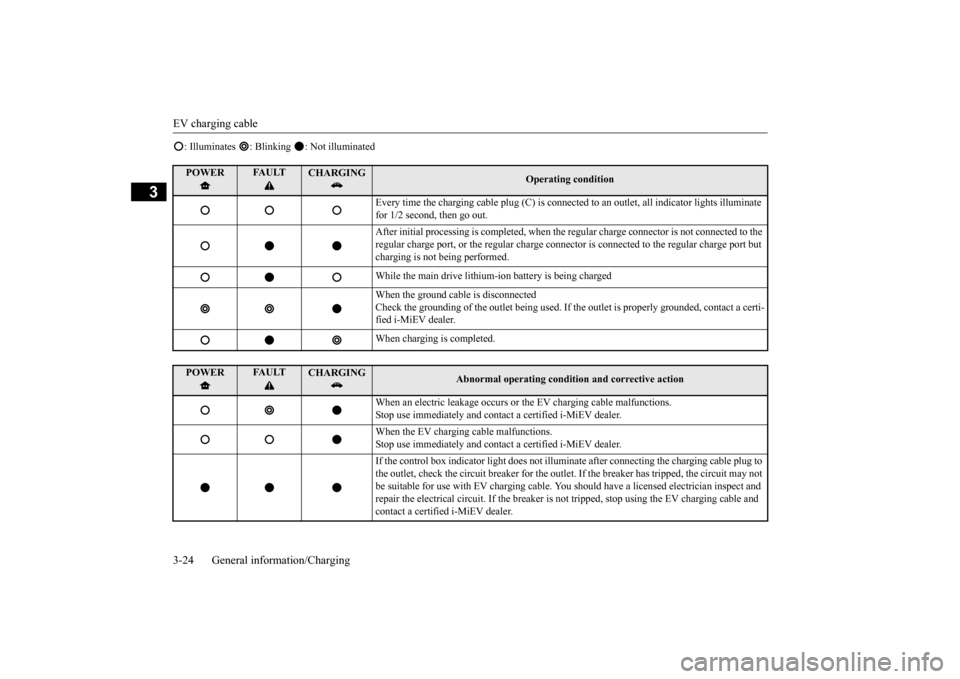
: Illuminates : Blinking : Not illuminatedPOWER
FAULT
CHARGING
Operating condition
Every time the charging cable plug (C) is connected
to an outlet, all indicator lights illuminate
for 1/2 second, then go out. After initial processing is comple
ted, when the regular charge c
onnector is not connected to the
regular charge port, or the regular charge connec
tor is connected to the regular charge port but
charging is not being performed. While the main drive lithium-i
on battery is being charged
When the ground cable is disconnected Check the grounding of the outlet being used. If
the outlet is properly gr
ounded, contact a certi-
fied i-MiEV dealer. When charging is completed.
POWER
FAULT
CHARGING
Abnormal operating conditi
on and corrective action
When an electric leakage occurs or the EV charging cable malfunctions. Stop use immediately and contac
t a certified i-MiEV dealer.
When the EV chargi
ng cable malfunctions.
Stop use immediately and contac
t a certified i-MiEV dealer.
If the control box indicator light
does not illuminate after connect
ing the charging cable plug to
the outlet, check the circuit breaker for the outlet.
If the breaker has tripped, the circuit may not
be suitable for use with EV charging cable. Y
ou should have a licensed
electrician inspect and
repair the electrical circuit. If the breaker is
not tripped, stop using the EV charging cable and
contact a certifie
d i-MiEV dealer.
BK0220401US.book 24 ページ 2015年6月3日 水曜日 午前7時42分