service MITSUBISHI iMiEV 2017 1.G Owner's Manual
[x] Cancel search | Manufacturer: MITSUBISHI, Model Year: 2017, Model line: iMiEV, Model: MITSUBISHI iMiEV 2017 1.GPages: 296, PDF Size: 7.79 MB
Page 229 of 296
Antenna
Comfort controls 7-27
7
N00734200471
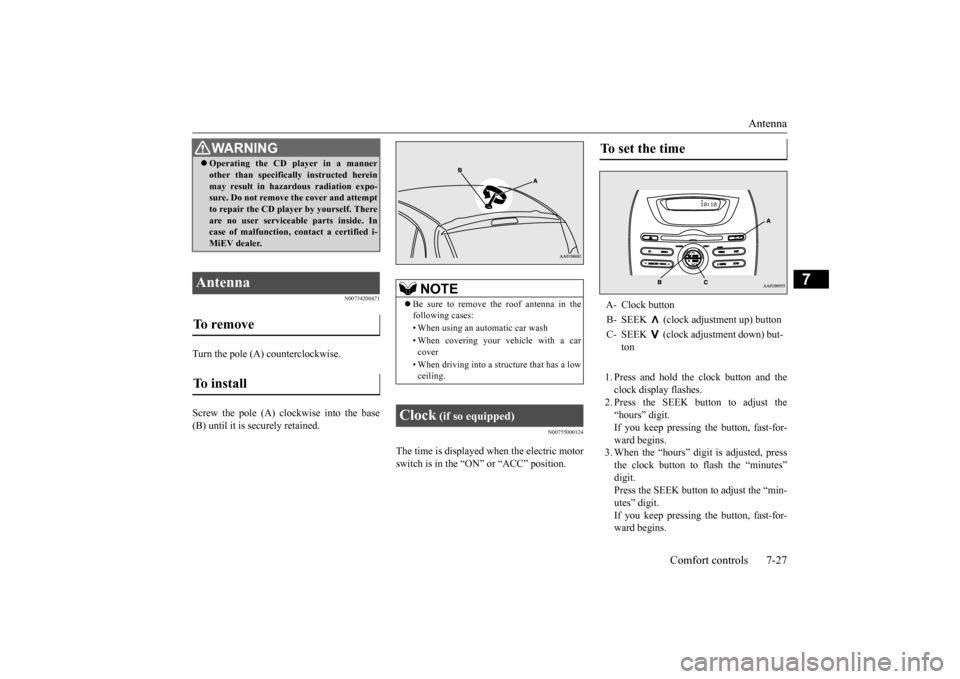
Turn the pole (A) counterclockwise. Screw the pole (A) clockwise into the base (B) until it is securely retained.
N00755000124
The time is displayed when the electric motorswitch is in the “
1. Press and hold the clock button and the clock display flashes. 2. Press the SEEK button to adjust the“hours” digit. If you keep pressing the button, fast-for- ward begins.3. When the “hours” digit is adjusted, press the clock button to flash the “minutes” digit.Press the SEEK button to adjust the “min- utes” digit. If you keep pressing the button, fast-for-ward begins.
WA R N I N G Operating the CD player in a manner other than specifically instructed hereinmay result in hazardous radiation expo-sure. Do not remove the cover and attempt to repair the CD player by yourself. There are no user serviceable parts inside. Incase of malfunction, contact a certified i- MiEV dealer.
Antenna To remove To install
NOTE
Be sure to remove the roof antenna in the following cases: • When using an automatic car wash • When covering your vehicle with a car cover • When driving into a structure that has a low ceiling.
Clock
(if so equipped)
To set the time
A- Clock button B- SEEK (clock adjustment up) buttonC- SEEK (clock adjustment down) but-
ton
BK0220401US.book 27 ページ 2015年6月3日 水曜日 午前7時42分
Page 243 of 296
Towing
For emergencies 8-11
8
Before driving, stow the compressor and make sure that the rear seat cushion isproperly secured.
20. After driving for 10 minutes or 3 miles (5
km) again, check the tire pressure usingthe air pressure gauge on the compressor. If the tire pressure has apparently not dropped, the emergency repair procedureis complete. Before driving, make sure that the compressor is stowed and the seat cushion is properly secured. You muststill not exceed a speed of 50 mph (80 km/h). Observe local speed limits.
21. Immediately drive with great care to a
certified i-MiEV de
aler and have tire
repair/replacement performed.
N00837001931
If you need to tow your
vehicle, contact a cer-
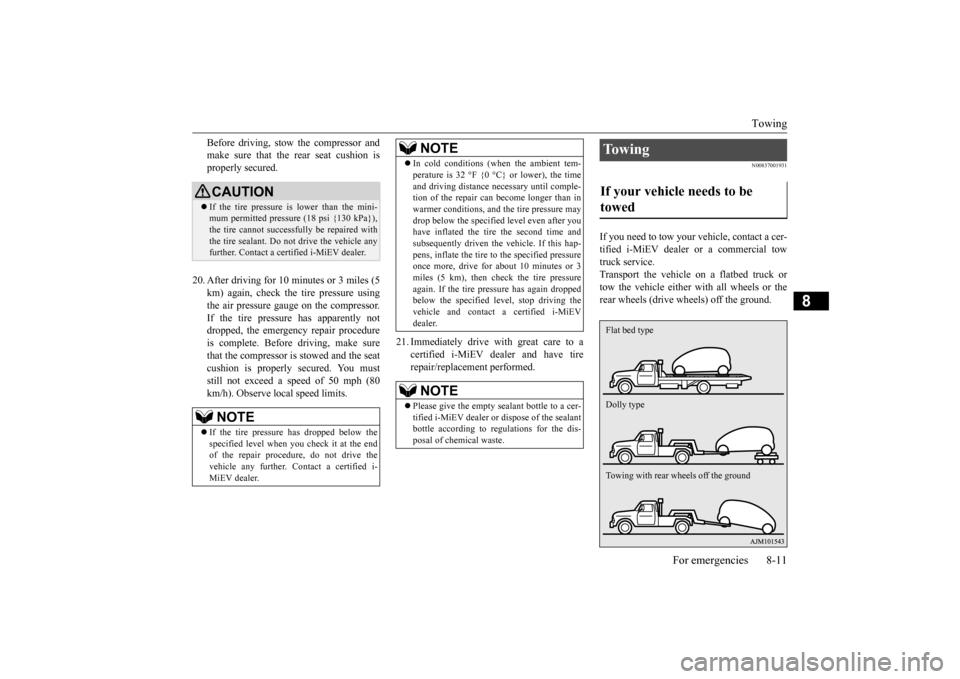
tified i-MiEV dealer or a commercial towtruck service. Transport the vehicle on a flatbed truck or tow the vehicle either with all wheels or the rear wheels (drive wheels) off the ground.
CAUTION If the tire pressure is lower than the mini- mum permitted pressure (18 psi {130 kPa}), the tire cannot successf
ully be repaired with
the tire sealant. Do not drive the vehicle anyfurther. Contact a cert
ified i-MiEV dealer.
NOTE
If the tire pressure has dropped below the specified level when you check it at the endof the repair procedure, do not drive the vehicle any further.
Contact a certified i-
MiEV dealer.
In cold conditions (when the ambient tem- perature is 32 °F {0 °C} or lower), the timeand driving distance ne
cessary until comple-
tion of the repair can
become longer than in
warmer conditions, and the tire pressure may drop below the specified level even after youhave inflated the tire the second time and subsequently driven the vehicle. If this hap- pens, inflate the tire to the specified pressureonce more, drive for about 10 minutes or 3 miles (5 km), then check the tire pressure again. If the tire pressure has again droppedbelow the specified level, stop driving the vehicle and contact
a certified i-MiEV
dealer.NOTE
Please give the empty
sealant bottle to a cer-
tified i-MiEV dealer or
dispose of the sealant
bottle according to re
gulations for the dis-
posal of chemical waste.NOTE
To w i n g If your vehicle needs to be towed Towing with rear wheels off the ground Dolly type Flat bed type
BK0220401US.book 11 ページ 2015年6月3日 水曜日 午前7時42分
Page 244 of 296
Towing 8-12 For emergencies
8
If a wheel gets stuck in
a ditch, do not try to
tow the vehicle. Please contact a certifie
d i-MiEV dealer or a
commercial tow truck service for assistance. There may be local re
gulations concerning
towing in your area. Obey the regulations inthe area where you are driving your vehicle.
Place the selector lever in the “N” (NEU- TRAL) position. Turn the electric motor switch to the “ACC” position and secure thesteering wheel in a st
raight-ahead position
with a rope or tie-down strap. Never place the electric motor switch in the “LOCK” or “ON”
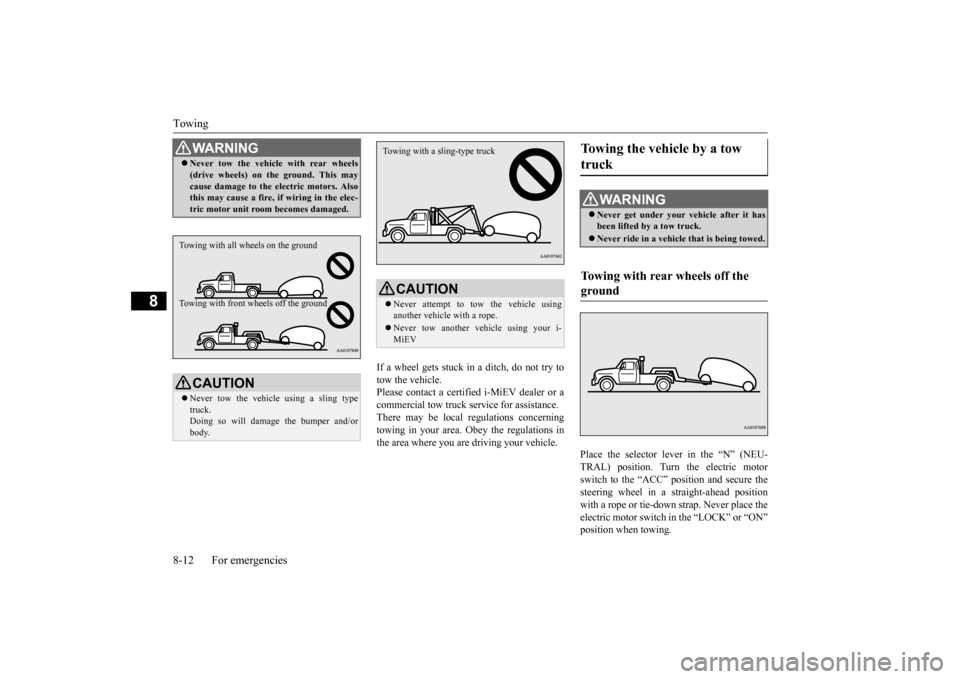
WA R N I N G Never tow the vehicle with rear wheels (drive wheels) on th
e ground. This may
cause damage to the electric motors. Alsothis may cause a fire, if wiring in the elec- tric motor unit room becomes damaged.CAUTION Never tow the vehicl
e using a sling type
truck. Doing so will damage the bumper and/or body.Towing with all wheels on the ground Towing with front wheels off the ground
CAUTION Never attempt to tow the vehicle using another vehicle with a rope. Never tow another ve
hicle using your i-
MiEVTowing with a sling-type truck
Towing the vehicle by a tow truck
WA R N I N G Never get under your vehicle after it has been lifted by a tow truck. Never ride in a vehicl
e that is being towed.
Towing with rear wheels off the ground
BK0220401US.book 12 ページ 2015年6月3日 水曜日 午前7時42分
Page 245 of 296
Operation under adverse driving conditions
For emergencies 8-13
8
N00837200747
If your vehicle becomes stuck in snow, sand, or mud, it can often be moved by a rocking motion. Rock your vehicle back and forth tofree it. Do not spin the wheels. Constant efforts to free a stuck vehicle can cause transmissionfailure. If your vehicle is still
stuck after several rock-
ing attempts, call for a commercial tow truckservice.
When driving on a road covered with snow or ice, use snow tires. Tire chains cannot be used on your vehicle. Theremay be state or local regulations about using snow tires. Always check the regu- lations in your local area before usingthem. Refer to the section entitled “Snow tires” on page 9-15 and “Tire chains” on page 9-16. Drive slowly. Do not make sudden starts or stops, sharp turns, or slam on the brakes. Allow extra distance between your vehi- cle and the vehicle in front of you, and avoid sudden braking. If a skid occurs when the accelerator pedal is depressed, take your foot off the pedal. Steer gently in the direction of theskid. Your vehicle is equippe
d with an anti-lock
braking system (ABS), hold the brakepedal down firmly and
keep it depressed.
Do not pump the brake pedal which will result in reduced braking performance.
CAUTION If the transmission or the steering system has a problem or damage,
transport the vehicle
on a flatbed truck or to
w the vehicle with the
all wheels off the ground. If the electric motor switch is in the “ON”
lting in an accident.
Make sure the electric motor switch is in the“ACC” position before towing.
Operation under adverse driving conditions If your vehicle becomes stuck in sand, mud or snow
WA R N I N G When trying to rock
your vehicle out of a
stuck position, make sure that there are nopeople nearby. The
rocking motion can
make your vehicle suddenly lurch forward or backward, and inju
re any bystanders.
On wet roads
CAUTIONDo not drive on a flooded road. If you drive on a flooded road, not only the electric motorunit stops but also a fail
ure like electric leak-
age or short circuit may occur. If you inevitably had to run on a floodedroad and the vehicle was exposed to water, be sure to have your vehicle inspected by a certified i-MiEV dealer. When driving in rain, on water-covered roads, or through a car wash, water could getinto the brake discs and make them fail tem- porarily. In such cases, lightly press the brake pedal to see if they are working prop-erly. If they are not, press the pedal lightlyseveral times while driv
ing to dry the brake
pads or linings, then check them again. When driving in rain, a layer of water may form between the tires and the road surface (aquaplaning). This l
oosens your tires’ grip
on the road, making it difficult to steer or brake properly. When driving on a wet road:• Drive your vehicle at a safe speed.
• Do not drive on worn tires.• Always keep the tires at the correct infla- tion pressures.
On snowy or icy roads
CAUTION
BK0220401US.book 13 ページ 2015年6月3日 水曜日 午前7時42分
Page 247 of 296
9
Vehicle care and maintenanceService precautions ..........................................................................9-2 Hood .............
............
...........
...........
...........
...........
...........
...........
.....9-3
View under the hood and electric motor unit room .........................9-4Coolant/Hot water heater fluid ........................................................9-4 Washer fluid .....................................................................................9-7 Brake fluid .......................................................................................9-712V starter battery ...........................................................................9-7 Tires ...............................................................................................9-10 Brake pedal free play .....................................................................9-16Parking brake lever stroke .............................................................9-16 Wiper blades ..................................................................................9-16 General maintenance .....................................................................9-17For cold and snowy weather ..........................................................9-18 Fusible links ...................................................................................9-18 Fuses ..............................................................................................9-18Replacement of light bulbs ............................................................9-21 Vehicle care precautions ................................................................9-28 Cleaning the inside of your vehicle .......
...........
...........
...........
.......9-28
Cleaning the outside of your vehicle .....
...........
...........
...........
.......9-30
BK0220401US.book 1 ページ 2015年6月3日 水曜日 午前7時42分
Page 248 of 296
Service precautions 9-2 Vehicle care and maintenance
9
N00937301414
Taking regular care of your vehicle helps pre- serve its value and appe
arance as long as pos-
sible.This vehicle is an electric vehicle and is equipped with many high-voltage compo- nents. Refer to “High-voltage components”on page 3-34. You can do some of the maintenance work described in this manual by yourself, but the rest must be performed
only by a certified i-
MiEV dealer.If you discover a malfunction or other prob- lem, have it corrected by a certified i-MiEV dealer.Also follow the instru
ctions and take note of
the precautions for each procedure.
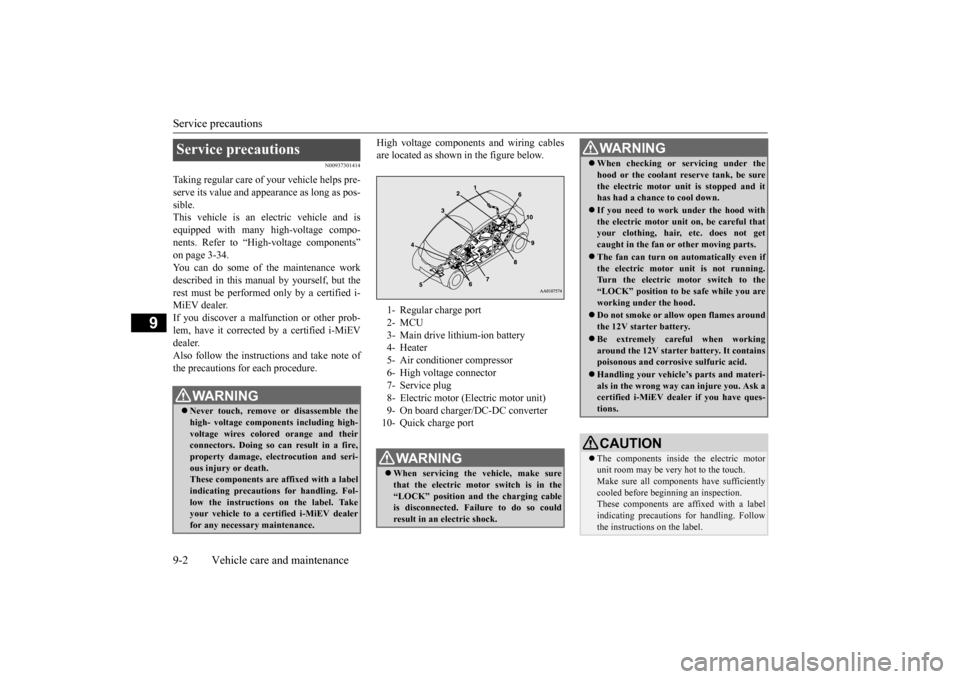
High voltage components and wiring cables are located as shown in the figure below.
Service precautions
WA R N I N G Never touch, remove or disassemble the high- voltage componen
ts including high-
voltage wires colore
d orange and their
connectors. Doing so can result in a fire, property damage, elec
trocution and seri-
ous injury or death. These components are affixed with a label indicating precautions for handling. Fol-low the instructions on the label. Take your vehicle to a cert
ified i-MiEV dealer
for any necessary maintenance.
1- Regular charge port 2- MCU 3- Main drive lithium-ion battery4- Heater 5- Air conditioner compressor 6- High voltage connector7- Service plug 8- Electric motor (Electric motor unit)10- Quick charge port
WA R N I N G When servicing the vehicle, make sure that the electric motor switch is in the“LOCK” position and
the charging cable
is disconnected. Failure to do so could result in an electric shock.
When checking or servicing under the hood or the coolant reserve tank, be surethe electric motor unit is stopped and ithas had a chance to cool down. If you need to work
under the hood with
the electric motor unit on, be careful that your clothing, hair, etc. does not get caught in the fan or other moving parts. The fan can turn on automatically even if the electric motor unit is not running.Turn the electric motor switch to the “LOCK” position to be
safe while you are
working under the hood. Do not smoke or allow open flames around the 12V starter battery. Be extremely careful when working around the 12V starter battery. It containspoisonous and corros
ive sulfuric acid.
Handling your vehicle’s parts and materi- als in the wrong way can injure you. Ask a certified i-MiEV dealer
if you have ques-
tions. CAUTION The components inside
the electric motor
unit room may be very
hot to the touch.
Make sure all components have sufficientlycooled before beginning an inspection. These components are affixed with a label indicating precautions
for handling. Follow
the instructions on the label.WA R N I N G
BK0220401US.book 2 ページ 2015年6月3日 水曜日 午前7時42分
Page 258 of 296
Tires 9-12 Vehicle care and maintenance
9
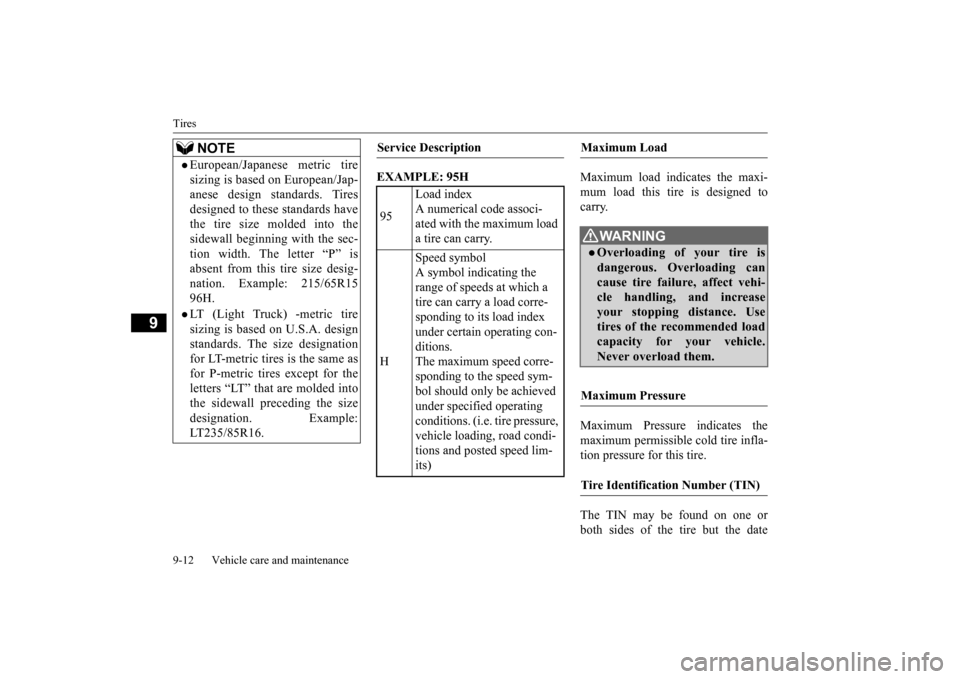
EXAMPLE: 95H
Maximum load indicates the maxi- mum load this tire is designed to carry. Maximum Pressure indicates the maximum permissible cold tire infla-tion pressure for this tire. The TIN may be found on one or both sides of the tire but the date
NOTE
European/Japanese metric tire sizing is based on European/Jap- anese design standards. Tires designed to these standards havethe tire size molded into the sidewall beginning with the sec- tion width. The letter “P” isabsent from this tire size desig- nation. Example: 215/65R15 96H.LT (Light Truck) -metric tiresizing is based on U.S.A. designstandards. The size designation for LT-metric tires is the same as for P-metric tires except for theletters “LT” that are molded into the sidewall preceding the size designation. Example:LT235/85R16.
Service Description 95
Load index A numerical code associ- ated with the maximum load a tire can carry.
H
Speed symbol A symbol indicating the range of speeds at which a tire can carry a load corre- sponding to its
load index
under certain operating con-ditions.The maximum speed corre- sponding to the speed sym- bol should only be achieved under specified operating conditions. (i.e. tire pressure, vehicle loading, road condi-tions and posted speed lim- its)
WA R N I N GOverloading of your tire is dangerous. Overloading cancause tire failure, affect vehi- cle handling, and increase your stopping distance. Usetires of the recommended load capacity for your vehicle. Never overload them.
Maximum Pressure Tire Identification Number (TIN)
BK0220401US.book 12 ページ 2015年6月3日 水曜日 午前7時42分
Page 259 of 296

Tires
Vehicle care and maintenance 9-13
9
code may only be on one side. Look for the TIN on the outboard side of tires as mounted on the vehicle. If the TIN is not found on the outboard sidethen you will find it on the inboard side of the tire. EXAMPLE: DOT MA L9 ABCD 1504
The treadwear grade is a comparative rating based on the wear rate of the tire when testedunder controlled conditions on a specified government test course
. For example, a tire
graded 150 would wear one and one-half (11/2) times as well on the government course
as a tire graded 100. The relative performance of tires depends upon the actual conditions of their use, however, and may depart signifi-cantly from the norm due to variations in driving habits, service practices and differ- ences in road characteristics and climate. The traction grades, from highest to lowest, are AA, A, B and C. Those grades represent the tire’s ability to stop on wet pavement as measured under contro
lled conditions on
specified government te
st surfaces of asphalt
and concrete. A tire marked C may have poor traction performance. The temperature grades are A (the highest), B and C, representing the ti
re’s resistance to the
generation of heat and it
s ability to dissipate
heat when tested u
nder controlled conditions
on a specified indoor
laboratory test wheel.
Sustained high temperature can cause the material of the tire to
degenerate and reduce
tire life, and excessive temperature can lead to sudden tire failure. The grade C corre-sponds to a level of
performance which all
passenger car tires must
meet under the Fed-
eral Motor Vehicle Safety Standard No. 109.Grades B and A represent higher levels of performance on the laboratory test wheel than the minimum required by law.
N00939300873
Proper tire inflation pre
ssure is essential for
the safe and satisfac
tory operation of your
vehicle. The wrong tire pressure will cause problems in three major areas: Safety
DOT
Department of Transporta- tion This symbol certifies that the tire is in compliance with the U.S.
Department
of Transportation tire safety standards, and is approved for highway use.
MA
Code representing the tire manufacturing location. (2 digits)
L9 ABCD
Code representing the tire size. (2 digits)Code used by tire manufac- turer. (1 to 4 digits)
15
Number representing the week in which the tire was manufactured. (2 digits)
04
Number representing the year in which the tire was manufactured. (2 digits)
ature Grades Treadwear Tr a c t i o n
TemperatureTire inflation pressures
BK0220401US.book 13 ページ 2015年6月3日 水曜日 午前7時42分
Page 263 of 296
General maintenance
Vehicle care and maintenance 9-17
9
If the blades are frozen to the windshield or rear window, do not operate the wipers until the ice has melted and the blades are freed,otherwise the wiper mo
tor may be damaged.
N00941500289
The next pages list th
e maintenance service
recommended by Mitsubishi Motors Corpo- ration. In addition to the general maintenancethat needs to be performed at the times listed, there are other parts which do not usually need regular maintenance.But, if any of these parts stops working prop- erly, your vehicle performance could suffer. Have these items checked if you notice a problem with them. See a certified i-MiEV dealer for assistance, if you have any questions.
N00941600033
Good brakes are essential to safe driving. Check the brake pads and brake linings for wear and check the rear wheel cylinders forleaks. For good braking performance, replace the brake pads with the same type pads as the originals.
N00941700047
Brake hoses and tubing should be checked for: Severe surface cracki
ng, scuffing or worn
spots. If the fabric casing of the hose isshowing through any cracks or worn spots in the rubber hose cover, the hose should be replaced. The brakes can fail if the hose wears through. Improper installation may cause twisting, or wheel, tire or
chassis interference.
N00941800077
Check the following parts for damage and grease leaks: Ball joint boots of the front suspension and steering linkage Bellows on both ends of the drive shaft
N00942500114
The hood lock release mechanism and hood safety catch should be
checked, cleaned, and
oiled when needed for easy movement and to
NOTE
Do not run the wipers on dry glass for a long time. This wears out the rubber and canscratch the glass.
During cold weather
NOTE
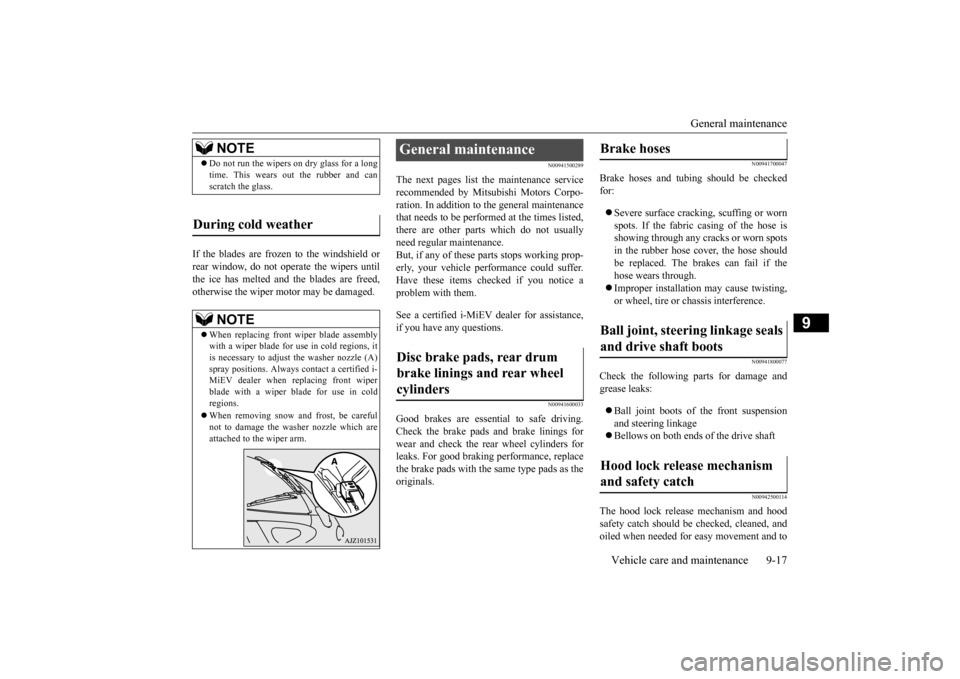
When replacing front wiper blade assembly with a wiper blade for use in cold regions, it is necessary to adjust the washer nozzle (A)
contact a certified i-
MiEV dealer when re
placing front wiper
blade with a wiper blade for use in cold regions. When removing snow and frost, be careful not to damage the wash
er nozzle which are
attached to the wiper arm.
General maintenance Disc brake pads, rear drum brake linings and rear wheel cylinders
Brake hoses Ball joint, steering linkage seals and drive shaft boots Hood lock release mechanism and safety catch
BK0220401US.book 17 ページ 2015年6月3日 水曜日 午前7時42分
Page 280 of 296
Consumer information (For vehicles sold in U.S.A.) 10-2 Customer assistance/Re
porting Safety Defects
10
N01047100171
This information is provided in compliance with the requirements of the National High- way Traffic Safety Ad
ministration, Depart-
ment of Transportation. It provides the purchasers and/or prospective purchasers with information on repor
ting safety defects.
DOT quality grades - Al
l passenger vehicle
tires must conform to
Federal Safety Require-
ments in addition to these grades. The spe- cific grade rating in each grade category isshown on the side wall of the tires on your vehicle. The treadwear grade is a comparative rating based on the wear rate of
the tire when tested
under controlled conditions on a specifiedgovernment test course
. For example, a tire
graded 150 would wear one and one-half (11/2) times as well on the government course
as a tire graded 100.
The relative performance
of tires depends upon the actual conditions of
their use, however, and may depart signifi- cantly from the norm due to variations indriving habits, service practices and differ- ences in road characteristics and climate. The traction grades, from highest to lowest, are AA, A, B and C. Those grades represent the tire’s ability to
stop on wet pavement as
measured under controlled conditions on specified government te
st surfaces of asphalt
and concrete. A tire marked C may have poor traction performance. The temperature grades are A (the highest), B and C, representing the ti
re’s resistance to the
generation of heat and it
s ability to dissipate
heat when tested un
der controlled conditions
on a specified indoor
laboratory test wheel.
Sustained high temperature can cause the
material of the tire to
degenerate and reduce
tire life, and excessive temperature can leadto sudden tire failure. The grade C corre- sponds to a level of performance which all passenger car tires must meet under the Fed-eral Motor Vehicle Safety Standard No. 109. Grades B and A represent higher levels of performance on the labora
tory test wheel than
the minimum required by law.
N01047201515
If you believe that your vehicle has a defect which could cause a crash or could cause injury or death, you should immediately inform theNational Highway Traffic Safety Administration (NHTSA) in addi- tion to notifying Mitsubishi MotorsCorporation.
Consumer information (For vehicles sold in U.S.A.) Uniform tire quality grading Treadwear
Traction AA, A, B, C
WA R N I N G The traction grade assi
gned to this tire is
based on straight-ahead braking tractiontests, and does not include acceleration, cornering, hydroplani
ng, or peak traction
characteristics.
Temperature A, B, C
WA R N I N G The temperature grade for this tire is established for a tire that is properlyinflated and not overloaded. Excessive speed, underinflation
, or excessive load-
ing, either separately
or in combination,
can cause heat buildup and possible tire failure.
Reporting Safety Defects
BK0220401US.book 2 ページ 2015年6月3日 水曜日 午前7時42分