brake MITSUBISHI iMiEV 2017 1.G Service Manual
[x] Cancel search | Manufacturer: MITSUBISHI, Model Year: 2017, Model line: iMiEV, Model: MITSUBISHI iMiEV 2017 1.GPages: 296, PDF Size: 7.79 MB
Page 239 of 296
Tire repair kit
For emergencies 8-7
8
1. Park the vehicle on a
safe, flat and level
place. 2. Set the parking brake firmly. 3. Move the selector
lever to the “P”
motor switch to the “LOCK” position. 4. Turn on the hazard warning flashers andset up a warning sign, such as a warning triangle or flashing signal lamp, at an ade- quate distance from the vehicle, and haveall your passengers leave the vehicle. 5. Take out the tire repair kit.
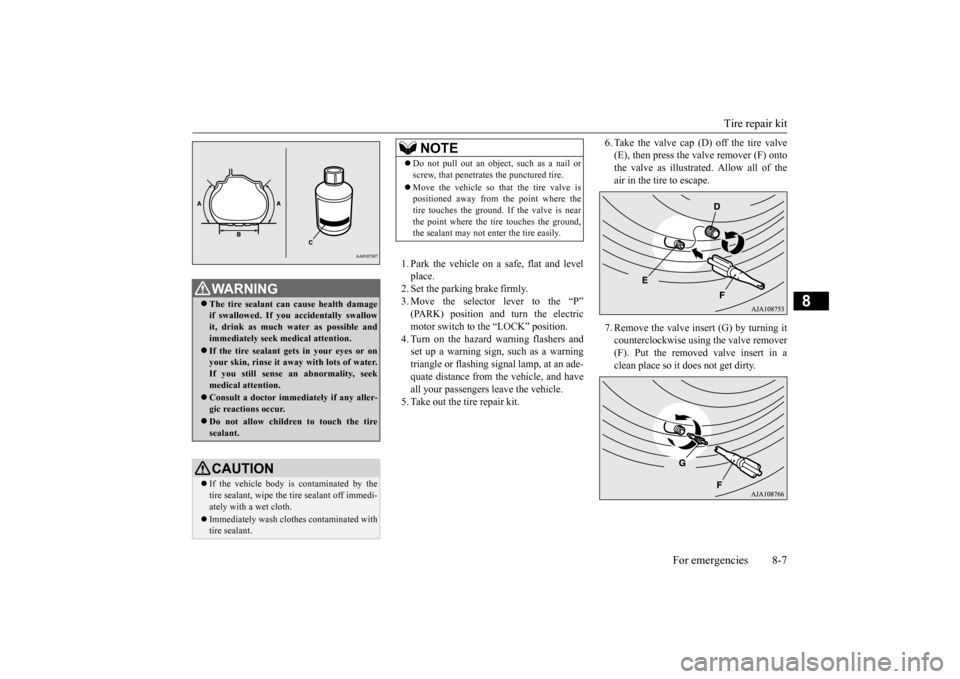
6. Take the valve cap (D) off the tire valve (E), then press the valve remover (F) ontothe valve as illustrated. Allow all of the air in the tire to escape. 7. Remove the valve insert (G) by turning it counterclockwise using the valve remover(F). Put the removed valve insert in a clean place so it does not get dirty.
WA R N I N G The tire sealant can
cause health damage
if swallowed. If you
accidentally swallow
it, drink as much water as possible and immediately seek medical attention. If the tire sealant gets in your eyes or on your skin, rinse it away with lots of water. If you still sense an
abnormality, seek
medical attention. Consult a doctor immediately if any aller- gic reactions occur. Do not allow children to touch the tire sealant.CAUTION If the vehicle body is contaminated by the tire sealant, wipe the tire sealant off immedi- ately with a wet cloth. Immediately wash clothes contaminated with tire sealant.
NOTE
Do not pull out an object, such as a nail or screw, that penetrat
es the punctured tire.
Move the vehicle so that the tire valve is positioned away from the point where the tire touches the ground. If the valve is nearthe point where the tire touches the ground, the sealant may not enter the tire easily.
BK0220401US.book 7 ページ 2015年6月3日 水曜日 午前7時42分
Page 245 of 296
Operation under adverse driving conditions
For emergencies 8-13
8
N00837200747
If your vehicle becomes stuck in snow, sand, or mud, it can often be moved by a rocking motion. Rock your vehicle back and forth tofree it. Do not spin the wheels. Constant efforts to free a stuck vehicle can cause transmissionfailure. If your vehicle is still
stuck after several rock-
ing attempts, call for a commercial tow truckservice.
When driving on a road covered with snow or ice, use snow tires. Tire chains cannot be used on your vehicle. Theremay be state or local regulations about using snow tires. Always check the regu- lations in your local area before usingthem. Refer to the section entitled “Snow tires” on page 9-15 and “Tire chains” on page 9-16. Drive slowly. Do not make sudden starts or stops, sharp turns, or slam on the brakes. Allow extra distance between your vehi- cle and the vehicle in front of you, and avoid sudden braking. If a skid occurs when the accelerator pedal is depressed, take your foot off the pedal. Steer gently in the direction of theskid. Your vehicle is equippe
d with an anti-lock
braking system (ABS), hold the brakepedal down firmly and
keep it depressed.
Do not pump the brake pedal which will result in reduced braking performance.
CAUTION If the transmission or the steering system has a problem or damage,
transport the vehicle
on a flatbed truck or to
w the vehicle with the
all wheels off the ground. If the electric motor switch is in the “ON”
lting in an accident.
Make sure the electric motor switch is in the“ACC” position before towing.
Operation under adverse driving conditions If your vehicle becomes stuck in sand, mud or snow
WA R N I N G When trying to rock
your vehicle out of a
stuck position, make sure that there are nopeople nearby. The
rocking motion can
make your vehicle suddenly lurch forward or backward, and inju
re any bystanders.
On wet roads
CAUTIONDo not drive on a flooded road. If you drive on a flooded road, not only the electric motorunit stops but also a fail
ure like electric leak-
age or short circuit may occur. If you inevitably had to run on a floodedroad and the vehicle was exposed to water, be sure to have your vehicle inspected by a certified i-MiEV dealer. When driving in rain, on water-covered roads, or through a car wash, water could getinto the brake discs and make them fail tem- porarily. In such cases, lightly press the brake pedal to see if they are working prop-erly. If they are not, press the pedal lightlyseveral times while driv
ing to dry the brake
pads or linings, then check them again. When driving in rain, a layer of water may form between the tires and the road surface (aquaplaning). This l
oosens your tires’ grip
on the road, making it difficult to steer or brake properly. When driving on a wet road:• Drive your vehicle at a safe speed.
• Do not drive on worn tires.• Always keep the tires at the correct infla- tion pressures.
On snowy or icy roads
CAUTION
BK0220401US.book 13 ページ 2015年6月3日 水曜日 午前7時42分
Page 246 of 296
Operation under adverse driving conditions 8-14 For emergencies
8
After parking on snowy or icy road, it may be difficult to move your vehicle dueto freeze-up of the brake. Depress the accelerator pedal little by little to move the vehicle after confirming safety of thevehicle. Drive as slow as possible when driving on bumpy or rutted roads or over potholes etc.CAUTION Do not depress the acce
lerator pedal rapidly.
The vehicle could start moving when itbreaks free from the ic
e, possibly resulting in
an accident.
On a bumpy or rutted road
CAUTION Driving on bumpy, rutted roads or over pot- holes can damage the tires and wheels. Wheels with low-profiles tires or under-inflated tires are especi
ally at risk for dam-
age. The vehicle’s body, bumper, muffler and other parts may be dama
ged if the vehicle is:
• driven over a step (for example, at the entrance or exit of a parking lot);
• parked too closely against a curb or parkingblock, or by the side of a road with curb-stones;• driven on a steep slope.CAUTION
BK0220401US.book 14 ページ 2015年6月3日 水曜日 午前7時42分
Page 247 of 296
9
Vehicle care and maintenanceService precautions ..........................................................................9-2 Hood .............
............
...........
...........
...........
...........
...........
...........
.....9-3
View under the hood and electric motor unit room .........................9-4Coolant/Hot water heater fluid ........................................................9-4 Washer fluid .....................................................................................9-7 Brake fluid .......................................................................................9-712V starter battery ...........................................................................9-7 Tires ...............................................................................................9-10 Brake pedal free play .....................................................................9-16Parking brake lever stroke .............................................................9-16 Wiper blades ..................................................................................9-16 General maintenance .....................................................................9-17For cold and snowy weather ..........................................................9-18 Fusible links ...................................................................................9-18 Fuses ..............................................................................................9-18Replacement of light bulbs ............................................................9-21 Vehicle care precautions ................................................................9-28 Cleaning the inside of your vehicle .......
...........
...........
...........
.......9-28
Cleaning the outside of your vehicle .....
...........
...........
...........
.......9-30
BK0220401US.book 1 ページ 2015年6月3日 水曜日 午前7時42分
Page 250 of 296
View under the hood and
electric motor unit room
9-4 Vehicle care and maintenance
9
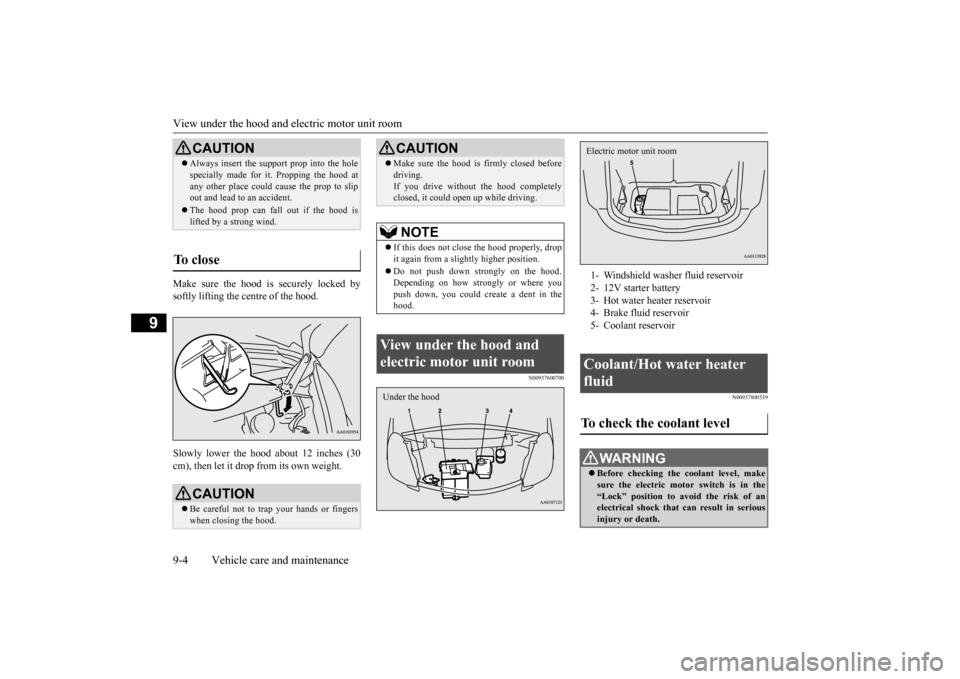
Make sure the hood is securely locked by softly lifting the centre of the hood. Slowly lower the hood about 12 inches (30 cm), then let it drop from its own weight.
N00937600700
N00937800539
CAUTION Always insert the support prop into the hole specially made for
it. Propping the hood at
any other place could
cause the prop to slip
out and lead to
an accident.
The hood prop can fall out if the hood is lifted by a strong wind.
To close
CAUTION Be careful not to trap your hands or fingers when closing the hood.
Make sure the hood is firmly closed before driving.If you drive without the hood completelyclosed, it could open up while driving.NOTE
If this does not close the hood properly, drop it again from a slightly higher position. Do not push down strongly on the hood. Depending on how strongly or where you push down, you could create a dent in the hood.
View under the hood and electric motor unit room
CAUTION
Under the hood
1- Windshield washer fluid reservoir 2- 12V starter battery 3- Hot water heater reservoir 4- Brake fluid reservoir5- Coolant reservoirCoolant/Hot water heater fluid To check the coolant level
WA R N I N G Before checking the
coolant level, make
sure the electric motor switch is in the“Lock” position to
avoid the risk of an
electrical shock that can result in serious injury or death.Electric motor unit room
BK0220401US.book 4 ページ 2015年6月3日 水曜日 午前7時42分
Page 253 of 296
Washer fluid
Vehicle care and maintenance 9-7
9
N00938600303
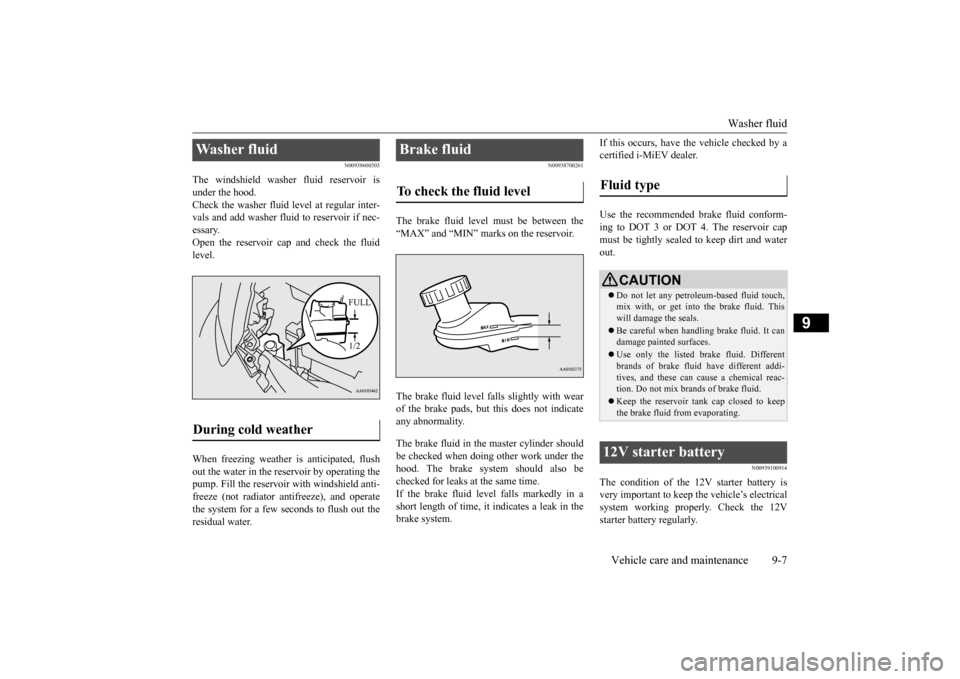
The windshield washer fluid reservoir is under the hood. Check the washer fluid level at regular inter-vals and add washer fluid to reservoir if nec- essary. Open the reservoir cap and check the fluidlevel. When freezing weather is anticipated, flush out the water in the reservoir by operating the pump. Fill the reservoir with windshield anti-freeze (not radiator
antifreeze), and operate
the system for a few se
conds to flush out the
residual water.
N00938700261
The brake fluid level must be between the “MAX” and “MIN” marks on the reservoir. The brake fluid level fa
lls slightly with wear
of the brake pads, but
this does not indicate
any abnormality. The brake fluid in the master cylinder should be checked when doing other work under the hood. The brake system should also bechecked for leaks at the same time. If the brake fluid level falls markedly in a short length of time, it indicates a leak in thebrake system.
If this occurs, have the vehicle checked by a certified i-MiEV dealer. Use the recommended brake fluid conform- ing to DOT 3 or DOT 4. The reservoir capmust be tightly sealed
to keep dirt and water
out.
N00939100914
The condition of the 12V starter battery is very important to keep the vehicle’s electricalsystem working properly. Check the 12V starter battery regularly.
Washer fluid During cold weather
FULL 1/2
Brake fluid To check the fluid level
Fluid type
CAUTION Do not let any petrol
eum-based fluid touch,
mix with, or get into the brake fluid. This will damage the seals. Be careful when handling brake fluid. It can damage painted surfaces. Use only the listed brake fluid. Different brands of brake fluid have different addi-tives, and these can cause a chemical reac- tion. Do not mix brands of brake fluid. Keep the reservoir ta
nk cap closed to keep
the brake fluid from evaporating.
12V starter battery
BK0220401US.book 7 ページ 2015年6月3日 水曜日 午前7時42分
Page 262 of 296
Brake pedal free play 9-16 Vehicle care and maintenance
9
N00940100129 N00940300310
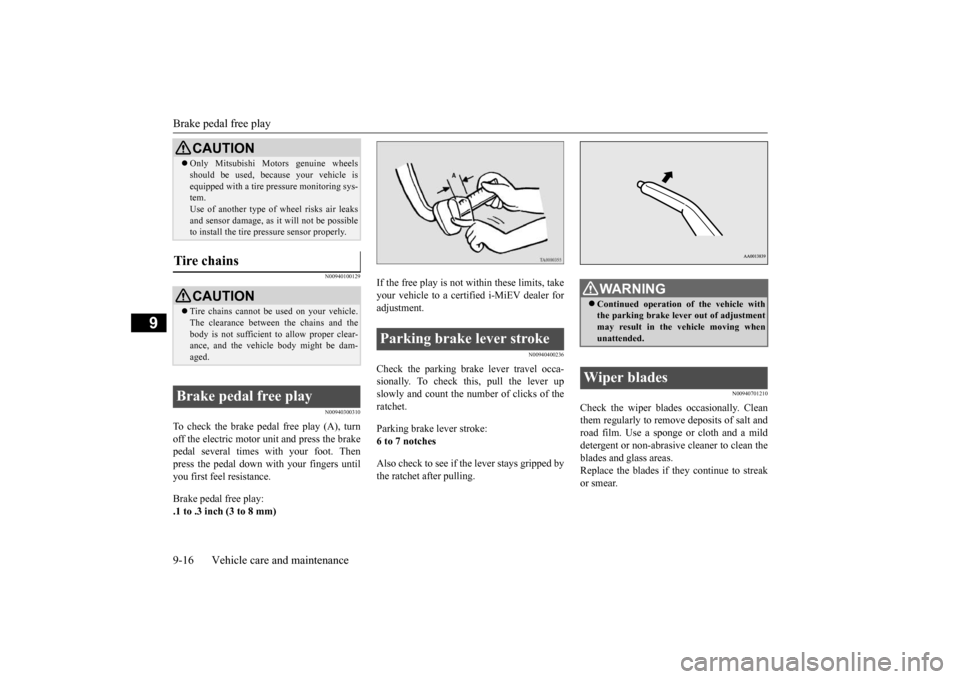
To check the brake pedal free play (A), turn off the electric motor unit and press the brakepedal several times
with your foot. Then
press the pedal down wi
th your fingers until
you first feel resistance. Brake pedal free play: .1 to .3 inch (3 to 8 mm)
If the free play is not within these limits, take your vehicle to a certified i-MiEV dealer for adjustment.
N00940400236
Check the parking brake lever travel occa- sionally. To check this, pull the lever upslowly and count the number of clicks of the ratchet. Parking brake lever stroke: 6 to 7 notches Also check to see if the lever stays gripped by the ratchet after pulling.
N00940701210
Check the wiper blades occasionally. Cleanthem regularly to remove
deposits of salt and
road film. Use a sponge or cloth and a mild detergent or non-abrasive
cleaner to clean the
blades and glass areas. Replace the blades if th
ey continue to streak
or smear.
Only Mitsubishi Motors genuine wheels should be used, beca
use your vehicle is
equipped with a tire pr
essure monitoring sys-
tem. Use of another type of
wheel risks air leaks
and sensor damage, as
it will not be possible
to install the tire pressure sensor properly.
Tire chains
CAUTION Tire chains cannot be used on your vehicle. The clearance between
the chains and the
body is not sufficient to allow proper clear- ance, and the vehicle body might be dam- aged.
Brake pedal free play
CAUTION
Parking brake lever stroke
WA R N I N G Continued operation
of the vehicle with
the parking brake leve
r out of adjustment
may result in the
vehicle moving when
unattended.
Wiper blades
BK0220401US.book 16 ページ 2015年6月3日 水曜日 午前7時42分
Page 263 of 296
General maintenance
Vehicle care and maintenance 9-17
9
If the blades are frozen to the windshield or rear window, do not operate the wipers until the ice has melted and the blades are freed,otherwise the wiper mo
tor may be damaged.
N00941500289
The next pages list th
e maintenance service
recommended by Mitsubishi Motors Corpo- ration. In addition to the general maintenancethat needs to be performed at the times listed, there are other parts which do not usually need regular maintenance.But, if any of these parts stops working prop- erly, your vehicle performance could suffer. Have these items checked if you notice a problem with them. See a certified i-MiEV dealer for assistance, if you have any questions.
N00941600033
Good brakes are essential to safe driving. Check the brake pads and brake linings for wear and check the rear wheel cylinders forleaks. For good braking performance, replace the brake pads with the same type pads as the originals.
N00941700047
Brake hoses and tubing should be checked for: Severe surface cracki
ng, scuffing or worn
spots. If the fabric casing of the hose isshowing through any cracks or worn spots in the rubber hose cover, the hose should be replaced. The brakes can fail if the hose wears through. Improper installation may cause twisting, or wheel, tire or
chassis interference.
N00941800077
Check the following parts for damage and grease leaks: Ball joint boots of the front suspension and steering linkage Bellows on both ends of the drive shaft
N00942500114
The hood lock release mechanism and hood safety catch should be
checked, cleaned, and
oiled when needed for easy movement and to
NOTE
Do not run the wipers on dry glass for a long time. This wears out the rubber and canscratch the glass.
During cold weather
NOTE
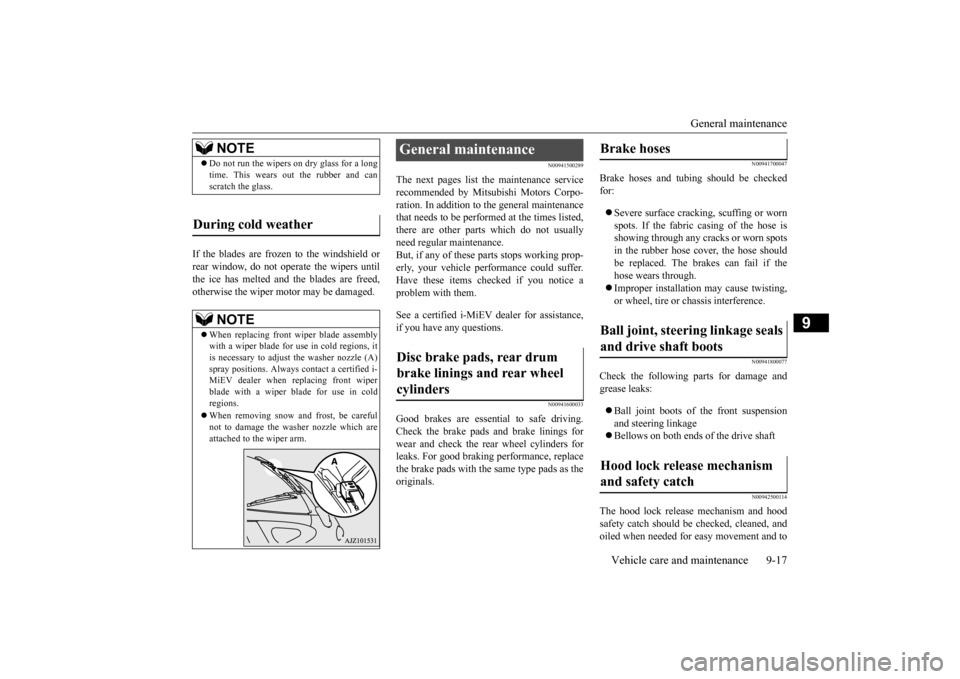
When replacing front wiper blade assembly with a wiper blade for use in cold regions, it is necessary to adjust the washer nozzle (A)
contact a certified i-
MiEV dealer when re
placing front wiper
blade with a wiper blade for use in cold regions. When removing snow and frost, be careful not to damage the wash
er nozzle which are
attached to the wiper arm.
General maintenance Disc brake pads, rear drum brake linings and rear wheel cylinders
Brake hoses Ball joint, steering linkage seals and drive shaft boots Hood lock release mechanism and safety catch
BK0220401US.book 17 ページ 2015年6月3日 水曜日 午前7時42分
Page 266 of 296
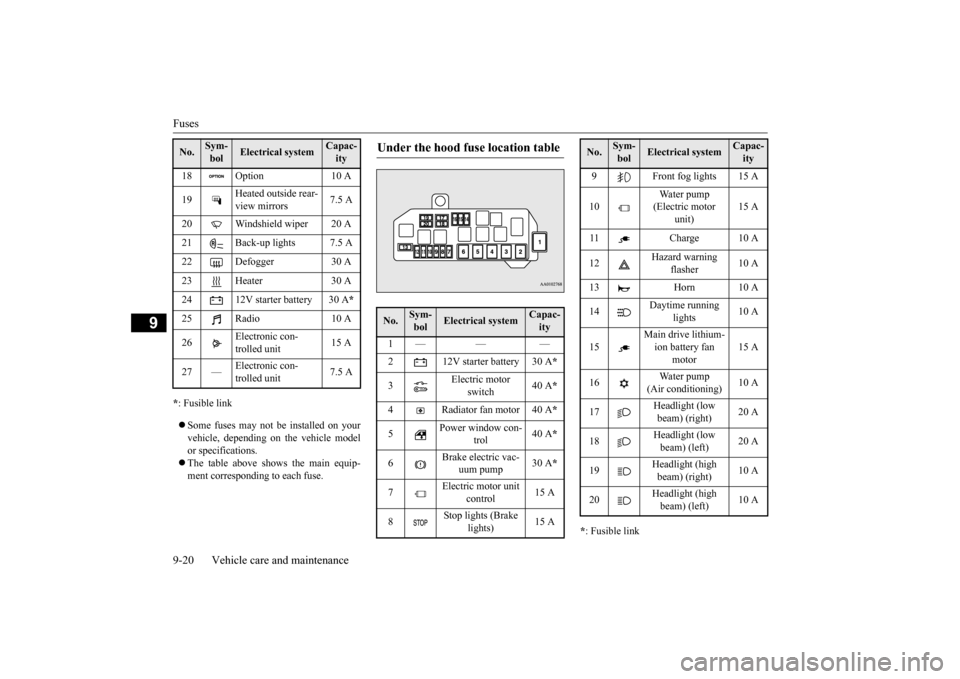
Fuses 9-20 Vehicle care and maintenance
9
* : Fusible link Some fuses may not be installed on your vehicle, depending on the vehicle model or specifications. The table above shows the main equip- ment corresponding to each fuse.
* : Fusible link
18 Option 10 A 19
Heated outside rear- view mirrors
7.5 A
20 Windshield wiper 20 A 21 Back-up lights 7.5 A 22 Defogger 30 A23 Heater 30 A24 12V starter battery 30 A
*
25 Radio 10 A 26
Electronic con- trolled unit
15 A
27 —
trolled unit
7.5 A
No.
Sym- bol
Electrical system
Capac-ity
Under the hood fuse location table No.
Sym- bol
Electrical system
Capac-ity
1— — — 2 12V starter battery 30 A
*
3
Electric motor
switch
40 A
*
4 Radiator fan motor 40 A
*
5
Power window con-
trol
40 A
*
6
Brake electric vac-
uum pump
30 A
*
7
Electric motor unit
control
15 A
8
Stop lights (Brake
lights)
15 A
9 Front fog lights 15 A 10
Water pump (Electric motor
unit)
15 A
11 Charge 10 A 12
Hazard warning
flasher
10 A
13 Horn 10 A 14
Daytime running
lights
10 A
15
Main drive lithium- ion battery fan
motor
15 A
16
Water pump
(Air conditioning)
10 A
17
Headlight (low beam) (right)
20 A
18
Headlight (low beam) (left)
20 A
19
Headlight (high beam) (right)
10 A
20
Headlight (high beam) (left)
10 A
No.
Sym- bol
Electrical system
Capac-ity
BK0220401US.book 20 ページ 2015年6月3日 水曜日 午前7時42分
Page 278 of 296
Cleaning the outside of your vehicle 9-32 Vehicle care and maintenance
9
N00946400065
To prevent spots and corrosion of chrome parts, wash with water, dry thoroughly, andapply a nonabrasive automotive wax. If the chrome is severely da
maged or pitted, use a
commercially available chrome polish.
N00946500196
1. Remove dirt using a wet sponge.2. Use a mild detergent on any dirt that can-not be removed ea
sily with water.
Rinse off the detergent after washing the wheel.3. Dry the wheel thoroughly using a chamois leather or a soft cloth.
N00946600067
The window glass can
usually be cleaned
using only a sponge and
water. Glass cleaner
can be used to remove wax, oil, grease, deadinsects, etc. After washing the glass, wipe it dry with a clean, dry, soft cloth.
N00946700097
Use a soft cloth and gl
ass cleaner to remove
grease, dead insects, etc., from the wiper blades.Replace the wiper blades when they no longer clean the windshield and rear window prop- erly.
N00947000127
Never spray or splash
water on the electrical
components under the hood, as this may cause damage.Do not allow any nearby
parts (such as plastic
parts) come into contact with sulphuric acid (12V starter battery el
ectrolyte), which may
crack, stain, or discolour them. If this occurs, wipe the parts with a soft cloth saturated with a mild detergent and water solution. Then immediately rinse the affected partswith plenty of water.
Do not use wax containing compounds (pol- ishing powder) which ma
y damage the plas-
tic surface. Do not let the plastic parts get soiled with gasoline, oil, brake fl
uids, greases, paint
thinner, and sulfuric
acid (battery electro-
lyte). These fluids, et
c., may crack, stain or
discolor the plastic parts.If any of these get on the plastic parts, wipe them up with a soft cloth or chamois and a mild solution of soap and water. Then rinsethem immediately with water.
Chrome parts Aluminum wheels
CAUTION
CAUTION Do not use a brush or other hard implement on the wheels.Doing so could scratch the wheels. Do not use any cleaner that contains an abra- sive substance or is ac
idic or alkaline. Doing
so could cause the co
ating on the wheels to
peel or become disc
olored or stained.
Do not directly apply
hot water using a steam
cleaner or by any other means. Contact with seawater or road salt used for de-icing can cause corr
osion. Rinse off such
substances as soon as possible.
Window glass Wiper blades
Under the hood
BK0220401US.book 32 ページ 2015年6月3日 水曜日 午前7時42分