brake MITSUBISHI iMiEV 2017 1.G User Guide
[x] Cancel search | Manufacturer: MITSUBISHI, Model Year: 2017, Model line: iMiEV, Model: MITSUBISHI iMiEV 2017 1.GPages: 296, PDF Size: 7.79 MB
Page 42 of 296
Quick charging (charging method with quick charger) 3-28 General information/Charging
3
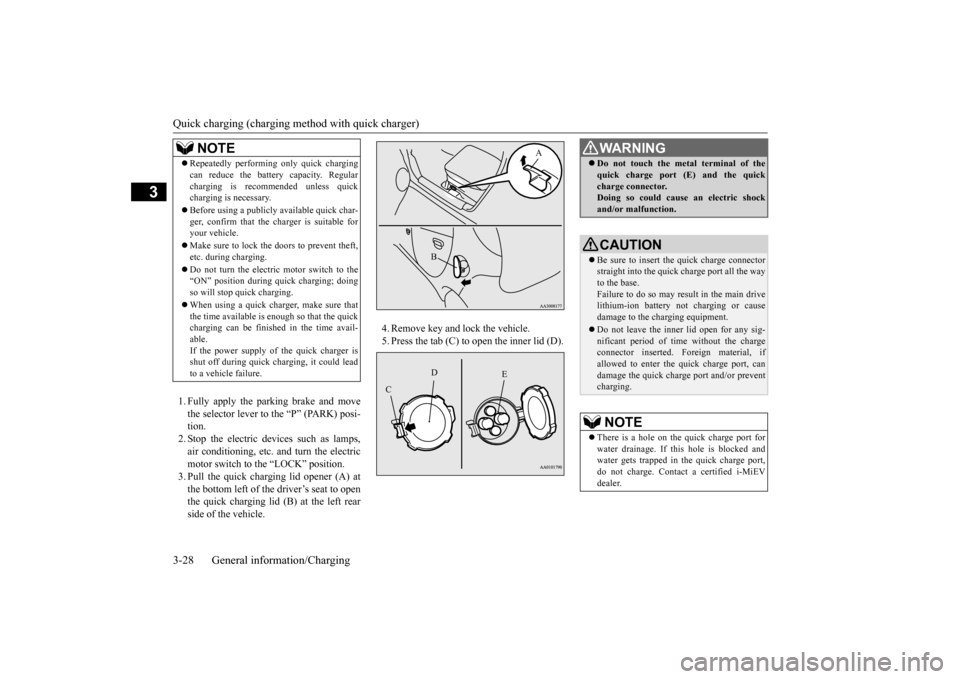
1. Fully apply the parking brake and move the selector lever to the “P” (PARK) posi- tion.2. Stop the electric devices such as lamps, air conditioning, etc.
and turn the electric
motor switch to the “LOCK” position.3. Pull the quick charging lid opener (A) at the bottom left of the driver’s seat to open the quick charging lid (B) at the left rearside of the vehicle.
4. Remove key and lock the vehicle. 5. Press the tab (C) to open the inner lid (D).
NOTE
Repeatedly performi
ng only quick charging
can reduce the battery capacity. Regularcharging is recommended unless quickcharging is necessary. Before using a publicly available quick char- ger, confirm that the charger is suitable for your vehicle. Make sure to lock the doors to prevent theft, etc. during charging. Do not turn the electric motor switch to the “ON” position during
quick charging; doing
so will stop quick charging. When using a quick charger, make sure that the time available is
enough so that the quick
charging can be finished in the time avail- able. If the power supply of the quick charger isshut off during quick ch
arging, it could lead
to a vehicle failure.
A
B
E
D
C
WA R N I N G Do not touch the metal terminal of the quick charge port (E) and the quickcharge connector.Doing so could cause an electric shock and/or malfunction.CAUTION Be sure to insert the quick charge connector straight into the quick charge port all the wayto the base. Failure to do so may result in the main drive lithium-ion battery not charging or causedamage to the charging equipment. Do not leave the inner lid open for any sig- nificant period of ti
me without the charge
connector inserted.
Foreign material, if
allowed to enter the quick charge port, candamage the quick charge port and/or prevent charging.NOTE
There is a hole on the quick charge port for water drainage. If this
hole is blocked and
water gets trapped in the quick charge port,do not charge. Contac
t a certified i-MiEV
dealer.
BK0220401US.book 28 ページ 2015年6月3日 水曜日 午前7時42分
Page 49 of 296
High-Voltage components
General information/Charging 3-35
3
N01205800031
A crash or impact significant enough to require an emergency response for conven- tional vehicles would
also require the same
response for electric vehicles. Also follow the instru
ctions described below
to avoid severe burns a
nd electrical shock that
may result in serious injury or death. 10- Quick charge portIn case of a collision
WA R N I N G If your vehicle is dri
vable, pull your vehi-
cle off the road to a safe, nearby locationand remain on the scene. Also, if possible, do the following opera- tions and stay out of the way of anyoncoming traffic while awaiting the arrival of emerge
ncy responders.
• Apply chocks to the wheels.• Move the selector
lever to the “P”
• Apply the parking brake.• Open the windows,
doors and liftgate.
• Turn the electric motor switch to the “LOCK” position.• Turn on the hazard warning flashers.• Move the key away from the vehicle to prevent unintended start-up of the sys- tem by inadvertent co
ntact with a switch
or impact from the crash.
Never touch high-voltage wiring, connec- tors, and other high-vol
tage parts, such as
the inverter unit and main drive lithium-ion battery. An electric shock may occur if exposed electric wires are visible when viewed from inside
or outside of your
vehicle. For their locations, see “High- voltage components” on page 3-34. If the vehicle receives a strong impact to the floor while driving, stop the vehicle in a safe place and check the floor. Leaks or damage to the main drive lith- ium-ion battery may result in a fire. If youdiscover them, contact emergency services immediately. Since the fluid leak may be lithium manganite from the Lithium-ionbattery, never touch any fluid leaking from the inside or outs
ide of the vehicle. If
the fluid contacts you
r skin or eyes, wash
it off immediately with a large amount of water and receive immediate medical attention to help
avoid serious injury.
If you are unable to safely assess the vehi- cle due to vehicle damage, do not touchthe vehicle. Leave the vehicle and contact emergency services. Advise emergency responders that this is
an electric vehicle.
WA R N I N G
If a fire occurs in th
is vehicle,
leave the
vehicle as soon as possible and contactemergency services. Do not attempt toextinguish a fire by yourself. If the fire involves a lithium-ion battery, it will require large, sustained volumes of waterfor extinguishment.
Using a small amount
of water or the incorrect fire extinguisher can result in serious injury or death fromelectrical shock. When you leave the ve
hicle, if possible,
open the windows,
doors and liftgate to
prevent accumulation of poisonous/com- bustible gasses. This will also assist in therescue and fire fighting process. As with any vehicle fi
re, the byproducts of
combustion can be toxic. Do not inhale smoke, vapors, or gas
from the vehicle.
Move to a safe distan
ce upwind and uphill
from the vehicle fire
and out of the way of
any oncoming traffic
while awaiting the
arrival of emerge
ncy responders.
If you detect leaking
fluids, sparks, smoke,
flames, gurgling, popp
ing or hissing noises
originating from the
high voltage battery
compartment, contact emergency services immediately. This may result in a fire. Physical damage to the vehicle or high voltage battery may result in immediate ordelayed release of t
oxic and/or flammable
gases and fire.WA R N I N G
BK0220401US.book 35 ページ 2015年6月3日 水曜日 午前7時42分
Page 93 of 296
Supplemental Restraint System (SRS) - airbag
Seat and restraint systems 4-21
4
abdomen and hip injuri
es by deploying the
bag on the side impact
ed in moderate to
severe side impact collisions. The SRS cur- tain airbags provide the driver and passengers on the front seat and re
ar seat with protection
against head injuries
by deploying a bag on
the side impacted in moderate to severe side impact collisions. The SRS airbags are NOT a substitute for use of the seat belts. For maximum protection in all types of accidents, seat belts must ALWAYS be worn by everyone who drives or rides in this vehicle
(with infants and small
children in an appropriate child restraint sys-tem in the rear seat, and older children buck- led in the rear seat). Refer to “Child restraint systems” on page 4-13.
WA R N I N G IT IS VERY IMPORTANT TO ALWAYS WEAR YOUR SEAT BELT PROPERLY EVEN WITH AN AIRBAG.
• Seat belts help keep the driver and pas-sengers properly positioned. Thisreduces the risk of injury in all collisions,and reduces the risk of serious injuries or death when the airbags inflate. During sudden braking just before a col-lision, an unrestra
ined or improperly
restrained driver or passengers can move forward into direct contact with, orwithin close proximity to, the airbag when it begins to inflate. The beginning stage of
airbag inflation is
the most forceful and can cause serious injuries or death if the occupant comes in contact with the ai
rbag at this time.
• Seat belts reduce the risk of injury in rollovers, rear impact collisions, and inlower-speed frontal collisions, because the airbags are not de
signed to inflate in
those situations.• Seat belts reduce the risk of beingthrown from your vehi
cle in a collision or
rollover.
IT IS VERY IMPORTANT TO BE PROP- ERLY SEATED.• A driver or front passenger sitting tooclose to the steering wheel or instrument panel during airbag deployment can be seriously inju
red or killed.
WA R N I N G
• Airbags inflate ve
ry quickly and with
great force. If the driver and front pas-senger are not properly seated andrestrained, the airbag may not provide the proper protection and can cause seri- ous injuries or deat
h when it inflates.
• To reduce the risk to the driver of serious injury or death
due to a deploying
driver’s airbag, al
ways properly wear
your seat belt and adju
st the driver’s seat
as far back as possible, maintaining aposition that still allows the driver to have good control of the steering wheel, brake, accelerator,
and other vehicle con-
trols.• To reduce the risk to the front passengerof serious injury or
death from a deploy-
ing passenger’s airbag, make sure the passenger always wears the seat beltproperly, remains seat
ed upright and all
the way back in the
seat, and positions
the seat as far back as possible. • Seat all infants and children in the rearseat, properly restrain
ed in an appropri-
ate child restraint system.
Airbags inflate very
quickly and with
great force. Do not sit on the edge of the seat or lean your head
or chest close to the
steering wheel or the instrument panel. Do not put your feet or legs on or against the instrument panel.WA R N I N G
BK0220401US.book 21 ページ 2015年6月3日 水曜日 午前7時42分
Page 96 of 296
Supplemental Restraint System (SRS) - airbag 4-24 Seat and restraint systems
4
short period of time,
typically 30 seconds or
less. The EDR in this vehicle is designed to record such data as: How various systems in your vehicle were operating; Whether or not the driver safety belt was buckled/fastened; How far (if at all) the driver was depress- ing the accelerator and/or brake pedal; and, How fast the vehicle was traveling.
These data can help provide a better under- standing of the circumstances in which crashes and injuries occur. To read data recorded by an EDR, special equipment is required, and access to the vehi-
cle or the EDR is needed. In addition to the vehicle manufacturer, ot
her parties, such as
law enforcement, that have the special equip- ment, can read the information if they have access to the vehicle or the EDR.
N00417900210
The driver’s seat posit
ion sensor is attached
to the seat rail and provides the airbag control unit with information
on the seat’s fore-aft
position. The airbag control unit controlsdeployment of the driver’s front airbag in accordance with the information it receives from this sensor.If there is a problem involving the driver’s seat position sensor, th
e SRS warning light in
the instrument panel will come on. Refer to“SRS warning light” on page 4-26.
N00418000351
The passenger’s seat oc
cupant classification
sensor system is attached to the front passen- ger seat cushion and provides the airbag con- trol unit with inform
ation regarding the
occupant on the front passenger seat. The air- bag control unit controls deployment of the passenger’s front airbag in accordance withthe information it receives from this system. The passenger’s front airbag will not deploy in an impact when the system senses no occu-pant on the front passenger’s seat or a child in a child restraint system. In this case, the pas- senger’s airbag off indi
cator will come on.
Refer to “Passenger’s ai
rbag off indicator” on
page 4-25. If there is a problem involving the passen-ger’s seat occupant cl
assification sensor sys-
tem, the SRS warning light in the instrument panel will come on. Refer to “SRS warninglight” page 4-26.
NOTE
EDR data are recorded by your vehicle only if a non-trivial crash situation occurs; no dataare recorded by the EDR under normal driv- ing conditions and no personal data (e.g., name, gender, age, and crash location) arerecorded. However, ot
her parties, such as
law enforcement, could combine the EDR data with the type of
personally identifying
data routinely acquire
d during a crash inves-
tigation.
Driver’s seat position sensor
WA R N I N G If the SRS warning
light comes on, have
the vehicle inspected by a certified i-MiEV dealer as soon as possible. Please observe the following instructions to ensure that the driver’s seat position sensor can operate correctly.• Adjust the seat to the correct position,and sit well back
against the seatback.
Refer to “Front seats” on page 4-3.• Do not recline the seatback more thannecessary when driving.
• Do not place metall
ic objects or luggage
under the front seat.
If the vehicle is involved in a severe impact, have the SRS sensor inspected by a certified i-MiEV deal
er as soon as possi-
ble.
Passenger’s seat occupant clas- sification sensor system
WA R N I N G
BK0220401US.book 24 ページ 2015年6月3日 水曜日 午前7時42分
Page 109 of 296

5
Features and controlsBreak-in recommendations ..............................................................5-2 Keys .................................................................................................5-2 Electronic immobilizer (Anti-theft starting system) ........................5-2Keyless entry system .......................................................................5-5 Door locks ........................................................................................5-8 Power door locks ........
...........
...........
...........
...........
...........
.........
.....5-9
Child safety locks for rear door ..........
...........
.........
.........
.........
.....5-10
Liftgate ........................................................................................... 5-11 Theft-alarm system ........................................................................5-12Power window control ...................................................................5-14 Parking brake .................................................................................5-16 Inside rearview mirror ...................................................................5-16Outside rearview mirrors ...............................................................5-17 Electric motor switch .....................................................................5-18 Steering wheel lock ........................................................................5-20Starting the electric motor unit ......................................................5-20 Selector lever .................................................................................5-21 Acoustic vehicle alerting system (AVAS) ......................................5-23Service brake .................................................................................5-24 Brake assist system ........................................................................5-25 Anti-lock braking system ...............................................................5-25Electric power steering system (EPS) ............................................5-27 Active stability control (ASC) .......................................................5-28 Tire pressure monitoring system ....................................................5-30Rear-view camera (if so equipped) .................................................5-34 Instrument cluster ..........................................................................5-36 Indicator and warning light package ..............................................5-43Indicators .......................................................................................5-44
Warning lights ................................................................................ 5-44 Combination headlights and dimmer switch ................................. 5-46 Turn signal lever ............................................................................ 5-49Hazard warning flasher switch ...................................................... 5-49 Front fog light switch .................................................................... 5-50 Wiper and washer switch ............................................................... 5-50Electric rear window defogger switch ....
...........
...........
...........
...... 5-52
Horn switch ................................................................................... 5-53 Link System (if so equipped) ......................................................... 5-53 Bluetooth
® 2.0 interface (if so equipped)....................................... 5-53
USB input terminal (if so equipped) .......
...........
...........
...........
...... 5-73
Sun visors ...................................................................................... 5-7612 V power outlet .......................................................................... 5-76 Interior lights ................................................................................. 5-77 Storage spaces ................................................................................ 5-79Cup holder ..................................................................................... 5-80 Assist grip ...................................................................................... 5-81
BK0220401US.book 1 ページ 2015年6月3日 水曜日 午前7時42分
Page 124 of 296
Parking brake 5-16 Features and controls
5
N00511400386
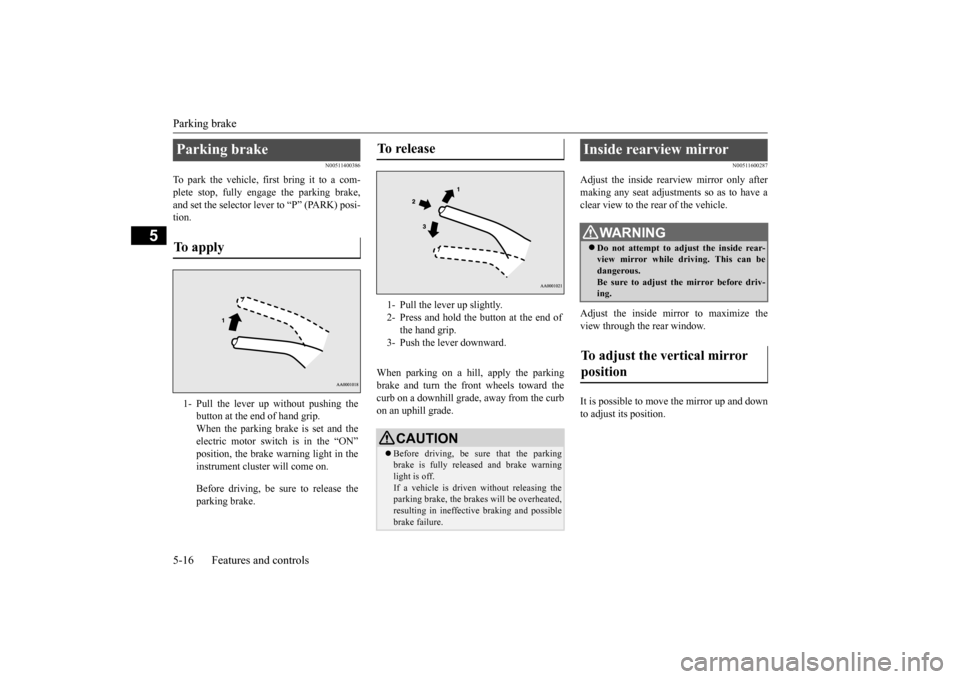
To park the vehicle, first bring it to a com- plete stop, fully engage the parking brake, and set the selector le
ver to “P” (PARK) posi-
tion.
When parking on a hill, apply the parking brake and turn the front wheels toward the curb on a downhill grade, away from the curb on an uphill grade.
N00511600287
Adjust the inside rearview mirror only after making any seat adjustme
nts so as to have a
clear view to the rear of the vehicle. Adjust the inside mirror to maximize the view through the rear window. It is possible to move the mirror up and down to adjust its position.
Parking brake To apply 1- Pull the lever up without pushing the
button at the end of hand grip. When the parking brake is set and the electric motor switch is in the “ON” instrument cluster will come on. Before driving, be sure to release the parking brake.
To release 1- Pull the lever up slightly. 2- Press and hold the button at the end of
the hand grip.
3- Push the lever downward. CAUTION Before driving, be sure that the parking brake is fully released and brake warning light is off.If a vehicle is driven without releasing the parking brake, the brak
es will be overheated,
resulting in ineffective braking and possiblebrake failure.
Inside rearview mirror
WA R N I N G Do not attempt to adjust the inside rear- view mirror while driving. This can be dangerous. Be sure to adjust the mirror before driv-ing.
To adjust the vertical mirror position
BK0220401US.book 16 ページ 2015年6月3日 水曜日 午前7時42分
Page 128 of 296
Steering wheel lock 5-20 Features and controls
5
N00571700013
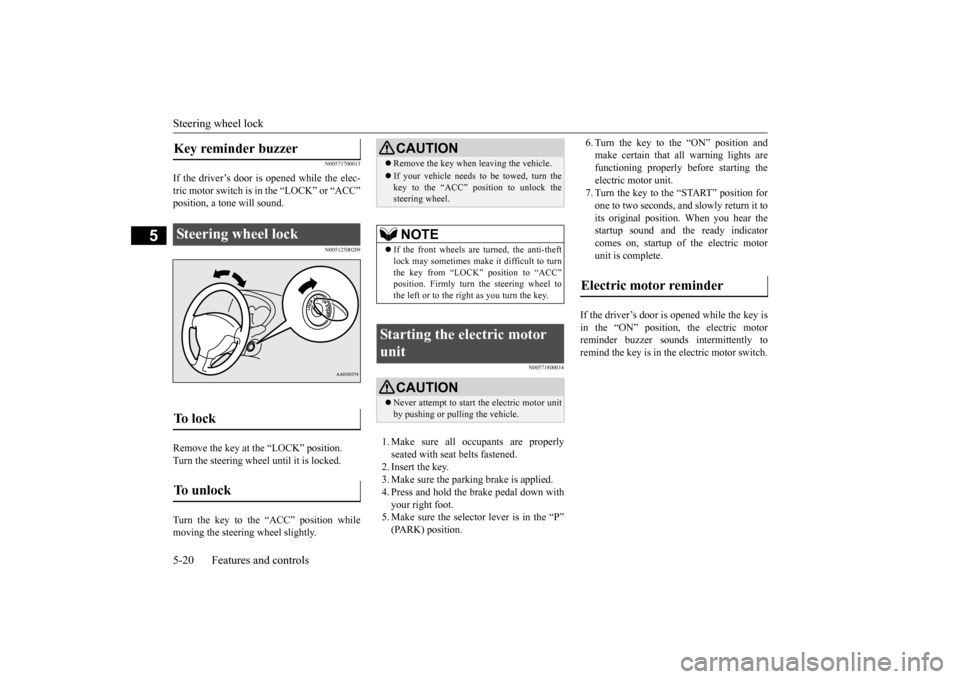
If the driver’s door is opened while the elec- tric motor switch is in the “LOCK” or “ACC”
N00512500209
Remove the key at
the “LOCK” position.
Turn the steering wheel until it is locked. Turn the key to the “ACC” position while moving the steering
wheel slightly.
N00571800014
1. Make sure all occupants are properly seated with seat belts fastened. 2. Insert the key. 3. Make sure the parking brake is applied.4. Press and hold the brake pedal down with your right foot. 5. Make sure the selector
lever is in the “P”
6. Turn the key to the “ON” position and make certain that all warning lights arefunctioning properly before starting the electric motor unit. 7. Turn the key to the “START” position forone to two seconds, and
slowly return it to
its original position. When you hear the startup sound and the ready indicatorcomes on, startup of the electric motor unit is complete.
If the driver’s door is opened while the key is in the “ON” position, the electric motorreminder buzzer sounds
intermittently to
remind the key is in the electric motor switch.
Key reminder buzzer Steering wheel lock To l o c k To u n l o c k
CAUTION Remove the key when leaving the vehicle.If your vehicle needs to be towed, turn the key to the “ACC” position to unlock the steering wheel.NOTE
If the front wheels are turned, the anti-theft lock may sometimes make it difficult to turnthe key from “LOCK” position. Firmly turn the steering wheel to the left or to the right as you turn the key.
Starting the electric motor unit
CAUTION Never attempt to start the electric motor unit by pushing or pulling the vehicle.
Electric motor reminder
BK0220401US.book 20 ページ 2015年6月3日 水曜日 午前7時42分
Page 129 of 296
Selector lever
Features and controls 5-21
5
N00583600022 N00583700023
N00583800024
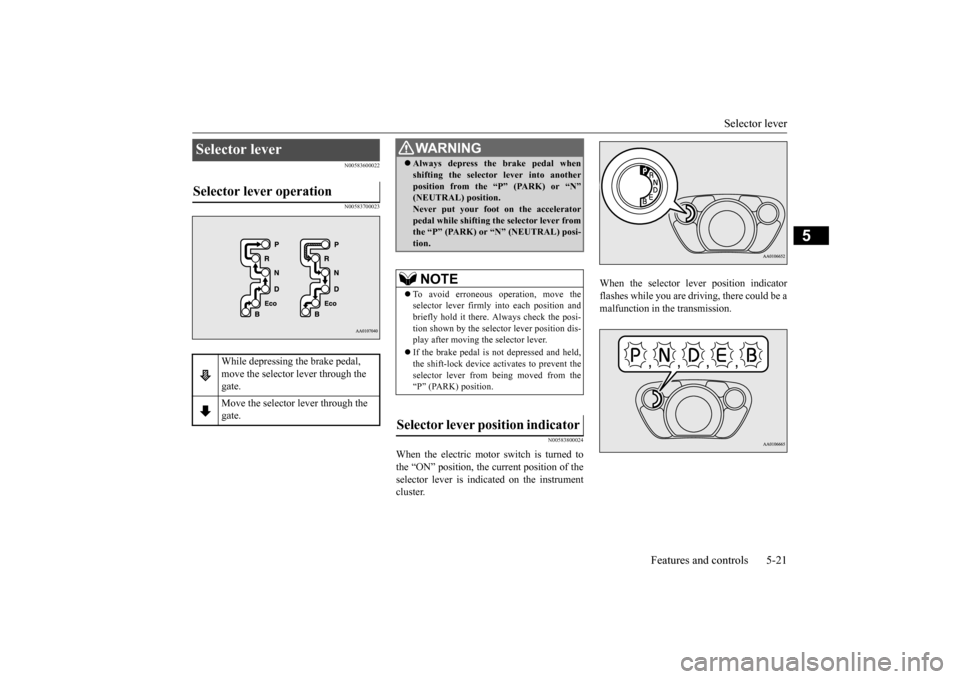
When the electric motor switch is turned to the “ON” position, the current position of the selector lever is indi
cated on the instrument
cluster.
When the selector le
ver position indicator
flashes while you are driv
ing, there could be a
malfunction in the transmission.
Selector lever Selector lever operation
While depressing the brake pedal, move the selector lever through the gate. Move the selector lever through the gate.
WA R N I N G Always depress the brake pedal when shifting the selector
lever into another
position from the
“P” (PARK) or “N”
(NEUTRAL) position. Never put your foot on the accelerator pedal while shifting the selector lever fromthe “P” (PARK) or
“N” (NEUTRAL) posi-
tion.NOTE
To avoid erroneous
operation, move the
selector lever firmly into each position andbriefly hold it there. Always check the posi- tion shown by the select
or lever position dis-
play after moving the selector lever. If the brake pedal is not depressed and held, the shift-lock device activates to prevent theselector lever from being moved from the “P” (PARK) position.
Selector lever po
sition indicator
BK0220401US.book 21 ページ 2015年6月3日 水曜日 午前7時42分
Page 130 of 296
Selector lever 5-22 Features and controls
5
N00583900025
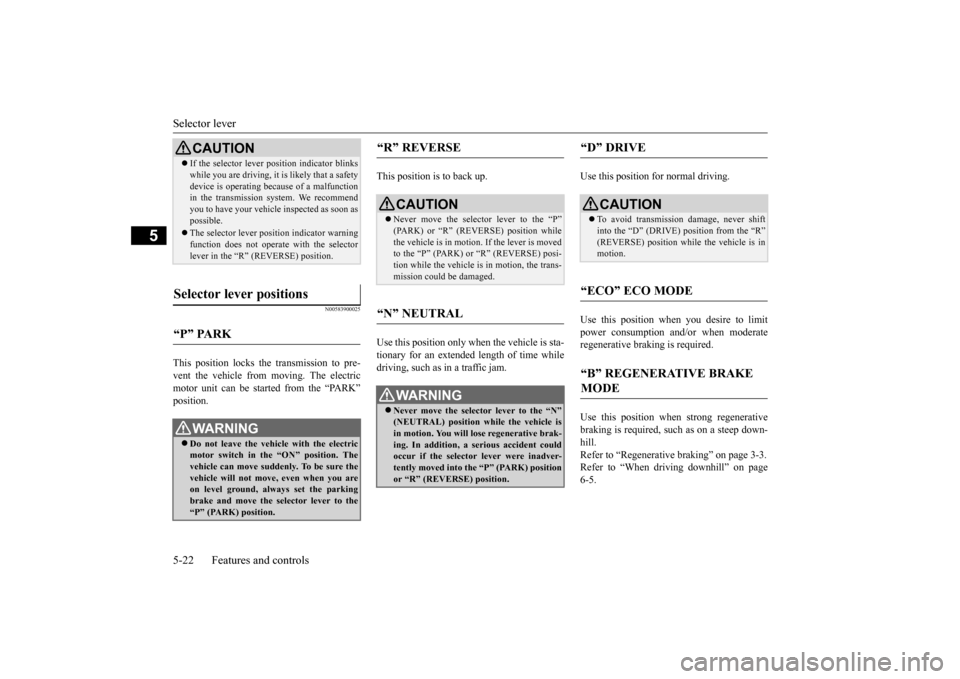
This position locks the transmission to pre- vent the vehicle from moving. The electric motor unit can be started from the “PARK” position.
This position is to back up. Use this position only wh
en the vehicle is sta-
tionary for an extended length of time while driving, such as in a traffic jam.
Use this position for normal driving. Use this position when you desire to limit power consumption and/or when moderateregenerative braking is required. Use this position when strong regenerative braking is required, such as on a steep down-hill. Refer to “Regenerative braking” on page 3-3. Refer to “When driving downhill” on page6-5.
CAUTION If the selector lever pos
ition indicator blinks
while you are driving, it
is likely that a safety
device is operating be
cause of a malfunction
in the transmission system. We recommend you to have your vehicle inspected as soon as possible. The selector lever posit
ion indicator warning
function does not operate with the selectorlever in the “R”
Selector lever positions “P” PARK
WA R N I N GDo not leave the vehicle with the electric motor switch in the “ON” position. The vehicle can move suddenly. To be sure the vehicle will not move,
even when you are
on level ground, alw
ays set the parking
brake and move the se
lector lever to the
“P” (PARK) position.
“R” REVERSE
CAUTION Never move the selector lever to the “P” (PARK) or
Page 131 of 296
Acoustic vehicle alerting system (AVAS)
Features and controls 5-23
5
N00584000023
N00584100024
For short waiting periods, such as at traffic signals the vehicle can be
left in selector lever
position and held stationary with the service brake. For longer waiting periods with the electricmotor unit running, plac
e the selector lever in
the “N” (NEUTRAL) position and apply the parking brake, while holding the vehicle sta-tionary with the service brake.
N00584200025
To park the vehicle, first bring it to a com-plete stop, fully engage the parking brake, and then move the selector lever to the “P” (PARK) position.
If you are going to leave the vehicle unat- tended, always switch
off the electric motor
unit and carry the key.
N00571900028
While driving at low speeds, such as in park-ing lots, the acoustic vehicle alerting system(AVAS) alerts people who may not hear your vehicle approaching. The system sounds when the vehicle speed isapproximately 22 mph
(35 km/h) or less.
The acoustic vehicle alerting system (AVAS) will operate under th
e following conditions:
When the vehicle sp
eed is approximately
2 mph (3 km/h) or less and the brake pedal is not depressed.
WA R N I N G While driving on a slippery road, do not use the “B” position.
Abruptly releasing
the accelerator pedal can apply strongregenerative braking
causing the vehicle
to skid which could result in an accident.NOTE
When the main drive lithium-ion battery level is full or nearly
full, or the main drive
lithium-ion battery temp
erature is too high or
too low, the regenerative braking force may be reduced and stronger effort may berequired to operate the brakes.
Operation of the transmission
CAUTION Before selecting a pos
ition with the electric
motor unit running and the vehicle station- ary, fully depress the brake pedal to prevent the vehicle from creeping.The vehicle will begin to move as soon as the transmission is engage
d, the brakes should
only be released when you are ready to driveaway. Depress the brake pedal
with the right foot at
all times. Using the left foot could cause driver move- ment delay in case of an emergency.
Operating the accelerator pedal while the other foot is resting
on the brake pedal will
affect braking efficien
cy and may cause pre-
mature wear of brake pads.
Waiting
CAUTION Never hold the vehicle
stationary on a hill
with the accelerator. Always apply the park- ing brake and/or service brake.
Parking
CAUTION
NOTE
On a slope, be sure to apply the parking brake before moving the selector lever to the“P” (PARK) position. If you move the selec- tor lever to the