key MITSUBISHI iMiEV 2017 1.G Owners Manual
[x] Cancel search | Manufacturer: MITSUBISHI, Model Year: 2017, Model line: iMiEV, Model: MITSUBISHI iMiEV 2017 1.GPages: 296, PDF Size: 7.79 MB
Page 7 of 296
Outside (Rear)
Overview 1-6
1
N00100601352
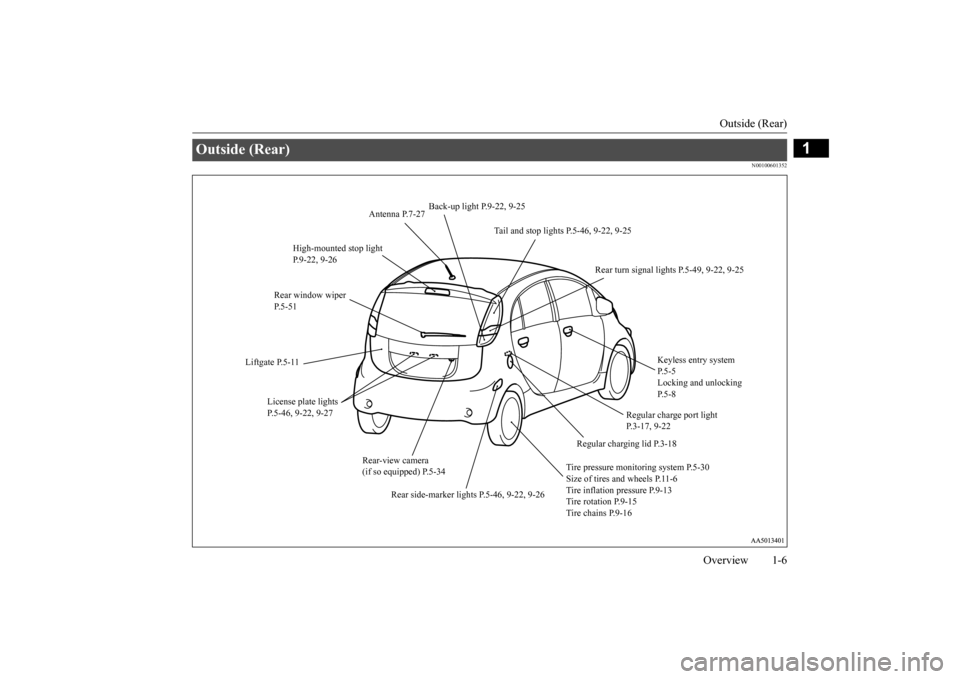
Outside (Rear)
Back-up light P.9-22, 9-25
Antenna P.7-27
Tail and stop lights P.5-46, 9-22, 9-25
High-mounted stop light P.9-22, 9-26
Rear turn signal lights P.5-49, 9-22, 9-25
Rear window wiper P.5-51
Keyless entry system P. 5 - 5Locking and unlocking P. 5 - 8
Liftgate P.5-11
License plate lights P.5-46, 9-22, 9-27
Regular charge port light P.3-17, 9-22
Regular charging lid P.3-18 Tire pressure monitoring system P.5-30 Size of tires and wheels P.11-6 Tire inflation pressure P.9-13 Tire rotation P.9-15Tire chains P.9-16
Rear-view camera (if so equipped) P.5-34
Rear side-marker lights P.5-46, 9-22, 9-26
BK0220401US.book 6 ページ 2015年6月3日 水曜日 午前7時42分
Page 12 of 296
If this problem occurs... 2-4 Quick index
2
N00200901923
If this problem occurs...
Problem
Do this
Ref. Page
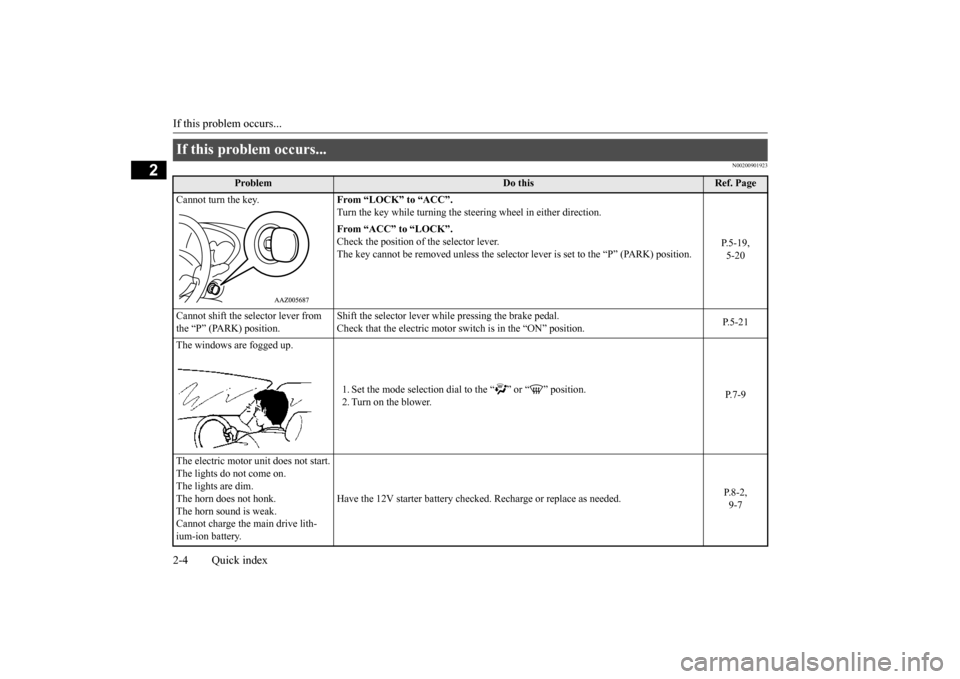
Cannot turn the key.
From “LOCK” to “ACC”. Turn the key while turning the st
eering wheel in either direction.
P.5-19, 5-20
From “ACC” to “LOCK”. Check the position of the selector lever. The key cannot be removed unless the selector
lever is set to the “P” (PARK) position.
Cannot shift the selector lever from the “P” (PARK) position.
Shift the selector lever wh
ile pressing the brake pedal.
Check that the electric motor switch is in the “ON” position.
P.5-21
The windows are fogged up.
1. Set the mode selection dial
to the “ ” or “ ” position.
2. Turn on the blower.
P.7-9
The electric motor unit does not start. The lights do not come on. The lights are dim. The horn does not honk. The horn sound is weak. Cannot charge the main drive lith-ium-ion battery.
Have the 12V starter battery checked.
Recharge or replace as needed.
P.8-2, 9-7
BK0220401US.book 4 ページ 2015年6月3日 水曜日 午前7時42分
Page 31 of 296
Regular charging (charging method with rated AC 120 V outlet)
General information/Charging 3-17
3
N01216200019
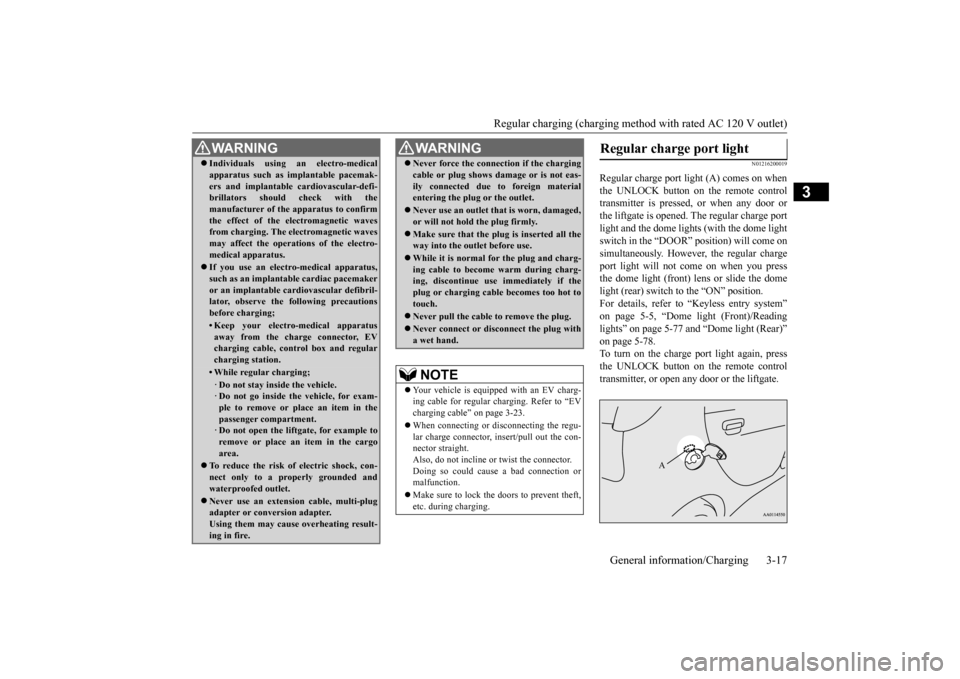
Regular charge port light (A) comes on when the UNLOCK button on the remote control transmitter is pressed, or when any door orthe liftgate is opened.
The regular charge port
light and the dome light
s (with the dome light
switch in the “DOOR” position) will come onsimultaneously. However, the regular charge port light will not
come on when you press
the dome light (front) lens or slide the dome light (rear) switch to the “ON” position. For details, refer to
“Keyless entry system”
on page 5-5, “Dome
light (Front)/Reading
lights” on page 5-77 a
nd “Dome light (Rear)”
To turn on the charge port light again, press the UNLOCK button on the remote control transmitter, or open any
door or the liftgate.
Individuals using an
electro-medical
apparatus such as implantable pacemak-ers and implantable
cardiovascular-defi-
brillators should
check with the
manufacturer of the apparatus to confirm the effect of the el
ectromagnetic waves
from charging. The el
ectromagnetic waves
may affect the operations of the electro- medical apparatus. If you use an electro-medical apparatus, such as an implanta
ble cardiac pacemaker
or an implantable ca
rdiovascular
defibril-
lator, observe the following precautions before charging;• Keep your electro-medical apparatusaway from the charge connector, EVcharging cable, control box and regular charging station.• While regular charging;· Do not stay inside the vehicle. · Do not go inside the vehicle, for exam- ple to remove or place an item in the passenger compartment.· Do not open the liftgate, for example to remove or place an item in the cargo area.
To reduce the risk of electric shock, con- nect only to a prop
erly grounded and
waterproofed outlet. Never use an extension cable, multi-plug adapter or conversion adapter. Using them may cause overheating result- ing in fire.WA R N I N G
Never force the connection if the charging cable or plug shows damage or is not eas-ily connected due to foreign materialentering the plug or the outlet. Never use an outlet that is worn, damaged, or will not hold the plug firmly. Make sure that the plug is inserted all the way into the outlet before use. While it is normal fo
r the plug and charg-
ing cable to become warm during charg- ing, discontinue use immediately if the plug or charging cable becomes too hot totouch. Never pull the cable to remove the plug.Never connect or disconnect the plug with a wet hand.NOTE
Your vehicle is equipped with an EV charg- ing cable for regular charging. Refer to “EVcharging cable” on page 3-23. When connecting or
disconnecting the regu-
lar charge connector, in
sert/pull out the con-
nector straight. Also, do not incline or twist the connector.Doing so could cause a bad connection ormalfunction. Make sure to lock the doors to prevent theft, etc. during charging.WA R N I N G
Regular charge port light
A
BK0220401US.book 17 ページ 2015年6月3日 水曜日 午前7時42分
Page 32 of 296
Regular charging (charging method with rated AC 120 V outlet)
3
N01203201041
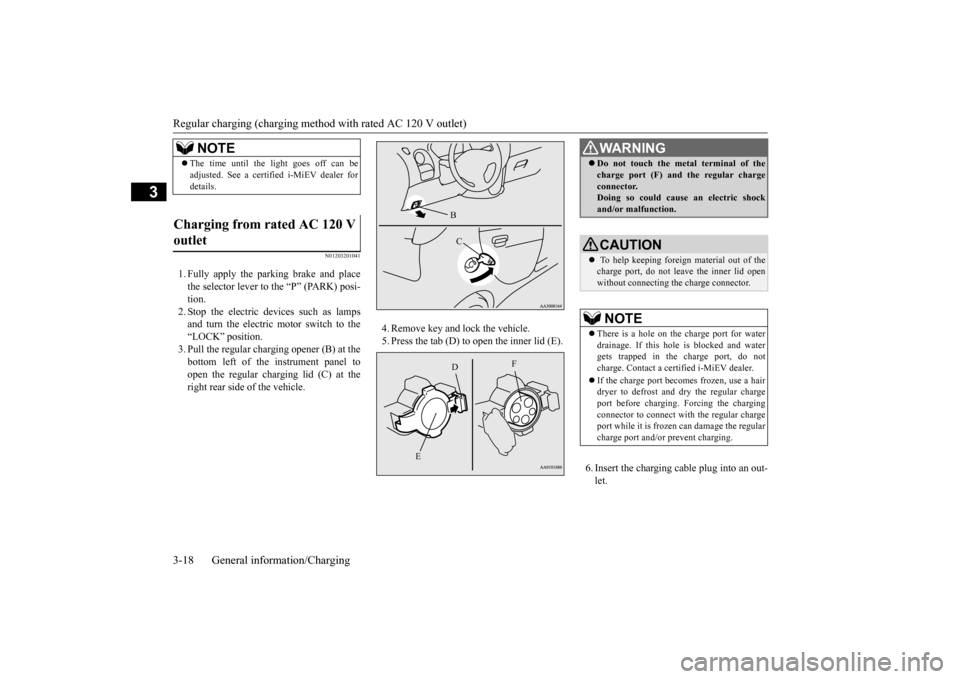
1. Fully apply the parking brake and place the selector lever to the “P” (PARK) posi- tion. 2. Stop the electric devices such as lampsand turn the electric motor switch to the “LOCK” position. 3. Pull the regular charging opener (B) at thebottom left of the instrument panel to open the regular charging lid (C) at the right rear side of the vehicle.
4. Remove key and lock the vehicle. 5. Press the tab (D) to open the inner lid (E).
6. Insert the charging cable plug into an out- let.
NOTE
The time until the light goes off can be adjusted. See a certified i-MiEV dealer fordetails.
Charging from rated AC 120 V outlet
B C
F
D
E
WA R N I N G Do not touch the metal terminal of the charge port (F) an
d the regular charge
connector.Doing so could cause an electric shock and/or malfunction.CAUTION To help keeping forei
gn material out of the
charge port, do not leave the inner lid openwithout connecting th
e charge connector.
NOTE
There is a hole on the charge port for water drainage. If this hole
is blocked and water
gets trapped in the charge port, do not charge. Contact a certified i-MiEV dealer. If the charge port becomes frozen, use a hair dryer to defrost and dry the regular chargeport before charging. Forcing the charging connector to connect w
ith the regular charge
port while it is frozen
can damage the regular
charge port and/or prevent charging.
BK0220401US.book 18 ページ 2015年6月3日 水曜日 午前7時42分
Page 42 of 296
Quick charging (charging method with quick charger) 3-28 General information/Charging
3
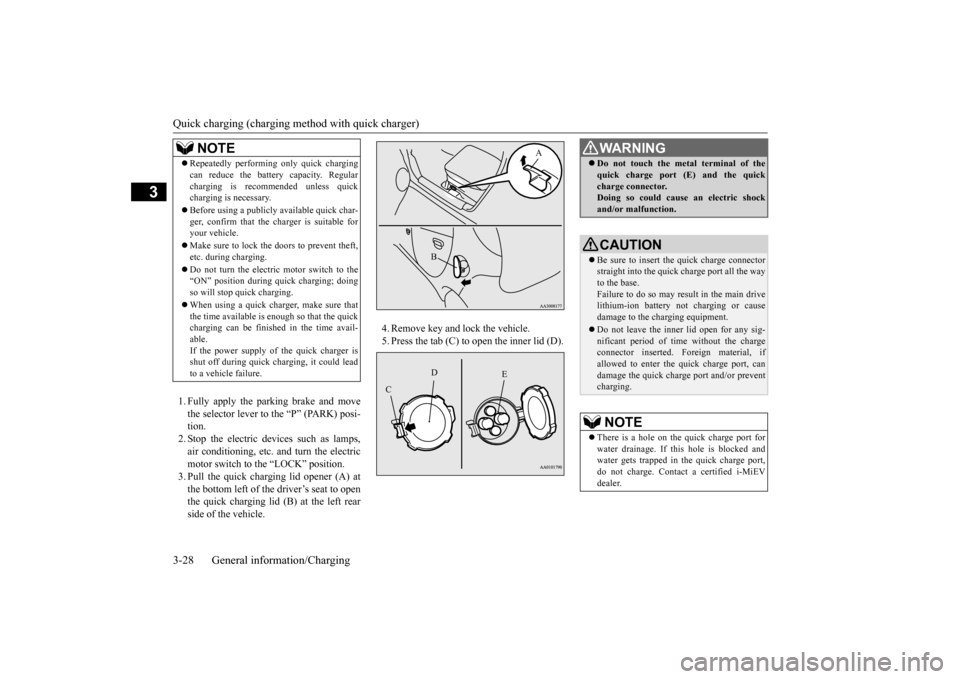
1. Fully apply the parking brake and move the selector lever to the “P” (PARK) posi- tion.2. Stop the electric devices such as lamps, air conditioning, etc.
and turn the electric
motor switch to the “LOCK” position.3. Pull the quick charging lid opener (A) at the bottom left of the driver’s seat to open the quick charging lid (B) at the left rearside of the vehicle.
4. Remove key and lock the vehicle. 5. Press the tab (C) to open the inner lid (D).
NOTE
Repeatedly performi
ng only quick charging
can reduce the battery capacity. Regularcharging is recommended unless quickcharging is necessary. Before using a publicly available quick char- ger, confirm that the charger is suitable for your vehicle. Make sure to lock the doors to prevent theft, etc. during charging. Do not turn the electric motor switch to the “ON” position during
quick charging; doing
so will stop quick charging. When using a quick charger, make sure that the time available is
enough so that the quick
charging can be finished in the time avail- able. If the power supply of the quick charger isshut off during quick ch
arging, it could lead
to a vehicle failure.
A
B
E
D
C
WA R N I N G Do not touch the metal terminal of the quick charge port (E) and the quickcharge connector.Doing so could cause an electric shock and/or malfunction.CAUTION Be sure to insert the quick charge connector straight into the quick charge port all the wayto the base. Failure to do so may result in the main drive lithium-ion battery not charging or causedamage to the charging equipment. Do not leave the inner lid open for any sig- nificant period of ti
me without the charge
connector inserted.
Foreign material, if
allowed to enter the quick charge port, candamage the quick charge port and/or prevent charging.NOTE
There is a hole on the quick charge port for water drainage. If this
hole is blocked and
water gets trapped in the quick charge port,do not charge. Contac
t a certified i-MiEV
dealer.
BK0220401US.book 28 ページ 2015年6月3日 水曜日 午前7時42分
Page 49 of 296
High-Voltage components
General information/Charging 3-35
3
N01205800031
A crash or impact significant enough to require an emergency response for conven- tional vehicles would
also require the same
response for electric vehicles. Also follow the instru
ctions described below
to avoid severe burns a
nd electrical shock that
may result in serious injury or death. 10- Quick charge portIn case of a collision
WA R N I N G If your vehicle is dri
vable, pull your vehi-
cle off the road to a safe, nearby locationand remain on the scene. Also, if possible, do the following opera- tions and stay out of the way of anyoncoming traffic while awaiting the arrival of emerge
ncy responders.
• Apply chocks to the wheels.• Move the selector
lever to the “P”
• Apply the parking brake.• Open the windows,
doors and liftgate.
• Turn the electric motor switch to the “LOCK” position.• Turn on the hazard warning flashers.• Move the key away from the vehicle to prevent unintended start-up of the sys- tem by inadvertent co
ntact with a switch
or impact from the crash.
Never touch high-voltage wiring, connec- tors, and other high-vol
tage parts, such as
the inverter unit and main drive lithium-ion battery. An electric shock may occur if exposed electric wires are visible when viewed from inside
or outside of your
vehicle. For their locations, see “High- voltage components” on page 3-34. If the vehicle receives a strong impact to the floor while driving, stop the vehicle in a safe place and check the floor. Leaks or damage to the main drive lith- ium-ion battery may result in a fire. If youdiscover them, contact emergency services immediately. Since the fluid leak may be lithium manganite from the Lithium-ionbattery, never touch any fluid leaking from the inside or outs
ide of the vehicle. If
the fluid contacts you
r skin or eyes, wash
it off immediately with a large amount of water and receive immediate medical attention to help
avoid serious injury.
If you are unable to safely assess the vehi- cle due to vehicle damage, do not touchthe vehicle. Leave the vehicle and contact emergency services. Advise emergency responders that this is
an electric vehicle.
WA R N I N G
If a fire occurs in th
is vehicle,
leave the
vehicle as soon as possible and contactemergency services. Do not attempt toextinguish a fire by yourself. If the fire involves a lithium-ion battery, it will require large, sustained volumes of waterfor extinguishment.
Using a small amount
of water or the incorrect fire extinguisher can result in serious injury or death fromelectrical shock. When you leave the ve
hicle, if possible,
open the windows,
doors and liftgate to
prevent accumulation of poisonous/com- bustible gasses. This will also assist in therescue and fire fighting process. As with any vehicle fi
re, the byproducts of
combustion can be toxic. Do not inhale smoke, vapors, or gas
from the vehicle.
Move to a safe distan
ce upwind and uphill
from the vehicle fire
and out of the way of
any oncoming traffic
while awaiting the
arrival of emerge
ncy responders.
If you detect leaking
fluids, sparks, smoke,
flames, gurgling, popp
ing or hissing noises
originating from the
high voltage battery
compartment, contact emergency services immediately. This may result in a fire. Physical damage to the vehicle or high voltage battery may result in immediate ordelayed release of t
oxic and/or flammable
gases and fire.WA R N I N G
BK0220401US.book 35 ページ 2015年6月3日 水曜日 午前7時42分
Page 92 of 296
Maintenance and inspection of seat belts 4-20 Seat and restraint systems
4
booster seat must be used
, to raise the child so
that the shoulder belt crosses their shoulderand the lap belt re
mains positioned low
across their hips. The
booster seat should fit
the vehicle seat and ha
ve a label certifying
compliance with Federal Motor Vehicle Safety Standards or Motor Vehicle Restraint Systems and Booster Se
ats Safety Regula-
tions.
N00407000351
The seat belt webbing
may be cleaned with
mild soap or detergent solution. Do not use an organic solvent. Allow the belts to dry in theshade. Do not allow them to retract until com- pletely dry. Do not attempt to bleach or re- dye the belts. The color may rub off and thewebbing strength may be affected. Regularly check your se
at belt buckles and
their release mechanisms
for positive engage-
ment and release of the
latch plate. Check the
retractors for automatic locking when in the Automatic Locking Retractor function. The entire seat belt assembly should be replaced if the webbing shows any obvious cuts, tears, increase in thickness in any sec- tion of the webbing from broken fibers, orsevere fading from sunlig
ht. All of these con-
ditions indicate a weakening of the belt, which may adversely affe
ct seat belt perfor-
mance in an accident.
N00407701834
This vehicle is equippe
d with a Supplemental
Restraint System (SRS), which includes air- bags for the driver and passengers. The SRS front airbags are designed to supple- ment the primary protection of the driver andfront passenger seat belt systems by provid- ing those occupants w
ith protection against
head and chest injuries
in certain moderate to
severe frontal
collisions.
The SRS front airbags, together with sensors at the front of the
vehicle and sensors
attached to the front seats, form an advanced airbag system. The SRS side airbags and the curtain airbags are also designed to s
upplement the seat belts.
The SRS side airbags provide the driver and front passenger with pr
otection against chest,
WA R N I N GAny child who is too small to properly wear a seat belt
must be properly
restrained in an appropriate child restraint system, to reduce their risk of serious injury or de
ath in an
accident.
A child should never be
left unattended in,
or unsupervised, around your vehicle.When you leave the
vehicle always take
the child out as well. Children can die from heat stroke if left or trapped inside the vehicle, especially on hot days. Keep your vehicle locked when not in use. Keep your vehicle keys away from chil-dren.
Maintenance and inspection of seat belts
WA R N I N G Do not attempt to repair or replace any part of the seat belt assemblies. This workshould be done by a certified i-MiEVdealer. Failure to h
ave a certified i-MiEV
dealer perform the work could reduce the effectiveness of the belts and could resultin a serious injury or
death in an accident.
Supplemental Restraint Sys- tem (SRS) - airbag
BK0220401US.book 20 ページ 2015年6月3日 水曜日 午前7時42分
Page 109 of 296
5
Features and controlsBreak-in recommendations ..............................................................5-2 Keys .................................................................................................5-2 Electronic immobilizer (Anti-theft starting system) ........................5-2Keyless entry system .......................................................................5-5 Door locks ........................................................................................5-8 Power door locks ........
...........
...........
...........
...........
...........
.........
.....5-9
Child safety locks for rear door ..........
...........
.........
.........
.........
.....5-10
Liftgate ........................................................................................... 5-11 Theft-alarm system ........................................................................5-12Power window control ...................................................................5-14 Parking brake .................................................................................5-16 Inside rearview mirror ...................................................................5-16Outside rearview mirrors ...............................................................5-17 Electric motor switch .....................................................................5-18 Steering wheel lock ........................................................................5-20Starting the electric motor unit ......................................................5-20 Selector lever .................................................................................5-21 Acoustic vehicle alerting system (AVAS) ......................................5-23Service brake .................................................................................5-24 Brake assist system ........................................................................5-25 Anti-lock braking system ...............................................................5-25Electric power steering system (EPS) ............................................5-27 Active stability control (ASC) .......................................................5-28 Tire pressure monitoring system ....................................................5-30Rear-view camera (if so equipped) .................................................5-34 Instrument cluster ..........................................................................5-36 Indicator and warning light package ..............................................5-43Indicators .......................................................................................5-44
Warning lights ................................................................................ 5-44 Combination headlights and dimmer switch ................................. 5-46 Turn signal lever ............................................................................ 5-49Hazard warning flasher switch ...................................................... 5-49 Front fog light switch .................................................................... 5-50 Wiper and washer switch ............................................................... 5-50Electric rear window defogger switch ....
...........
...........
...........
...... 5-52
Horn switch ................................................................................... 5-53 Link System (if so equipped) ......................................................... 5-53 Bluetooth
® 2.0 interface (if so equipped)....................................... 5-53
USB input terminal (if so equipped) .......
...........
...........
...........
...... 5-73
Sun visors ...................................................................................... 5-7612 V power outlet .......................................................................... 5-76 Interior lights ................................................................................. 5-77 Storage spaces ................................................................................ 5-79Cup holder ..................................................................................... 5-80 Assist grip ...................................................................................... 5-81
BK0220401US.book 1 ページ 2015年6月3日 水曜日 午前7時42分
Page 110 of 296
Break-in recommendations 5-2 Features and controls
5
N00508700343
Advanced automobile manufacturing tech- niques permit you to operate your new vehi- cle without requiring
a long break-in period
of low-speed driving. However, you can add to the future perfor- mance and economy of your vehicle byobserving the followi
ng precautions during
the first 300 miles (500 km). Drive your vehicle at moderate speeds during the break-in period. Do not overload the ve
hicle. Observe the
seating capacity (See “Cargo load precau-tions” on page 6-10). Do not use this vehi
cle for trailer towing.
N00508800618
Two keys are provided. The keys fit all locks. Keep one in a safe place as a spare key.
N00509101846
The electronic immobilize
r is designed to sig-
nificantly reduce the
possibility of vehicle
theft. The purpose of the system is to immo-bilize the vehicle if
an invalid start is
attempted. A valid st
art attempt can only be
achieved (subject to ce
rtain conditions), using
a key “registered” to the immobilizer system. All of the keys provided with your new vehi- cle have been program
med to the vehicle’s
electronics.
Break-in recommendations Keys
NOTE
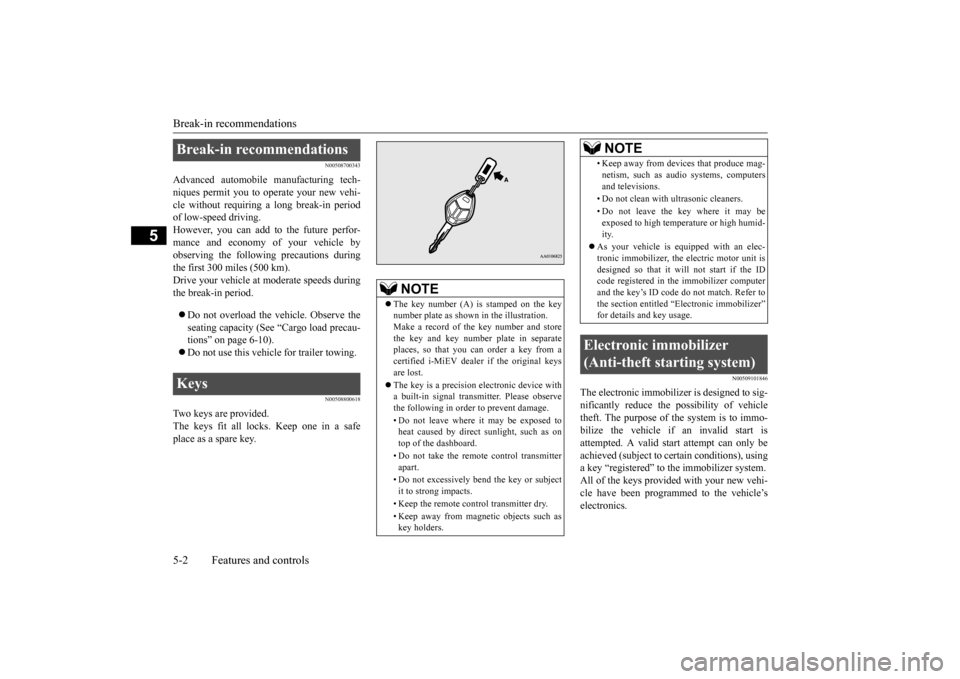
The key number (A) is stamped on the key number plate as shown
in the illustration.
Make a record of th
e key number and store
the key and key number plate in separate places, so that you can order a key from acertified i-MiEV dealer if the original keys are lost. The key is a precision
electronic device with
a built-in signal transm
itter. Please observe
the following in order to prevent damage. • Do not leave where it may be exposed to heat caused by direct sunlight, such as ontop of the dashboard. • Do not take the remote
control transmitter
apart. • Do not excessively bend the key or subject it to strong impacts. • Keep the remote control transmitter dry.• Keep away from magne
tic objects such as
key holders.
• Keep away from devi
ces that produce mag-
netism, such as audio systems, computersand televisions. • Do not clean with
ultrasonic cleaners.
• Do not leave the key where it may be exposed to high temperature or high humid- ity.
As your vehicle is equipped with an elec- tronic immobilizer, the electric motor unit isdesigned so that it wi
ll not start if the ID
code registered in the immobilizer computer and the key’s ID code
do not match. Refer to
the section entitled “E
lectronic immobilizer”
for details and key usage.
Electronic immobilizer (Anti-theft starting system)
NOTE
BK0220401US.book 2 ページ 2015年6月3日 水曜日 午前7時42分
Page 111 of 296
Electronic immobilizer (Ant
i-theft starting system)
Features and controls 5-3
5
Only keys that have been programmed to the vehicle electronics can be used to start the vehicle. If you lose a key, you can order a key from a certified i-MiEV dealer by referring to the key number. To prevent vehicle theft, the ID code for thevehicle keys must be changed. Take your vehicle and al
l remaining keys to a
certified i-MiEV dealer
to have your ID code
changed. To add a key, you need to register the ID code to the vehicle. Registering the ID code can be done by a cer- tified i-MiEV dealer.
Or it can be done by
yourself (except for vehi
cles sold in Canada).
To register the ID code yourself, follow the “Customer key programming” procedurebelow.
NOTE
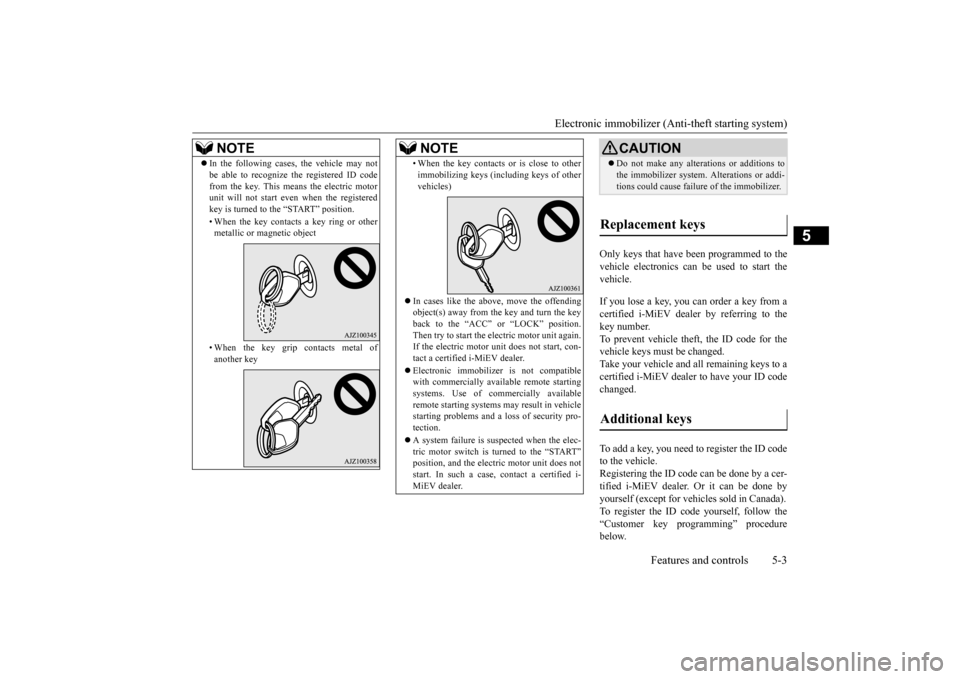
In the following cases, the vehicle may not be able to recognize
the registered ID code
from the key. This means the electric motorunit will not start even when the registered key is turned to the “START” position. • When the key contacts
a key ring or other
metallic or magnetic object • When the key grip
contacts metal of
another key
• When the key contacts
or is close to other
immobilizing keys (inc
luding keys of other
vehicles)
In cases like the above, move the offending object(s) away from the key and turn the key back to the “ACC” or “LOCK” position.Then try to start the electric motor unit again. If the electric motor unit does not start, con- tact a certified i-MiEV dealer. Electronic immobilize
r is not compatible
with commercially available remote startingsystems. Use of commercially available remote starting systems may result in vehicle starting problems
and a loss of security pro-
tection. A system failure is suspected when the elec- tric motor switch is turned to the “START”
tric motor unit does not
start. In such a case, contact a certified i-MiEV dealer.NOTE
CAUTION Do not make any altera
tions or additions to
the immobilizer system.
Alterations or addi-
tions could cause failur
e of the immobilizer.
Replacement keys Additional keys
BK0220401US.book 3 ページ 2015年6月3日 水曜日 午前7時42分