maintenance MITSUBISHI L200 2004 Owner's Manual (in English)
[x] Cancel search | Manufacturer: MITSUBISHI, Model Year: 2004, Model line: L200, Model: MITSUBISHI L200 2004Pages: 264, PDF Size: 4.14 MB
Page 1 of 264
Table of contents
General information
Locking and unlocking
Seat and seat belts
Instruments and controls
Starting and driving
For pleasant driving
Vehicle care
For emergencies
Maintenance
Specifications
01engL2_240082_4 22-01-2004 12:58 Page 1-1
Page 62 of 264
SEAT AND SEAT BELTS
3-30
WARNINGIf any of following conditions occur,
the SRS is not working properly, and
you should immediately have it in-
spected by an authorized MITSU-
BISHI dealer.
• The SRS warning lamp does not il-
luminate when you start the vehi-
cle.
• The SRS warning lamp does not
go out after several seconds.
• The SRS warning lamp illuminates
while driving.
SRS servicing
The entire SRS system must be inspected
by an authorized MITSUBISHI dealer at
10 years.
WARNING(1) Any maintenance performed on
or near the components of the
SRS must be performed only by
an authorized MITSUBISHI
dealer. Do not permit anyone
else to do service, inspection,
maintenance or repair on any
SRS components or wiring; sim-
ilarly, no part of the SRS system
should ever be handled or dis-
posed of by anyone except an
authorized MITSUBISHI dealer.
Improper work on the SRS com-
ponents or wiring could result in
inadvertent deployment of the air
bag, or could render the SRS sys-
tem inoperative; either situation
could result in serious injury.
(2)Do not modify your steering
wheel or any other SRS compo-
nents. For example, replacement
of the steering wheel, or modifi-
cations to the front bumper or
body structure can adversely af-
fect SRS performance and lead
to possible injury.
(3) If your vehicle has received any
front - end damage, you should
have the SRS inspected by an
authorized MITSUBISHI dealer
to ensure it is in proper working
order.
NOTE
(1) When you transfer ownership of the
vehicle to some other person, we
urge you to alert the new owner that it
is equipped with the SRS and refer
that owner to the applicable section in
this owner’s manual.
(2) If you junk or scrap the vehicle, we
urge you to first take the vehicle to an
authorized MITSUBISHI dealer so
that the SRS can be rendered safe.
03engL2_240082_4 22-01-2004 13:01 Page 3-30
Page 112 of 264
STARTING AND DRIVING
5-26
Correct 4-wheel drive
operation
EI32ABDa
By shifting lock to 4-wheel drive (4H, 4L),
both axles of the vehicle are rigidly con-
nected with each other. This improves the
traction characteristics. When turning
sharp corners or moving forward and
backward repeatedly, however, the drive
line is stressed, which is felt as a braking
effect. A 4-wheel drive vehicle can accele-
rate more quickly and smoothly.
However, note that the braking distance is
not shorter than that of a rear-wheel drive
vehicle.
When using 4-wheel drive on rough roads
(snow, mud, sand, etc.), it is important to
operate the vehicle correctly.
NOTE
(1) The driving posture should be more
upright and closer to the wheel than
usual; adjust the seat to a good posi-
tion for easy steering and pedal oper-
ation. Be sure to wear the seat belt.
(2) After driving on rough roads, check
each part of the vehicle and wash it
thoroughly with water. Refer to the
“Vehicle care” section and “Inspection
and maintenance following rough
road operation” sections.Driving on dry paved road and highway
Select 2WD (2H) to drive on dry paved
roads. Especially on dry highway, never
select the 4WD (4H or 4L).
CAUTIONSelecting 4-wheel drive to drive on
dry paved road will increase the fuel
consumption with possible noise
generation and early tyre wear.
It may also increase the differential
oil temperature, resulting in possible
damage to the driving system. Fur-
ther, the drive train will be subjected
to excessive loading, possibly lead-
ing to oil leakage, component
seizure, or other serious faults.
Driving on snowy or icy roads
Set the transfer shift lever to “4H” or “4L” in
accordance with the road conditions, and
then gradually depress the accelerator
pedal for a smooth start.
NOTE
(1) The use of snow tyres and/or tyre
chains is recommended.
(2) Maintain a safe distance between
vehicles, avoid sudden braking, and
use engine braking (downshifting).
CAUTIONAvoid sudden braking, sudden ac-
celeration, and sharp turning; such
operations could cause skidding
and spinouts.
Driving on sandy or muddy roads
Set the transfer shift lever to “4H” or “4L”,
and then gradually depress the accelera-
tor pedal for a smooth start. Keep the
pressure on the accelerator pedal as con-
stant as possible, and drive at low speed.
05engL2_240082_4 22-01-2004 13:05 Page 5-26
Page 115 of 264
STARTING AND DRIVING
5-29
CAUTIONNever cross a stream where the
water is deep.
Do not change gears while crossing
the stream.
Frequent crossing of streams can
adversely affect the life span of the
vehicle; consult an authorized
MITSUBISHI dealer and take the ne-
cessary measures to prepare, in-
spect, and repair the vehicle.
After crossing a stream, apply the brakes
to be sure they are functioning properly. If
the brakes are wet and not functioning
properly, dry them out by driving slowly
while lightly depressing the brake pedal.
Inspect each part of the vehicle carefully.
Refer to the “Inspection and maintenance
following rough road operation” section.
Cautions on handling of
4WD vehicles
EI49A-Ce
Tyres and wheels
Since the driving torque can be applied to
the 4 wheels, the performance of the vehi-
cle when operating in 4WD is greatly
affected by the condition of the tyres.
Pay close attention to the tyres.
• Install specified tyres on all wheels. Re-
fer to the “Tyres and wheels” on page
10-8, 10-14, 10-22.
• All tyres should be rotated whenever the
wear difference between front and rear
tyres is recognizable.
Good vehicle performance cannot be
expected if there is a difference in wear
between tyres. Refer to the “Tyre rota-
tion” on page 9-11.
• Check the tyre inflation pressure regu-
larly.
Inspection and maintenance
following rough road operation
After operating the vehicle in rough road
conditions, be sure to perform the following
inspection and maintenance procedures:
(1) Check that the vehicle has not been
damaged by rocks, gravel, etc.
(2) Carefully wash the vehicle with water.
Drive the vehicle slowly while lightly
depressing the brake pedal in order to
dry out the brakes. If the brakes still
do not function properly, contact an
authorized MITSUBISHI dealer as
soon as possible to have the brakes
checked.
(3) Remove the insects, dried grass, etc.
clogging the radiator core.
(4) If a stream has been crossed, check
the engine, transmission, and differ-
ential oil and propeller shaft grease. If
the oil or grease is milky or cloudy
because of water contamination, it
must be replaced with new oil.
(5) Check the inside of the vehicle. If
ingress of water is found, dry the car-
pet etc.
(6) Inspect the headlamps. If the head-
lamp bulb is flooded with water, have
the headlamp drained off at an autho-
rized MITSUBISHI dealer.
(7) Have an authorized MITSUBISHI
dealer replace grease in the wheel
bearing.
05engL2_240082_4 22-01-2004 13:05 Page 5-29
Page 168 of 264
VEHICLE CARE
EK21A-Ad
In order to maintain the value of your vehi-
cle, it is necessary to perform regular
maintenance using the proper proce-
dures. Always maintain your vehicle in
compliance with any environmental pollu-
tion control regulations. Carefully select
the materials used for washing, etc., to be
sure that they do not contain corrosives; if
in doubt, contact your authorized MITSU-
BISHI dealer for assistance in the selec-
tion of these materials.CAUTIONCleaning products can be danger-
ous. Some are poisonous. Others
can burst into flame if you strike a
match or drop them on a hot part of
the vehicle. Some are dangerous if
you breathe their fumes in a closed
space. When you use anything in a
container to clean your vehicle,
always follow the instructions and
always open your vehicle doors or
windows when you’re cleaning the
inside. Never use the following to
clean your vehicle:
• Gasoline
• Paint Thinner
• Benzine
• Turpentine
• Naphtha
• Lacquer Thinner
• Carbon Tetrachloride
• Nail Polish Remover
• Acetone
These are all dangerous, and can
damage your vehicle.
Cleaning the inside of your
vehicle
EK23A-Ae
After cleaning the inside of your vehicle
with water, cleaner or similar, wipe and dry
in a shady, well-ventilated area.
CAUTIONDo not use organic substances (sol-
vents, kerosine, alcohol, gasoline,
etc.) or alkaline or acidic solutions.
These chemicals can cause dis-
colouring, staining or cracking of
the surface.
If you use cleaners or polishing
agents, make sure their ingredients
do not include the substances men-
tioned above.
NOTE
Always read the instructions on the
cleaner label.
7-2
07engL2_240082_4 22-01-2004 13:09 Page 7-2
Page 199 of 264
FOR EMERGENCIES
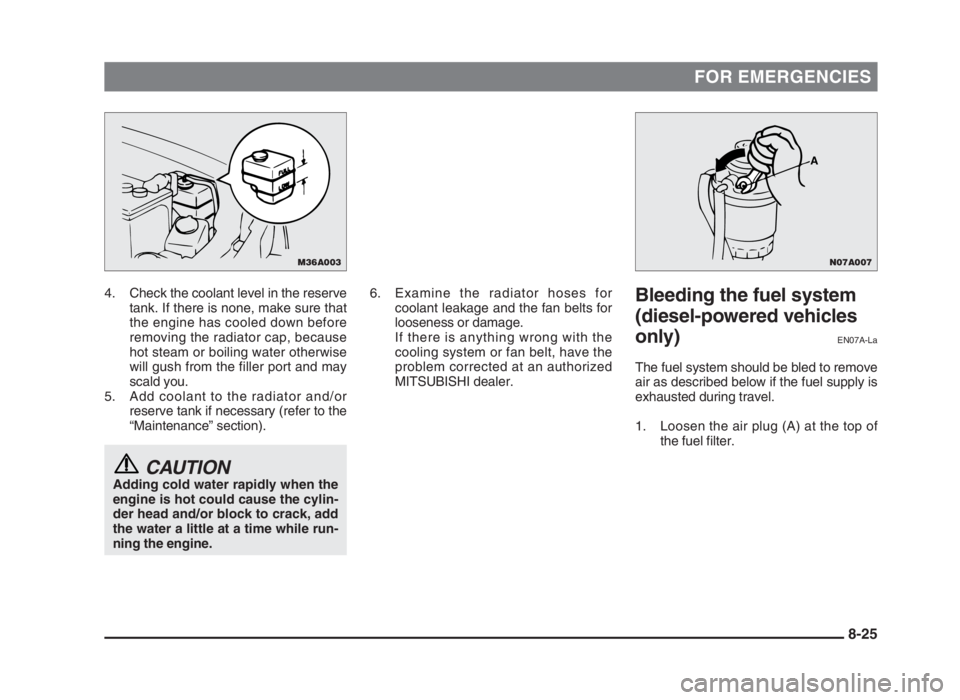
4. Check the coolant level in the reserve
tank. If there is none, make sure that
the engine has cooled down before
removing the radiator cap, because
hot steam or boiling water otherwise
will gush from the filler port and may
scald you.
5. Add coolant to the radiator and/or
reserve tank if necessary (refer to the
“Maintenance” section).
CAUTIONAdding cold water rapidly when the
engine is hot could cause the cylin-
der head and/or block to crack, add
the water a little at a time while run-
ning the engine.
Bleeding the fuel system
(diesel-powered vehicles
only)
EN07A-La
The fuel system should be bled to remove
air as described below if the fuel supply is
exhausted during travel.
1. Loosen the air plug (A) at the top of
the fuel filter. 6. Examine the radiator hoses for
coolant leakage and the fan belts for
looseness or damage.
If there is anything wrong with the
cooling system or fan belt, have the
problem corrected at an authorized
MITSUBISHI dealer.
8-25
M36A003N07A007
A
08engL2_240082_4 22-01-2004 13:10 Page 8-25
Page 215 of 264
Engine oil ................................................................ 9-2
Automatic transmission fluid* .............................. 9-4
Engine coolant ....................................................... 9-5
Battery ..................................................................... 9-6
Brake fluid............................................................... 9-8
Power steering fluid* ............................................. 9-9
Clutch fluid* ............................................................ 9-9
Washer fluid............................................................ 9-10
Wheel condition ..................................................... 9-10
Tyre inflation pressure .......................................... 9-11
Tyre rotation ........................................................... 9-11
Snow tyres .............................................................. 9-12
Tyre chains ............................................................. 9-13
Fuel, engine coolant, oil and exhaust gas
leakage ............................................................. 9-14
Exterior and interior lamp operation .................... 9-14
Meter, gauge and indication/warning lamp
operation .......................................................... 9-14
Clutch pedal free play* .......................................... 9-14
Brake pedal free play ............................................. 9-15
Parking brake lever stroke .................................... 9-15
Hinges and latches lubrication ............................. 9-16
Wiper blades ........................................................... 9-16
Ventilation slots ..................................................... 9-17
Weatherstripping.................................................... 9-17
Additional equipment
(For regions where snow is encountered) .... 9-17
Maintenance
9
09engL2_240082_4 22-01-2004 13:12 Page 9-1
Page 216 of 264
MAINTENANCE
EM01A-Hh
Adequate care of your vehicle at regular
intervals serves to preserve the value and
appearance as long as possible.
Some maintenance items can be carried
out by the owner (do it yourself), while
others should be carried out by an author-
ized MITSUBISHI dealer (periodic inspec-
tion and maintenance). This section de-
scribes only those items which can be car-
ried out by the owner. In the event a
malfunction or other problem is disco-
vered, have it corrected by an authorized
MITSUBISHI dealer. This section contains
information on inspection maintenance
procedures that you can do yourself, if you
wish to do so. Follow the instructions and
cautions for each of the various proce-
dures.WARNING(1) When checking or servicing the
inside of the engine compart-
ment, make sure the engine is
switched off and has had a
chance to cool down.
(2) If it is necessary to do work in
the engine compartment with
the engine running, be espe-
cially careful that your clothing,
hair, etc., does not become
caught by the fan, drive belts, or
other moving parts.
(3) Do not smoke, cause sparks or
allow open flames around fuel or
battery. The fumes are flam-
mable.
(4) Be extremely cautious when
working around the battery. It
contains poisonous and cor-
rosive sulphuric acid.
(5) Do not get under your vehicle
with just the body jack support-
ing it. Always use automotive
jack stands.
(6) Improper handling of compo-
nents and materials used in the
vehicle can endanger your
personal safety.
Consult an authorized MITSU-
BISHI dealer for necessary infor-
mation.
Engine oilEM03A-Dh
The engine oil used has a significant effect
on the engine’s performance, service life
and startability. Only use oil of the recom-
mended quality and appropriate viscosity.
All engines consume a certain amount of
oil during normal operation (See note be-
low). It is important, therefore to check the
oil at regular intervals or before starting a
long journey.
9-2
M03A036
2500 model
09engL2_240082_4 22-01-2004 13:12 Page 9-2
Page 217 of 264
MAINTENANCE
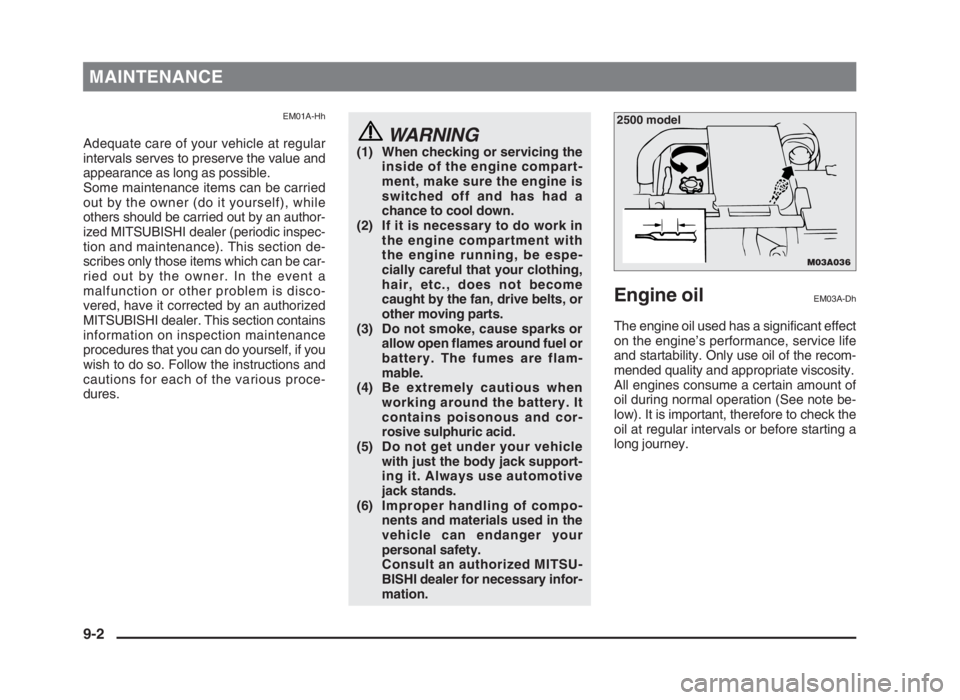
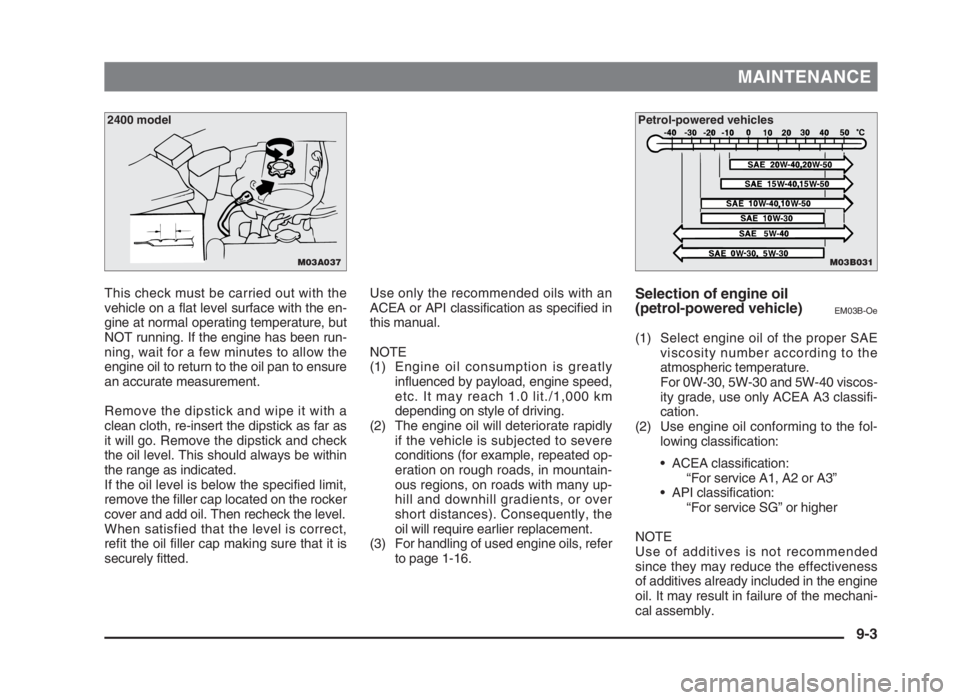
This check must be carried out with the
vehicle on a flat level surface with the en-
gine at normal operating temperature, but
NOT running. If the engine has been run-
ning, wait for a few minutes to allow the
engine oil to return to the oil pan to ensure
an accurate measurement.
Remove the dipstick and wipe it with a
clean cloth, re-insert the dipstick as far as
it will go. Remove the dipstick and check
the oil level. This should always be within
the range as indicated.
If the oil level is below the specified limit,
remove the filler cap located on the rocker
cover and add oil. Then recheck the level.
When satisfied that the level is correct,
refit the oil filler cap making sure that it is
securely fitted.Selection of engine oil
(petrol-powered vehicle)
EM03B-Oe
(1) Select engine oil of the proper SAE
viscosity number according to the
atmospheric temperature.
For 0W-30, 5W-30 and 5W-40 viscos-
ity grade, use only ACEA A3 classifi-
cation.
(2) Use engine oil conforming to the fol-
lowing classification:
• ACEA classification:
“For service A1, A2 or A3”
• API classification:
“For service SG” or higher
NOTE
Use of additives is not recommended
since they may reduce the effectiveness
of additives already included in the engine
oil. It may result in failure of the mechani-
cal assembly. Use only the recommended oils with an
ACEA or API classification as specified in
this manual.
NOTE
(1) Engine oil consumption is greatly
influenced by payload, engine speed,
etc. It may reach 1.0 lit./1,000 km
depending on style of driving.
(2) The engine oil will deteriorate rapidly
if the vehicle is subjected to severe
conditions (for example, repeated op-
eration on rough roads, in mountain-
ous regions, on roads with many up-
hill and downhill gradients, or over
short distances). Consequently, the
oil will require earlier replacement.
(3) For handling of used engine oils, refer
to page 1-16.
9-3
M03A037
2400 model
M03B031
Petrol-powered vehicles
09engL2_240082_4 22-01-2004 13:12 Page 9-3
Page 218 of 264
MAINTENANCE
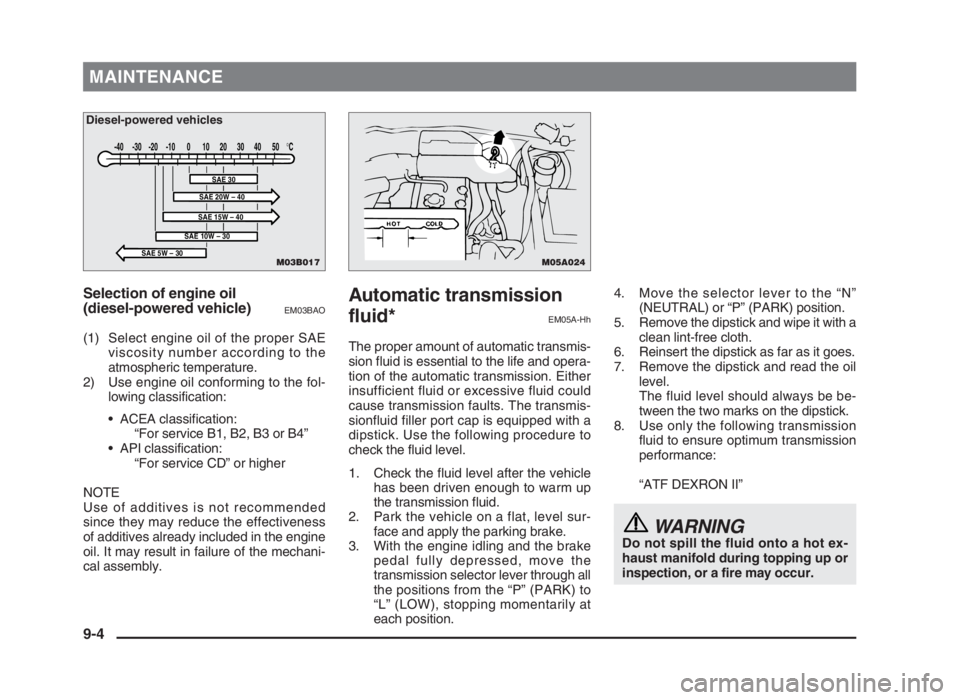
Selection of engine oil
(diesel-powered vehicle)
EM03BAO
(1) Select engine oil of the proper SAE
viscosity number according to the
atmospheric temperature.
2) Use engine oil conforming to the fol-
lowing classification:
• ACEA classification:
“For service B1, B2, B3 or B4”
• API classification:
“For service CD” or higher
NOTE
Use of additives is not recommended
since they may reduce the effectiveness
of additives already included in the engine
oil. It may result in failure of the mechani-
cal assembly.
Automatic transmission
fluid*
EM05A-Hh
The proper amount of automatic transmis-
sion fluid is essential to the life and opera-
tion of the automatic transmission. Either
insufficient fluid or excessive fluid could
cause transmission faults. The transmis-
sionfluid filler port cap is equipped with a
dipstick. Use the following procedure to
check the fluid level.
1. Check the fluid level after the vehicle
has been driven enough to warm up
the transmission fluid.
2. Park the vehicle on a flat, level sur-
face and apply the parking brake.
3. With the engine idling and the brake
pedal fully depressed, move the
transmission selector lever through all
the positions from the “P” (PARK) to
“L” (LOW), stopping momentarily at
each position.4. Move the selector lever to the “N”
(NEUTRAL) or “P” (PARK) position.
5. Remove the dipstick and wipe it with a
clean lint-free cloth.
6. Reinsert the dipstick as far as it goes.
7. Remove the dipstick and read the oil
level.
The fluid level should always be be-
tween the two marks on the dipstick.
8. Use only the following transmission
fluid to ensure optimum transmission
performance:
“ATF DEXRON II”
WARNINGDo not spill the fluid onto a hot ex-
haust manifold during topping up or
inspection, or a fire may occur.
9-4
M05A024M03B017
-40 -30 -20 -10 0 10 20 30 40 50 °C
SAE 5W – 30SAE 10W – 30
SAE 30
SAE 20W – 40
SAE 15W – 40
Diesel-powered vehicles
09engL2_240082_4 22-01-2004 13:12 Page 9-4