oil MITSUBISHI L200 2004 Owner's Manual (in English)
[x] Cancel search | Manufacturer: MITSUBISHI, Model Year: 2004, Model line: L200, Model: MITSUBISHI L200 2004Pages: 264, PDF Size: 4.14 MB
Page 17 of 264
GENERAL INFORMATION
Used engine oils safety
instructions
EB12A-A
WARNING(1) Prolonged and repeated contact
may cause serious skin disor-
ders, including dermatitis and
cancer.
(2) Avoid contact with the skin as
far as possible and wash thor-
oughly after any contact.
(3) Keep out of reach of children.
Protect the environment
It is illegal to pollute drains, water courses
and soil. Use authorized waste collection
facilities, including civic amenity sites and
garages providing facilities for disposal of
used oil and used oil filters. If in doubt,
contact your local authority for advice on
disposal.
Driving and alcoholEB25A-Aa
Driving under the influence of alcohol is
one of the most frequent causes of acci-
dents.
Your driving ability can even be seriously
impaired with blood alcohol levels below
the legal minimum. If you are drinking,
don’t drive. Ride with a designated non-
drinking driver, call a cab, a friend, or use
public transportation.
WARNINGDriving after drinking can lead to an
accident. Your perceptions are less
sharp, your reflexes are slower, and
your judgement is impaired when
you have been drinking.
NEVER DRINK AND THEN DRIVE.
Safe driving techniques
EB26A-Cb
Driving safety and protection against in-
jury cannot be fully ensured. However, we
recommend that you pay extra attention to
the following:
(1) Before starting the vehicle, make sure
that you and your passengers have
fastened your seat belts.
(2) Never leave your vehicle unattended
with the key in the ignition and
children inside the vehicle. Children
may play with the driving controls and
this could lead to an accident.
(3) Make sure that infants and small chil-
dren are properly restrained in accor-
dance with the laws and regulations,
and for maximum protection in case
of an accident.
1-17
01engL2_240082_4 22-01-2004 12:58 Page 1-17
Page 70 of 264
INSTRUMENTS AND CONTROLS
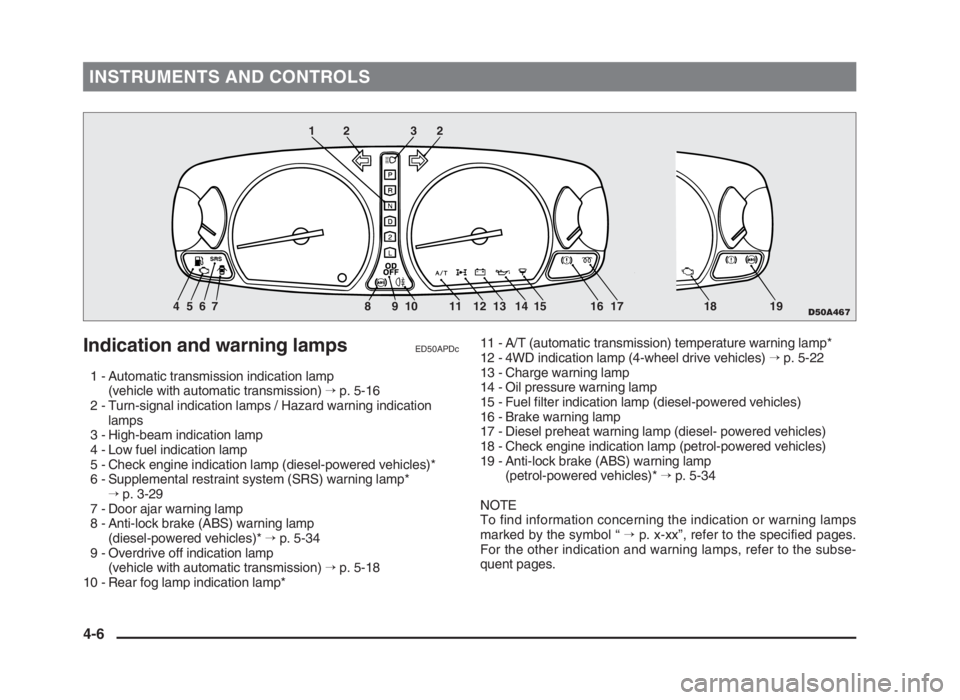
Indication and warning lampsED50APDc
1 - Automatic transmission indication lamp
(vehicle with automatic transmission) →p. 5-16
2 - Turn-signal indication lamps / Hazard warning indication
lamps
3 - High-beam indication lamp
4 - Low fuel indication lamp
5 - Check engine indication lamp (diesel-powered vehicles)*
6 - Supplemental restraint system (SRS) warning lamp*
→p. 3-29
7 - Door ajar warning lamp
8 - Anti-lock brake (ABS) warning lamp
(diesel-powered vehicles)* →p. 5-34
9 - Overdrive off indication lamp
(vehicle with automatic transmission) →p. 5-18
10 - Rear fog lamp indication lamp*11 - A/T (automatic transmission) temperature warning lamp*
12 - 4WD indication lamp (4-wheel drive vehicles) →p. 5-22
13 - Charge warning lamp
14 - Oil pressure warning lamp
15 - Fuel filter indication lamp (diesel-powered vehicles)
16 - Brake warning lamp
17 - Diesel preheat warning lamp (diesel- powered vehicles)
18 - Check engine indication lamp (petrol-powered vehicles)
19 - Anti-lock brake (ABS) warning lamp
(petrol-powered vehicles)* →p. 5-34
NOTE
To find information concerning the indication or warning lamps
marked by the symbol “ →p. x-xx”, refer to the specified pages.
For the other indication and warning lamps, refer to the subse-
quent pages.
4-6
D50A467
12 32
4 5 6 7 8 9 10 11 12 13 14 15 16 17 18 19
04engL2_240082_4 22-01-2004 13:19 Page 4-6
Page 73 of 264
INSTRUMENTS AND CONTROLS
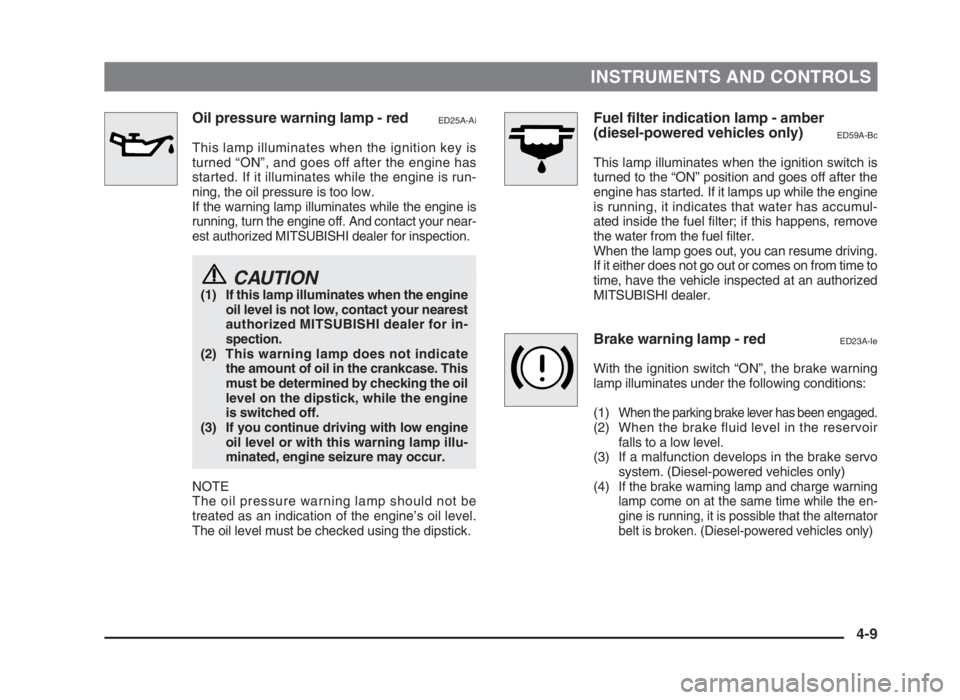
Oil pressure warning lamp - redED25A-Ai
This lamp illuminates when the ignition key is
turned “ON”, and goes off after the engine has
started. If it illuminates while the engine is run-
ning, the oil pressure is too low.
If the warning lamp illuminates while the engine is
running, turn the engine off. And contact your near-
est authorized MITSUBISHI dealer for inspection.
CAUTION(1) If this lamp illuminates when the engine
oil level is not low, contact your nearest
authorized MITSUBISHI dealer for in-
spection.
(2) This warning lamp does not indicate
the amount of oil in the crankcase. This
must be determined by checking the oil
level on the dipstick, while the engine
is switched off.
(3) If you continue driving with low engine
oil level or with this warning lamp illu-
minated, engine seizure may occur.
NOTE
The oil pressure warning lamp should not be
treated as an indication of the engine’s oil level.
The oil level must be checked using the dipstick.
Fuel filter indication lamp - amber
(diesel-powered vehicles only)
ED59A-Bc
This lamp illuminates when the ignition switch is
turned to the “ON” position and goes off after the
engine has started. If it lamps up while the engine
is running, it indicates that water has accumul-
ated inside the fuel filter; if this happens, remove
the water from the fuel filter.
When the lamp goes out, you can resume driving.
If it either does not go out or comes on from time to
time, have the vehicle inspected at an authorized
MITSUBISHI dealer.
Brake warning lamp - redED23A-Ie
With the ignition switch “ON”, the brake warning
lamp illuminates under the following conditions:
(1)
When the parking brake lever has been engaged.(2) When the brake fluid level in the reservoir
falls to a low level.
(3) If a malfunction develops in the brake servo
system. (Diesel-powered vehicles only)
(4)
If the brake warning lamp and charge warning
lamp come on at the same time while the en-
gine is running, it is possible that the alternator
belt is broken. (Diesel-powered vehicles only)
4-9
04engL2_240082_4 22-01-2004 13:19 Page 4-9
Page 108 of 264
STARTING AND DRIVING
NOTE
(1) When shifting from “2H” to “4H” soon
after driving the vehicle in a cold
weather district, the transmission
gear may make a noise. So try to shift
the gear while the vehicle is stopped.
(2) The 4WD operation indication lamp
will go out momentarily during shifting
process from “4H” to “4L” or vice
versa, as the shift lever passes
through the neutral position.
Be sure to operate the shift lever until
the 4WD operation indicator lamp illu-
minates again.
(3) There may be a case that the transfer
shift lever fees heavy when it is
moved from “4H” to “2H” with the
steering wheel in turned position. This
is normal and not any indication of
trouble.
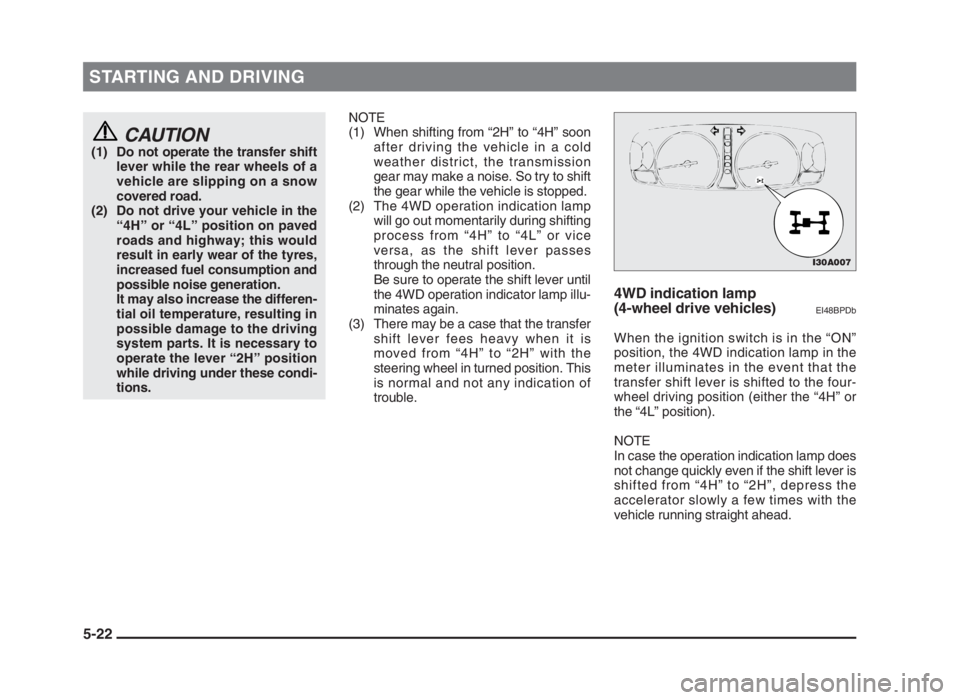
4WD indication lamp
(4-wheel drive vehicles)
EI48BPDb
When the ignition switch is in the “ON”
position, the 4WD indication lamp in the
meter illuminates in the event that the
transfer shift lever is shifted to the four-
wheel driving position (either the “4H” or
the “4L” position).
NOTE
In case the operation indication lamp does
not change quickly even if the shift lever is
shifted from “4H” to “2H”, depress the
accelerator slowly a few times with the
vehicle running straight ahead.
5-22
I30A007
CAUTION(1) Do not operate the transfer shift
lever while the rear wheels of a
vehicle are slipping on a snow
covered road.
(2) Do not drive your vehicle in the
“4H” or “4L” position on paved
roads and highway; this would
result in early wear of the tyres,
increased fuel consumption and
possible noise generation.
It may also increase the differen-
tial oil temperature, resulting in
possible damage to the driving
system parts. It is necessary to
operate the lever “2H” position
while driving under these condi-
tions.
05engL2_240082_4 22-01-2004 13:05 Page 5-22
Page 112 of 264
STARTING AND DRIVING
5-26
Correct 4-wheel drive
operation
EI32ABDa
By shifting lock to 4-wheel drive (4H, 4L),
both axles of the vehicle are rigidly con-
nected with each other. This improves the
traction characteristics. When turning
sharp corners or moving forward and
backward repeatedly, however, the drive
line is stressed, which is felt as a braking
effect. A 4-wheel drive vehicle can accele-
rate more quickly and smoothly.
However, note that the braking distance is
not shorter than that of a rear-wheel drive
vehicle.
When using 4-wheel drive on rough roads
(snow, mud, sand, etc.), it is important to
operate the vehicle correctly.
NOTE
(1) The driving posture should be more
upright and closer to the wheel than
usual; adjust the seat to a good posi-
tion for easy steering and pedal oper-
ation. Be sure to wear the seat belt.
(2) After driving on rough roads, check
each part of the vehicle and wash it
thoroughly with water. Refer to the
“Vehicle care” section and “Inspection
and maintenance following rough
road operation” sections.Driving on dry paved road and highway
Select 2WD (2H) to drive on dry paved
roads. Especially on dry highway, never
select the 4WD (4H or 4L).
CAUTIONSelecting 4-wheel drive to drive on
dry paved road will increase the fuel
consumption with possible noise
generation and early tyre wear.
It may also increase the differential
oil temperature, resulting in possible
damage to the driving system. Fur-
ther, the drive train will be subjected
to excessive loading, possibly lead-
ing to oil leakage, component
seizure, or other serious faults.
Driving on snowy or icy roads
Set the transfer shift lever to “4H” or “4L” in
accordance with the road conditions, and
then gradually depress the accelerator
pedal for a smooth start.
NOTE
(1) The use of snow tyres and/or tyre
chains is recommended.
(2) Maintain a safe distance between
vehicles, avoid sudden braking, and
use engine braking (downshifting).
CAUTIONAvoid sudden braking, sudden ac-
celeration, and sharp turning; such
operations could cause skidding
and spinouts.
Driving on sandy or muddy roads
Set the transfer shift lever to “4H” or “4L”,
and then gradually depress the accelera-
tor pedal for a smooth start. Keep the
pressure on the accelerator pedal as con-
stant as possible, and drive at low speed.
05engL2_240082_4 22-01-2004 13:05 Page 5-26
Page 115 of 264
STARTING AND DRIVING
5-29
CAUTIONNever cross a stream where the
water is deep.
Do not change gears while crossing
the stream.
Frequent crossing of streams can
adversely affect the life span of the
vehicle; consult an authorized
MITSUBISHI dealer and take the ne-
cessary measures to prepare, in-
spect, and repair the vehicle.
After crossing a stream, apply the brakes
to be sure they are functioning properly. If
the brakes are wet and not functioning
properly, dry them out by driving slowly
while lightly depressing the brake pedal.
Inspect each part of the vehicle carefully.
Refer to the “Inspection and maintenance
following rough road operation” section.
Cautions on handling of
4WD vehicles
EI49A-Ce
Tyres and wheels
Since the driving torque can be applied to
the 4 wheels, the performance of the vehi-
cle when operating in 4WD is greatly
affected by the condition of the tyres.
Pay close attention to the tyres.
• Install specified tyres on all wheels. Re-
fer to the “Tyres and wheels” on page
10-8, 10-14, 10-22.
• All tyres should be rotated whenever the
wear difference between front and rear
tyres is recognizable.
Good vehicle performance cannot be
expected if there is a difference in wear
between tyres. Refer to the “Tyre rota-
tion” on page 9-11.
• Check the tyre inflation pressure regu-
larly.
Inspection and maintenance
following rough road operation
After operating the vehicle in rough road
conditions, be sure to perform the following
inspection and maintenance procedures:
(1) Check that the vehicle has not been
damaged by rocks, gravel, etc.
(2) Carefully wash the vehicle with water.
Drive the vehicle slowly while lightly
depressing the brake pedal in order to
dry out the brakes. If the brakes still
do not function properly, contact an
authorized MITSUBISHI dealer as
soon as possible to have the brakes
checked.
(3) Remove the insects, dried grass, etc.
clogging the radiator core.
(4) If a stream has been crossed, check
the engine, transmission, and differ-
ential oil and propeller shaft grease. If
the oil or grease is milky or cloudy
because of water contamination, it
must be replaced with new oil.
(5) Check the inside of the vehicle. If
ingress of water is found, dry the car-
pet etc.
(6) Inspect the headlamps. If the head-
lamp bulb is flooded with water, have
the headlamp drained off at an autho-
rized MITSUBISHI dealer.
(7) Have an authorized MITSUBISHI
dealer replace grease in the wheel
bearing.
05engL2_240082_4 22-01-2004 13:05 Page 5-29
Page 116 of 264
STARTING AND DRIVING
5-30
CAUTIONAlways use tyres of the same size,
same type, and same brand, and
which have no wear differences. Us-
ing tyres which differ in size, type,
brand or the degree of wear will in-
crease the differential oil tempera-
ture, resulting in possible damage to
the driving system.
Further, the drive train will be sub-
jected to excessive loading, possi-
bly leading to oil leakage, compo-
nent seizure, or other serious faults.
Jacking up vehicle on 4-wheel
drive vehicles
CAUTIONDo not crank the engine while jack-
ing up the vehicle.
The tyre on the ground may turn and
the vehicle may roll off the jack.
Operate clutch pedal slowly and
positively
Quick or slight clutch engagement made
while the engine is running at high speed
will cause damage to the clutch and trans-
mission because the tractive force is very
great.
Operate the pedal slowly and positively.
Parking brakeEI07A-Tb
To park the vehicle, first bring it to a com-
plete stop, fully engage the parking brake,
and then move the gearshift level to 1st
(on an uphill) or Reverse (on a downhill)
position for vehicles with a manual trans-
mission or set the selector lever to the “P”
(PARK) position on automatic transmis-
sion vehicles.
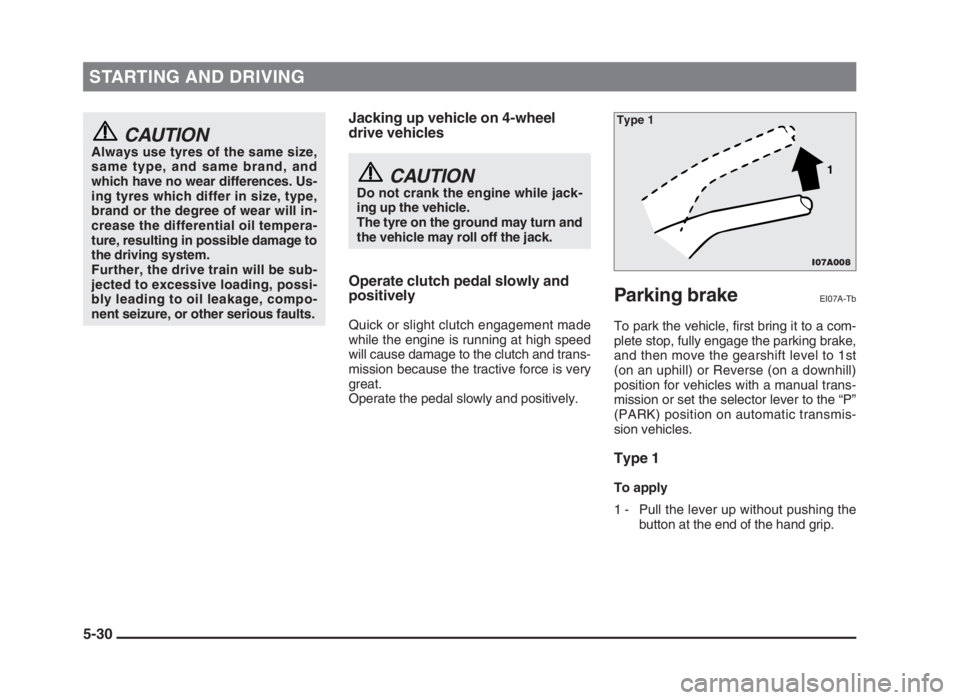
Type 1
To apply
1 - Pull the lever up without pushing the
button at the end of the hand grip.
I07A008
1
Type 1
05engL2_240082_4 22-01-2004 13:05 Page 5-30
Page 119 of 264
STARTING AND DRIVING
5-33 Brake pads and linings
(1) With new brake pads or linings, avoid
where possible sudden full applica-
tion of the brakes for the first 200 km
(125 miles) of driving.
(2) The disc brakes are provided with a
warning device which emits a shriek-
ing metallic sound while braking if the
brake pads have reached their limit.
If you hear this sound, have the brake
pads replaced by your MITSUBISHI
dealer.
CAUTION(1) Do not leave any objects or
place a thick floor mat around
the brake pedal; doing so could
prevent the full pedal stroke that
would be necessary in an emer-
gency. Make sure that the pedal
can be operated freely at all
times.
(2) Avoid driving habits that may
lead to sudden braking and
never “ride” the brakes by rest-
ing your foot on the brake pedal
while driving.
It causes brake overheating and
fade.
• Driving on gravel or snow-covered
roads.
• Driving with tyre chains installed.
• Driving on roads where the road
surface is pitted or has other differ-
ences in surface height.
• Driving on bumpy roads or other
poor driving surfaces.
(3) Operation of the ABS is not restricted
to situations where brakes are applied
suddenly. This system may also oper-
ate to prevent wheel lock when you
are driving over manholes, steel road-
work plates, or the vehicle is driven
over steps or level differences in the
road, road markings, or other sur-
faces which are difficult for the wheels
to grip.
(4) When the ABS is activated, you may
feel the brake pedal pulsating and
hear a characteristic noise. Also at
this time, it may feel as if the pedal at-
tempts to resist being depressed.
In this situation, to let the ABS
work for you, just hold the brake
pedal down more firmly. Do not
pump the brake. This will result in
reduced braking performance.Anti-lock brake system
(ABS)*
EI24APD
Environmental conditions can have an ef-
fect on braking. During sudden braking
when there is snow, ice, oil, water etc; on
the road surface, a skid may occur. In this
situation, steering control and braking ef-
fectiveness is reduced and the stopping
distance is increased. The vehicle may
also go into an uncontrolled spin.
The ABS helps prevent the wheels from
locking during braking, thus maintaining
directional stability, ensuring controllabi-
lity, and providing optimum braking force.
Driving hints
(1) With ABS fitted, steering during sud-
den braking (when the ABS functions)
differs slightly from when the brakes
are not being applied.
Steer the vehicle carefully in these
conditions.
(2) Always maintain the same distance
from the vehicle in front of you as you
would for a vehicle not equipped with
an ABS.
Compared with vehicles not fitted
with ABS, your vehicle may require a
longer stopping distance in the follow-
ing cases:
05engL2_240082_4 22-01-2004 13:05 Page 5-33
Page 142 of 264
FOR PLEASANT DRIVING
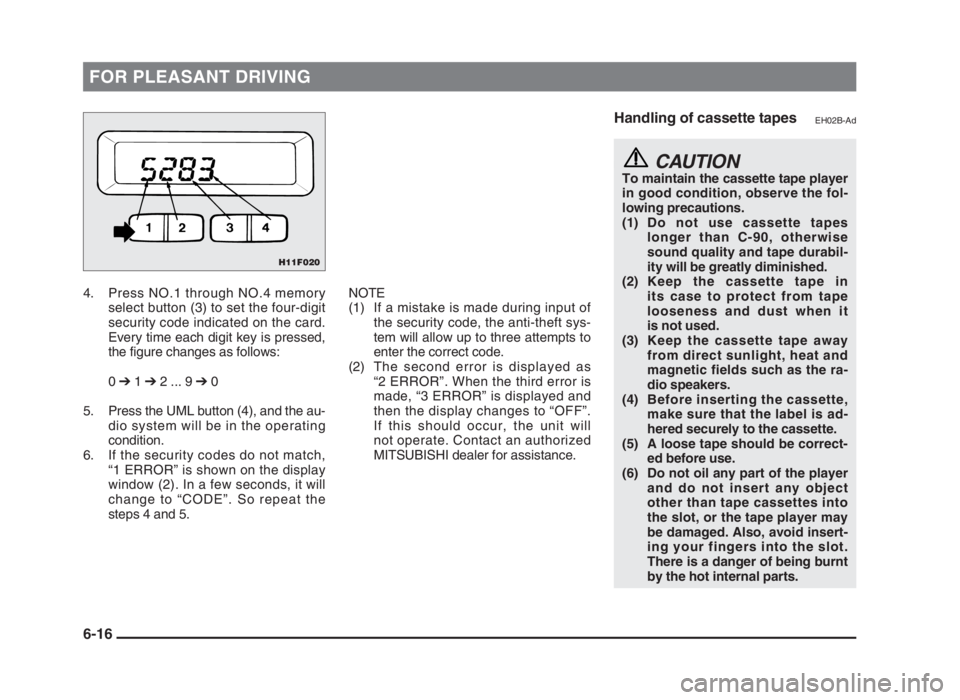
4. Press NO.1 through NO.4 memory
select button (3) to set the four-digit
security code indicated on the card.
Every time each digit key is pressed,
the figure changes as follows:
0 ➔1 ➔2 ... 9 ➔0
5. Press the UML button (4), and the au-
dio system will be in the operating
condition.
6. If the security codes do not match,
“1 ERROR” is shown on the display
window (2). In a few seconds, it will
change to “CODE”. So repeat the
steps 4 and 5.NOTE
(1) If a mistake is made during input of
the security code, the anti-theft sys-
tem will allow up to three attempts to
enter the correct code.
(2) The second error is displayed as
“2 ERROR”. When the third error is
made, “3 ERROR” is displayed and
then the display changes to “OFF”.
If this should occur, the unit will
not operate. Contact an authorized
MITSUBISHI dealer for assistance.
Handling of cassette tapesEH02B-Ad
CAUTIONTo maintain the cassette tape player
in good condition, observe the fol-
lowing precautions.
(1) Do not use cassette tapes
longer than C-90, otherwise
sound quality and tape durabil-
ity will be greatly diminished.
(2) Keep the cassette tape in
its case to protect from tape
looseness and dust when it
is not used.
(3) Keep the cassette tape away
from direct sunlight, heat and
magnetic fields such as the ra-
dio speakers.
(4) Before inserting the cassette,
make sure that the label is ad-
hered securely to the cassette.
(5) A loose tape should be correct-
ed before use.
(6) Do not oil any part of the player
and do not insert any object
other than tape cassettes into
the slot, or the tape player may
be damaged. Also, avoid insert-
ing your fingers into the slot.
There is a danger of being burnt
by the hot internal parts.
6-16
H11F020
06engL2_240082_4 22-01-2004 13:07 Page 6-16
Page 169 of 264
VEHICLE CARE
Plastic, vinyl leather, fabric and
flocked parts
EK24A-Ab
1. Gently wipe off with gauze or other
soft cloth soaked with a 3% aqueous
solution of neutral detergent.
2. Dip cloth in fresh water and wring out
well. Using this cloth, wipe off the
detergent thoroughly.
NOTE
Do not use the cleaners, conditioners and
protectants containing silicons or wax.
Such products may cause annoying re-
flections and obscure vision.
Genuine leather*EK27A-Gb
1. Lightly wipe off with gauze or other
soft cloth soaked with a 5% aqueous
solution of neutral detergent for wool.
2. Dip cloth in fresh water and wring it
out well. Using this cloth, wipe off the
detergent thoroughly.
3. Apply leather protecting agent to the
genuine leather surface.
NOTE
(1) If genuine leather is wet with water or
is washed in water, wipe off water as
quickly as possible with a dry, soft
cloth.
(2) Slight stains on genuine leather may
be removed with leather cleaner as
well.
(3) The genuine leather surface may be
damaged if a nylon brush or synthetic
fibre is rubbed hard against it.
(4) Organic solvents such as benzine, al-
cohol and gasoline, acid or alkaline
solvents may discolor the genuine
leather surface. Be sure to use neu-
tral detergents.
(5) The genuine leather surface may
harden and shrink if it is exposed to
direct rays of the sun for long hours.
When your vehicle is parked, place it
in the shade as much as possible.
UpholsteryEK25A-Aa
1. To maintain the value of your new
vehicle, handle the upholstery care-
fully and keep the interior clean.
Use a vacuum cleaner and brush to
clean the seats. If stained, vinyl and
synthetic leather should be cleaned
with an appropriate cleaner, and cloth
fabrics can be cleaned with either up-
holstery cleaner or a 3% solution of
neutral detergent in lukewarm water.
2. Clean the carpeting with a vacuum
cleaner and remove any stains with
carpet cleaner. Oil and grease can be
removed by lightly dabbing with a
clean colourfast cloth and stain re-
mover.
7-3
07engL2_240082_4 22-01-2004 13:09 Page 7-3