ABS MITSUBISHI L200 2015 (in English) User Guide
[x] Cancel search | Manufacturer: MITSUBISHI, Model Year: 2015, Model line: L200, Model: MITSUBISHI L200 2015Pages: 418, PDF Size: 25.8 MB
Page 178 of 418
CAUTIONlEven the ABS cannot prevent the natural
laws of physics from acting on the vehicle. Itcannot for instance avoid accidents that may
result from excessive speed on bends or fol- lowing another vehicle too closely or aqua- planing. It should remain the driver’s task to
observe safety precautions to judge speeds and brake applications correctly in such con-
ditions.
l Be sure to use tyres of the same type and
size on 4 wheels.
If tyre types or sizes are mixed, ABS may not function normally.
l Never install a limited-slip differential,
which is not a MITSUBISHI MOTORS gen-
uine part, as the ABS may not function nor-
mally.
We recommend you to consult a MITSUBISHI MOTORS Authorized Serv-
ice Point.ABS warning lamp
E00607201164
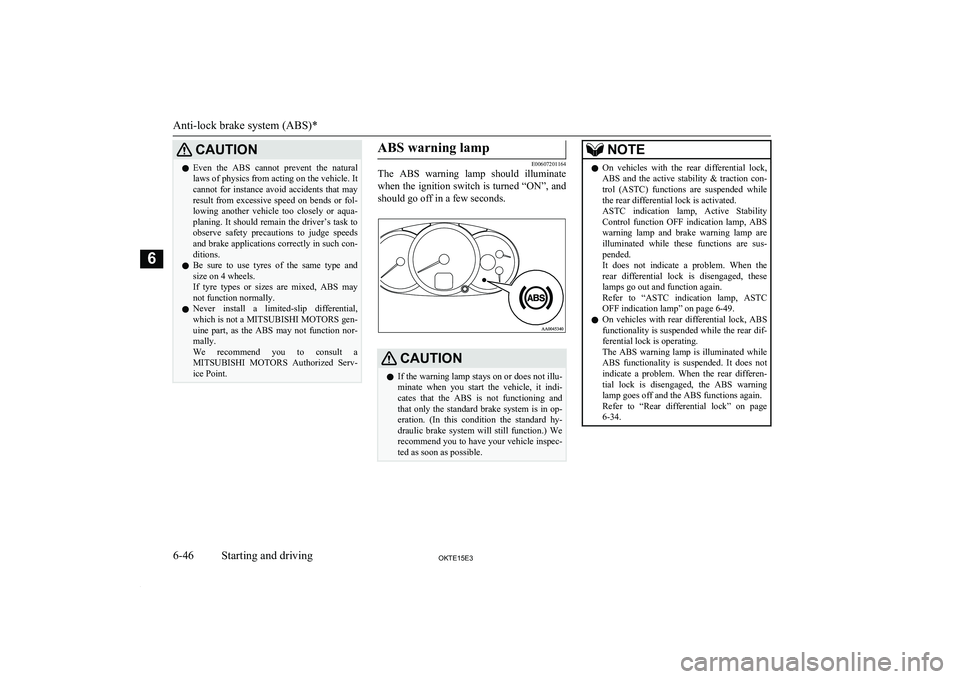
The ABS warning lamp should illuminate
when the ignition switch is turned “ON”, and
should go off in a few seconds.
CAUTIONl If the warning lamp stays on or does not illu-
minate when you start the vehicle, it indi-
cates that the ABS is not functioning and
that only the standard brake system is in op-
eration. (In this condition the standard hy- draulic brake system will still function.) We
recommend you to have your vehicle inspec- ted as soon as possible.NOTEl On vehicles with the rear differential lock,
ABS and the active stability & traction con-
trol (ASTC) functions are suspended while the rear differential lock is activated.
ASTC indication lamp, Active Stability
Control function OFF indication lamp, ABS warning lamp and brake warning lamp are
illuminated while these functions are sus- pended.
It does not indicate a problem. When the
rear differential lock is disengaged, these lamps go out and function again.
Refer to “ASTC indication lamp, ASTC
OFF indication lamp” on page 6-49.
l On vehicles with rear differential lock, ABS
functionality is suspended while the rear dif- ferential lock is operating.
The ABS warning lamp is illuminated while ABS functionality is suspended. It does notindicate a problem. When the rear differen-
tial lock is disengaged, the ABS warning
lamp goes off and the ABS functions again.
Refer to “Rear differential lock” on page
6-34.
Anti-lock brake system (ABS)*
6-46OKTE15E3Starting and driving6
Page 179 of 418
If the warning lamp illuminateswhile driving
E00607302436
If only the ABS warning lamp illuminates
l Avoid hard braking and high-speed driv-
ing. Stop the vehicle in a safe place.
Restart the engine and check to see whether the lamp goes out after a few
minutes driving; if it then remains off during driving, there is no problem.
However, if the lamp does not go out, or if it lights up again when the vehicle is
driven, we recommend you to have the
vehicle checked as soon as possible.
l The ABS warning lamp can illuminate if
the battery voltage is insufficient when the engine is started. In this case, it doesnot indicate an ABS fault.
Charge the battery by allowing the en- gine to idle for a while.
If the battery has been charged but the
ABS warning lamp continues to illumi-
nate or illuminates intermittently, have
the vehicle inspected.
If the ABS warning lamp and
brake warning lamp illuminate
at the same time
The ABS and brake force distribution func- tion will not work, so hard braking could
make the vehicle unstable.
Avoid hard braking and high-speed driving.
Stop the vehicle in a safe place and contact a MITSUBISHI MOTORS Authorized Service
Point.
NOTEl Immediately after the vehicle starts moving
after engine start up, a whining sound of a motor will be heard from the engine com-
partment. If the brake pedal is depressed at that moment, you can feel the brake pedal
pulsating.
This pulsation is due to the self-diagnosis
operation of the ABS and does not indicate a malfunction.
l After driving on snowy roads, remove any
snow and ice which may have become ad-
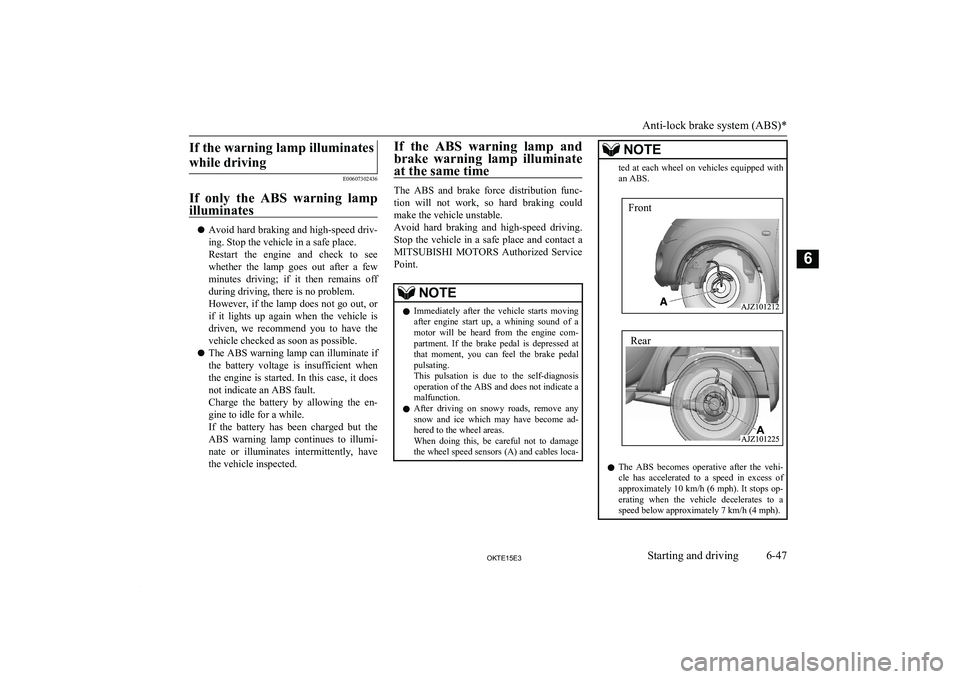
hered to the wheel areas.
When doing this, be careful not to damage the wheel speed sensors (A) and cables loca-NOTEted at each wheel on vehicles equipped with
an ABS.
l The ABS becomes operative after the vehi-
cle has accelerated to a speed in excess of approximately 10 km/h (6 mph). It stops op-
erating when the vehicle decelerates to a speed below approximately 7 km/h (4 mph).
Anti-lock brake system (ABS)*
6-47OKTE15E3Starting and driving6 Front Rear
Page 180 of 418
Power steering systemE00607400387
The power steering system operates while the
engine is running. It helps reduce the effort needed to turn the steering wheel.
The power steering system has mechanical
steering capability in case the power assist is lost. If the power assist is lost for some rea-
son, you will still be able to steer your vehi-
cle, but you will notice it takes much more effort to steer. If this happens, have your ve-
hicle inspected at an authorized MITSUBISHI MOTORS service point.WARNINGl Do not stop the engine while the vehicle is
moving. Stopping the engine would make
the steering wheel extremely hard to turn, possibly resulting in an accident.CAUTIONl Do not leave the steering wheel turned all
the way in one direction. This can causedamage to the power steering system.Active Stability & Traction
Control (ASTC)* E00616700344
The active stability & traction control (ASTC) takes overall control of the anti-lockbrake system, traction control function and Active Stability Control function to help
maintain the vehicle’s control and traction. Please read this section in conjunction with the page on the anti-lock brake system, trac- tion control function and Active Stability
Control function.
Anti-lock brake system (ABS) ® p. 6-45
Active Traction Control function ® p. 6-49
Active Stability Control function ® p. 6-49CAUTIONl Do not over-rely on the ASTC. This system,
like any other system, has limits and cannot
help you to maintain traction and control of
the vehicle in all circumstances. Reckless
driving may lead to accidents. Always drive carefully, taking into account the traffic,road and environmental conditions.
l Be sure to use the same specified type and
size of tyre on all 4 wheels. Otherwise, the
ASTC may not work correctly.NOTEl After your vehicle is driven a short distance
after starting the engine, a click is heard from the engine compartment; however, this
is only the sound of ASTC being checked.
l Some vibration will be felt in the vehicle
body and a whining sound of a motor will be heard from the engine compartment when the ASTC functions. This is a normal result
of the ASTC operation, and does not indi- cate a malfunction.
l The ASTC does not operate while the ABS
warning lamp is illuminated.
l On vehicles with the rear differential lock,
the ASTC and ABS functions are suspended
while the rear differential lock is activated. ASTC indication lamp, ASTC OFF indica-tion lamp and ABS warning lamp are illumi-
nated while these functions are suspended. It
does not indicate a problem. When the rear differential lock is disengaged, these lamps
go out and function again.
Refer to “ABS warning lamp” on page 6-46,
“ASTC indication lamp, ASTC OFF indica-
tion lamp” on page 6-49.
Power steering system
6-48OKTE15E3Starting and driving6
Page 189 of 418
Club cabSingle cab, Double cab (Vehicles withoutlong bed)Double cab (Vehicles with long bed)130 mm30 mm30 mm255 mm55 mm55 mm3115 mm60 mm60 mm4872 mm812 mm812 mm520 mm20 mm20 mm685 mm85 mm85 mm7687 - 698 mm681 - 695 mm, 579 - 581 mm*682 - 690 mm, 576 mm*8642 - 653 mm639 - 654 mm, 537 - 539 mm*640 - 649 mm, 534 mm*9612 - 623 mm609 - 624 mm, 507 - 509 mm*610 - 619 mm, 504 mm*10406 - 418 mm400 - 415 mm, 292 - 294 mm*405 - 414 mm, 302 mm*11486 - 498 mm480 - 496 mm, 486 - 488 mm*476 - 502 mm, 486 mm*12897 mm897 mm897 mm131,251 mm1,136 mm1,316 mm1470 mm70 mm70 mm15502.5 mm502.5 mm502.5 mm16540.5 mm540.5 mm540.5 mmItem 7, 8, 9, 10, 11: at kerb weight
*: 2WD vehicles with 15 inch tyresNOTEl The values under item 7, 8, 9, 10, 11 are ap-
plicable to unladen vehicles. These values
can also be varied depending on the tyre size, optional equipment and suspension
conditions.Operating hints
l Do not let the clutch slip (vehicles with a
M/a only) and do not increase the engine
speed more than necessary when start-
ing.Trailer towing
6-57OKTE15E3Starting and driving6
Page 312 of 418
WARNINGlElectrolyte is corrosive diluted sulphuric
acid.
If electrolyte (battery acid) comes into contact with your hands, eyes, clothes and
the painted surface of your vehicle, it should be thoroughly flushed with water.If electrolyte gets in your eyes, flush them
with water immediately and thoroughly, and get prompt medical attention.CAUTIONl Do not attempt to start the engine by pulling
or pushing the vehicle.
It could damage your vehicle.
l Always wear protective eye goggles when
working near the battery.
l Keep the battery out of the reach of children.NOTEl
On vehicles with anti-lock brake system, if
the vehicle is put in motion without fully charging the battery, it might cause the loss
of smooth engine operation and the antilock brake warning lamp to illuminate.
Refer to “Anti-lock brake system (ABS)” on
page 6-45.Engine overheating
E00800602777
If the water temperature gauge indication re-
mains in the overheating zone for a long
time, the engine may be overheating. If this occurs, take the following corrective meas-
ures: 1. Stop the vehicle in a safe place.
2. Check whether steam is coming from the
engine compartment.
[If steam does not come from the engine
compartment]
With the engine still running, raise the bonnet to ventilate the engine compart-
ment.
[If steam is coming from the engine
compartment]
Stop the engine, and when the steam
stops, raise the bonnet to ventilate the engine compartment. Restart the engine.WARNINGl Do not open the bonnet while steam is
coming from the engine compartment. It
could cause steam or hot water to spurt out, causing burns. Hot water could spurt
out even when there is no steam coming out, and some parts will be very hot. Be
very careful when opening the bonnet.WARNINGl Be careful of hot steam, which could be
blowing off the reserve tank cap.
l Do not attempt to remove the radiator
cap while the engine is hot.
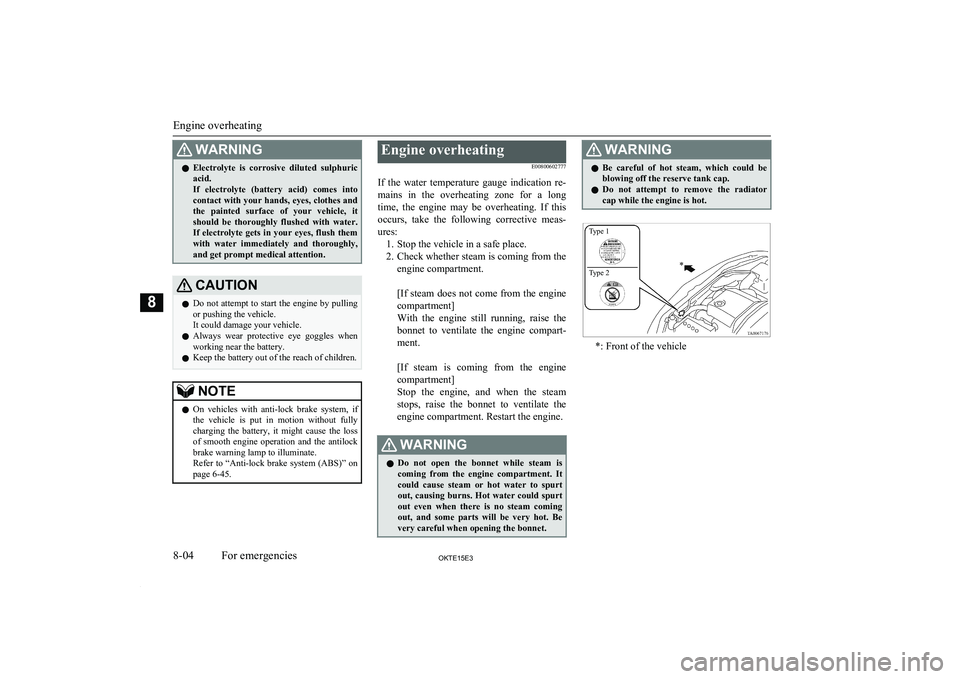
*: Front of the vehicle
Engine overheating
8-04OKTE15E3For emergencies8 Type 1
Type 2
Page 334 of 418
Avoid racing the engine or spinning thewheels. Prolonged efforts to free a stuck ve-
hicle may result in overheating and transmis- sion failure. Allow the engine to idle for a
few minutes to let the transmission cool be-
tween rocking attempts.
If the vehicle remains stuck after several rocking attempts, seek other assistance.WARNINGl When attempting to rock your vehicle out
of a stuck position, be sure that the area
around the vehicle is clear of people and
physical objects. The rocking motion may cause the vehicle to suddenly launch for-ward or backward, causing injury or
damage to nearby people or objects.
On 2WD vehicles, it is recommended to start
the vehicle with parking brake partially, but
not completely, applied by slightly pulling the parking brake lever.
After the vehicle has become free, do not for-
get to release the parking brake.
NOTEl Depress the accelerator pedal gradually
when starting the vehicle.On a flooded road
l Avoid flooded roads. Water could enter
the brake discs, resulting in temporarily
ineffective brakes. In such cases, lightly
depress the brake pedal to see if the brakes operate properly. If they do not,
lightly depress the pedal several times while driving in order to dry the brake
pads.
l When driving in rain or on a road with
many puddles a layer of water may form between the tyres and the road surface.
This reduces a tyre’s frictional resistance
on the road, resulting in loss of steering stability and braking capability.
To cope with this, observe the following
items:
(a)Drive your vehicle at slow speed. (b)Do not drive on worn tyres. Al-
ways maintain the specified tyre
inflation pressures.On a snow-covered or frozen
road
l When driving on a snow-covered or fro-
zen road, it is recommended that you use snow tyres or tyre chains.
Refer to the “Snow tyres” and “Tyre
chains” sections.
l Avoid high-speed operation, sudden ac-
celeration, abrupt brake application and
sharp cornering.
l Depressing the brake pedal during travel
on snowy or icy roads may cause tyre
slippage and skidding. When traction be-
tween the tyres and the road is reduced the wheels may skid and the vehicle can-
not readily be brought to a stop by con- ventional braking techniques. Brakingwill differ, depending upon whether you
have anti-lock brake system (ABS). If you do have ABS, brake by pressing the brake system pedal hard, and keeping it
pressed. If you do not have ABS, pump
the brake pedal with short rapid jabs, each time fully applying and fully re-
leasing for greatest effect.
l Allow extra distance between your vehi-
cle and the vehicle in front of you, and avoid sudden braking.
Operation under adverse driving conditions
8-26OKTE15E3For emergencies8
Page 378 of 418
NOTEFront room lamp and personallamps*
E01004700364
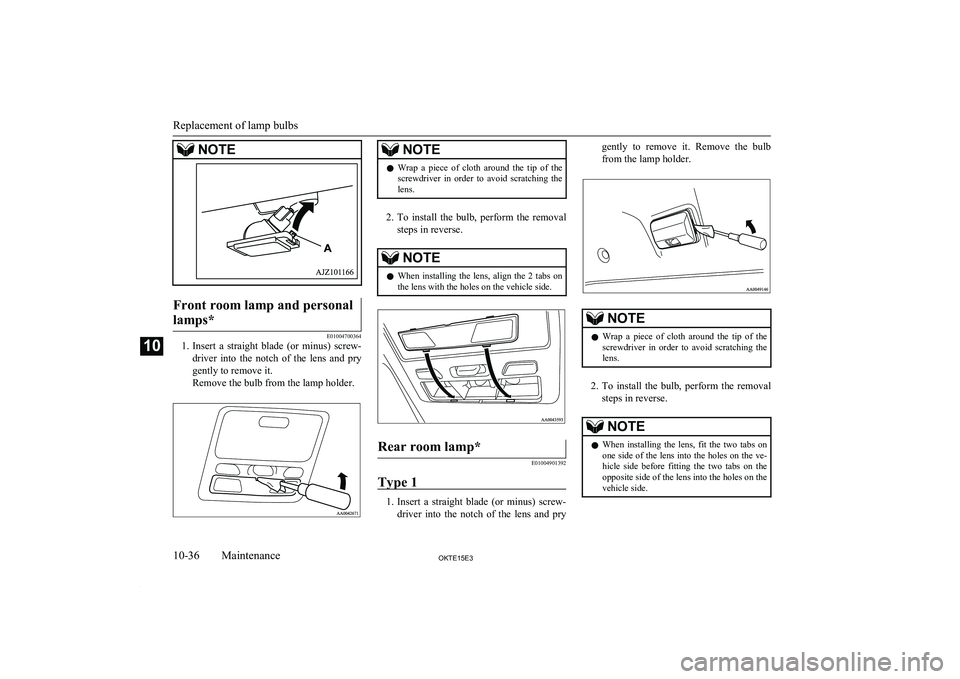
1. Insert a straight blade (or minus) screw-
driver into the notch of the lens and pry gently to remove it.
Remove the bulb from the lamp holder.
NOTEl Wrap a piece of cloth around the tip of the
screwdriver in order to avoid scratching the
lens.
2. To install the bulb, perform the removal
steps in reverse.
NOTEl When installing the lens, align the 2 tabs on
the lens with the holes on the vehicle side.Rear room lamp*
E01004901392
Type 1
1. Insert a straight blade (or minus) screw-
driver into the notch of the lens and pry
gently to remove it. Remove the bulb
from the lamp holder.NOTEl Wrap a piece of cloth around the tip of the
screwdriver in order to avoid scratching the
lens.
2. To install the bulb, perform the removal
steps in reverse.
NOTEl When installing the lens, fit the two tabs on
one side of the lens into the holes on the ve-hicle side before fitting the two tabs on the opposite side of the lens into the holes on the
vehicle side.
Replacement of lamp bulbs
10-36OKTE15E3Maintenance10
Page 379 of 418
NOTE
Type 2
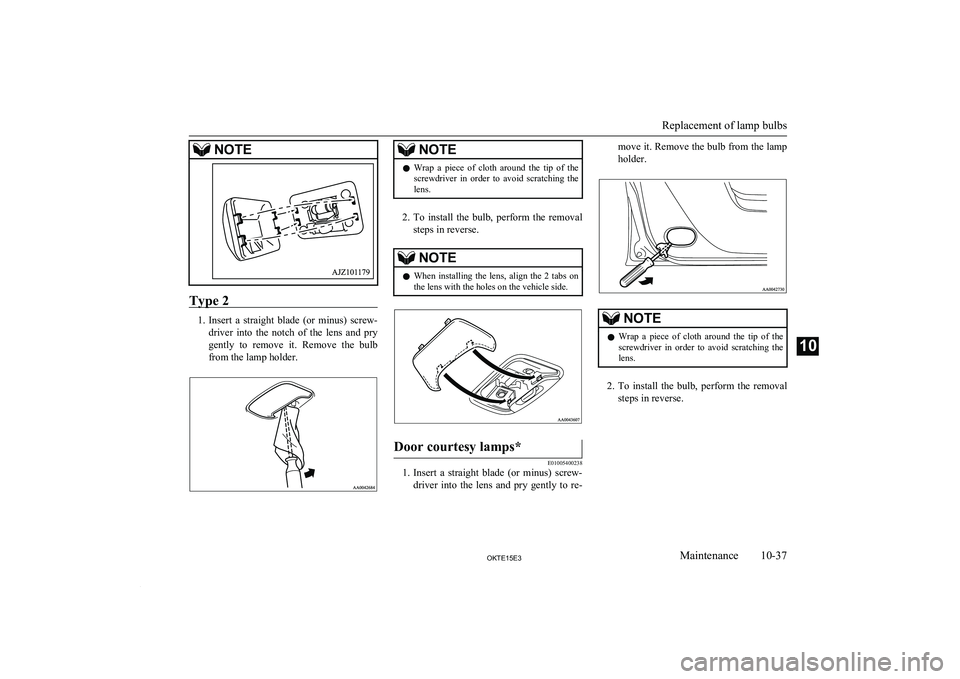
1.Insert a straight blade (or minus) screw-
driver into the notch of the lens and pry gently to remove it. Remove the bulb
from the lamp holder.
NOTEl Wrap a piece of cloth around the tip of the
screwdriver in order to avoid scratching the
lens.
2. To install the bulb, perform the removal
steps in reverse.
NOTEl When installing the lens, align the 2 tabs on
the lens with the holes on the vehicle side.Door courtesy lamps*
E01005400238
1. Insert a straight blade (or minus) screw-
driver into the lens and pry gently to re-
move it. Remove the bulb from the lamp
holder.NOTEl Wrap a piece of cloth around the tip of the
screwdriver in order to avoid scratching the
lens.
2. To install the bulb, perform the removal
steps in reverse.
Replacement of lamp bulbs
10-37OKTE15E3Maintenance10
Page 380 of 418
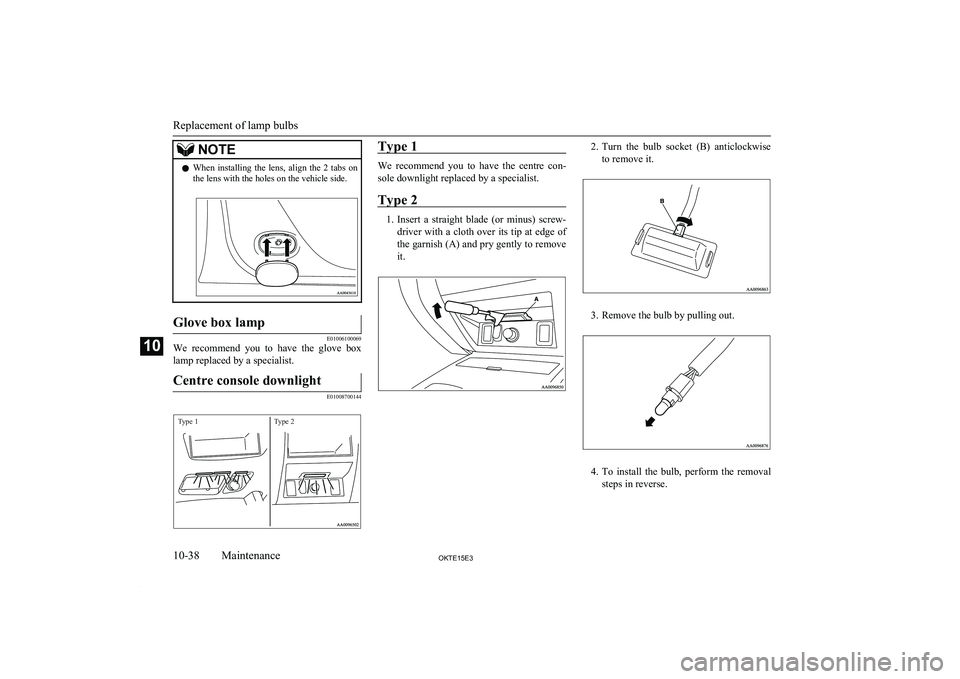
NOTElWhen installing the lens, align the 2 tabs on
the lens with the holes on the vehicle side.Glove box lamp
E01006100069
We recommend you to have the glove box
lamp replaced by a specialist.
Centre console downlight
E01008700144
Type 1Type 2Type 1
We recommend you to have the centre con-
sole downlight replaced by a specialist.
Type 2
1. Insert a straight blade (or minus) screw-
driver with a cloth over its tip at edge of
the garnish (A) and pry gently to remove it.
2. Turn the bulb socket (B) anticlockwise
to remove it.
3. Remove the bulb by pulling out.
4. To install the bulb, perform the removal
steps in reverse.
Replacement of lamp bulbs
10-38OKTE15E3Maintenance10
Page 399 of 418
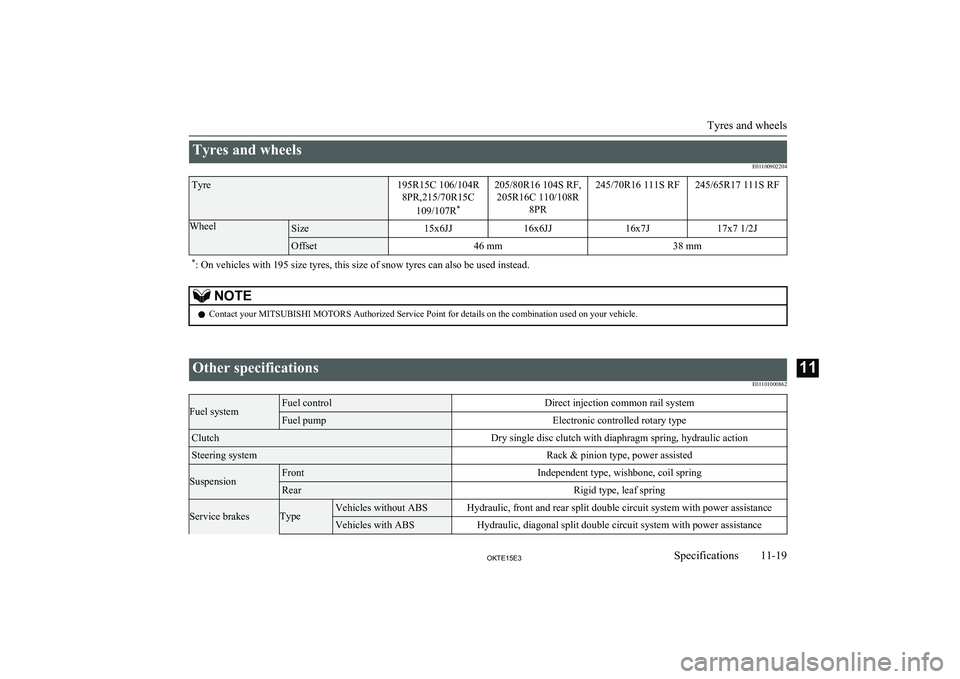
Tyres and wheelsE01100902204Tyre195R15C 106/104R8PR,215/70R15C
109/107R *205/80R16 104S RF,
205R16C 110/108R 8PR245/70R16 111S RF245/65R17 111S RFWheelSize15x6JJ16x6JJ16x7J17x7 1/2JOffset46 mm38 mm*: On vehicles with 195 size tyres, this size of snow tyres can also be used instead.NOTEl Contact your MITSUBISHI MOTORS Authorized Service Point for details on the combination used on your vehicle.
Other specifications
E01101000862Fuel systemFuel controlDirect injection common rail systemFuel pumpElectronic controlled rotary typeClutchDry single disc clutch with diaphragm spring, hydraulic actionSteering systemRack & pinion type, power assistedSuspensionFrontIndependent type, wishbone, coil springRearRigid type, leaf springService brakesTypeVehicles without ABSHydraulic, front and rear split double circuit system with power assistanceVehicles with ABSHydraulic, diagonal split double circuit system with power assistance
Tyres and wheels
11-19OKTE15E3Specifications11