steering MITSUBISHI LANCER 2014 8.G Owner's Manual
[x] Cancel search | Manufacturer: MITSUBISHI, Model Year: 2014, Model line: LANCER, Model: MITSUBISHI LANCER 2014 8.GPages: 434, PDF Size: 57.5 MB
Page 122 of 434
Ignition switch
Features and controls 5-55
5
Engages the starter. After the engine starts, release the key and it will return automati-cally to the “ON” position.
N00539601097
After about 30 minutes has elapsed with theignition switch in the “ACC” position, the function automatically cuts out the power for the audio system and other electric devicesthat can be operated with that position. When the ignition switch is turned from the “ACC” position, the power is supplied againto those devices.
N00550900184
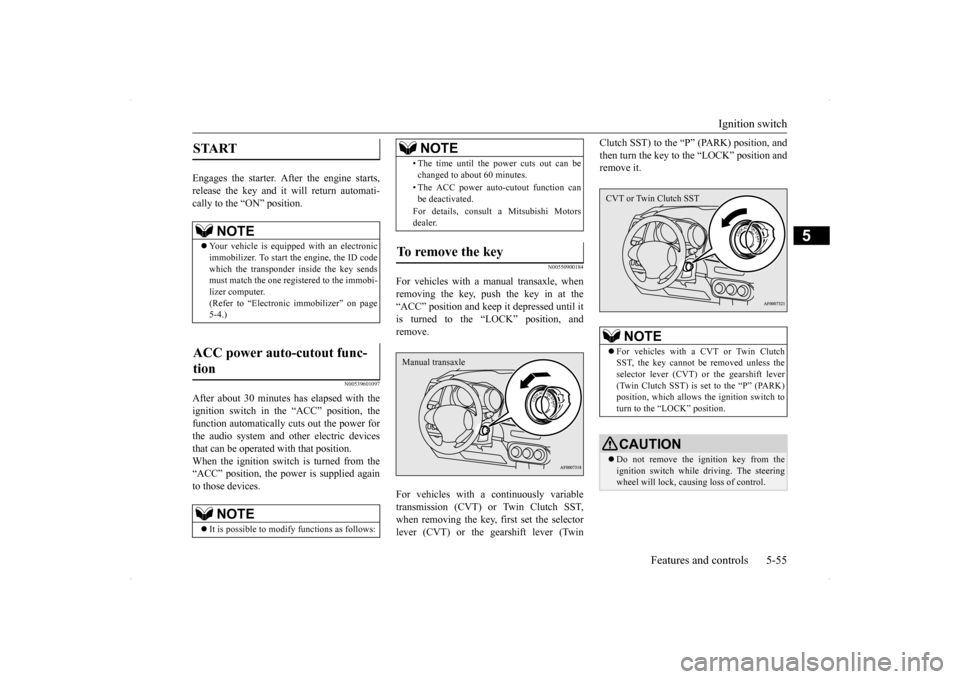
For vehicles with a manual transaxle, whenremoving the key, push the key in at the“ACC” position and keep it depressed until it is turned to the “LOCK” position, and remove. For vehicles with a continuously variable transmission (CVT) or Twin Clutch SST,when removing the key, first set the selector lever (CVT) or the gearshift lever (Twin
Clutch SST) to the “P
” (PARK) position, and
then turn the key to the “LOCK” position and remove it.
START
NOTE
Your vehicle is equipped with an electronic immobilizer. To start the engine, the ID code which the transponder inside the key sendsmust match the one registered to the immobi- lizer computer. (Refer to “Electronic immobilizer” on page5-4.)
ACC power auto-cutout func- tion
NOTE
It is possible to modify functions as follows:
• The time until the power cuts out can be changed to about 60 minutes. • The ACC power auto-cutout function can be deactivated. For details, consult a Mitsubishi Motors dealer.
To remove the key
NOTE
Manual transaxle
NOTE
For vehicles with a CVT or Twin Clutch SST, the key cannot be removed unless the selector lever (CVT) or the gearshift lever(Twin Clutch SST) is set to the “P” (PARK) position, which allows the ignition switch to turn to the “LOCK” position.CAUTION Do not remove the ignition key from the ignition switch while driving. The steering wheel will lock, causing loss of control.CVT or Twin Clutch SST
Page 123 of 434
![MITSUBISHI LANCER 2014 8.G Owners Manual Steering wheel lock 5-56 Features and controls
5
N00512500195
[For vehicles equipped with the F.A.S.T.-key] For information on operations for vehiclesequipped with the F.A.S.T.-key, refer to “F.A.S.](/img/19/7460/w960_7460-122.png "MITSUBISHI LANCER 2014 8.G Owners Manual Steering wheel lock 5-56 Features and controls
5
N00512500195
[For vehicles equipped with the F.A.S.T.-key] For information on operations for vehiclesequipped with the F.A.S.T.-key, refer to “F.A.S.")
Steering wheel lock 5-56 Features and controls
5
N00512500195
[For vehicles equipped with the F.A.S.T.-key] For information on operations for vehiclesequipped with the F.A.S.T.-key, refer to “F.A.S.T.-key: Steering wheel lock” on page 5-20. [Except for vehicles equipped with the F. A . S . T. - k e y ]
Remove the key at the “LOCK” position. Turn the steering wheel until it is locked. Turn the key to the “ACC” position while moving the steering wheel slightly.
N00542100060
Do not operate the starter motor continu- ously for longer than 15 seconds as thiscould run the battery down or damage the starter motor. If the engine does not start, turn the ignition switch back to the“LOCK” position, wait a few seconds, and then try again. Trying repeatedly with the engine or starter motor still turningwill damage the starter mechanism. If the engine will not start because the bat- tery is weak or discharged, refer to“Jump-starting the engine” (on page 8-2) for instructions.
If the engine is turned off while driving, the power brake booster will stop functioning and braking efficiency will be reduced. Also, the power steering system will not function and it will require greater effort to manuallysteer the vehicle. Do not leave the key in the “ON” position for a long time when the engine is not running. This will cause the battery to run down. Do not turn the key to the “START” position when the engine is running. It will damage the starter motor.
Steering wheel lock
CAUTION
To l o c k To u n l o c k
CAUTION Remove the key when leaving the vehicle.
NOTE
If the front wheels are turned, the anti-theft lock may sometimes make it difficult to turn the key from “LOCK” position to “ACC” position. Firmly turn the steering wheel to the left or to the right as you turn the key.
Starting and stopping the engine Tips for starting
Page 126 of 434

Starting and stopping the engine Features and controls 5-59
5
from a standstill even with the selector lever (CVT) or the gearshift lever (Twin Clutch SST) in the “D” (DRIVE) position. This phenomenon occurs because the trans-axle has not warmed up sufficiently; it does not indicate a problem. If it occurs, place the selector lever (CVT) or the gearshift lever(Twin Clutch SST) in the “P” (PARK) posi- tion and let the engine idle for at least 10 min- utes.The transaxle will warm up, and you will beable to start normally. Do not leave the vehicle during warm-up operation.
N00547600015
At high altitude locations, the idle speed maybe higher. This is done in order to stabilizethe idle speed when the power steering sys- tem and other systems operate. It does not indicate a malfunction.
N00542300088
1. Bring the vehicle to a complete stop. 2. Fully engage the parking brake whiledepressing the brake pedal.
3. For vehicles with a manual transaxle, turn the ignition switch to the “LOCK” posi- tion to stop the engine, and then move the gearshift lever to the 1st (on a uphill) or“R” (Reverse) (on a downhill) position. For vehicles with continuously variable transmission (CVT) or Twin Clutch SST,place the selector lever (CVT) or the gear- shift lever (Twin Clutch SST) in the “P” (PARK) position, and then turn the igni-tion switch to the “LOCK” position tostop the engine.
Idle speed in high altitude area Stopping the engine
NOTE
For vehicles with Twin Clutch SST, the engine will stop and the vehicle power will turn off approximately 1 second after the ignition switch is turned to the “LOCK”; position. The reason for this is that, in the time from when the ignition switch is turned to the“LOCK” position until the engine stops, the gears inside the Twin Clutch SST disengage so that the engine will start smoothly thenext time it is started. Two clutches installed in the Twin Clutch SST alternately engage and disengage toachieve smooth shifting. In addition, the gear on the side with the free clutch is engaged, therefore, quick shifting isperformed. If the engine was stopped with the gear engaged like this, it would provide resistancethe next time the engine is started. Therefore, the gear disengages in the approximately 1- second period until the engine stops. For vehicles with Twin Clutch SST, do not operate the gearshift lever or the acceleratorpedal for approximately 1 second until the engine stops.
Page 134 of 434
Continuously variable transmission (CVT) (if so equipped)
Features and controls 5-67
5
This position is used for most city and high- way driving. The trans
mission will automati-
cally and continuously change its gear ratio depending on road and driving conditions. This position is for driv
ing up very steep hills
and for engine braking at low speeds when driving down steep hills.
N00514400417
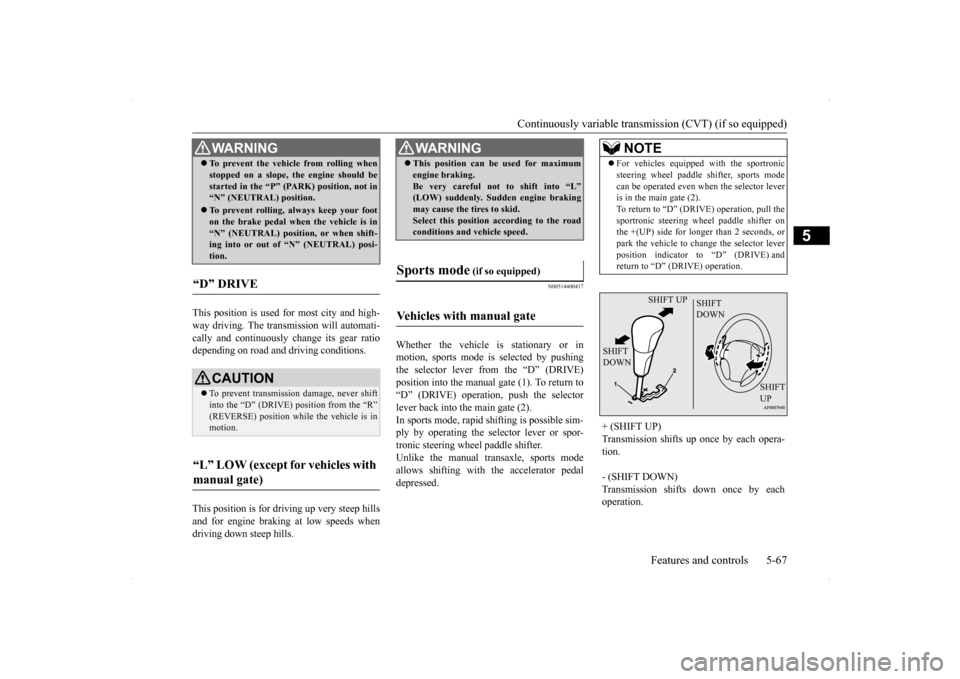
Whether the vehicle is stationary or inmotion, sports mode is selected by pushingthe selector lever from the “D” (DRIVE) position into the manual gate (1). To return to “D” (DRIVE) operation, push the selectorlever back into the main gate (2). In sports mode, rapid
shifting is possible sim-
ply by operating the selector lever or spor-tronic steering wheel paddle shifter. Unlike the manual transaxle, sports mode allows shifting with the accelerator pedaldepressed.
To prevent the vehicle from rolling when stopped on a slope, the engine should be started in the “P” (PARK) position, not in “N” (NEUTRAL) position. To prevent rolling, always keep your foot on the brake pedal when the vehicle is in “N” (NEUTRAL) position, or when shift-ing into or out of “N” (NEUTRAL) posi- tion.
“D” DRIVE
CAUTION To prevent transmission damage, never shift into the “D” (DRIVE) position from the “R” (REVERSE) position while the vehicle is inmotion.
“L” LOW (except for vehicles with manual gate)
WA R N I N G
WA R N I N G This position can be used for maximum engine braking. Be very careful not to shift into “L” (LOW) suddenly. Sudden engine braking may cause the tires to skid.Select this position according to the road conditions and vehicle speed.
Sports mode
(if so equipped)
Vehicles with manual gate
NOTE
For vehicles equipped with the sportronic steering wheel paddle shifter, sports mode can be operated even when the selector lever is in the main gate (2). To return to “D” (DRIVE) operation, pull thesportronic steering wheel paddle shifter on the +(UP) side for longer than 2 seconds, or park the vehicle to change the selector leverposition indicator to “D” (DRIVE) and return to “D” (DRIVE) operation.
+ (SHIFT UP) Transmission shifts up once by each opera- tion. - (SHIFT DOWN) Transmission shifts down once by each operation.
SHIFT UP
SHIFT DOWN
SHIFT DOWN
SHIFT UP
Page 135 of 434
Continuously variable transm
ission (CVT) (if so equipped)
5-68 Features and controls
5
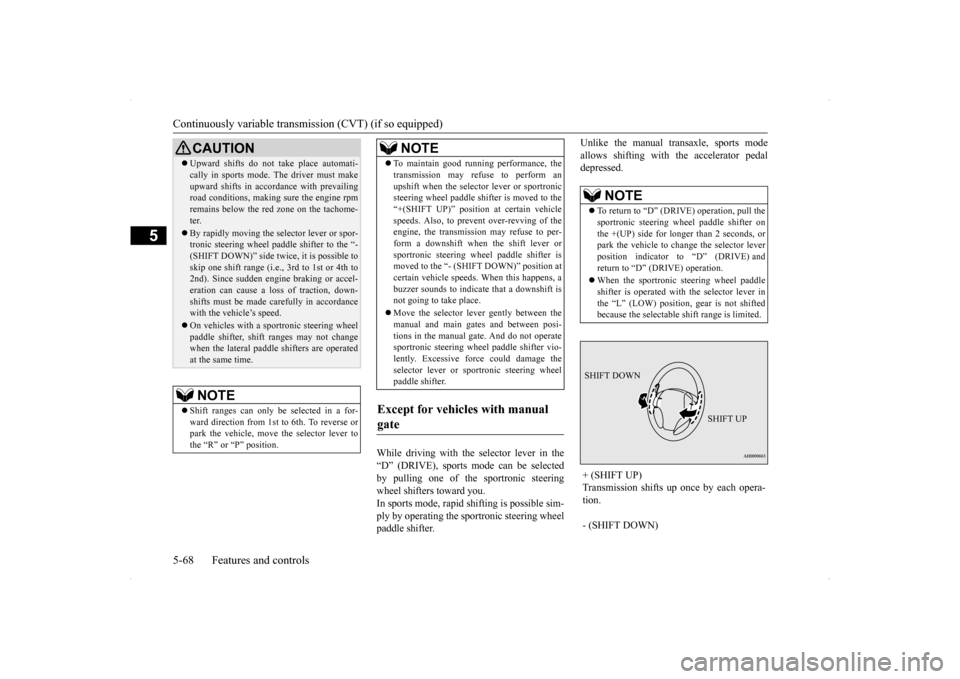
While driving with the selector lever in the “D” (DRIVE), sports mode can be selected by pulling one of the sportronic steering wheel shifters toward you.In sports mode, rapid shifting is possible sim- ply by operating the sportronic steering wheel paddle shifter.
Unlike the manual transaxle, sports mode allows shifting with the accelerator pedal depressed.
CAUTION Upward shifts do not take place automati- cally in sports mode. The driver must make upward shifts in accordance with prevailing road conditions, making sure the engine rpm remains below the red zone on the tachome-ter. By rapidly moving the selector lever or spor- tronic steering wheel padd
le shifter to the “-
(SHIFT DOWN)” side tw
ice, it is possible to
skip one shift range (i.e., 3rd to 1st or 4th to2nd). Since sudden engine braking or accel- eration can cause a loss of traction, down- shifts must be made carefully in accordancewith the vehicle’s speed. On vehicles with a sportronic steering wheel paddle shifter, shift ranges may not change when the lateral paddle shifters are operated at the same time.NOTE
Shift ranges can only be selected in a for- ward direction from 1st to 6th. To reverse or park the vehicle, move the selector lever tothe “R” or “P” position.
To maintain good running performance, the transmission may refuse to perform an upshift when the selector lever or sportronic steering wheel paddle shifter is moved to the “+(SHIFT UP)” position at certain vehiclespeeds. Also, to prevent over-revving of the engine, the transmission may refuse to per- form a downshift when the shift lever orsportronic steering wheel paddle shifter is moved to the “- (SHIFT DOWN)” position at certain vehicle speeds. When this happens, abuzzer sounds to indicate that a downshift is not going to take place. Move the selector lever gently between the manual and main gates and between posi- tions in the manual gate. And do not operatesportronic steering whee
l paddle shifter vio-
lently. Excessive force could damage the selector lever or sportronic steering wheelpaddle shifter.
Except for vehicles with manual gate
NOTE
NOTE
To return to “D” (DRIVE) operation, pull the sportronic steering wheel paddle shifter on the +(UP) side for longer than 2 seconds, or park the vehicle to change the selector leverposition indicator to “D” (DRIVE) and return to “D” (DRIVE) operation. When the sportronic steering wheel paddle shifter is operated with the selector lever in the “L” (LOW) position, gear is not shiftedbecause the selectable shift range is limited.
+ (SHIFT UP) Transmission shifts up once by each opera- tion. - (SHIFT DOWN) SHIFT DOWN
SHIFT UP
Page 136 of 434
Continuously variable transmission (CVT) (if so equipped)
Features and controls 5-69
5
N00538800154
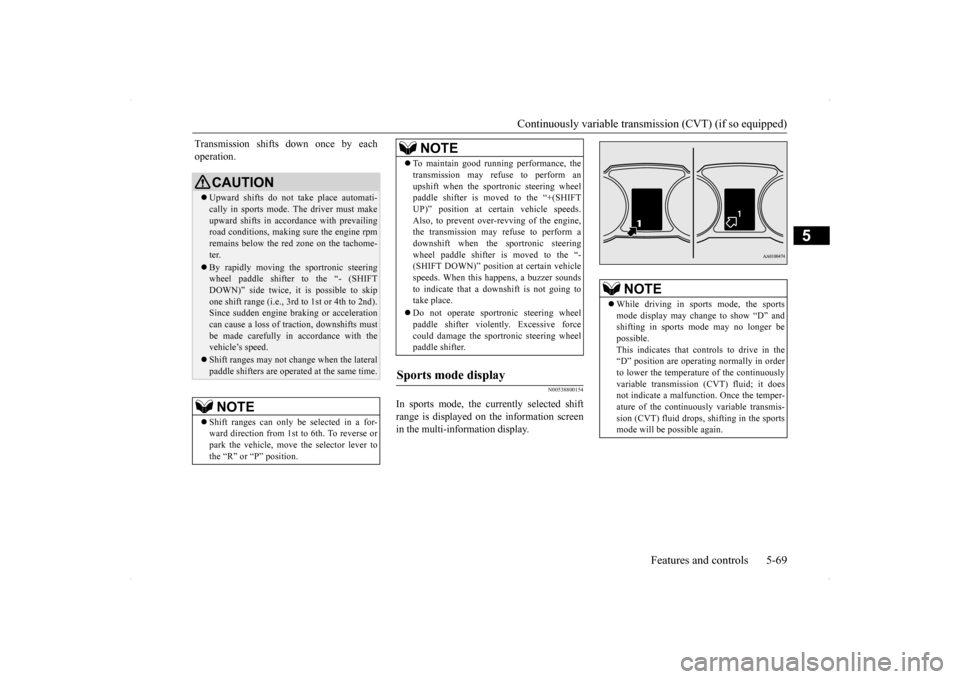
In sports mode, the currently selected shift range is displayed on the information screen in the multi-information display.
Transmission shifts down once by each operation.
CAUTION Upward shifts do not take place automati- cally in sports mode. The driver must makeupward shifts in accordance with prevailing road conditions, making sure the engine rpm remains below the red zone on the tachome-ter. By rapidly moving the sportronic steering wheel paddle shifter to the “- (SHIFT DOWN)” side twice, it is possible to skip one shift range (i.e., 3rd to 1st or 4th to 2nd).Since sudden engine braking or acceleration can cause a loss of tract
ion, downshifts must
be made carefully in accordance with thevehicle’s speed. Shift ranges may not change when the lateral paddle shifters are operated at the same time.NOTE
Shift ranges can only be selected in a for- ward direction from 1st to 6th. To reverse orpark the vehicle, move the selector lever to the “R” or “P” position.
To maintain good running performance, the transmission may refuse to perform an upshift when the sportronic steering wheel paddle shifter is moved to the “+(SHIFT UP)” position at certain vehicle speeds.Also, to prevent over-revving of the engine, the transmission may refuse to perform a downshift when the sportronic steeringwheel paddle shifter is moved to the “- (SHIFT DOWN)” position at certain vehicle speeds. When this happens, a buzzer soundsto indicate that a downshift is not going to take place. Do not operate sportronic steering wheel paddle shifter violently. Excessive force could damage the sportronic steering wheelpaddle shifter.
Sports mode display
NOTE
NOTE
While driving in sports mode, the sports mode display may change to show “D” and shifting in sports mode may no longer bepossible. This indicates that cont
rols to drive in the
“D” position are operating normally in orderto lower the temperature of the continuously variable transmission (CVT) fluid; it does not indicate a malfunction. Once the temper-ature of the continuously variable transmis- sion (CVT) fluid drops, shifting in the sports mode will be possible again.
Page 137 of 434
Continuously variable transm
ission (CVT) (if so equipped)
5-70 Features and controls
5
N00514500287
N00514900063
To gain extra acceleration in “D” (DRIVE) position (when passing another vehicle) push the accelerator to the floor if it is safe to do so in traffic conditions. The CVT will automati-cally downshift.
N00515000074
For short waiting periods, such as at traffic lights, the vehicle can be left in selector lever position and held stationary with the servicebrake.
For longer waiting periods with the engine running, the selector lever should be placed in the “N” (NEUTRAL) position.
N00515100062
To park the vehicle, first bring it to a com- plete stop, fully engage the parking brake,and then move the selector lever to the “P” (PARK) position. If you are going to l
eave the vehicle unat-
tended, always switch off the engine and carry the key.
Operation of the CVT
CAUTION Before selecting a position with the engine running and the vehicle stationary, fully depress the brake pedal to prevent the vehi- cle from creeping.Do not release the brakes until you are ready to drive away. The vehicle will begin to move as soon as the CVT is engaged, espe-cially when the engine speed is high (fast idle or air conditioning on). Depress the brake pedal with the right foot. Using the left foot could cause driver move- ment delay in case of an emergency. To prevent sudden acceleration, never run the engine at high rpms when shifting fromthe “P” (PARK) or “N” (NEUTRAL) posi- tion. Operating the accelerator pedal while the other foot is resting on the brake pedal will affect braking efficiency and may cause pre-mature wear of brake pads. Use the selector lever in the correct shift position in accordance with driving condi- tions. Never coast downhill backward in the driv- ing shift position { “D” (DRIVE), “L” (LOW) or sports mode} or coast forward inthe “R” (REVERSE) position. Engine stopping and increased brake pedal and steering effort could lead to an accident.
Do not rev the engine with the brake pedal pressed when the vehicle is stationary. This can damage the CVT. Also, when you depress the accelerator pedal while holding down the brake pedal with theselector lever in the “D” (DRIVE) position, the engine revolutions may not rise as high as when performing the same operation withthe selector lever in the “N” (NEUTRAL) position.
Passing acceleration
NOTE
In sports mode, downshifts do not take place when the accelerator is depressed all the way to the floor.
Wa i t i n g
CAUTION
CAUTION To avoid transmission overheating, never try to keep your vehicle stationary on a hill by using the accelerator pedal. Always apply the parking brake and/or service brake. Unexpected acceleration may occur if the selector lever is in a position other than “P”(PARK) or “N” (NEUTRAL). Before driving off from a stop, make sure that the selector lever is in “D” (DRIVE)position or “Sports mode” position.
Parking
Page 144 of 434
Twin Clutch SST (Sportronic Shif
t Transmission) (if so equipped) Features and controls 5-77
5
N00540300068
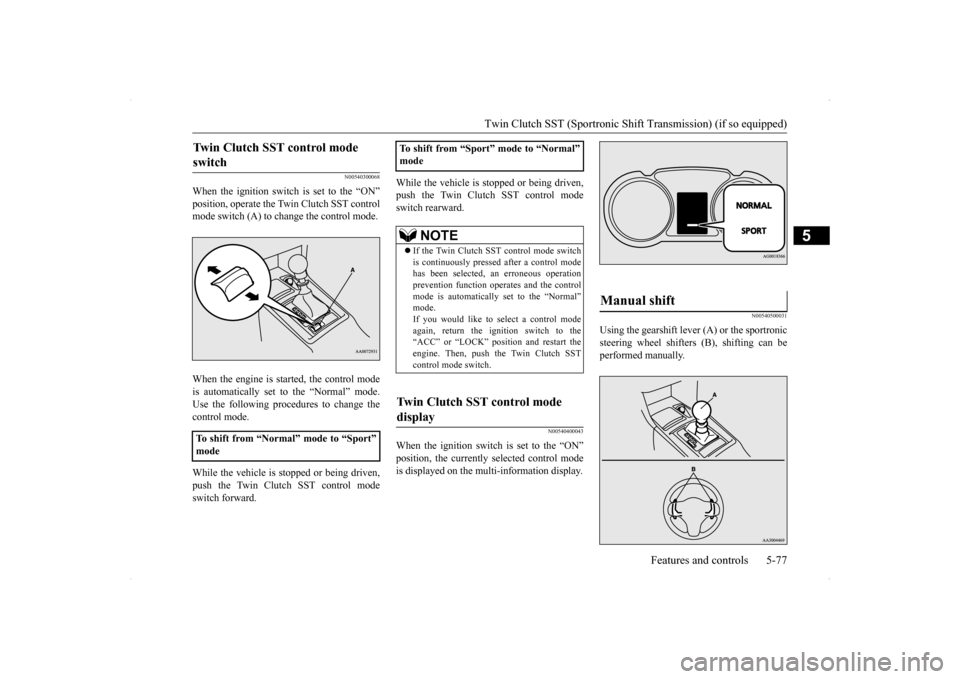
When the ignition switch is set to the “ON” position, operate the Twin Clutch SST control mode switch (A) to change the control mode. When the engine is started, the control mode is automatically set to the “Normal” mode. Use the following procedures to change the control mode. While the vehicle is stopped or being driven, push the Twin Clutch SST control modeswitch forward.
While the vehicle is stopped or being driven, push the Twin Clutch SST control mode switch rearward.
N00540400043
When the ignition switch is set to the “ON”position, the currently selected control modeis displayed on the multi-information display.
N00540500031
Using the gearshift lever (A) or the sportronicsteering wheel shifters (B), shifting can beperformed manually.
Twin Clutch SST control mode switch
To shift from “Normal” mode to “Sport” mode
To shift from “Sport” mode to “Normal” mode
NOTE
If the Twin Clutch SST control mode switch is continuously pressed after a control modehas been selected, an erroneous operation prevention function operates and the control mode is automatically set to the “Normal”mode. If you would like to select a control mode again, return the ignition switch to the“ACC” or “LOCK” position and restart the engine. Then, push the Twin Clutch SST control mode switch.
Twin Clutch SST control mode display
Manual shift
Page 145 of 434
Twin Clutch SST (Sportronic Shif
t Transmission) (if so equipped)
5-78 Features and controls
5
Shifting can be performed even while the accelerator pedal is depressed. This allows the driver to enjoy sporty driving, such as quick cornering, by nimbly down-shifting to reduce vehicle speed just before entering a curve.
N00540600032
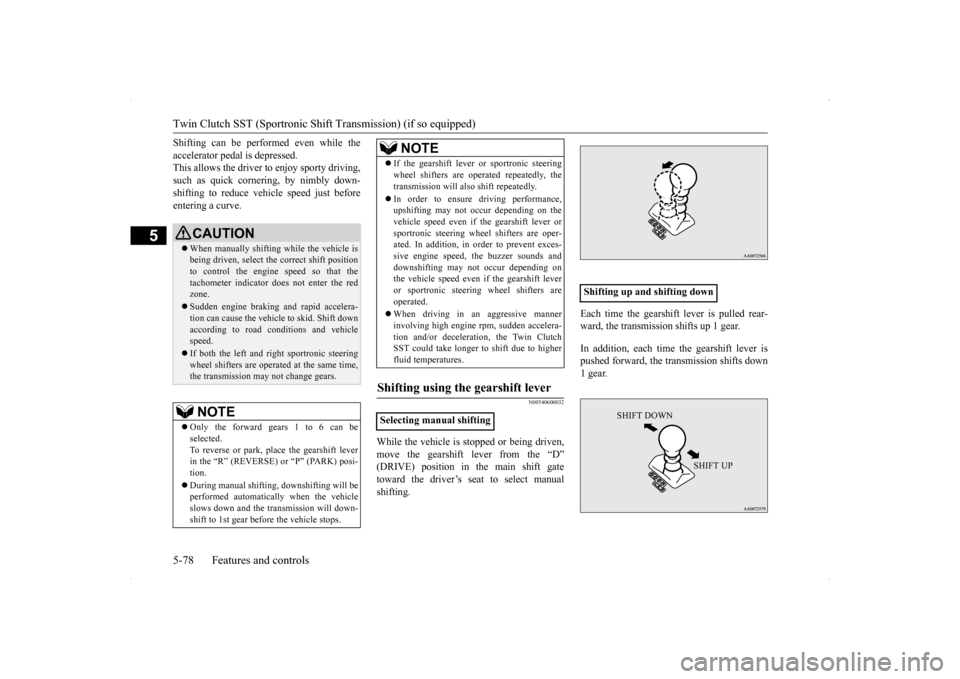
While the vehicle is stopped or being driven,move the gearshift lever from the “D” (DRIVE) position in the main shift gatetoward the driver’s seat to select manual shifting.
Each time the gearshift lever is pulled rear- ward, the transmission shifts up 1 gear. In addition, each time the gearshift lever is pushed forward, the transmission shifts down1 gear.
CAUTION When manually shifting while the vehicle is being driven, select the correct shift position to control the engine speed so that the tachometer indicator does not enter the redzone. Sudden engine braking and rapid accelera- tion can cause the vehicle to skid. Shift down according to road conditions and vehicle speed. If both the left and right sportronic steering wheel shifters are operated at the same time,the transmission may not change gears.NOTE
Only the forward gears 1 to 6 can be selected. To reverse or park, place the gearshift lever in the “R” (REVERSE) or “P” (PARK) posi-tion. During manual shifting, downshifting will be performed automatically when the vehicle slows down and the transmission will down- shift to 1st gear before the vehicle stops.
If the gearshift lever or sportronic steering wheel shifters are operated repeatedly, the transmission will also shift repeatedly. In order to ensure driving performance, upshifting may not occur depending on the vehicle speed even if the gearshift lever or sportronic steering wheel shifters are oper-ated. In addition, in order to prevent exces- sive engine speed, the buzzer sounds and downshifting may not occur depending onthe vehicle speed even if the gearshift lever or sportronic steering wheel shifters are operated. When driving in an aggressive manner involving high engine rpm, sudden accelera-tion and/or deceleration, the Twin Clutch SST could take longer to shift due to higher fluid temperatures.
Shifting using the gearshift lever
Selecting manual shifting
NOTE
Shifting up and shifting downçç
SHIFT DOWN
SHIFT UP
Page 146 of 434
Twin Clutch SST (Sportronic Shif
t Transmission) (if so equipped) Features and controls 5-79
5
Move the gearshift lever toward the front pas- senger’s seat to return to automated shifting.
N00540700033
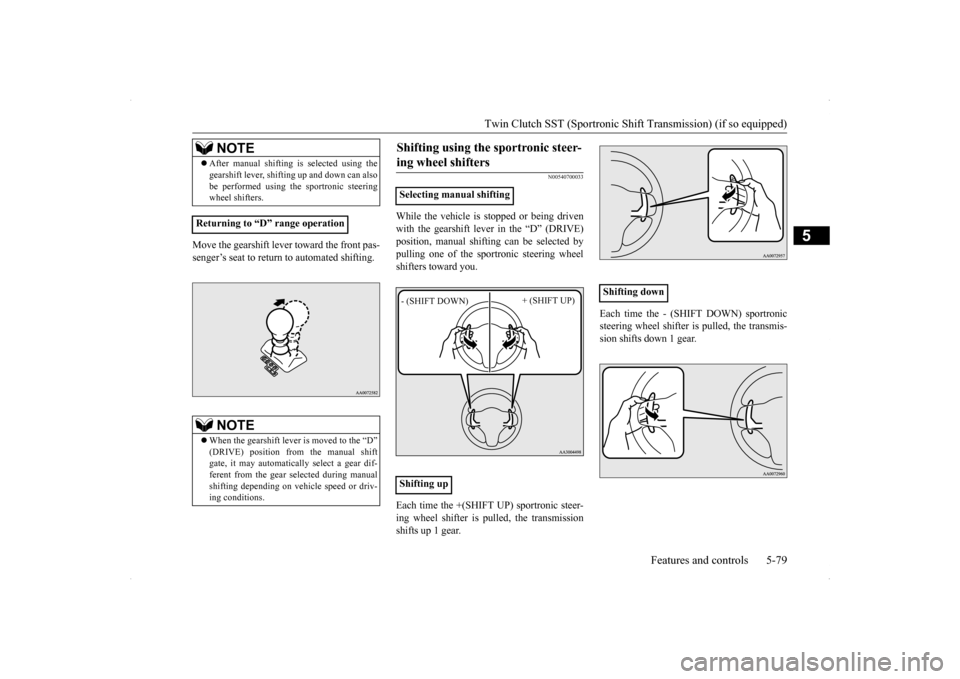
While the vehicle is stopped or being drivenwith the gearshift lever in the “D” (DRIVE) position, manual shifting can be selected by pulling one of the sportronic steering wheelshifters toward you. Each time the +(SHIFT UP) sportronic steer- ing wheel shifter is pulled, the transmissionshifts up 1 gear.
Each time the - (SHIFT DOWN) sportronic steering wheel shifter is pulled, the transmis- sion shifts down 1 gear.
NOTE
After manual shifting is selected using the gearshift lever, shifting up and down can also be performed using the sportronic steering wheel shifters.
Returning to “D” range operation
NOTE
When the gearshift lever is moved to the “D” (DRIVE) position from the manual shift gate, it may automatically select a gear dif-ferent from the gear selected during manual shifting depending on vehicle speed or driv- ing conditions.
ç
Shifting using the sportronic steer- ing wheel shifters
Selecting manual shifting Shifting up- (SHIFT DOWN)
+ (SHIFT UP)
Shifting downçç