engine oil MITSUBISHI LANCER 2015 8.G User Guide
[x] Cancel search | Manufacturer: MITSUBISHI, Model Year: 2015, Model line: LANCER, Model: MITSUBISHI LANCER 2015 8.GPages: 434, PDF Size: 16.59 MB
Page 365 of 434
Engine coolant 9-8 Vehicle care and maintenance
9
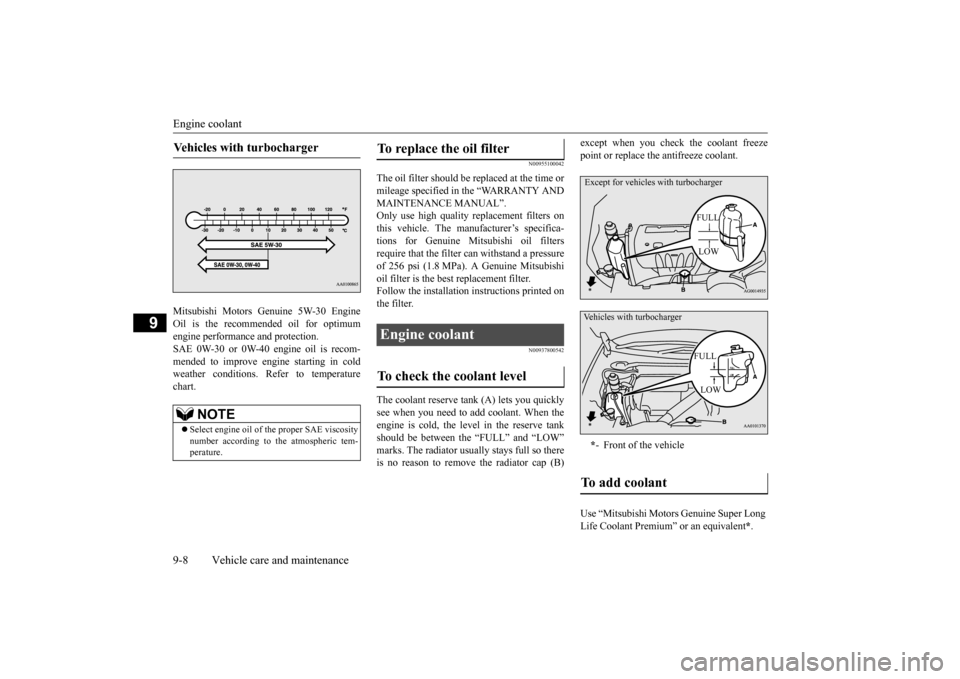
Mitsubishi Motors Genuine 5W-30 Engine Oil is the recommended oil for optimum engine performance and protection. SAE 0W-30 or 0W-40 engine oil is recom-mended to improve engine starting in cold weather conditions. Refer to temperature chart.
N00955100042
The oil filter should be replaced at the time ormileage specified in the “WARRANTY ANDMAINTENANCE MANUAL”. Only use high quality replacement filters on this vehicle. The manufacturer’s specifica-tions for Genuine Mitsubishi oil filters require that the filter can withstand a pressure of 256 psi (1.8 MPa). A Genuine Mitsubishioil filter is the best replacement filter.Follow the installation
instructions printed on
the filter.
N00937800542
The coolant reserve tank (A) lets you quickly see when you need to add coolant. When the engine is cold, the level in the reserve tank should be between the “FULL” and “LOW”marks. The radiator usually stays full so there is no reason to remove
the radiator cap (B)
except when you check the coolant freeze point or replace the antifreeze coolant.
Vehicles with turbocharger
NOTE
Select engine oil of the proper SAE viscosity number according to the atmospheric tem-perature.
To replace the oil filter Engine coolant To check the coolant level
* - Front of the vehicle
To add coolant Use “Mitsubishi Motors Genuine Super Long Life Coolant Premium” or an equivalent
*.
Except for vehicles with turbocharger
FULL LOW
Vehicles with turbocharger
FULL LOW
BK0210300US.bo
ok 8 ページ 2014年4月8日 火曜日 午前10時46分
Page 366 of 434
Air cleaner filter
Vehicle care and maintenance 9-9
9
Mitsubishi Motors Genuine Coolant provides excellent protection against corrosion and rust formation on all metals, including alumi-num, and prevents blockages in some parts of engine. If you need to add co
olant often, or if the
level in the reserve tank does not drop whenthe engine cools, the cooling system should be pressure-tested for leaks. Take your vehi- cle to an authorized
Mitsubishi Motors dealer
or a repair facility of your choice for testing.
The radiator cap must be tight sealed to pre- vent losing coolant which may result in engine damage. Only use a Genuine Mitsubi-shi Parts radiator cap, or an approved equiva- lent. Do not overfill the reserve tank.
Your vehicle uses a special radiator cap that stays sealed and lets the coolant flow from the reserve tank back to the radiator when the engine cools down. If you needto change the cap, use the exact same kind. Check the coolant freeze point in the radi- ator with the proper gauge, and only when it is safe. If you add antifreeze, the con- tents of the reserve tank must be protectedagainst freezing. Keep the front of the radiator and con- denser clean. If the temperature of the engine coolant does not rise after th
e engine is warmed-
up, take your vehicle to an authorized Mitsubishi Motors dealer or a repair facil-ity of your choice to have the thermostat checked, and replaced if necessary.
N00937901481
The air cleaner filter w
ill get dirty and dusty
from use and not filter properly. Replace it with a new filter using the schedule in the“WARRANTY AND MAINTENANCE MANUAL”. 1. Remove the clips (A), then remove the duct (B).
* : similar high quality ethylene glycol
based non-silicate, non-amine, non-nitrate and non-borate coolant with long life hybrid organic acid technologyCAUTION Do not use alcohol or methanol antifreeze or any engine coolants that contain them. Using the wrong antifreeze can corrode aluminum parts. The required concentration of anti-freeze dif- fers depending on the expected ambient tem-perature. Above -31 °F (-35 °C) : 50 % concentration of anti-freeze Below -31 °F (-35 °C) : 60% concentration of anti-freezeYou can check the concentration level with a gauge from an automotive supply store, or your authorized Mitsubishi Motors dealer orservice station can check it for you.
Do not use water to adjust the concentration of coolant. Do not top off the tank with plain water only. Water by itself boils at a lower temperatureand does not stop rust or freezing. If the water freezes, it will damage your cooling system. Do not use tapwater. It can causecorrosion and rust.
Radiator cap
WA R N I N G Wait for the engine to cool down before opening the radiator cap. Otherwise hotsteam or boiling coolant could spray up from the radiator and scald you.
Points to remember
CAUTION
Air cleaner filter
BK0210300US.bo
ok 9 ページ 2014年4月8日 火曜日 午前10時46分
Page 385 of 434
For cold and snowy weather 9-28 Vehicle care and maintenance
9
Have a competent mechanic inspect the com- plete exhaust system and nearby body areas for broken, damaged, deteriorated, or mispo- sitioned parts if you notice any of the follow-ing: A change in the sound of the exhaust sys- tem The smell of exhaust fumes inside the vehicle The underside or rear of the vehicle is damaged
Also check the exhaust system each time the vehicle is raised for lubrication, oil changes,or required service. Any open seams or loose connections could let dangerous exhaust fumes seep into the luggage compartment andpassenger compartments. Check for holes or exhaust gas leaks caused by corrosion or damage. Check the joints and connections for looseness or exhaust gas leaks. Check the rubber hangers and brackets for damage.
N00942500114
The hood lock release mechanism and hoodsafety catch should be checked, cleaned, and oiled when needed for easy movement and to stop rust and wear. Use Multipurpose GreaseNLGI Grade 2 sparingly for all sliding parts of the hood latch and release lever. Work the grease into the hood lock mechanism until allthe movable surfaces are covered.Also, put a light coat of the same grease on the safety catch wherever moving parts touch.
N00942600102
The ventilation slots in front of the wind-shield should be brushed clear after a heavy snowfall so that the operation of the heatingand ventilation systems will not be impaired. To prevent freezing of the weatherstripping on the doors, engine hood, etc., they should be treated with silicone grease.
It is a good idea to carry a shovel or a short- handled spade in the vehicle during the win- ter so that you can clear away snow if you getstranded. A small hand-brush for sweeping snow off the vehicle and a plastic scraper for the windshield, side and rear window are alsouseful.
N00942700259
The fusible links will melt
to prevent a fire if
a large current attempts to flow through cer-tain electrical systems. In case of a melted fusible link, see your authorized Mitsubishi Motors dealer or arepair facility of your choice for inspection and replacement. For the fusible links, please refer to “Fuseload capacities” on page 9-30.
Check for any of the following conditions:
Hood lock release mechanism and safety catch For cold and snowy weather Ventilation slots Weatherstripping
Additional equipment (For regions where snow is encoun- tered) Fusible links
WA R N I N G Fusible links must not be replaced by any other device. Failing to fit the correct fus- ible link may result in fire in the vehicle,property destruction and serious or fatal injuries at any time.
BK0210300US.bo
ok 28 ページ 2014年4月8日 火曜日 午前10時46分
Page 388 of 434
Fuses
Vehicle care and maintenance 9-31
9
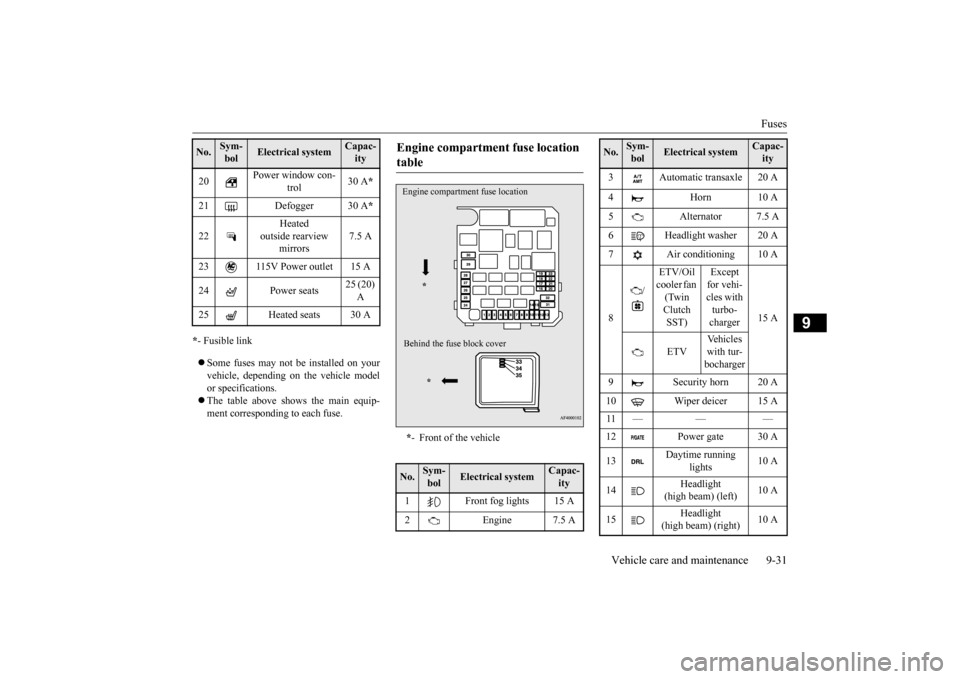
* - Fusible link Some fuses may not be installed on your vehicle, depending on the vehicle model or specifications. The table above shows the main equip- ment corresponding to each fuse. 20
Power window con-
trol
30 A
*
21 Defogger 30 A
*
22
Heated
outside rearview
mirrors
7.5 A
23 115V Power outlet 15 A 24 Power seats
25 (20) A
25 Heated seats 30 ANo.
Sym- bol
Electrical system
Capac-ity
Engine compartment fuse location table * - Front of the vehicle
No.
Sym- bol
Electrical system
Capac-ity
1 Front fog lights 15 A 2 Engine 7.5 AEngine compartment fuse location
*
Behind the fuse block cover
*
3 Automatic transaxle 20 A 4 Horn 10 A 5 Alternator 7.5 A 6 Headlight washer 20 A 7 Air conditioning 10 A 8
/
ETV/Oil cooler fan (Twin Clutch SST)
Except for vehi- cles with turbo- charger
15 A
ETV
Vehicles with tur-bocharger
9 Security horn 20 A 10 Wiper deicer 15 A 11 — — — 13
Daytime running
lights
10 A
14
Headlight
(high beam) (left)
10 A
15
Headlight
(high beam) (right)
10 A
No.
Sym- bol
Electrical system
Capac-ity
BK0210300US.bo
ok 31 ページ 2014年4月8日 火曜日 午前10時46分
Page 390 of 434
Fuses
Vehicle care and maintenance 9-33
9
Replace the borrowed fuse with a fuse that has the correct capacity as soon as possible.
N00954900027
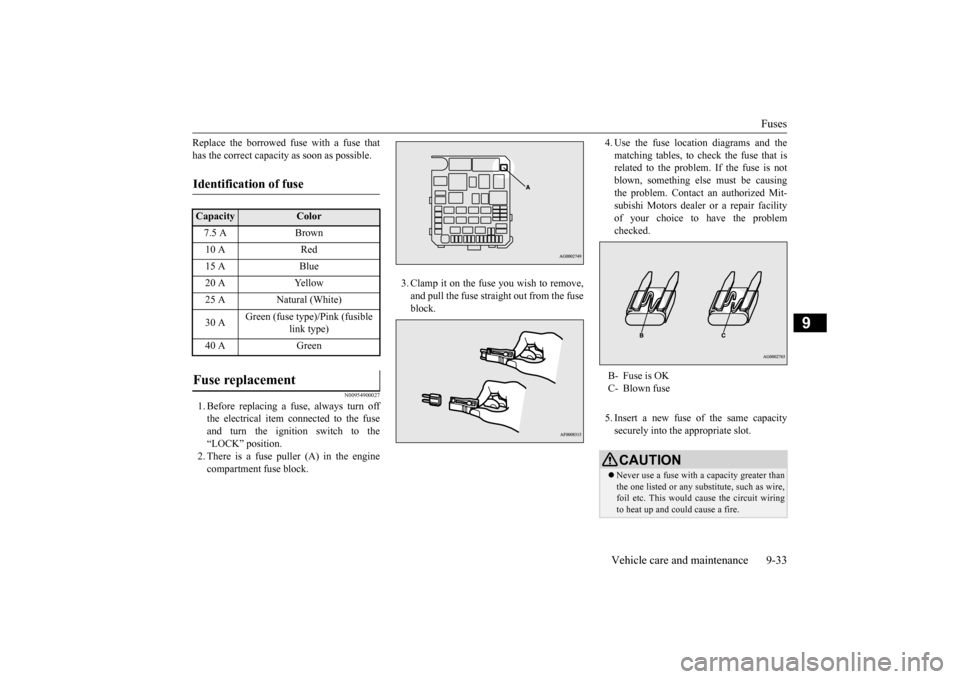
1. Before replacing a fuse, always turn offthe electrical item connected to the fuseand turn the ignition switch to the“LOCK” position. 2. There is a fuse puller (A) in the engine compartment fuse block.
3. Clamp it on the fuse you wish to remove, and pull the fuse straight out from the fuse block.
4. Use the fuse location diagrams and the matching tables, to check the fuse that is related to the problem. If the fuse is not blown, something else must be causingthe problem. Contact an authorized Mit- subishi Motors dealer or a repair facility of your choice to have the problemchecked. 5. Insert a new fuse of the same capacity securely into the appropriate slot.
Identification of fuse Capacity
Color
7.5 A Brown10 A Red15 A Blue20 A Yellow25 A Natural (White) 30 A
Green (fuse type)/Pink (fusible
link type)
40 A Green
Fuse replacement
B- Fuse is OK C- Blown fuseCAUTION Never use a fuse with a capacity greater than the one listed or any substitute, such as wire, foil etc. This would cause the circuit wiringto heat up and could cause a fire.
BK0210300US.bo
ok 33 ページ 2014年4月8日 火曜日 午前10時46分
Page 407 of 434
Cleaning the outside of your vehicle 9-50 Vehicle care and maintenance
9
N00945900526
Chemicals contained in the dirt and dust picked up from air, rain, snow or road sur-faces can damage the paint and body of your vehicle if left on. Frequent washing and waxing is the best wayto protect your vehicle from this damage. Do not wash the vehicle in direct sunlight. Park the vehicle in the shade and spray it withwater to remove dust. Next, using plenty ofclean water and a car washing mitt or sponge, wash the vehicle from top to bottom. Use a mild car washing soap if necessary.Rinse thoroughly and wipe dry with a cham- ois or soft cloth. After washing the vehicle, carefully clean the joints and flanges of thedoors, hood, etc., where dirt is likely to remain.
Salt and other chemicals spread on winter roads in some geographical areas can have adetrimental effect on the vehicle underbody. You should flush the underbody with a high pressure hose every time you wash the out-side of your vehicle. Take special care to remove mud or other debris which could trap and hold salt andmoisture. After washing your vehicle, wipe off all waterdrops from the rubber parts around thedoors to prevent the doors from freezing.
Wa s h i n g
CAUTION When washing the underside of your vehicle or the wheels, wear a pair of gloves to pro-tect your hands. If your vehicle has rain sensor wipers, place the wiper switch lever in the “OFF” position to deactivate the rain sensor before washingthe vehicle. Otherwise, the wipers will oper- ate in the presence of water spray on the windshield and may get damaged as a result.
Never spray or splash water on the electrical parts in the engine compartment. This may damage them. Be careful also when washing the underbody. Do not spray water into the engine compartment. Avoid automatic car washers that use rotat- ing brushes. These brushes may scratch thepaint surface and make it dull. Scratches are more noticeable on darker col- ored vehicles. Some hot water washing equipment uses high pressure and heat to clean your vehicle.This heated water may damage your vehi- cle’s resin parts. It can flood the interior of the vehicle. Therefore, be sure of the follow-ing:• Keep the washing nozzle at least 20 inches(50 cm) away from the vehicle body.• When washing around the door glass, holdthe nozzle at a distance of more than 20 inches (50 cm) and at right angles to the glass surface.
When using high-pressure water to wash a vehicle equipped with the F.A.S.T.-key sys-tem, keep the water from spraying on the open button on the trunk. This could cause the trunk to open and flood the inside of the trunk. Make sure to do the following when using an automatic car wash, with help from either this manual or the car wash operator, toavoid damaging your vehicle:• Fold the outside mirrors.CAUTION
• Put down (except for vehicles with SIRIUS satellite radio antenna) or remove the antenna.• If your vehicle is equipped with rearspoiler, check with the car wash operator before using the car wash.• If your vehicle has rain sensor wipers, placethe wiper switch lever in the “OFF” posi- tion to deactivate the rain sensor.
During cold weather
CAUTION
BK0210300US.bo
ok 50 ページ 2014年4月8日 火曜日 午前10時46分
Page 409 of 434
Cleaning the outside of your vehicle 9-52 Vehicle care and maintenance
9
N00946400065
To prevent spots and corrosion of chrome parts, wash with water, dry thoroughly, and apply a nonabrasive automotive wax. If thechrome is severely damaged or pitted, use a commercially available chrome polish.
N00946500196
1. Remove dirt using a wet sponge. 2. Use a mild detergent on any dirt that can-not be removed easily with water. Rinse off the detergent after washing the wheel.3. Dry the wheel thoroug
hly using a chamois
leather or a soft cloth.
N00946600067
The window glass can usually be cleaned using only a sponge and water. Glass cleanercan be used to remove
wax, oil, grease, dead
insects, etc. After washing the glass, wipe it dry with a clean, dry, soft cloth.
N00946700097
Use a soft cloth and glass cleaner to removegrease, dead insects, etc., from the wiperblades. Replace the wiper blades when they no longer clean the windshield and rear window prop-erly.
N00946800072
Clean the inside of the sunroof with a soft cloth. Hard deposits should be wiped away with a cloth dipped in warm, neutral deter-gent solution. Wipe away the solution with a sponge dipped in fresh water.
N00947000042
Never spray or splash water on the electricalcomponents in the engine compartment, as this may cause damage.Do not allow any nearby parts (such as plastic parts) come into contact with sulphuric acid (battery electrolyte), which may crack, stain,or discolour them. If this occurs, wipe the parts with a soft cloth saturated with a mild detergent and watersolution. Then immediately rinse the affected parts with plenty of water.
Do not let the plastic parts get soiled with gasoline, oil, brake fluids, engine oils, greases, paint thinner, and sulfuric acid (bat- tery electrolyte). These fluids, etc., may crack, stain or discolor the plastic parts.If any of these get on the plastic parts, wipe them up with a soft cloth or chamois and a mild solution of soap and water. Then rinsethem immediately with water.
Chrome parts Aluminum wheels (if so equipped)
CAUTION
CAUTION Do not use a brush or other hard implement on the wheels. Doing so could scratch the wheels. Do not use any cleaner that contains an abra- sive substance or is acidic or alkaline. Doing so could cause the coating on the wheels to peel or become discolored or stained. Do not directly apply hot water using a steam cleaner or by any other means. Contact with seawater or road salt used for de-icing can cause corrosion. Rinse off suchsubstances as soon as possible.
Window glass Wiper blades
Cleaning the sunroof
(if so
equipped)
NOTE
The surface treatment on the inside of the glass may be removed if a hard cloth or organic solvent is used.
Engine compartment
BK0210300US.bo
ok 52 ページ 2014年4月8日 火曜日 午前10時46分
Page 423 of 434
Refill capacities 11-6 Specifications
11
PCD: Pitch Circle Diameter (installation holes)
N01148002101
NOTE
Contact an authorized Mitsubishi Motors dealer for details on the combination used on your vehicle.
These tires satisfy vehicle loading conditions described in this owner’s manual.NOTE
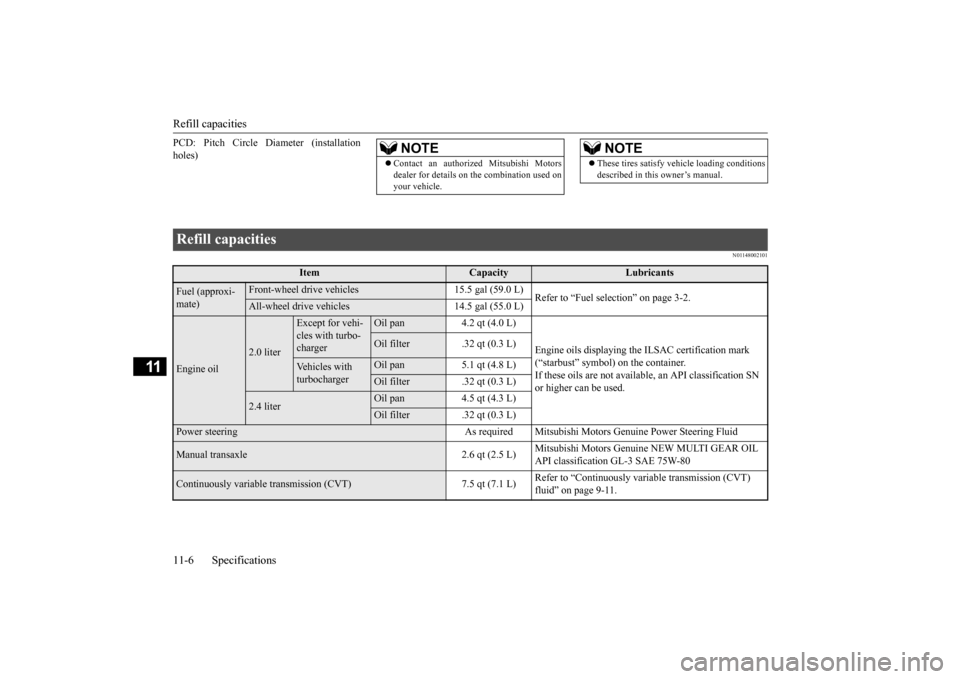
Refill capacities
Item
Capacity
Lubricants
Fuel (approxi- mate)
Front-wheel drive vehicles 15.5 gal (59.0 L)
Refer to “Fuel selection” on page 3-2.
All-wheel drive vehicles 14.5 gal (55.0 L)
Engine oil
2.0 liter
Except for vehi- cles with turbo- charger
Oil pan 4.2 qt (4.0 L)
Engine oils displaying the ILSAC certification mark (“starbust” symbol) on the container.If these oils are not available, an API classification SN or higher can be used.
Oil filter .32 qt (0.3 L)
Vehicles with turbocharger
Oil pan 5.1 qt (4.8 L)Oil filter .32 qt (0.3 L)
2.4 liter
Oil pan 4.5 qt (4.3 L)Oil filter .32 qt (0.3 L)
Power steering As required Mitsubishi Motors Genuine Power Steering Fluid Manual transaxle 2.6 qt (2.5 L)
Mitsubishi Motors Genuine NEW MULTI GEAR OIL API classification GL-3 SAE 75W-80
Continuously variable transmission (CVT) 7.5 qt (7.1 L)
Refer to “Continuously variable transmission (CVT) fluid” on page 9-11.
BK0210300US.bo
ok 6 ページ 2014年4月8日 火曜日 午前10時46分
Page 424 of 434
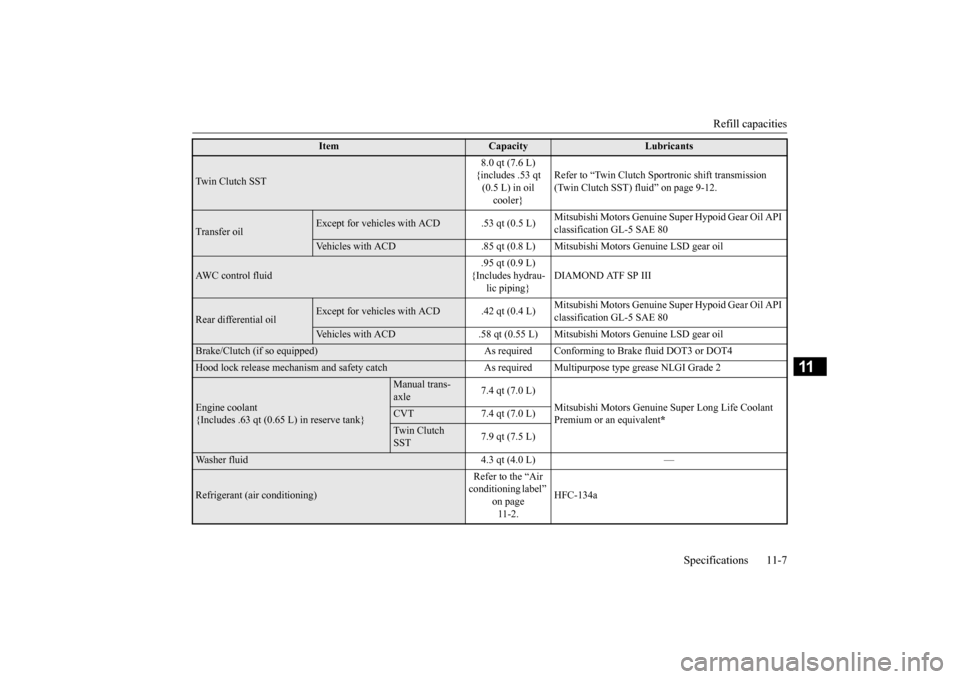
Refill capacities
Specifications 11-7
11
Twin Clutch SST
8.0 qt (7.6 L) {includes .53 qt (0.5 L) in oil cooler}
Refer to “Twin Clutch Sportronic shift transmission (Twin Clutch SST) fluid” on page 9-12.
Transfer oil
Except for vehicles with ACD .53 qt (0.5 L)
Mitsubishi Motors Genuine Super Hypoid Gear Oil API classification GL-5 SAE 80
Vehicles with ACD .85 qt (0.8 L) Mitsubishi Motors Genuine LSD gear oil
AWC control fluid
.95 qt (0.9 L) {Includes hydrau-
lic piping}
DIAMOND ATF SP III
Rear differential oil
Except for vehicles with ACD .42 qt (0.4 L)
Mitsubishi Motors Genuine Super Hypoid Gear Oil API classification GL-5 SAE 80
Vehicles with ACD .58 qt (0.55 L) Mits
ubishi Motors Genuine LSD gear oil
Brake/Clutch (if so equipped) As required C
onforming to Brake fluid DOT3 or DOT4
Hood lock release mechanism and safety catch As
required Multipurpose type grease NLGI Grade 2
Engine coolant {Includes .63 qt (0.65 L) in reserve tank}
Manual trans- axle
7.4 qt (7.0 L)
Mitsubishi Motors Genuine Super Long Life Coolant Premium or an equivalent
*
CVT 7.4 qt (7.0 L)Twin Clutch SST
7.9 qt (7.5 L)
Washer fluid 4.3 qt (4.0 L) —
Refer to the “Air conditioning label”
on page 11-2.
HFC-134a
Item
Capacity
Lubricants
BK0210300US.bo
ok 7 ページ 2014年4月8日 火曜日 午前10時46分
Page 427 of 434

Alphabetical index 12-2
12
Coming home light
...........................
5-151
Consumer information
........................
10-2
Continuously variable transmission (CVT)
....
5-61Fluid
.....................
...............
9-11
, 11-6
Selector lever operation
...................
5-61
Sports mode
..................
.................
5-66
Coolant (engine)
..........................
9-8
, 11-6
Cruise control
....................
.................
5-97
Indicator
...................
.....................
5-98
Cup holder
....................
...................
5-190
D
Daytime running lights
Bulb capacity
................
.................
9-34
Replacement
.................
.................
9-38
Defogger (rear window)
....................
5-158
Defrosting or defogging (windshield, door windows)
...............
7-12
, 7-17
, 7-22
, 7-27
Digital clock
Time setting
..................
.................
7-59
Dimensions
...................
.....................
11-4
Dimmer (high/low beam change)
.......
5-150
Disc brake pads
.................
.................
9-27
Dome light
Bulb capacity
................
.................
9-36
Replacement
.................
.................
9-47
Switch
......................
...................
5-186
Dome light/Reading lights
Bulb capacity
..................
................
9-36
Replacement
...................
................
9-46
Switch
.....................
.....................
5-186
Doors
Lock
.......................
.......................
5-35
Power door locks
............................
5-37
Drive mode indicator
...........................
5-85
Drive mode-selector
............................
5-84
Driving during cold weather
..................
6-4
Driving, alcohol and drugs
....................
6-2
E
Electric rear window defogger switch
..5-158
Electronic immobilizer (Anti-theft starting system)
.....................
................
5-4
, 5-28
Electronically controlled 4WD system
..5-84
Drive mode indicator
.......................
5-85
Drive mode-selector
........................
5-84
Emergency key
...................
................
5-23
Emission-control system maintenance
...
9-25
Engine
Compartment
..................
.................
9-5
Coolant
...................
................
9-8
, 11-6
Hood
.......................
........................
9-3
Oil and oil filter
.......................
9-6
, 11-6
Overheating
....................
.................
8-4
Serial number
.................
................
11-2
Specifications
.................
................
11-5
Engine coolant temperature display
....
5-117
Exhaust system
..................
.................
9-27
F
Filling the fuel tank
...............
................
3-4
Floor console box
.............................
5-189
Floor mat
......................
.......................
6-2
Fluid
..........................
........................
11-6
AWC control fluid
..........................
9-12
Brake fluid
............................
9-13
, 11-6
Clutch fluid
...........................
9-13
, 11-6
Continuously variable transmission (CVT) fluid
....................
...............
9-11
, 11-6
Engine coolant
........................
9-8
, 11-6
Power steering fluid
...............
9-14
, 11-6
Twin Clutch Sportron
ic shift transmission
(Twin Clutch SST) fluid
.......
9-12
, 11-6
Washer fluid
.................
.................
11-6
Fluid capacities and lubricants
.............
11-6
Fog lights
Bulb capacity
................
.................
9-34
Indicator
...................
...................
5-143
Replacement
.........................
9-41
, 9-42
Switch
......................
...................
5-153
Free-hand advanced security transmitter (F.A.S.T.-key)
.................
.................
5-12
Front console boxes
..........................
5-189
Front console tray
.............................
5-189
Front seats
.........................
...................
4-3
BK0210300US.bo
ok 2 ページ 2014年4月8日 火曜日 午前10時46分