warning MITSUBISHI LANCER 2015 8.G User Guide
[x] Cancel search | Manufacturer: MITSUBISHI, Model Year: 2015, Model line: LANCER, Model: MITSUBISHI LANCER 2015 8.GPages: 434, PDF Size: 16.59 MB
Page 53 of 434
Supplemental Restraint System (SRS) - airbag 4-24 Seat and restraint systems
4
N00407800506
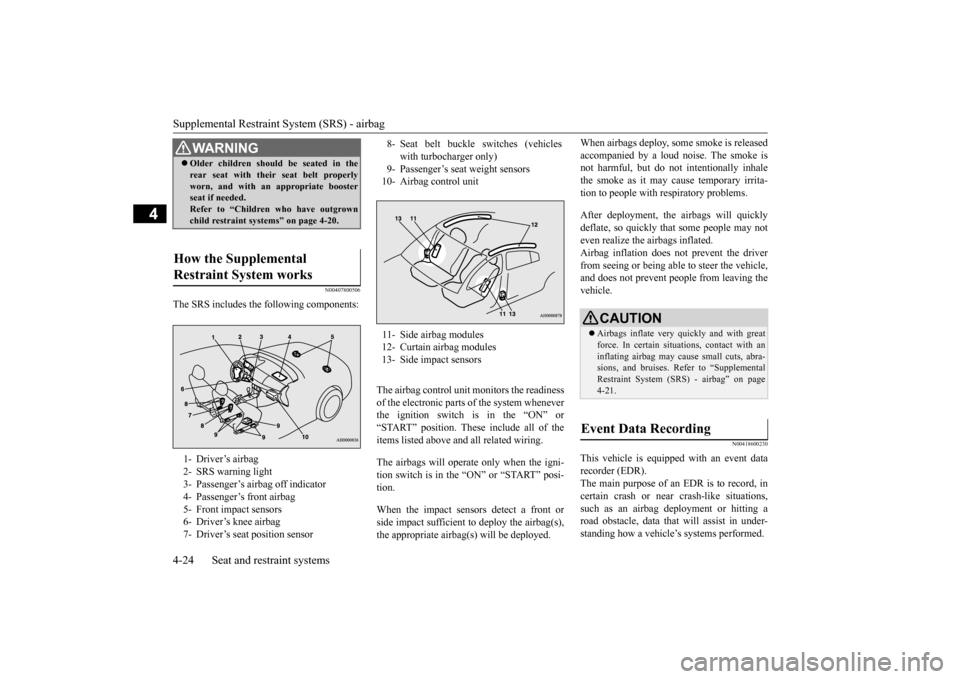
The SRS includes the following components:
The airbag control unit monitors the readiness of the electronic parts of the system whenever the ignition switch is in the “ON” or“START” position. These include all of the items listed above and all related wiring. The airbags will operate
only when the igni-
tion switch is in the “ON” or “START” posi-tion. When the impact sensors detect a front or side impact sufficient to deploy the airbag(s), the appropriate airbag(s) will be deployed.
When airbags deploy, some smoke is released accompanied by a loud noise. The smoke is not harmful, but do not intentionally inhale the smoke as it may cause temporary irrita-tion to people with respiratory problems. After deployment, the airbags will quickly deflate, so quickly that some people may not even realize the airbags inflated.Airbag inflation does not prevent the driver from seeing or being ab
le to steer the vehicle,
and does not prevent people from leaving thevehicle.
N00418600230
This vehicle is equipped with an event datarecorder (EDR). The main purpose of an EDR is to record, in certain crash or near crash-like situations,such as an airbag deployment or hitting a road obstacle, data that will assist in under- standing how a vehicle’s systems performed.
WA R N I N G Older children should
be seated in the
rear seat with their seat belt properly worn, and with an appropriate booster seat if needed. Refer to “Children who have outgrownchild restraint systems” on page 4-20.
How the Supplemental Restraint System works 1- Driver’s airbag 2- SRS warning light 3- Passenger’s airbag off indicator 4- Passenger’s front airbag5- Front impact sensors 6- Driver’s knee airbag 7- Driver’s seat position sensor
8- Seat belt buckle switches (vehicles
with turbocharger only)
9- Passenger’s seat weight sensors 10- Airbag control unit 11- Side airbag modules 12- Curtain airbag modules 13- Side impact sensors
CAUTION Airbags inflate very quickly and with great force. In certain situations, contact with an inflating airbag may cause small cuts, abra-sions, and bruises. Refer to “Supplemental Restraint System (SRS) - airbag” on page 4-21.
Event Data Recording
BK0210300US.bo
ok 24 ページ 2014年4月8日 火曜日 午前10時46分
Page 54 of 434
Supplemental Restraint System (SRS) - airbag
Seat and restraint systems 4-25
4
The EDR is designed to record data related to vehicle dynamics and safety systems for a short period of time, typically 30 seconds or less. The EDR in this vehicle is designed to record such data as: How various systems in your vehicle were operating; Whether or not the driver and passenger safety belts were buckled/fastened; How far (if at all) the driver was depress- ing the accelerator and/or brake pedal; and, How fast the vehicle was traveling.
These data can help provide a better under- standing of the circumstances in which crashes and injuries occur.
To read data recorded by an EDR, special equipment is required, and access to the vehi- cle or the EDR is needed. In addition to the vehicle manufacturer, other parties, such aslaw enforcement, that have the special equip- ment, can read the information if they have access to the vehicle or the EDR.
N00417900164
The driver’s seat position sensor is attached to the seat rail and provides the airbag control unit with information on the seat’s fore-aftposition. The airbag control unit controls deployment of the driver’s front airbag in accordance with the information it receivesfrom this sensor. If there is a problem involving the driver’s seat position sensor, the SRS warning in theinstrument panel will come on. Refer to “SRS warning” on page 4-27.
N00418000247
The passenger’s seat weight sensors are attached to the seat rails and provide the air- bag control unit with information regarding the weight on the front passenger seat. Theairbag control unit controls deployment of the passenger’s front airbag in accordance with the information it receives from this sensor.The passenger’s front airbag will not deploy in an impact when the weight on the seat is sensed to be less than approximately 66pounds (30 kg). In this case, the passenger’s airbag off indicator will come on. Refer to “Passenger’s airbag off indicator” onpage 4-26. If there is a problem involving the passen- ger’s seat weight sensors, the SRS warning inthe instrument panel will come on. Refer to “SRS warning” page 4-27.
NOTE
EDR data are recorded by your vehicle only if a non-trivial crash situation occurs; no data are recorded by the EDR under normal driv- ing conditions and no personal data (e.g., name, gender, age, and crash location) arerecorded. However, other parties, such as law enforcement, could combine the EDR data with the type of personally identifyingdata routinely acquired during a crash inves- tigation.
Driver’s seat position sensor
WA R N I N G If the SRS warning comes on, have the vehicle inspected by an authorized Mit- subishi Motors dealer as soon as possible. Please observe the following instructions to ensure that the driver’s seat position sensor can operate correctly.• Adjust the seat to the correct position,and sit well back against the seatback.Refer to “Front seats” on page 4-3.
• Do not recline the seatback more than necessary when driving.• Do not place metallic objects or luggage under the front seat.
If the vehicle is involved in a severe impact, have the SRS sensor inspected byan authorized Mitsubishi Motors dealer as soon as possible.
Passenger’s seat weight sensors
WA R N I N G
BK0210300US.bo
ok 25 ページ 2014年4月8日 火曜日 午前10時46分
Page 55 of 434
Supplemental Restraint System (SRS) - airbag 4-26 Seat and restraint systems
4
N00418100277
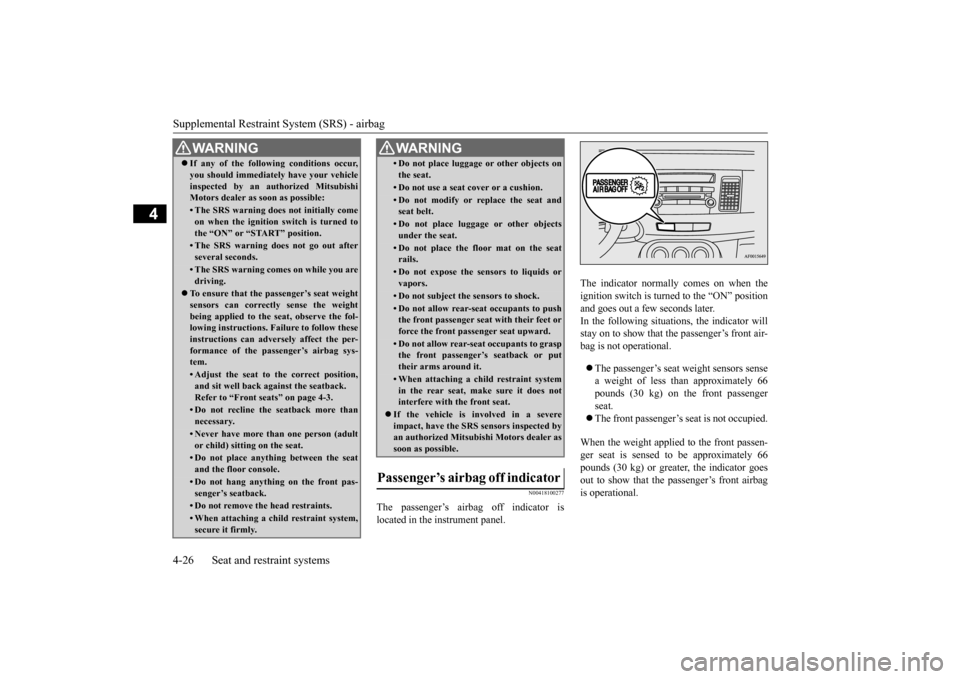
The passenger’s airbag off indicator is located in the instrument panel.
The indicator normally comes on when the ignition switch is turned to the “ON” positionand goes out a few seconds later. In the following situa
tions, the indicator will
stay on to show that the passenger’s front air-bag is not operational. The passenger’s seat weight sensors sense a weight of less than approximately 66 pounds (30 kg) on the front passenger seat. The front passenger’s seat is not occupied.
When the weight applied to the front passen- ger seat is sensed to be approximately 66 pounds (30 kg) or greater, the indicator goesout to show that the passenger’s front airbag is operational.
WA R N I N G If any of the following conditions occur, you should immediately have your vehicle inspected by an authorized Mitsubishi Motors dealer as soon as possible:• The SRS warning does not initially comeon when the ignition switch is turned to the “ON” or “START” position.• The SRS warning does not go out afterseveral seconds.• The SRS warning comes on while you aredriving.
To ensure that the passenger’s seat weight sensors can correctly sense the weightbeing applied to the seat, observe the fol- lowing instructions. Failure to follow these instructions can adversely affect the per-formance of the passenger’s airbag sys- tem.• Adjust the seat to the correct position,and sit well back against the seatback. Refer to “Front seats” on page 4-3.• Do not recline the seatback more thannecessary.• Never have more than one person (adultor child) sitting on the seat.• Do not place anything between the seatand the floor console.• Do not hang anything on the front pas-senger’s seatback.• Do not remove the head restraints.• When attaching a child restraint system,secure it firmly.
• Do not place luggage or other objects on the seat.• Do not use a seat cover or a cushion.• Do not modify or replace the seat andseat belt.• Do not place luggage or other objectsunder the seat.• Do not place the floor mat on the seatrails.• Do not expose the sensors to liquids orvapors.• Do not subject the sensors to shock.• Do not allow rear-seat occupants to push the front passenger seat with their feet or force the front passenger seat upward.• Do not allow rear-seat occupants to graspthe front passenger’s seatback or put their arms around it.• When attaching a child restraint systemin the rear seat, make sure it does notinterfere with the front seat.
If the vehicle is involved in a severe impact, have the SRS sensors inspected by an authorized Mitsubishi Motors dealer as soon as possible.
Passenger’s airbag off indicator
WA R N I N G
BK0210300US.bo
ok 26 ページ 2014年4月8日 火曜日 午前10時46分
Page 56 of 434
Supplemental Restraint System (SRS) - airbag
Seat and restraint systems 4-27
4
N00408301619
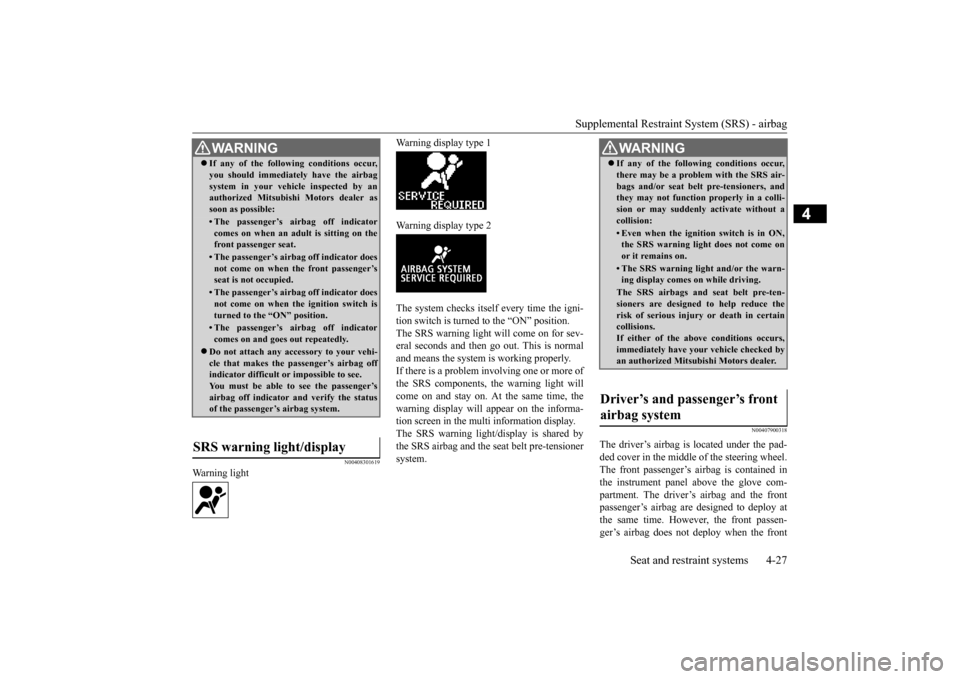
Warning light
Warning display type 1 Warning display type 2The system checks itself every time the igni- tion switch is turned to the “ON” position.The SRS warning light will come on for sev- eral seconds and then go out. This is normal and means the system is working properly.If there is a problem involving one or more of the SRS components, the warning light will come on and stay on. At the same time, thewarning display will appear on the informa- tion screen in the multi information display. The SRS warning light/display is shared bythe SRS airbag and the seat belt pre-tensionersystem.
N00407900318
The driver’s airbag is located under the pad-ded cover in the middle of the steering wheel. The front passenger’s airbag is contained in the instrument panel above the glove com-partment. The driver’s airbag and the front passenger’s airbag are designed to deploy at the same time. However, the front passen-ger’s airbag does not deploy when the front
WA R N I N G If any of the following conditions occur, you should immediately have the airbag system in your vehicle inspected by an authorized Mitsubishi Motors dealer as soon as possible:• The passenger’s airbag off indicatorcomes on when an adult is sitting on thefront passenger seat.• The passenger’s airbag off indicator doesnot come on when the front passenger’s seat is not occupied.• The passenger’s airbag off indicator doesnot come on when the ignition switch is turned to the “ON” position.• The passenger’s airbag off indicatorcomes on and goes out repeatedly.
Do not attach any accessory to your vehi- cle that makes the passenger’s airbag offindicator difficult or impossible to see. You must be able to see the passenger’s airbag off indicator and verify the statusof the passenger’s airbag system.
SRS warning light/display
WA R N I N G If any of the following conditions occur, there may be a problem with the SRS air- bags and/or seat belt pre-tensioners, and they may not function properly in a colli- sion or may suddenly activate without acollision:• Even when the ignition switch is in ON,the SRS warning light does not come on or it remains on.• The SRS warning light and/or the warn-ing display comes on while driving.The SRS airbags and seat belt pre-ten-sioners are designed to help reduce the risk of serious injury or death in certaincollisions. If either of the above conditions occurs, immediately have your vehicle checked byan authorized Mitsubishi Motors dealer.
Driver’s and passenger’s front airbag system
BK0210300US.bo
ok 27 ページ 2014年4月8日 火曜日 午前10時46分
Page 67 of 434
Supplemental Restraint System (SRS) - airbag 4-38 Seat and restraint systems
4
N00408600341
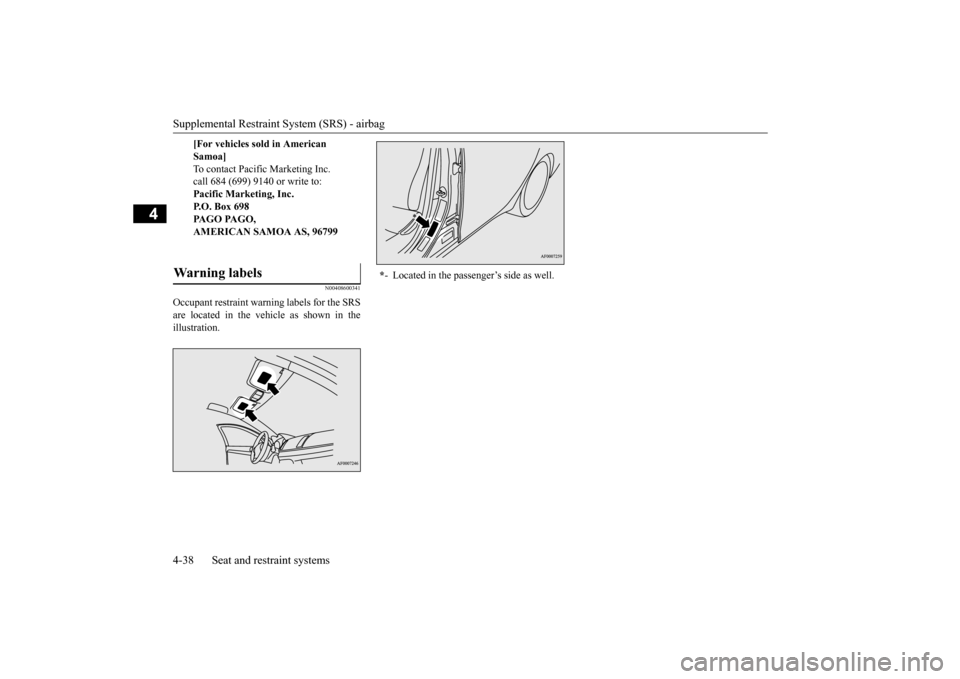
Occupant restraint warning labels for the SRS are located in the vehicle as shown in the illustration.
[For vehicles sold in American Samoa]To contact Pacific Marketing Inc. call 684 (699) 9140 or write to: Pacific Marketing, Inc.P.O. Box 698 PAGO PAGO, AMERICAN SAMOA AS, 96799
Warning labels
* - Located in the passenger’s side as well.
BK0210300US.bo
ok 38 ページ 2014年4月8日 火曜日 午前10時46分
Page 70 of 434
5
Features and controlsBreak-in recommendation
s ..............................................................5-3
Keys ..........................................
.......................................................5-3
Electronic immobilizer (Anti-thef
t starting system) ........................5-4
Keyless entry system (if so equipped) ..............................................5-7Free-hand Advanced Security Transmitter (F.A.S.T.-key) (if so
equipped) ..................................................5-12
Door locks .......................
...............................................................5-35
Power door locks ............
...............................................................5-37
“Child safety locks” for
rear door ..................................................5-39
Trunk lid ...................................
.....................................................5-39
Inside emergency trunk lid
release ................................................5-41
Theft-alarm system
................................................
........................5-42
Power windows ...............
...............................................................5-44
Sunroof (if so equipped
) .........................................
........................5-46
Parking brake ..................
...............................................................5-48
Steering wheel tilt lock lever .........................................................5-50Inside day/night rearview
mirror ...................................................5-50
Outside rearview mirr
ors ...............................................................5-52
Ignition switch ......
.................................................
........................5-53
Steering wheel lock
................................................
........................5-55
Starting and stopping the e
ngine ....................................................5-55
Turbocharger operation (if so equipped) ........................................5-59Manual transaxle (if so equipped) ..................................................5-59Continuously variable transmissi
on (CVT) (if so equipped)..........5-61
Twin Clutch SST (Sportronic Shift Transmission) (if so equipped) .
.................................................
........................5-70
ACD (Active center differential system) (if so equipped)..............5-82 Electronically controlled 4WD system (if so equipped).................5-84
All-wheel driving opera
tion .................................
......................... 5-86
Cautions on handling of all-wheel drive vehicles ......................... 5-87 Limited-slip differential (i
f so equipped) ....................................... 5-88
Service brake .................
.................................................
............... 5-89
Brake assist system
...............................................
......................... 5-90
Hill start assist (vehicles with
Twin Clutch SST) .......................... 5-90
Anti-lock braking syst
em .....................................
......................... 5-91
Active Stability Control (ASC
) (if so equipped) ............................ 5-94
Power steering system
..........................................
......................... 5-96
Cruise control (if so eq
uipped) ....................................................... 5-97
Tire pressure monitoring
system ................................................. 5-102
Rear-view camera (if so
equipped)..............
................................. 5-106
Instrument cluster
.................................................
....................... 5-108
Multi-information display ........................................................... 5-110 Indicator light, warning light, and information screen display list .......................................
.................................................... 5-131
Indicators .................................
.................................................... 5-143
Warning lights ................
.................................................
............. 5-144
Information screen disp
lay ...................................
....................... 5-145
Combination headlights and dimmer switch ............................... 5-147 Headlight leveling switch (if
so equipped)................................... 5-152
Turn signal lever ..
.................................................
....................... 5-152
Hazard warning flasher
switch .................................................... 5-153
Front fog light switch (if so
equipped) ......................................... 5-153
Wiper and washer swit
ch ......................................
....................... 5-154
Electric rear window def
ogger switch ......................................... 5-158
Horn switch .............................
.................................................... 5-159
Link System (if so equi
pped) ....................................................... 5-159
BK0210300US.bo
ok 1 ページ 2014年4月8日 火曜日 午前10時46分
Page 87 of 434
Free-hand Advanced Security Transmitter (F.A.S.T.-key) (if so equipped) 5-18 Features and controls
5
N00503500160
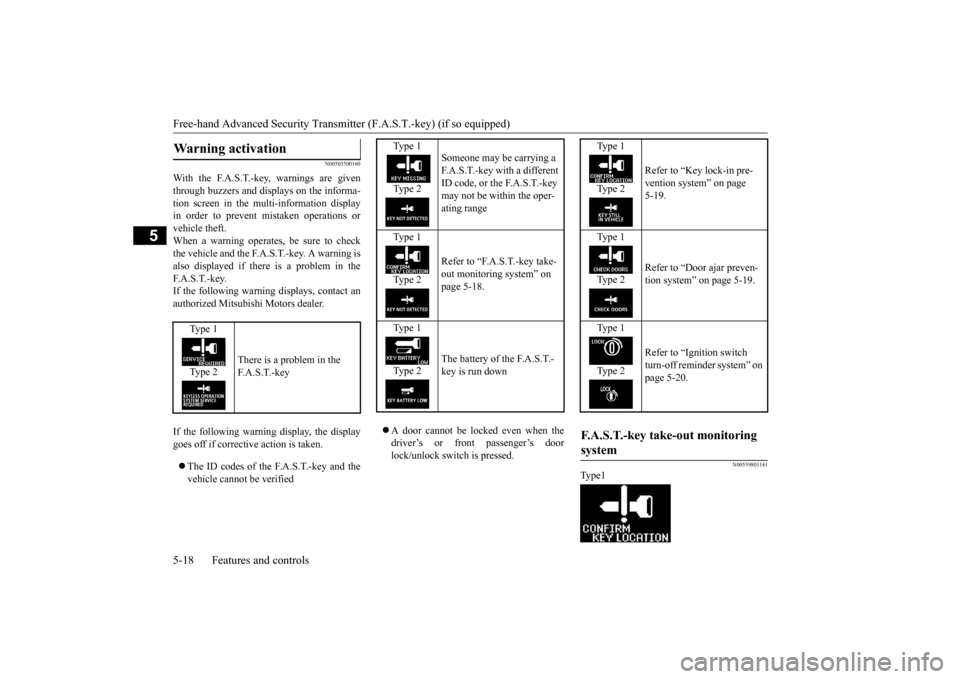
With the F.A.S.T.-key, warnings are given through buzzers and displays on the informa-tion screen in the multi-information display in order to prevent mistaken operations or vehicle theft.When a warning operates, be sure to check the vehicle and the F.A.S.T.-key. A warning is also displayed if there is a problem in theF. A . S . T. - k e y.If the following warning displays, contact an authorized Mitsubishi Motors dealer. If the following warning display, the display goes off if corrective action is taken. The ID codes of the F.A.S.T.-key and the vehicle cannot be verified
A door cannot be locked even when the driver’s or front passenger’s door lock/unlock switch is pressed.
N00559801141
Ty p e 1
Warning activation
Type 1 Type 2
There is a problem in the F. A . S . T. - k e y
Type 1 Type 2
Someone may be carrying a F.A.S.T.-key with a different ID code, or the F.A.S.T.-key may not be within the oper- ating range
Type 1 Type 2
Refer to “F.A.S.T.-key take- out monitoring system” on page 5-18.
Type 1 Type 2
The battery of the F.A.S.T.- key is run down
Type 1 Type 2
Refer to “Key lock-in pre- vention system” on page 5-19.
Type 1 Type 2
Refer to “Door ajar preven- tion system” on page 5-19.
Type 1 Type 2
Refer to “Ignition switch turn-off reminder system” on page 5-20.
F.A.S.T.-key take-out monitoring system
BK0210300US.bo
ok 18 ページ 2014年4月8日 火曜日 午前10時46分
Page 88 of 434
Free-hand Advanced Security Transmit
ter (F.A.S.T.-key) (if so equipped)
Features and controls 5-19
5
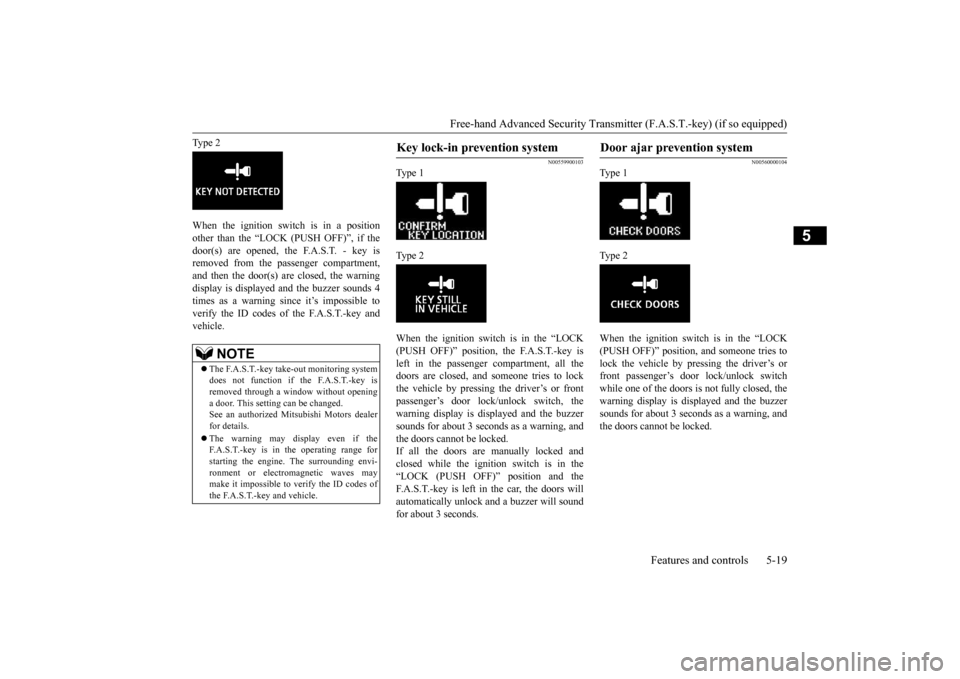
Type 2 When the ignition switch is in a position other than the “LOCK (PUSH OFF)”, if the door(s) are opened, the F.A.S.T. - key isremoved from the passenger compartment, and then the door(s) are closed, the warning display is displayed and the buzzer sounds 4times as a warning since it’s impossible to verify the ID codes of the F.A.S.T.-key and vehicle.
N00559900103
Type 1 Type 2 When the ignition switch is in the “LOCK (PUSH OFF)” position, the F.A.S.T.-key is left in the passenger compartment, all thedoors are closed, and someone tries to lock the vehicle by pressing the driver’s or front passenger’s door lock/unlock switch, thewarning display is displayed and the buzzer sounds for about 3 seconds as a warning, and the doors cannot be locked.If all the doors are manually locked andclosed while the ignition switch is in the “LOCK (PUSH OFF)” position and the F.A.S.T.-key is left in the car, the doors willautomatically unlock and a buzzer will sound for about 3 seconds.
N00560000104
Type 1 Type 2 When the ignition switch is in the “LOCK (PUSH OFF)” position, and someone tries to lock the vehicle by pressing the driver’s orfront passenger’s door lock/unlock switch while one of the doors is not fully closed, the warning display is displayed and the buzzersounds for about 3 seconds as a warning, and the doors cannot be locked.
NOTE
The F.A.S.T.-key take-out monitoring system does not function if the F.A.S.T.-key isremoved through a window without opening a door. This setting can be changed. See an authorized Mitsubishi Motors dealerfor details. The warning may display even if the F.A.S.T.-key is in the operating range for starting the engine. The surrounding envi- ronment or electromagnetic waves maymake it impossible to verify the ID codes of the F.A.S.T.-key and vehicle.
Key lock-in prevention system
Door ajar prevention system
BK0210300US.bo
ok 19 ページ 2014年4月8日 火曜日 午前10時46分
Page 89 of 434
Free-hand Advanced Security Transmitter (F.A.S.T.-key) (if so equipped) 5-20 Features and controls
5
N00560100105
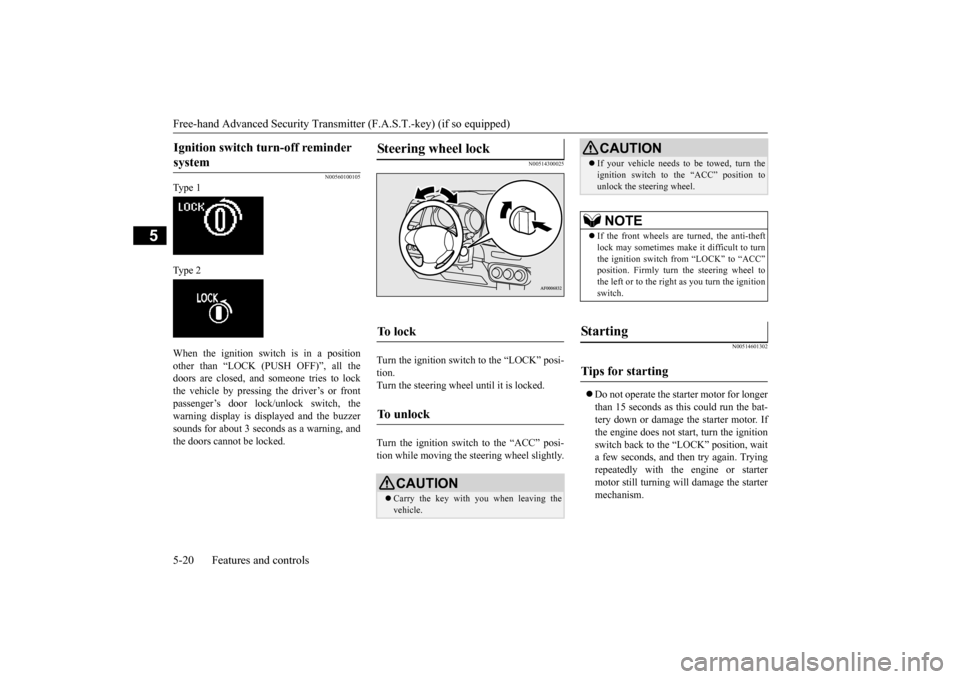
Ty p e 1 Ty p e 2 When the ignition switch is in a position other than “LOCK (PUSH OFF)”, all the doors are closed, and someone tries to lock the vehicle by pressing the driver’s or frontpassenger’s door lock/unlock switch, the warning display is displayed and the buzzer sounds for about 3 seconds as a warning, andthe doors cannot be locked.
N00514300025
Turn the ignition switch to the “LOCK” posi-tion.Turn the steering wheel until it is locked. Turn the ignition switch to the “ACC” posi- tion while moving the steering wheel slightly.
N00514601302
Do not operate the starter motor for longer than 15 seconds as this could run the bat-tery down or damage the starter motor. If the engine does not start, turn the ignition switch back to the “LOCK” position, waita few seconds, and then try again. Trying repeatedly with the engine or starter motor still turning will damage the startermechanism.
Ignition switch turn-off reminder system
Steering wheel lock
To l o c k
To u n l o c k
CAUTION Carry the key with you when leaving the vehicle.
If your vehicle needs to be towed, turn the ignition switch to the “ACC” position to unlock the steering wheel.NOTE
If the front wheels are turned, the anti-theft lock may sometimes make it difficult to turn the ignition switch from “LOCK” to “ACC”position. Firmly turn the steering wheel to the left or to the right as you turn the ignition switch.
St arting
Tips for starting
CAUTION
BK0210300US.bo
ok 20 ページ 2014年4月8日 火曜日 午前10時46分
Page 91 of 434

Free-hand Advanced Security Transmitter (F.A.S.T.-key) (if so equipped) 5-22 Features and controls
5
5. While pushing the ignition switch from “LOCK” (PUSH OFF) to “LOCK” (PUSH ON), set the ignition switch to the “ON” position and confirm that all warn-ing lights and warning displays are oper- ating properly. 6. Without pressing the accelerator pedal,slowly turn the ignition switch to the “START” position to start the engine. Release the ignition switch when theengine starts.
After several attempts, you may experience that the engine still does not start. 1. Make sure that all electric devices, such as lights, air conditioning blower and rear window defogger, are turned off.
2. While depressing the brake pedal on vehi- cles equipped with continuously variable transmission (CVT) or Twin Clutch SST or the clutch pedal on the vehiclesequipped with manual transaxle, press the accelerator pedal halfway and hold it there, then crank the engine. Release theaccelerator pedal, immediately after the engine starts. 3. If the engine still will not start, the enginecould be flooded with too much gasoline.While depressing the brake pedal on vehi- cles equipped with CVT or Twin Clutch SST or the clutch pedal on the vehiclesequipped with manual
transaxle, push the
accelerator pedal all the way down and hold it there, then crank the engine for 5to 6 seconds. Return the ignition switch to the “LOCK” position and release the accelerator pedal. Wait a few seconds, andthen crank the engine again for 5 to 6 sec- onds while depressing the brake pedal or the clutch pedal, but do not push theaccelerator pedal. Release the ignition key if the engine starts.
If the engine fails to
start, repeat these procedures. If theengine still will not start, contact your local Mitsubishi Motors dealer or a repair facility of your choice for assistance.
When the ambient temperature is -4°F (-20°C) or lower on vehicles with CVT, or -22°F (-30°C) or lower on vehicles with Twin Clutch SST, it may not be possible to startfrom a standstill even with the selector lever (CVT) or the gearshift lever (Twin Clutch SST) in the “D” (DRIVE) or “R”(REVERSE) position.This phenomenon occurs because the trans- axle has not warmed up sufficiently; it does not indicate a problem. If this occurs, placethe selector lever (CVT) or the gearshift lever (Twin Clutch SST) in the “P” (PARK) posi- tion and let the engine idle for at least 10 min-utes. The transaxle will warm up, and you will be able to drive normally.Do not leave the vehicle during warm-up operation.
NOTE
Minor noises may be heard on engine start- up. These will disappear as the engine warms up.
When the engine is hard to start
Startability of continuously variable transmission (CVT) vehicles or Twin Clutch SST vehicles at extremely coldambient temperature
BK0210300US.bo
ok 22 ページ 2014年4月8日 火曜日 午前10時46分