clutch MITSUBISHI LANCER 2015 8.G Owner's Guide
[x] Cancel search | Manufacturer: MITSUBISHI, Model Year: 2015, Model line: LANCER, Model: MITSUBISHI LANCER 2015 8.GPages: 434, PDF Size: 16.59 MB
Page 147 of 434
Twin Clutch SST (Sportronic Shif
t Transmission) (if so equipped)
5-78 Features and controls
5
N00540700033
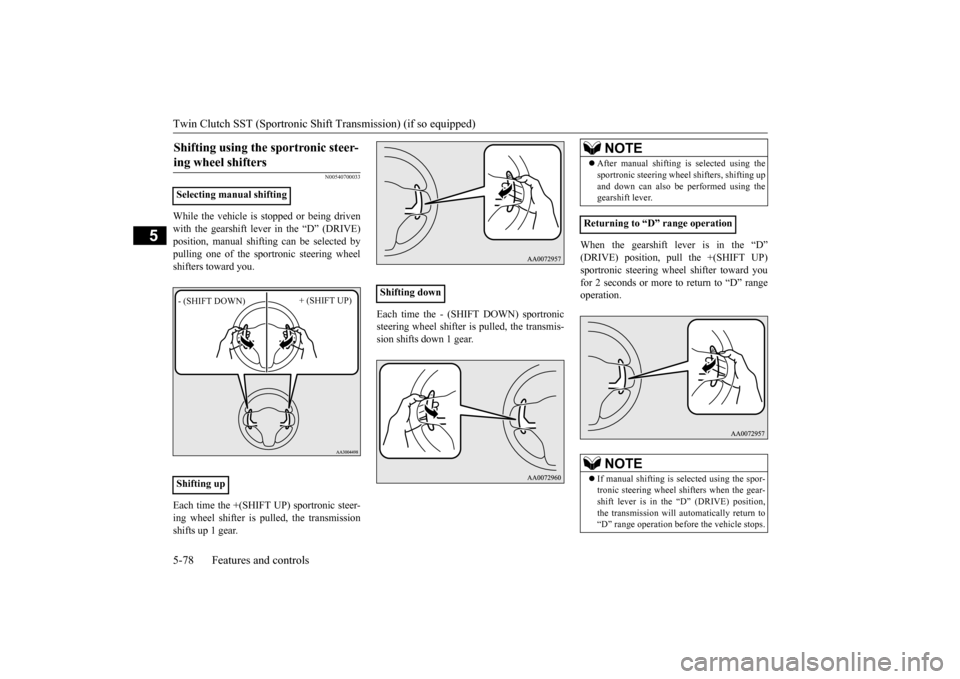
While the vehicle is stopped or being driven with the gearshift lever in the “D” (DRIVE) position, manual shifting can be selected by pulling one of the sportronic steering wheelshifters toward you. Each time the +(SHIFT UP) sportronic steer- ing wheel shifter is pulled, the transmissionshifts up 1 gear.
Each time the - (SHIFT DOWN) sportronic steering wheel shifter is pulled, the transmis- sion shifts down 1 gear.
When the gearshift lever is in the “D” (DRIVE) position, pull the +(SHIFT UP)sportronic steering wheel shifter toward youfor 2 seconds or more to return to “D” range operation.
Shifting using the sportronic steer- ing wheel shifters
Selecting manual shifting Shifting up- (SHIFT DOWN)
+ (SHIFT UP)
Shifting down
NOTE
After manual shifting is
selected using the
sportronic steering wheel shifters, shifting up and down can also be performed using the gearshift lever.
Returning to “D” range operation
NOTE
If manual shifting is selected using the spor- tronic steering wheel shifters when the gear- shift lever is in the “D” (DRIVE) position,the transmission will automatically return to “D” range operation before the vehicle stops.
BK0210300US.bo
ok 78 ページ 2014年4月8日 火曜日 午前10時46分
Page 148 of 434
Twin Clutch SST (Sportronic Shif
t Transmission) (if so equipped) Features and controls 5-79
5
N00543000040
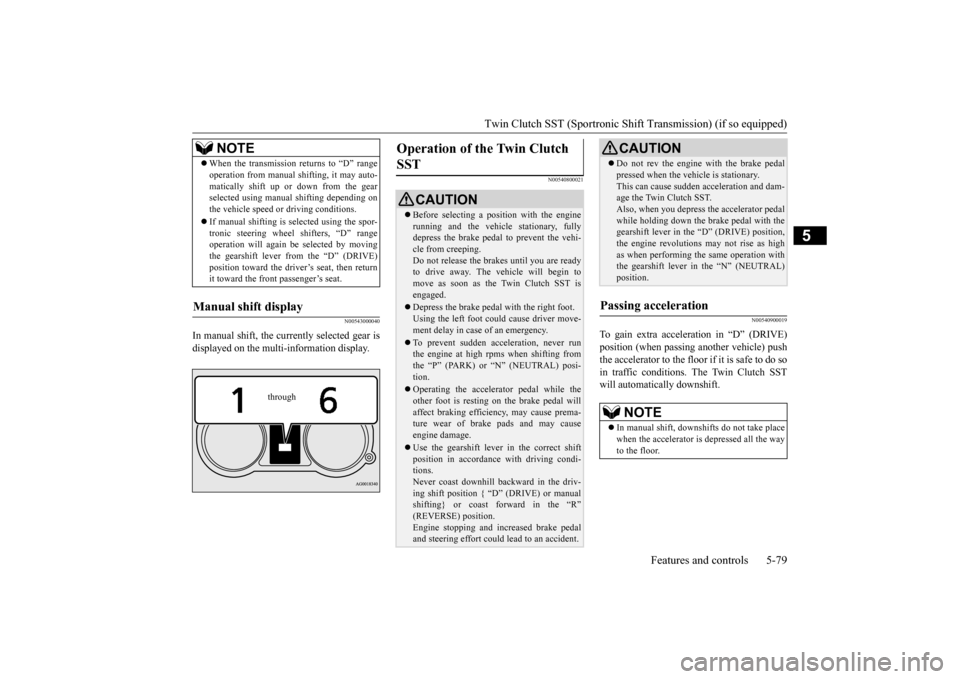
In manual shift, the currently selected gear is displayed on the multi-information display.
N00540800021
N00540900019
To gain extra acceleration in “D” (DRIVE) position (when passing another vehicle) pushthe accelerator to the floor
if it is safe to do so
in traffic conditions. The Twin Clutch SST will automatically downshift.
When the transmission returns to “D” range operation from manual shifting, it may auto- matically shift up or down from the gear selected using manual shifting depending on the vehicle speed or driving conditions. If manual shifting is selected using the spor- tronic steering wheel shifters, “D” rangeoperation will again be selected by moving the gearshift lever from the “D” (DRIVE) position toward the driver’s seat, then returnit toward the front passenger’s seat.
Manual shift display
NOTE
through
Operation of the Twin Clutch SST
CAUTION Before selecting a position with the engine running and the vehicle stationary, fullydepress the brake pedal to prevent the vehi- cle from creeping. Do not release the brakes until you are readyto drive away. The vehicle will begin to move as soon as the Twin Clutch SST is engaged. Depress the brake pedal with the right foot. Using the left foot could cause driver move-ment delay in case of an emergency. To prevent sudden acceleration, never run the engine at high rpms when shifting from the “P” (PARK) or “N” (NEUTRAL) posi- tion. Operating the accelerator pedal while the other foot is resting on the brake pedal willaffect braking efficiency, may cause prema- ture wear of brake pads and may cause engine damage. Use the gearshift lever in the correct shift position in accordance with driving condi- tions. Never coast downhill backward in the driv-ing shift position { “D” (DRIVE) or manual shifting} or coast forward in the “R” (REVERSE) position.Engine stopping and increased brake pedal and steering effort could lead to an accident.
Do not rev the engine with the brake pedal pressed when the vehicle is stationary. This can cause sudden acceleration and dam- age the Twin Clutch SST. Also, when you depress the accelerator pedalwhile holding down the brake pedal with the gearshift lever in the “D” (DRIVE) position, the engine revolutions may not rise as highas when performing the same operation with the gearshift lever in the “N” (NEUTRAL) position.
Passing acceleration
NOTE
In manual shift, downshifts do not take place when the accelerator is depressed all the way to the floor.CAUTION
BK0210300US.bo
ok 79 ページ 2014年4月8日 火曜日 午前10時46分
Page 149 of 434
Twin Clutch SST (Sportronic Shif
t Transmission) (if so equipped)
5-80 Features and controls
5
N00541600039
The Twin Clutch SST may not upshift to a higher shift position if the computer deter- mines the current speed cannot be maintainedonce a higher shift position is engaged. For smoother vehicle performance, if you release the throttle while climbing a steepgrade, the Twin Clutch SST may not upshift.This is normal, as the computer is temporarily preventing shifting. After reaching the top of the hill, normal shift function will resume.
When traveling down steep grades, the com- puter may automatically select a lower shift position. This function
assists engine braking
efforts, reducing the need for using the ser- vice brakes.
N00541000033
For short waiting periods, such as at trafficlights, the vehicle can be left in gearshift
lever position and held stationary with the service brake. For longer waiting periods with the engine running, place the gearshift lever in the “N”(NEUTRAL) position and apply the parking brake, while holding the vehicle stationary with the service brake.Prior to moving off after having stopped the vehicle, make sure that the gearshift lever is in “D” (DRIVE) position or manual shiftposition.
Uphill/downhill driving
DRIVING UPHILL
CAUTION Do not use the tendency of the vehicle to creep forward in order to drive at low speeds up hills.The transmission may be damaged and an accident may occur due to the following con- ditions.• The Twin Clutch SST fluid temperaturewill rise and can cause transmission dam-age.
• If the vehicle is continuously driven at low speeds using the tendency of the vehicle to creep forward, the vehicle will vibrate or the warning display will appear on the information screen in the multi-information display to alert the driver that the Twin Clutch SST fluid temperature has risen.After that, if the Twin Clutch SST fluid temperature rises even higher, the transmis- sion protection control will operate.If this occurs, the vehicle may suddenly reverse as if the gearshift lever was in the “N” (NEUTRAL) position and cause an accident. If the warning display appears or the transmission protection control operates, refer to “When warning display is showing” on page 5-72.
DRIVING DOWNHILLWa i t i n g
CAUTION
CAUTION Do not rev the engine unnecessarily while the vehicle is stationary. Unexpected acceler- ation may occur if the gearshift lever is in aposition other than “P” (PARK) or “N” (NEUTRAL). Do not keep the vehicle in a stopped position on an uphill slope by depressing the acceler- ator pedal instead of the brake pedal.The transmission may be damaged and an accident may occur due to the following con- ditions.• The Twin Clutch SST fluid temperaturewill rise and can cause transmission dam- age.
BK0210300US.bo
ok 80 ページ 2014年4月8日 火曜日 午前10時46分
Page 150 of 434
Twin Clutch SST (Sportronic Shif
t Transmission) (if so equipped) Features and controls 5-81
5
N00541100018
To park the vehicle, first bring it to a com- plete stop, fully engage the parking brake, and then move the gearshift lever to the “P”(PARK) position.
N00541201087
If there is a malfunction in the Twin Clutch SST or engine electronic control module, the following may occur. Twin Clutch SST does not shift. Vehicle cannot move. Twin Clutch SST acceleration is slow. Vehicle does not creep. “Shift shock” is large. Shifting occurs at higher engine speed. Response is slow.
If any of these occurs, perform the following procedure. The temperature of Twin Clutch SST fluid is high. Refer to “Warning display” on page 5-72 and follow the appropriate measures. There could be a malfunction in the engine electronic control module.
Refer to “Engine malfunction indicator (“SERVICE ENGINE SOON” or “Check engine light”)” on page 5-144 and follow the appropriate measures. A safety device in the Twin Clutch SST has been activated due to a possible malfunctionin the Twin Clutch SST. Refer to “If the gearshift lever position dis- play is not showing” on
page 5-72 and follow
the appropriate measures. A safety device in the Twin Clutch SST has been activated due to a possible malfunctionin the Twin Clutch SST or in the engine elec-tronic control module. Perform the following procedure.1. Park your vehicle in a safe place and stop the engine. 2. Restart the engine. If the vehicle moves and accelerates normally after this procedure is performed, there is no malfunction in the transmission.
• If the vehicle is kept in a stopped position by depressing the accelerator pedal instead of the brake pedal, the vehicle will vibrate or the warning display will appear on the information screen in the multi-infor- mation display to alert the driver that the Twin Clutch SST fluid temperature hasrisen. After that, if the Twin Clutch SST fluid temperature rises even higher, the transmis-sion protection control will operate. If this occurs, the vehicle may suddenly reverse as if the gearshift lever was in the “N” (NEUTRAL) position and cause an accident. If the warning display appears or the transmission protection control operates, refer to “When warning display is showing” on page 5-72.
Parking
CAUTION
What to do if the following occur with the Twin Clutch SST
When warning display is showing When the engine malfunction indicator (“SERVICE ENGINE SOON” or “Check engine light”) comes on or blinking
When the gearshift lever position displayis not showing When warning display is showing or when no warning is showing in the multi- information display
BK0210300US.bo
ok 81 ページ 2014年4月8日 火曜日 午前10時46分
Page 151 of 434
ACD (Active center differential system) (if so equipped) 5-82 Features and controls
5
However, if the vehicle does not move or accelerate normally, or if this problem occurs repeatedly, have the vehicle checked by an authorized Mitsubishi Motors dealer or arepair facility of your choice as soon as possi- ble.
N00538500034
The ACD is a system that improves accelera- tion performance and straight-ahead stabilityby regulating the differential limiting action and power drive distribution of the center dif- ferential.
N00545400048
Select the control mode from the followingthree types to suit the driving conditions.
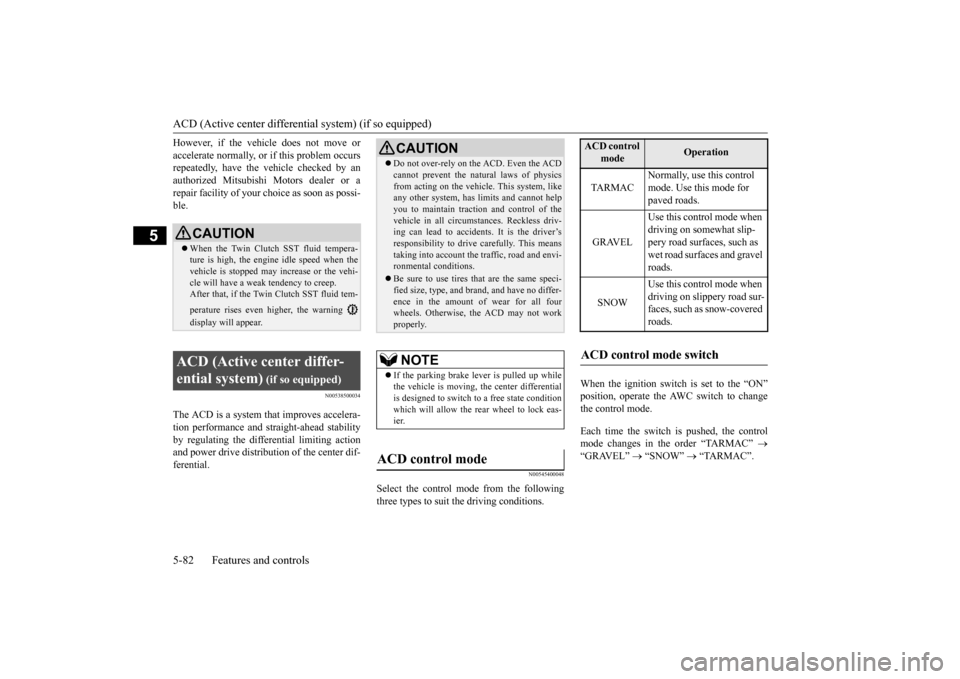
When the ignition switch is set to the “ON” position, operate the AWC switch to change the control mode. Each time the switch is pushed, the control mode changes in the order “TARMAC”
“GRAVEL”
“SNOW”
“TARMAC”.
CAUTIONWhen the Twin Clutch SST fluid tempera- ture is high, the engine idle speed when the vehicle is stopped may increase or the vehi- cle will have a weak tendency to creep. After that, if the Twin Clutch SST fluid tem- perature rises even higher, the warning display will appear.
ACD (Active center differ- ential system)
(if so equipped)
CAUTION Do not over-rely on the ACD. Even the ACD cannot prevent the natural laws of physics from acting on the vehicle. This system, like any other system, has limits and cannot help you to maintain traction and control of thevehicle in all circumstances. Reckless driv- ing can lead to accidents. It is the driver’s responsibility to drive carefully. This meanstaking into account the traffic, road and envi- ronmental conditions. Be sure to use tires that are the same speci- fied size, type, and brand, and have no differ- ence in the amount of wear for all fourwheels. Otherwise, the ACD may not work properly.NOTE
If the parking brake lever is pulled up while the vehicle is moving, the center differential is designed to switch to a free state condition which will allow the rear wheel to lock eas-ier.
ACD control mode
ACD control
mode
Operation
TA R M A C
Normally, use this control mode. Use this mode for paved roads.
GRAVEL
Use this control mode when driving on somewhat slip- pery road surfaces, such as wet road surfaces and gravel roads.
SNOW
Use this control mode when driving on slippery road sur-faces, such as snow-covered roads.
ACD control mode switch
BK0210300US.bo
ok 82 ページ 2014年4月8日 火曜日 午前10時46分
Page 159 of 434
Brake assist system 5-90 Features and controls
5
N00567300076
The brake assist system is a device assisting drivers who cannot depress the brake pedal firmly such as in emergency stop situationsand provides greater braking force. If the brake pedal is depressed suddenly, the brakes will be applied with more force than usual.
N00562600032
The hill start assist makes it easy to start off on a steep uphill slope by preventing thevehicle from moving backwards. It keeps the braking force for about 2 seconds when you move your foot from the brake pedal to theaccelerator pedal.
N00562700062
1. Stop the vehicle completely using thebrake pedal.2. Release the brake pedal and the hill start assist will maintain the braking force applied while stopping for approximately2 seconds.
WA R N I N G Driving with worn brake pads will make it harder to stop, and can cause an accident.
Brake assist system
CAUTION The brake assist system is not a device designed to exercise braking force greaterthan its capacity. Make sure to always keep a sufficient distance between vehicles in front of you without relying too much on the brakeassist system.NOTE
Once the brake assist system is operational, it maintains great braking force even if the brake pedal is lightly released. To stop its operation, completely removeyour foot from the brake pedal.
The brake assist system may become opera- tional when the brake pedal is fully depressed even if it has not been depressed suddenly. When the brake assist system is in use while driving, you may feel as if the depressed brake pedal is soft, the pedal moves in smallmotions in conjunction with the operation noise, or the vehicle body and the steering wheel vibrate. This occurs when the brakeassist system is operating normally and does not indicate faulty operation. Continue to depress the brake pedal. You may hear an operation noise when the brake pedal is suddenly or fully depressedwhile stationary. This does not indicate a malfunction and the brake assist system is operating normally.
Hill start assist (vehicles with Twin Clutch SST)
NOTE
CAUTION Do not overly rely on the hill start assist to prevent backwards movement of the vehicle. Under certain circumstances, even when hill start assist is activated, the vehicle may move backwards if the brake pedal is not suf-ficiently depressed, if the vehicle is heavily loaded, or if the road is very steep or slip- pery. The hill start assist is not designed to keep the vehicle stopped in place on uphill slopesfor more than 2 seconds. When facing uphill, do
not rely on using the
hill start assist to maintain a stopped position as an alternative to depressing the brake pedal.Doing so could cause an accident. Do not turn the ignition switch to the “LOCK” or “ACC” position while the hill start assist is operating. The hill start assist could stop operating, which could result inan accident.
To operate
BK0210300US.bo
ok 90 ページ 2014年4月8日 火曜日 午前10時46分
Page 166 of 434
Cruise control (if so equipped) Features and controls 5-97
5
N00547200053
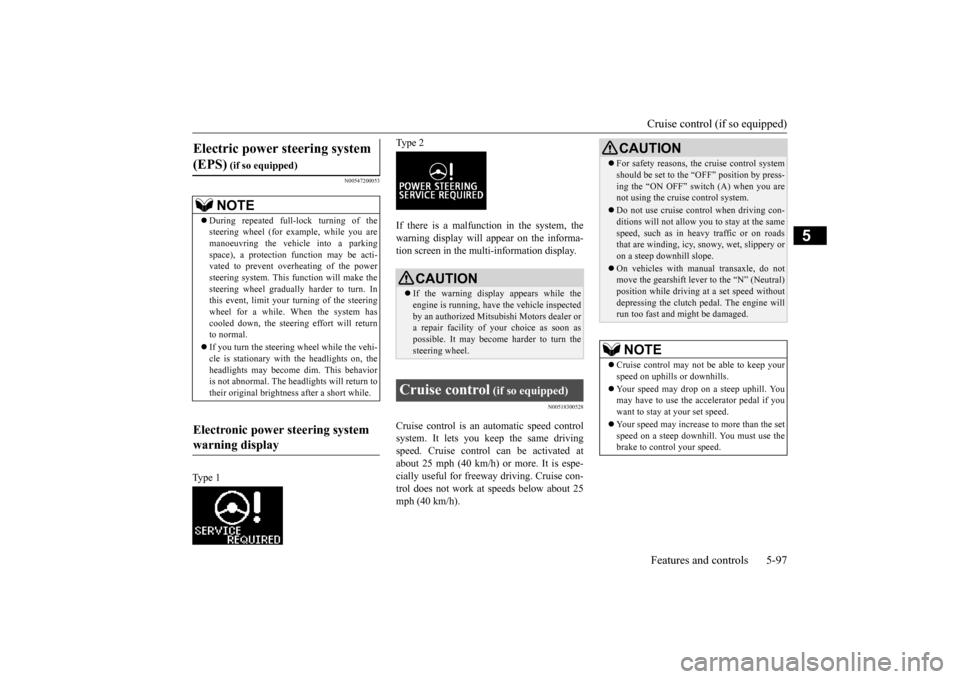
Type 1
Type 2 If there is a malfunction in the system, the warning display will appear on the informa- tion screen in the multi-information display.
N00518300528
Cruise control is an automatic speed control system. It lets you keep the same driving speed. Cruise control can be activated atabout 25 mph (40 km/h) or more. It is espe-cially useful for freeway driving. Cruise con- trol does not work at speeds below about 25 mph (40 km/h).
Electric power steering system (EPS)
(if so equipped)NOTE
During repeated full-lock turning of the steering wheel (for example, while you are manoeuvring the vehicle into a parkingspace), a protection function may be acti- vated to prevent overheating of the power steering system. This function will make thesteering wheel gradually harder to turn. In this event, limit your tu
rning of the steering
wheel for a while. When the system hascooled down, the steering effort will return to normal. If you turn the steering wheel while the vehi- cle is stationary with the headlights on, the headlights may become dim. This behavioris not abnormal. The headlights will return to their original brightness after a short while.
Electronic power steering system warning display
CAUTION If the warning display appears while the engine is running, have the vehicle inspected by an authorized Mitsubishi Motors dealer ora repair facility of your choice as soon as possible. It may become harder to turn the steering wheel.
Cruise control
(if so equipped)
CAUTION For safety reasons, the cruise control system should be set to the “OFF” position by press- ing the “ON OFF” switch (A) when you are not using the cruise control system. Do not use cruise control when driving con- ditions will not allow you to stay at the same speed, such as in heavy traffic or on roadsthat are winding, icy, snowy, wet, slippery or on a steep downhill slope. On vehicles with manual transaxle, do not move the gearshift lever to the “N” (Neutral) position while driving at a set speed withoutdepressing the clutch pedal. The engine will run too fast and might be damaged. NOTE
Cruise control may not be able to keep your speed on uphills or downhills. Your speed may drop on a steep uphill. You may have to use the accelerator pedal if you want to stay at your set speed. Your speed may increase to more than the set speed on a steep downhill. You must use the brake to control your speed.
BK0210300US.bo
ok 97 ページ 2014年4月8日 火曜日 午前10時46分
Page 168 of 434
Cruise control (if so equipped) Features and controls 5-99
5
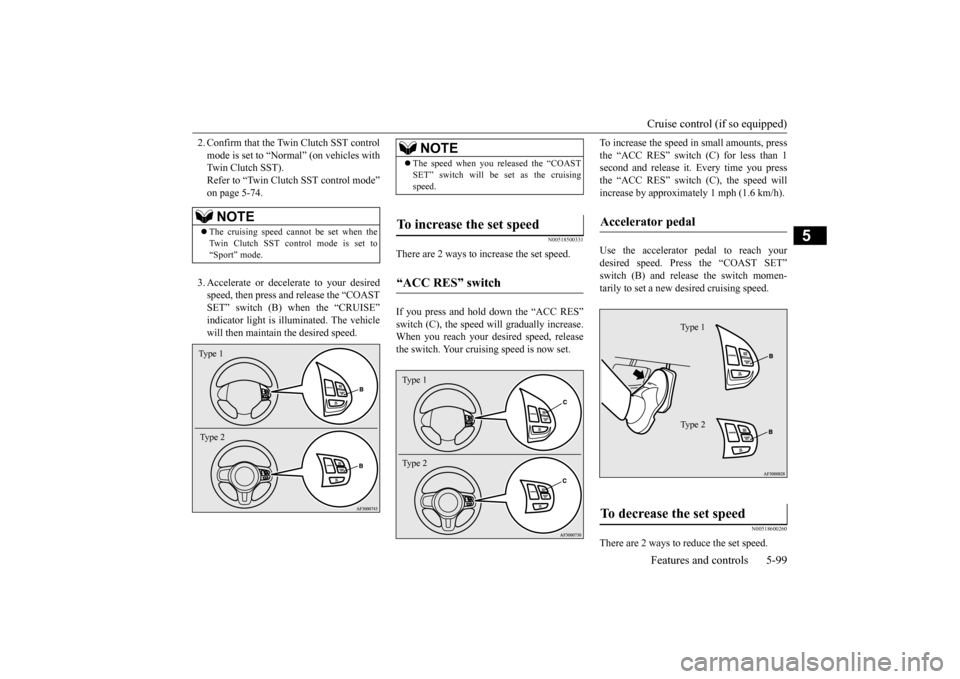
2. Confirm that the Twin Clutch SST control mode is set to “Normal” (on vehicles with Twin Clutch SST). Refer to “Twin Clutch SST control mode”on page 5-74. 3. Accelerate or decelerate to your desired speed, then press and release the “COAST SET” switch (B) when the “CRUISE”indicator light is illuminated. The vehicle will then maintain the desired speed.
N00518500331
There are 2 ways to increase the set speed. If you press and hold down the “ACC RES” switch (C), the speed will gradually increase. When you reach your desired speed, releasethe switch. Your cruising speed is now set.
To increase the speed in small amounts, press the “ACC RES” switch (C) for less than 1 second and release it. Every time you press the “ACC RES” switch (C), the speed willincrease by approximately 1 mph (1.6 km/h). Use the accelerator pedal to reach your desired speed. Press the “COAST SET”switch (B) and release the switch momen- tarily to set a new desired cruising speed.
N00518600260
There are 2 ways to reduce the set speed.
NOTE
The cruising speed cannot be set when the Twin Clutch SST control mode is set to“Sport” mode.Type 1 Type 2
NOTE
The speed when you released the “COAST SET” switch will be set as the cruising speed.
To increase the set speed
“ACC RES” switch
Type 1 Type 2
Accelerator pedal
To decrease the set speed
Type 1 Type 2
BK0210300US.bo
ok 99 ページ 2014年4月8日 火曜日 午前10時46分
Page 170 of 434
Cruise control (if so equipped) Features and controls 5-101
5
N00518800493
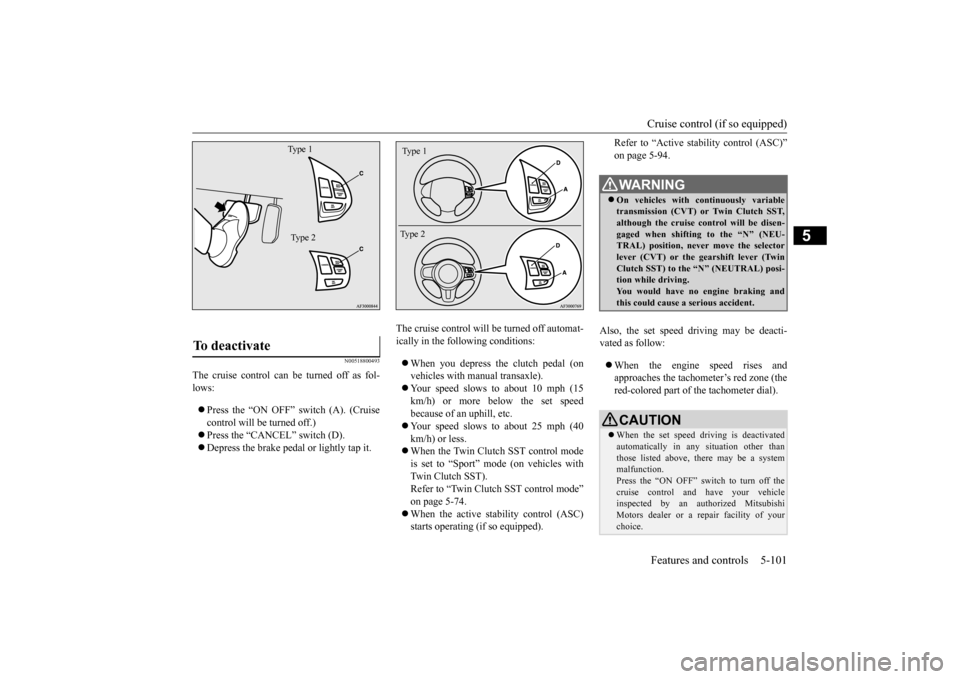
The cruise control can be turned off as fol- lows: Press the “ON OFF” switch (A). (Cruise control will be turned off.) Press the “CANCEL” switch (D). Depress the brake pedal or lightly tap it.
The cruise control will be turned off automat- ically in the following conditions: When you depress the clutch pedal (on vehicles with manual transaxle). Your speed slows to about 10 mph (15 km/h) or more below the set speedbecause of an uphill, etc. Your speed slows to about 25 mph (40 km/h) or less. When the Twin Clutch SST control mode is set to “Sport” mode (on vehicles with Twin Clutch SST).Refer to “Twin Clutch SST control mode” on page 5-74. When the active stability control (ASC) starts operating (if so equipped).
Refer to “Active stability control (ASC)” on page 5-94.
Also, the set speed driving may be deacti- vated as follow: When the engine speed rises and approaches the tachometer’s red zone (thered-colored part of the tachometer dial).
To deactivate
Type 1 Type 2
Type 1 Type 2
WA R N I N G On vehicles with continuously variable transmission (CVT) or Twin Clutch SST, although the cruise control will be disen-gaged when shifting to the “N” (NEU- TRAL) position, never move the selector lever (CVT) or the gearshift lever (TwinClutch SST) to the “N” (NEUTRAL) posi- tion while driving. You would have no engine braking andthis could cause a serious accident.CAUTION When the set speed driving is deactivated automatically in any situation other than those listed above, there may be a systemmalfunction. Press the “ON OFF” switch to turn off the cruise control and have your vehicleinspected by an authorized Mitsubishi Motors dealer or a repair facility of your choice.
BK0210300US.book
101 ページ 2014年4月8日 火曜日 午前10時46分
Page 178 of 434
Instrument cluster
Features and controls 5-109
5
tion (Twin Clutch SST) and engine speed combinations. This gauge also assists in evaluating engine performance.
N00554900137
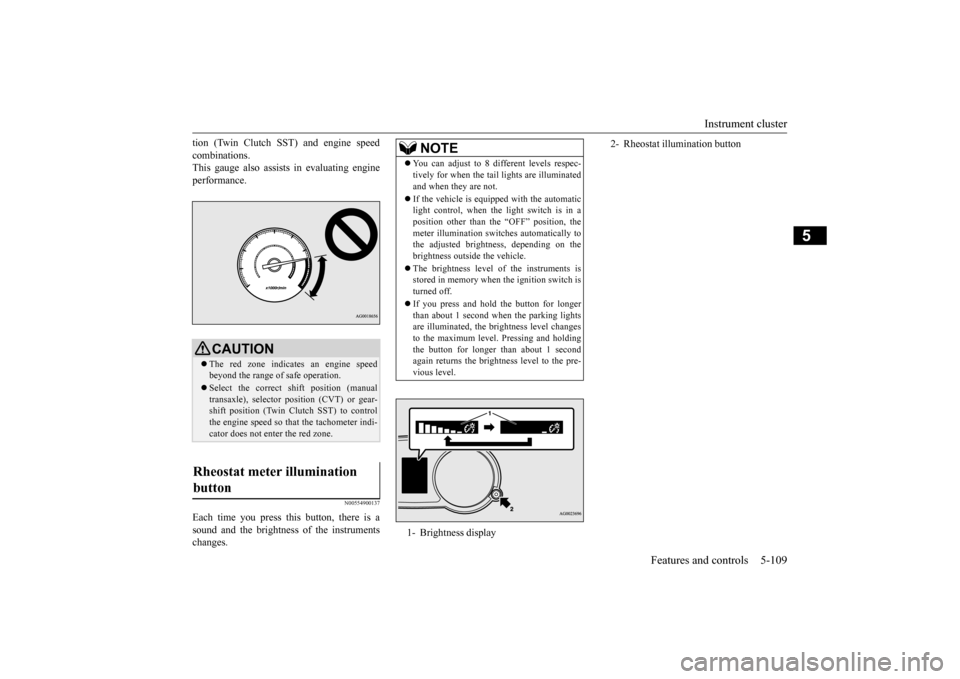
Each time you press this button, there is asound and the brightness of the instrumentschanges.
CAUTION The red zone indicates an engine speed beyond the range of safe operation. Select the correct shift position (manual transaxle), selector position (CVT) or gear- shift position (Twin Clutch SST) to controlthe engine speed so that the tachometer indi- cator does not enter the red zone.
Rheostat meter illumination button
NOTE
You can adjust to 8 different levels respec- tively for when the tail
lights are illuminated
and when they are not. If the vehicle is equipped with the automatic light control, when the light switch is in a position other than the “OFF” position, the meter illumination switches automatically tothe adjusted brightness, depending on the brightness outside the vehicle. The brightness level of the instruments is stored in memory when the ignition switch is turned off. If you press and hold the button for longer than about 1 second when the parking lightsare illuminated, the brightness level changes to the maximum level. Pressing and holding the button for longer than about 1 secondagain returns the brightness level to the pre- vious level.1- Brightness display
2- Rheostat illumination button
BK0210300US.book
109 ページ 2014年4月8日 火曜日 午前10時46分